Recognition: 2 theorem links
· Lean TheoremFair Agents: Balancing Multistakeholder Alignment in Multi-Agent Personalization Systems
Pith reviewed 2026-05-08 18:13 UTC · model grok-4.3
The pith
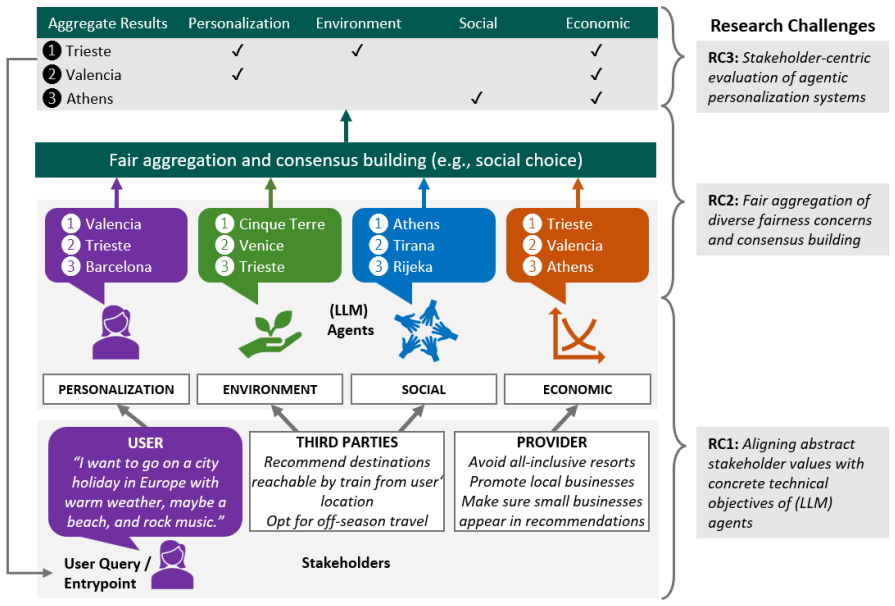
A conceptual framework aligns LLM agents with multiple stakeholder goals in personalization systems by combining objective mapping, social-choice aggregation, and targeted evaluations.
A machine-rendered reading of the paper's core claim, the machinery that carries it, and where it could break.
Core claim
The paper claims that fair outcomes in multi-agent multistakeholder personalization systems depend on three linked components: methods that translate competing stakeholder objectives into measurable goals for LLM agents, aggregation strategies such as those from social choice theory that combine individual agent outputs into collective decisions, and evaluation procedures that assess how well both individual agents and the overall system serve each stakeholder, demonstrated through a tourism use case and applicable to other domains.
What carries the argument
The conceptual framework for fair multi-agent multistakeholder personalization systems, which integrates objective alignment methods, aggregation strategies for collective decisions, and stakeholder-centric evaluation procedures.
If this is right
- Methods to align stakeholder objectives with LLM agents provide the measurable goals needed for independent optimization.
- Aggregation based on social choice theory forms collective decisions that aim to treat all stakeholders equitably.
- Stakeholder-centric evaluations measure success for both single agents and the full system.
- The same structure applies to education and healthcare with adjustments for domain-specific fairness tensions.
- Existing datasets support testing of multistakeholder fairness and multi-agent personalization.
Where Pith is reading between the lines
- The framework could be adapted to non-LLM agent systems where multiple decision makers must reconcile conflicting priorities.
- Real deployments would likely surface practical difficulties in quantifying objectives that the paper treats as given.
- Connections to established fairness metrics in recommender systems could provide concrete benchmarks for the evaluation component.
- Scaling the aggregation step to dozens of stakeholders may require new variants of social choice methods.
Load-bearing premise
Stakeholder objectives can be identified, mapped, and turned into quantifiable targets for agents so that aggregation produces fair results without creating new biases or unresolved conflicts.
What would settle it
A real-world test in which stakeholder goals are quantified and agents use the proposed aggregation yet one stakeholder group still reports consistently lower satisfaction or utility than others would show the framework fails to deliver balanced outcomes.
Figures
read the original abstract
LLM agents are increasingly used for personalization due to their ability to communicate directly with users in natural language, integrate external knowledge bases, and negotiate with other (possibly human) agents. Especially in multistakeholder AI systems with multiple distinct objectives, LLM agents are used to independently optimize for each stakeholder's goals. Here, stakeholder alignment is essential to identify and map these goals to provide LLM agents with quantifiable objectives. Plus, the way in which the outputs of the LLM agents are aggregated is fundamental to ensuring fair outcomes for all agents and, therefore, stakeholders. In this work, we identify open research challenges and propose a conceptual framework for designing fair multi-agent multistakeholder personalization systems that balance competing stakeholder objectives. Our framework integrates (i) methods to align stakeholder objectives and LLM agents, (ii) aggregation strategies, e.g., based on social choice theory, to form fair collective decisions, and (iii) stakeholder-centric evaluation procedures for both individual and collective agent behavior. We showcase our framework through a tourism use case and discuss possible applications in other domains, such as education and healthcare. Finally, we discuss domain-specific fairness tensions and review datasets for evaluating multistakeholder fairness and multi-agent personalization systems.
Editorial analysis
A structured set of objections, weighed in public.
Referee Report
Summary. The paper identifies open research challenges in multistakeholder LLM-agent personalization systems and proposes a high-level conceptual framework for balancing competing stakeholder objectives. The framework consists of three components: (i) methods to align stakeholder objectives with LLM agents, (ii) aggregation strategies (e.g., drawing on social choice theory) to form fair collective decisions, and (iii) stakeholder-centric evaluation procedures for individual and collective agent behavior. It illustrates the framework via a tourism use case, discusses applications in domains such as education and healthcare, reviews domain-specific fairness tensions, and surveys relevant datasets for evaluation.
Significance. If the framework can serve as a useful organizing structure for future empirical and algorithmic work on multistakeholder fairness, the paper would make a modest but timely contribution to information retrieval and multi-agent AI by surfacing alignment and aggregation issues that current single-stakeholder personalization approaches overlook. Its value lies primarily in problem framing and cross-domain discussion rather than in new theorems, algorithms, or validated results.
major comments (2)
- [Framework (component ii) and tourism use case] The description of component (ii) (aggregation strategies) remains at the level of 'e.g., based on social choice theory' without specifying which voting or ranking rules would be applied to LLM agent outputs or how ties, intransitivities, or conflicting natural-language recommendations would be resolved; this vagueness is load-bearing for the central claim that the framework ensures fair outcomes.
- [Framework (component i) and § on open challenges] Component (i) (alignment methods) asserts that stakeholder objectives can be 'identified, mapped, and quantified' to provide measurable goals for LLM agents, yet the manuscript provides no concrete mapping procedure, prompt-engineering template, or verification step; without this, the feasibility of the subsequent aggregation and evaluation steps cannot be assessed.
minor comments (3)
- [Tourism use case] The tourism use case is labeled a 'showcase' but functions only as a narrative sketch; adding even a small table of hypothetical stakeholder objectives, agent outputs, and aggregation results would clarify how the three framework components interact.
- [Related work and framework] Citations to social choice theory and multistakeholder fairness literature are present but could be expanded with specific references to classic results (e.g., Arrow's theorem implications for LLM aggregation) to strengthen the conceptual grounding.
- [Abstract and Introduction] The abstract and introduction would benefit from an explicit statement of what the paper contributes beyond a literature survey (i.e., the precise novelty of the three-component integration).
Simulated Author's Rebuttal
We thank the referee for the positive overall assessment and the recommendation for minor revision. The comments highlight areas where the high-level nature of our conceptual framework could be clarified, and we address each point below with proposed revisions to strengthen the manuscript while preserving its focus on problem framing and open challenges.
read point-by-point responses
-
Referee: [Framework (component ii) and tourism use case] The description of component (ii) (aggregation strategies) remains at the level of 'e.g., based on social choice theory' without specifying which voting or ranking rules would be applied to LLM agent outputs or how ties, intransitivities, or conflicting natural-language recommendations would be resolved; this vagueness is load-bearing for the central claim that the framework ensures fair outcomes.
Authors: We agree that component (ii) is described at a high level and that greater specificity on aggregation would help substantiate the framework's utility. The manuscript intentionally frames aggregation as an open research area rather than providing prescriptive rules, given the complexities of natural-language outputs. To address this, we will revise the framework description and tourism use case to include concrete examples of applicable methods, such as extracting ranked preferences from LLM outputs via structured prompting and applying adapted social choice rules (e.g., Borda count for multi-attribute recommendations or Copeland's method for handling conflicts). We will also add a brief discussion of mechanisms for ties and intransitivities, such as iterative LLM-mediated preference elicitation. These additions will be limited to illustrative discussion consistent with the paper's conceptual scope. revision: yes
-
Referee: [Framework (component i) and § on open challenges] Component (i) (alignment methods) asserts that stakeholder objectives can be 'identified, mapped, and quantified' to provide measurable goals for LLM agents, yet the manuscript provides no concrete mapping procedure, prompt-engineering template, or verification step; without this, the feasibility of the subsequent aggregation and evaluation steps cannot be assessed.
Authors: We recognize that the manuscript asserts the importance of identifying, mapping, and quantifying stakeholder objectives without providing a detailed procedure, template, or verification method. This is because the work positions these as open challenges central to the framework, rather than solved components. To improve assessability, we will revise the open challenges section to outline high-level steps (e.g., combining stakeholder input methods with LLM-based quantification) and explicitly note that concrete, verifiable templates remain future work. This will better link component (i) to the feasibility of later steps without introducing unsubstantiated specifics. revision: partial
Circularity Check
No circularity: high-level conceptual framework with no derivations or self-referential reductions
full rationale
The paper is a position-style proposal that identifies open challenges in multistakeholder LLM-agent personalization and outlines a three-part conceptual framework (stakeholder-LLM alignment, social-choice aggregation, stakeholder-centric evaluation). It draws on external ideas such as social choice theory without presenting equations, fitted parameters, theorems, or empirical predictions. The tourism use case is explicitly illustrative rather than a validation that could create circularity. No load-bearing step reduces to the paper's own inputs by construction, self-citation, or renaming; the central claim remains a high-level suggestion of structure rather than a derived result.
Axiom & Free-Parameter Ledger
axioms (2)
- domain assumption Stakeholder objectives can be identified, mapped, and quantified to provide LLM agents with measurable objectives
- domain assumption Aggregation strategies based on social choice theory can form fair collective decisions from agent outputs
Reference graph
Works this paper leans on
-
[1]
Towards agentic recommender systems in the era of multimodal large language models
C. Huang, J. Wu, Y. Xia, Z. Yu, R. Wang, T. Yu, R. Zhang, R. A. Rossi, B. Kveton, D. Zhou, et al., Towards agentic recommender systems in the era of multimodal large language models, arXiv preprint arXiv:2503.16734 (2025)
-
[2]
L. Xu, J. Zhang, B. Li, J. Wang, S. Chen, W. X. Zhao, J.-R. Wen, Tapping the potential of large language models as recommender systems: A comprehensive framework and empirical analysis, ACM TKDD 19 (2025) 1–51
2025
-
[3]
Burke, Multisided fairness for recommendation, Workshop on Fairness, Accountability, and Transparency in Machine Learning (2017)
R. Burke, Multisided fairness for recommendation, Workshop on Fairness, Accountability, and Transparency in Machine Learning (2017)
2017
-
[4]
Burke, G
R. Burke, G. Adomavicius, T. Bogers, T. Di Noia, D. Kowald, J. Neidhardt, Ö. Özgöbek, M. S. Pera, N. Tintarev, J. Ziegler, De-centering the (traditional) user: Multistakeholder evaluation of recommender systems, International Journal of Human-Computer Studies (2025) 103560
2025
-
[5]
M. D. Ekstrand, A. Razi, A. Sarcevic, M. S. Pera, R. Burke, K. L. Wright, Recommending with, not for: Co-designing recommender systems for social good, ACM TORS (2025)
2025
-
[6]
Deldjoo, D
Y. Deldjoo, D. Jannach, A. Bellogin, A. Difonzo, D. Zanzonelli, Fairness in recommender systems: research landscape and future directions, User Modeling and User-Adapted Interaction 34 (2024) 59–108
2024
- [7]
-
[8]
K.-T. Tran, D. Dao, M.-D. Nguyen, Q.-V. Pham, B. O’Sullivan, H. D. Nguyen, Multi-agent collabora- tion mechanisms: A survey of llms, arXiv preprint arXiv:2501.06322 (2025)
work page internal anchor Pith review arXiv 2025
-
[9]
V. Dignum, F. Dignum, Agentifying agentic ai, arXiv preprint arXiv:2511.17332 (2025)
-
[10]
Conformity and social impact on ai agents, 2026
A. Bellina, G. De Marzo, D. Garcia, Conformity and social impact on ai agents, arXiv preprint arXiv:2601.05384 (2026)
- [11]
- [12]
-
[13]
K. J. Arrow, Social Choice and Individual Values, Yale University Press, 1951
1951
-
[14]
Sen, Collective Choice and Social Welfare, Holden-Day, 1970
A. Sen, Collective Choice and Social Welfare, Holden-Day, 1970
1970
-
[15]
A. Aird, P. Farastu, J. Sun, E. Stefancova, C. All, A. Voida, N. Mattei, R. Burke, Dynamic fairness- aware recommendation through multi-agent social choice, ACM TORS 3 (2024) 1–35
2024
-
[16]
Bauer, L
C. Bauer, L. Chen, N. Ferro, N. Fuhr, A. Anand, T. Breuer, G. Faggioli, O. Frieder, H. Joho, J. Karlgren, et al., Conversational agents: A framework for evaluation (cafe)(dagstuhl perspectives workshop 24352), Dagstuhl Manifestos 11 (2025) 19–67
2025
-
[17]
M. Kaya, T. Bogers, Mapping stakeholder needs to multi-sided fairness in candidate recommenda- tion for algorithmic hiring, in: Proceedings of RecSys’25, 2025, pp. 257–267
2025
-
[18]
J. J. Smith, A. Buhayh, A. Kathait, P. Ragothaman, N. Mattei, R. Burke, A. Voida, The many faces of fairness: Exploring the institutional logics of multistakeholder microlending recommendation, in: Proceedings of FAccT’23, 2023, pp. 1652–1663
2023
-
[19]
Mhlambi, S
S. Mhlambi, S. Tiribelli, Decolonizing ai ethics: Relational autonomy as a means to counter ai harms, Topoi 42 (2023) 867–880
2023
-
[20]
Deldjoo, Understanding biases in chatgpt-based recommender systems: Provider fairness, temporal stability, and recency, ACM TORS 4 (2025) 1–35
Y. Deldjoo, Understanding biases in chatgpt-based recommender systems: Provider fairness, temporal stability, and recency, ACM TORS 4 (2025) 1–35
2025
-
[21]
arXiv preprint arXiv:2310.16048 , year=
A. Mishra, Ai alignment and social choice: Fundamental limitations and policy implications, arXiv preprint arXiv:2310.16048 (2023)
-
[22]
Abou Ali, F
M. Abou Ali, F. Dornaika, J. Charafeddine, Agentic ai: a comprehensive survey of architectures, applications, and future directions, Artificial Intelligence Review 59 (2025) 11
2025
- [23]
-
[24]
Binkyte, Interactional fairness in llm multi-agent systems: An evaluation framework, in: Proceedings of AIES-25, volume 8, 2025, pp
R. Binkyte, Interactional fairness in llm multi-agent systems: An evaluation framework, in: Proceedings of AIES-25, volume 8, 2025, pp. 457–468
2025
-
[25]
J. Li, X. Liu, Y. Feng, From single to societal: Analyzing persona-induced bias in multi-agent interactions, in: Proceedings of AAAI-2026, volume 40, 2026, pp. 31609–31617
2026
-
[26]
A. P. Uchoa, C. E. Oliveira, C. L. Motta, D. Schneider, Multi-stakeholder alignment in llm-powered collaborative ai systems: A multi-agent framework for intelligent tutoring, in: Proceedings of CHIRA’25, Springer, 2025, pp. 360–379
2025
-
[27]
Jackpot! alignment as a maximal lottery
R.-R. Maura-Rivero, M. Lanctot, F. Visin, K. Larson, Jackpot! alignment as a maximal lottery, arXiv preprint arXiv:2501.19266 (2025)
-
[28]
A. Banerjee, A. Satish, F. N. Aisyah, W. Wörndl, Y. Deldjoo, Collab-rec: An llm-based agentic framework for balancing recommendations in tourism, arXiv preprint arXiv:2508.15030 (2025)
-
[29]
Popescu, Group recommender systems as a voting problem, in: International Conference on Online Communities and Social Computing, Springer, 2013, pp
G. Popescu, Group recommender systems as a voting problem, in: International Conference on Online Communities and Social Computing, Springer, 2013, pp. 412–421
2013
-
[30]
A. P. Uchoa, C. E. Oliveira, C. L. Motta, D. Schneider, Natural-language mediation versus nu- merical aggregation in multi-stakeholder ai governance: Capability boundaries and architectural requirements, Computers 15 (2026) 24
2026
-
[31]
Müllner, A
P. Müllner, A. Schreuer, S. Kopeinik, B. Wieser, D. Kowald, Multistakeholder fairness in tourism: what can algorithms learn from tourism management?, Frontiers in big Data 8 (2025) 1632766
2025
-
[32]
E. L. González-Sanz, I. Cantador, A. Bellogín, Llm-based generation of personalized, context-aware city tourist itineraries: A user study with gpt trip planner (2025)
2025
-
[33]
Lozano, Envisioning sustainability three-dimensionally, Journal of cleaner production 16 (2008)
R. Lozano, Envisioning sustainability three-dimensionally, Journal of cleaner production 16 (2008)
2008
-
[34]
Forster, S
A. Forster, S. Kopeinik, D. Helic, S. Thalmann, D. Kowald, Exploring the effect of context-awareness and popularity calibration on popularity bias in poi recommendations, in: Proceedings of RecSys’25, 2025, pp. 593–598
2025
-
[35]
The squared kemeny rule for averaging rankings
P. Lederer, D. Peters, T. Wąs, The squared kemeny rule for averaging rankings, arXiv preprint arXiv:2404.08474 (2024)
-
[36]
H. Abdollahpouri, M. Mansoury, R. Burke, B. Mobasher, The impact of popularity bias on fairness and calibration in recommendation, arXiv preprint arXiv:1910.05755 (2019)
-
[37]
Lesota, A
O. Lesota, A. Melchiorre, N. Rekabsaz, S. Brandl, D. Kowald, E. Lex, M. Schedl, Analyzing item popularity bias of music recommender systems: are different genders equally affected?, in: Proceedings of RecSys’21, 2021, pp. 601–606
2021
-
[38]
Banerjee, P
A. Banerjee, P. Banik, W. Wörndl, A review on individual and multistakeholder fairness in tourism recommender systems, Frontiers in big Data 6 (2023) 1168692
2023
-
[39]
Hadziarapovic, M
N. Hadziarapovic, M. van Steenbergen, P. Ravesteijn, J. Versendaal, G. Mertens, Integrating stakeholder values in system of collective management of music copyrights: A value-sensitive design approach, International Journal of Music Business Research 14 (2025) 27–43
2025
-
[40]
Unger, P
M. Unger, P. Li, M. C. Cohen, B. Brost, A. Tuzhilin, Deep multi-objective multi-stakeholder recommendations in the media industry, Available at SSRN (2025)
2025
-
[41]
Geiger, Georg Vogeler, and Do- minik Kowald
F. Atzenhofer-Baumgartner, B. C. Geiger, G. Vogeler, D. Kowald, Value identification in multi- stakeholder recommender systems for humanities and historical research: The case of the digital archive monasterium. net, arXiv preprint arXiv:2409.17769 (2024)
-
[42]
Atzenhofer-Baumgartner, G
F. Atzenhofer-Baumgartner, G. Vogeler, D. Kowald, A multistakeholder approach to value-driven co-design of recommender systems evaluation metrics in digital archives, in: Proceedings of RecSys’25, 2025, pp. 503–508
2025
-
[43]
Langer, C
M. Langer, C. J. König, Introducing a multi-stakeholder perspective on opacity, transparency and strategies to reduce opacity in algorithm-based human resource management, Human Resource Management Review 33 (2023) 100881
2023
-
[44]
Rozenblit, A
L. Rozenblit, A. Price, A. Solomonides, A. L. Joseph, E. Koski, G. Srivastava, S. Labkoff, D. Bray, M. Lopez-Gonzalez, R. Singh, et al., Toward responsible ai governance: balancing multi-stakeholder perspectives on ai in healthcare, International Journal of Medical Informatics 203 (2025) 106015
2025
-
[45]
Thiebes, F
S. Thiebes, F. Gao, R. O. Briggs, M. Schmidt-Kraepelin, A. Sunyaev, Design concerns for mul- tiorganizational, multistakeholder collaboration: a study in the healthcare industry, Journal of Management Information Systems 40 (2023) 239–270
2023
-
[46]
J. Lin, X. Dai, Y. Xi, W. Liu, B. Chen, H. Zhang, Y. Liu, C. Wu, X. Li, C. Zhu, et al., How can recommender systems benefit from large language models: A survey, ACM TOIS 43 (2025) 1–47
2025
-
[47]
Vente, M
T. Vente, M. Heep, A. Abbas, T. Sperle, J. Beel, B. Goethals, Aps explorer: Navigating algorithm performance spaces for informed dataset selection, in: Proceedings of RecSys’25, 2025, pp. 1322– 1324
2025
-
[48]
Di Palma, F
D. Di Palma, F. A. Merra, M. Sfilio, V. W. Anelli, F. Narducci, T. Di Noia, Do llms memorize recommendation datasets? a preliminary study on movielens-1m, in: Proceedings of SIGIR’25, 2025, pp. 2582–2586
2025
-
[49]
Banerjee, A
A. Banerjee, A. Satish, F. N. Aisyah, W. Wörndl, Y. Deldjoo, Synthtrips: A knowledge-grounded framework for benchmark data generation for personalized tourism recommenders, in: Proceed- ings of SIGIR’25, 2025, pp. 3743–3752
2025
-
[50]
Sánchez, A
P. Sánchez, A. Bellogin, J. L. Jorro-Aragoneses, Context trails: A dataset to study contextual and route recommendation, in: Proceedings of RecSys’25, 2025, pp. 716–725
2025
-
[51]
H. A. Rahmani, Y. Deldjoo, A. Tourani, M. Naghiaei, The unfairness of active users and popularity bias in point-of-interest recommendation, in: International workshop on algorithmic bias in search and recommendation, Springer, 2022, pp. 56–68
2022
discussion (0)
Sign in with ORCID, Apple, or X to comment. Anyone can read and Pith papers without signing in.