Recognition: 3 theorem links
· Lean TheoremOn the power of standard DFS and BFS
Pith reviewed 2026-05-08 18:24 UTC · model grok-4.3
The pith
Standard DFS and BFS traversals recognize and certify trivially perfect, split, and proper interval graphs via pattern-avoiding orderings.
A machine-rendered reading of the paper's core claim, the machinery that carries it, and where it could break.
Core claim
The central claim is that the vertex orderings generated by ordinary DFS and BFS can be checked directly against pattern-avoidance properties to recognize and certify the listed graph classes. This yields linear-time procedures that use fewer or simpler traversals than previous approaches. For connected proper interval graphs the paper proves that any two orderings satisfying the characterization differ only by reversal or by exchanging true twins.
What carries the argument
Pattern-avoiding vertex orderings produced by standard DFS and BFS traversals
If this is right
- Trivially perfect graphs can be recognized and certified by one standard DFS pass.
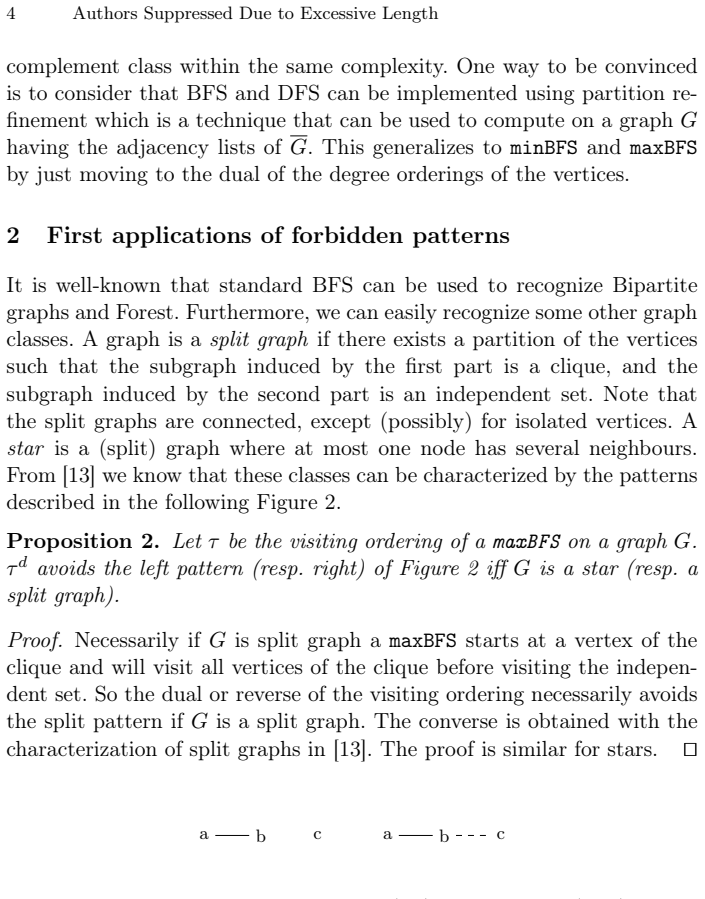
- Split graphs and bipartite chain graphs can be recognized by one standard BFS pass.
- Proper interval graphs can be recognized by two consecutive standard BFS passes.
- Certifications consist of verifying that the produced ordering avoids the relevant forbidden patterns.
- For connected proper interval graphs the characterizing orderings are unique up to reversal and true-twin swaps.
Where Pith is reading between the lines
- These results indicate that basic search procedures may suffice for recognition of additional hereditary classes whose definitions rest on ordering characterizations.
- The uniqueness property for proper interval graphs could support canonical representations or faster isomorphism checks.
- The approach suggests a route toward unifying recognition algorithms across multiple graph classes around ordinary traversals rather than specialized searches.
Load-bearing premise
The vertex orderings produced by standard DFS and BFS traversals match the pattern-avoiding characterizations of these graph classes.
What would settle it
A single counterexample graph that is trivially perfect yet whose DFS ordering contains a forbidden pattern, or a graph whose DFS ordering avoids all forbidden patterns yet is not trivially perfect.
Figures




read the original abstract
It is well-known since the seventies of last century that Depth First Search (DFS) can be used to compute strongly connected components [RE. Tarjan. SIAM Journal on Computing, 1972] and Breadth First Search (BFS) can be used to compute distance in graphs [GY. Handler. Transportation Science, 1973]. We furthermore demonstrate that these standard graph searches are powerful enough to recognize and certify several well-structured graph classes. Specifically, we provide a single DFS approach for recognizing and certifying trivially perfect graphs that is significantly simpler than previous methods using [FPM. Chu. Information Processing Letters, 2008]. We further show that a single BFS can recognize split graphs and bipartite chain graphs, and we improve upon the triple LexBFS algorithm for proper interval graphs [DG. Corneil. Discrete Applied Mathematics, 2004] by proposing a two consecutive BFS recognition scheme. These results are underpinned by characterizations using vertex orderings that avoid specific patterns [L. Feuilloley, M. Habib. SIAM Journal on Discrete Mathematics, 2021]. Finally, we provide a structural study of connected proper interval graphs, proving that their characterizations via special orderings are unique up to reversal and the permutation of true twins.
Editorial analysis
A structured set of objections, weighed in public.
Referee Report
Summary. The paper claims that standard (non-lexicographic) DFS and BFS traversals suffice to recognize and certify trivially perfect graphs (via single DFS), split graphs and bipartite chain graphs (via single BFS), and proper interval graphs (via two consecutive BFS), by producing vertex orderings that directly verify the pattern-avoidance characterizations of Feuilloley-Habib (2021). It also proves that the special orderings for connected proper interval graphs are unique up to reversal and true-twin permutation, and supplies explicit algorithms together with correctness proofs.
Significance. If the derivations hold, the work demonstrates that ordinary DFS and BFS are already powerful enough for recognition and certification of these classes, yielding simpler procedures than the prior single-DFS method of Chu (2008) for trivially perfect graphs and the triple-LexBFS method of Corneil (2004) for proper interval graphs. The explicit algorithms, the direct reduction from search stacks/queues to the required ordering properties, the absence of free parameters or ad-hoc entities, and the structural uniqueness result for proper interval graphs are concrete strengths that strengthen the contribution.
minor comments (3)
- [Abstract] The abstract states that the DFS method is 'significantly simpler' than Chu (2008); a brief complexity comparison or operation count in the introduction would make the improvement concrete.
- The two-BFS scheme for proper interval graphs is presented as an improvement over the triple-LexBFS algorithm; clarifying whether the two BFS runs are consecutive on the same graph or involve an auxiliary structure would aid readability.
- The structural uniqueness theorem for connected proper interval graphs is a useful addition; a short remark on whether the result extends immediately to disconnected graphs would complete the picture.
Simulated Author's Rebuttal
We thank the referee for the positive assessment of our manuscript and the recommendation for minor revision. The referee's summary accurately captures our main results on the use of standard DFS and BFS for recognition and certification of trivially perfect graphs, split graphs, bipartite chain graphs, and proper interval graphs, as well as the uniqueness result for connected proper interval graphs. We appreciate the recognition of the simplicity of our methods relative to prior work such as Chu (2008) and Corneil (2004).
Circularity Check
Minor self-citation of characterization; derivations independent
full rationale
The paper underpins its DFS/BFS recognition schemes on pattern-avoiding vertex orderings from Feuilloley-Habib 2021 (SIAM J. Discrete Math.), which shares an author (Habib) with the present work. This constitutes a minor self-citation. However, the central claims consist of new, explicit algorithms (single DFS for trivially perfect graphs, single BFS for split and bipartite chain graphs, two BFS for proper interval graphs), correctness proofs relating search stacks/queues to the required ordering properties, and an original structural uniqueness result for connected proper interval graphs (up to reversal and true-twin permutation). None of these reduce by construction to the cited characterizations; the prior work supplies external benchmarks, while the derivations here are self-contained and falsifiable via the supplied algorithms and proofs. No fitted parameters, self-definitions, or load-bearing self-citation chains appear.
Axiom & Free-Parameter Ledger
axioms (2)
- standard math Standard correctness and ordering properties of DFS and BFS traversals
- domain assumption Graph classes admit characterizations by forbidden patterns in linear orderings
Reference graph
Works this paper leans on
-
[1]
Beisegel, J., Denkert, C., Köhler, E., Krnc, M., Pivac, N., Scheffler, R., Strehler, M.: The recognition problem of graph search trees. SIAM J. Discret. Math.35(2), 1418–1446 (2021). https://doi.org/10.1137/20M1313301, https://doi.org/10.1137/ 20M1313301
-
[2]
Bhaduri, S.: Finding a maximum clique of a chordal graph by removing vertices of minimum degree. Tech. rep., Master Thesis, Kent University USA (2008)
2008
-
[3]
Booth, K.S., Lueker, G.S.: Testing for the consecutive ones property, interval graphs, and graph planarity using pq-tree algorithms. J. Comput. Syst. Sci.13(3), 335–379 (1976). https://doi.org/10.1016/S0022-0000(76)80045-1, https://doi.org/ 10.1016/S0022-0000(76)80045-1
-
[4]
Charbit, P., Habib, M., Mamcarz, A.: Influence of the tie-break rule on the end- vertex problem. Discret. Math. Theor. Comput. Sci.16(2), 57–72 (2014). https: //doi.org/10.46298/DMTCS.2081, https://doi.org/10.46298/dmtcs.2081
-
[5]
Chu, F.P.M.: A simple linear time certifying LBFS-based algorithm for recognizing trivially perfect graphs and their complements. Inf. Process. Lett.107(1), 7–12 (2008) 26 Authors Suppressed Due to Excessive Length
2008
-
[6]
Discrete Applied Mathematics138(3), 371–379 (2004)
Corneil, D.G.: A simple 3-sweep LBFS algorithm for the recognition of unit interval graphs. Discrete Applied Mathematics138(3), 371–379 (2004). https://doi.org/10. 1016/j.dam.2003.07.001, http://dx.doi.org/10.1016/j.dam.2003.07.001
-
[8]
Corneil, D.G., Kim, H., Natarajan, S., Olariu, S., Sprague, A.P.: Simple linear time recognition of unit interval graphs. Inf. Process. Lett.55(2), 99–104 (1995). https: //doi.org/10.1016/0020-0190(95)00046-F, https://doi.org/10.1016/0020-0190(95) 00046-F
-
[9]
Corneil, D.G., Krueger, R.: A unified view of graph searching. SIAM J. Discret. Math.22(4), 1259–1276 (2008). https://doi.org/10.1137/050623498, https://doi. org/10.1137/050623498
-
[10]
Corneil, D.G., Olariu, S., Stewart, L.: The LBFS structure and recognition of interval graphs. SIAM J. Discret. Math.23(4), 1905–1953 (2009). https://doi.org/ 10.1137/S0895480100373455, https://doi.org/10.1137/S0895480100373455
-
[11]
Cournier, A., Ille, P.: Minimal indecomposable graphs. Discret. Math.183(1-3), 61–80 (1998). https://doi.org/10.1016/S0012-365X(97)00077-0, https://doi.org/ 10.1016/S0012-365X(97)00077-0
-
[12]
Dissertation, University of Montepllier II (2007)
Crespelle, C.: Représentations dynamiques de graphes. Dissertation, University of Montepllier II (2007)
2007
-
[13]
Topics in Combinatorics and Graph Theory, R
Damaschke, P.: Forbidden ordered subgraphs. Topics in Combinatorics and Graph Theory, R. Bodendiek and R. Hennm Eds pp. 219–229 (1990)
1990
-
[14]
Ducoffe, G., Feuilloley, L., Habib, M., Pitois, F.: Pattern detection in ordered graphs. CoRRabs/2302.11619(2023). https://doi.org/10.48550/ARXIV.2302. 11619, https://doi.org/10.48550/arXiv.2302.11619
work page internal anchor Pith review doi:10.48550/arxiv.2302 2023
-
[15]
(eds.), Measure Theory Oberwolfach 1983, Lecture Notes in Mathematics, vol
Erdős, P.: Kölzow, D.; Maharam-Stone, D. (eds.), Measure Theory Oberwolfach 1983, Lecture Notes in Mathematics, vol. 1089, Springer (1984)
1983
-
[16]
SIAM Journal on Discrete Mathematics (SIDMA)35(1), 55–90 (2021)
Feuilloley, L., Habib, M.: Graph classes and forbidden patterns on three vertices. SIAM Journal on Discrete Mathematics (SIDMA)35(1), 55–90 (2021). https:// doi.org/10.1137/19M1280399
-
[17]
Information Processing Letters56(3), 179–184 (1995)
de Figueiredo1, C.M., Meidanis, J., de Mello, C.P.: A linear-time algorithm for proper interval graph recognition. Information Processing Letters56(3), 179–184 (1995). https://doi.org/https://doi.org/10.1016/0020-0190(95)00133-W
-
[18]
Fishburn, P.C.: Interval graphs and interval orders. Discret. Math.55(2), 135–149 (1985). https://doi.org/10.1016/0012-365X(85)90042-1, https://doi.org/10.1016/ 0012-365X(85)90042-1
-
[19]
Discrete Mathematics24(1), 105–107 (1978)
Golumbic, M.C.: Trivially perfect graphs. Discrete Mathematics24(1), 105–107 (1978)
1978
-
[20]
North-Holland Publishing Co., NLD (2004)
Golumbic, M.C.: Algorithmic Graph Theory and Perfect Graphs (Annals of Dis- crete Mathematics, Vol 57). North-Holland Publishing Co., NLD (2004)
2004
-
[21]
Pattern Recog- nition153, 110500 (2024).https://doi.org/https://doi.org/10.1016/j
Habib,M.,Limouzy,V.:Onsomesimplicialeliminationschemesforchordalgraphs. Electron. Notes Discrete Math.32, 125–132 (2009). https://doi.org/10.1016/J. ENDM.2009.02.017, https://doi.org/10.1016/j.endm.2009.02.017
work page doi:10.1016/j 2009
-
[22]
Habib, M., Paul, C., Viennot, L.: Linear time recognition of p4-indifference graphs. Discret. Math. Theor. Comput. Sci.4(2), 173–178 (2001). https://doi.org/10. 46298/DMTCS.269, https://doi.org/10.46298/dmtcs.269
-
[23]
Handler, G.Y.: Minimax location of a facility in an undirected tree graph. Trans- portation Science7(3), 287–293 (1973), https://pubsonline.informs.org/doi/abs/ 10.1287/trsc.7.3.287 On the power of standard DFS and BFS 27
-
[24]
Heggernes, P., Kratsch, D.: Linear-time certifying recognition algorithms and for- bidden induced subgraphs. Nord. J. Comput.14(1-2), 87–108 (2007)
2007
-
[25]
Electronic Notes in Discrete Mathematics32, 27–34 (2009)
Heggernes, P., Meister, D., Papadopoulos, C.: A new representation of proper interval graphs with an application to clique-width. Electronic Notes in Discrete Mathematics32, 27–34 (2009). https://doi.org/https://doi.org/10.1016/j.endm. 2009.02.005, dIMAP Workshop on Algorithmic Graph Theory
-
[26]
Hell, P., Huang, J.: Certifying LexBFS recognition algorithms for proper in- terval graphs and proper interval bigraphs. SIAM J. Discret. Math.18(3), 554–570 (2004). https://doi.org/10.1137/S0895480103430259, https://doi.org/10. 1137/S0895480103430259
-
[27]
Hell, P., Shamir, R., Sharan, R.: A fully dynamic algorithm for recog- nizing and representing proper interval graphs. SIAM J. Comput.31(1), 289–305 (2001). https://doi.org/10.1137/S0097539700372216, https://doi.org/10. 1137/S0097539700372216
-
[28]
Hsu, W.: A simple test for interval graphs. In: Mayr, E.W. (ed.) Graph- Theoretic Concepts in Computer Science, 18th International Workshop, WG ’92, Wiesbaden-Naurod, Germany, June 19-20, 1992, Proceedings. Lecture Notes in Computer Science, vol. 657, pp. 11–16. Springer (1992). https://doi.org/10.1007/ 3-540-56402-0_31, https://doi.org/10.1007/3-540-56402-0_31
-
[29]
Discrete Ap- plied Mathematics69(3), 247–255 (1996)
Jing-Ho, Y., Jer-Jeong, C., Chang, G.J.: Quasi-threshold graphs. Discrete Ap- plied Mathematics69(3), 247–255 (1996). https://doi.org/https://doi.org/10. 1016/0166-218X(96)00094-7, https://www.sciencedirect.com/science/article/pii/ 0166218X96000947
1996
-
[30]
Korte, N., Möhring, R.H.: A simple linear -time algorithm to recognize interval graphs. In: Tinhofer, G., Schmidt, G. (eds.) Graphtheoretic Concepts in Com- puter Science, International Workshop, WG ’86, Bernried, Germany, June 17- 19, 1986, Proceedings. Lecture Notes in Computer Science, vol. 246, pp. 1–16. Springer (1986). https://doi.org/10.1007/3-540-...
-
[31]
Li, P., Wu, Y.: A four-sweep LBFS recognition algorithm for interval graphs. Dis- cret. Math. Theor. Comput. Sci.16(3), 23–50 (2014). https://doi.org/10.46298/ DMTCS.2094, https://doi.org/10.46298/dmtcs.2094
-
[32]
Looges, P., Olariu, S.: Optimal greedy algorithm for indifference graphs. Comput. Math. Appl.25, 15–25 (1993)
1993
-
[33]
Mahadev, N.V., Peled, U.N.: Threshold graphs and related topics, vol. 56. Elsevier (1995)
1995
-
[34]
In: Beyersdorff, O., Kanté, M.M., Kupferman, O., Lokshtanov, D
Paul, C., Protopapas, E.: Tree-layout based graph classes: Proper chordal graphs. In: Beyersdorff, O., Kanté, M.M., Kupferman, O., Lokshtanov, D. (eds.) 41st International Symposium on Theoretical Aspects of Computer Science, STACS 2024, March 12-14, 2024, Clermont-Ferrand, France. LIPIcs, vol. 289, pp. 55:1– 55:18. Schloss Dagstuhl - Leibniz-Zentrum für ...
-
[35]
in Proof Techniques in Graph Theory (F
Roberts, F.: Indifference graphs. in Proof Techniques in Graph Theory (F. Harary ed.), Academic Press pp. 301–310 (1969)
1969
-
[36]
Shevrin, L., Filipov, N.: Partially ordered sets and their comparability graphs. Siber. Math. J.11, 497–509 (1970)
1970
-
[37]
SIAM Journal on Computing13(3), 566–579 (1984)
Tarjan, R.E., Yannakakis, M.: Simple linear-time algorithms to test chordality of graphs, test acyclicity of hypergraphs, and selectively reduce acyclic hyper- graphs. SIAM Journal on Computing13(3), 566–579 (1984). https://doi.org/10. 1137/0213035 28 Authors Suppressed Due to Excessive Length
1984
-
[38]
Tarjan, R.E.: Depth-first search and linear graph algorithms. SIAM J. Comput. 1(2), 146–160 (1972). https://doi.org/10.1137/0201010, https://doi.org/10.1137/ 0201010
-
[39]
Dissertation, University of Göttingen (1967)
Wegner, G.: Eignenschaften der Nerven Homologisch-einfacher Familien imRn. Dissertation, University of Göttingen (1967)
1967
-
[40]
Proceedings of the American Math- ematical Society13, 789–795 (1962)
Wolk, E.S.: The comparability graph of a tree. Proceedings of the American Math- ematical Society13, 789–795 (1962)
1962
discussion (0)
Sign in with ORCID, Apple, or X to comment. Anyone can read and Pith papers without signing in.