Recognition: 4 theorem links
· Lean TheoremAging Record Statistics in Saturating Self-Interacting Random Walks
Pith reviewed 2026-05-08 18:32 UTC · model grok-4.3
The pith
Saturating self-interacting random walks have an exact asymptotic record-age distribution that splits into a geometry-controlled regime and a memory-corrected regime.
A machine-rendered reading of the paper's core claim, the machinery that carries it, and where it could break.
Core claim
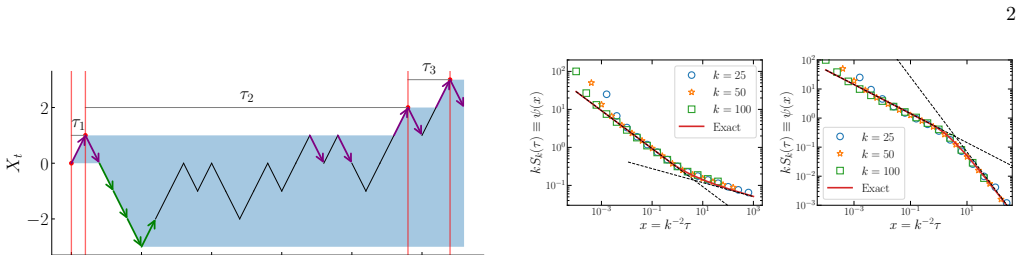
We derive the exact asymptotic distribution of tau_k for saturating self-interacting random walks. We uncover two asymptotic regimes, in agreement with recent scaling predictions: at short times (tau much smaller than k squared), record statistics are governed by the geometry of the explored region, while at long times (tau much larger than k squared), memory effects become subdominant and reduce to nontrivial prefactor corrections. Our exact result provides a rare analytic window beyond scaling theory and extends to a framework that fully quantifies aging dynamics in the presence of saturating self-interaction.
What carries the argument
The saturating self-interacting random walk, whose memory arises from a bounded interaction with visited sites, together with the asymptotic separation of its record-age distribution into a short-time geometric regime and a long-time prefactor-corrected regime.
If this is right
- Record ages tau_k depend on the record index k, so the process exhibits aging.
- For tau much smaller than k squared the distribution is determined solely by the geometry of the set of visited sites.
- For tau much larger than k squared the non-Markovian memory appears only as a multiplicative k-dependent prefactor.
- The two-regime structure holds for the broad class of saturating self-interacting walks and matches prior scaling predictions.
- The derivation supplies an exact analytic description that goes beyond scaling arguments.
Where Pith is reading between the lines
- The same separation into geometry and prefactor regimes may hold for other non-Markovian models whose memory saturates after a finite number of visits.
- The geometric regime could be linked to known properties of the range and shape of random-walk trajectories in different dimensions.
- Numerical verification of the exact distributions would provide a direct test of the regime boundary at tau approximately k squared.
- The framework could be used to predict aging signatures in physical or biological systems that display saturating self-interaction.
Load-bearing premise
The memory generated by saturating self-interaction can be captured exactly by an asymptotic analysis that cleanly divides the distribution into a geometry-dominated part and a memory-only prefactor part without higher-order corrections that would change the functional form.
What would settle it
High-precision simulations of the walks for large k that show the empirical distribution of tau_k failing to match the predicted geometric expression for tau much less than k squared or the prefactor-corrected expression for tau much greater than k squared.
Figures

read the original abstract
The record age tau_k, defined as the time between the k-th and k+1-st record-breaking events, is a central observable of extreme-value statistics. In Markovian processes, the absence of memory makes tau_k independent of k. How memory breaks this invariance and induces aging, meaning a dependence of tau_k on k, remains a fundamental question, closely connected to widely observed aging phenomena in non-Markovian dynamics. In this Letter, we derive the exact asymptotic distribution of tau_k for saturating self-interacting random walks, a broad class of non-Markovian processes. We uncover two asymptotic regimes, in agreement with recent scaling predictions: at short times (tau much smaller than k squared), record statistics are governed by the geometry of the explored region, while at long times (tau much larger than k squared), memory effects become subdominant and reduce to nontrivial prefactor corrections. Our exact result provides a rare analytic window beyond scaling theory and extends to a framework that fully quantifies aging dynamics in the presence of saturating self-interaction.
Editorial analysis
A structured set of objections, weighed in public.
Referee Report
Summary. The paper derives the exact asymptotic distribution of the record age τ_k (time between the k-th and (k+1)-st record) for saturating self-interacting random walks. It identifies two regimes in agreement with scaling predictions: for τ ≪ k² record statistics are governed by the geometry of the explored region, while for τ ≫ k² memory effects are subdominant and appear only as nontrivial prefactor corrections. The result is presented as parameter-free and extends to a general framework for aging in non-Markovian dynamics with saturating self-interaction.
Significance. If the derivation is correct, the work supplies a rare exact analytic expression for aging record statistics beyond scaling theory, cleanly separating geometric and memory contributions. This strengthens the link between extreme-value observables and non-Markovian memory while providing a concrete, falsifiable prediction for the distribution of τ_k in a broad class of processes.
minor comments (3)
- [Abstract] The abstract states an 'exact' derivation but supplies no equations or outline of the steps; the full manuscript should include at least the key intermediate expressions (e.g., the form of the generating function or the integral representation used for the asymptotic analysis) so that the separation into geometry-dominated and memory-corrected regimes can be verified directly.
- [Introduction] Notation for the saturating self-interaction (e.g., the precise form of the interaction kernel or the saturation threshold) is used without an explicit definition in the opening paragraphs; add a short paragraph or equation in the introduction that fixes the model before the asymptotic analysis begins.
- [Results] The claim that memory effects 'reduce to nontrivial prefactor corrections' at long times should be accompanied by an explicit statement of what those prefactors are (or at least their leading k-dependence) rather than leaving them implicit.
Simulated Author's Rebuttal
We thank the referee for the positive evaluation and the recommendation of minor revision. The referee's summary accurately reflects the scope and main findings of the manuscript regarding the exact asymptotic distribution of record ages τ_k in saturating self-interacting random walks, including the separation into geometry-dominated and memory-subdominant regimes.
Circularity Check
No significant circularity in the derivation chain
full rationale
The paper claims an exact asymptotic derivation of the record age distribution tau_k for saturating self-interacting random walks, cleanly separating short-time geometry-dominated regime (tau << k^2) from long-time memory-corrected regime (tau >> k^2) with only prefactor adjustments. This is presented as independent first-principles analysis that agrees with but does not derive from prior scaling predictions. No self-definitional steps, fitted inputs renamed as predictions, load-bearing self-citations reducing the central result to inputs, or ansatz smuggling are identifiable from the stated claims or abstract. The derivation is self-contained against external benchmarks and does not reduce by construction to its inputs.
Axiom & Free-Parameter Ledger
Lean theorems connected to this paper
-
Cost.FunctionalEquationwashburn_uniqueness_aczel (no relation: paper's hypergeometric/BESQ kernel is not the J-cost ½(x+x⁻¹)−1 and exhibits no ratio symmetry x↔x⁻¹) unclear?
unclearRelation between the paper passage and the cited Recognition theorem.
ψ(x) = β√(2/(πx)) · ∫₀¹ u^{α-1}(1-u)^{β-1}(2Ξ_α(xu²)-1) du / B(α,β), with Ξ_α(u) = Σ ((1-α)/2)_n ((1+α)/2)_n exp(-2n²/u)
-
Foundation/AlexanderDuality (D=3 forcing) — no contactalexander_duality_circle_linking (paper works on Z (1D), no spatial-dimension forcing question) unclear?
unclearRelation between the paper passage and the cited Recognition theorem.
BESQ_δ satisfies dY_δ(t) = δ dt + 2√|Y_δ(t)| dW_t; Ray–Knight decomposition L_{T_k}(x)/A → Y_{2β}(k'-x') for 0<x'<k', Ỹ_{2-2α}(-x') for x'<0
-
Foundation/AlphaCoordinateFixationalpha_pin_under_high_calibration (paper's α is a reinforcement parameter on Z, structurally unrelated to the bilinear-family α in RS branch selection) unclear?
unclearRelation between the paper passage and the cited Recognition theorem.
θ = α/2 for SATW; ψ(x) ~ (2/x)^{α/2} Γ((1+α)/2)/(√π B(α,β)) for x ≫ 1
What do these tags mean?
- matches
- The paper's claim is directly supported by a theorem in the formal canon.
- supports
- The theorem supports part of the paper's argument, but the paper may add assumptions or extra steps.
- extends
- The paper goes beyond the formal theorem; the theorem is a base layer rather than the whole result.
- uses
- The paper appears to rely on the theorem as machinery.
- contradicts
- The paper's claim conflicts with a theorem or certificate in the canon.
- unclear
- Pith found a possible connection, but the passage is too broad, indirect, or ambiguous to say the theorem truly supports the claim.
Reference graph
Works this paper leans on
-
[1]
S. N. Majumdar, A. Pal, and G. Schehr, Physics Reports Extreme value statistics of correlated random variables: A pedagogical review,840, 1 (2020)
2020
-
[2]
Aliakbari, P
A. Aliakbari, P. Manshour, and M. J. Salehi, Chaos27, 033116 (2017)
2017
-
[3]
Benigni, C
L. Benigni, C. Cosco, A. Shapira, and K. J. Wiese, Elec- tronic Communications in Probability23, 1 (2018)
2018
-
[4]
Ben-Naim and P
E. Ben-Naim and P. L. Krapivsky, Physical Review E88, 022145 (2013)
2013
-
[5]
Godr` eche, S
C. Godr` eche, S. N. Majumdar, and G. Schehr, Journal of Physics A: Mathematical and Theoretical50, 333001 (2017)
2017
-
[6]
C. Godr` eche and J.-M. Luck, Journal of Statistical Physics186, 4 (2022), arXiv:2109.05582 [cond-mat]
-
[7]
Godr` eche, S
C. Godr` eche, S. N. Majumdar, and G. Schehr, Journal of Statistical Mechanics: Theory and Experiment2015, P03014 (2015)
2015
-
[8]
Lacroix-A-Chez-Toine and F
B. Lacroix-A-Chez-Toine and F. Mori, Journal of Physics A: Mathematical and Theoretical53, 495002 (2020)
2020
-
[9]
Witze, Nature608, 464 (2022)
A. Witze, Nature608, 464 (2022)
2022
-
[10]
N. N. Ambraseys, Nature232, 375 (1971)
1971
-
[11]
Coumou, A
D. Coumou, A. Robinson, and S. Rahmstorf, Climatic Change118, 771 (2013)
2013
-
[12]
Ahsanullah and V
M. Ahsanullah and V. B. Nevzorov, inInternational En- cyclopedia of Statistical Science(Springer, Berlin, Hei- delberg, 2011) pp. 1195–1202
2011
-
[13]
K. N. Chandler, Journal of the Royal Statistical Society. Series B (Methodological)14, 220 (1952)
1952
-
[14]
A. J. Bray, S. N. Majumdar, and G. Schehr, Adv. Phys. 62, 225 (2013)
2013
-
[15]
S. N. Majumdar, A. Rosso, and A. Zoia, Physical Review Letters104, 020602 (2010)
2010
-
[16]
E. S. Andersen, Scandinavian Actuarial Journal1949, 27 (1949)
1949
-
[17]
V. E. Tarasov,Fractional Dynamics: Applications of Fractional Calculus to Dynamics of Particles, Fields and Media, edited by A. C. J. Luo and N. H. Ibragimov, Non- linear Physical Science, Vol. 0 (Springer, Berlin, Heidel- berg, 2010)
2010
-
[18]
Flyvbjerg, Nature Physics17, 771 (2021), publisher: Nature Publishing Group
H. Flyvbjerg, Nature Physics17, 771 (2021), publisher: Nature Publishing Group
2021
-
[19]
M. J. Saxton, Biophysical Journal66, 394 (1994)
1994
-
[20]
Barkai, E
E. Barkai, E. Aghion, and D. A. Kessler, Physical Review X4, 021036 (2014)
2014
-
[21]
J. d’Alessandro, A. Barbier-Chebbah, V. Cellerin, O. Benichou, R. M` ege, R. Voituriez, and B. Ladoux, Nature Communications12, 10.1038/s41467-021-24249- 8 (2021)
-
[22]
Tr¨ oger, F
L. Tr¨ oger, F. Goirand, and K. Alim, Proceedings of the National Academy of Sciences121, e2312611121 (2024), publisher: Proceedings of the National Academy of Sci- ences
2024
-
[23]
Boyer and C
D. Boyer and C. Solis-Salas, Physical Review Letters 112, 240601 (2014)
2014
-
[24]
Dussutour, V
A. Dussutour, V. Fourcassi´ e, D. Helbing, and J.-L. Deneubourg, Nature428, 70 (2004)
2004
-
[25]
R´ egnier, M
L. R´ egnier, M. Dolgushev, and O. B´ enichou, Nature Communications14, 6288 (2023), publisher: Nature Publishing Group
2023
-
[26]
B. D. Hughes,Random Walks and Random Environ- ments: Random Walks(Clarendon Press, 1995)
1995
-
[27]
S. N. Majumdar, Physica A: Statistical Mechanics and its Applications389, 4299 (2010)
2010
-
[28]
J. H. P. Schulz, E. Barkai, and R. Metzler, Physical Re- view X4, 011028 (2014)
2014
-
[29]
Br´ emont, T
J. Br´ emont, T. Jakuszeit, R. Voituriez, and O. B´ enichou, Physical Review E110, 014604 (2024)
2024
-
[30]
Barbier-Chebbah, O
A. Barbier-Chebbah, O. B´ enichou, and R. Voituriez, Phys. Rev. X12, 011052 (2022)
2022
-
[31]
Z. R. Fox, E. Barkai, and D. Krapf, Nature Communica- tions12, 6162 (2021)
2021
-
[32]
Br´ emont, L
J. Br´ emont, L. R´ egnier, A. Barbier–Chebbah, R. Voi- turiez, and O. B´ enichou, Nature Communications17, 453 (2025)
2025
-
[33]
B. V. Hokmabad, J. Agudo-Canalejo, S. Saha, R. Golestanian, and C. C. Maass, Proceedings of the Na- tional Academy of Sciences119, e2122269119 (2022)
2022
-
[34]
W. Chen, A. Izzet, R. Zakine, E. Cl´ ement, E. Vanden- Eijnden, and J. Brujic, Physical Review Letters134, 018301 (2025)
2025
-
[35]
W. T. Kranz, A. Gelimson, K. Zhao, G. C. L. Wong, and R. Golestanian, Physical Review Letters117, 038101 (2016)
2016
-
[36]
R. M. Adar and J.-F. m. c. Joanny, Phys. Rev. Lett.133, 118402 (2024)
2024
-
[37]
Massouli´ e, C
B. Massouli´ e, C. Erignoux, C. Toninelli, and W. Krauth, Physical Review Letters135, 127102 (2025)
2025
-
[38]
A. C. Maggs, Europhysics Letters147, 21001 (2024)
2024
-
[39]
Br´ emont, O
J. Br´ emont, O. B´ enichou, and R. Voituriez, Physical Re- view Letters133, 157101 (2024)
2024
-
[41]
L. Dumaz and B. T´ oth, Marginal densities of the ”true” self-repelling motion (2012), arXiv:1202.4327 [math]
-
[42]
Barbier-Chebbah, O
A. Barbier-Chebbah, O. Benichou, and R. Voituriez, Phys. Rev. E102, 062115 (2020)
2020
-
[43]
Romano and A
J. Romano and A. Gambassi, Physical Review Letters 136, 107102 (2026)
2026
-
[44]
In particular, it would make explicit the effective inde- pendence of record ages when considering extreme statis- tics
-
[45]
T´ oth, Ann Probab24, 1324 (1996)
B. T´ oth, Ann Probab24, 1324 (1996)
1996
-
[46]
Similar conclusions hold for site-reinforced SIRWs [39]
-
[47]
It does not contain or imply our main result Eq
In the mathematical literature, we are aware of a sin- gle related study [58] which, while seemingly address- ing record statistics of the SATW, actually concerns the number of distinct visited sites. It does not contain or imply our main result Eq. (4)
-
[48]
Carmona, F
P. Carmona, F. Petit, and M. Yor, Journal of the London Mathematical Society58, 239 (1998)
1998
-
[49]
Coghi, R
F. Coghi, R. Duvezin, and J. S. Wettlaufer, Journal of Statistical Physics192, 128 (2025)
2025
- [50]
-
[51]
Gu´ erin, N
T. Gu´ erin, N. Levernier, O. B´ enichou, and R. Voituriez, Nature534, 356 (2016)
2016
-
[53]
J. G. Foster, P. Grassberger, and M. Paczuski, New Jour- nal of Physics11, 023009 (2009)
2009
-
[55]
Kosygina, T
E. Kosygina, T. Mountford, and J. Peterson, Probability 7 Theory and Related Fields182, 189 (2022)
2022
-
[56]
Note that (15) is easily iterated by considering more than two successive visited territories, fully characterizing ag- ing in SATW
-
[57]
A. N. Borodin and P. Salminen,Handbook of Brownian Motion - Facts and Formulae, Probability and Its Appli- cations (Birkh¨ auser Basel, Basel, 2002)
2002
-
[58]
Serlet, inS´ eminaire de Probabilit´ es XLIX, edited by C
L. Serlet, inS´ eminaire de Probabilit´ es XLIX, edited by C. Donati-Martin, A. Lejay, and A. Rouault (Springer International Publishing, Cham, 2018) pp. 495–519. Supplementary Material : Aging Record Statistics in Saturating Self-Interacting Random Walks J. Br´ emont,1 R. Voituriez, 2, 3 and O. B´ enichou2 1Coll` ege de France, 3 Rue d’Ulm, 75005 Paris, ...
2018
-
[59]
The joint distribution of the area under the process ∫t 0Xudu, and the position Xt at time t: Ea δ [ e−s ∫t 0 Xudu ; Xt =b ] = ∫ X0=a,Xt=b DXe−s ∫t 0 Xudu. (1)
-
[60]
(2) In both Eqs
The joint distribution of the area ∫t 0Xudu and the first-passage time T0 to the origin: Ea δ [ e−s ∫t 0 Xudu ; T0 =t ] = ∫ X0=a,T 0=t DXe−s ∫t 0 Xudu. (2) In both Eqs. (1) and (2), the path integral measure DX corresponds to that of a BESQ δprocess: trajectories are weighted according to the law of a BESQ δprocess over the interval [0,t ]. In Eq. (1), th...
-
[61]
The walker last visits k2 We now define the aged probability q(2) + (k2,m 2,t|k1,m 1), which extend the one-time observable q+(k1,m 1,t ) to describe the statistics of a second excursion of the SIRW starting from a previously established visited territory. Specifically,q(2) + (k2,m 2,t|k1,m 1) denotes the joint probability density that the RW, having alre...
-
[62]
(20) 4 Thus,q(2) −(k2,m 2,t|k1,m 1) as defined above defines the joint distribution of ( t,k 2)
The walker last visits −m2 Analogously (although this is not used in the main text) we define the aged probability q(2) −(k2,m 2,t|k1,m 1) for the case where the walk continues after time Tk1 and instead reaches a more negative site −m2 <−m1: q(2) −(k2,m 2,t|k1,m 1) = P (T−m2−Tk1 =t, span = [−m2,k 2]|span at Tk1 = [−m1,k 1]). (20) 4 Thus,q(2) −(k2,m 2,t|k...
-
[63]
we consider only time-integrated quantities ˆq(2) ±(s = 0)
We first start with setting the Laplace variables = 0, i.e. we consider only time-integrated quantities ˆq(2) ±(s = 0). We will consider the effect of nonzero s at the end
-
[64]
We derive functional relations for such probabilities
-
[65]
These relations remarkably close for the ratio observable γ= ˆq(2) + (k2,m2,s=0|k1,m1) ˆq(2) −(k2,m2,s=0|k1,m1)
-
[66]
A joint continuum limit yields coupled partial differential equations
-
[67]
These reduce to a Riccati equation for γ, admitting an exact hypergeometric solution
-
[68]
(19) and (22)
We show how to reconstruct ˆq(2) ±(s = 0) from the knowledge of γ, recovering our results Eqs. (19) and (22). For simplicity, we consider symmetric SATW, that is α=β≡ϕ. 9 A. Functional equation and ratio observable Thanks to translation invariance, we can assume that m1 = 0, and k1 = L1 is the length of the already visited interval. A first key observatio...
-
[69]
(70) In contrast with the complementary contribution ˆq(2) + (L1 +x,y|L1), no Dirac peak at x = 0 appears in this case
Continuum limit of ˆπx,−y We start from the exact expression (61) ˆq(2) −(L1 +x,y|L1) =ϕ x−1∏ l=0 (L1 +l +ϕ) y−1∏ j=1 (ϕγ(x,j ) +L1 +j +x +ϕ) x+y−1∏ j=0 (L1 +j + 2ϕ) . (70) In contrast with the complementary contribution ˆq(2) + (L1 +x,y|L1), no Dirac peak at x = 0 appears in this case. We now consider the scaling regime x +y = ∆ = δL1, j =u∆, u ∈[0, 1−z]...
-
[70]
A. N. Borodin and P. Salminen, Handbook of Brownian Motion - Facts and Formulae , Probability and Its Applications (Birkh¨ auser Basel, Basel, 2002)
2002
-
[71]
G¨ oing-Jaeschke and M
A. G¨ oing-Jaeschke and M. Yor, Bernoulli9, 313 (2003)
2003
-
[72]
G. F. Lawler, arXiv (2019)
2019
-
[73]
Br´ emont, O
J. Br´ emont, O. B´ enichou, and R. Voituriez, Physical Review Letters133, 157101 (2024)
2024
-
[74]
Chaumont, R
L. Chaumont, R. A. Doney, and Y. Hu, Annales de l’I.H.P. Probabilit´ es et statistiques36, 219 (2000)
2000
-
[75]
Abramowitz and I
M. Abramowitz and I. Stegun, Handbook of Mathematical Functions: With Formulas, Graphs, and Mathematical Tables , Applied Mathematics Series (Dover Publications, 1965)
1965
-
[76]
Br´ emont, L
J. Br´ emont, L. R´ egnier, R. Voituriez, and O. B´ enichou, Physical Review Letters134, 197103 (2025)
2025
discussion (0)
Sign in with ORCID, Apple, or X to comment. Anyone can read and Pith papers without signing in.