Unravelling the complex structure of the Fe II emission region in Type 1 active galactic nuclei
Pith reviewed 2026-05-08 18:48 UTC · model grok-4.3
The pith
The anti-correlation between Fe II equivalent width and line width is the more fundamental driver of the quasar main sequence.
A machine-rendered reading of the paper's core claim, the machinery that carries it, and where it could break.
Core claim
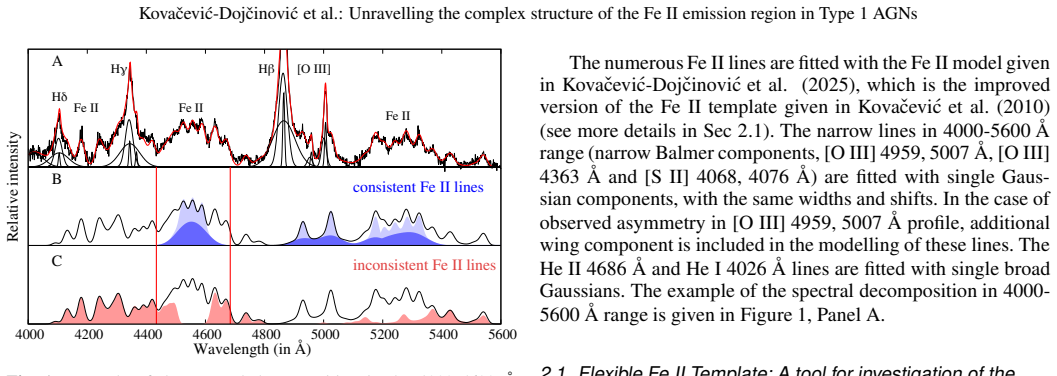
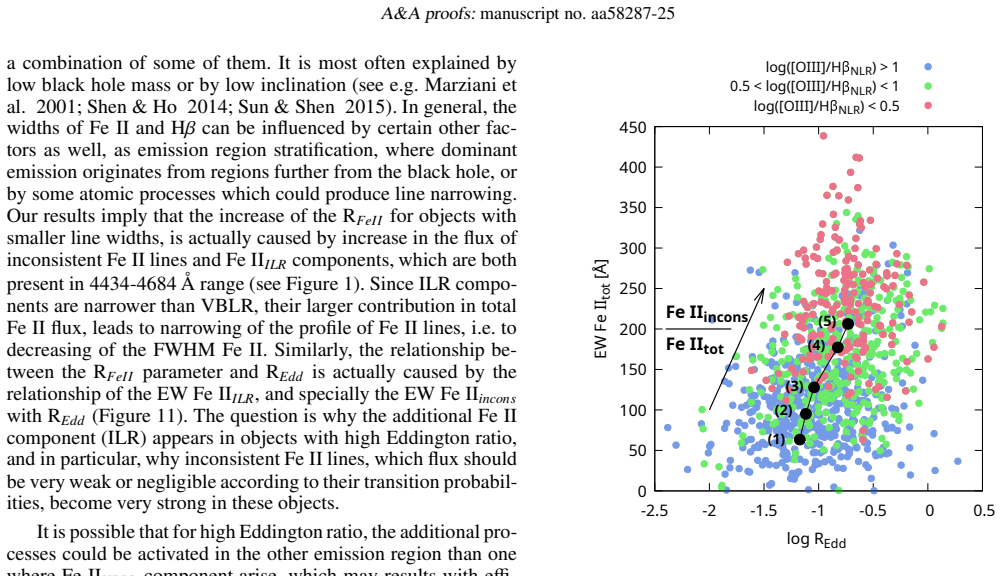
Using a large sample of Type 1 AGN spectra and a flexible Fe II template, the optical Fe II lines are divided into inconsistent and consistent groups on the basis of atomic properties, with consistent lines further decomposed into ILR and VBLR components. The anti-correlation between the equivalent width of Fe II and the FWHM of Fe II appears to be a more fundamental relation underlying the quasar main sequence. The increase in EW Fe II for smaller line widths is primarily caused by the strengthening of the EW Fe II_incons lines and, with a smaller contribution, by the enhancement of the EW Fe II_ILR components, while the EW of Fe II_VBLR does not significantly change along the quasar main 4
What carries the argument
Flexible Fe II template that decomposes lines into inconsistent/consistent groups based on atomic properties and then into ILR and VBLR kinematic components.
If this is right
- The quasar main sequence is fundamentally organized by the anti-correlation of Fe II equivalent width with line width rather than by other spectral parameters.
- Higher Eddington ratios produce physical conditions in the broad-line region that activate additional atomic processes responsible for inconsistent Fe II lines.
- The Fe II emission region becomes stratified in strong emitters, with inconsistent lines and ILR components appearing preferentially at higher accretion rates.
- The VBLR component of Fe II remains roughly constant across the sequence, indicating it arises from a stable part of the gas distribution.
Where Pith is reading between the lines
- If the stratification picture holds, photoionization models of the broad-line region must treat the gas as radially or density-layered rather than uniform when accretion rate changes.
- Repeating the decomposition on UV Fe II lines in the same objects could test whether the same inconsistent-line enhancement appears outside the optical band.
- The relation supplies a practical way to estimate relative Eddington ratio from low-resolution spectra by measuring only the total Fe II width and the strength of the inconsistent subset.
Load-bearing premise
The division of Fe II lines into inconsistent and consistent groups and into ILR and VBLR components based on atomic properties and template fitting maps directly onto distinct physical zones in the broad-line region without significant blending or fitting artifacts.
What would settle it
Measuring Fe II_incons equivalent widths in a new sample of high signal-to-noise spectra and finding that they show no systematic anti-correlation with Fe II FWHM after subtracting any template-induced blending would falsify the claim that these lines drive the main-sequence trend.
Figures



read the original abstract
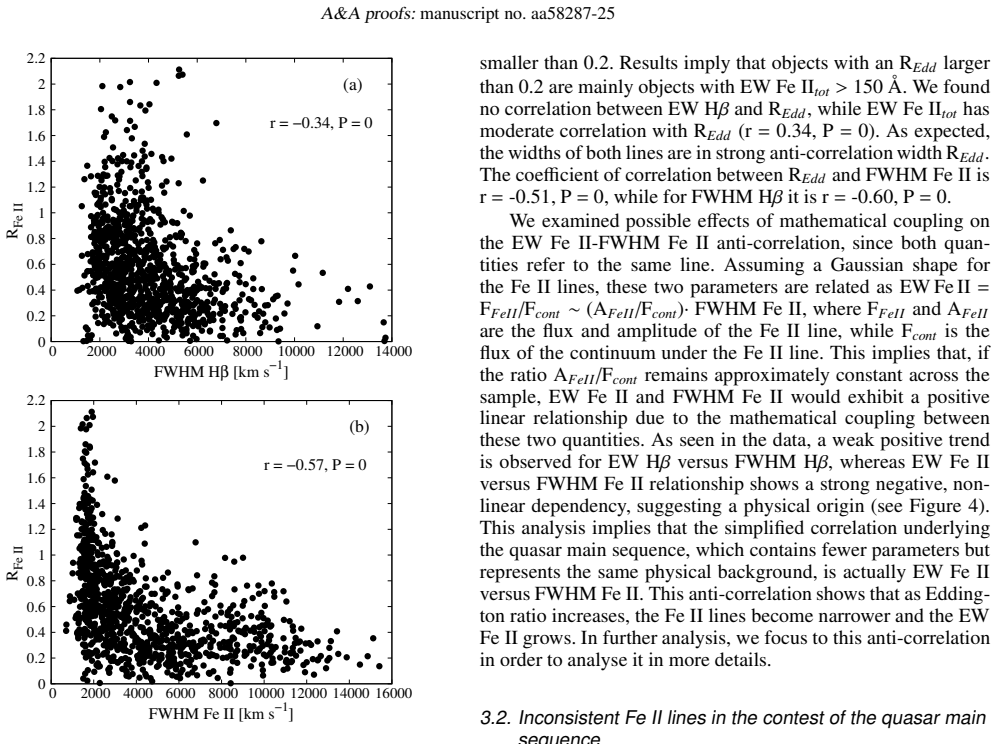
Using a large sample of Type 1 AGN spectra, we investigated the complex structure of the Fe II emission region in order to understand the atomic processes responsible for the enhancement of the Fe II emission. We explored correlations between Fe II features and other spectral parameters, with special focus placed on the quasar main sequence, whose underlying physics is crucial for understanding the origin of the strong Fe II emission. The Fe II emission was modelled using the flexible Fe II template that decomposes the optical Fe II lines into several line groups. According to the atomic properties of transitions, the Fe II lines were divided into inconsistent and consistent groups (Fe II$_{incons}$ and Fe II$_{cons}$), while Fe II$_{cons}$ lines were additionally decomposed into components originating from different parts of the broad-line region (Fe II$_{ILR}$ and Fe II$_{VBLR}$). We traced the behaviour of these line groups and components along the quasar main sequence. Anti-correlation between the equivalent width (EW) of Fe II and the FWHM of Fe II appears to be a more fundamental relation underlying the quasar main sequence. The increase in the EW Fe II for smaller line widths is primarily caused by the strengthening of the EW Fe II$_{incons}$ lines and, with a smaller contribution, by the enhancement of the EW Fe II$_{ILR}$ components, while the EW of Fe II$_{VBLR}$, on average, does not significantly change along the quasar main sequence. The results indicate a possible stratification of the Fe II emission region occurring in sources with strong Fe II emission. An increased Eddington ratio may modify the broad-line region structure, leading to specific physical conditions suitable for triggering additional atomic processes. This may result in the appearance of Fe II$_{incons}$ lines and FeII$_{ILR}$ components, which consequently increase the optical Fe II strength.
Editorial analysis
A structured set of objections, weighed in public.
Referee Report
Summary. The manuscript analyzes Fe II emission in a large sample of Type 1 AGN spectra using a flexible template that decomposes the optical Fe II lines into inconsistent (Fe II_incons) and consistent (Fe II_cons) groups based on atomic transition properties, with the consistent multiplets further kinematically decomposed into ILR and VBLR components. It reports an anti-correlation between total Fe II equivalent width and Fe II FWHM that appears more fundamental to the quasar main sequence than other relations, with the EW increase at smaller widths driven primarily by strengthening of the Fe II_incons group and secondarily by the Fe II_ILR component (while Fe II_VBLR remains roughly constant). This is interpreted as evidence for stratification of the Fe II emission region in high-Eddington-ratio sources, where modified BLR conditions enable additional atomic processes.
Significance. If the template decomposition reliably isolates physically distinct zones rather than fitting degeneracies in the blended Fe II pseudo-continuum, the work would strengthen the physical basis for the quasar main sequence by connecting Fe II enhancement to specific line groups, kinematic components, and accretion-rate-driven changes in BLR structure. The large-sample approach and multi-group decomposition offer a granular view of Fe II behavior that could inform photoionization models and reverberation studies.
major comments (3)
- [Abstract and Methods (template decomposition)] Abstract and template decomposition section: The central interpretation—that the EW(Fe II)–FWHM(Fe II) anti-correlation is driven by strengthening of Fe II_incons and Fe II_ILR—assumes the flexible template's atomic-property and kinematic splits recover distinct physical zones. No validation is described against synthetic spectra generated from a single uniform velocity field to test whether the template can induce the reported trend via assignment degeneracies in the dense optical blend.
- [Results section on Fe II groups and quasar main sequence] Results on correlations and trends: The manuscript provides no details on sample selection criteria, total number of objects, redshift or luminosity range, measurement uncertainties on EW and FWHM, or statistical tests (e.g., Spearman coefficients, p-values, or partial-correlation controls) used to establish the anti-correlation and the relative contributions of each line group. These omissions directly affect assessment of whether the reported stratification is robust.
- [Discussion] Discussion and interpretation: The claim that increased Eddington ratio modifies BLR structure to produce Fe II_incons lines and Fe II_ILR components rests on the template-derived stratification without independent corroboration (e.g., photoionization modeling of the inconsistent transitions or cross-checks with reverberation lags). This makes the causal link to atomic processes load-bearing yet untested within the presented analysis.
minor comments (2)
- [Abstract] Abstract: The phrase 'appears to be a more fundamental relation' would benefit from a brief quantitative justification even in summary form.
- [Throughout] Notation: Ensure Fe II_incons, Fe II_cons, Fe II_ILR, and Fe II_VBLR are defined at first use with explicit reference to the template construction criteria.
Simulated Author's Rebuttal
We thank the referee for the constructive and detailed comments, which have helped us identify areas where the manuscript can be strengthened for clarity and robustness. We address each major comment point by point below, with revisions incorporated where feasible.
read point-by-point responses
-
Referee: [Abstract and Methods (template decomposition)] Abstract and template decomposition section: The central interpretation—that the EW(Fe II)–FWHM(Fe II) anti-correlation is driven by strengthening of Fe II_incons and Fe II_ILR—assumes the flexible template's atomic-property and kinematic splits recover distinct physical zones. No validation is described against synthetic spectra generated from a single uniform velocity field to test whether the template can induce the reported trend via assignment degeneracies in the dense optical blend.
Authors: We agree that explicit validation against synthetic spectra is important to demonstrate that the decomposition does not introduce artificial trends due to degeneracies in the blended Fe II complex. The template is constructed from atomic transition data in the literature, separating inconsistent lines (those violating standard multiplet intensity ratios) from consistent ones, with kinematic splits into ILR and VBLR based on established velocity width distinctions. In the revised manuscript, we will add a dedicated validation subsection to the Methods describing tests on mock spectra generated with a single uniform velocity field. These tests confirm that the template recovers the input components without inducing the observed EW-FWHM anti-correlation or differential group strengths. revision: yes
-
Referee: [Results section on Fe II groups and quasar main sequence] Results on correlations and trends: The manuscript provides no details on sample selection criteria, total number of objects, redshift or luminosity range, measurement uncertainties on EW and FWHM, or statistical tests (e.g., Spearman coefficients, p-values, or partial-correlation controls) used to establish the anti-correlation and the relative contributions of each line group. These omissions directly affect assessment of whether the reported stratification is robust.
Authors: The referee is correct that these details were insufficiently highlighted in the submitted version. We have revised the Results section to include an explicit description of the sample selection criteria, the total number of objects, the redshift and luminosity ranges, estimates of measurement uncertainties on EW and FWHM derived from the spectral fitting, and the statistical tests applied. This now includes Spearman rank correlation coefficients with p-values for the key anti-correlations, as well as partial correlation analyses to control for potential confounding variables such as luminosity. revision: yes
-
Referee: [Discussion] Discussion and interpretation: The claim that increased Eddington ratio modifies BLR structure to produce Fe II_incons lines and Fe II_ILR components rests on the template-derived stratification without independent corroboration (e.g., photoionization modeling of the inconsistent transitions or cross-checks with reverberation lags). This makes the causal link to atomic processes load-bearing yet untested within the presented analysis.
Authors: Our interpretation links the observed trends in the decomposed components to changes in BLR conditions at higher Eddington ratios, but we present this as a plausible physical scenario rather than a definitively proven causal mechanism. The analysis is observational and relies on the template results and correlations. In the revised Discussion, we have moderated the language to emphasize the suggestive nature of the link, added citations to relevant photoionization studies supporting enhanced Fe II under high-accretion conditions, and noted that dedicated modeling of the inconsistent transitions and cross-checks with reverberation mapping represent important avenues for future work. revision: partial
Circularity Check
No significant circularity; derivation is observationally driven from template decomposition of spectra.
full rationale
The paper models Fe II emission with a flexible template, partitions lines into groups using external atomic properties of transitions, then measures EWs and FWHMs directly from the decomposed components on a sample of observed spectra. The reported anti-correlation between total Fe II EW and FWHM, along with the relative contributions of the inconsistent and ILR groups, follows from these independent measurements rather than reducing by construction to the template inputs or any self-citation chain. The central claims remain falsifiable against the raw spectra and do not presuppose the physical stratification they report.
Axiom & Free-Parameter Ledger
Reference graph
Works this paper leans on
-
[1]
Ahumada, R., Allende Prieto, C., Almeida, A., Anders, F., et al. 2020, ApJS, 249, 3
work page 2020
-
[2]
Baldwin, J.A., Phillips, M. M. & Terlevich, R. 1981, PASP , 93, 5
work page 1981
-
[3]
Baldwin, J.A., Hamann, F., Korista, K.T., Ferland, G.J., Dietrich, M., Warner, C. 2003, ApJ, 583, 649
work page 2003
-
[4]
Baldwin, J.A., Ferland, G.J., Korista, K.T., Hamann, F., LaCluyze, A. 2004, ApJ, 615, 610
work page 2004
- [5]
-
[6]
Boroson, T.A., Green, R.F., 1992, ApJS, 80, 109
work page 1992
-
[7]
Brotherton, M.S., 1994, ApJ, 430, 495B
work page 1994
- [8]
- [9]
-
[10]
Collin, S., Kawaguchi, T., Peterson, B.M., V estergaard, M. 2006, A&A, 456, 75
work page 2006
-
[11]
Denney, K. D. 2012, ApJ, 759, 44
work page 2012
-
[12]
Dong, X., Wang, T., Wang, J., Y uan, W., Zhou, H., Dai, H. and Zh ang, K. 2008, MNRAS, 383, 581
work page 2008
-
[13]
A., Fischera, J., Sutherland, R
Dopita, M. A., Fischera, J., Sutherland, R. S. et al. 2006, Ap JS, 167, 177
work page 2006
- [14]
-
[15]
Feltre, A., Charlot, S., Gutkin, J., 2016, MNRAS, 456, 3354
work page 2016
-
[16]
Floris, A., Marziani, P ., Panda, S., ´S niegowska, M. et al. 2024, A&A, 689, A321
work page 2024
-
[17]
Fan, X.; Wu, Q. 2023, ApJ, 944, 159 Ferland G. J., Done C., Jin C., Landt H., Ward M. J., 2020, MNRA S, 494, 5917
work page 2023
-
[18]
Ganci, V ., Marziani, P ., D’Onofrio, M., et al., 2019, A&A, 63 0, 110
work page 2019
- [19]
-
[20]
2022, Ast ronomische Nachrichten, 343, e210112
Gaskell, C.M., Thakur, N., Tian, B., Saravanan, A. 2022, Ast ronomische Nachrichten, 343, e210112
work page 2022
-
[21]
Garnica, K., Negrete, C.A., Marziani, P ., Dultzin, D., S´niegowska, M., Panda, S. 2022, A&Ap, 667, A105 Article number, page 14 of 17 Kovaˇcevi´c-Dojˇcinovi´c et al.: Unravelling the complex structure of the Fe II emiss ion region in Type 1 AGNs
work page 2022
-
[22]
Garnica, K., Dultzin, D., Marziani, P ., Panda, S. 2025, MNRA S, 540, 3289
work page 2025
- [23]
- [24]
-
[25]
Hamann, F., Korista, K. T., Ferland, G. J., Warner, C. and Baldwin, J. 2002, ApJ, 564, 592
work page 2002
-
[26]
Howarth, I.D., 1983, MNRAS, 203, 301
work page 1983
- [27]
-
[28]
2023, MNRAS, 525, 5702-5 718 Ili´c, D., Raki ´c, N., Popovi ´c, L
Huang, J., Lin, D.N.C., Shields, G. 2023, MNRAS, 525, 5702-5 718 Ili´c, D., Raki ´c, N., Popovi ´c, L. ˇC. 2023, ApJS, 267, 19
work page 2023
-
[29]
2000, ApJ, 533, 631 Kauffmann, G., Heckman, T.M., Tremonti, C., Brinchmann, J., Char iot, S.,
Kaspi, S., Smith, P .S., Netzer, H., Maoz, D., Jannuzi, B.T.,Giveon, U. 2000, ApJ, 533, 631 Kauffmann, G., Heckman, T.M., Tremonti, C., Brinchmann, J., Char iot, S.,
work page 2000
-
[30]
White, S. D. M., Ridgway, S.E. et al. 2003, MNRAS, 346, 1055-1 077 Kovaˇcevi´c-Dojˇcinovi´c, J., Popovi ´c, L. ˇC. 2015, ApJS, 221, 35 Kovaˇcevi´c, J., Popovi ´c, L. ˇC., Dimitrijevi´c, M. 2010, ApJS, 189, 15 Kovaˇcevi´c-Dojˇcinovi´c, J., Doj ˇcinovi´c, I., Laki ´cevi´c, M., Popovi ´c, L. ˇC. 2022, A& A, 659, 130 Kovaˇcevi´c-Dojˇcinovi´c, J., Doj ˇcinovi´...
work page 2003
-
[31]
Kwan, J., Krolik, J. H. 1981, ApJ, 250, 478
work page 1981
-
[32]
Li, Z., Zhou, H., Hao, L., Wang, H. et al. 2015, ApJ, 812, 99 Lípari, S.L., Terlevich, R.J. 2006, MNRAS, 368, 1001
work page 2015
- [33]
- [34]
-
[35]
Marziani, P ., Sulentic, J.W., Zwitter, T., Dultzin-Hacyan, D., Calvani, M. 2001, ApJ, 558, 553
work page 2001
-
[36]
Marziani, P ., Dultzin, D., Sulentic, J.W. et al. 2018, FrASS, 5, 6
work page 2018
-
[37]
Buendia-Rios, T. M., Negrete, C. A., Dultzin, D. 2025, Unive rse, 11, 69 Marinello M., Rodrıguez-Ardila R., Marziani, P ., Sigut, A. , Pradhan, A. 2020, MNRAS, 494, 4187 Netzer H. 1980, ApJ, 236, 406 Netzer H., Shemmer, O., Maiolino, R. et al. 2004, ApJ, 614, 55 8
work page 2025
-
[38]
Osterbrock, D., Ferland, G., 2006, Astrophysics of gaseous nebulae and active galactic nuclei, Sausalito, CA: University Science Book
work page 2006
- [39]
- [40]
- [41]
-
[42]
Panda, S., Czerny, B., Adhikari, T.P ., Hryniewicz, K. et al. 2018, ApJ, 866, 115
work page 2018
-
[43]
Panda, S., Czerny, B., Done, C., Kubota, A. 2019, ApJ, 875, 13 3
work page 2019
- [44]
-
[45]
L., Czerny, B., Panda, S., Z ajaˇcek, M., Wang, J.-M., Li, Y .-R, Du, P ., 2025, ApJS, 277, 36
Pandey, A., Martínez-Aldama, M. L., Czerny, B., Panda, S., Z ajaˇcek, M., Wang, J.-M., Li, Y .-R, Du, P ., 2025, ApJS, 277, 36
work page 2025
-
[46]
2004, ApJ, 613, 682 Popovi´c, L
Peterson, B.M., Ferrarese, L., Gilbert,K.M., Kaspi, S., et al. 2004, ApJ, 613, 682 Popovi´c, L. ˇC., Kova ˇcevi´c-Dojˇcinovi´c, J., Doj ˇcinovi´c, I., Laki ´cevi´c, M. 2023, A&A, 679, 34 Popovi´c, L. ˇC., Kovaˇcevi´c J. 2011, ApJ, 738, 68
work page 2004
- [47]
- [48]
-
[49]
O., Matzko, W., Darden, N., Canalizo, G., Gorjian, V
Sexton, R. O., Matzko, W., Darden, N., Canalizo, G., Gorjian, V . 2021, MNRAS, 500, 2871
work page 2021
-
[50]
Shapovalova, A.I., Popovi´c, L. ˇC., Burenkov, A.N. et al. 2012, ApJS, 202, 10
work page 2012
-
[51]
Shen, Y ., Ho, L.C. 2014, Nature, 513, 210´Sniegowska, M., Marziani, P ., Czerny, B., Panda, S., del Olm o, A., D’Onofrio, M., Martínez-Aldama, M. L. 2021, ApJ, 910, 115
work page 2014
-
[52]
Hacyan, D., 2002, ApJL, 566, L71
work page 2002
-
[53]
W., Bachev, R., Marziani, P ., Negrete, A.C
Sulentic, J. W., Bachev, R., Marziani, P ., Negrete, A.C. and Dultzin, D., 2007, ApJ, 666, 757
work page 2007
-
[54]
Sulentic, J. W., Marziani, P . and Zamfir, S., 2011, Balt. Astr onomy, 20, 427
work page 2011
-
[55]
& Pradal, A.K., 1998, ApJ, 499, L139
Sigut, T.A.A. & Pradal, A.K., 1998, ApJ, 499, L139
work page 1998
- [56]
-
[57]
2021, MNRAS, 505, 3247-3259 V anden Berk, D.E., Shen, J., Yip, C.-W
Temple, M.J., Ferland, G.J., Rankine, A.L., Chatzikos, M., Hewett, P .C. 2021, MNRAS, 505, 3247-3259 V anden Berk, D.E., Shen, J., Yip, C.-W. et al. 2006, AJ, 131, 8 4 Véron-Cetty, M.-P ., Joly, M., Véron, P . 2004, A&A, 417, 515 Véron-Cetty, M.-P ., Véron, P ., Gonçalves, A. C. 2001, A&A, 372, 730
work page 2021
-
[58]
Wang, J.M., Ge, J.Q., Hu, C., Baldwin, J.A., Li, Y .R., Ferlan d, G.J., Xiang, F., Y an, C.S., Zhang, S. 2011, ApJ, 739, 3
work page 2011
-
[59]
Wang, J., Du, P ., Hu, C., et al., 2014, ApJ, 793, 108
work page 2014
- [60]
- [61]
-
[62]
et al., 2026, A&A, in press, https://doi.org/10.1051/0004-6361/202557934
Wolf, J., Bañados, E., Fan, X. et al., 2026, A&A, in press, https://doi.org/10.1051/0004-6361/202557934
-
[63]
Woo, J.-H., Bae, H.-J., Son, D., Karouzos, M. 2016, ApJ, 817, 108
work page 2016
- [64]
-
[65]
Yip, C.W., Connolly, A.J., V anden Berk, D.E. et al. 2004b, AJ, 128, 2603 Y u, L.-M., Zhao, B.-X., Bian, W.-H. , Wang, C. and Ge, X. 2020, MNRAS, 491, 5881
work page 2020
-
[66]
Zhang, X., Wang, T., Ferland, G., He, Z., Wang, Y . 2024, ApJ, 971, 6
work page 2024
- [67]
-
[68]
1991, ApJ, 382, 121 Article number, page 15 of 17 A&A proofs: manuscript no
Zheng, W., Keel, W.C. 1991, ApJ, 382, 121 Article number, page 15 of 17 A&A proofs: manuscript no. aa58287-25 Appendix A: Two-component model of Fe II lines The two-component model of the broad emission lines, which assumes that the BLR consists of two subregions (ILR and VBLR), has been considered in many studies (see Hu et al. 2008; Li et al. 2015, and ...
work page 1991
discussion (0)
Sign in with ORCID, Apple, or X to comment. Anyone can read and Pith papers without signing in.