Recognition: 2 theorem links
· Lean TheoremChoir: Tackling RTBC Performance Impossible Triangle with 5G Collaboration
Pith reviewed 2026-05-08 17:51 UTC · model grok-4.3
The pith
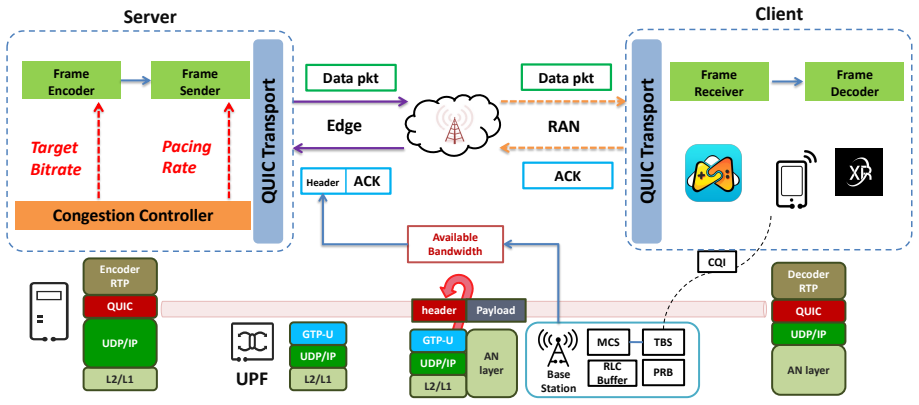
Choir deploys on 5G base stations to guide sender rate control by integrating radio characteristics and video patterns, meeting high bitrate, low delay, and fairness requirements simultaneously.
A machine-rendered reading of the paper's core claim, the machinery that carries it, and where it could break.
Core claim
Choir is a collaborative solution mainly deployed on 5G base stations that deeply integrates 5G radio characteristics and video streaming traffic patterns to guide efficient sender-side rate control. This overcomes the failure of existing end-to-end and network-assisted algorithms to simultaneously satisfy high average bitrate, low tail delay, and inter-flow fairness in RTBC scenarios.
What carries the argument
Choir, the base-station deployed collaborative controller that fuses 5G physical layer details with video traffic patterns to direct rate decisions at the sender.
If this is right
- Achieves video bitrates exceeding 30 Mbps with tail delay below 50 ms
- Ensures fairness among multiple concurrent video flows
- Maintains performance in varied 5G network conditions as validated by simulations and testbed experiments
- Allows RTBC applications like cloud VR and 8K streaming to meet all criteria without trade-offs
Where Pith is reading between the lines
- This approach could extend to other latency-sensitive 5G applications beyond video, such as real-time gaming or remote control.
- It suggests that tighter integration between the radio access network and application layer may reduce reliance on purely end-to-end protocols in future networks.
- Deploying such logic on base stations might improve scalability for many users by centralizing some control.
Load-bearing premise
Existing solutions fail primarily because they do not adapt to the 5G radio access network's dynamic delays and resource allocation strategies, and that integrating radio and video details at the base station can achieve all performance goals without creating new problems.
What would settle it
An experiment in a real 5G testbed where Choir fails to deliver bitrates above 30 Mbps with tail delays under 50 ms and fair sharing at the same time, while an existing method succeeds.
Figures






read the original abstract
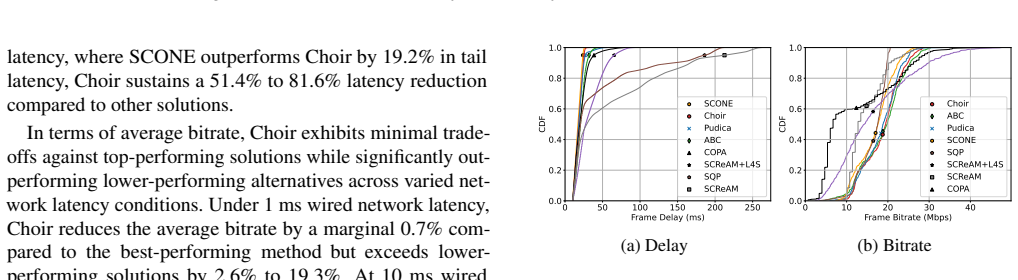
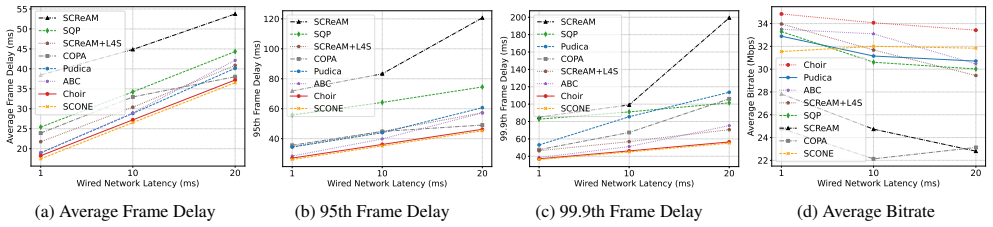
Real-time broadband communication (RTBC) scenarios, such as cloud virtual reality and 8K live streaming, further raise the criteria of the performance triangle, requiring video bitrates exceeding 30 Mbps, tail delay below 50 ms, and fairness guarantees for multi-user concurrent access. Based on our testing and analysis, existing RTBC-oriented rate control solutions, including end-to-end algorithms and network-assisted algorithms, fail to simultaneously satisfy all performance metrics. The native dynamic delay and physical-layer resource allocation strategy inherent to the 5G radio access network (RAN) are the key reasons. These solutions lack adaptation to the 5G architecture, leading to reduced decision performance. This paper proposes Choir, an innovative collaborative solution mainly deployed on 5G base stations that deeply integrates 5G radio characteristics and video streaming traffic patterns to guide efficient sender-side rate control. Extensive simulation and testbed evaluations demonstrate Choir's significant performance in achieving high average bitrate, low tail delay, and inter-flow fairness across different 5G network scenarios.
Editorial analysis
A structured set of objections, weighed in public.
Referee Report
Summary. The manuscript claims that existing end-to-end and network-assisted RTBC rate-control algorithms cannot simultaneously satisfy >30 Mbps average bitrate, <50 ms tail delay, and inter-flow fairness in 5G networks. It attributes this failure to the native dynamic delay and PHY-layer resource allocation in the 5G RAN, and proposes Choir, a collaborative framework deployed primarily on 5G base stations that integrates radio characteristics with video traffic patterns to drive sender-side rate control. Extensive simulation and testbed results are said to demonstrate that Choir meets all three metrics across varied 5G scenarios.
Significance. If the evaluations prove rigorous and include appropriate 5G-aware controls, the work could meaningfully advance practical integration of RAN feedback with application-layer adaptation for demanding real-time broadband services such as cloud VR and 8K streaming. The base-station-centric design choice is a concrete architectural contribution that leverages 5G infrastructure.
major comments (3)
- [Abstract] Abstract: the assertion of 'significant performance' from simulations and testbeds supplies no methodology, baselines, quantitative metrics, or statistical evidence, rendering the central performance-triangle claims unverifiable from the given text.
- [Introduction] Introduction (and § on related work): the diagnosis that 'native dynamic delay and physical-layer resource allocation strategy' in the 5G RAN is the primary reason prior solutions fail must be tested against 5G-aware baselines that already exploit CQI, MCS, or RB-allocation feedback; without such comparisons the root-cause attribution and the 'no new trade-offs' claim are unanchored.
- [Evaluation] Evaluation section: the simulation and testbed descriptions must demonstrate that actual PHY scheduler dynamics and per-RB allocation are exposed rather than replaced by abstracted delay models; otherwise the claimed superiority of Choir's radio-video integration cannot be distinguished from simpler 5G-specific feedback mechanisms.
minor comments (2)
- [Abstract] The abstract sentence 'demonstrate Choir's significant performance in achieving' is grammatically awkward and should be rephrased for clarity.
- Clarify the precise signaling path and deployment split: which components run on the BS versus the sender or client, and what control messages are exchanged.
Simulated Author's Rebuttal
Thank you for the constructive review and the recommendation for major revision. We appreciate the specific feedback on the abstract, the root-cause diagnosis in the introduction, and the need for clearer evaluation details. We will revise the manuscript to incorporate more quantitative evidence, additional baselines, and expanded descriptions of the PHY modeling.
read point-by-point responses
-
Referee: [Abstract] Abstract: the assertion of 'significant performance' from simulations and testbeds supplies no methodology, baselines, quantitative metrics, or statistical evidence, rendering the central performance-triangle claims unverifiable from the given text.
Authors: We agree that the abstract is currently too high-level and lacks the requested details. In the revised manuscript, we will expand the abstract to explicitly state the evaluation methodology (simulations with 5G RAN model and real testbed), the primary baselines (end-to-end algorithms such as BBR and network-assisted schemes), key quantitative metrics (e.g., >35 Mbps average bitrate, <40 ms 99th-percentile delay, and fairness index >0.9 across flows), and the number of runs/scenarios with statistical significance. This will make the performance-triangle claims directly verifiable. revision: yes
-
Referee: [Introduction] Introduction (and § on related work): the diagnosis that 'native dynamic delay and physical-layer resource allocation strategy' in the 5G RAN is the primary reason prior solutions fail must be tested against 5G-aware baselines that already exploit CQI, MCS, or RB-allocation feedback; without such comparisons the root-cause attribution and the 'no new trade-offs' claim are unanchored.
Authors: We acknowledge that strengthening the attribution requires direct comparisons to 5G-aware baselines. While the current related-work discussion highlights limitations of prior methods, we will add new evaluation results against 5G-aware variants that incorporate CQI, MCS, and RB feedback. These will show that such feedback alone is insufficient for simultaneous satisfaction of the three metrics due to missing video-pattern integration, whereas Choir achieves all three without new trade-offs. The introduction will be updated to reference these results and refine the diagnosis accordingly. revision: yes
-
Referee: [Evaluation] Evaluation section: the simulation and testbed descriptions must demonstrate that actual PHY scheduler dynamics and per-RB allocation are exposed rather than replaced by abstracted delay models; otherwise the claimed superiority of Choir's radio-video integration cannot be distinguished from simpler 5G-specific feedback mechanisms.
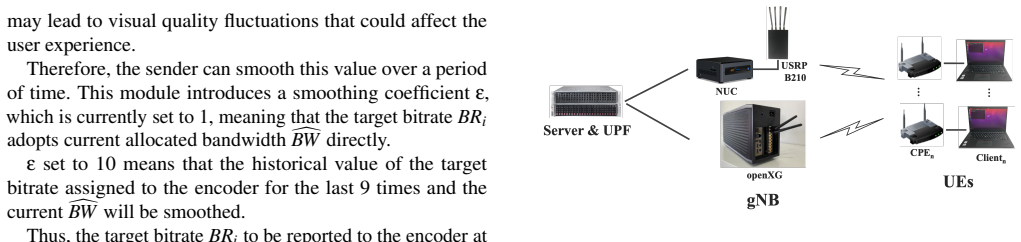
Authors: Our simulation employs a detailed 5G PHY-layer model that explicitly simulates per-RB allocation, CQI-based MCS selection, and base-station scheduler dynamics rather than relying solely on abstracted delay models; the testbed uses real 5G hardware exposing RAN metrics. To make this distinction clearer and address the concern, we will add expanded descriptions, traces of RB allocations, and delay-component breakdowns in the evaluation section, along with direct comparisons showing how Choir's radio-video integration outperforms simpler 5G feedback mechanisms. revision: partial
Circularity Check
No circularity: architectural proposal with external validation, no derivations or self-referential fits
full rationale
The paper frames its contribution as an engineering architecture (Choir deployed on 5G BSes) that integrates radio characteristics and video patterns, justified by 'testing and analysis' plus simulation/testbed results. No equations, parameters, or derivation chain appear in the provided text. The root-cause attribution to 5G RAN dynamics is presented as an empirical observation rather than a mathematical reduction. No self-citation load-bearing steps, uniqueness theorems, or ansatzes are visible. The central claims rest on external evaluations, not on any quantity that is defined in terms of itself or fitted then renamed as prediction. This is the common case of a self-contained systems paper.
Axiom & Free-Parameter Ledger
axioms (1)
- domain assumption 5G RAN exhibits native dynamic delay and physical-layer resource allocation that existing rate control solutions cannot adapt to
Reference graph
Works this paper leans on
-
[1]
Immersive interconnected virtual and augmented reality: A 5g and iot perspective.Jour- nal of Network and Systems Management, 28:796–826, 2020
Maria Torres Vega, Christos Liaskos, Sergi Abadal, Evangelos Papapetrou, Akshay Jain, Belkacem Mouhouche, Gökhan Kalem, Salih Ergüt, Marian Mach, Tomas Sabol, et al. Immersive interconnected virtual and augmented reality: A 5g and iot perspective.Jour- nal of Network and Systems Management, 28:796–826, 2020
2020
-
[2]
Cloudvr solution white paper
HUAWEI-iLab. Cloudvr solution white paper
-
[3]
Immersive environments and virtual reality: Systematic review and advances in com- munication, interaction and simulation.Multimodal technologies and interaction, 1(4):21, 2017
Jose Luis Rubio-Tamayo, Manuel Gertrudix Barrio, and Francisco García García. Immersive environments and virtual reality: Systematic review and advances in com- munication, interaction and simulation.Multimodal technologies and interaction, 1(4):21, 2017
2017
-
[4]
A measurement study on achieving imperceptible latency in mobile cloud gaming
Teemu Kämäräinen, Matti Siekkinen, Antti Ylä-Jääski, Wenxiao Zhang, and Pan Hui. A measurement study on achieving imperceptible latency in mobile cloud gaming. InProceedings of the 8th ACM on Multimedia Systems Conference, pages 88–99, 2017
2017
-
[5]
Congestion control for web real-time communication.IEEE/ACM Transactions on Network- ing, 25(5):2629–2642, 2017
Gaetano Carlucci, Luca De Cicco, Stefan Holmer, and Saverio Mascolo. Congestion control for web real-time communication.IEEE/ACM Transactions on Network- ing, 25(5):2629–2642, 2017
2017
-
[6]
Per- formance analysis of receive-side real-time congestion control for webrtc
Varun Singh, Albert Abello Lozano, and Jorg Ott. Per- formance analysis of receive-side real-time congestion control for webrtc. In2013 20th International Packet Video Workshop, pages 1–8. IEEE, 2013
2013
-
[7]
Release 16
3GPP. Release 16. https://www.3gpp.org/ specifications-technologies/releases/ release-16, 2024
2024
-
[8]
Self- Clocked Rate Adaptation for Multimedia
Ingemar Johansson and Zaheduzzaman Sarker. Self- Clocked Rate Adaptation for Multimedia. RFC 8298, December 2017
2017
-
[9]
Copa: Practical {Delay-Based} congestion control for the internet
Venkat Arun and Hari Balakrishnan. Copa: Practical {Delay-Based} congestion control for the internet. In 15th USENIX Symposium on Networked Systems Design and Implementation (NSDI 18), pages 329–342, 2018
2018
-
[10]
Devdeep Ray, Connor Smith, Teng Wei, David Chu, and Srinivasan Seshan. Sqp: Congestion control for low-latency interactive video streaming.arXiv preprint arXiv:2207.11857, 2022
-
[11]
Pudica: Toward {Near- Zero} queuing delay in congestion control for cloud gaming
Shibo Wang, Shusen Yang, Xiao Kong, Chenglei Wu, Longwei Jiang, Chenren Xu, Cong Zhao, Xuesong Yang, Jianjun Xiao, Xin Liu, et al. Pudica: Toward {Near- Zero} queuing delay in congestion control for cloud gaming. In21st USENIX Symposium on Networked Systems Design and Implementation (NSDI 24), pages 113–129, 2024
2024
-
[12]
{ABC}: A sim- ple explicit congestion controller for wireless networks
Prateesh Goyal, Anup Agarwal, Ravi Netravali, Moham- mad Alizadeh, and Hari Balakrishnan. {ABC}: A sim- ple explicit congestion controller for wireless networks. In17th USENIX Symposium on Networked Systems De- sign and Implementation (NSDI 20), pages 353–372, 2020
2020
-
[13]
Rfc 9330: Low latency, low loss, and scalable throughput (l4s) in- ternet service: Architecture, 2023
K De Schepper, M Bagnulo, and G White. Rfc 9330: Low latency, low loss, and scalable throughput (l4s) in- ternet service: Architecture, 2023
2023
-
[14]
Achiev- ing consistent low latency for wireless real-time commu- nications with the shortest control loop
Zili Meng, Yaning Guo, Chen Sun, Bo Wang, Justine Sherry, Hongqiang Harry Liu, and Mingwei Xu. Achiev- ing consistent low latency for wireless real-time commu- nications with the shortest control loop. InProceedings of the ACM SIGCOMM 2022 Conference, pages 193– 206, 2022
2022
-
[15]
SCONE Real Time Communi- cation Requirement
Hang Shi, Xuesong Geng, Qiangzhou Gao, Qinghua Wu, and Jiaxing Zhang. SCONE Real Time Communi- cation Requirement. Internet-Draft draft-shi-scone-rtc- requirement-02, Internet Engineering Task Force, April
-
[16]
Bbr: Congestion-based congestion control: Measuring bottle- neck bandwidth and round-trip propagation time.ACM Queue, 14(5):20–53, 2016
Neal Cardwell, Yuchung Cheng, C Stephen Gunn, Soheil Hassas Yeganeh, and Van Jacobson. Bbr: Congestion-based congestion control: Measuring bottle- neck bandwidth and round-trip propagation time.ACM Queue, 14(5):20–53, 2016
2016
-
[17]
Cubic: a new tcp-friendly high-speed tcp variant.ACM SIGOPS operating systems review, 42(5):64–74, 2008
Sangtae Ha, Injong Rhee, and Lisong Xu. Cubic: a new tcp-friendly high-speed tcp variant.ACM SIGOPS operating systems review, 42(5):64–74, 2008
2008
-
[18]
Pbe-cc: Congestion control via endpoint-centric, physical-layer bandwidth measurements
Yaxiong Xie, Fan Yi, and Kyle Jamieson. Pbe-cc: Congestion control via endpoint-centric, physical-layer bandwidth measurements. InProceedings of the Annual conference of the ACM Special Interest Group on Data Communication on the applications, technologies, ar- chitectures, and protocols for computer communication, pages 451–464, 2020
2020
-
[19]
The addition of explicit congestion notification (ecn) to ip
Kadangode Ramakrishnan, Sally Floyd, and David Black. The addition of explicit congestion notification (ecn) to ip. Technical report, 2001
2001
-
[20]
Adaptable l4s congestion control for cloud-based real-time streaming over 5g.IEEE Open Journal of Signal Processing, 2024
Jangwoo Son, Yago Sanchez, Cornelius Hellge, and Thomas Schierl. Adaptable l4s congestion control for cloud-based real-time streaming over 5g.IEEE Open Journal of Signal Processing, 2024
2024
-
[21]
Implementing the’prague requirements’ for low latency low loss scalable throughput (l4s).Netdev 0x13, 2019
Bob Briscoe, Koen De Schepper, Olivier Tilmans, Mirja Kühlewind, Joakim Misund, Olga Albisser, and A Sajjad Ahmed. Implementing the’prague requirements’ for low latency low loss scalable throughput (l4s).Netdev 0x13, 2019
2019
-
[22]
Principles for internet congestion management
Lloyd Brown, Albert Gran Alcoz, Frank Cangialosi, Ak- shay Narayan, Mohammad Alizadeh, Hari Balakrish- nan, Eric Friedman, Ethan Katz-Bassett, Arvind Krish- namurthy, Michael Schapira, et al. Principles for internet congestion management. InProceedings of the ACM SIGCOMM 2024 Conference, pages 166–180, 2024
2024
-
[23]
Cellre- play: Towards accurate record-and-replay for cellular networks
William Sentosa, Balakrishnan Chandrasekaran, P Brighten Godfrey, and Haitham Hassanieh. Cellre- play: Towards accurate record-and-replay for cellular networks. NSDI 2025
2025
-
[24]
An e2e simulator for 5g nr networks
Natale Patriciello, Sandra Lagen, Biljana Bojovic, and Lorenza Giupponi. An e2e simulator for 5g nr networks. Simulation Modelling Practice and Theory, 96:101933, 2019
2019
-
[25]
An ns-3 implementation of a bursty traffic framework for virtual reality sources
Mattia Lecci, Andrea Zanella, and Michele Zorzi. An ns-3 implementation of a bursty traffic framework for virtual reality sources. InProceedings of the 2021 Work- shop on ns-3, pages 73–80, 2021
2021
-
[26]
Calibration of the 5g-lena system level sim- ulator in 3gpp reference scenarios.Simul
Katerina Koutlia, Biljana Bojovic, Zoraze Ali, and San- dra Lagén. Calibration of the 5g-lena system level sim- ulator in 3gpp reference scenarios.Simul. Model. Pract. Theory, 119:102580, 2022
2022
-
[27]
Openairin- terface: Democratizing innovation in the 5g era.Com- puter Networks, 176:107284, 2020
Florian Kaltenberger, Aloizio P Silva, Abhimanyu Go- sain, Luhan Wang, and Tien-Thinh Nguyen. Openairin- terface: Democratizing innovation in the 5g era.Com- puter Networks, 176:107284, 2020
2020
-
[28]
xgproduct
WITCOMM. xgproduct. https://witcomm.net/ xgstation, 2023
2023
-
[29]
Openairinterface 5g: Feature set documentation
OpenAirInterface. Openairinterface 5g: Feature set documentation. https://gitlab.eurecom.fr/ oai/openairinterface5g/blob/develop/doc/ FEATURE_SET.md. Accessed: 2024-10-09
2024
-
[30]
Technical specification group radio access network; nr; radio re- source control (rrc) protocol specification
3rd Generation Partnership Project (3GPP). Technical specification group radio access network; nr; radio re- source control (rrc) protocol specification. 3GPP TS 38.331, September 2023. Version 17.7.0
2023
-
[31]
Technical specification group radio access network; nr; radio link control (rlc) protocol specification
3rd Generation Partnership Project (3GPP). Technical specification group radio access network; nr; radio link control (rlc) protocol specification. 3GPP TS 38.322, September 2023. Version 17.7.0
2023
-
[32]
3GPP TS 23.288: Architecture enhancements for 5g system (5gs) to support network data analytics ser- vices
3GPP. 3GPP TS 23.288: Architecture enhancements for 5g system (5gs) to support network data analytics ser- vices. Technical Specification (TS) 23.288, 3rd Genera- tion Partnership Project (3GPP), December 2019. Ver- sion 15.4.0
2019
-
[33]
XQUIC Library released by Alibaba is a cross- platform implementation of QUIC and HTTP/3 protocol
Alibaba. XQUIC Library released by Alibaba is a cross- platform implementation of QUIC and HTTP/3 protocol. 2022
2022
-
[34]
RTP over QUIC (RoQ)
Mathis Engelbart, Joerg Ott, and Spencer Dawkins. RTP over QUIC (RoQ). Internet-Draft draft-ietf-avtcore- rtp-over-quic-11, Internet Engineering Task Force, July
-
[35]
Application-aware IPv6 Networking (APN6) Encapsulation
Zhenbin Li, Shuping Peng, Chongfeng Xie, and Shuai Zhang. Application-aware IPv6 Networking (APN6) Encapsulation. Internet-Draft draft-li-6man-apn-ipv6- encap-00, Internet Engineering Task Force, March 2024. Work in Progress
2024
-
[36]
Analysis and design of the google congestion control for web real-time communication (webrtc)
Gaetano Carlucci, Luca De Cicco, Stefan Holmer, and Saverio Mascolo. Analysis and design of the google congestion control for web real-time communication (webrtc). InProceedings of the 7th International Con- ference on Multimedia Systems, pages 1–12, 2016
2016
-
[37]
Network-assisted dynamic adaptation (nada): a unified congestion control scheme for real-time media.RFC 8698, 2020
Xiaoqing Zhu, Rong Pan, M Ramalho, and S Mena. Network-assisted dynamic adaptation (nada): a unified congestion control scheme for real-time media.RFC 8698, 2020
2020
-
[38]
Congestion control for rtp media: A com- parison on simulated environment
Songyang Zhang, Weimin Lei, Wei Zhang, and Yun- chong Guan. Congestion control for rtp media: A com- parison on simulated environment. InInternational Conference on Simulation Tools and Techniques, pages 43–52. Springer, 2019
2019
-
[39]
Zili Meng, Nirav Atre, Mingwei Xu, Justine Sherry, and Maria Apostolaki. Confucius: Achieving consistent low latency with practical queue management for real- time communications.arXiv preprint arXiv:2310.18030, 2023
-
[40]
Enabling high quality {Real-Time} communications with adaptive {Frame-Rate}
Zili Meng, Tingfeng Wang, Yixin Shen, Bo Wang, Ming- wei Xu, Rui Han, Honghao Liu, Venkat Arun, Hongxin Hu, and Xue Wei. Enabling high quality {Real-Time} communications with adaptive {Frame-Rate}. In20th USENIX Symposium on Networked Systems Design and Implementation (NSDI 23), pages 1429–1450, 2023
2023
-
[41]
Jitbright: towards low-latency mobile cloud rendering through jitter buffer optimiza- tion
Yuankang Zhao, Qinghua Wu, Gerui Lv, Furong Yang, Jiuhai Zhang, Feng Peng, Yanmei Liu, Zhenyu Li, Ying Chen, Hongyu Guo, et al. Jitbright: towards low-latency mobile cloud rendering through jitter buffer optimiza- tion. InProceedings of the 34th edition of the Workshop on Network and Operating System Support for Digital Audio and Video, pages 36–42, 2024
2024
-
[42]
Hairpin: Rethinking packet loss recov- ery in edge-based interactive video streaming
Zili Meng, Xiao Kong, Jing Chen, Bo Wang, Mingwei Xu, Rui Han, Honghao Liu, Venkat Arun, Hongxin Hu, and Xue Wei. Hairpin: Rethinking packet loss recov- ery in edge-based interactive video streaming. In21st USENIX Symposium on Networked Systems Design and Implementation (NSDI 24), pages 907–926, 2024
2024
-
[43]
Tambur: Efficient loss recovery for videoconferencing via streaming codes
Michael Rudow, Francis Y Yan, Abhishek Ku- mar, Ganesh Ananthanarayanan, Martin Ellis, and KV Rashmi. Tambur: Efficient loss recovery for videoconferencing via streaming codes. In20th USENIX Symposium on Networked Systems Design and Implementation (NSDI 23), pages 953–971, 2023
2023
-
[44]
Learning to co- ordinate video codec with transport protocol for mobile video telephony
Anfu Zhou, Huanhuan Zhang, Guangyuan Su, Leilei Wu, Ruoxuan Ma, Zhen Meng, Xinyu Zhang, Xiufeng Xie, Huadong Ma, and Xiaojiang Chen. Learning to co- ordinate video codec with transport protocol for mobile video telephony. InThe 25th Annual International Con- ference on Mobile Computing and Networking, pages 1–16, 2019
2019
-
[45]
Onrl: Improving mobile video telephony via online reinforcement learning
Huanhuan Zhang, Anfu Zhou, Jiamin Lu, Ruoxuan Ma, Yuhan Hu, Cong Li, Xinyu Zhang, Huadong Ma, and Xi- aojiang Chen. Onrl: Improving mobile video telephony via online reinforcement learning. InProceedings of the 26th Annual International Conference on Mobile Computing and Networking, pages 1–14, 2020
2020
-
[46]
Loki: improving long tail performance of learning-based real-time video adaptation by fusing rule-based models
Huanhuan Zhang, Anfu Zhou, Yuhan Hu, Chaoyue Li, Guangping Wang, Xinyu Zhang, Huadong Ma, Leilei Wu, Aiyun Chen, and Changhui Wu. Loki: improving long tail performance of learning-based real-time video adaptation by fusing rule-based models. InProceedings of the 27th Annual International Conference on Mobile Computing and Networking, pages 775–788, 2021. ...
2021
discussion (0)
Sign in with ORCID, Apple, or X to comment. Anyone can read and Pith papers without signing in.