Recognition: unknown
Research trends in music-based interventions in neonatal intensive care units: a text mining and topic modeling study
Pith reviewed 2026-05-08 02:05 UTC · model grok-4.3
The pith
NICU music intervention studies have expanded from short-term physiological fixes to include parent involvement and long-term developmental goals.
A machine-rendered reading of the paper's core claim, the machinery that carries it, and where it could break.
Core claim
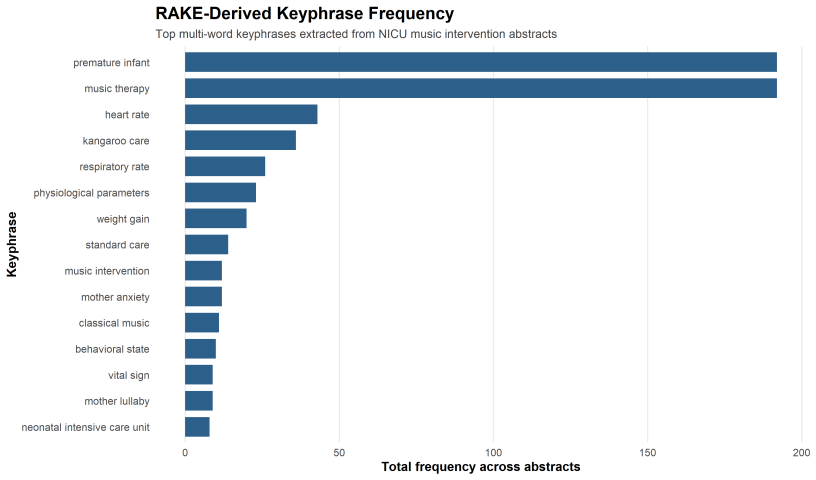
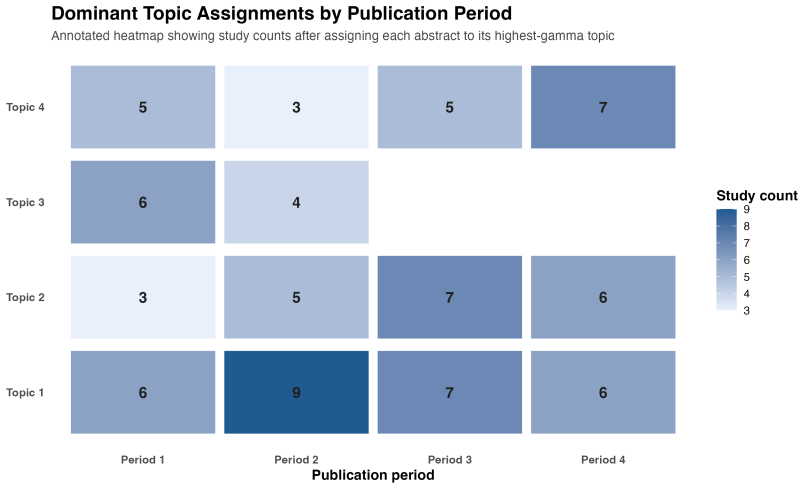
Using RAKE keyphrase extraction, frequency counts, temporal analysis, and latent Dirichlet allocation topic modeling on the 83 abstracts, the study establishes that NICU music-based intervention research is becoming more interdisciplinary. Early work emphasized passive auditory stimulation and short-term physiological and behavioral responses, while later work increasingly addresses live music, parent participation, neurodevelopmental outcomes, parental emotional health, and parent-infant interaction. Music therapy abstracts cover broader developmental and relational topics than music medicine abstracts, with parent-involved physiological regulation emerging as the dominant theme.
What carries the argument
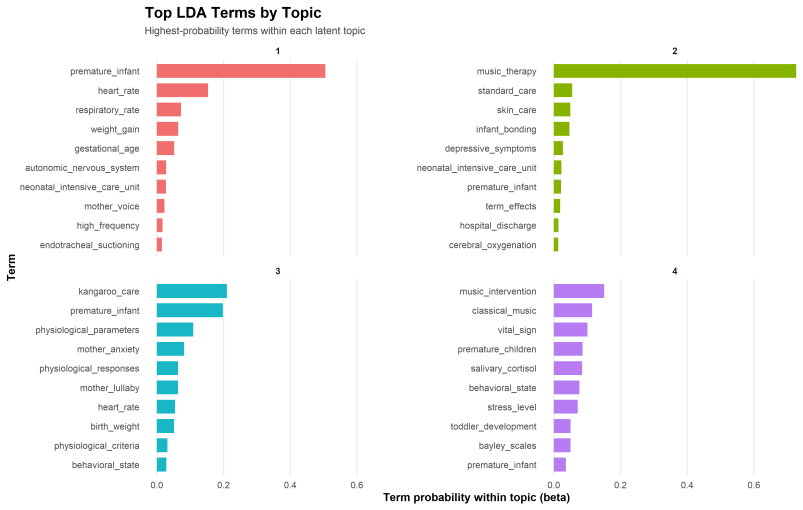
Latent Dirichlet allocation topic modeling applied to study abstracts, which groups texts by shared word patterns to surface four dominant themes, combined with RAKE keyphrase extraction and keyword frequency tracking over time.
If this is right
- Research volume will continue to grow with greater emphasis on live and parent-led approaches.
- Music therapy studies will address wider developmental and relational goals than music medicine studies.
- Future work needs to clarify the boundary between music therapy and music medicine.
- Interdisciplinary collaboration among NICU teams will become more central to study design and care delivery.
Where Pith is reading between the lines
- Hospitals might develop protocols that routinely include parent-infant music sessions to support bonding during extended NICU stays.
- Longitudinal follow-up studies could test whether the shift to broader goals produces measurable improvements in infant neurodevelopment after discharge.
- Training programs for neonatal staff could incorporate music therapy techniques based on the dominant parent-regulation theme.
- Funding bodies may prioritize projects that combine music interventions with family support services.
Load-bearing premise
The 83 abstracts give a representative picture of the full literature and that analysis limited to abstracts accurately reflects the main trends without substantial loss of detail from the complete papers.
What would settle it
A full-text re-analysis of the same studies or a larger corpus that finds no increase in parent-involved interventions or no movement toward developmental and psychosocial outcomes would contradict the reported shift.
Figures
read the original abstract
Background: Music-based interventions are increasingly used in neonatal intensive care units (NICUs), but the literature remains heterogeneous in intervention type, provider role, and research focus. This study examined research trends in NICU music-based intervention studies using text mining. Methods: We analyzed 83 abstracts from peer-reviewed studies published between 1998 and 2025. Methods included preprocessing, RAKE-based keyphrase extraction, keyword frequency analysis, temporal trend analysis, intervention-type comparison, and latent Dirichlet allocation topic modeling. The optimal number of topics was determined using the CaoJuan2009, Arun2010, and Deveaud2014 metrics. Results: Study volume increased steadily over time, with nearly half (38/83) published from 2020 onward. Early studies focused on passive music listening and short-term physiological outcomes, whereas recent studies increasingly examined singing, live music, and parent-involved interventions. Keyword analysis showed a shift from physiological stability and behavioral responses toward neurodevelopmental outcomes, parental emotional well-being, and parent-infant interaction. Music medicine studies emphasized passive auditory stimulation and immediate physiological outcomes, whereas music therapy studies addressed broader developmental, relational, and psychosocial topics. Topic modeling identified four major themes, with parent-involved physiological regulation and stress reduction the most frequent dominant topic. Conclusions: NICU music-based intervention research is becoming more interdisciplinary. The field has expanded from immediate physiological stabilization to broader developmental, relational, and psychosocial goals. Future work should clarify the distinction between music therapy and music medicine and promote interdisciplinary collaboration in NICU care.
Editorial analysis
A structured set of objections, weighed in public.
Referee Report
Summary. The manuscript analyzes 83 abstracts of peer-reviewed studies on music-based interventions in neonatal intensive care units (NICUs) published 1998–2025. It applies RAKE keyphrase extraction, keyword frequency and temporal trend analysis, intervention-type comparisons, and LDA topic modeling (with CaoJuan2009, Arun2010, and Deveaud2014 metrics used to select the number of topics). The authors report increasing publication volume (nearly half post-2020), a shift from passive listening and short-term physiological outcomes toward singing/live music, parent involvement, neurodevelopmental outcomes, and psychosocial topics, and conclude that the field is becoming more interdisciplinary with expansion from immediate physiological stabilization to broader developmental, relational, and psychosocial goals.
Significance. If the trends are robustly supported, the work provides a quantitative, systematic overview of evolving research priorities in NICU music interventions, distinguishing music-medicine from music-therapy emphases and underscoring the rise of parent-infant and developmental foci. This could usefully inform study design and interdisciplinary collaboration. The application of multiple established coherence metrics for topic selection is a methodological strength.
major comments (2)
- [Methods] Methods (LDA subsection): Although three coherence metrics are cited to justify four topics, the manuscript does not report the actual coherence values across candidate k, the top words or probability distributions for each topic, or any post-hoc validation (human labeling, stability across runs, or full-text comparison). Without these, it is not possible to verify whether the topics cleanly separate early physiological terms from later developmental/psychosocial ones, which is required to substantiate the central claim of thematic expansion.
- [Results] Results (topic-modeling paragraph): The claim that research has shifted toward broader goals rests on both keyword-frequency trends and the four-topic model, yet the corpus comprises only 83 short abstracts. No sensitivity checks for topic stability, alternative preprocessing, or period-specific topic modeling are described; this limits confidence that the observed interdisciplinarity is not an artifact of small-sample LDA behavior on brief texts.
minor comments (2)
- [Abstract] Abstract and Results: The statement that 'parent-involved physiological regulation and stress reduction' is the most frequent dominant topic should be accompanied by the corresponding topic label or top keywords so readers can assess alignment with the claimed shift.
- [Methods] Consider reporting the exact coherence scores and the chosen k in a table or supplementary figure for full reproducibility.
Simulated Author's Rebuttal
We thank the referee for their constructive and detailed comments, which highlight important aspects of transparency in our LDA analysis and the robustness of findings given the corpus size. We have prepared revisions to address these points directly and provide the requested details and checks. Our responses to each major comment are below.
read point-by-point responses
-
Referee: [Methods] Methods (LDA subsection): Although three coherence metrics are cited to justify four topics, the manuscript does not report the actual coherence values across candidate k, the top words or probability distributions for each topic, or any post-hoc validation (human labeling, stability across runs, or full-text comparison). Without these, it is not possible to verify whether the topics cleanly separate early physiological terms from later developmental/psychosocial ones, which is required to substantiate the central claim of thematic expansion.
Authors: We agree that reporting the coherence values, top words, and validation steps will improve verifiability. In the revised manuscript we will add a table showing coherence scores for k = 2 to 10 under each of the three metrics, confirming the selection of k = 4. We will also list the top 10 words and their probabilities for each topic. For post-hoc validation, we will describe LDA runs with multiple random seeds to assess stability of the word distributions and will include a brief account of manual review of topic assignments on a random subset of abstracts to confirm separation of physiological versus developmental/psychosocial themes. Full-text comparison is outside the scope of the study, which was intentionally limited to abstracts to enable inclusion of the broadest possible set of publications. revision: yes
-
Referee: [Results] Results (topic-modeling paragraph): The claim that research has shifted toward broader goals rests on both keyword-frequency trends and the four-topic model, yet the corpus comprises only 83 short abstracts. No sensitivity checks for topic stability, alternative preprocessing, or period-specific topic modeling are described; this limits confidence that the observed interdisciplinarity is not an artifact of small-sample LDA behavior on brief texts.
Authors: The primary support for the shift toward broader goals is provided by the keyword-frequency trends and intervention-type comparisons, which do not depend on the topic model. The LDA results are presented as a complementary exploratory analysis. To address concerns about small-sample behavior, the revised manuscript will include sensitivity checks: multiple LDA runs to demonstrate topic stability, comparison of results under alternative preprocessing choices (e.g., with and without stemming), and separate topic models fitted to the pre-2020 and post-2020 subsets. We will report whether the main themes persist across these checks and add the results to the supplementary materials. While subsample sizes limit the power of period-specific models, these additions will increase confidence that the observed patterns are not artifacts. revision: partial
Circularity Check
No circularity: purely descriptive text mining of external abstracts
full rationale
The paper collects 83 external peer-reviewed abstracts (1998-2025) and applies standard, off-the-shelf text-mining procedures: RAKE keyphrase extraction, simple frequency counts, temporal binning, and LDA topic modeling whose topic count is selected via the published CaoJuan2009, Arun2010 and Deveaud2014 metrics. All reported trends (shift from physiological to developmental/psychosocial themes, music-medicine vs. music-therapy differences, four dominant topics) are direct outputs of these operations on the collected corpus. No equations, fitted parameters, or predictions are defined in terms of themselves; no self-citation supplies a load-bearing uniqueness theorem or ansatz; the derivation chain does not reduce to its inputs by construction. The study is therefore self-contained against external benchmarks.
Axiom & Free-Parameter Ledger
free parameters (1)
- number of topics =
4
axioms (2)
- domain assumption Abstracts contain sufficient information to represent research trends and themes in full papers
- domain assumption RAKE keyphrase extraction and LDA with the selected metrics produce interpretable and valid research themes
Reference graph
Works this paper leans on
-
[1]
Clinical benefits of music-based interventions on preterm infants’ health: a systematic review of randomised trials.Acta Paediatr
Costa VS, Bundchen DC, Sousa H, Pires LB, Felipetti FA. Clinical benefits of music-based interventions on preterm infants’ health: a systematic review of randomised trials.Acta Paediatr. 2022;111(3):478–489
2022
-
[2]
Standley JM.Evidence-based Music Therapy for Premature Infants. 3rd ed. Silver Spring: American Music Therapy Association; 2023
2023
-
[3]
Music therapy in tertiary neonatal intensive care: a matter of unlikely allies?Acta Paediatr
Jaschke AC, Mitra S, Bos AF. Music therapy in tertiary neonatal intensive care: a matter of unlikely allies?Acta Paediatr. 2024;113(8):1772–1777
2024
-
[4]
Understanding kangaroo care and its benefits for preterm infants.Pediatr Child Health
Campbell-Yeo M, Disher T, Benoit B, Johnston C. Understanding kangaroo care and its benefits for preterm infants.Pediatr Child Health. 2022;27(8):458–464. 14
2022
-
[5]
Papatzikis E, Agapaki M, Selvan RN, Hanson-Abromeit D, Gold C, Epstein S, et al. Music medicine and music therapy in neonatal care: a scoping review of passive music listening research applications and findings on infant development and medical practice.BMC Pediatr. 2024;24(1):829
2024
-
[6]
Music therapy in neonatal care: an updated overview.Nord J Music Ther
Ettenberger M. Music therapy in neonatal care: an updated overview.Nord J Music Ther. 2017;26(3):193–214
2017
-
[7]
An acoustic gap between the NICU and womb: a potential risk for compromised neuroplasticity of the auditory system in preterm infants.Front Neurosci
Lahav A, Skoe E. An acoustic gap between the NICU and womb: a potential risk for compromised neuroplasticity of the auditory system in preterm infants.Front Neurosci. 2014;8:381
2014
-
[8]
Slower postnatal growth is associated with delayed cerebral cortical maturation in preterm newborns.Sci Transl Med
Vinall J, Grunau RE, Brant R, Chau V, Poskitt KJ, Synnes AR, et al. Slower postnatal growth is associated with delayed cerebral cortical maturation in preterm newborns.Sci Transl Med. 2014;6(230):230ra44
2014
-
[9]
Short and longer term outcomes after preterm birth.Arch Dis Child Fetal Neonatal Ed
Carson C, Redshaw M, Gray R, Quigley MA. Short and longer term outcomes after preterm birth.Arch Dis Child Fetal Neonatal Ed. 2015;100(4):F315–F320
2015
-
[10]
Maternal resolution of grief after preterm birth: implications for infant attachment security.Pediatrics
Shah PE, Clements M, Poehlmann J. Maternal resolution of grief after preterm birth: implications for infant attachment security.Pediatrics. 2011;127(2):284–292
2011
-
[11]
Short-term music therapy for families with preterm infants: a randomized trial.Pediatrics
Söderström Gaden T, Ghetti C, Kvestad I, Bieleninik L, Stordal AS, Assmus J, et al. Short-term music therapy for families with preterm infants: a randomized trial.Pediatrics. 2022;149(2):e2021052797
2022
-
[12]
Music therapy and other music-based interventions in pediatric health care: an overview.Medicines
Stegemann T, Geretsegger M, Quoc EB, Riedl H, Smetana M. Music therapy and other music-based interventions in pediatric health care: an overview.Medicines. 2019;6(1):25
2019
-
[13]
Music-based interventions for premature infants and their caregivers in neonatal intensive care: a systematic review.Complement Ther Clin Pract
Yue W, Han X, Luo J, Zhan Y. Music-based interventions for premature infants and their caregivers in neonatal intensive care: a systematic review.Complement Ther Clin Pract. 2021;43:101330
2021
-
[14]
Silver Spring: American Music Therapy Association; 1999
Dileo C.Introduction to Music Therapy and Medicine. Silver Spring: American Music Therapy Association; 1999
1999
-
[15]
Bruscia KE.Defining Music Therapy. 3rd ed. Gilsum: Barcelona Publishers; 2014
2014
-
[16]
Music therapy versus music medicine in clinical care: a scoping review of terminology and intervention delivery.Arts Psychother
Foroushani PS, Schneider M, Assareh N. Music therapy versus music medicine in clinical care: a scoping review of terminology and intervention delivery.Arts Psychother. 2020;69:101668
2020
-
[17]
Nonpharmacological interventions for sleep promotion on preterm infants in neonatal intensive care units: a systematic review
Liao JH, Hu RF, Su LJ, Wang S, Xu Q, Qian XF, et al. Nonpharmacological interventions for sleep promotion on preterm infants in neonatal intensive care units: a systematic review. Worldviews Evid Based Nurs. 2018;15(5):386–393
2018
-
[18]
Music therapy for preterm infants and their parents: a meta-analysis.Pediatrics
Bieleninik L, Ghetti C, Gold C. Music therapy for preterm infants and their parents: a meta-analysis.Pediatrics. 2016;138(3):e20160971
2016
-
[19]
Smart literature review: a practical topic modelling approach to exploratory literature review.J Big Data
Asmussen CB, Moller C. Smart literature review: a practical topic modelling approach to exploratory literature review.J Big Data. 2019;6(1):93. 15
2019
-
[20]
Keyword Extraction: A Modern Perspective.SN Comput Sci
Nomoto T. Keyword Extraction: A Modern Perspective.SN Comput Sci. 2023;4:92
2023
-
[21]
Automatic keyword extraction from individual documents
Rose SJ, Engel DW, Cramer NO, Cowley WE. Automatic keyword extraction from individual documents. In: Berry MW, Kogan J, editors.Text Mining: Applications and Theory. Chichester: John Wiley & Sons; 2010. p. 3–20
2010
-
[22]
A density-based method for adaptive LDA model selection.Neurocomputing
Cao J, Xia T, Li J, Zhang Y, Tang S. A density-based method for adaptive LDA model selection.Neurocomputing. 2009;72(7–9):1775–1781
2009
-
[23]
On finding the natural number of topics with latent Dirichlet allocation: some observations
Arun R, Suresh V, Veni Madhavan CE, Narasimha Murthy MN. On finding the natural number of topics with latent Dirichlet allocation: some observations. In:Advances in Knowledge Discovery and Data Mining. Berlin, Heidelberg: Springer; 2010. p. 391–402
2010
-
[24]
Accurate and effective latent concept modeling for ad hoc information retrieval.Document numerique
Deveaud R, SanJuan E, Bellot P. Accurate and effective latent concept modeling for ad hoc information retrieval.Document numerique. 2014;17(1):61–84
2014
-
[25]
Vienna: R Foundation for Statistical Computing; 2026
R Core Team.R: A Language and Environment for Statistical Computing. Vienna: R Foundation for Statistical Computing; 2026. Available from:https://www.R-project. org/
2026
-
[26]
R package version 0.8.16; 2026
Wijffels J, Straka M.udpipe: Tokenization, Parts of Speech Tagging, Lemmatization and Dependency Parsing with the ’UDPipe’ ’NLP’ Toolkit. R package version 0.8.16; 2026. Available from:https://CRAN.R-project.org/package=udpipe
2026
-
[27]
tidytext: Text mining and analysis using tidy data principles in R
Silge J, Robinson D. tidytext: Text mining and analysis using tidy data principles in R. JOSS. 2016;1(3):37
2016
-
[28]
topicmodels: An R package for fitting topic models.J Stat Softw
Grün B, Hornik K. topicmodels: An R package for fitting topic models.J Stat Softw. 2011;40(13):1–30
2011
-
[29]
R package version 1.0.2; 2020
Chaney N.ldatuning: Tuning of the Latent Dirichlet Allocation Models Parameters. R package version 1.0.2; 2020. Available from: https://CRAN.R-project.org/package= ldatuning. Supplementary material Additional file 1 (PDF supplementary methods, figures, and tables for preprocessing, topic modeling, and effect-focused phrase analysis) is included with this ...
2020
discussion (0)
Sign in with ORCID, Apple, or X to comment. Anyone can read and Pith papers without signing in.