Recognition: 2 theorem links
IteRate: Autonomous AI Synthesis of In-Kernel eBPF Wi-Fi Rate Control Algorithms
Pith reviewed 2026-05-08 17:45 UTC · model grok-4.3
The pith
A multi-agent AI system called IteRate autonomously writes, deploys, and refines eBPF Wi-Fi rate control algorithms in the Linux kernel, delivering better real-world performance than the Minstrel algorithm.
A machine-rendered reading of the paper's core claim, the machinery that carries it, and where it could break.
Core claim
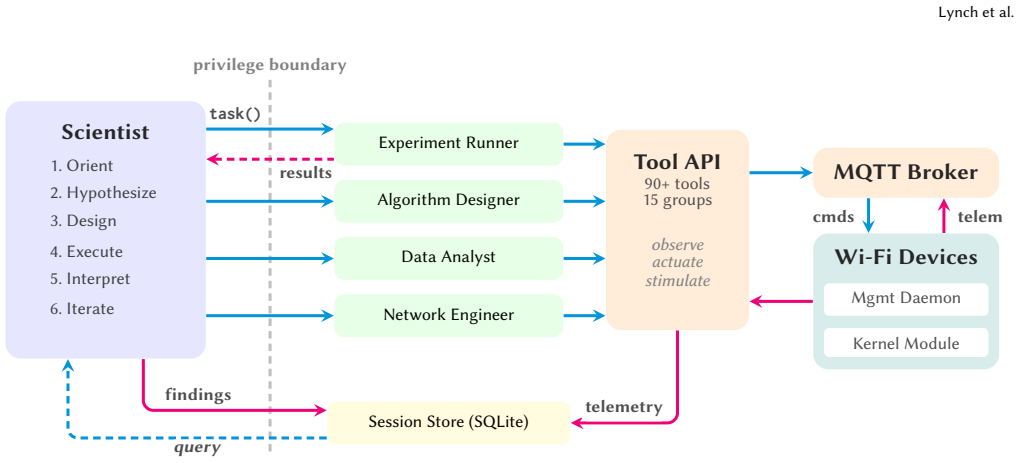
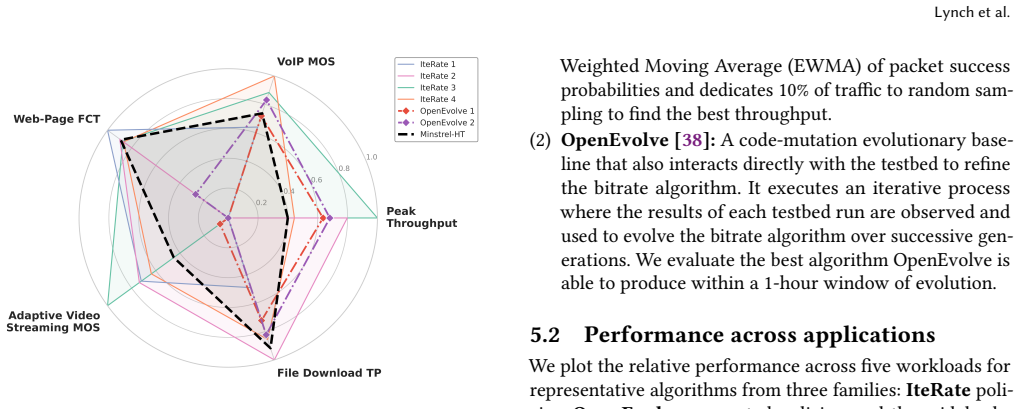
IteRate uses a multi-agent AI architecture with agents for algorithm design, experiment execution, and data analysis, coordinated by a hypothesis-driven protocol and persistent knowledge store. The system incorporates a new kernel module that exposes fine-grained hardware telemetry such as modulation and coding schemes and retry counts to eBPF programs. On a 58-node testbed running five workloads, the resulting rate control algorithms outperform the well-known Minstrel algorithm with 21% faster web-page loads, 7% higher video quality of experience, and 21% higher peak throughput.
What carries the argument
The multi-agent AI architecture that coordinates algorithm design, experiment execution, and data analysis through a hypothesis-driven research protocol with persistent knowledge, combined with a kernel module exposing per-frame telemetry to eBPF programs.
If this is right
- Wi-Fi rate control algorithms can be produced and updated automatically in response to measured performance data.
- eBPF programs generated by AI can safely implement dynamic rate adaptation inside the Linux kernel on embedded devices.
- Closed-loop automation reduces the need for manual heuristic tuning in wireless networking stacks.
- Performance improvements in web loading times, video streaming quality, and throughput follow directly from the synthesized controllers on comparable hardware.
Where Pith is reading between the lines
- The same agentic workflow could be applied to synthesizing algorithms for other kernel subsystems such as congestion control or packet scheduling.
- Persistent knowledge across iterations might enable the system to accumulate insights that speed up adaptation to new Wi-Fi standards or interference patterns.
- Testing on heterogeneous hardware would reveal whether additional hooks or retraining are needed for broader deployment.
Load-bearing premise
The rate control algorithms generated by the AI agents will generalize beyond the specific 58-node testbed, workloads, and hardware configurations used in the closed-loop experiments.
What would settle it
Deploying the synthesized algorithms on a different set of Wi-Fi hardware or in a network environment outside the original testbed and measuring no performance gain or a loss relative to Minstrel would show the claim does not hold.
Figures



read the original abstract
Wi-Fi rate adaptation remains a persistent challenge in wireless networking. Deployed algorithms like Minstrel-HT have remained largely stagnant for over a decade, relying on hand-tuned heuristics that fail to generalize to the complexity of modern wireless environments. We present \name, an autonomous research system that closes the loop on rate control development. IteRate uses a multi-agent AI architecture to conduct the full scientific cycle: formulating hypotheses, writing eBPF programs that run inside the Linux kernel, deploying them over-the-air to Wi-Fi devices, collecting fine-grained telemetry for analysis, and iterating based on experimental evidence, all without human intervention. IteRate makes three contributions. (1) a novel kernel module that exposes per-frame hardware telemetry including modulation and coding schemes (MCS) and retry counts to eBPF programs, (2) a structured agentic AI architecture employing specialized agents for algorithm design, experiment execution, and data analysis, coordinated via a hypothesis-driven research protocol with persistent knowledge, and (3) a closed-loop pipeline that automates the cross-compilation, deployment, and evaluation of in-kernel logic onto embedded Wi-Fi targets. On a 58-node testbed running five workloads. relative to the well-known Minstrel algorithm, IteRate achieves 21% faster web-page loads, 7% higher video quality of experience (QoE), and 21% higher peak throughput. Our work demonstrates that AI agents, when equipped with appropriate kernel-level hooks and a disciplined scientific workflow, can effectively automate the research required to design Wi-Fi rate controllers.
Editorial analysis
A structured set of objections, weighed in public.
Referee Report
Summary. The paper presents IteRate, an autonomous multi-agent AI system that closes the loop on Wi-Fi rate control research by formulating hypotheses, generating and cross-compiling eBPF programs, deploying them over-the-air to Wi-Fi devices, collecting per-frame hardware telemetry (MCS, retries), analyzing results, and iterating without human intervention. Key contributions include a kernel module exposing fine-grained telemetry to eBPF, a structured agent architecture with hypothesis-driven protocol and persistent knowledge, and the full deployment/evaluation pipeline. On a 58-node indoor testbed across five workloads, IteRate reports 21% faster web-page loads, 7% higher video QoE, and 21% higher peak throughput relative to Minstrel.
Significance. If the results hold under rigorous scrutiny, the work has substantial significance for wireless networking and systems research: it provides concrete evidence that AI agents equipped with kernel hooks and a disciplined scientific workflow can automate the design of in-kernel protocols that outperform long-standing hand-tuned heuristics. The eBPF-based in-kernel execution and closed-loop over-the-air experimentation are technical strengths that address real deployment barriers in AI-driven networking.
major comments (3)
- [§5] §5 (Evaluation): The headline performance numbers (21% web-load improvement, 7% QoE, 21% throughput) are stated without any information on the number of runs per workload, statistical tests, confidence intervals, error bars, or controls for wireless variability and AI overfitting to the testbed telemetry; this directly weakens the central empirical claim.
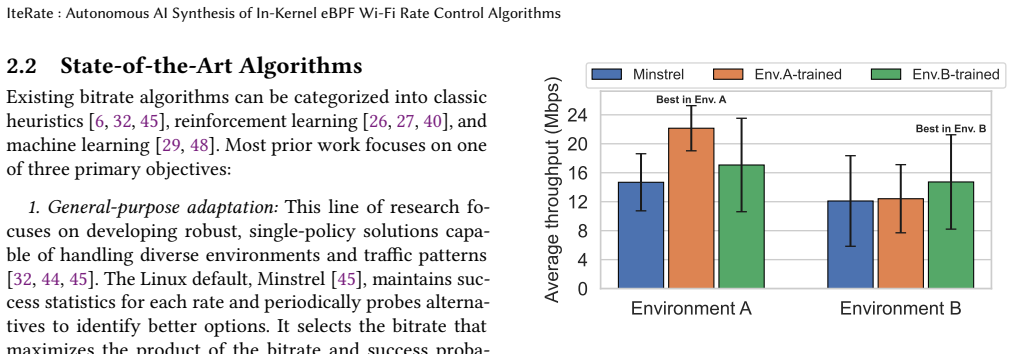
- [§4] §4 (Architecture and Pipeline): The multi-agent system with persistent knowledge and hypothesis iteration is described at a high level, but the text provides no mechanism, ablation, or experiment demonstrating that the synthesized eBPF policies generalize beyond the specific 58-node indoor testbed, hardware, and five workloads; this is load-bearing for the claim that the approach automates general rate-control research.
- [Abstract and §5] Abstract and §5: The evaluation compares only against Minstrel on one fixed testbed; no cross-hardware, cross-environment, or transfer experiments are reported, leaving open whether gains exploit testbed-specific artifacts (e.g., retry patterns or MCS distributions) rather than representing a broader advance.
minor comments (2)
- [Abstract] The abstract sentence beginning 'On a 58-node testbed...' is grammatically incomplete and should be integrated into a full sentence.
- [Abstract and §5] Workload definitions and exact testbed configuration details (channel, hardware models) are referenced but not summarized in the abstract or early sections, forcing readers to hunt in the evaluation for basic context.
Simulated Author's Rebuttal
We thank the referee for the constructive review and for recognizing the potential significance of an autonomous AI-driven system for in-kernel protocol design. We address each major comment below with specific plans for revision.
read point-by-point responses
-
Referee: [§5] §5 (Evaluation): The headline performance numbers (21% web-load improvement, 7% QoE, 21% throughput) are stated without any information on the number of runs per workload, statistical tests, confidence intervals, error bars, or controls for wireless variability and AI overfitting to the testbed telemetry; this directly weakens the central empirical claim.
Authors: We agree that the current presentation of results lacks sufficient methodological detail. In the revised manuscript we will expand §5 to report the exact number of independent runs per workload (20 runs), the application of paired t-tests with p-values, 95% confidence intervals, and error bars on all figures. We will also document controls for wireless variability (randomized deployment order, multiple channel conditions) and include an analysis of policy performance on held-out nodes to address potential overfitting concerns. revision: yes
-
Referee: [§4] §4 (Architecture and Pipeline): The multi-agent system with persistent knowledge and hypothesis iteration is described at a high level, but the text provides no mechanism, ablation, or experiment demonstrating that the synthesized eBPF policies generalize beyond the specific 58-node indoor testbed, hardware, and five workloads; this is load-bearing for the claim that the approach automates general rate-control research.
Authors: The evaluation is presented as a concrete demonstration of the closed-loop pipeline rather than exhaustive proof of generalization. We will revise §4 to detail the generalization mechanisms (hardware-agnostic eBPF telemetry hooks and hypothesis-driven iteration) and add an ablation study on the persistent knowledge base and agent coordination using the existing dataset. We will also add explicit discussion of scope and future cross-environment experiments. revision: partial
-
Referee: [Abstract and §5] Abstract and §5: The evaluation compares only against Minstrel on one fixed testbed; no cross-hardware, cross-environment, or transfer experiments are reported, leaving open whether gains exploit testbed-specific artifacts (e.g., retry patterns or MCS distributions) rather than representing a broader advance.
Authors: Minstrel is the standard Linux baseline, which motivated the comparison. We will update the abstract and §5 to state the evaluation scope clearly and add a limitations paragraph discussing possible testbed-specific effects. Where feasible we will include limited transfer results on a second hardware configuration; otherwise we will strengthen the discussion of scope and planned follow-on work. revision: partial
Circularity Check
No circularity in the derivation chain
full rationale
The paper's central claims rest on direct empirical comparisons of synthesized eBPF rate-control programs against the external Minstrel baseline, using over-the-air measurements on a fixed testbed. No equations, fitted parameters, or self-referential definitions are presented; the reported gains (21% faster loads, 7% QoE, 21% throughput) are raw performance deltas, not quantities constructed from the result itself. The multi-agent protocol and kernel telemetry hooks operate on external hardware feedback rather than closing a definitional loop. No load-bearing self-citations or uniqueness theorems imported from prior author work appear in the provided text, and the evaluation pipeline does not rename or smuggle in known results as novel derivations. The work is therefore self-contained against external benchmarks.
Axiom & Free-Parameter Ledger
axioms (2)
- domain assumption eBPF programs can be safely inserted into the Linux Wi-Fi stack to control rate selection without violating kernel stability or security invariants.
- domain assumption The 58-node testbed and five workloads produce telemetry that is representative of real-world Wi-Fi conditions for the purpose of algorithm evaluation.
invented entities (1)
-
IteRate multi-agent AI architecture with hypothesis-driven research protocol
no independent evidence
Reference graph
Works this paper leans on
-
[1]
Ali Abedi and Tim Brecht. 2014. T-RATE: A Framework for the Trace- Driven Evaluation of 802.11 Rate Adaptation Algorithms. InProceed- ings of the IEEE 22nd International Symposium on Modeling, Analysis, and Simulation of Computer and Telecommunication Systems (MAS- COTS). 1–10
2014
-
[2]
Ali Abedi, Andrew Heard, and Tim Brecht. 2016. T-SIMn: Towards the High Fidelity Trace-Based Simulation of 802.11n Networks. In Proceedings of the 19th ACM International Conference on Modeling, Analysis and Simulation of Wireless and Mobile Systems (MSWiM). 83–92
2016
-
[3]
Prashanth Aravinda Kumar Acharya, Ashish Sharma, Elizabeth M. Belding, Kevin C. Almeroth, and Konstantina Papagiannaki. 2010. Rate Adaptation in Congested Wireless Networks through Real-Time Measurements.IEEE Transactions on Mobile Computing9, 11 (2010), 1535–1550. https://doi.org/10.1109/TMC.2010.108
-
[4]
Abdullah Alomar, Pouya Hamadanian, Arash Nasr-Esfahany, An- ish Agarwal, Mohammad Alizadeh, and Devavrat Shah. 2023. {CausalSim}: A causal framework for unbiased {Trace-Driven} sim- ulation. In20th USENIX Symposium on Networked Systems Design and Implementation (NSDI 23). 1115–1147
2023
- [5]
-
[6]
John C. Bicket. 2005.Bit-Rate Selection in Wireless Networks. Master’s thesis. Massachusetts Institute of Technology
2005
-
[7]
Tony Braskich, Nattavut Smavatkul, and Steve Emeott. 2005. Opti- mization of a link adaptation algorithm for voice over wireless LAN applications. InIEEE Wireless Communications and Networking Confer- ence (WCNC). 1602–1607. https://doi.org/10.1109/WCNC.2005.1424753
- [8]
- [9]
-
[10]
Youngkyu Choi and Sunghyun Choi. 2008. A joint design of admission control and transmission rate adaptation for VoIP over wireless net- work. In2008 International Symposium on a World of Wireless, Mobile and Multimedia Networks (WoWMoM). 1–12. https://doi.org/10.1109/ WOWMOM.2008.4594817
-
[11]
Sayantan Choudhury and Jerry D. Gibson. 2007. Payload Length and Rate Adaptation for Multimedia Communications in Wireless LANs. IEEE Journal on Selected Areas in Communications25, 4 (2007), 796–807. https://doi.org/10.1109/JSAC.2007.361909
-
[12]
Cisco. 2026. Cisco Catalyst Center AI-Enhanced RRM Deployment Guide. https://www.cisco.com/c/en/us/td/docs/wireless/controller/ 9800/technical-reference/ai-enhanced-rrm-dg.html. (2026). accessed 2026-03-12
2026
-
[13]
Cisco Meraki. [n. d.]. Cisco Meraki Auto RF: Wi-Fi Channel and Power Management. https://documentation.meraki.com/MR/Radio_ Settings/Auto_RF%3A_Wi-Fi_Channel_and_Power_Management. ([n. d.]). accessed 2026-03-13
2026
-
[14]
Cisco Meraki. 2025. Meraki Health Overview. https: //documentation.meraki.com/Platform_Management/Dashboard_ Administration/Operate_and_Maintain/Monitoring_and_Reporting/ Meraki_Health_Overview. (2025). accessed 2026-03-12
2025
-
[15]
Extreme Networks. [n. d.]. Access Point System Reference Guide: Rate Selection Methods. https://documentation.extremenetworks. com/WiNG/7.3.1/APSRG/GUID-3D70DA57-4C08-4220-A19E- 3A95522CCA2C.shtml. ([n. d.]). WiNG 7.3.1 documentation; accessed 2026-03-12
2026
-
[16]
Varun Gupta, Craig Gutterman, Yigal Bejerano, and Gil Zussman. 2016. Experimental evaluation of large scale WiFi multicast rate control. In 35th Annual IEEE International Conference on Computer Communica- tions (INFOCOM). IEEE, 1–9. https://doi.org/10.1109/INFOCOM.2016. 7524343
-
[17]
Glia: A Human-Inspired AI for Automated Systems Design and Optimization
P. Hamadanian, P. Karimi, A. Nasr-Enfahany, K. Noorbakhsh, J. Chan- dler, A. Parandeh, M. Alizadeh, and H. Balakrishnan. [n. d.]. Glia: A Human-Inspired AI for Automated Systems Design and Optimization. https://arxiv.org/abs/2510.27176. ([n. d.])
work page internal anchor Pith review Pith/arXiv arXiv
-
[18]
Taal, Koen Langendoen, Reginald L
Ivaylo Haratcherev, Jacco R. Taal, Koen Langendoen, Reginald L. La- gendijk, and Henk J. Sips. 2005. Automatic IEEE 802.11 rate control for streaming applications.Wireless Communications and Mobile Com- puting5, 4 (2005), 421–437. https://doi.org/10.1002/wcm.301
-
[19]
HPE Aruba Networking. [n. d.]. AirMatch and ClientMatch in ArubaOS 10. https://www.arubanetworks.com/techdocs/aos/wifi- design-deploy/security/multi-zone/airmatch-clientmatch/. ([n. d.]). accessed 2026-03-13
2026
-
[20]
HPE Aruba Networking. [n. d.]. How AI-Powered AirMatch Op- timizes WLAN Performance. https://www.hpe.com/psnow/doc/ a00115435enw. ([n. d.]). accessed 2026-03-13
2026
-
[21]
Tingpei Huang, Shibao Li, and Shaoshu Gao. 2017. RaCA: A joint rate and channel adaptation scheme for dense 802.11n networks.Procedia Computer Science111 (2017), 183–189. https://doi.org/10.1016/j.procs. 2017.06.026
-
[22]
Glenn Judd, Xiaohui Wang, and Peter Steenkiste. 2008. Efficient Channel-Aware Rate Adaptation in Dynamic Environments. InPro- ceedings of the 6th International Conference on Mobile Systems, Applica- tions, and Services (MobiSys). 118–130. https://doi.org/10.1145/1378600. 1378615
-
[23]
Juniper Networks. [n. d.]. Overview of Juniper APs | Mist. https://www.juniper.net/documentation/us/en/software/mist/mist- wireless/topics/concept/mist-wireless-guide-ap-overview.html. ([n. d.]). accessed 2026-03-12
2026
-
[24]
Juniper Networks. [n. d.]. RRM Overview | Mist. https: //www.juniper.net/documentation/us/en/software/mist/mist- wireless/topics/topic-map/rrm.html. ([n. d.]). accessed 2026-03-13. 13 Lynch et al
2026
-
[25]
Juniper Networks. [n. d.]. Wi-Fi Data Rate Configuration | Mist. https://www.juniper.net/documentation/us/en/software/mist/ mist-wireless/topics/ref/mist-data-rates.html. ([n. d.]). accessed 2026- 03-12
2026
-
[27]
SmartLA: Reinforcement Learning-Based Link Adaptation for High Throughput Wireless Access Networks.Computer Communica- tions110 (2017), 1–25
2017
-
[28]
Raja Karmakar, Samiran Chattopadhyay, and Sandip Chakraborty
-
[29]
An Online Learning Approach for Auto Link-Configuration in IEEE 802.11ac Wireless Networks.Computer Networks181 (2020), 107426
2020
-
[30]
Malik Ahmad Yar Khan and Darryl Veitch. 2011. SmartRate: A new dynamic rate adaptation algorithm for 802.11 wireless networks. In 12th IEEE International Symposium on a World of Wireless, Mobile and Multimedia Networks (WoWMoM). IEEE Computer Society, 1–10. https://doi.org/10.1109/WOWMOM.2011.5986389
-
[31]
Shervin Khastoo, Tim Brecht, and Ali Abedi. 2020. NeuRA: Using Neural Networks to Improve WiFi Rate Adaptation. InProceedings of the 23rd ACM International Conference on Modeling, Analysis and Simulation of Wireless and Mobile Systems (MSWiM). 161–170
2020
-
[32]
Jinseok Kim, Seongkwan Kim, Sunghyun Choi, and Daji Qiao. 2006. CARA: Collision-Aware Rate Adaptation for IEEE 802.11 WLANs. In IEEE INFOCOM 2006. 1–11. https://doi.org/10.1109/INFOCOM.2006.95
-
[33]
Lefteris Kriara, Konstantinos Katsaros, George Xylomenos, and Ioan- nis Stavrakakis. 2015. SampleLite: Fast and Efficient Adaptive Rate Selection. InIFIP Networking Conference (IFIP Networking). 1–9. https: //doi.org/10.1109/IFIPNetworking.2015.7145308
-
[34]
Mathieu Lacage, Mohammad Hossein Manshaei, and Thierry Turletti
-
[35]
InProceed- ings of the 7th ACM International Symposium on Modeling, Analysis and Simulation of Wireless and Mobile Systems (MSWiM)
IEEE 802.11 Rate Adaptation: A Practical Approach. InProceed- ings of the 7th ACM International Symposium on Modeling, Analysis and Simulation of Wireless and Mobile Systems (MSWiM). 126–134
-
[36]
Hyewon Lee, Seongho Byeon, Byoungjin Kim, Kwang Bok Lee, and Sunghyun Choi. 2014. Enhancing Voice over WLAN via Rate Adapta- tion and Retry Scheduling.IEEE Transactions on Mobile Computing13, 12 (2014), 2791–2805. https://doi.org/10.1109/TMC.2013.54
-
[37]
Chi-Yu Li, Chunyi Peng, Songwu Lu, Xinbing Wang, and Ranveer Chandra. 2015. Latency-aware rate adaptation in 802.11n home net- works. In2015 IEEE Conference on Computer Communications (INFO- COM). 1293–1301. https://doi.org/10.1109/INFOCOM.2015.7218505
- [38]
-
[39]
MAMI Project. 2018. trafic: Traffic Mix Generator for Network Ex- periments. https://github.com/mami-project/trafic. (2018). GitHub repository
2018
-
[40]
Nguyen Le Minh, Choi Hee Yong, Choi Dongho, Kim Dongkyun, and Choi Choong Seon. 2011. RAMAS: Rate adaptation for Mobile users in 802.11n. In2011 IEEE International Conference on Communications (ICC). 1–5. https://doi.org/10.1109/icc.2011.5963415
-
[41]
OpenEvolve Authors. [n. d.]. OpenEvolve. https://github.com/ codelion/openevolve. ([n. d.]). GitHub repository; accessed 2026- 03-13
2026
- [42]
-
[43]
Ruben Queirós, Eduardo Nuno Almeida, Helder Fontes, José Ruela, and Rui Campos. 2022. Wi-Fi Rate Adaptation using a Simple Deep Re- inforcement Learning Approach. InProceedings of the IEEE Symposium on Computers and Communications (ISCC)
2022
-
[44]
Ioannis Selinis, Konstantinos Katsaros, Seiamak Vahid, and Rahim Tafazolli. 2019. Damysus: A Practical IEEE 802.11ax BSS Color Aware Rate Control Algorithm.International Journal of Wireless Information Networks26, 4 (2019), 285–307. https://doi.org/10.1007/S10776-019- 00439-6
-
[45]
Prashiddha D Thapa, Arne Kappen, and Julius Schulz-Zander. 2024. Towards infrastructure-assisted wifi rate adaptation for converged networks with morpheus. InProceedings of the 19th Workshop on Mobility in the Evolving Internet Architecture. 19–24
2024
-
[46]
Mythili Vutukuru, Hari Balakrishnan, and Kyle Jamieson. 2009. Cross- Layer Wireless Bit Rate Adaptation. InProceedings of the ACM SIG- COMM 2009 Conference on Data Communication. 3–14
2009
-
[47]
Starsky H. Y. Wong, Songwu Lu, Hao Yang, and Vaduvur Bhargha- van. 2006. Robust Rate Adaptation for 802.11 Wireless Networks. InProceedings of the 12th Annual International Conference on Mobile Computing and Networking (MobiCom). 146–157
2006
-
[49]
Dong Xia, Jonathan Hart, and Qiang Fu. 2013. Evaluation of the Minstrel Rate Adaptation Algorithm in IEEE 802.11g WLANs. InPro- ceedings of the IEEE International Conference on Communications (ICC). 2223–2228
2013
-
[50]
Yi Yang, Mahesh K. Marina, and Rajive L. Bagrodia. 2006. Exper- imental Evaluation of Application Performance with 802.11 PHY Rate Adaptation Mechanisms in Diverse Environments. InIEEE Wire- less Communications and Networking Conference (WCNC). 2273–2278. https://doi.org/10.1109/WCNC.2006.1696649
-
[51]
broker": {
Hao Yin, Murali Ramanujam, Joe Schaefer, Stan Adermann, Srihari Narlanka, Perry Lea, Ravi Netravali, and Krishna Chintalapudi. 2024. ADR-X: ANN-Assisted Wireless Link Rate Adaptation for Compute- Constrained Embedded Gaming Devices. In21st USENIX Symposium on Networked Systems Design and Implementation (NSDI 24). Santa Clara, CA, 1331–1349. 14 IteRate : A...
2024
discussion (0)
Sign in with ORCID, Apple, or X to comment. Anyone can read and Pith papers without signing in.