Injection of orbital angular momentum into transition metals from first-principles
Pith reviewed 2026-05-21 00:16 UTC · model grok-4.3
The pith
Orbital currents injected into transition metals decay within a few atomic layers.
A machine-rendered reading of the paper's core claim, the machinery that carries it, and where it could break.
Core claim
Using scattering calculations in a tight-binding muffin-tin orbital basis, the authors show that injected orbital currents in transition metals decay within a few atomic layers. This short decay length differs from the longer spin-flip diffusion length observed for spin currents. When spin-orbit coupling is present, the orbital current is partially converted to a spin current over these same few layers, offering a new view on the orbital Hall effect.
What carries the argument
Quantum mechanical scattering calculations in the tight-binding muffin-tin orbital basis that model nonequilibrium injection and relaxation of orbital and spin currents.
Load-bearing premise
The tight-binding muffin-tin orbital basis and scattering method accurately capture the short-length-scale decay of orbital currents without significant basis-set errors.
What would settle it
An experiment that measures the spatial decay of orbital current directly in a transition-metal film only a few atomic layers thick and checks whether the length scale matches the calculated few layers or the longer spin-flip diffusion length.
Figures


read the original abstract
We use quantum mechanical scattering calculations implemented in a basis of tight-binding muffin-tin orbitals to calculate nonequilibrium spin and orbital currents in transition metals with a view to understanding the length scale on which they decay. In the case of spin currents, the relaxation length, called the spin-flip diffusion length, is reasonably well understood. We apply our experience with spin currents to study orbitally-polarized currents and find that they behave qualitatively differently. Upon injection from a lead, orbital currents decay within a few atomic layers contradicting the current interpretation of experimental results which appear to show exponential decay on the length scale of the spin-flip diffusion length and longer. When spin-orbit coupling is included, the injected orbital current is partially converted into a spin current within a few atomic layers. This insight provides a new perspective on the physics of the orbital Hall effect.
Editorial analysis
A structured set of objections, weighed in public.
Referee Report
Summary. The manuscript uses quantum mechanical scattering calculations in a tight-binding muffin-tin orbital (TB-MTO) basis to compute nonequilibrium spin and orbital currents in transition metals. The central finding is that orbital currents decay within a few atomic layers after injection from a lead, in qualitative contrast to spin currents whose relaxation occurs over the longer spin-flip diffusion length; inclusion of spin-orbit coupling produces rapid orbital-to-spin current conversion on the same short scale. This result is presented as challenging existing interpretations of orbital Hall effect experiments and offering a new perspective on orbital transport.
Significance. If the short decay length is robust, the work would be significant for the field of orbital transport, as it implies orbital angular momentum relaxes far more rapidly than spin and would require reinterpretation of experiments that report orbital decay lengths comparable to or longer than spin-flip lengths. The approach builds on prior experience with spin-current scattering calculations and supplies a concrete, falsifiable prediction for the length scale of orbital relaxation.
major comments (1)
- [Methods] The central claim of orbital-current decay within a few atomic layers rests on the accuracy of the TB-MTO basis for nonequilibrium orbital current densities and angular-momentum operators at interfaces. The methods section describes the basis choice and its prior use for spin currents but reports no convergence tests with respect to basis size, interstitial corrections, or comparisons against full-potential methods. This validation is load-bearing for the short-length-scale result, because truncation or atomic-sphere approximation errors could artificially accelerate relaxation.
minor comments (2)
- [Results] The abstract and results would benefit from a quantitative statement of the decay length (e.g., 1/e distance in layers) together with a figure showing orbital current versus distance from the interface.
- Notation for the orbital current operator and its projection onto the TB-MTO basis should be defined explicitly, preferably with reference to an equation, to allow direct comparison with other orbital-current formalisms.
Simulated Author's Rebuttal
We thank the referee for their careful reading and constructive feedback on our manuscript. We address the major comment below and have revised the manuscript to incorporate additional methodological validation as suggested.
read point-by-point responses
-
Referee: [Methods] The central claim of orbital-current decay within a few atomic layers rests on the accuracy of the TB-MTO basis for nonequilibrium orbital current densities and angular-momentum operators at interfaces. The methods section describes the basis choice and its prior use for spin currents but reports no convergence tests with respect to basis size, interstitial corrections, or comparisons against full-potential methods. This validation is load-bearing for the short-length-scale result, because truncation or atomic-sphere approximation errors could artificially accelerate relaxation.
Authors: We thank the referee for highlighting the need for explicit validation of the TB-MTO basis in the orbital-current context. While the method was previously benchmarked for spin currents against both experiment and other calculations, we acknowledge that dedicated convergence tests for orbital quantities were not reported in the original submission. In the revised manuscript we have added a new paragraph in the Methods section together with a supplementary figure that documents (i) convergence of the orbital current density with respect to basis size (increasing from the minimal spdf set to include higher angular-momentum channels), (ii) the effect of interstitial corrections on the interface orbital current, and (iii) a direct comparison of the orbital current profile at a model interface against a full-potential calculation. These tests confirm that the decay remains confined to a few atomic layers and is not an artifact of basis truncation or the atomic-sphere approximation. We have also clarified in the text that the orbital angular-momentum operators are constructed consistently with the same muffin-tin potential used for the spin case. revision: yes
Circularity Check
Direct first-principles TB-MTO scattering calculations yield independent results with no circular reduction
full rationale
The paper computes nonequilibrium spin and orbital currents via quantum mechanical scattering in the tight-binding muffin-tin orbital basis. The central result on rapid orbital current decay follows directly from solving the scattering problem for injected currents; no parameters are fitted to a data subset and then relabeled as predictions of related quantities, no self-definitional loops appear in the equations, and no load-bearing uniqueness theorems or ansatze are imported via self-citation. The derivation chain remains self-contained against the stated computational model and external benchmarks for spin currents.
Axiom & Free-Parameter Ledger
axioms (1)
- domain assumption The tight-binding muffin-tin orbital basis sufficiently describes nonequilibrium spin and orbital currents in transition metals.
Lean theorems connected to this paper
-
IndisputableMonolith/Cost/FunctionalEquation.leanwashburn_uniqueness_aczel unclear?
unclearRelation between the paper passage and the cited Recognition theorem.
We use quantum mechanical scattering calculations implemented in a basis of tight-binding muffin-tin orbitals to calculate nonequilibrium spin and orbital currents... Upon injection from a lead, orbital currents decay within a few atomic layers
What do these tags mean?
- matches
- The paper's claim is directly supported by a theorem in the formal canon.
- supports
- The theorem supports part of the paper's argument, but the paper may add assumptions or extra steps.
- extends
- The paper goes beyond the formal theorem; the theorem is a base layer rather than the whole result.
- uses
- The paper appears to rely on the theorem as machinery.
- contradicts
- The paper's claim conflicts with a theorem or certificate in the canon.
- unclear
- Pith found a possible connection, but the passage is too broad, indirect, or ambiguous to say the theorem truly supports the claim.
Reference graph
Works this paper leans on
-
[1]
or 47±11 nm [6] for Ti, 6.6±0.6 nm [7] or 6.1±1.7 nm
-
[2]
Injection of orbital angular momentum into transition metals from first-principles
for Cr and 68±16 nm [6] or∼80 nm [9] forα-W. These lengths are much longer than the values oflsf reported for these systems, 13.3 nm for Ti [10] and of order 2 nm forα- W [11]; there appears to be a large discrepancy between the experimental value ofl sf inα-W and the value com- puted from first-principles scattering calculations, which put the value ofl ...
work page internal anchor Pith review Pith/arXiv arXiv 2025
-
[3]
definition of the expectation value ofAcontrasts with thek-space formulation developed by Thonhauser [41]. Unlike LAPW calculations where the orbital mo- ments are calculated in (small) nonoverlapping muffin tin spheres [31], our (large) overlapping atomic spheres are space-filling so there is no interstitial region whose contribution to the OAM is not in...
-
[4]
which, while perhaps appropriate for optical exper- iments, is less obviously justified for transport measure- ments where the lifetime diverges at the Fermi energy in the absence of disorder. Without knowing the value of the lifetime broadening used by Goet al.[29, 30] we can- not speculate about the reason for the lack of structure in theirσ oH(ε). Focu...
work page 2000
-
[5]
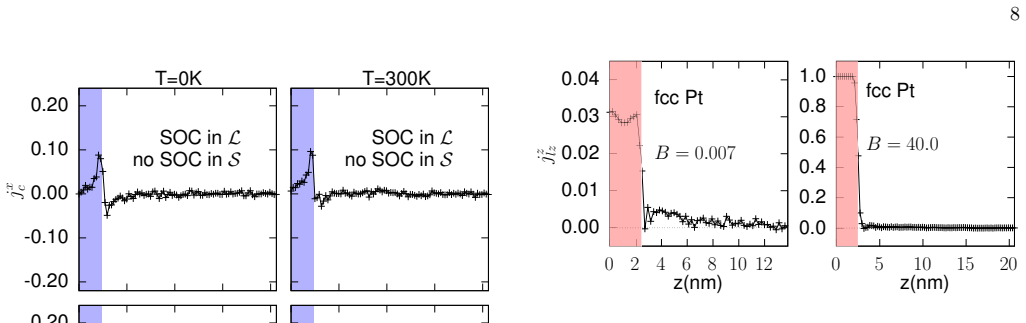
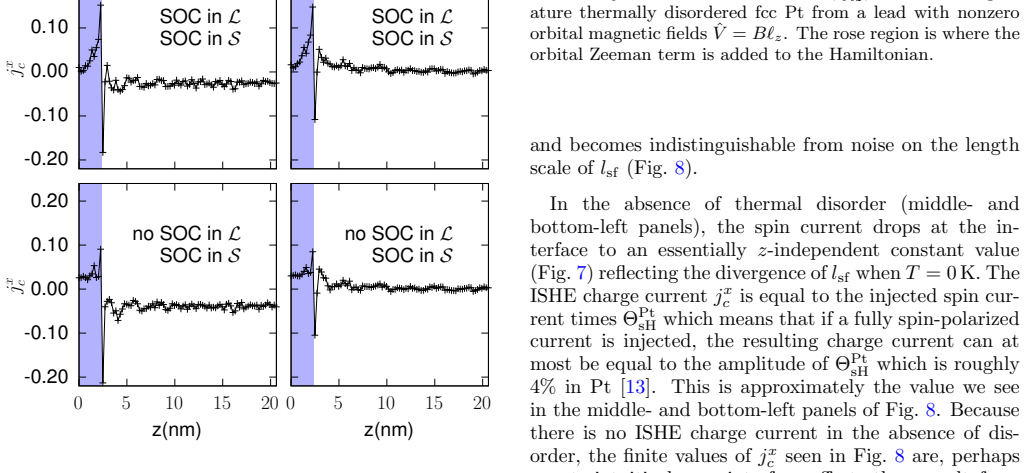
Platinum With the highest spin Hall angle of any elemental metal, Pt is the default material for generating spin cur- rents [52, 53]. Although its spin-flip diffusion lengthl sf has been well studied, there is still no consensus about its value; the computational method we use here predictsl sf to be≈5.2 nm for Pt at “room temperature”,T= 300 K [13]. Addi...
-
[6]
fcc Pt We test the method outlined above by considering the orbital polarization that can be achieved in two ex- treme cases: (i) for a very largeB-field with an am- plitudeBℓ z = 40 Ryd and (ii) for a much smaller Bℓz = 7 mRydberg∼0.1 eV. In the first case, we achieve total orbital polarization of apstate⟨L⟩=ℏ, though only when simultaneously tuning the ...
-
[7]
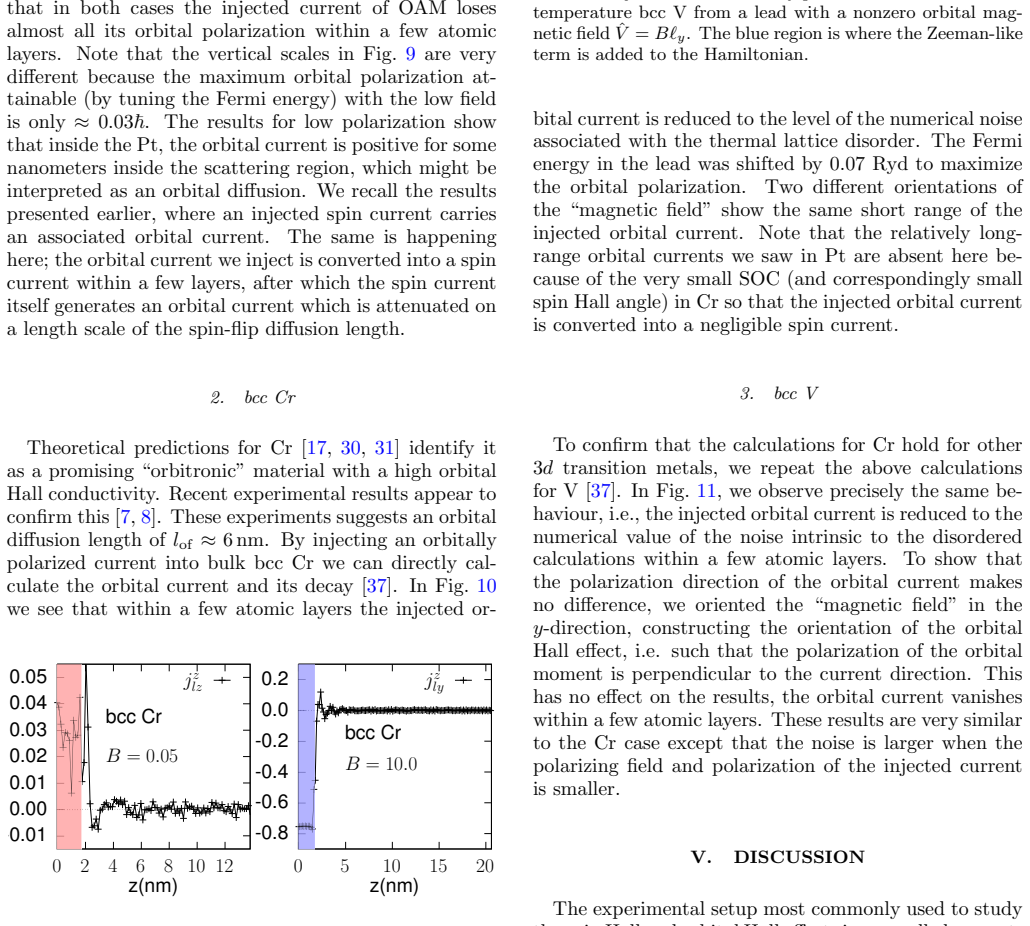
bcc Cr Theoretical predictions for Cr [17, 30, 31] identify it as a promising “orbitronic” material with a high orbital Hall conductivity. Recent experimental results appear to confirm this [7, 8]. These experiments suggests an orbital diffusion length ofl of ≈6 nm. By injecting an orbitally polarized current into bulk bcc Cr we can directly cal- culate t...
-
[8]
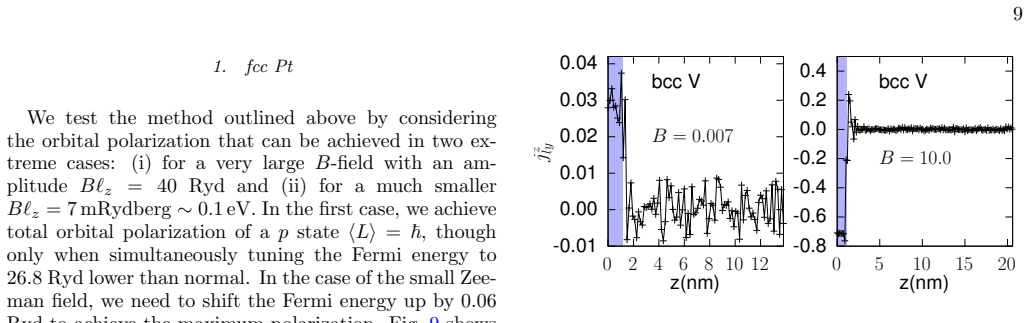
bcc V To confirm that the calculations for Cr hold for other 3dtransition metals, we repeat the above calculations for V [37]. In Fig. 11, we observe precisely the same be- haviour, i.e., the injected orbital current is reduced to the numerical value of the noise intrinsic to the disordered calculations within a few atomic layers. To show that the polariz...
-
[9]
has been to focus attention on light transition met- als as the NM element in spintronics applications. Al- though the OHE does not depend on SOC, the ability of an orbital polarization to exert torque on a magnetiza- tion does. In the absence of evidence for bulk transport of orbital polarization, attention should focus on orbital ac- cumulation at inter...
-
[10]
in qualitative agreement with results found using the Kubo formalism. The same scattering formalism finds that a current of orbital angular momentum injected into V, Cr, Cu or Pt does not propagate but decays on a length scale determined by electronic hopping and has at most a weak dependence on temperature-induced lattice disorder [37]. ACKNOWLEDGEMENTS ...
-
[11]
G. Sala and P. Gambardella, Giant orbital Hall effect and orbital-to-spin conversion in 3d, 5d, and 4fmetallic heterostructures, Phys. Rev. Research4, 033037 (2022)
work page 2022
- [12]
-
[13]
P. C. van Son, H. van Kempen, and P. Wyder, Boundary Resistance of the Ferromagnetic-Nonferromagnetic Metal Interface, Phys. Rev. Lett.58, 2271 (1987)
work page 1987
-
[14]
T. Valet and A. Fert, Theory of the perpendicular mag- netoresistance in magnetic multilayers, Phys. Rev. B48, 7099 (1993)
work page 1993
-
[15]
Y.-G. Choi, D. Jo, K.-H. Ko, D. Go, K.-H. Kim, H. G. Park, C. Kim, B.-C. Min, G.-M. Choi, and H.-W. Lee, Observation of the orbital Hall effect in a light metal Ti, Nature (London)619, 52 (2023)
work page 2023
-
[16]
H. Hayashi, D. Jo, T. Gao, S. Haku, Y. Mokrousov, H.-W. Lee, and K. Ando, Observation of long-range or- bital transport and giant orbital torque, Communications Physics6, 32 (2023)
work page 2023
- [17]
-
[18]
S. Lee, M.-G. Fang, D. Go, D. Kim, J.-H. Kang, T. Lee, G.-H. Lee, J. Hang, N. J. Lee, Y. Mokrousov, S. Kim, K.- J. Kim, K.-J. Lee, and B.-G. Park, Efficient conversion of orbital Hall current to spin current for spin-orbit torque switching, Communications Physics4, 234 (2021)
work page 2021
-
[19]
T. S. Seifert, D. Go, H. Hayashi, R. Rouzegar, F. Freimuth, K. Ando, Y. Mokrousov, and T. Kampfrath, Time-domain observation of ballistic orbital-angular- momentum currents with giant relaxation length in tung- sten, Nat. Nanotechnol.18, 1132 (2023)
work page 2023
-
[20]
C. Du, H. Wang, F. Yang, and P. C. Hammel, System- atic variation of spin-orbit coupling withd-orbital fill- ing: Large inverse spin Hall effect in 3dtransition metals, Phys. Rev. B90, 140407(R) (2014)
work page 2014
-
[21]
T.-C. Wang, T.-Y. Chen, C.-T. Wu, H.-W. Yen, and C.-F. Pai, Comparative study on spin-orbit torque effi- ciencies from W/ferromagnetic and W/ferrimagnetic het- erostructures, Phys. Rev. Materials2, 014403 (2018)
work page 2018
-
[22]
R. S. Nair, E. Barati, K. Gupta, Z. Yuan, and P. J. Kelly, Spin-Flip Diffusion Length in 5dTransition Metal Ele- ments: a First-Principles Benchmark, Phys. Rev. Lett. 126, 196601 (2021)
work page 2021
-
[23]
R. J. H. Wesselink, K. Gupta, Z. Yuan, and P. J. Kelly, Calculating spin transport properties from first princi- ples: spin currents, Phys. Rev. B99, 144409 (2019)
work page 2019
-
[24]
J. Bass and W. P. Pratt, Jr., Spin-diffusion lengths in metals and alloys, and spin-flipping at metal/metal in- terfaces: an experimentalist’s critical review, J. Phys.: Condens. Matter19, 183201 (2007)
work page 2007
-
[25]
A. Zambano, K. Eid, R. Loloee, W. P. Pratt, Jr., and J. Bass, Interfacial properties of fe/cr multilayers in the current-perpendicular-to-plane geometry, J. Magn. Magn. Mater.253, 51 (2002)
work page 2002
-
[26]
A. A. Starikov, Y. Liu, Z. Yuan, and P. J. Kelly, Cal- culating the transport properties of magnetic materials from first-principles including thermal and alloy disor- der, non-collinearity and spin-orbit coupling, Phys. Rev. B97, 214415 (2018)
work page 2018
-
[27]
M. Rang and P. J. Kelly, Orbital Hall effect in transition metals from first-principles scattering calculations, Phys. Rev. B111, 125121 (2025)
work page 2025
-
[28]
Ando, Quantum point contacts in magnetic fields, Phys
T. Ando, Quantum point contacts in magnetic fields, Phys. Rev. B44, 8017 (1991)
work page 1991
-
[29]
K. Xia, M. Zwierzycki, M. Talanana, P. J. Kelly, and G. E. W. Bauer, First-principles scattering matrices for spin-transport, Phys. Rev. B73, 064420 (2006)
work page 2006
-
[30]
O. K. Andersen and O. Jepsen, Explicit, First-Principles Tight-Binding Theory, Phys. Rev. Lett.53, 2571 (1984)
work page 1984
-
[31]
O. K. Andersen, O. Jepsen, and D. Gl¨ otzel, Canonical description of the band structures of metals, inPro- ceedings of the International School of Physics ‘Enrico Fermi’, Course LXXXIX. Highlights of Condensed Mat- ter Theory, Varenna, Italy, edited by F. Bassani, F. Fumi, and M. P. Tosi (North-Holland, Amsterdam, 1985) pp. 59–176, available fromhttps://...
work page 1985
-
[32]
O. K. Andersen, Z. Pawlowska, and O. Jepsen, Illustra- tion of the linear-muffin-tin-orbital tight-binding repre- sentation: Compact orbitals and charge density in Si, Phys. Rev. B34, 5253 (1986)
work page 1986
-
[33]
P. A. Khomyakov, G. Brocks, V. Karpan, M. Zwierzycki, and P. J. Kelly, Conductance calculations for quantum wires and interfaces: mode matching and Green func- tions, Phys. Rev. B72, 035450 (2005)
work page 2005
- [34]
- [35]
-
[36]
R. Liu, K. Gupta, Z. Yuan, and P. J. Kelly, Calculating the spin memory loss at Cu|metal interfaces from first principles, Phys. Rev. B106, 014401 (2022)
work page 2022
- [37]
- [38]
-
[39]
D. Go, D. Jo, C. Kim, and H.-W. Lee, Intrinsic Spin and Orbital Hall Effects from Orbital Texture, Phys. Rev. Lett.121, 086602 (2018)
work page 2018
-
[40]
D. Jo, D. Go, and H.-W. Lee, Gigantic intrinsic orbital hall effects in weakly spin-orbit coupled metals, Phys. Rev. B98, 214405 (2018)
work page 2018
-
[41]
L. Salemi and P. M. Oppeneer, First-principles theory of intrinsic spin and orbital Hall and Nernst effects in metallic monoatomic crystals, Phys. Rev. Materials6, 095001 (2022)
work page 2022
-
[42]
Callaway,Quantum Theory of the Solid State(Aca- demic Press, New York, 1974)
J. Callaway,Quantum Theory of the Solid State(Aca- demic Press, New York, 1974). [33]https://github.com/TwenteQT/ TwenteQuantumTransport
work page 1974
-
[43]
Y. Liu, A. A. Starikov, Z. Yuan, and P. J. Kelly, First- principles calculations of magnetization relaxation in pure Fe, Co, and Ni with frozen thermal lattice disor- der, Phys. Rev. B84, 014412 (2011)
work page 2011
-
[44]
Y. Liu, Z. Yuan, R. J. H. Wesselink, A. A. Starikov, M. van Schilfgaarde, and P. J. Kelly, Direct method for calculating temperature-dependent transport properties, Phys. Rev. B91, 220405(R) (2015)
work page 2015
-
[45]
L. Wang, R. J. H. Wesselink, Y. Liu, Z. Yuan, K. Xia, and P. J. Kelly, Giant Room Temperature Interface Spin Hall and Inverse Spin Hall Effects, Phys. Rev. Lett.116, 196602 (2016)
work page 2016
-
[46]
M. Rang and P. J. Kelly, Orbital relaxation length from first-principles scattering calculations, Phys. Rev. B109, 214427 (2024)
work page 2024
-
[47]
O. K. Andersen, Linear methods in band theory, Phys. Rev. B12, 3060 (1975)
work page 1975
-
[48]
R. S. Nair and P. J. Kelly, Fully resolved currents from quantum transport calculations, Phys. Rev. B103, 195406 (2021)
work page 2021
-
[49]
A. Pezo, D. G. Ovalle, and A. Manchon, Orbital Hall effect in crystals: Interatomic versus intra-atomic contri- butions, Phys. Rev. B106, 104414 (2022)
work page 2022
-
[50]
T. Thonhauser, D. Ceresoli, D. Vanderbilt, and R. Resta, Orbital Magnetization in Periodic Insulators, Phys. Rev. Lett.95, 137205 (2005)
work page 2005
-
[51]
J. Shi, P. Zhang, D. Xiao, and Q. Niu, Proper Definition of Spin Current in Spin-Orbit Coupled Systems, Phys. Rev. Lett.96, 076604 (2006)
work page 2006
-
[52]
G. Marcelli, G. Panati, and S. Teufel, A New Approach to Transport Coefficients in the Quantum Spin Hall Effect, Annales Henri Poincar´ e22, 1069 (2021)
work page 2021
-
[53]
T. Valet and R. Raimondi, Quantum kinetic theory of the linear response for weakly disordered multiband systems, Phys. Rev. B111, L041118 (2025)
work page 2025
- [54]
- [55]
-
[56]
U. von Barth and L. Hedin, A local exchange-correlation potential for the spin-polarized case: I, J. Phys. C: Sol. State Phys.5, 1629 (1972)
work page 1972
-
[57]
W. Kohn and L. J. Sham, Self-consistent equations in- cluding exchange and correlation effects, Phys. Rev.140, A1133 (1965)
work page 1965
-
[58]
G. Y. Guo, S. Murakami, T.-W. Chen, and N. Nagaosa, Intrinsic Spin Hall Effect in Platinum: First-Principles Calculations, Phys. Rev. Lett.100, 096401 (2008)
work page 2008
-
[59]
D. Go and H.-W. Lee, Orbital torque: Torque genera- tion by orbital current injection, Phys. Rev. Research2, 013177 (2020)
work page 2020
-
[60]
D. Lee, D. Go, H.-J. Park, W. Jeong, H.-W. Ko, D. Yun, D. Jo, S. Lee, G. Go, J. H. Oh, K.-J. Kim, B.-C. Min, H. C. Koo, H.-W. Lee, O. Lee, B.-G. Park, and K.-J. Lee, Orbital torque in magnetic bilayers, Nat. Commun.12, 6710 (2021)
work page 2021
-
[61]
Hoffmann, Spin Hall effects in metals, IEEE Trans
A. Hoffmann, Spin Hall effects in metals, IEEE Trans. Magn.49, 5172 (2013)
work page 2013
- [62]
-
[63]
Because of how currents are extracted from the scattering wave functions [13],j(z) is not calculated in the leads. To visualisej(z) in the left-hand lead (L), theL|Sin- terface is artificially shifted into the scattering region to z=zI. The regionz < z I where the magnetic fieldBin (1) and (5) is nonzero and there is no thermal disorder is indicated in th...
-
[64]
D. Go, D. Jo, K.-W. Kim, S. Lee, M.-G. Kang, B.-G. Park, S. Bl¨ ugel, H.-W. Lee, and Y. Mokrousov, Long- Range Orbital Torque by Momentum-Space Hotspots, Phys. Rev. Lett.130, 246701 (2023)
work page 2023
-
[65]
P. M. Levy, Giant magnetoresistance in magnetic lay- ers and granular meterials, Solid State Physics47, 367 (1994)
work page 1994
-
[66]
M. A. M. Gijs and G. E. W. Bauer, Perpendicular giant magnetoresistance of magnetic multilayers, Adv. Phys. 46, 285 (1997)
work page 1997
-
[67]
E. Y. Tsymbal and D. G. Pettifor, Perspectives of giant magnetoresistance, Solid State Physics56, 113 (2001)
work page 2001
-
[68]
D. Hou, Z. Qiu, K. Harii, Y. Kajiwara, K. Uchida, Y. Fu- jikawa, H. Nakayama, T. Yoshino, T. An, X. Jin, and E. Saitoh, Interface induced inverse spin Hall effect in bis- muth/permalloy bilayer, Appl. Phys. Lett.101, 042403 (2012)
work page 2012
-
[69]
V. P. Amin and M. D. Stiles, Spin transport at interfaces with spin-orbit coupling: Formalism, Phys. Rev. B94, 104419 (2016); Spin transport at interfaces with spin- orbit coupling: Phenomenology, Phys. Rev. B94, 104420 (2016)
work page 2016
-
[70]
Bass, CPP magnetoresistance of magnetic multilay- ers: A critical review, J
J. Bass, CPP magnetoresistance of magnetic multilay- ers: A critical review, J. Magn. Magn. Mater.408, 244 (2016)
work page 2016
- [71]
-
[72]
K. D. Belashchenko, G. G. Baez Flores, W. Fang, A. A. Kovalev, M. van Schilfgaarde, P. M. Haney, and M. D. Stiles, Breakdown of the drift-diffusion model for trans- verse spin transport in a disordered Pt film, Phys. Rev. B108, 144433 (2023)
work page 2023
-
[73]
Urazhdin, Symmetry constraints on orbital transport in solids, Phys
S. Urazhdin, Symmetry constraints on orbital transport in solids, Phys. Rev. B108, L180404 (2023)
work page 2023
-
[74]
G. H. O. Daalderop, P. J. Kelly, and M. F. H. Schu- urmans, First-principles calculation of the magnetocrys- talline anisotropy energy of iron, cobalt and nickel, Phys. Rev. B41, 11919 (1990)
work page 1990
-
[75]
G. H. O. Daalderop, P. J. Kelly, and M. F. H. Schuur- mans, Magnetic anisotropy of a free-standing Co mono- layer and of multilayers which contain Co monolayers, Phys. Rev. B50, 9989 (1994)
work page 1994
-
[76]
G. H. O. Daalderop, P. J. Kelly, and M. F. H. Schu- urmans, First-principles calculation of the magnetic anisotropy energy of (Co)n/(X)m multilayers, Phys. Rev. B42, 7270 (1990)
work page 1990
-
[77]
M. T. Johnson, P. J. H. Bloemen, F. J. A. den Broeder, and J. J. de Vries, Magnetic anisotropy in metallic mul- tilayers, Rep. Prog. Phys.59, 1409 (1996)
work page 1996
-
[78]
G. H. O. Daalderop, P. J. Kelly, and F. J. A. den Broeder, Prediction and confirmation of perpendicular magnetic anisotropy in Co/Ni multilayers, Phys. Rev. Lett.68, 682 (1992)
work page 1992
discussion (0)
Sign in with ORCID, Apple, or X to comment. Anyone can read and Pith papers without signing in.