Recognition: 2 theorem links
· Lean TheoremTemPose-TF-ASF: Two-Stage Bidirectional Stroke Context Fusion for Badminton Stroke Classification
Pith reviewed 2026-05-08 18:14 UTC · model grok-4.3
The pith
Bidirectional fusion of adjacent stroke context improves badminton stroke classification accuracy.
A machine-rendered reading of the paper's core claim, the machinery that carries it, and where it could break.
Core claim
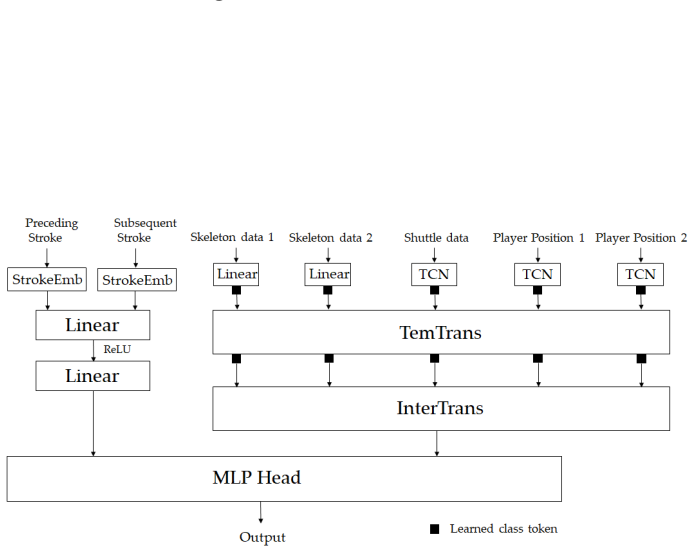
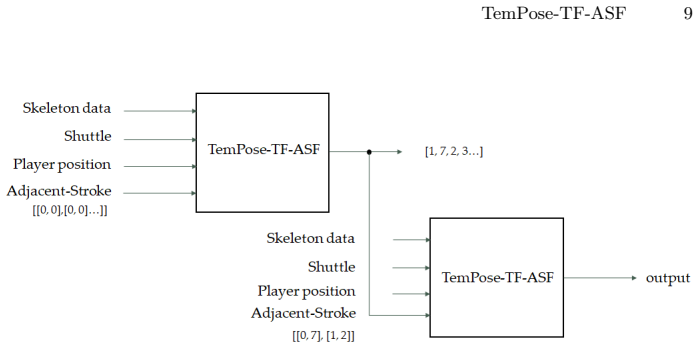
By reusing preliminary baseline predictions as estimated temporal context, the two-stage strategy guides joint optimization of the Adjacent-Stroke Fusion module and classifier, enabling explicit modeling of bidirectional stroke-type dependencies that yields higher Accuracy and Macro-F1 scores on large-scale badminton datasets while remaining integrable into other state-of-the-art models for further performance gains.
What carries the argument
The Adjacent-Stroke Fusion (ASF) module, which fuses stroke-type information from both preceding and subsequent strokes using preliminary predictions to guide two-stage optimization of bidirectional temporal dependencies.
If this is right
- Accuracy and Macro-F1 scores improve consistently over the baseline and its variants on large-scale badminton match data.
- The ASF module integrates into other advanced methods and produces notable performance gains in those models as well.
- Explicit bidirectional temporal dependency modeling enhances stroke recognition without requiring changes to the core architecture of host models.
- The approach exhibits strong transferability and generalization capability across different backbone methods.
Where Pith is reading between the lines
- The two-stage reuse of preliminary predictions may reduce the annotation burden for full temporal context in training data for sequential action tasks.
- Similar bidirectional fusion could apply to other sequential sports actions such as tennis serves or table-tennis strokes where past and future context matters.
- If initial prediction quality improves, the same fusion mechanism might support fully end-to-end training rather than staged optimization.
- Live match analysis could benefit from the method once error propagation from early predictions is further mitigated.
Load-bearing premise
Preliminary predictions from the baseline model supply sufficiently accurate estimated temporal context to guide joint optimization without introducing harmful error propagation.
What would settle it
Retraining the fusion module with ground-truth adjacent-stroke labels in place of preliminary predictions produces no accuracy gain or a performance drop relative to the baseline.
Figures




read the original abstract
Accurate badminton stroke prediction is crucial for fine-grained sports analysis and tactical decision support. However, existing methods struggle to model rich temporal context. This paper introduces TemPose-TF-ASF (Adjacent-Stroke Fusion), a context-aware extension of TemPose. It enhances stroke recognition by incorporating stroke-type information from both preceding and subsequent strokes. A two-stage training and inference strategy is adopted. Preliminary predictions from the baseline model are reused as estimated temporal context. These predictions guide the joint optimization of the ASF module and the classifier. By explicitly modeling bidirectional temporal stroke dependencies, the proposed method can be seamlessly integrated into existing state-of-the-art models. Experiments on a large-scale badminton match dataset show consistent improvements over the baseline and its variants in terms of Accuracy and Macro-F1. Moreover, integrating ASF into other advanced methods yields notable performance gains. These results demonstrate strong transferability and generalization capability.
Editorial analysis
A structured set of objections, weighed in public.
Referee Report
Summary. The manuscript introduces TemPose-TF-ASF, a context-aware extension of the TemPose baseline for badminton stroke classification. It incorporates bidirectional temporal context via an Adjacent-Stroke Fusion (ASF) module trained in two stages: preliminary baseline predictions are reused as estimated preceding and subsequent stroke labels to guide joint optimization of ASF and the classifier. The authors claim consistent Accuracy and Macro-F1 gains over the baseline and variants on a large-scale badminton dataset, plus transferability when ASF is plugged into other SOTA models.
Significance. If the performance claims are substantiated with quantitative results and controls, the bidirectional fusion approach could meaningfully advance temporal modeling for fine-grained action recognition in sports analytics, where stroke sequences encode tactical dependencies. The two-stage reuse of predictions is a pragmatic way to inject context without requiring fully annotated sequences at inference. No machine-checked proofs or parameter-free derivations are present, but the transferability claim, if verified, would be a practical strength.
major comments (2)
- Abstract: the central claim of 'consistent improvements' and 'notable performance gains' is asserted without any numerical values, error bars, dataset splits, ablation tables, or statistical significance tests. This prevents evaluation of whether the reported gains exceed baseline variance or are load-bearing for the two-stage ASF contribution.
- Abstract (two-stage strategy description): preliminary baseline predictions are reused as bidirectional context to 'guide the joint optimization' of ASF, yet no oracle ablation (ground-truth adjacent labels vs. predicted labels) or first-stage error-rate analysis is mentioned. If baseline error rates are non-negligible, any observed gains could partly compensate for propagated mistakes rather than demonstrate genuine context modeling; this is load-bearing for the method's validity.
minor comments (1)
- The acronym expansion and precise architectural differences between TemPose-TF-ASF and the baseline TemPose are not clarified in the abstract, complicating immediate understanding of the incremental contribution.
Simulated Author's Rebuttal
We thank the referee for the constructive feedback on the abstract and the two-stage training strategy. We address each major comment point by point below and outline the planned revisions.
read point-by-point responses
-
Referee: [—] Abstract: the central claim of 'consistent improvements' and 'notable performance gains' is asserted without any numerical values, error bars, dataset splits, ablation tables, or statistical significance tests. This prevents evaluation of whether the reported gains exceed baseline variance or are load-bearing for the two-stage ASF contribution.
Authors: We agree that the abstract would be strengthened by including specific quantitative results. In the revised version, we will update the abstract to report the key Accuracy and Macro-F1 improvements (with absolute deltas), reference the dataset splits, and point to the ablation tables and statistical tests already present in the experimental section of the full manuscript. revision: yes
-
Referee: [—] Abstract (two-stage strategy description): preliminary baseline predictions are reused as bidirectional context to 'guide the joint optimization' of ASF, yet no oracle ablation (ground-truth adjacent labels vs. predicted labels) or first-stage error-rate analysis is mentioned. If baseline error rates are non-negligible, any observed gains could partly compensate for propagated mistakes rather than demonstrate genuine context modeling; this is load-bearing for the method's validity.
Authors: This concern about error propagation is valid and load-bearing. The full manuscript contains ablations on the ASF module and transferability experiments, but lacks an explicit oracle comparison and first-stage error analysis. We will add both in the revision: (i) reported first-stage baseline error rates on the validation set, and (ii) an oracle ablation using ground-truth adjacent labels versus predicted labels to isolate the contribution of true context modeling. revision: yes
Circularity Check
No circularity: two-stage context reuse is standard bootstrapping, not definitional reduction
full rationale
The paper's core construction re-uses first-stage baseline predictions only as auxiliary input to train the ASF fusion weights; the final classifier output is not algebraically identical to those inputs, nor is any parameter fitted directly to the target metric by construction. No equations are presented that equate the reported Accuracy or Macro-F1 to the preliminary predictions, no self-citation supplies a uniqueness theorem, and no ansatz is smuggled in. The derivation therefore remains self-contained against external benchmarks and receives the default non-circularity finding.
Axiom & Free-Parameter Ledger
Lean theorems connected to this paper
-
Cost.FunctionalEquation (washburn_uniqueness_aczel)J(x) = ½(x+x⁻¹)−1 uniqueness unclear?
unclearRelation between the paper passage and the cited Recognition theorem.
Param: 1.95M ... TemPose-TF-ASF achieves substantial performance improvements over the baseline TemPose-TF.
What do these tags mean?
- matches
- The paper's claim is directly supported by a theorem in the formal canon.
- supports
- The theorem supports part of the paper's argument, but the paper may add assumptions or extra steps.
- extends
- The paper goes beyond the formal theorem; the theorem is a base layer rather than the whole result.
- uses
- The paper appears to rely on the theorem as machinery.
- contradicts
- The paper's claim conflicts with a theorem or certificate in the canon.
- unclear
- Pith found a possible connection, but the passage is too broad, indirect, or ambiguous to say the theorem truly supports the claim.
Reference graph
Works this paper leans on
-
[1]
arXiv preprint arXiv:2502.21085 (2025)
Chang, J.Y.: Bst: Badminton stroke-type transformer for skeleton-based action recognition in racket sports. arXiv preprint arXiv:2502.21085 (2025)
-
[2]
In: Proceedings of the 5th ACM International Conference on Multimedia in Asia
Chen, Y.J., Wang, Y.S.: Tracknetv3: Enhancing shuttlecock tracking with augmen- tations and trajectory rectification. In: Proceedings of the 5th ACM International Conference on Multimedia in Asia. pp. 1–7 (2023)
2023
-
[3]
In: Proceed- ings of the European conference on computer vision (ECCV)
Chen, Z., Huang, S., Tao, D.: Context refinement for object detection. In: Proceed- ings of the European conference on computer vision (ECCV). pp. 71–86 (2018)
2018
-
[4]
In: ECCV
Do, J., Kim, M.: Skateformer: skeletal-temporal transformer for human action recognition. In: ECCV. pp. 401–420. Springer (2025)
2025
-
[5]
In: 2019 international conference on image and video processing, and artificial intelligence
Dong, L., Li, D., Li, S., Lan, S., Wang, P.: Tai chi action recognition based on structural lstm with attention module. In: 2019 international conference on image and video processing, and artificial intelligence. vol. 11321, pp. 377–382. SPIE (2019)
2019
-
[6]
In: Proceedings of the IEEE/CVF Conference on Computer Vision and Pattern Recognition (CVPR) (June 2019)
Farha, Y.A., Gall, J.: Ms-tcn: Multi-stage temporal convolutional network for ac- tion segmentation. In: Proceedings of the IEEE/CVF Conference on Computer Vision and Pattern Recognition (CVPR) (June 2019)
2019
-
[7]
In: Dong, Y., Ifrim, G., Mladenić, D., Saunders, C., Van Hoecke, S
Fernández, J., Bornn, L.: Soccermap: A deep learning architecture for visually- interpretable analysis in soccer. In: Dong, Y., Ifrim, G., Mladenić, D., Saunders, C., Van Hoecke, S. (eds.) Machine Learning and Knowledge Discovery in Databases. Applied Data Science and Demo Track. pp. 491–506. Springer International Pub- lishing, Cham (2021)
2021
-
[8]
In: 2018 IEEE Winter Conference on Applications of Computer Vision (WACV)
Ghosh, A., Singh, S., Jawahar, C.: Towards structured analysis of broadcast bad- minton videos. In: 2018 IEEE Winter Conference on Applications of Computer Vision (WACV). pp. 296–304. IEEE (2018) TemPose-TF-ASF 15
2018
-
[9]
In: Proceedings
Graves, A., Schmidhuber, J.: Framewise phoneme classification with bidirectional lstm networks. In: Proceedings. 2005 IEEE International Joint Conference on Neu- ral Networks, 2005. vol. 4, pp. 2047–2052. IEEE (2005)
2005
-
[10]
Neural computation 9(8), 1735–1780 (1997)
Hochreiter, S., Schmidhuber, J.: Long short-term memory. Neural computation 9(8), 1735–1780 (1997)
1997
-
[11]
Applied Sciences11(10), 4499 (2021)
Huang, M.L., Li, Y.Z.: Use of machine learning and deep learning to predict the outcomes of major league baseball matches. Applied Sciences11(10), 4499 (2021)
2021
-
[12]
In: ProceedingsoftheIEEE/CVFConferenceonComputerVisionandPatternRecog- nition
Ibh, M., Grasshof, S., Witzner, D., Madeleine, P.: Tempose: a new skeleton-based transformer model designed for fine-grained motion recognition in badminton. In: ProceedingsoftheIEEE/CVFConferenceonComputerVisionandPatternRecog- nition. pp. 5199–5208 (2023)
2023
-
[13]
In: 2023 IEEE 28th Pacific Rim International Symposium on Dependable Computing (PRDC)
Jiang, K., Li, J., Liu, Z., Dong, C.: Court detection using masked perspective fields network. In: 2023 IEEE 28th Pacific Rim International Symposium on Dependable Computing (PRDC). pp. 342–345. IEEE (2023)
2023
-
[14]
In: Proceedings of the IEEE/CVF conference on computer vision and pattern recognition
Kulkarni, K.M., Shenoy, S.: Table tennis stroke recognition using two-dimensional human pose estimation. In: Proceedings of the IEEE/CVF conference on computer vision and pattern recognition. pp. 4576–4584 (2021)
2021
-
[15]
In: Proceedings of the IEEE Con- ference on Computer Vision and Pattern Recognition (CVPR) (July 2017)
Lea, C., Flynn, M.D., Vidal, R., Reiter, A., Hager, G.D.: Temporal convolutional networks for action segmentation and detection. In: Proceedings of the IEEE Con- ference on Computer Vision and Pattern Recognition (CVPR) (July 2017)
2017
-
[16]
Mobile Information Systems2022(1), 3413584 (2022)
Liu, J., Liang, B.: An action recognition technology for badminton players using deep learning. Mobile Information Systems2022(1), 3413584 (2022)
2022
-
[17]
In: Proceedings of the IEEE/CVF Conference on Computer Vision and Pattern Recognition
Liu, P., Wang, J.H.: Monotrack: Shuttle trajectory reconstruction from monocu- lar badminton video. In: Proceedings of the IEEE/CVF Conference on Computer Vision and Pattern Recognition. pp. 3513–3522 (2022)
2022
-
[18]
Journal of healthcare engineering2021(1), 7892902 (2021)
Ma, C., Yu, D., Feng, H.: [retracted] recognition of badminton shot action based on the improved hidden markov model. Journal of healthcare engineering2021(1), 7892902 (2021)
2021
-
[19]
In: JSAI International symposium on artificial intel- ligence
Nakai, M., Tsunoda, Y., Hayashi, H., Murakoshi, H.: Prediction of basketball free throw shooting by openpose. In: JSAI International symposium on artificial intel- ligence. pp. 435–446. Springer (2018)
2018
-
[20]
arXiv preprint arXiv:1511.08458 (2015)
O’shea, K., Nash, R.: An introduction to convolutional neural networks. arXiv preprint arXiv:1511.08458 (2015)
-
[21]
Computational Linguistics46(3), 667–712 (2020)
Oved, N., Feder, A., Reichart, R.: Predicting in-game actions from interviews of nba players. Computational Linguistics46(3), 667–712 (2020)
2020
-
[22]
In: Journal of Physics: Conference Series
Rahmad, N.A., As’ari, M.A.: The new convolutional neural network (cnn) local feature extractor for automated badminton action recognition on vision based data. In: Journal of Physics: Conference Series. vol. 1529, p. 022021. IOP Publishing (2020)
2020
-
[23]
Emerging Science Journal5(1), 25–33 (2021)
Sarabu, A., Santra, A.K.: Human action recognition in videos using convolution long short-term memory network with spatio-temporal networks. Emerging Science Journal5(1), 25–33 (2021)
2021
-
[24]
Advances in neural information processing systems27(2014)
Sutskever, I., Vinyals, O., Le, Q.V.: Sequence to sequence learning with neural networks. Advances in neural information processing systems27(2014)
2014
-
[25]
Advanced Materials Research1042, 89–93 (2014)
Ting, H.Y., Sim, K.S., Abas, F.S.: Automatic badminton action recognition using rgb-d sensor. Advanced Materials Research1042, 89–93 (2014)
2014
-
[26]
Advances in neural information pro- cessing systems30(2017)
Vaswani,A.,Shazeer,N.,Parmar,N.,Uszkoreit,J.,Jones,L.,Gomez,A.N.,Kaiser, Ł., Polosukhin, I.: Attention is all you need. Advances in neural information pro- cessing systems30(2017)
2017
-
[27]
CoRRabs/2306.04948(2023) 16 Liu and Lee
Wang,W.,Huang,Y.,Ik,T.,Peng,W.:Shuttleset:Ahuman-annotatedstroke-level singles dataset for badminton tactical analysis. CoRRabs/2306.04948(2023) 16 Liu and Lee
-
[28]
In: Proceedings of the AAAI Conference on Artificial Intelligence
Wang, W.Y., Shuai, H.H., Chang, K.S., Peng, W.C.: Shuttlenet: Position-aware fusion of rally progress and player styles for stroke forecasting in badminton. In: Proceedings of the AAAI Conference on Artificial Intelligence. vol. 36, pp. 4219– 4227 (2022)
2022
-
[29]
arXiv preprint arXiv:2412.09601 (2024)
Wang, X., Cheng, F., Wang, Z., Wang, H., Islam, M.M., Torresani, L., Bansal, M., Bertasius, G., Crandall, D.: Timerefine: Temporal grounding with time refining video llm. arXiv preprint arXiv:2412.09601 (2024)
-
[30]
In: CVPR (2024)
Zhou, Y., Yan, X., Cheng, Z.Q., Yan, Y., Dai, Q., Hua, X.S.: Blockgcn: Redefining topology awareness for skeleton-based action recognition. In: CVPR (2024)
2024
discussion (0)
Sign in with ORCID, Apple, or X to comment. Anyone can read and Pith papers without signing in.