Recognition: no theorem link
Entanglement Generation During Distribution via Spatial Superposition
Pith reviewed 2026-05-14 21:54 UTC · model grok-4.3
The pith
Separable quantum states become entangled when traversing coherently superposed noisy communication links.
A machine-rendered reading of the paper's core claim, the machinery that carries it, and where it could break.
Core claim
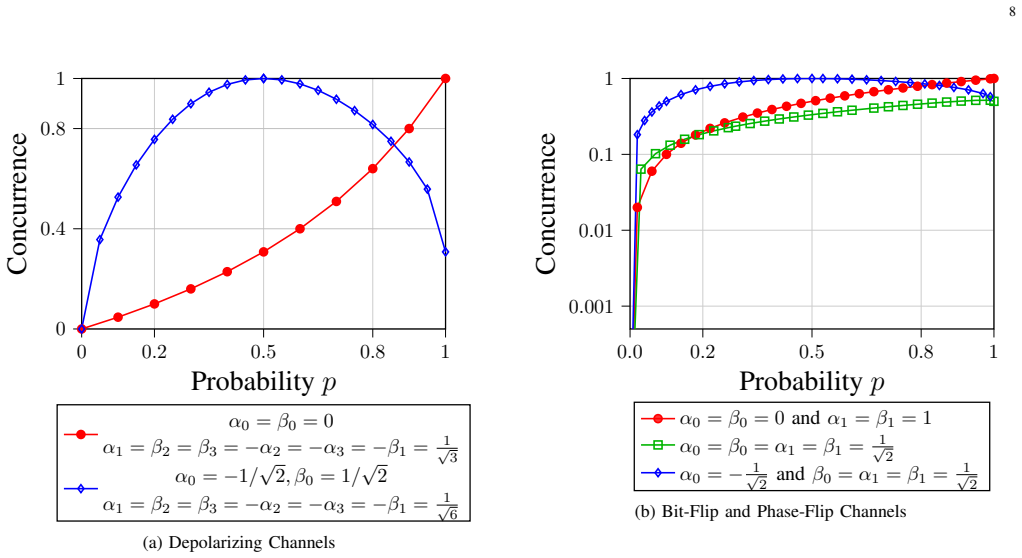
The coherent superposition of spatially distinct noisy communication links enables the deterministic transformation of separable quantum states into entangled states during their distribution, transforming quantum noise into a constructive resource for generating both bipartite and multipartite entanglement.
What carries the argument
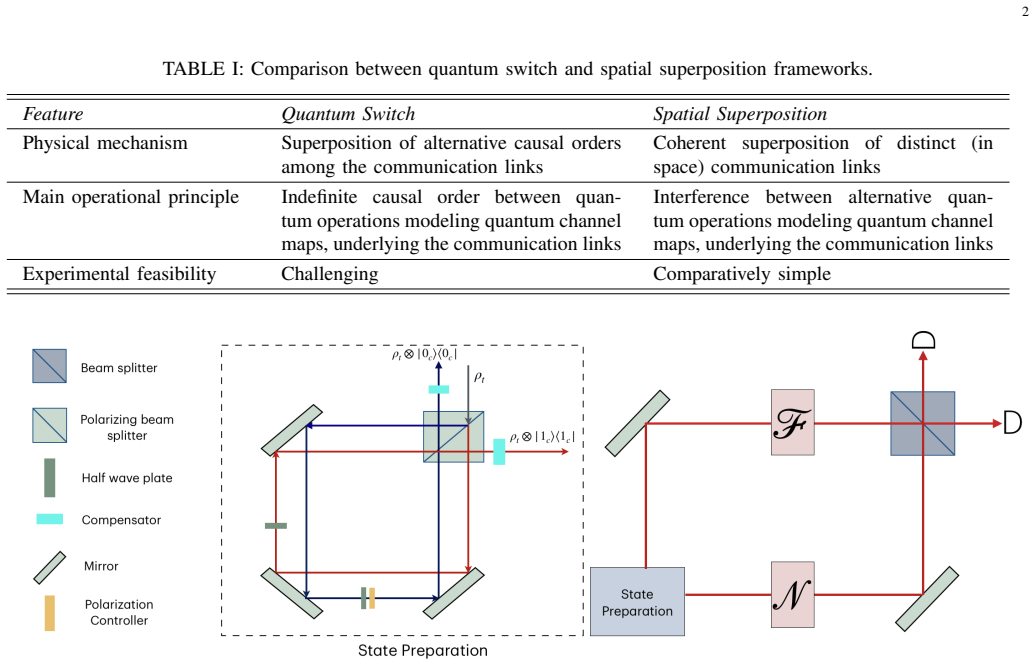
Coherent spatial superposition of distinct communication links, which permits constructive interference of channel noise to produce entanglement from separable inputs.
If this is right
- Entanglement generation occurs inherently during distribution without separate preparation steps.
- Quantum noise functions as a constructive resource for entanglement rather than a detriment.
- The transformation applies deterministically to both bipartite and multipartite entanglement.
- The method can be realized in practical interferometric setups for quantum networks.
Where Pith is reading between the lines
- Network designs could merge entanglement creation with transmission to lower the need for dedicated sources.
- Similar superposition techniques might extend to other noise-affected quantum tasks such as error mitigation.
- Real-world tests in fiber or free-space channels would clarify how well the required coherence holds at scale.
Load-bearing premise
The coherent superposition of distinct spatial paths can be maintained through the noisy channels without extra decoherence that disrupts the needed interference.
What would settle it
An experiment in which separable input states remain separable, with no entanglement generated, after distribution over coherently superposed noisy links would disprove the claim.
Figures




read the original abstract
The exploitation of quantum coherence at the level of propagation represents a powerful paradigm for quantum communication networks. In this work, we show that the coherent superposition of spatially distinct communication links enables entanglement generation inherently during distribution. Specifically, separable quantum states can be deterministically transformed into entangled states, when the noisy communication links they traverse are coherently superposed. Contrary to the conventional view of noise as a detrimental effect, we demonstrate that quantum noise itself can be transformed into a constructive resource for entanglement generation for both bipartite and multipartite entanglement. Given the practical feasibility of implementing spatial superposition in interferometric setups, our approach provides a feasible method for distributed entanglement engineering, opening new directions for quantum communication and networked quantum technologies.
Editorial analysis
A structured set of objections, weighed in public.
Referee Report
Summary. The manuscript claims that coherently superposing spatially distinct noisy communication links enables deterministic transformation of separable quantum states into entangled states during distribution. Quantum noise is reframed as a constructive resource that generates both bipartite and multipartite entanglement via interference in the superposed paths, with practical implementation via interferometric setups.
Significance. If the central claim is substantiated with explicit calculations, the result would be significant for quantum networks: it offers a noise-tolerant method for entanglement engineering that leverages rather than combats channel imperfections, potentially simplifying distributed quantum information processing.
major comments (2)
- [Channel model and output-state derivation] The protocol's viability hinges on maintaining coherence in the spatial superposition (which-path degree of freedom) through the noisy links. No explicit Kraus operators or density-matrix evolution for the superposed channel are supplied to demonstrate that path-dependent decoherence (e.g., differential phase noise) does not destroy the off-diagonal terms required for constructive interference.
- [Entanglement generation section] The determinism claim for separable-to-entangled transformation lacks a concrete calculation showing how the noise-induced interference term produces a non-separable output state; without this, it is impossible to verify that the protocol succeeds for the stated noise models.
minor comments (1)
- [Abstract] The abstract would be strengthened by a single sentence summarizing the noise model or the form of the superposed channel.
Simulated Author's Rebuttal
We thank the referee for the positive assessment of the potential significance of our work and for the constructive comments. We will revise the manuscript to provide the explicit derivations requested, which will strengthen the presentation of the channel model and the entanglement calculations.
read point-by-point responses
-
Referee: The protocol's viability hinges on maintaining coherence in the spatial superposition (which-path degree of freedom) through the noisy links. No explicit Kraus operators or density-matrix evolution for the superposed channel are supplied to demonstrate that path-dependent decoherence (e.g., differential phase noise) does not destroy the off-diagonal terms required for constructive interference.
Authors: We agree that an explicit Kraus-operator treatment of the superposed channel is required for rigor. In the revised manuscript we will derive the effective channel for the coherently superposed paths by constructing the joint Kraus operators from the individual link noise models. For the noise classes considered (symmetric depolarizing or dephasing channels without additional path-dependent differential phases), the calculation shows that the off-diagonal coherence terms in the which-path subspace remain intact, allowing the interference that produces entanglement. The density-matrix evolution through the superposed channel will be written out explicitly. revision: yes
-
Referee: The determinism claim for separable-to-entangled transformation lacks a concrete calculation showing how the noise-induced interference term produces a non-separable output state; without this, it is impossible to verify that the protocol succeeds for the stated noise models.
Authors: We accept that a fully explicit calculation is necessary to substantiate the deterministic transformation. In the revised version we will expand the entanglement-generation section with the complete step-by-step derivation: starting from a product input state, applying the superposed noisy channel, and obtaining the output density operator. The noise-induced cross terms will be isolated, and we will evaluate an entanglement monotone (concurrence or negativity) to confirm that the output is entangled for the noise parameters stated in the paper. This will make the deterministic character of the protocol verifiable. revision: yes
Circularity Check
No circularity: derivation follows from standard quantum superposition applied to noisy channels
full rationale
The paper derives entanglement generation from the coherent superposition of distinct noisy links acting on separable input states, using standard quantum mechanics (interference and channel action on superposed paths). No equations reduce by construction to fitted inputs, self-definitions, or load-bearing self-citations. The central claim is presented as a direct consequence of quantum principles without renaming known results or smuggling ansatzes via prior self-work. The derivation remains self-contained against external benchmarks of quantum channel theory.
Axiom & Free-Parameter Ledger
axioms (1)
- domain assumption Coherent superposition of spatially distinct communication links can be maintained through noisy channels.
Reference graph
Works this paper leans on
-
[1]
Entanglement generation via spatial paths superposition,
R. Sk, C. Pellitteri, M. Caleffi, , and A. S. Cacciapuoti, “Entanglement generation via spatial paths superposition,”Proc. of IEEE ICC, 2026
work page 2026
-
[2]
Quantum internet architecture: Unlocking quantum-native routing via quantum addressing,
M. Caleffi and A. S. Cacciapuoti, “Quantum internet architecture: Unlocking quantum-native routing via quantum addressing,”IEEE Transactions on Communications, vol. 74, pp. 3577–3599, 2026
work page 2026
-
[3]
When entanglement meets classical communications: Quantum teleportation for the quantum internet,
A. S. Cacciapuoti, M. Caleffi, R. Van Meter, and L. Hanzo, “When entanglement meets classical communications: Quantum teleportation for the quantum internet,”IEEE Transactions on Communications, vol. 68, no. 6, pp. 3808–3833, 2020
work page 2020
-
[4]
A quantum internet protocol suite beyond layering,
A. S. Cacciapuoti and M. Caleffi, “A quantum internet protocol suite beyond layering,”IEEE Transactions on Network Science and Engi- neering, pp. 1–18, 2026, invited Paper
work page 2026
-
[5]
A. Buchleitner, C. Viviescas, and M. Tiersch,Entanglement and deco- herence: foundations and modern trends. Springer, 2008, vol. 768
work page 2008
-
[6]
Dy- namics of quantum entanglement,
K. ˙Zyczkowski, P. Horodecki, M. Horodecki, and R. Horodecki, “Dy- namics of quantum entanglement,”Physical Review A, vol. 65, no. 1, p. 012101, 2001
work page 2001
-
[7]
Entanglement dynamics of two independent qubits in environments with and without memory,
B. Bellomo, R. Lo Franco, and G. Compagno, “Entanglement dynamics of two independent qubits in environments with and without memory,” Physical Review A—Atomic, Molecular, and Optical Physics, vol. 77, no. 3, p. 032342, 2008
work page 2008
-
[8]
Entanglement dynamics of two qubits in a common bath,
J. Ma, Z. Sun, X. Wang, and F. Nori, “Entanglement dynamics of two qubits in a common bath,”Physical Review A—Atomic, Molecular, and Optical Physics, vol. 85, no. 6, p. 062323, 2012
work page 2012
-
[9]
Quantum repeaters: From quantum networks to the quantum internet,
K. Azuma, S. E. Economou, D. Elkouss, P. Hilaire, L. Jiang, H.-K. Lo, and I. Tzitrin, “Quantum repeaters: From quantum networks to the quantum internet,”Reviews of Modern Physics, vol. 95, no. 4, p. 045006, 2023
work page 2023
-
[10]
Entanglement purification for quantum communication,
J.-W. Pan, C. Simon, ˇC. Brukner, and A. Zeilinger, “Entanglement purification for quantum communication,”Nature, vol. 410, no. 6832, pp. 1067–1070, 2001
work page 2001
-
[11]
Advances in quan- tum entanglement purification,
P.-S. Yan, L. Zhou, W. Zhong, and Y .-B. Sheng, “Advances in quan- tum entanglement purification,”Science China Physics, Mechanics & Astronomy, vol. 66, no. 5, p. 250301, 2023
work page 2023
-
[12]
Protecting entan- glement from decoherence using weak measurement and quantum measurement reversal,
Y .-S. Kim, J.-C. Lee, O. Kwon, and Y .-H. Kim, “Protecting entan- glement from decoherence using weak measurement and quantum measurement reversal,”Nature Physics, vol. 8, no. 2, pp. 117–120, 2012
work page 2012
-
[13]
Distillation of multipartite entanglement by local filtering operations,
Y .-S. Huang, H.-B. Xing, M. Yang, Q. Yang, W. Song, and Z.-L. Cao, “Distillation of multipartite entanglement by local filtering operations,” Physical Review A, vol. 89, no. 6, p. 062320, 2014
work page 2014
-
[14]
Z. Cai, R. Babbush, S. C. Benjamin, S. Endo, W. J. Huggins, Y . Li, J. R. McClean, and T. E. O’Brien, “Quantum error mitigation,”Reviews of Modern Physics, vol. 95, no. 4, p. 045005, 2023
work page 2023
-
[15]
Quantum shannon theory with superpositions of trajectories,
G. Chiribella and H. Kristjánsson, “Quantum shannon theory with superpositions of trajectories,”Proceedings of the Royal Society A, vol. 475, no. 2225, p. 20180903, 2019
work page 2019
-
[16]
Experimental quantum switching for exponentially superior quantum communication complex- ity,
K. Wei, N. Tischler, S.-R. Zhao, Y .-H. Li, J. M. Arrazola, Y . Liu, W. Zhang, H. Li, L. You, Z. Wanget al., “Experimental quantum switching for exponentially superior quantum communication complex- ity,”Physical review letters, vol. 122, no. 12, p. 120504, 2019
work page 2019
-
[17]
Experimental verification of an indefinite causal order,
G. Rubino, L. A. Rozema, A. Feix, M. Araújo, J. M. Zeuner, L. M. Procopio, ˇC. Brukner, and P. Walther, “Experimental verification of an indefinite causal order,”Science advances, vol. 3, no. 3, p. e1602589, 2017
work page 2017
-
[18]
Indefinite causal order and quantum coordinates,
A.-C. de la Hamette, V . Kabel, M. Christodoulou, and ˇC. Brukner, “Indefinite causal order and quantum coordinates,”Physical Review Letters, vol. 135, no. 14, p. 141402, 2025. 13
work page 2025
-
[19]
Communication through coherent control of quantum channels,
A. A. Abbott, J. Wechs, D. Horsman, M. Mhalla, and C. Branciard, “Communication through coherent control of quantum channels,”Quan- tum, vol. 4, p. 333, 2020
work page 2020
-
[20]
Experimental communication through superpo- sition of quantum channels,
A. O. Pang, N. Lupu-Gladstein, H. Ferretti, Y . B. Yilmaz, A. Brodutch, and A. M. Steinberg, “Experimental communication through superpo- sition of quantum channels,”Quantum, vol. 7, p. 1125, 2023
work page 2023
-
[21]
Quantum correlations with no causal order,
O. Oreshkov, F. Costa, and ˇC. Brukner, “Quantum correlations with no causal order,”Nature communications, vol. 3, no. 1, p. 1092, 2012
work page 2012
-
[22]
Experimental aspects of indefinite causal order in quantum mechanics,
L. A. Rozema, T. Strömberg, H. Cao, Y . Guo, B.-H. Liu, and P. Walther, “Experimental aspects of indefinite causal order in quantum mechanics,” Nature Reviews Physics, vol. 6, no. 8, pp. 483–499, 2024
work page 2024
-
[23]
Error filtration and entanglement purification for quantum communication,
N. Gisin, N. Linden, S. Massar, and S. Popescu, “Error filtration and entanglement purification for quantum communication,”Physical Review A—Atomic, Molecular, and Optical Physics, vol. 72, no. 1, p. 012338, 2005
work page 2005
-
[24]
Communication through quantum-controlled noise,
P. A. Guérin, G. Rubino, and ˇC. Brukner, “Communication through quantum-controlled noise,”Physical Review A, vol. 99, no. 6, p. 062317, 2019
work page 2019
-
[25]
Quantum paths: A quantum walk approach,
C. Pellitteri, M. Caleffi, and A. S. Cacciapuoti, “Quantum paths: A quantum walk approach,” in2025 IEEE International Conference on Quantum Computing and Engineering (QCE), vol. 01, 2025, pp. 1248– 1251
work page 2025
-
[26]
Enhanced communication with the assistance of indefinite causal order,
D. Ebler, S. Salek, and G. Chiribella, “Enhanced communication with the assistance of indefinite causal order,”Phys. Rev. Lett., vol. 120, no. 12, p. 120502, 2018
work page 2018
-
[27]
Quantum switch for the quantum internet: Noiseless communications through noisy channels,
M. Caleffi and A. S. Cacciapuoti, “Quantum switch for the quantum internet: Noiseless communications through noisy channels,”IEEE Journal on Selected Areas in Communications, vol. 38, no. 3, pp. 575– 588, 2020
work page 2020
-
[28]
Experimental quantum communication enhancement by superposing trajectories,
G. Rubino, L. A. Rozema, D. Ebler, H. Kristjánsson, S. Salek, P. Al- lard Guérin, A. A. Abbott, C. Branciard, ˇC. Brukner, G. Chiribellaet al., “Experimental quantum communication enhancement by superposing trajectories,”Physical Review Research, vol. 3, no. 1, p. 013093, 2021
work page 2021
-
[29]
The entanglement- assisted communication capacity over quantum trajectories,
D. Chandra, M. Caleffi, and A. S. Cacciapuoti, “The entanglement- assisted communication capacity over quantum trajectories,”IEEE Transactions on Wireless Communications, vol. 21, no. 6, pp. 3632– 3647, 2021
work page 2021
-
[30]
Universal quantum computation via superposed orders of single-qubit gates,
K. Simonov, M. Caleffi, J. Illiano, J. Romero, and A. S. Cacciapuoti, “Universal quantum computation via superposed orders of single-qubit gates,”Phys. Rev. Res., vol. 8, p. 013239, Mar 2026. [Online]. Available: https://link.aps.org/doi/10.1103/6xwr-9b4y
-
[31]
Beyond shannon limits: Quantum communications through quantum paths,
M. Caleffi, K. Simonov, and A. S. Cacciapuoti, “Beyond shannon limits: Quantum communications through quantum paths,”IEEE Journal on Selected Areas in Communications, vol. 41, no. 8, pp. 2707–2724, 2023
work page 2023
-
[32]
Quan- tum computations without definite causal structure,
G. Chiribella, G. M. D’Ariano, P. Perinotti, and B. Valiron, “Quan- tum computations without definite causal structure,”Physical Review A—Atomic, Molecular, and Optical Physics, vol. 88, no. 2, p. 022318, 2013
work page 2013
-
[33]
Quantum computation with indefinite causal structures,
M. Araújo, P. A. Guérin, and Ä. Baumeler, “Quantum computation with indefinite causal structures,”Physical Review A, vol. 96, no. 5, p. 052315, 2017
work page 2017
-
[34]
No-signalling constrains quan- tum computation with indefinite causal structure,
L. Apadula, A. Bisio, and P. Perinotti, “No-signalling constrains quan- tum computation with indefinite causal structure,”Quantum, vol. 8, p. 1241, 2024
work page 2024
-
[35]
Deterministic generation of multipartite entanglement via causal activation in the quantum internet,
S. Koudia, A. S. Cacciapuoti, and M. Caleffi, “Deterministic generation of multipartite entanglement via causal activation in the quantum internet,”IEEE Access, vol. 11, pp. 73 863–73 878, 2023
work page 2023
-
[36]
W.-Q. Liu and H.-R. Wei, “Deterministic generation of multiqubit entangled states among distant parties using indefinite causal order,” Physical Review Applied, vol. 23, no. 5, p. 054075, 2025
work page 2025
-
[37]
Self-configuring quantum networks with superposition of trajectories,
A. Chan, Z. Shi, J. Miguel-Ramiro, L. Dellantonio, C. A. Muschik, and W. Dür, “Self-configuring quantum networks with superposition of trajectories,”arXiv preprint arXiv:2510.19092, 2025
-
[38]
Dynamically disordered quantum walk as a maximal entanglement generator,
R. Vieira, E. P. Amorim, and G. Rigolin, “Dynamically disordered quantum walk as a maximal entanglement generator,”Physical review letters, vol. 111, no. 18, p. 180503, 2013
work page 2013
-
[39]
Quantum walk on a line with two entangled particles,
Y . Omar, N. Paunkovi ´c, L. Sheridan, and S. Bose, “Quantum walk on a line with two entangled particles,”Physical Review A—Atomic, Molecular, and Optical Physics, vol. 74, no. 4, p. 042304, 2006
work page 2006
-
[40]
Entangled state generation via quantum walks with multiple coins,
M. Li and Y . Shang, “Entangled state generation via quantum walks with multiple coins,”npj Quantum Information, vol. 7, no. 1, p. 70, 2021
work page 2021
-
[41]
Quantum walks: a comprehensive review,
S. E. Venegas-Andraca, “Quantum walks: a comprehensive review,” Quantum Information Processing, vol. 11, no. 5, pp. 1015–1106, Oct
-
[42]
Available: https://doi.org/10.1007/s11128-012-0432-5
[Online]. Available: https://doi.org/10.1007/s11128-012-0432-5
-
[43]
Quantum random walks: An introductory overview,
J. K. and, “Quantum random walks: An introductory overview,” Contemporary Physics, vol. 44, no. 4, pp. 307–327, 2003. [Online]. Available: https://doi.org/10.1080/00107151031000110776
-
[44]
Quantum internet protocol stack: A comprehensive survey,
J. Illiano, M. Caleffi, A. Manzalini, and A. S. Cacciapuoti, “Quantum internet protocol stack: A comprehensive survey,”Computer Networks, vol. 213, p. 109092, 2022
work page 2022
-
[45]
Classification of ghz-type,w-type, and ghz-w-type multiqubit entanglement,
L. Chen and Y .-X. Chen, “Classification of ghz-type,w-type, and ghz-w-type multiqubit entanglement,”Phys. Rev. A, vol. 74, p. 062310, Dec 2006. [Online]. Available: https://link.aps.org/doi/10. 1103/PhysRevA.74.062310
work page 2006
-
[46]
Intra-qlan connectivity via graph states: Beyond the physical topology,
F. Mazza, M. Caleffi, and A. S. Cacciapuoti, “Intra-qlan connectivity via graph states: Beyond the physical topology,”IEEE Transactions on Network Science and Engineering, vol. 12, no. 2, pp. 870–887, 2025
work page 2025
-
[47]
Three qubits can be entangled in two inequivalent ways,
W. Dür, G. Vidal, and J. I. Cirac, “Three qubits can be entangled in two inequivalent ways,”Phys. Rev. A, vol. 62, p. 062314, Nov
-
[49]
Entanglement of formation of an arbitrary state of two qubits,
W. K. Wootters, “Entanglement of formation of an arbitrary state of two qubits,”Phys. Rev. Lett., vol. 80, pp. 2245–2248, Mar 1998. [Online]. Available: https://link.aps.org/doi/10.1103/PhysRevLett.80.2245
-
[50]
Multipartite analysis of average- subsystem entropies,
A. Alonso-Serrano and M. Visser, “Multipartite analysis of average- subsystem entropies,”Phys. Rev. A, vol. 96, p. 052302, Nov
-
[51]
Fowler, Matteo Mariantoni, John M
[Online]. Available: https://link.aps.org/doi/10.1103/PhysRevA. 96.052302
-
[52]
J. Miguel-Ramiro, F. Riera-Sàbat, and W. Dür, “Quantum repeater for wstates,”PRX Quantum, vol. 4, p. 040323, Nov 2023. [Online]. Available: https://link.aps.org/doi/10.1103/PRXQuantum.4.040323
discussion (0)
Sign in with ORCID, Apple, or X to comment. Anyone can read and Pith papers without signing in.