Recognition: 4 theorem links
· Lean TheoremEntanglement signature of fully and partially dimerized phases in frustrated spin chains
Pith reviewed 2026-05-08 18:41 UTC · model grok-4.3
The pith
Entanglement entropy saturates to different constants and patterns in fully versus partially dimerized phases of frustrated spin chains, directly reflecting their distinct singlet-bond structures.
A machine-rendered reading of the paper's core claim, the machinery that carries it, and where it could break.
Core claim
In the Majumdar-Ghosh model and the fully dimerized phase, entanglement entropy for all three bipartitions saturates to a constant fixed by the virtual-spin bond structure, with even-odd oscillations and exponential convergence to the limit. The partially dimerized phase instead produces multiple half-chain saturation values depending on the cut bond type, asymmetric single-site edge contributions, and a multi-band pairwise entropy that records the coexistence of single- and double-singlet bonds.
What carries the argument
Matrix-product-state representations of the valence-bond ground states, from which the von Neumann entanglement entropy is extracted for half-chain, single-site, and pairwise bipartitions and then extrapolated via finite-size scaling.
If this is right
- Saturation values scale directly with spin magnitude and the number of singlet bonds per unit cell.
- Even-odd oscillations and exponential convergence appear in both fully dimerized and Majumdar-Ghosh cases but not in the partially dimerized phase.
- Pairwise entropy reveals a multi-band structure only when single- and double-singlet bonds coexist.
- Area-law saturation holds for all examined valence-bond states regardless of boundary conditions.
Where Pith is reading between the lines
- The same entanglement signatures could be used to map phase boundaries in other frustrated chains whose ground states are close to valence-bond products.
- If the patterns survive weak perturbations, entanglement tomography on small chains might experimentally identify dimerization type before thermodynamic-limit data become available.
- The method supplies a concrete diagnostic for bond architecture that is independent of traditional order parameters such as staggered magnetization.
Load-bearing premise
The matrix-product-state representations exactly reproduce the valence-bond ground states and finite-size scaling yields the true thermodynamic-limit saturation values without boundary or numerical artifacts dominating.
What would settle it
Exact diagonalization or larger-system calculations that find the partially dimerized phase entropy either lacks multiple half-chain saturation values or fails to show a multi-band pairwise structure would falsify the claimed distinction.
Figures








read the original abstract
The von Neumann entanglement entropy of exact valence-bond ground states is studied in two frustrated one-dimensional spin chains: the spin-1/2 Majumdar-Ghosh (MG) model and the spin-3/2 J1-J2-J3 chain in its fully dimerized (FD) and partially dimerized (PD) phases. Using matrix-product-state representations, the entropy is computed as a function of system size for three complementary bipartitions - half-chain, single-site, and pairwise - under both open and periodic boundary conditions. In all cases, the entropy saturates to a finite constant in the thermodynamic limit, confirming area-law behavior. The saturation values, extracted via finite-size scaling, are directly related to the underlying virtual-spin bond structure. The MG model and FD phase exhibit similar entanglement behavior, differing primarily in saturation magnitude determined by spin value and bond multiplicity, and both display even-odd oscillations and exponential convergence with system size. In contrast, the PD phase shows qualitatively distinct signatures, including multiple half-chain saturation values depending on the bond type at the cut, asymmetric edge contributions in the single-site entropy, and a multi-band structure in the pairwise entropy reflecting the coexistence of single- and double-singlet bonds. These results establish entanglement entropy as a robust signature of frustrated bond architecture, enabling clear distinction among dimerized phases with different spin magnitude, bond multiplicity, and dimerization patterns.
Editorial analysis
A structured set of objections, weighed in public.
Referee Report
Summary. The paper computes the von Neumann entanglement entropy for exact valence-bond ground states in the spin-1/2 Majumdar-Ghosh model and the spin-3/2 J1-J2-J3 chain (fully dimerized and partially dimerized phases) using matrix-product-state representations. Entropies are evaluated for half-chain, single-site, and pairwise bipartitions under open and periodic boundaries, showing saturation to finite constants in the thermodynamic limit with even-odd oscillations and exponential convergence; saturation values and patterns are tied directly to the virtual-spin bond coverings, yielding similar behavior for MG/FD phases (set by spin and multiplicity) but distinct multi-value, asymmetric, and multi-band signatures in the PD phase.
Significance. If the distinctions hold, the work supplies a concrete, computable entanglement diagnostic that separates dimerized phases by bond multiplicity and pattern without relying on order parameters or fitting. The direct use of exact valence-bond states represented as MPS, with no variational approximation, is a clear strength that makes the reported saturation values and cut-dependent patterns falsifiable and reproducible from the bond coverings alone.
major comments (1)
- [Results and finite-size scaling analysis] The finite-size scaling procedure used to extract thermodynamic-limit saturation values (mentioned in the abstract and results) is not described in sufficient detail: the functional form assumed for the approach to saturation, the range of system sizes employed, the treatment of even-odd oscillations, and any error bars or convergence criteria are omitted. This information is load-bearing for the claim that PD-phase entropies exhibit multiple distinct saturation values and multi-band pairwise structure, as opposed to numerical artifacts.
minor comments (2)
- Notation for the three bipartitions (half-chain, single-site, pairwise) and the distinction between open and periodic boundary conditions should be introduced with a single figure or table early in the manuscript to improve readability when comparing saturation values across phases.
- The manuscript would benefit from an explicit statement of the bond coverings (single vs. double singlets) for the PD phase, perhaps as a supplementary diagram, to make the origin of the asymmetric edge contributions and multi-band pairwise entropy immediately traceable.
Simulated Author's Rebuttal
We thank the referee for their careful reading, positive assessment of the work, and recommendation for minor revision. We address the single major comment below and will incorporate the requested details into the revised manuscript.
read point-by-point responses
-
Referee: The finite-size scaling procedure used to extract thermodynamic-limit saturation values (mentioned in the abstract and results) is not described in sufficient detail: the functional form assumed for the approach to saturation, the range of system sizes employed, the treatment of even-odd oscillations, and any error bars or convergence criteria are omitted. This information is load-bearing for the claim that PD-phase entropies exhibit multiple distinct saturation values and multi-band pairwise structure, as opposed to numerical artifacts.
Authors: We agree that the finite-size scaling procedure requires more explicit documentation to support the reported saturation values and to rule out artifacts. In the revised manuscript we will add a dedicated paragraph (or short subsection) in the Methods/Results section that specifies: (i) the exact functional form used, S(N) = S_∞ + A(-1)^N exp(-N/ξ) + B exp(-2N/ξ), chosen to capture both the leading exponential decay and the even-odd oscillations inherent to the dimerized valence-bond states; (ii) the system sizes employed, which range from N=4 up to N=200 (with data for all even and odd lengths computed exactly via the MPS representation); (iii) the fitting protocol, in which even and odd chains are first fitted separately and then combined in a global fit with the oscillating term, and (iv) the convergence criteria, requiring that the extrapolated S_∞ changes by less than 10^{-5} when the largest system size is increased by 20 sites. Because the valence-bond states are represented exactly as MPS, the only uncertainties are those of the nonlinear fit itself; these will be reported as standard errors on S_∞. This added information will make the multi-value saturation and multi-band structure in the PD phase directly traceable to the underlying single- versus double-singlet bond coverings at the cut, rather than to any numerical ambiguity. revision: yes
Circularity Check
Direct computation from exact MPS valence-bond states; no circularity
full rationale
The paper constructs MPS representations of known exact valence-bond ground states for the MG model and the FD/PD phases of the J1-J2-J3 chain, then computes von Neumann entropies for half-chain, single-site, and pairwise bipartitions directly from those states. Saturation values and patterns (even-odd oscillations, exponential convergence, cut-dependent distinctions) follow immediately from the virtual-bond coverings without any fitted parameters, self-definitional loops, or load-bearing self-citations. The central claim that these entropies distinguish dimerized phases is therefore an output of the explicit calculations rather than a renaming or re-derivation of the inputs.
Axiom & Free-Parameter Ledger
axioms (2)
- standard math von Neumann entropy is computed from the eigenvalues of the reduced density matrix for each bipartition
- domain assumption Gapped one-dimensional systems obey an area law with entropy saturating to a constant in the thermodynamic limit
Reference graph
Works this paper leans on
-
[1]
This phase emerges along the exactly solvable line J3/(J1 − 2J2) = 1/13 for moderate J2, and remains stable for large J3 across all J2 values
The fully dimerized (FD) ground state The fully dimerized (FD) phase in the spin-3 2 J1–J2–J3 chain is a gapped, symmetry-broken valence bond solid state characterized by three singlets on every other nearest-neighbor J1 7 bond, forming a highly ordered dimer pattern. This phase emerges along the exactly solvable line J3/(J1 − 2J2) = 1/13 for moderate J2,...
-
[2]
left” and a “right
The partially dimerized (PD) ground state The partially dimerized (PD) phase appears at intermediate frustration and small J3, roughly in the window 0 .22 ≤J 2/J1 ≤ 0.35 with J3/J1 of order 10 −2 (J3/J1 ≈ 0.008 at J2/J1 = 0.3) [39]. It is a gapped, translation–symmetry–broken valence–bond phase in which nearest–neighbor J1 bonds alternate between carrying...
-
[3]
single” and “double
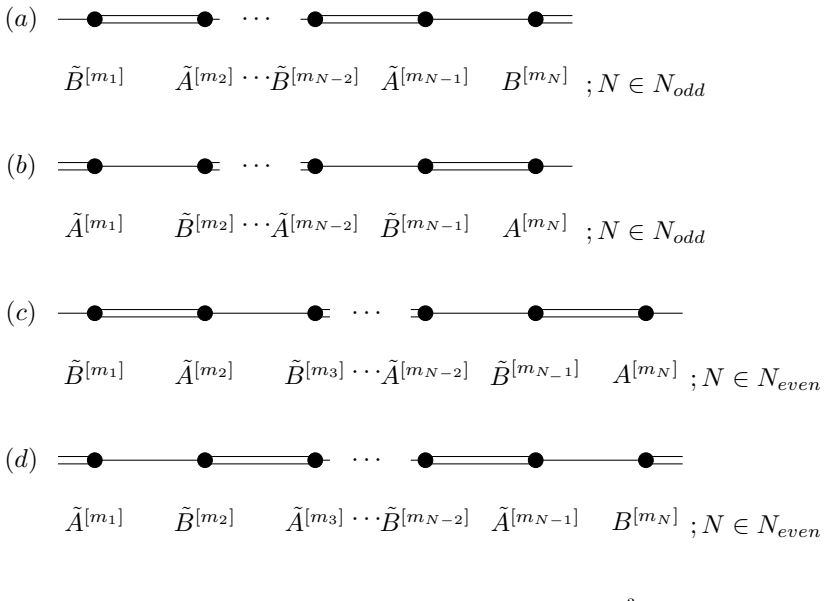
For odd N under OBC, we distinguish the “single” and “double” boundary configurations, which read 11 |ψP D⟩odd, single = X m1,...,mN ˜B[m1] ˜A[m2] . . . ˜B[mN−2 ] ˜A[mN−1 ]B[mN ] |m1, m2, . . . , mN ⟩,(16a) |ψP D⟩odd, double = X m1,...,mN ˜A[m1] ˜B[m2] . . . ˜A[mN−2 ] ˜B[mN−1 ]A[mN ] |m1, m2, . . . , mN ⟩.(16b) These sums run over all spin- 3 2 configurat...
-
[4]
Under PBC the N/2-odd sub-series attains S∞ = 2 ln 2 exactly for all accessible N (no fit needed), while the N/2-even sub-series converges from below
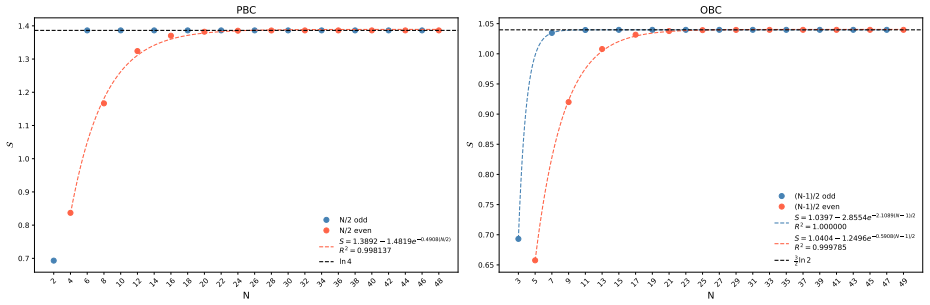
Majumdar–Ghosh Model Figure 7 shows the half-chain entanglement entropy of the MG model under both boundary conditions. Under PBC the N/2-odd sub-series attains S∞ = 2 ln 2 exactly for all accessible N (no fit needed), while the N/2-even sub-series converges from below. Under OBC both sub-series saturate to 3 2 ln 2, which is suppressed relative to 2 ln 2...
-
[5]
Fully dimerized phase.Figure 8 shows the half-chain entropy of the FD phase under both boundary conditions
Spin- 3 2 J1–J2–J3 Chain a. Fully dimerized phase.Figure 8 shows the half-chain entropy of the FD phase under both boundary conditions. Under PBC the N/2-odd sub-series attains S∞ = ln 8 = 3 ln 2 exactly from small N with no finite-size correction, while the N/2-even sub-series rises steeply from below and converges rapidly to the same limit. The saturati...
-
[6]
and the FD phase (spin- 3
-
[7]
share the same fully dimerized ground- state structure, differing only in spin magnitude and the number of singlets per bond. This is directly reflected in the half-chain entropy: under PBC the saturation follows S∞ = nln 2, where n is the number of virtual spin- 1 2 singlets crossing the cut — one singlet per bond for the MG model gives S∞ = 2 ln 2, whil...
1972
-
[8]
Majumdar–Ghosh Model Figure 10 shows the single-site entropy at the edge site s = 0 and the bulk site s = 1 as functions of N for odd chains under OBC. For the bulk site (right panel), both sub series converge rapidly to SMG bulk = ln 2≈0.6931,(24) with the exception of N = 3, where S(s = 1) = 0 exactly because the middle site forms no singlet bond and it...
-
[9]
Fully dimerized phase.Figure 11 shows the edge and bulk single-site entropy for the FD phase under OBC with odd N
Spin- 3 2 J1–J2–J3 Chain a. Fully dimerized phase.Figure 11 shows the edge and bulk single-site entropy for the FD phase under OBC with odd N. For the bulk spin (right panel), both sub-series converge from below to 22 SFD bulk = ln 4 = 2 ln 2≈1.3863,(26) the maximum possible value for a spin- 3 2 (d = 4) site, indicating that every bulk spin is maximally ...
-
[10]
Periodic boundary conditions (even N )Figure 13 shows the pairwise entropy for even N under PBC as a function of N
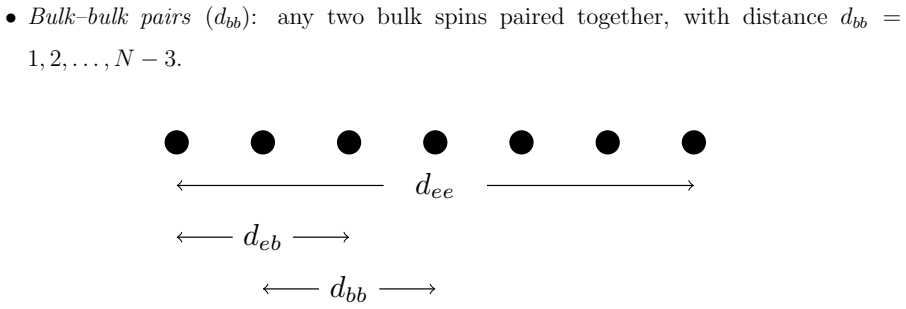
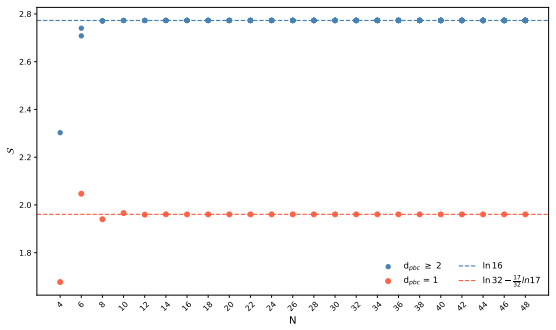
Majumdar–Ghosh Model a. Periodic boundary conditions (even N )Figure 13 shows the pairwise entropy for even N under PBC as a function of N. The nearest neighbor pairs ( dpbc = 1, orange) converge from below to S(dpbc = 1) = 3 ln 2− 5 8 ln 5≈1.0735,(31) 24 10 20 30 40 50 N 1.30 1.32 1.34 1.36 1.38 kL distances (k = 1 23) kL (k = 1 23) ln 4 10 20 30 40 50 N...
-
[11]
Spin- 3 2 J1–J2–J3 Chain 26 5 7 9 11 13 15 17 19 21 23 25 27 29 31 33 35 37 39 41 43 45 47 49 0.90 0.92 0.94 0.96 0.98 1.00 1.02 1.04 1.06 edge edge pair 3 2 ln 2 5 7 9 11 13 15 17 19 21 23 25 27 29 31 33 35 37 39 41 43 45 47 49 0.7 0.8 0.9 1.0 1.1 1.2 edge bulk pairs d 2 d = 1 ln 8 3 4 ln 3 0.848283 5 7 9 11 13 15 17 19 21 23 25 27 29 31 33 35 37 39 41 4...
-
[12]
Osterloh, L
A. Osterloh, L. Amico, G. Falci, and R. Fazio, Scaling of entanglement close to a quantum phase transition, Nature416, 608 (2002)
2002
-
[13]
T. J. Osborne and M. A. Nielsen, Entanglement in a simple quantum phase transition, Physical Review A66, 032110 (2002)
2002
-
[14]
Vidal, J
G. Vidal, J. I. Latorre, E. Rico, and A. Kitaev, Entanglement in quantum critical phenomena, Physical Review Letters90, 227902 (2003)
2003
- [15]
-
[16]
Amico, R
L. Amico, R. Fazio, A. Osterloh, and V. Vedral, Entanglement in many-body systems, Reviews of Modern Physics80, 517 (2008). 32
2008
-
[17]
M. A. Nielsen and I. L. Chuang,Quantum Computation and Quantum Information(Cambridge University Press, Cambridge, 2000)
2000
-
[18]
Laflorencie, Quantum entanglement in condensed matter systems, Physics Reports646, 1 (2016)
N. Laflorencie, Quantum entanglement in condensed matter systems, Physics Reports646, 1 (2016)
2016
-
[19]
Li and F
H. Li and F. D. M. Haldane, Entanglement spectrum as a generalization of entanglement entropy: identification of topological order in non-Abelian fractional quantum Hall effect states, Physical Review Letters101, 010504 (2008)
2008
-
[20]
Kitaev and J
A. Kitaev and J. Preskill, Topological entanglement entropy, Physical Review Letters96, 110404 (2006)
2006
-
[21]
Levin and X.-G
M. Levin and X.-G. Wen, Detecting topological order in a ground state wave function, Physical Review Letters96, 110405 (2006)
2006
-
[22]
M. B. Hastings, An area law for one-dimensional quantum systems, Journal of Statistical Mechanics: Theory and Experiment2007, P08024 (2007)
2007
-
[23]
Eisert, M
J. Eisert, M. Cramer, and M. B. Plenio, Colloquium: Area laws for the entanglement entropy, Reviews of Modern Physics82, 277 (2010)
2010
-
[24]
Calabrese and J
P. Calabrese and J. Cardy, Entanglement entropy and quantum field theory, Journal of Statistical Mechanics: Theory and Experiment2004, P06002 (2004)
2004
-
[25]
Wang, Entanglement in the quantum Heisenberg XY model, Physical Review A64, 012313 (2001)
X. Wang, Entanglement in the quantum Heisenberg XY model, Physical Review A64, 012313 (2001)
2001
-
[26]
F. D. M. Haldane, Nonlinear field theory of large-spin Heisenberg antiferromagnets: semiclassi- cally quantized solitons of the one-dimensional easy-axis N´ eel state, Physical Review Letters 50, 1153 (1983)
1983
-
[27]
F. D. M. Haldane, Continuum dynamics of the 1-D Heisenberg antiferromagnet: identification with the O(3) nonlinear sigma model, Physics Letters A93, 464 (1983)
1983
-
[28]
Affleck, T
I. Affleck, T. Kennedy, E. H. Lieb, and H. Tasaki, Rigorous results on valence-bond ground states in antiferromagnets, Physical Review Letters59, 799 (1987)
1987
-
[29]
Affleck, T
I. Affleck, T. Kennedy, E. H. Lieb, and H. Tasaki, Valence bond ground states in isotropic quantum antiferromagnets, Communications in Mathematical Physics115, 477 (1988)
1988
-
[30]
Schollw¨ ock, The density-matrix renormalization group in the age of matrix product states, Annals of Physics326, 96 (2011)
U. Schollw¨ ock, The density-matrix renormalization group in the age of matrix product states, Annals of Physics326, 96 (2011)
2011
-
[31]
Perez-Garcia, F
D. Perez-Garcia, F. Verstraete, M. M. Wolf, and J. I. Cirac, Matrix product state representations, 33 Quantum Information and Computation7, 401 (2007)
2007
-
[32]
Verstraete, V
F. Verstraete, V. Murg, and J. I. Cirac, Matrix product states, projected entangled pair states, and variational renormalization group methods for quantum spin systems, Advances in Physics 57, 143 (2008)
2008
-
[33]
H. Fan, V. Korepin, and V. Roychowdhury, Entanglement in a valence-bond-solid state, Physical Review Letters93, 227203 (2004)
2004
-
[34]
Katsura, T
H. Katsura, T. Hirano, and Y. Hatsugai, Exact analysis of entanglement in gapped quantum spin chains, Physical Review B76, 012401 (2007)
2007
-
[35]
S. D. Geraedts and E. S. Sørensen, Exact results for the bipartite entanglement entropy of the AKLT spin-1 chain, Journal of Physics A: Mathematical and Theoretical43, 185304 (2010)
2010
-
[36]
Hirano and Y
T. Hirano and Y. Hatsugai, Entanglement entropy of one-dimensional gapped spin chains, Journal of the Physical Society of Japan76, 074603 (2007)
2007
-
[37]
Toulouse, Theory of the frustration effect in spin glasses: I, Communications in Physics2, 115 (1977)
G. Toulouse, Theory of the frustration effect in spin glasses: I, Communications in Physics2, 115 (1977)
1977
-
[38]
Villain, Spin glass with non-random interactions, Journal of Physics C: Solid State Physics 10, 1717 (1977)
J. Villain, Spin glass with non-random interactions, Journal of Physics C: Solid State Physics 10, 1717 (1977)
1977
-
[39]
H. T. Diep, ed.,Frustrated Spin Systems, 3rd ed. (World Scientific, Singapore, 2020)
2020
-
[40]
G. H. Wannier, Antiferromagnetism. The triangular Ising net, Physical Review79, 357 (1950)
1950
-
[41]
C. K. Majumdar and D. K. Ghosh, On next-nearest-neighbor interaction in linear chain. i, Journal of Mathematical Physics10, 1388 (1969)
1969
-
[42]
C. K. Majumdar and D. K. Ghosh, On next-nearest-neighbor interaction in linear chain. ii, Journal of Mathematical Physics10, 1399 (1969)
1969
-
[43]
C. K. Majumdar, Antiferromagnetic model with known ground state, Journal of Physics C: Solid State Physics3, 911 (1970)
1970
-
[44]
R. W. Chhajlany, P. Tomczak, A. W´ ojcik, and J. Richter, Entanglement in the Majumdar– Ghosh model, Physical Review A75, 032340 (2007)
2007
-
[45]
Dixit, S
S. Dixit, S. Sinha, and A. Dhar, Entanglement signatures for the dimerization transition in the Majumdar–Ghosh model, Physical Review B86, 165112 (2012)
2012
-
[46]
F. Alet, I. P. McCulloch, S. Capponi, and M. Mambrini, Valence-bond entanglement entropy of frustrated spin chains, Physical Review B82, 094452 (2010)
2010
-
[47]
V. M. L. D. P. Goli, S. Sahoo, S. Ramasesha, and D. Sen, Quantum phases of dimerized and 34 frustrated Heisenberg spin chains with s = 1 /2, 1 and 3 /2: an entanglement entropy and fidelity study, Journal of Physics: Condensed Matter25, 125603 (2013)
2013
-
[48]
Boette, R
A. Boette, R. Rossignoli, N. Canosa, and J. M. Matera, Pair entanglement in dimerized spin- s chains, Physical Review B94, 214407 (2016)
2016
-
[49]
Pankeaw, P
W. Pankeaw, P. Kalasuwan, and T. Pengpan, Entanglement of valence-bond-solid state models on topological surfaces, Results in Physics39, 105704 (2022)
2022
-
[50]
Chepiga, I
N. Chepiga, I. Affleck, and F. Mila, Floating, critical, and dimerized phases in a frustrated spin- 3 2 chain, Phys. Rev. B101, 174407 (2020)
2020
-
[51]
W. J. Caspers, K. M. Emmett, and W. Magnus, The majumdar–ghosh chain: Twofold ground state and elementary excitations, Journal of Physics A: Mathematical and General17, 2687 (1984)
1984
-
[52]
Kumar, Quantum spin models with exact dimer ground states, Physical Review B66, 024406 (2002)
B. Kumar, Quantum spin models with exact dimer ground states, Physical Review B66, 024406 (2002). Appendix A: Matrix representation We represent each physical spin-3 2 as a fully symmetric combination of three virtual spin- 1 2 degrees of freedom. For a given physical projectionm∈ {− 3 2 ,− 1 2 , 1 2 , 3 2 }, we derived T [m] = X m=i+j+k C ijk|si 1⟩ ⊗ |sj...
2002
discussion (0)
Sign in with ORCID, Apple, or X to comment. Anyone can read and Pith papers without signing in.