Recognition: 2 theorem links
· Lean TheoremNESSi 2.0: The Non-Equilibrium Systems Simulation package version 2.0
Pith reviewed 2026-05-08 18:36 UTC · model grok-4.3
The pith
Truncating memory integrals in the Kadanoff-Baym equations reduces nonequilibrium Green's function simulation cost from cubic to linear scaling with total time steps.
A machine-rendered reading of the paper's core claim, the machinery that carries it, and where it could break.
Core claim
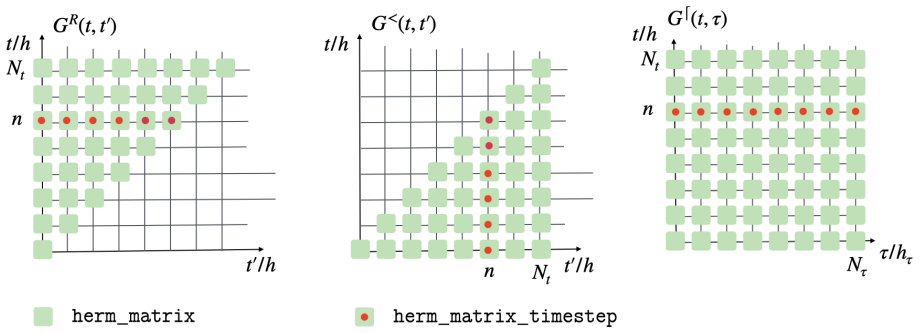
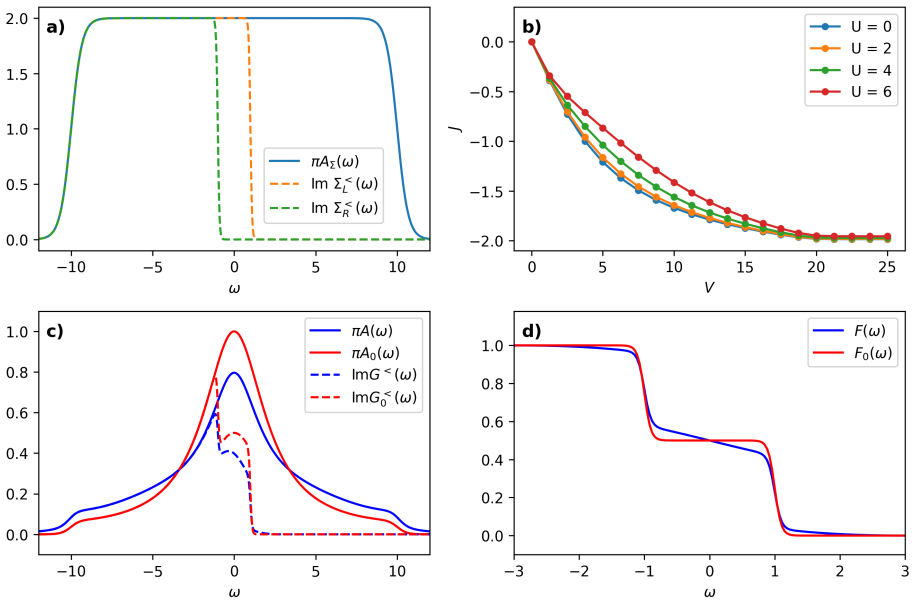
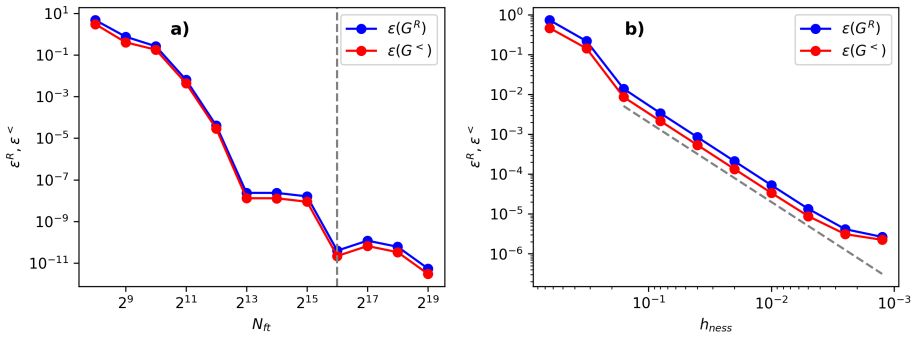
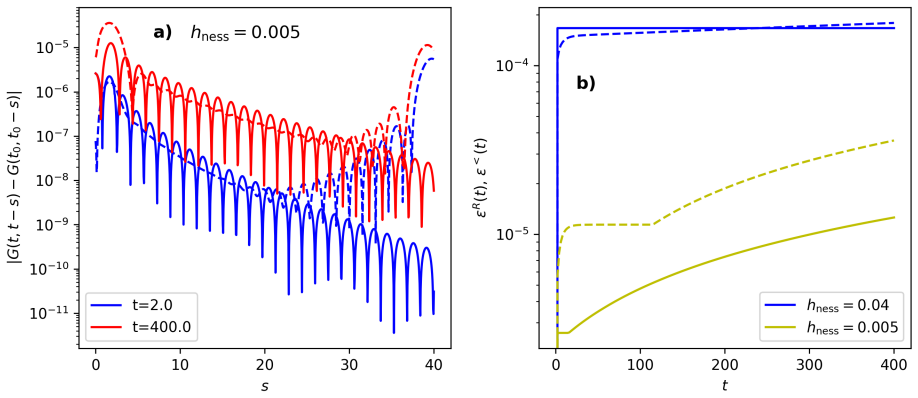
By truncating the memory integrals in the Kadanoff-Baym equations to a maximum of N_c timesteps, the computational complexity is reduced to O(N_t N_c^2), and the memory requirement to O(N_c^2). Provided that the results converge with respect to the cutoff N_c, memory truncation allows to extend the simulations to significantly longer times. Functionalities are introduced to describe nonequilibrium steady states, i.e. time-translationally invariant nonequilibrium states relevant for transport settings and approximate descriptions of slowly evolving prethermal states.
What carries the argument
Memory truncation of the integrals appearing in the Kadanoff-Baym equations to a finite number of timesteps N_c
If this is right
- Simulations of laser-driven electron dynamics in solids can now reach from sub-femtosecond to picosecond scales within feasible compute budgets.
- Nonequilibrium steady states become directly accessible for transport calculations without evolving the full transient.
- Prethermal regimes can be approximated by steady-state solvers rather than requiring the complete long-time trajectory.
- Perturbative methods already implemented in the package, such as nonequilibrium GW and dynamical mean-field theory, inherit the improved scaling.
Where Pith is reading between the lines
- The same truncation approach could be ported to other nonequilibrium Green's function codes that face similar memory bottlenecks.
- The smallest N_c at which observables stabilize may serve as a practical measure of the intrinsic memory time of a given interaction or material.
- Steady-state capabilities combined with truncation could enable hybrid simulations that switch from full transient evolution to steady-state description once transients have died out.
Load-bearing premise
Physical results converge with respect to the memory cutoff N_c for the target systems and timescales, so truncation does not introduce uncontrolled errors.
What would settle it
For a fixed physical system and total simulation length, increase the cutoff N_c and check whether key observables stabilize to a chosen numerical tolerance.
Figures




read the original abstract
Nonequilibrium Green's functions provide a powerful framework for studying quantum many-body dynamics including the laser-induced dynamics in solids. The Non-Equilibrium Systems Simulation package (NESSi) offers an efficient platform for such simulations, ranging from perturbative approaches like nonequilibrium $GW$ to nonequilibrium dynamical mean-field theory. However, simulations based on nonequilibrium Green's functions become computationally demanding when the dynamics span a large temporal range, such as from sub-femtosecond electron dynamics to the picosecond dynamics of collective modes. Due to the memory integral in the Kadanoff-Baym equations, which serve as equations of motion for nonequilibrium Green's functions, the computational cost scales as $\mathcal{O}(N_t^3)$ with the number of timesteps $N_t$, and the memory requirement scales as $\mathcal{O}(N_t^2)$. In this work, we extend NESSi by incorporating techniques that aim to overcome this bottleneck: (i) By truncating the memory integrals in the KBE to a maximum of $N_c$ timesteps, the computational complexity is reduced to $\mathcal{O}(N_tN_c^2)$, and the memory requirement to $\mathcal{O}(N_c^2)$. Provided that the results converge with respect to the cutoff $N_c$, memory truncation allows to extend the simulations to significantly longer times. (ii) We introduce functionalities to describe nonequilibrium steady states, i.e. time-translationally invariant nonequilibrium states. Such states are relevant for transport settings, and they provide an approximate description of slowly evolving (prethermal) nonequilibrium states.
Editorial analysis
A structured set of objections, weighed in public.
Referee Report
Summary. The manuscript presents NESSi 2.0, an update to the Non-Equilibrium Systems Simulation package for nonequilibrium Green's function (NEGF) calculations. It introduces (i) truncation of the memory integrals in the Kadanoff-Baym equations (KBE) to a maximum of N_c timesteps, reducing computational complexity from O(N_t^3) to O(N_t N_c^2) and memory requirements from O(N_t^2) to O(N_c^2), conditional on convergence with respect to N_c, and (ii) new functionalities to simulate nonequilibrium steady states (NESS) that are time-translationally invariant, relevant for transport and prethermal regimes.
Significance. If the truncation converges for the systems and timescales of interest, the work enables NEGF simulations (including nonequilibrium GW and DMFT) over significantly longer times, bridging sub-femtosecond electron dynamics to picosecond collective modes in solids. The NESS tools add practical value for steady-state transport problems. The conditional framing of the truncation and the focus on standard Volterra-integral reductions are appropriately stated.
major comments (2)
- [Memory truncation implementation] The central utility of the memory truncation rests on the assumption that observables converge with N_c (abstract). The manuscript should include quantitative benchmarks for at least one representative system (e.g., a Hubbard model under laser driving) that demonstrate both convergence of key quantities and the achieved error level as a function of N_c.
- [Nonequilibrium steady states section] For the NESS functionality, it is unclear how the time-translation invariance is numerically enforced when solving the KBE and whether the truncation is applied consistently to the steady-state self-energies and Green's functions to preserve the claimed scaling.
minor comments (2)
- [Abstract and scaling discussion] Ensure that all complexity statements in the main text match the abstract exactly, including the precise definition of N_c relative to the full timestep count N_t.
- [Software interface] Add a short table or figure caption that lists the new classes or functions introduced in version 2.0 for users migrating from NESSi 1.x.
Simulated Author's Rebuttal
We thank the referee for the positive assessment of NESSi 2.0 and the constructive major comments. We address each point below and will incorporate clarifications and additional material into the revised manuscript.
read point-by-point responses
-
Referee: The central utility of the memory truncation rests on the assumption that observables converge with N_c (abstract). The manuscript should include quantitative benchmarks for at least one representative system (e.g., a Hubbard model under laser driving) that demonstrate both convergence of key quantities and the achieved error level as a function of N_c.
Authors: We agree that explicit quantitative benchmarks strengthen the presentation of the memory truncation. The revised manuscript will include a new subsection (or expanded results section) with benchmarks for the Hubbard model under laser driving. These will show convergence of observables such as the double occupancy and current as a function of N_c, together with the error relative to the full-memory reference calculation, thereby substantiating the conditional statement in the abstract. revision: yes
-
Referee: For the NESS functionality, it is unclear how the time-translation invariance is numerically enforced when solving the KBE and whether the truncation is applied consistently to the steady-state self-energies and Green's functions to preserve the claimed scaling.
Authors: We appreciate the request for clarification. In the NESS module, time-translation invariance is enforced by reformulating the Kadanoff-Baym equations in terms of the relative time τ = t − t′ only; the two-time Green's functions and self-energies are replaced by their steady-state counterparts G(τ) and Σ(τ). The equations are solved either by fixed-point iteration in real time (with a sufficiently long transient discarded) or via Fourier transformation to frequency space. The memory cutoff is applied uniformly by restricting the integral over τ to |τ| ≤ N_c Δt, which reduces the steady-state problem to an effective one-dimensional convolution whose cost scales as O(N_c²) per iteration, consistent with the claimed complexity. The revised manuscript will add a dedicated paragraph (with the relevant equations) in the NESS section to make this implementation explicit. revision: yes
Circularity Check
No circularity in the memory truncation or NESSi 2.0 implementation
full rationale
The paper presents a software package implementing standard numerical techniques for solving the Kadanoff-Baym equations (KBEs) of nonequilibrium Green's functions. The claimed complexity reduction from O(N_t^3) to O(N_t N_c^2) follows directly from the explicit truncation of the memory integrals at N_c timesteps, with the paper stating the conditional requirement that observables must converge with N_c. This is a conventional approximation for Volterra integral equations and does not involve self-definition, renaming of known results as new derivations, fitted parameters presented as predictions, or load-bearing self-citations. The derivation chain is self-contained against external numerical benchmarks for integral truncation and requires no internal reduction to its own inputs.
Axiom & Free-Parameter Ledger
axioms (1)
- domain assumption Kadanoff-Baym equations serve as the equations of motion for nonequilibrium Green's functions
Reference graph
Works this paper leans on
-
[1]
Kadanoff, G
L. Kadanoff, G. Baym, Quantum Statistical Mechanics: Green’s Function Methods in Equilibrium and Nonequilibrium Problems, Frontiers in physics, W.A. Benjamin, 1962
1962
-
[2]
L. V. Keldysh, Diagram technique for nonequilibrium processes, Sov. Phys. JETP 20 (1965) 1018
1965
-
[3]
Kamenev, Field Theory of Non-Equilibrium Systems, Cambridge University Press, Cambridge, 2011
A. Kamenev, Field Theory of Non-Equilibrium Systems, Cambridge University Press, Cambridge, 2011
2011
-
[4]
Stefanucci, R
G. Stefanucci, R. van Leeuwen, Nonequilibrium Many-Body Theory of Quantum Systems: A Modern Introduction, Cambridge University Press, Cambridge, 2013
2013
-
[5]
A. de la Torre, D. M. Kennes, M. Claassen, S. Gerber, J. W. McIver, M. A. Sentef, Colloquium: Nonthermal pathways to ultrafast control in quantum materials, Rev. Mod. Phys. 93 (2021) 041002. doi:10.1103/RevModPhys.93.041002
-
[6]
C. Giannetti, M. Capone, D. Fausti, M. Fabrizio, F. Parmigiani, D. Mihailovic, Ultrafast optical spec- troscopy of strongly correlated materials and high-temperature superconductors: a non-equilibrium approach, Advances in Physics 65 (2) (2016) 58–238.doi:10.1080/00018732.2016.1194044
-
[7]
Y. Murakami, D. Golež, M. Eckstein, P. Werner, Photoinduced nonequilibrium states in mott insulators, Rev. Mod. Phys. 97 (2025) 035001.doi:10.1103/tkjh-lr83
-
[8]
M. Schüler, D. Golez, Y. Murakami, N. Bittner, A. Herrmann, H. U. Strand, P. Werner, M. Eckstein, Nessi: The non-equilibrium systems simulation package, Comput. Phys. Commun. 257 (2020) 107484. doi:https://doi.org/10.1016/j.cpc.2020.107484
-
[9]
F. Aryasetiawan, O. Gunnarsson, The gw method, Reports on Progress in Physics 61 (3) (1998) 237. doi:10.1088/0034-4885/61/3/002
-
[10]
D. Golež, P. Werner, M. Eckstein, Photoinduced gap closure in an excitonic insulator, Phys. Rev. B 94 (2016) 035121.doi:10.1103/PhysRevB.94.035121
-
[11]
N. E. Bickers, D. J. Scalapino, S. R. White, Conserving approximations for strongly correlated electron systems: Bethe-salpeter equation and dynamics for the two-dimensional hubbard model, Phys. Rev. Lett. 62 (1989) 961–964.doi:10.1103/PhysRevLett.62.961
-
[12]
Sayyad, N
S. Sayyad, N. Tsuji, A. Vaezi, M. Capone, M. Eckstein, H. Aoki, Momentum-dependent relaxation dynamics of the doped repulsive hubbard model, Phys. Rev. B 99 (2019) 165132.doi:10.1103/ PhysRevB.99.165132
2019
-
[13]
C. Stahl, M. Eckstein, Electronic and fluctuation dynamics following a quench to the superconducting phase, Phys. Rev. B 103 (2021) 035116.doi:10.1103/PhysRevB.103.035116
-
[14]
H. Aoki, N. Tsuji, M. Eckstein, M. Kollar, T. Oka, P. Werner, Nonequilibrium dynamical mean-field theory and its applications, Rev. Mod. Phys. 86 (2014) 779–837.doi:10.1103/RevModPhys.86.779
-
[15]
A. Stan, N. E. Dahlen, R. van Leeuwen, Time propagation of the kadanoff-baym equations for inhomo- geneous systems, J. Chem. Phys. 130 (22) (2009) 224101.doi:10.1063/1.3127247. 44
-
[16]
J. K. Freericks, V. M. Turkowski, V. Zlatić, Nonequilibrium dynamical mean-field theory, Phys. Rev. Lett. 97 (2006) 266408.doi:10.1103/PhysRevLett.97.266408
-
[17]
Balzer, M
K. Balzer, M. Bonitz, Nonequilibrium Green’s Functions Approach to Inhomogeneous Systems, Lecture Notes in Physics, Springer Berlin Heidelberg, 2012
2012
-
[18]
J. Kaye, D. Golež, Low rank compression in the numerical solution of the nonequilibrium Dyson equa- tion, SciPost Phys. 10 (2021) 091.doi:10.21468/SciPostPhys.10.4.091
-
[19]
H. Shinaoka, M. Wallerberger, Y. Murakami, K. Nogaki, R. Sakurai, P. Werner, A. Kauch, Multiscale space-time ansatz for correlation functions of quantum systems based on quantics tensor trains, Phys. Rev. X 13 (2023) 021015.doi:10.1103/PhysRevX.13.021015
-
[20]
M. Środa, K. Inayoshi, H. Shinaoka, P. Werner, Memory-efficient nonequilibrium green’s function frame- work built on quantics tensor trains, Phys. Rev. Lett. 135 (2025) 226501.doi:10.1103/dxfb-b3l5. URLhttps://link.aps.org/doi/10.1103/dxfb-b3l5
-
[21]
F. Meirinhos, M. Kajan, J. Kroha, T. Bode, Adaptive numerical solution of Kadanoff-Baym equations, SciPost Phys. Core 5 (2022) 030.doi:10.21468/SciPostPhysCore.5.2.030
-
[22]
J. Lang, S. Sachdev, S. Diehl, Numerical renormalization of glassy dynamics, Phys. Rev. Lett. 135 (2025) 247101.doi:10.1103/z64g-nqs6
-
[23]
J. Yin, Y. hao Chan, F. H. da Jornada, D. Y. Qiu, S. G. Louie, C. Yang, Using dynamic mode decomposition to predict the dynamics of a two-time non-equilibrium green’s function, Journal of Computational Science 64 (2022) 101843.doi:https://doi.org/10.1016/j.jocs.2022.101843
-
[24]
Y. Zhu, J. Yin, C. C. Reeves, C. Yang, V. Vlček, Predicting nonequilibrium green’s function dynamics and photoemission spectra via nonlinear integral operator learning, Machine Learning: Science and Technology 6 (1) (2025) 015027.doi:10.1088/2632-2153/ada99d
-
[25]
P. Lipavský, V. Špička, B. Velický, Generalized kadanoff-baym ansatz for deriving quantum transport equations, Phys. Rev. B 34 (1986) 6933–6942.doi:10.1103/PhysRevB.34.6933
-
[26]
N. Schlünzen, J.-P. Joost, M. Bonitz, Achieving the scaling limit for nonequilibrium green functions simulations, Phys. Rev. Lett. 124 (2020) 076601.doi:10.1103/PhysRevLett.124.076601
-
[27]
M. Schüler, M. Eckstein, P. Werner, Truncating the memory time in nonequilibrium dynamical mean field theory calculations, Phys. Rev. B 97 (2018) 245129.doi:10.1103/PhysRevB.97.245129
-
[28]
C. Stahl, N. Dasari, J. Li, A. Picano, P. Werner, M. Eckstein, Memory truncated kadanoff-baym equations, Phys. Rev. B 105 (2022) 115146.doi:10.1103/PhysRevB.105.115146
-
[29]
A. Picano, M. Eckstein, Accelerated gap collapse in a slater antiferromagnet, Phys. Rev. B 103 (2021) 165118.doi:10.1103/PhysRevB.103.165118
-
[30]
N. Dasari, J. Li, P. Werner, M. Eckstein, Photoinduced strange metal with electron and hole quasipar- ticles, Phys. Rev. B 103 (2021) L201116.doi:10.1103/PhysRevB.103.L201116
-
[31]
F. Lange, Z. Lenarčič, A. Rosch, Pumping approximately integrable systems, Nature Communications 8 (1) (Jun. 2017).doi:10.1038/ncomms15767
-
[32]
J. Li, M. Eckstein, Nonequilibrium steady-state theory of photodoped mott insulators, Phys. Rev. B 103 (2021) 045133.doi:10.1103/PhysRevB.103.045133
-
[33]
Künzel, A
F. Künzel, A. Erpenbeck, D. Werner, E. Arrigoni, E. Gull, G. Cohen, M. Eckstein, Numerically ex- act simulation of photodoped mott insulators, Phys. Rev. Lett. 132 (2024) 176501.doi:10.1103/ PhysRevLett.132.176501. 45
2024
-
[34]
R. E. V. Profumo, C. Groth, L. Messio, O. Parcollet, X. Waintal, Quantum monte carlo for correlated out-of-equilibrium nanoelectronic devices, Phys. Rev. B 91 (2015) 245154.doi:10.1103/PhysRevB. 91.245154
-
[35]
A. Erpenbeck, E. Gull, G. Cohen, Quantum monte carlo method in the steady state, Phys. Rev. Lett. 130 (2023) 186301.doi:10.1103/PhysRevLett.130.186301
-
[36]
M. Eckstein, Solving quantum impurity models in the non-equilibrium steady state with tensor trains (2024).arXiv:2410.19707
-
[37]
A. J. Kim, P. Werner, Strong coupling impurity solver based on quantics tensor cross interpolation, Phys. Rev. B 111 (2025) 125120.doi:10.1103/PhysRevB.111.125120
-
[38]
E. Arrigoni, M. Knap, W. von der Linden, Nonequilibrium dynamical mean-field theory: An auxiliary quantum master equation approach, Phys. Rev. Lett. 110 (2013) 086403.doi:10.1103/PhysRevLett. 110.086403
-
[39]
M. Frigo, S. Johnson, The design and implementation of fftw3, Proceedings of the IEEE 93 (2) (2005) 216–231.doi:10.1109/JPROC.2004.840301
-
[40]
Press, Numerical Recipes 3rd Edition: The Art of Scientific Computing, Cambridge University Press, 2007
W. Press, Numerical Recipes 3rd Edition: The Art of Scientific Computing, Cambridge University Press, 2007
2007
-
[41]
S. G. J. Matteo Frigo, FFTW online manual, Massachusetts Institute of Technology (2020) [cited 30.09.2025]. URLhttps://www.fftw.org/fftw3.pdf
2020
-
[42]
D. Chowdhury, A. Georges, O. Parcollet, S. Sachdev, Sachdev-ye-kitaev models and beyond: Window into non-fermi liquids, Rev. Mod. Phys. 94 (2022) 035004.doi:10.1103/RevModPhys.94.035004
-
[43]
M. Moeckel, S. Kehrein, Interaction quench in the hubbard model, Phys. Rev. Lett. 100 (2008) 175702. doi:10.1103/PhysRevLett.100.175702
-
[44]
M. Eckstein, M. Kollar, P. Werner, Thermalization after an interaction quench in the hubbard model, Phys. Rev. Lett. 103 (2009) 056403.doi:10.1103/PhysRevLett.103.056403
-
[45]
P. Werner, T. Oka, M. Eckstein, A. J. Millis, Weak-coupling quantum monte carlo calculations on the keldysh contour: Theory and application to the current-voltage characteristics of the anderson model, Phys. Rev. B 81 (2010) 035108.doi:10.1103/PhysRevB.81.035108
-
[46]
A.Georges, G.Kotliar, W.Krauth, M.J.Rozenberg, Dynamicalmean-fieldtheoryofstronglycorrelated fermion systems and the limit of infinite dimensions, Rev. Mod. Phys. 68 (1996) 13–125.doi:10.1103/ RevModPhys.68.13
1996
-
[47]
Physical Review B81, 195107 (2010) https://doi.org/10.1103/PhysRevB.81
M. Eckstein, M. Kollar, P. Werner, Interaction quench in the hubbard model: Relaxation of the spectral function and the optical conductivity, Phys. Rev. B 81 (2010) 115131.doi:10.1103/PhysRevB.81. 115131. 46
discussion (0)
Sign in with ORCID, Apple, or X to comment. Anyone can read and Pith papers without signing in.