Recognition: 3 theorem links
· Lean TheoremA stiff limit of non-homogeneous conservation laws for crowd motion modeling
Pith reviewed 2026-05-08 17:55 UTC · model grok-4.3
The pith
A stiff limit of non-homogeneous conservation laws produces a novel PDE for crowd motion with unilateral density constraints.
A machine-rendered reading of the paper's core claim, the machinery that carries it, and where it could break.
Core claim
The solutions of the non-homogeneous conservation laws converge, as the stiffness parameter tends to zero, to a solution of a new PDE that encodes crowd motion under density constraints acting only from the front. Uniform bounds in BV on the densities of the approximating equations ensure strong compactness and thus existence for the limit problem.
What carries the argument
The stiff asymptotic limit applied to non-homogeneous conservation laws, using uniform BV estimates on the density to obtain strong compactness.
If this is right
- Solutions to the limit PDE satisfy new entropy inequalities associated with the unilateral density constraint.
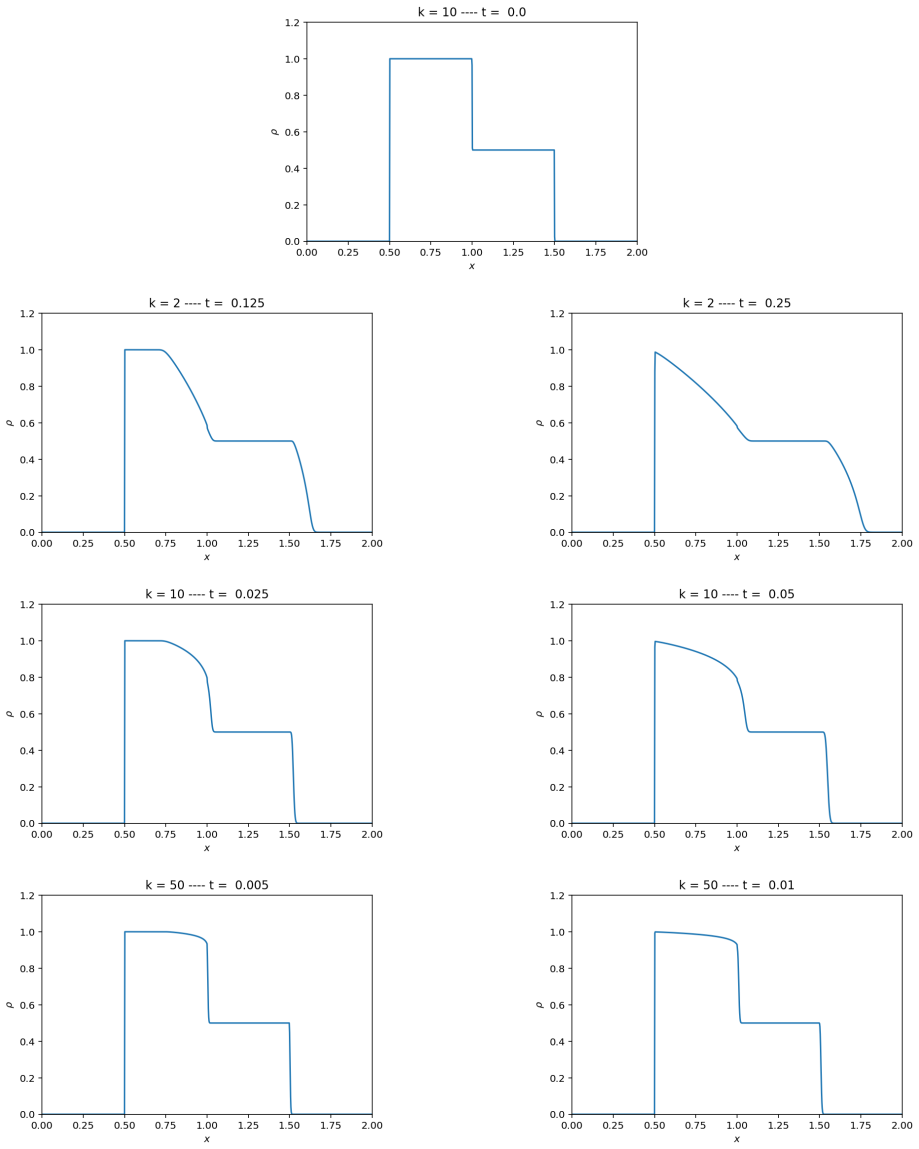
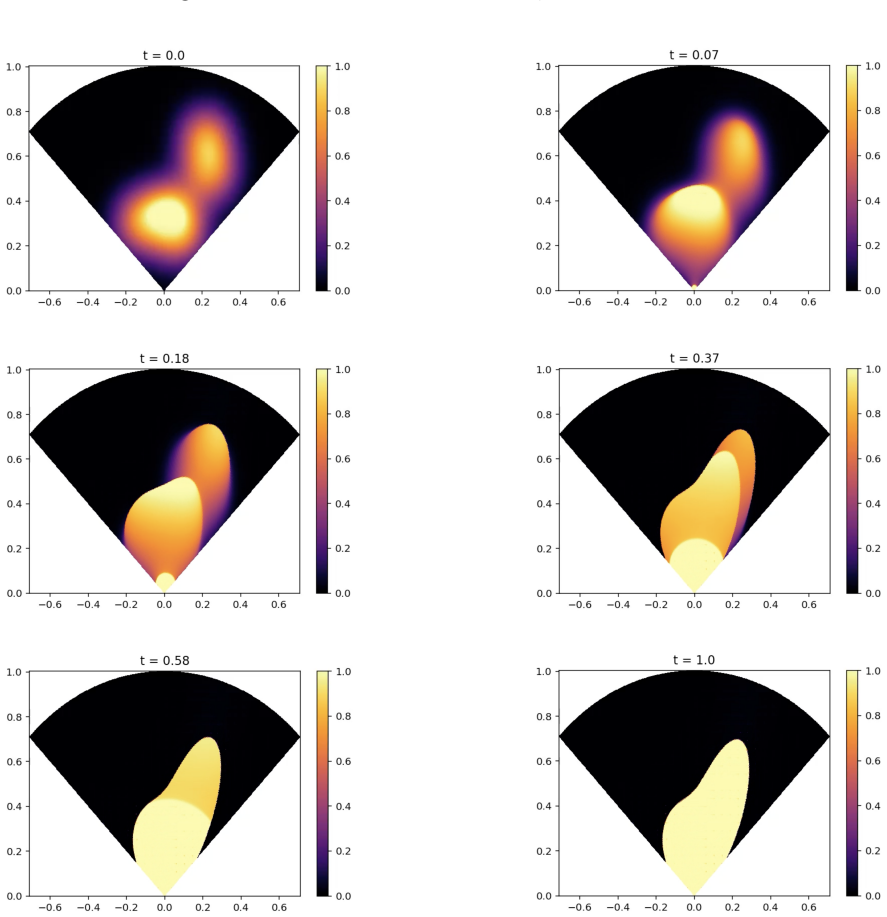
- Numerical simulations in one and two dimensions illustrate the qualitative behavior of the limit solutions.
- Motion remains unaffected by density constraints unless a saturated region lies immediately ahead of an agent.
Where Pith is reading between the lines
- The same stiff-limit technique could apply to other constrained hyperbolic systems arising in traffic or pedestrian flow.
- Direct numerical verification of the BV bounds for chosen initial data would test the compactness step in practice.
- The resulting PDE may admit connections to variational or optimal-transport formulations used in related crowd models.
Load-bearing premise
The approximating solutions of the non-homogeneous conservation laws admit BV bounds that remain uniform as the stiffness parameter approaches its limit value.
What would settle it
A sequence of initial data for which the total variation of the density solutions increases without bound as the stiffness parameter vanishes would disprove the uniform estimates and block passage to the limit.
Figures





read the original abstract
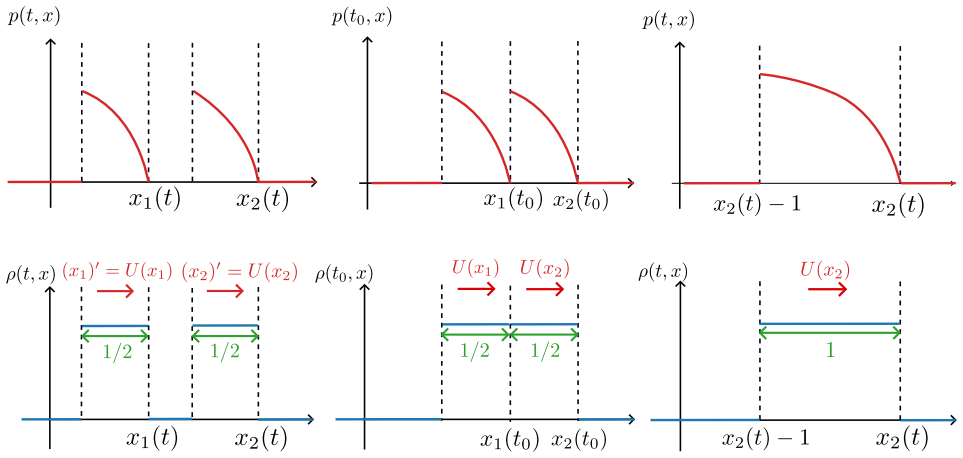
We propose a new approach for crowd motion models where the density constraint can only slow down the motion of each agent, with no effect on those agents who are not in a saturated area or who have no saturated density ''in front'' of them. This is done by means of a limit of conservation laws inspired by the equations used for traffic as in Follow the leader-type models. We study the asymptotics of the solutions of these conservation laws in a certain asymptotic regime, and obtain a PDE at the limit of a whole new type. One of the main goals of the paper is to prove uniform BV estimates on the density, and thus strong compactness to prove the existence of solutions to this limit equation. We also discuss the qualitative behavior of solutions, provide numerical illustrations both in dimension 1 and 2, and establish the new entropy inequalities associated with this limit equation.
Editorial analysis
A structured set of objections, weighed in public.
Referee Report
Summary. The paper proposes a new modeling approach for crowd motion in which the density constraint acts only to slow down agents (with no effect on unsaturated agents or those without saturated density ahead), derived as the stiff limit of non-homogeneous conservation laws inspired by follow-the-leader traffic models. In a specific asymptotic regime the authors obtain a new type of limit PDE, prove its existence via uniform BV estimates on the density (yielding strong compactness), discuss qualitative behavior, supply 1D and 2D numerical illustrations, and derive associated entropy inequalities.
Significance. If the uniform BV estimates are indeed independent of the stiffness parameter, the work introduces a mathematically novel PDE class for unilateral crowd constraints that improves on standard models by respecting the one-sided slowing effect. The combination of compactness-based existence, entropy inequalities, and numerical validation would constitute a solid contribution to the analysis of hyperbolic conservation laws with constraints, with potential applications in traffic and pedestrian dynamics.
major comments (1)
- [Abstract and the section deriving the uniform BV estimates] The central existence argument rests on obtaining BV bounds on the density that remain uniform with respect to the stiffness parameter so that Helly compactness applies and the limit can be passed inside the non-homogeneous flux. The abstract and the proof of the BV estimate (presumably the section containing the a-priori estimates) do not explicitly rule out a hidden dependence on the stiffness parameter arising from the interaction between the density constraint and the velocity field in the chosen asymptotic regime; if such dependence exists, strong compactness is lost and the passage to the new limit equation is not justified.
minor comments (2)
- [Introduction / setup] The precise definition of the asymptotic regime (the scaling relating the stiffness parameter to the non-homogeneous terms) should be stated explicitly at the beginning of the analysis section rather than only in the abstract.
- [Discussion of the limit equation] A short comparison table or paragraph contrasting the new limit PDE with existing crowd models (e.g., the Hughes model or standard LWR-type equations) would help readers assess novelty.
Simulated Author's Rebuttal
We thank the referee for the careful reading and the positive overall assessment of our work on the stiff limit for selective density-constrained crowd motion. We address the single major comment below.
read point-by-point responses
-
Referee: [Abstract and the section deriving the uniform BV estimates] The central existence argument rests on obtaining BV bounds on the density that remain uniform with respect to the stiffness parameter so that Helly compactness applies and the limit can be passed inside the non-homogeneous flux. The abstract and the proof of the BV estimate (presumably the section containing the a-priori estimates) do not explicitly rule out a hidden dependence on the stiffness parameter arising from the interaction between the density constraint and the velocity field in the chosen asymptotic regime; if such dependence exists, strong compactness is lost and the passage to the new limit equation is not justified.
Authors: We agree that uniformity of the BV bound with respect to the stiffness parameter is indispensable for the compactness argument. In the a-priori estimates section the total-variation bound is obtained by testing the non-homogeneous conservation law against a suitable mollifier and exploiting the one-sided character of the constraint together with the uniform Lipschitz bound on the velocity field; the resulting differential inequality for the total variation closes with a constant that depends only on the initial L^1 and BV norms and on the model parameters other than the stiffness parameter. Consequently no hidden ε-dependence enters through the density-velocity interaction. To make this explicit we have revised the abstract to state that the BV estimates are uniform in the stiffness parameter and have added a short clarifying paragraph immediately after the main estimate, confirming that the constraint term does not produce ε-amplified oscillations. With these changes the application of Helly’s theorem and the subsequent passage to the limit equation are fully justified. revision: yes
Circularity Check
Limit PDE derivation from conservation laws is self-contained; no reduction to fitted inputs or self-citations
full rationale
The paper starts from standard non-homogeneous conservation laws (inspired by follow-the-leader models), takes a stiff asymptotic limit, and proves existence of the resulting novel PDE via uniform BV estimates on the density for compactness. No quoted step defines the target PDE in terms of itself, renames a fitted quantity as a prediction, or relies on a load-bearing self-citation whose content reduces to the present claim. The uniform-BV step is presented as a technical result to be established from the approximating equations, not presupposed by construction. The derivation chain therefore remains independent of its inputs.
Axiom & Free-Parameter Ledger
Lean theorems connected to this paper
-
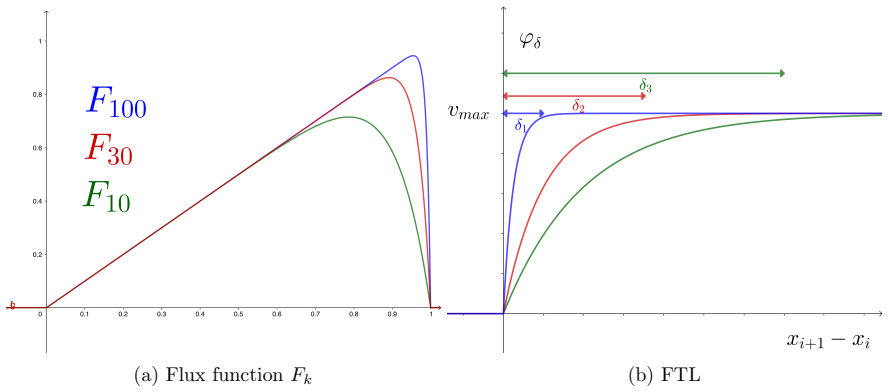
IndisputableMonolith/Cost/FunctionalEquation.leanwashburn_uniqueness_aczel unclearWe consider the entropic solution of the LWR-type equation ∂_t ρ + ∇·(F_k(ρ)U)=0, F_k(ρ)=ρ(1-ρ^k), and pass to the limit k→+∞.
-
IndisputableMonolith/Foundation/Atomicity.leansequential_preserves_conservation unclearUniform BV estimates ‖∂_x ρ(t)‖_{L^1} ≤ C(T)‖ρ_0‖_{BV} and ∫∫|∂_x ρ^{k+1} ∂_x U| ≤ C(T)‖ρ_0‖_{BV}, used for strong compactness via Aubin–Lions.
-
IndisputableMonolith/Foundation/BranchSelection.leanbranch_selection unclearEntropy inequalities ∂_t S(ρ)+∇·(Q_k(ρ)U)+(S'(ρ)F_k(ρ)-Q_k(ρ))∇·U ≤ 0 (Kruzhkov-type), passed to the k→∞ limit.
Reference graph
Works this paper leans on
-
[1]
Mathematical Models and Methods in Applied Sciences , author =
A macroscopic crowd motion model of gradient flow type , volume =. Mathematical Models and Methods in Applied Sciences , author =. 2010 , note =. doi:10.1142/S0218202510004799 , abstract =
-
[2]
Mathematical Models and Methods in Applied Sciences , author =
Analysis and approximation of a scalar conservation law with a flux function with discontinuous coefficients , volume =. Mathematical Models and Methods in Applied Sciences , author =. 2003 , note =. doi:10.1142/S0218202503002477 , abstract =
-
[3]
Maury, B. and Roudneff-Chupin, A. and Santambrogio, F. and Venel, J. , month = jan, year =. Handling congestion in crowd motion modeling , url =. doi:10.48550/arXiv.1101.4102 , abstract =
-
[4]
Modelisation macroscopique de mouvements de foule , year =
Roudneff-Chupin, Aude , file =. Modelisation macroscopique de mouvements de foule , year =
-
[5]
Scalar conservation laws:. Comptes Rendus. Mathématique , author =. 2018 , pages =. doi:10.1016/j.crma.2018.09.010 , language =
-
[6]
Archive for Rational Mechanics and Analysis , author =
Structure of. Archive for Rational Mechanics and Analysis , author =. 2003 , pages =. doi:10.1007/s00205-003-0270-9 , abstract =
-
[7]
First order quasilinear equations in several independent variables
Mathematics of the USSR-Sbornik , author =. 1970 , note =. doi:10.1070/SM1970v010n02ABEH002156 , abstract =
-
[8]
Quarterly of Applied Mathematics , author =
A. Quarterly of Applied Mathematics , author =. 1998 , note =
1998
-
[9]
Hyperbolic conservation laws in continuum physics , isbn =
Dafermos, Constantine Michael , year =. Hyperbolic conservation laws in continuum physics , isbn =
-
[10]
Milan Journal of Mathematics , author =
Variational convergence of gradient flows and rate-independent evolutions in metric spaces , volume =. Milan Journal of Mathematics , author =. 2012 , note =. doi:10.1007/s00032-012-0190-y , abstract =
-
[11]
and Necas, J
Malek, J. and Necas, J. and Rokyta, M. and Ruzicka, M. , year =. Weak and
-
[12]
Gradient
Ambrosio, Luigi , collaborator =. Gradient. 2005 , file =
2005
-
[13]
State-of-the-art of vehicular traffic flow modelling , volume =. Proceedings of the Institution of Mechanical Engineers, Part I: Journal of Systems and Control Engineering , author =. 2001 , note =. doi:10.1177/095965180121500402 , abstract =
-
[14]
A theory of. Archive for Rational Mechanics and Analysis , author =. 2011 , note =. doi:10.1007/s00205-010-0389-4 , abstract =
-
[15]
Journal of Evolution Equations , author =
Conservation. Journal of Evolution Equations , author =. 2023 , note =. doi:10.1007/s00028-023-00902-1 , abstract =
-
[16]
Numerische Mathematik , author =
Finite volume schemes for constrained conservation laws , volume =. Numerische Mathematik , author =. 2010 , pages =
2010
-
[17]
Periodica Polytechnica Transportation Engineering , author =
Comparison of. Periodica Polytechnica Transportation Engineering , author =. 2016 , keywords =. doi:10.3311/PPtr.8297 , abstract =
-
[18]
Francesco, Marco Di and Fagioli, Simone and Rosini, Massimiliano D. , month = may, year =. Deterministic particle approximation of scalar conservation laws , url =. doi:10.48550/arXiv.1605.05883 , abstract =
-
[19]
Conservation laws with discontinuous flux , volume =. Networks and Heterogeneous Media , author =. 2006 , note =. doi:10.3934/nhm.2007.2.159 , abstract =
-
[20]
Archive for Rational Mechanics and Analysis , author =
Incomplete blowup of solutions of quasilinear hyperbolic balance laws , volume =. Archive for Rational Mechanics and Analysis , author =. 1996 , keywords =. doi:10.1007/BF02198141 , abstract =
-
[21]
Annales de l'Institut Henri Poincaré C, Analyse non linéaire , author =
Kinetic formulation for heterogeneous scalar conservation laws , volume =. Annales de l'Institut Henri Poincaré C, Analyse non linéaire , author =. 2006 , pages =. doi:10.1016/j.anihpc.2005.05.005 , abstract =
-
[22]
Mathematical and Computer Modelling , author =
Godunov scheme for the scalar nonlinear conservation laws with flux depending on the space variable , volume =. Mathematical and Computer Modelling , author =. 1995 , pages =. doi:10.1016/0895-7177(95)00151-Q , language =
-
[23]
Transportation Research Part B: Methodological , author =
The cell transmission model, part. Transportation Research Part B: Methodological , author =. 1995 , pages =. doi:10.1016/0191-2615(94)00022-R , abstract =
-
[24]
Nonlinear Analysis: Real World Applications , author =
Existence of nonclassical solutions in a. Nonlinear Analysis: Real World Applications , author =. 2009 , keywords =. doi:10.1016/j.nonrwa.2008.08.002 , abstract =
-
[25]
Leveque, Randall J , file =. Finite
-
[26]
Systèmes de lois de conservation, tome 1
Serre, Denis , year =. Systèmes de lois de conservation, tome 1
-
[27]
Crowd motion modelisation under some constraints , year =
Al Reda, Fatima , file =. Crowd motion modelisation under some constraints , year =
-
[28]
Modélisation du mouvement de foules denses : phénoménologie et couplage de modèles , shorttitle =
Pinsard, Etienne , month = dec, year =. Modélisation du mouvement de foules denses : phénoménologie et couplage de modèles , shorttitle =
-
[29]
Operations Research , author =
Shock. Operations Research , author =. 1956 , note =. doi:10.1287/opre.4.1.42 , abstract =
-
[30]
Proceedings of the Royal Society of London
On kinematic waves. Proceedings of the Royal Society of London. Series A. Mathematical and Physical Sciences , author =. 1997 , note =. doi:10.1098/rspa.1955.0089 , abstract =
-
[31]
Maury, Bertrand and Venel, Juliette , editor =. Handling of. Traffic and. 2009 , keywords =. doi:10.1007/978-3-540-77074-9_15 , language =
-
[32]
Holden, Helge and Risebro, Nils Henrik , month = sep, year =. Follow-the-. doi:10.48550/arXiv.1702.01718 , abstract =
-
[33]
Rendiconti del Seminario Matematico della Università di Padova , author =
On the micro-macro limit in traffic flow , volume =. Rendiconti del Seminario Matematico della Università di Padova , author =. 2014 , pages =. doi:10.4171/rsmup/131-13 , abstract =
-
[34]
SIAM Journal on Applied Mathematics , author =
Derivation of. SIAM Journal on Applied Mathematics , author =. 2002 , pages =. doi:10.1137/S0036139900380955 , abstract =
-
[35]
Discrete & Continuous Dynamical Systems - S , author =
A justification of a. Discrete & Continuous Dynamical Systems - S , author =. 2014 , pages =. doi:10.3934/dcdss.2014.7.579 , language =
-
[36]
Archive for Rational Mechanics and Analysis , author =
Rigorous derivation of nonlinear scalar conservation laws from follow-the-leader type models via many particle limit , volume =. Archive for Rational Mechanics and Analysis , author =. 2015 , note =. doi:10.1007/s00205-015-0843-4 , abstract =
-
[37]
, year =
Ladyzhenskaia, Olga Aleksandrovna and Solonnikov, Vsevolod Alekseevich and Uraltseva, Nina N. , year =. Linear and
-
[38]
The variational formulation of the fokker–planck equation
The. SIAM Journal on Mathematical Analysis , author =. 1998 , note =. doi:10.1137/S0036141096303359 , abstract =
-
[39]
Numerische Mathematik , author =
A computational fluid mechanics solution to the. Numerische Mathematik , author =. 2000 , pages =. doi:10.1007/s002110050002 , abstract =
-
[40]
Compact sets in the spaceLp(0, T;B)
Compact sets in the. Annali di Matematica Pura ed Applicata , author =. 1986 , keywords =. doi:10.1007/BF01762360 , abstract =
-
[41]
Santambrogio, Filippo , year =. Optimal. doi:10.1007/978-3-319-20828-2 , language =
-
[42]
Archive for Rational Mechanics and Analysis , author =
The. Archive for Rational Mechanics and Analysis , author =. 2014 , note =. doi:10.1007/s00205-013-0704-y , abstract =
-
[43]
, year =
Lieberman, Gary M. , year =. Second
-
[44]
Functions of
Ambrosio, Luigi and Fusco, Nicola and Pallara, Diego , month = mar, year =. Functions of
-
[45]
Inventiones Mathematicae98(3), 511–547 (1989) https://doi.org/ 10.1007/bf01393835
Ordinary differential equations, transport theory and. Inventiones mathematicae , author =. 1989 , keywords =. doi:10.1007/BF01393835 , abstract =
-
[46]
Kim, Inwon and Yao, Yao , month = nov, year =. The. doi:10.48550/arXiv.1102.0092 , abstract =
-
[47]
David, Noemi and Santambrogio, Filippo and Schmidtchen, Markus , month = may, year =. Uniform regularity estimates for nonlinear diffusion-advection equations in the hard-congestion limit , url =. doi:10.48550/arXiv.2405.06942 , abstract =
-
[48]
Existence of solutions of the hyperbolic
Perthame, Beno. Existence of solutions of the hyperbolic. Trans. Am. Math. Soc. , issn =. 2009 , language =. doi:10.1090/S0002-9947-08-04656-4 , keywords =
-
[49]
Kinetic formulation of conservation laws , SERIES =
Perthame, Beno\^. Kinetic formulation of conservation laws , SERIES =. 2002 , PAGES =
2002
-
[50]
Incompressible limit of porous media equation with chemotaxis and growth , BOOKTITLE =
He, Qingyou and Li, Hai-Liang and Perthame, Beno\^. Incompressible limit of porous media equation with chemotaxis and growth , BOOKTITLE =. [2025] 2025 , ISBN =. doi:10.1007/978-3-031-91282-5\ _ 6 , URL =
-
[51]
Helbing, Dirk and Johansson, Anders , month = apr, year =. Pedestrian,. Encyclopedia of. doi:10.1007/978-1-4419-7695-6_37 , abstract =
discussion (0)
Sign in with ORCID, Apple, or X to comment. Anyone can read and Pith papers without signing in.