Recognition: 3 theorem links
· Lean TheoremThe flow of local quantum fluids: Conservation laws and vertex corrections from many-body linear-response theory with local self-energy
Pith reviewed 2026-05-08 18:30 UTC · model grok-4.3
The pith
Vertex corrections to the electromagnetic response of local quantum fluids vanish at zero momentum under inversion symmetry and odd bare vertices, and vanish entirely for quadratic dispersions at any wavevector.
A machine-rendered reading of the paper's core claim, the machinery that carries it, and where it could break.
Core claim
Under local interactions and charge/mass conservation maintained by Bethe-Salpeter equations, vertex corrections generally vanish at q=0 for inversion-symmetric dispersions and odd bare interaction vertices; they vanish identically from the current-current correlation function for quadratic dispersion at any q and ω. Explicit nonlocal correlation functions are obtained for Fermi liquids and non-Fermi liquids with arbitrary local self-energies.
What carries the argument
Bethe-Salpeter equations for renormalized interaction vertices inside the Kubo linear-response formalism, combined with a local self-energy that depends only on frequency.
If this is right
- Nonlocal correlation functions for currents and stress can be written without vertex corrections whenever the stated symmetry conditions hold.
- The Hall viscosity of Landau levels receives no vertex corrections under the paper's criteria.
- The same simplification applies equally to Fermi liquids and to non-Fermi liquids lacking quasiparticles.
- The expressions remain valid when momentum conservation is additionally imposed or when weak symmetry breaking and multiband effects are included.
Where Pith is reading between the lines
- The result suggests that optical conductivity at long wavelength in parabolic-band materials may be computed from the bubble diagram alone even in the presence of strong local correlations.
- Extension to other point-group symmetries could identify further classes of systems where transport coefficients simplify.
- The framework offers a route to test conservation-law constraints numerically in lattice models with local interactions.
Load-bearing premise
Interactions must be local and frequency-dependent while charge and mass conservation hold exactly through the Bethe-Salpeter equations that renormalize the vertices.
What would settle it
A explicit diagrammatic calculation or numerical simulation that finds a nonzero vertex correction to the long-wavelength current response in an inversion-symmetric quadratic-band system with odd bare vertices would disprove the vanishing result.
Figures

read the original abstract
In non-diffusive conduction regimes of strongly correlated quantum electron systems, electromagnetic perturbations simultaneously probe the electronic dynamics in time and space: the exchanged energy $\hbar \omega$ excites retarded, i.e., frequency-dependent, many-body interactions, while the probing spatial modulation renders the response spatially nonlocal, i.e., dependent on the external wave vector $\vec{q}$. This work determines the exact nonlocal electrodynamic response of such dynamical quantum fluids under the assumptions of local, frequency-dependent interactions and charge/mass conservation. The latter is ensured by Bethe-Salpeter equations for renormalized interaction vertices, entering the Kubo formalism for two-particle correlation functions (e.g., for density, currents, momentum, stress). Within such framework, it is shown that vertex corrections generally vanish at $q=0$ for single-particle dispersions with inversion symmetry and for bare interaction vertices that are odd with respect to specific point group transformations in momentum space, including inversion for vector vertices, and mirror reflections or two- or higher-fold rotations for tensor vertices. In addition, for quadratic dispersion vertex corrections identically vanish from the current-current correlation function, at any momentum $\vec{q}$ and frequency $\omega$. The robustness of these criteria against further symmetry breaking, multiband effects, and additionally imposing momentum conservation, is discussed, with application to the Hall viscosity of Landau levels. Explicit expressions for generic nonlocal correlation functions are derived for Fermi liquids (with well-defined quasiparticle peaks) and non-Fermi liquids (devoid of quasiparticles), for arbitrary local self-energies.
Editorial analysis
A structured set of objections, weighed in public.
Referee Report
Summary. The manuscript develops a many-body linear-response framework for the nonlocal electrodynamic response of quantum fluids, combining the Kubo formalism with Bethe-Salpeter equations that enforce charge and mass conservation under the assumption of a local, frequency-dependent self-energy. It derives symmetry-based conditions under which vertex corrections vanish at q=0 (inversion-symmetric single-particle dispersion together with bare vertices odd under appropriate point-group operations) and shows that vertex corrections vanish identically from the current-current correlation function for quadratic dispersion at arbitrary q and ω. Explicit expressions for generic nonlocal correlation functions are obtained for both Fermi-liquid and non-Fermi-liquid regimes.
Significance. If the derivations hold, the work supplies exact, parameter-free simplifications of nonlocal response functions in strongly correlated systems. The symmetry arguments and the exact cancellation for quadratic bands rest on standard Ward identities built into the Bethe-Salpeter equations, while the explicit FL/NFL expressions provide concrete, falsifiable predictions that can be compared directly with numerics or experiment. These results are particularly useful for non-diffusive transport and for quantities such as Hall viscosity.
minor comments (3)
- A concise table or bullet list summarizing the distinct symmetry conditions that cause vertex corrections to vanish would improve readability and allow quick comparison across cases.
- [Discussion section] The discussion of robustness against further symmetry breaking and multiband effects (mentioned in the abstract) would benefit from one additional paragraph that explicitly states which of the derived vanishing conditions survive or are modified when inversion symmetry is weakly broken.
- Notation for vector versus tensor vertices is introduced clearly but is not always carried through consistently in the later correlation-function expressions; a brief notational key would help.
Simulated Author's Rebuttal
We thank the referee for their positive and accurate summary of our manuscript, including the recognition of the exact simplifications arising from symmetry arguments and Ward identities, as well as the concrete predictions for Fermi-liquid and non-Fermi-liquid regimes. We appreciate the assessment of potential utility for non-diffusive transport and quantities such as Hall viscosity. The recommendation for minor revision is noted. No specific major comments were listed in the report, so we have no point-by-point rebuttals to provide at this stage. We will incorporate any minor editorial or clarification changes in the revised version.
Circularity Check
No significant circularity; derivation self-contained via standard Ward identities
full rationale
The central results follow from applying the Kubo formalism to two-particle correlators, with conservation enforced by Bethe-Salpeter equations on renormalized vertices (standard many-body structure, not self-referential). Vanishing of vertex corrections at q=0 is obtained by direct symmetry arguments on inversion-symmetric dispersions and odd bare vertices under point-group operations; the quadratic-dispersion cancellation at all q,ω likewise follows identically from the same Ward identities without additional assumptions or fits. Explicit nonlocal expressions for FL/NFL regimes are written in terms of the arbitrary local self-energy, again without reduction to inputs by construction. No load-bearing self-citations, fitted parameters renamed as predictions, or ansatze smuggled via prior work are present; the framework is externally falsifiable against known limits (e.g., Landau levels, Hall viscosity).
Axiom & Free-Parameter Ledger
axioms (4)
- domain assumption Interactions are local in space but frequency-dependent
- domain assumption Charge and mass conservation are ensured by Bethe-Salpeter equations for renormalized vertices
- domain assumption Single-particle dispersions possess inversion symmetry
- domain assumption Bare interaction vertices are odd under specific point-group transformations
Lean theorems connected to this paper
-
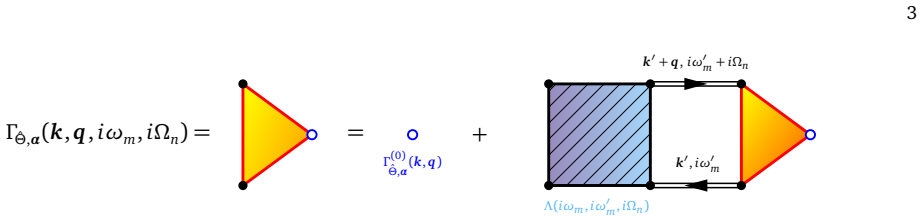
Cost/FunctionalEquation (RS uniqueness J(x)=½(x+x⁻¹)−1) — no analogue invoked herewashburn_uniqueness_aczel unclearWithin the assumption (3), and relabelling ... the ladder Bethe-Salpeter equation (4) ... the irreducible two-particle vertex is a local function, i.e., it only depends on the fermionic and exchanged frequencies
Reference graph
Works this paper leans on
-
[1]
Strongly interacting correlated-electron systems and non-Fermi liquids In strongly correlated solid-state systems, complex ex- perimental phase diagrams are accompanied by low-energy intertwined phases, high interaction energy scales compared to characteristic transition temperatures, and collective elec- tron behaviour[ 4, 8, 221, 222]. There, experiment...
-
[2]
Systems close to a classical or quantum phase transition In many materials, especially those with strong correla- tions, the system might be in a regime where temporal fluctu- ations are dominant, and the dynamics of quasiparticles are primarily controlled by frequency ω (or energy ¯hω) rather than by momentum k. For instance, near a Mott transition or qu...
-
[3]
canonical
High-frequency limit and optical excitations At high frequencies ω (or exchanged energy scales ¯hω) with respect to all other system energy scales, the frequency dependence ofΣ R(k,ω)often becomes more important than its momentum dependence. This dominance occurs because at temperatures kBT≪¯hω the electron ensemble effectively behaves as a T≈ 0 system, a...
-
[4]
Allen formula
Coherent regime at zero momentum: Allen formula for the linear-response function In coherent regime, the transport function at zero momen- tum can be approximated by its zero-energy value, as in Eq. (51). Here, using the identity for Lorentzian functions 1 π Z +∞ −∞ dξ α1α2 (ε1 −ξ) 2+α 2 1 (ε2 −ξ) 2+α 2 2 = α1+α 2 (ε1 −ε 2)2+(α 1+α 2)2 (E1) applied to the...
-
[5]
(53) for the strongly peaked transport func- tion in Eq
Incoherent regime at zero momentum Inserting Eq. (53) for the strongly peaked transport func- tion in Eq. (50), we obtain 26 χ αβ,(0) ˆΘ ˆΘ (0,iΩ n)=− Φαβ ˆΘ (0) π2 Z +∞ −∞ dε1 Z +∞ −∞ dε2 fF D(ε1)−f F D(ε2) iΩn+ε 1 −ε 2 Σ2(ε1) [ε1 −Σ 1(ε1)]2+[Σ 2(ε1)]2 Σ2(ε2) [ε2 −Σ 1(ε2)]2+[Σ 2(ε2)]2 . (E4) We now analytically continue with iΩn →ω + i0+, and we take the...
-
[6]
physicist’s
Vertex corrections with magnetic translational invariance in Landau-level basis Momentum k is not a good quantum number when time- reversal symmetry is broken by the magnetic fieldB. For this reason, we first have to convert the Bethe-Salpeter equation (4) to the Landau-level basis. First, we project to real space of coordinatesrusing ΓˆT,αβ(r1 −r 2,iω m,...
-
[7]
topological
Hall viscosity of Landau levels: Kubo-formula derivation and “topological” ground-state contribution Since the Hamiltonian in a magnetic field B= ∇ ×A is given by minimal coupling, ˆH= (ˆp−eA) 2 2m =( ˆπA)2 2m = ( ˆπA,x)2+( ˆπA,y)2 2m , (G21) where we have defined the kinetic momentum πA=p−eA, (G22) the kinetic stress tensor is ˆTi j= 1 2m ˆπA,i ˆπA,j+ ˆπ...
-
[8]
topological
Noninteracting limit atT=0: “topological” DC Hall viscosity Let us first consider the noninteracting limit, where only the “topological” part of the Hall viscosity exists and is re- lated to the Galilean invariance of the electronic system. We then setΣ( iωm)=0 ∀iωm and employ the Matsubara sum given by Eq. (47). Let us also first go to the zero-temperatu...
-
[9]
topological
Noninteracting finite-frequency regime atT=0: “topological” AC Hall viscosity The correlation function from Eq. (65) at finite tempera- ture reads χ(x x−y y)x y ˆTˆT (0,iΩ n)= 1 A ¯hωc 2 2X l § i2(l+1)(l+2) iΩn −2¯hωc ×[f F D(εl+2)−f F D(εl)]− i2l(l−1) iΩn+2¯hωc ×[f F D(εl)−f F D(εl−2)]}. (G38) AtT=0, Eq. (G38) specializes to χ(x x−y y)x y ˆTˆT (0,iΩ n)...
-
[10]
(A4), the matrix elements of stress vertices from Eqs
Interacting regime at finite frequency andT>0: self-energy effects At finite temperature and frequency, using the spectral representation from Eq. (A4), the matrix elements of stress vertices from Eqs. (G27) and (G30), and performing the analytic continuationiΩ n →ω+i0 +, Eq. (65) becomes 31 χ(x x−y y)x y,R ˆTˆT (0,ω)=− 2 A ¯hωc 2 2¨X l {(l+1)(l+2) Z +∞...
-
[11]
G. D. Mahan,Many-particle physics(Kluwer Aca- demic/Plenum, New York, 2000)
2000
-
[12]
Bruus and K
H. Bruus and K. Flensberg,Many-body quantum theory in condensed matter physics: an introduction(Oxford university press, Oxford, 2004)
2004
-
[13]
Berthod,Spectroscopic Probes of Quantum Matter, 2053- 2563 (IOP Publishing, 2018)
C. Berthod,Spectroscopic Probes of Quantum Matter, 2053- 2563 (IOP Publishing, 2018)
2053
-
[14]
Chowdhury, A
D. Chowdhury, A. Georges, O. Parcollet, and S. Sachdev, Sachdev-Ye-Kitaev models and beyond: Window into non- Fermi liquids, Rev. Mod. Phys.94, 035004 (2022)
2022
-
[15]
P . W . Phillips, N. E. Hussey , and P . Abbamonte, Stranger than metals, Science377, eabh4273 (2022)
2022
-
[16]
J. G. Checkelsky, B. A. Bernevig, P . Coleman, Q. Si, and S. Paschen, Flat bands, strange metals and the Kondo effect, Nat. Rev. Mater.9, 509 (2024)
2024
-
[17]
V . J. Emery and S. A. Kivelson, Importance of phase fluc- tuations in superconductors with small superfluid density, Nature (London)374, 434 (1995)
1995
-
[18]
P . A. Lee, N. Nagaosa, and X.-G. Wen, Doping a Mott insu- lator: Physics of high-temperature superconductivity, Rev. Mod. Phys.78, 17 (2006)
2006
-
[19]
Vuˇciˇcevi´c, D
J. Vuˇciˇcevi´c, D. Tanaskovi´c, M. J. Rozenberg, and V . Do- brosavljevi´c, Bad-metal behavior reveals mott quantum criticality in doped Hubbard models, Phys. Rev. Lett.114, 246402 (2015)
2015
-
[20]
Lucas and S
A. Lucas and S. A. Hartnoll, Resistivity bound for hydrody- namic bad metals, Proc. Natl. Acad. Sci. USA114, 11344 (2017)
2017
-
[21]
S. B. Roy,Mott insulators: physics and applications(IOP publishing, Bristol, 2019)
2019
-
[22]
Schäfer, N
T . Schäfer, N. Wentzell, F . Šimkovic, Y.-Y. He, C. Hille, M. Klett, C. J. Eckhardt, B. Arzhang, V . Harkov, F . m. c.- M. Le Régent, A. Kirsch, Y. Wang, A. J. Kim, E. Kozik, E. A. Stepanov, A. Kauch, S. Andergassen, P . Hansmann, D. Rohe, Y . M. Vilk, J. P . F . LeBlanc, S. Zhang, A.-M. S. Tremblay , M. Fer- rero, O. Parcollet, and A. Georges, Tracking ...
2021
-
[23]
W . E. Pickett, Colloquium: Room temperature superconduc- tivity: The roles of theory and materials design, Rev. Mod. Phys.95, 021001 (2023)
2023
-
[24]
Randeria and E
M. Randeria and E. Taylor, Crossover from Bardeen-Cooper- Schrieffer to Bose-Einstein condensation and the unitary Fermi gas, Annu. Rev. Condens. Matter Phys.5, 209 (2014)
2014
-
[25]
Frank, W
B. Frank, W . Zwerger, and T . Enss, Quantum critical thermal transport in the unitary Fermi gas, Phys. Rev. Res.2, 023301 (2020)
2020
-
[26]
X. Li, X. Luo, S. Wang, K. Xie, X.-P . Liu, H. Hu, Y.-A. Chen, X.-C. Yao, and J.-W . Pan, Second sound attenuation near quantum criticality , Science375, 528 (2022)
2022
-
[27]
Fujii and T
K. Fujii and T . Enss, Hydrodynamic attractor in ultracold atoms, Phys. Rev. Lett.133, 173402 (2024)
2024
-
[28]
B. S. Kasmaei, M. Nopoush, and M. Strickland, Quark self- energy in an ellipsoidally anisotropic quark-gluon plasma, Phys. Rev. D94, 125001 (2016)
2016
-
[29]
Y. Wang, Q. Du, and Y. Guo, Real-time hard-thermal-loop gluon self-energy in a semiquark-gluon plasma, Phys. Rev. D106, 054033 (2022)
2022
-
[30]
N., Cooling of neutron stars
Blaschke, D., Grigorian, H., and Voskresensky , D. N., Cooling of neutron stars. hadronic model, A&A424, 979 (2004)
2004
-
[31]
P˛ ecak, A
D. P˛ ecak, A. Zdanowicz, N. Chamel, P . Magierski, and G. Wlazłowski, Time-dependent nuclear energy-density func- tional theory toolkit for neutron star crust: Dynamics of a nucleus in a neutron superfluid, Phys. Rev. X14, 041054 (2024)
2024
-
[32]
Malik, V
T . Malik, V . Dexheimer, and C. m. c. Providência, Astrophysics and nuclear physics informed interactions in dense matter: Inclusion of PSR J0437-4715, Phys. Rev. D110, 043042 (2024)
2024
-
[33]
D. T . Son, Superconductivity by long-range color magnetic interaction in high-density quark matter, Phys. Rev. D59, 094019 (1999)
1999
-
[34]
W . E. Brown, J. T . Liu, and H.-c. Ren, Non-Fermi liquid behavior, the Becchi-Rouet-Stora-Tyutin identity in the dense quark-gluon plasma, and color superconductivity , Phys. Rev. D62, 054013 (2000)
2000
-
[35]
Geißel, T
A. Geißel, T . Gorda, and J. Braun, Pressure and speed of sound in two-flavor color-superconducting quark matter at next-to-leading order, Phys. Rev. D110, 014034 (2024)
2024
-
[36]
The superscript “R” denotes retarded quantities, correspond- ing to the analytic continuation iωm →ω+ i0+ of the Mat- subara forms of self-energies and correlation functions, e.g., Σ(iω m)for the fermionic self-energy; see also App. A
-
[37]
Metzner and D
W . Metzner and D. Vollhardt, Correlated lattice fermions in d=∞dimensions, Phys. Rev. Lett.62, 324 (1989)
1989
-
[38]
Müller-Hartmann, The Hubbard model at high dimen- sions: some exact results and weak coupling theory , Z
E. Müller-Hartmann, The Hubbard model at high dimen- sions: some exact results and weak coupling theory , Z. Phys. 32 B: Condens. Matter76, 211 (1989)
1989
-
[39]
Khurana, Electrical conductivity in the infinite- dimensional Hubbard model, Phys
A. Khurana, Electrical conductivity in the infinite- dimensional Hubbard model, Phys. Rev. Lett.64, 1990 (1990)
1990
-
[40]
Georges, G
A. Georges, G. Kotliar, W . Krauth, and M. J. Rozenberg, Dynamical mean-field theory of strongly correlated fermion systems and the limit of infinite dimensions, Rev. Mod. Phys. 68, 13 (1996)
1996
-
[41]
Janiš and D
V . Janiš and D. Vollhardt, Conductivity of disordered elec- trons: Mean-field approximation containing vertex correc- tions, Phys. Rev. B63, 125112 (2001)
2001
-
[42]
Kotliar and D
G. Kotliar and D. Vollhardt, Strongly correlated materials: Insights from dynamical mean-field theory , Phys. Today57, 53 (2004)
2004
-
[43]
Berthod, J
C. Berthod, J. Mravlje, X. Deng, R. Žitko, D. van der Marel, and A. Georges, Non-Drude universal scaling laws for the op- tical response of local Fermi liquids, Phys. Rev. B87, 115109 (2013)
2013
-
[44]
Giuliani and G
G. Giuliani and G. Vignale,Quantum Theory of the Electron Liquid(Cambridge University Press, Cambridge, 2005)
2005
-
[45]
G. E. H. Reuter and E. H. Sondheimer, The theory of the anomalous skin effect in metals, Proc. R. Soc. A195(1948). [36]R. G. Chambers, The anomalous skin effect, Proc. Roy . Soc. A215, 10.1098/rspa.1947.0123 (1952)
-
[46]
Silin, On the theory of the anomalous skin effect in metals, Soviet Phys
V . Silin, On the theory of the anomalous skin effect in metals, Soviet Phys. JETP6(1958)
1958
-
[47]
Casimir and J
H. Casimir and J. Ubbink, The skin effect. i. introduction; the current distribution for various configurations, Philips Tech. Rev.28, 271 (1967)
1967
-
[48]
Casimir and J
H. Casimir and J. Ubbink, The skin effect. ii. the skin effect at high frequencies, Philips Tech. Rev.28, 271 (1967)
1967
-
[49]
Casimir and J
H. Casimir and J. Ubbink, The skin effect. iii. the skin effect in superconductors, Philips Tech. Rev.28, 366 (1967)
1967
-
[50]
Wooten, Chapter 4 - free-electron metals, inOptical Prop- erties of Solids, edited by F
F . Wooten, Chapter 4 - free-electron metals, inOptical Prop- erties of Solids, edited by F . Wooten (Academic Press, 1972) pp. 85–107
1972
-
[51]
E. H. Sondheimer, The anomalous skin effect and the optical properties of metals, Advances in Physics50(2001)
2001
-
[52]
Dressel and G
M. Dressel and G. Grüner,Electrodynamics of Solids(Cam- bridge University Press, Cambridge, 2002)
2002
-
[53]
Valentinis, Optical signatures of shear collective modes in strongly interacting Fermi liquids, Phys
D. Valentinis, Optical signatures of shear collective modes in strongly interacting Fermi liquids, Phys. Rev. Research3, 023076 (2021)
2021
-
[54]
Valentinis, J
D. Valentinis, J. Zaanen, and D. Van Der Marel, Propagation of shear stress in strongly interacting metallic Fermi liquids enhances transmission of terahertz radiation, Sci. Rep.11, 1 (2021)
2021
-
[55]
D. L. Maslov and A. V . Chubukov, Optical response of corre- lated electron systems, Rep. Prog. Phys.80, 026503 (2017)
2017
-
[56]
Matus, R
P . Matus, R. M. A. Dantas, R. Moessner, and P . Surówka, Skin effect as a probe of transport regimes in Weyl semimetals, Proc. Natl. Acad. Sci. U. S. A.119, e2200367119 (2022)
2022
-
[57]
Vagov, I
A. Vagov, I. Larkin, M. Croitoru, and V . M. Axt, Superanoma- lous skin-effect and enhanced absorption of light scattered on conductive media, Sci. Rep.13, 5103 (2023)
2023
-
[58]
Valentinis, G
D. Valentinis, G. Baker, D. A. Bonn, and J. Schmalian, Ki- netic theory of the nonlocal electrodynamic response in anisotropic metals: Skin effect in 2D systems, Phys. Rev. Res. 5, 013212 (2023)
2023
-
[59]
Zhou, R.-C
H. Zhou, R.-C. Xiao, S.-H. Zhang, W . Gan, H. Han, H.-M. Zhao, W . Lu, C. Zhang, Y. Sun, H. Li, and D.-F . Shao, Skin effect of nonlinear optical responses in antiferromagnets, Phys. Rev. Lett.133, 236903 (2024)
2024
-
[60]
Baker, T
G. Baker, T . W . Branch, J. S. Bobowski, J. Day , D. Valentinis, M. Oudah, P . McGuinness, S. Khim, P . Surówka, Y. Maeno, T . Scaffidi, R. Moessner, J. Schmalian, A. P . Mackenzie, and D. A. Bonn, Nonlocal electrodynamics in ultrapure PdCoO2, Phys. Rev. X14, 011018 (2024)
2024
-
[61]
De Ceglia, M
D. De Ceglia, M. Scalora, M. A. Vincenti, S. Campione, K. Kel- ley , E. L. Runnerstrom, J.-P . Maria, G. A. Keeler, and T . S. Luk, Viscoelastic optical nonlocality of low-loss epsilon-near-zero nanofilms, Sci. Rep.8, 1 (2018)
2018
-
[62]
D. Yoo, F . Vidal-Codina, C. Ciracì, N.-C. Nguyen, D. R. Smith, J. Peraire, and S.-H. Oh, Modeling and observation of mid- infrared nonlocality in effective epsilon-near-zero ultranar- row coaxial apertures, Nat. Comm.10, 1 (2019)
2019
-
[63]
A. Nag, M. Zhu, M. Bejas, J. Li, H. C. Robarts, H. Yamase, A. N. Petsch, D. Song, H. Eisaki, A. C. Walters, M. García- Fernández, A. Greco, S. M. Hayden, and K.-J. Zhou, Detec- tion of acoustic plasmons in hole-doped Lanthanum and Bismuth cuprate superconductors using resonant inelastic X-ray scattering, Phys. Rev. Lett.125, 257002 (2020)
2020
-
[64]
F . Haas, J. T . Mendonça, and H. Terças, Plasmon dispersion and landau damping in the nonlinear quantum regime, Phys. Rev. E108, 055203 (2023)
2023
-
[65]
Sharma, A
P . Sharma, A. Principi, G. Vignale, and D. L. Maslov, Opti- cal conductivity and damping of plasmons due to electron- electron interaction, Phys. Rev. B109, 045431 (2024)
2024
-
[66]
Fiore, N
J. Fiore, N. Sellati, F . Gabriele, C. Castellani, G. Seibold, M. Udina, and L. Benfatto, Investigating Josephson plasmons in layered cuprates via nonlinear terahertz spectroscopy, Phys. Rev. B110, L060504 (2024)
2024
-
[67]
V . G. Veselago, The electrodynamics of substances with si- multaneously negative values of ε and µ, Sov. Phys. Uspekhi 10, 509 (1968)
1968
-
[68]
Veselago, L
V . Veselago, L. Braginsky , V . Shklover, and C. Hafner, Negative refractive index materials, J. Comput. Theor. Nanos.3, 189 (2006)
2006
-
[69]
Forcella, A
D. Forcella, A. Mezzalira, and D. Musso, Electromagnetic re- sponse of strongly coupled plasmas, Journal of High Energy Physics2014, 1 (2014)
2014
-
[70]
Forcella, J
D. Forcella, J. Zaanen, D. Valentinis, and D. van der Marel, Electromagnetic properties of viscous charged fluids, Phys. Rev. B90, 456 (2014)
2014
-
[71]
Forcella, C
D. Forcella, C. Prada, and R. Carminati, Causality , nonlocal- ity, and negative refraction, Phys. Rev. Lett.118, 134301 (2017)
2017
-
[72]
Zanotto, G
S. Zanotto, G. Biasiol, P . V . Santos, and A. Pitanti, Metamaterial-enabled asymmetric negative refraction of GHz mechanical waves, Nature Comm.13, 5939 (2022)
2022
-
[73]
Zhang, C
T . Zhang, C. Zheng, Z. N. Chen, and C.-W . Qiu, Negative reflection and negative refraction in biaxial van der Waals materials, Nano Lett.22, 5607 (2022)
2022
-
[74]
Sternbach, S
A. Sternbach, S. L. Moore, A. Rikhter, S. Zhang, R. Jing, Y . Shao, B. Kim, S. Xu, S. Liu, J. H. Edgar, A. Rubio, C. Dean, J. Hone, M. M. Fogler, and D. N. Basov, Negative refraction in hyperbolic hetero-bicrystals, Science379, 555 (2023)
2023
-
[75]
H. Hu, N. Chen, H. Teng, R. Yu, M. Xue, K. Chen, Y. Xiao, Y. Qu, D. Hu, J. Chen, Z. Sun, P . Li, F . J. García de Abajo, and Q. Dai, Gate-tunable negative refraction of mid-infrared polaritons, Science379, 558 (2023)
2023
-
[76]
Suter, E
A. Suter, E. Morenzoni, R. Khasanov, H. Luetkens, T . Prokscha, and N. Garifianov, Direct observation of nonlo- cal effects in a superconductor, Phys. Rev. Lett.92, 087001 (2004)
2004
-
[77]
Suter, E
A. Suter, E. Morenzoni, N. Garifianov, R. Khasanov, E. Kirk, H. Luetkens, T . Prokscha, and M. Horisberger, Observation of nonexponential magnetic penetration profiles in the Meiss- 33 ner state: A manifestation of nonlocal effects in supercon- ductors, Phys. Rev. B72, 024506 (2005)
2005
-
[78]
R. F . Kiefl, M. D. Hossain, B. M. Wojek, S. R. Dunsiger, G. D. Morris, T . Prokscha, Z. Salman, J. Baglo, D. A. Bonn, R. Liang, W . N. Hardy , A. Suter, and E. Morenzoni, Direct measurement of the london penetration depth in YBa2Cu3O6.92 using low- energyµSR, Phys. Rev. B81, 180502 (2010)
2010
-
[79]
Suter, E
A. Suter, E. Morenzoni, T . Prokscha, B. M. Wojek, H. Luetkens, G. Nieuwenhuys, A. Gozar, G. Logvenov, and I. Božovi´c, Two-dimensional magnetic and superconducting phases in metal-insulator La2−x SrxCuO4 superlattices mea- sured by muon-spin rotation, Phys. Rev. Lett.106, 237003 (2011)
2011
-
[80]
H. S. Røising, A. Kreisel, and B. M. Andersen, Nonlocal elec- trodynamics and the penetration depth of superconducting Sr2RuO4, Phys. Rev. B110, 094511 (2024)
2024
discussion (0)
Sign in with ORCID, Apple, or X to comment. Anyone can read and Pith papers without signing in.