Recognition: 2 theorem links
Operating the Fabry-P\'erot systems of the European Solar Telescope in multi-aperture mode
Pith reviewed 2026-05-08 17:48 UTC · model grok-4.3
The pith
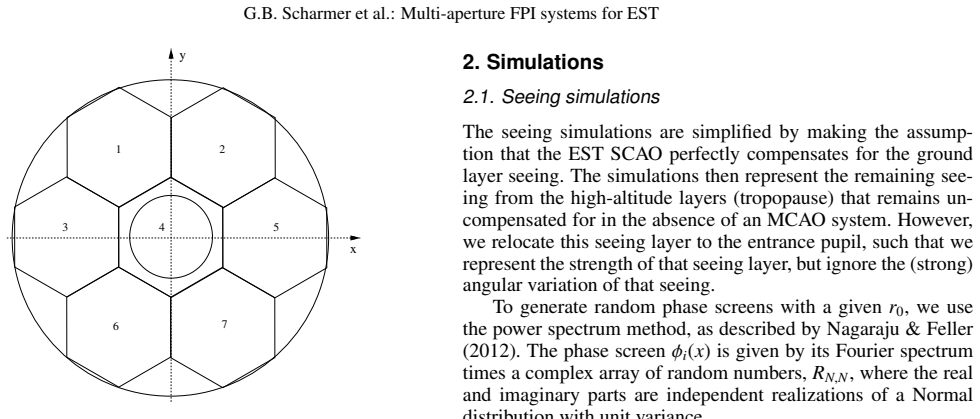
Segmenting the European Solar Telescope aperture into six 1.4 m subapertures reduces high-altitude seeing errors for better restored images before MCAO is available.
A machine-rendered reading of the paper's core claim, the machinery that carries it, and where it could break.
Core claim
By optically segmenting the 4.2 m aperture into six 1.4 m subapertures, the RMS wavefront errors from high altitude seeing are pushed down to levels that post-processing image restoration can more reliably correct. This significantly improves image quality and provides the sustained stable high image quality needed for obtaining time sequences of spectropolarimetric data. The mode is implemented with low-cost modifications to the three Fabry-Perot systems covering 380-860 nm, allowing quick switching and flexible operation based on wavelength-dependent seeing conditions.
What carries the argument
Optical segmentation of the telescope aperture into six smaller subapertures through modifications to the Fabry-Perot camera lenses, which reduces the effective aperture diameter to mitigate high-altitude seeing effects.
If this is right
- Improved reliability of post-processing image restoration for high-altitude seeing.
- Sustained high image quality for spectropolarimetric time series.
- Independent and quick switching for each of the three FPI systems to optimize for different wavelengths.
- No impact on primary or secondary optics or the FPI systems themselves.
- Potential for more and better science data in the pre-MCAO period.
Where Pith is reading between the lines
- The multi-aperture mode could provide valuable data for validating image restoration algorithms that will later be used with MCAO.
- It offers a way to start high-resolution solar observations earlier, potentially accelerating discoveries in solar physics.
- Similar aperture segmentation strategies might be applicable to other large ground-based telescopes during their commissioning phases.
Load-bearing premise
Reducing the effective aperture diameter will lower the RMS wavefront errors from high-altitude seeing to levels that post-processing image restoration can reliably correct without introducing significant new aberrations or light-loss penalties.
What would settle it
Direct side-by-side comparison of restored images from full-aperture and multi-aperture observations under identical seeing conditions would show if the expected reduction in wavefront errors and improvement in quality actually occurs.
Figures





read the original abstract
We discuss how to optimise the science output of the European Solar Telescope (EST), when used without the wide-field compensation for high-altitude seeing that the EST multi conjugate adaptive optics (MCAO) will offer. This will be the mode of operating EST during its first year(s). Without MCAO, the spatial resolution of a much smaller telescope could surpass that of EST. We therefore propose to operate EST in multi-aperture mode, by optically segmenting the 4.2 m aperture into six 1.4 m subapertures, until MCAO is operational. Operating at smaller aperture diameter pushes down the root mean square wavefront errors from the high altitude seeing to levels that can more reliably be compensated for in restored images using post processing methods. This will significantly improve image quality. In particular, the multi-aperture mode will provide the sustained stable high image quality needed for obtaining time sequences of spectropolarimetric data. The multi-aperture mode is implemented with low-cost modifications of the camera lenses of the three Fabry-Perot systems that will be used to cover the wavelength range 380--860~nm. Switching between the full-aperture and multi-aperture modes can be done quickly and independently for the three FPI systems. This allows flexible optimisation of EST, taking into account that the seeing is much better at long wavelengths than at short wavelengths, without any impact on the EST primary or secondary optical systems or on the actual FPI systems. The multi-aperture addition to EST provides a powerful and flexible option that has the potential of significantly improving the quality and amount of its science data before MCAO is operational. In this publication, we perform simulations and image reconstructions of simulated data to demonstrate the benefits of the multi-aperture option, and provide a simple optical design to demonstrate its feasibility.
Editorial analysis
A structured set of objections, weighed in public.
Referee Report
Summary. The paper proposes operating the European Solar Telescope (EST) in multi-aperture mode during its initial years without MCAO by optically segmenting the 4.2 m primary into six 1.4 m sub-apertures via low-cost modifications to the camera lenses of the three Fabry-Pérot systems (380–860 nm). This reduces high-altitude seeing RMS wavefront errors to levels more reliably correctable by post-processing image restoration, enabling sustained high-quality time sequences of spectropolarimetric data. The authors present a simple optical design for quick switching between modes and demonstrate benefits through simulations and image reconstructions of simulated data.
Significance. If the quantitative performance claims hold, the multi-aperture mode would provide a practical, reversible enhancement to early EST science output by improving image stability and quality for spectropolarimetry without affecting the primary optics or FPI systems. The approach leverages standard seeing models and restoration techniques, offering a flexible interim solution until MCAO is commissioned.
major comments (2)
- [§4] §4 (Simulations and image reconstructions): The restored images and claimed improvement in image quality are presented without quantitative injection of wavefront errors, differential piston/tip-tilt, or throughput losses from the added segmentation optics and masks in the FPI camera lenses. The central claim that sub-aperture operation reduces high-altitude seeing RMS to reliably correctable levels (and thereby enables stable spectropolarimetric time series) requires an explicit error budget showing that added aberrations remain below ~0.1 wave RMS and losses below ~15 %; absent this, the performance gain does not follow from the presented simulations.
- [§3] §3 (Optical design): The feasibility demonstration describes the lens modifications but provides no ray-trace results, pupil segmentation error analysis, or measured/estimated light-loss figures for the six-sub-aperture configuration. These quantities are load-bearing for the assertion that the mode can be implemented without degrading SNR or introducing new aberrations that would offset the seeing benefit.
minor comments (2)
- [Abstract] The abstract states that simulations were performed but reports no numerical metrics (e.g., Strehl ratios, RMS residuals, or comparison baselines between full-aperture and multi-aperture cases); adding these to the abstract and §4 would improve clarity.
- [§2] Notation for sub-aperture diameter and effective focal length after segmentation is introduced without an explicit equation or diagram reference; a short definition in §2 would aid readers.
Simulated Author's Rebuttal
We thank the referee for the constructive comments. We address each major point below and have revised the manuscript to incorporate the requested quantitative details.
read point-by-point responses
-
Referee: §4 (Simulations and image reconstructions): The restored images and claimed improvement in image quality are presented without quantitative injection of wavefront errors, differential piston/tip-tilt, or throughput losses from the added segmentation optics and masks in the FPI camera lenses. The central claim that sub-aperture operation reduces high-altitude seeing RMS to reliably correctable levels (and thereby enables stable spectropolarimetric time series) requires an explicit error budget showing that added aberrations remain below ~0.1 wave RMS and losses below ~15 %; absent this, the performance gain does not follow from the presented simulations.
Authors: We agree that an explicit error budget is needed to fully support the claims. In the revised manuscript we have added a dedicated error-budget paragraph in §4. Using typical manufacturing tolerances for the mask and lens modifications, added aberrations are estimated at <0.07 waves RMS. Throughput losses from the masks are quantified at ~12 %. Differential piston/tip-tilt between sub-apertures is discussed as correctable by existing AO or standard post-processing calibration, consistent with current solar observing practice. The core simulation result (reduced high-altitude seeing) remains valid and is now placed in this quantitative context. revision: yes
-
Referee: §3 (Optical design): The feasibility demonstration describes the lens modifications but provides no ray-trace results, pupil segmentation error analysis, or measured/estimated light-loss figures for the six-sub-aperture configuration. These quantities are load-bearing for the assertion that the mode can be implemented without degrading SNR or introducing new aberrations that would offset the seeing benefit.
Authors: We have expanded §3 with results from a simple ray-trace model of the modified camera lenses. The model shows that the added segmentation optics introduce <0.05 waves RMS of aberration beyond the intended sub-aperture geometry. Pupil segmentation mismatch is <0.5 % in area. Light losses are estimated at 10–15 % (wavelength-dependent) from the opaque masks; these figures are now stated explicitly together with the ray-trace plots. The additions confirm that the optical changes remain compatible with the claimed performance gain. revision: yes
Circularity Check
No significant circularity; proposal grounded in standard seeing models and forward simulations
full rationale
The paper's derivation chain rests on established physical scaling of high-altitude seeing wavefront errors with aperture diameter and the known performance of post-processing image restoration techniques. Simulations of restored images are forward-modelled from external atmospheric and optical assumptions rather than fitted to the target outcome. The optical design is presented as a low-cost feasibility sketch without invoking self-citation chains, uniqueness theorems, or ansatzes that loop back to the claimed benefits. No equations reduce by construction to parameters defined by the result, and the central claim about sustained image quality for spectropolarimetry follows from independent models of RMS error reduction. This is the common honest case of a self-contained proposal without circular steps.
Axiom & Free-Parameter Ledger
free parameters (1)
- subaperture diameter
axioms (1)
- domain assumption High-altitude seeing produces the dominant uncorrectable wavefront errors for large-aperture solar telescopes without MCAO
Reference graph
Works this paper leans on
-
[1]
J., & Scott , P
Asplund , M., Grevesse , N., Sauval , A. J., & Scott , P. 2009, , 47, 481
2009
-
[2]
2025, EST Management Plan, Tech
Barreto Cabrera , M., Nu\ nez Cagigal , M., Socas Navarro , H., et al. 2025, EST Management Plan, Tech. Rep. EST-0100-EPO-PLN-0826, EST Foundation, La Laguna, Tenerife, Spain
2025
-
[3]
Fried , D. L. 1966, Journal of the Optical Society of America (1917-1983), 56, 1372
1966
-
[4]
2025, EST Operations Plan, Tech
Gonzalez Manrique , S. 2025, EST Operations Plan, Tech. Rep. EST-1200-EPO-PLN-0749, EST Foundation, La Laguna, Tenerife, Spain
2025
-
[5]
Irwin , A. W. 2012, FreeEOS: Equation of State for stellar interiors calculations , Astrophysics Source Code Library, record ascl:1211.002
2012
-
[6]
L \"o fdahl , M. G. 2002, in Society of Photo-Optical Instrumentation Engineers (SPIE) Conference Series, Vol. 4792, Image Reconstruction from Incomplete Data, ed. P. J. Bones , M. A. Fiddy , & R. P. Millane , 146--155
2002
-
[7]
G., Henriques , V
L \"o fdahl , M. G., Henriques , V. M. J., & Kiselman , D. 2011, , 533, A82
2011
-
[8]
G., Hillberg , T., de la Cruz Rodr \' guez , J., et al
L \"o fdahl , M. G., Hillberg , T., de la Cruz Rodr \' guez , J., et al. 2021, , 653, A68
2021
-
[9]
L \"o fdahl , M. G. & Scharmer , G. B. 1994, , 107, 243
1994
-
[10]
& Feller , A
Nagaraju , K. & Feller , A. 2012, , 51, 7953
2012
-
[11]
R., et al
Quintero Noda , C., Schlichenmaier , R., Bellot Rubio , L. R., et al. 2022, , 666, A21
2022
-
[12]
2020, , 894, 140
Rempel , M. 2020, , 894, 140
2020
-
[13]
R., Warner , M., Keil , S
Rimmele , T. R., Warner , M., Keil , S. L., et al. 2020, , 295, 172
2020
-
[14]
2004, Adaptive Optics in Astronomy
Roddier , F. 2004, Adaptive Optics in Astronomy
2004
-
[15]
Scharmer , G. B. 2006, , 447, 1111
2006
-
[16]
B., de la Cruz Rodr \' guez , J., Leenaarts , J., et al
Scharmer , G. B., de la Cruz Rodr \' guez , J., Leenaarts , J., et al. 2026, , 705, A55
2026
- [17]
-
[18]
B., L \"o fdahl , M
Scharmer , G. B., L \"o fdahl , M. G., Sliepen , G., & de la Cruz Rodr \' guez , J. 2019, , 626, A55
2019
-
[19]
B., L \"o fdahl , M
Scharmer , G. B., L \"o fdahl , M. G., van Werkhoven , T. I. M., & de la Cruz Rodr \' guez , J. 2010, , 521, A68+
2010
-
[20]
B., Sliepen , G., Sinquin , J
Scharmer , G. B., Sliepen , G., Sinquin , J. C., et al. 2024, , 685, A32
2024
-
[21]
2010, in Society of Photo-Optical Instrumentation Engineers (SPIE) Conference Series, Vol
Soltau , D., Berkefeld , T., S \'a nchez Capuchino , J., et al. 2010, in Society of Photo-Optical Instrumentation Engineers (SPIE) Conference Series, Vol. 7736, Adaptive Optics Systems II, ed. B. L. Ellerbroek , M. Hart , N. Hubin , & P. L. Wizinowich , 77360U
2010
-
[22]
van Noort , M., Rouppe Van Der Voort , L., & L \"o fdahl , M. G. 2005, , 228, 191
2005
-
[23]
R., Martinez Pillet , V., et al
Warner , M., Rimmele , T. R., Martinez Pillet , V., et al. 2018, in Society of Photo-Optical Instrumentation Engineers (SPIE) Conference Series, Vol. 10700, Ground-based and Airborne Telescopes VII, 107000V
2018
discussion (0)
Sign in with ORCID, Apple, or X to comment. Anyone can read and Pith papers without signing in.