Recognition: 2 theorem links
Augmenting Interface Usability Heuristics for Reliable Computer-Use Agents
Pith reviewed 2026-05-08 18:46 UTC · model grok-4.3
The pith
Augmenting Nielsen's usability heuristics helps computer-use agents succeed on unseen interfaces while keeping human workflows intact.
A machine-rendered reading of the paper's core claim, the machinery that carries it, and where it could break.
Core claim
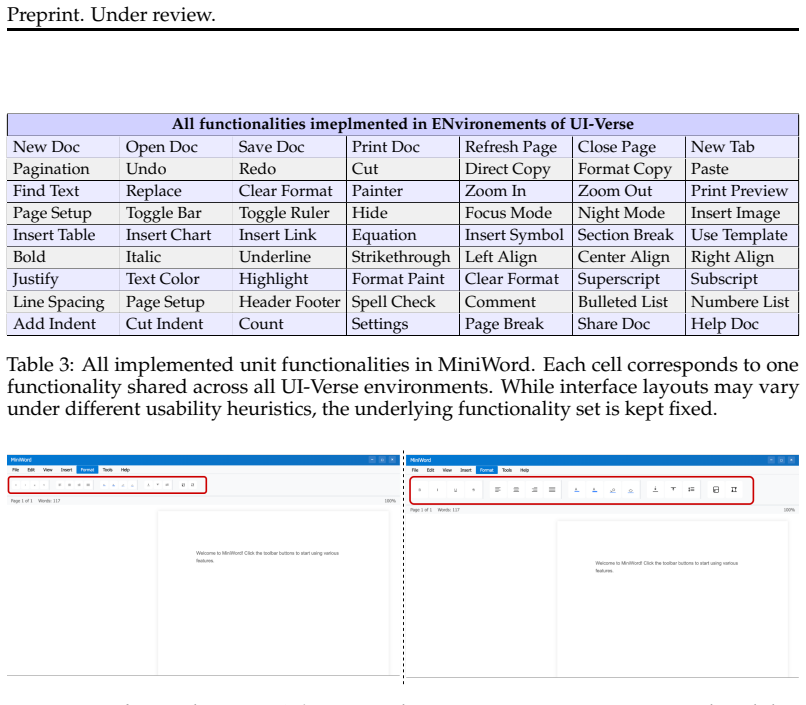
We revisit Nielsen's 10 usability heuristics through the lens of computer-use agents, identifying which principles transfer naturally, where implicit design assumptions create agent-specific failures, and how safe additive augmentations can improve robustness without harming human usability. To evaluate these ideas, we introduce UI-Verse, a suite of controlled environments built around functionally similar interfaces with different applied heuristics. Experiments show that our augmented heuristics consistently improve task completion and modestly improve efficiency, with combined heuristics yielding further gains. Human studies further show that these designs preserve the originalinteraction
What carries the argument
Augmented versions of Nielsen's usability heuristics that add agent-compatible design rules to address generalization failures on new interfaces.
If this is right
- Agents complete more tasks when interfaces follow the augmented heuristics instead of the originals.
- Modest efficiency gains appear alongside the completion improvements.
- Using several augmented heuristics together produces additional performance lifts.
- Human users continue to interact with the interfaces using the same workflows and report no regressions.
Where Pith is reading between the lines
- Interface creators could treat these augmentations as an optional checklist when building applications expected to be used by agents.
- The same identification process might be applied to other sets of design guidelines to make them agent-friendly.
- Over time, widespread use could lower the pressure on agents to reason around interface variability.
Load-bearing premise
The controlled environments in UI-Verse capture the main challenges of real-world unseen and evolving interfaces, and the human studies are sufficient to detect any usability regressions for people.
What would settle it
Running the same agent tasks on a collection of previously unseen real-world applications and finding no rise in task completion rates, or conducting wider human testing and observing workflow changes or usability complaints, would falsify the central claims.
Figures




read the original abstract
Recent advances have enabled general computer-use agents that interpret screens and execute grounded actions from human instructions, yet they still struggle to generalize to unseen and evolving interfaces. While improving agent capability remains important, agent compatible interface design offers a complementary path by aligning interaction semantics with agent prior knowledge. In this paper, we revisit Nielsen 10 usability heuristics through the lens of computer-use agents, identifying which principles naturally transfer, where implicit design assumptions create agent specific failures, and how safe additive augmentations can improve robustness without harming human usability. To evaluate these ideas, we introduce UI-Verse, a suite of controlled environments built around functionally similar interfaces with different applied heuristics. Experiments show that our augmented heuristics consistently improve task completion and modestly improve efficiency, with combined heuristics yielding further gains. Human studies further show that these designs preserve the original interaction workflow without observable usability regressions. Overall, our findings highlight interface design as a practical complementary avenue for improving the reliability and generalization of computer use agents.
Editorial analysis
A structured set of objections, weighed in public.
Referee Report
Summary. The paper revisits Nielsen's 10 usability heuristics through the lens of computer-use agents, identifying transferable principles, agent-specific failure modes arising from implicit design assumptions, and safe additive augmentations that improve robustness. It introduces UI-Verse, a suite of controlled environments built from functionally similar interfaces that differ only in the applied heuristics, and reports that the augmented heuristics improve task completion rates and modestly improve efficiency, with combined heuristics yielding further gains. Human studies are claimed to show that these designs preserve the original interaction workflow with no observable usability regressions.
Significance. If the central empirical claims hold under more diverse testing, the work offers a practical complementary avenue to agent capability improvements by aligning interface semantics with agent priors. The emphasis on safe, additive changes that avoid harming human usability is a strength, as is the introduction of a controlled testbed for isolating heuristic effects.
major comments (2)
- [Abstract and Evaluation] Abstract and UI-Verse description: the environments are constructed from functionally similar interfaces that share the same underlying layout, state transitions, and interaction primitives, differing only in heuristic application. This controlled similarity means the reported gains in task completion and efficiency may not demonstrate improved generalization to unseen or evolving real-world interfaces (web apps, desktop software, mobile views) whose differences extend beyond heuristic application, weakening the central claim about reliability for computer-use agents.
- [Human Studies] Human studies paragraph: the claim of no observable usability regressions is load-bearing for the safety argument, yet the provided text gives no participant count, task diversity, statistical tests, or power analysis. This absence prevents evaluation of whether the studies are sufficient to support the no-regression conclusion.
minor comments (2)
- The exact definitions and implementation details of the proposed augmentations should be presented in a dedicated table or section to support reproducibility.
- Consider expanding the related-work discussion to include prior HCI efforts on agent-compatible interface design.
Simulated Author's Rebuttal
We thank the referee for the constructive feedback. Below we respond point-by-point to the major comments, indicating the revisions we will make to address the concerns.
read point-by-point responses
-
Referee: [Abstract and Evaluation] Abstract and UI-Verse description: the environments are constructed from functionally similar interfaces that share the same underlying layout, state transitions, and interaction primitives, differing only in heuristic application. This controlled similarity means the reported gains in task completion and efficiency may not demonstrate improved generalization to unseen or evolving real-world interfaces (web apps, desktop software, mobile views) whose differences extend beyond heuristic application, weakening the central claim about reliability for computer-use agents.
Authors: The UI-Verse environments were intentionally designed with high functional similarity to isolate the causal impact of the heuristic augmentations from other interface differences. This controlled setup strengthens the internal validity of our results by allowing direct attribution of performance gains to the design changes. We acknowledge that the current testbed does not fully capture the heterogeneity of real-world interfaces. In the revised manuscript we will add a limitations subsection that explicitly discusses the scope of generalization and outlines future work applying the heuristics to more diverse interfaces such as varied web applications and desktop software. revision: partial
-
Referee: [Human Studies] Human studies paragraph: the claim of no observable usability regressions is load-bearing for the safety argument, yet the provided text gives no participant count, task diversity, statistical tests, or power analysis. This absence prevents evaluation of whether the studies are sufficient to support the no-regression conclusion.
Authors: We agree that the human studies reporting is insufficient as presented. The study used a within-subjects design with 15 participants completing four tasks on both original and augmented interfaces, collecting task completion times, error rates, and NASA-TLX scores. We will expand the section to include participant count and demographics, full task descriptions, the statistical tests performed (paired t-tests with p > 0.05 for no significant differences), and a post-hoc power analysis. These additions will allow proper evaluation of the no-regression claim. revision: yes
Circularity Check
No circularity: empirical claims rest on new experiments and testbeds
full rationale
The paper introduces UI-Verse as a new suite of controlled environments and reports results from fresh experiments plus human studies. No equations, fitted parameters, or self-citation chains appear in the provided text. The central claims (improved task completion with augmented heuristics, no usability regressions) are presented as direct outcomes of these new evaluations rather than reductions to prior fitted quantities or self-referential definitions. The derivation chain is therefore self-contained against external benchmarks.
Axiom & Free-Parameter Ledger
Reference graph
Works this paper leans on
-
[1]
URL https: //arxiv.org/abs/2410.08164. Shuai Bai, Yuxuan Cai, Ruizhe Chen, Keqin Chen, Xionghui Chen, Zesen Cheng, Lianghao Deng, Wei Ding, Chang Gao, Chunjiang Ge, Wenbin Ge, Zhifang Guo, Qidong Huang, Jie Huang, Fei Huang, Binyuan Hui, Shutong Jiang, Zhaohai Li, Mingsheng Li, Mei Li, Kaixin Li, Zicheng Lin, Junyang Lin, Xuejing Liu, Jiawei Liu, Chenglon...
-
[2]
URL https://arxiv.org/abs/2511.21631. Rogerio Bonatti, Dan Zhao, Francesco Bonacci, Dillon Dupont, Sara Abdali, Yinheng Li, Yadong Lu, Justin Wagle, Kazuhito Koishida, Arthur Bucker, Lawrence Jang, and Zack Hui. Windows agent arena: Evaluating multi-modal os agents at scale, 2024a. URL https://arxiv.org/abs/2409.08264. Rogerio Bonatti, Dan Zhao, Francesco...
work page Pith review arXiv 2023
-
[3]
URL https://arxiv.org/abs/2510.02250. Md Mehedi Hasan et al. Model context protocol (mcp) at first glance.arXiv preprint arXiv:2506.13538,
-
[4]
Model Context Protocol (MCP): Landscape, Security Threats, and Future Research Directions
GitHub repository. Xinyi Hou, Yanjie Zhao, Shenao Wang, and Haoyu Wang. Model context protocol (mcp): Landscape, security threats, and future research directions.arXiv preprint arXiv:2503.23278,
work page internal anchor Pith review arXiv
-
[5]
URL https://arxiv.org/abs/ 2508.04482. Seonghoon Kang and Won Kim. Minimalist and intuitive user interface design guidelines for consumer electronics devices.Journal of Object T echnology, 6(3):39–52,
-
[6]
Jiateng Liu, Zhenhailong Wang, Rushi Wang, Bingxuan Li, Jeonghwan Kim, Aditi Tiwari, Pengfei Yu, Denghui Zhang, and Heng Ji. Osexpert: Computer-use agents learning professional skills via exploration.arXiv preprint arXiv:2603.07978,
-
[7]
Jakob Nielsen
Official documentation. Jakob Nielsen. Enhancing the explanatory power of usability heuristics. InProceedings of the SIGCHI conference on Human Factors in Computing Systems, pp. 152–158, 1994a. Jakob Nielsen. 10 usability heuristics for user interface design. https://www.nngroup.com/ articles/ten-usability-heuristics/, 1994b. Nielsen Norman Group, updated...
2024
-
[8]
URLhttps://arxiv.org/abs/2406.12373. Yujia Qin, Yining Ye, Junjie Fang, Haoming Wang, Shihao Liang, Shizuo Tian, Junda Zhang, Jiahao Li, Yunxin Li, Shijue Huang, Wanjun Zhong, Kuanye Li, Jiale Yang, Yu Miao, Woyu Lin, Longxiang Liu, Xu Jiang, Qianli Ma, Jingyu Li, Xiaojun Xiao, Kai Cai, Chuang Li, Yaowei Zheng, Chaolin Jin, Chen Li, Xiao Zhou, Minchao Wan...
-
[9]
URL https://arxiv.org/ abs/2501.12326. Christopher Rawles, Sarah Clinckemaillie, Yifan Chang, Jonathan Waltz, Gabrielle Lau, Marybeth Fair, Alice Li, William Bishop, Wei Li, Folawiyo Campbell-Ajala, Daniel Toyama, Robert Berry, Divya Tyamagundlu, Timothy Lillicrap, and Oriana Riva. Androidworld: A dynamic benchmarking environment for autonomous agents,
-
[10]
AndroidWorld: A Dynamic Benchmarking Environment for Autonomous Agents
URL https://arxiv. org/abs/2405.14573. Ben Shneiderman. Direct manipulation for comprehensible, predictable and controllable user interfaces. InProceedings of the 2nd international conference on Intelligent user interfaces, pp. 33–39,
work page internal anchor Pith review arXiv
-
[11]
CoAct-1: Computer-using agents with coding as actions.arXiv preprint arXiv:2508.03923, 2025
doi: 10.48550/arXiv.2508.03923. URLhttps://arxiv.org/abs/2508.03923. Xinyuan Wang, Bowen Wang, Dunjie Lu, Junlin Yang, Tianbao Xie, Junli Wang, Jiaqi Deng, Xiaole Guo, Yiheng Xu, Chen Henry Wu, et al. Opencua: Open foundations for computer- use agents,
-
[12]
OfficeBench: Benchmarking language agents across multiple applications for office automation
URLhttps://arxiv.org/abs/2407.19056. Justin D Weisz, Jessica He, Michael Muller, Gabriela Hoefer, Rachel Miles, and Werner Geyer. Design principles for generative ai applications. InProceedings of the 2024 CHI Conference on Human Factors in Computing Systems, pp. 1–22,
-
[13]
OSWorld: Benchmarking Multimodal Agents for Open-Ended Tasks in Real Computer Environments
Tianbao Xie, Danyang Zhang, Jixuan Chen, Xiaochuan Li, Siheng Zhao, Ruisheng Cao, Toh Jing Hua, Zhoujun Cheng, Dongchan Shin, Fangyu Lei, Yitao Liu, Yiheng Xu, Shuyan Zhou, Silvio Savarese, Caiming Xiong, Victor Zhong, and Tao Yu. Osworld: Benchmarking multimodal agents for open-ended tasks in real computer environments, 2024a. Tianbao Xie, Danyang Zhang,...
work page internal anchor Pith review arXiv 2024
-
[14]
In particular, both exhibit similar distribution shifts under our usability heuristics, further supporting the reliability of the automatic analysis
These results show that although human judgments and the automatic analyzer may differ slightly in absolute values, they remain broadly consistent overall. In particular, both exhibit similar distribution shifts under our usability heuristics, further supporting the reliability of the automatic analysis. C Discussions Scope and boundary of our setting.Our...
2025
discussion (0)
Sign in with ORCID, Apple, or X to comment. Anyone can read and Pith papers without signing in.