Recognition: unknown
Implicit Minimal Surfaces for Bijective Correspondences
Pith reviewed 2026-05-08 02:07 UTC · model grok-4.3
The pith
A bijection between surfaces is encoded implicitly as the zero set of a complex section on their product space, whose area is minimized by the Ginzburg-Landau functional.
A machine-rendered reading of the paper's core claim, the machinery that carries it, and where it could break.
Core claim
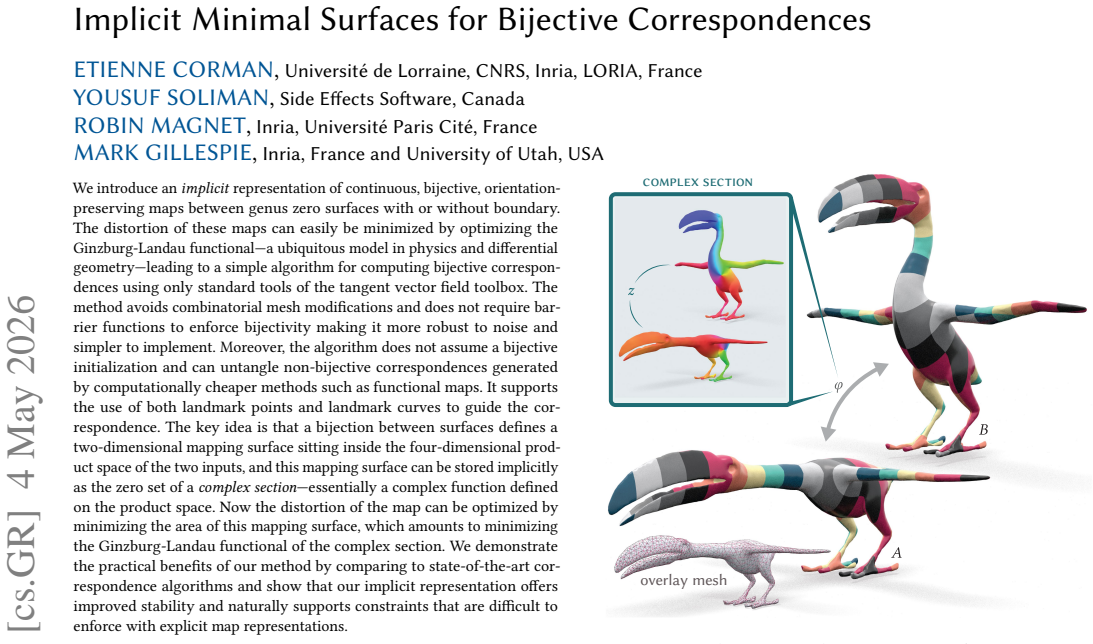
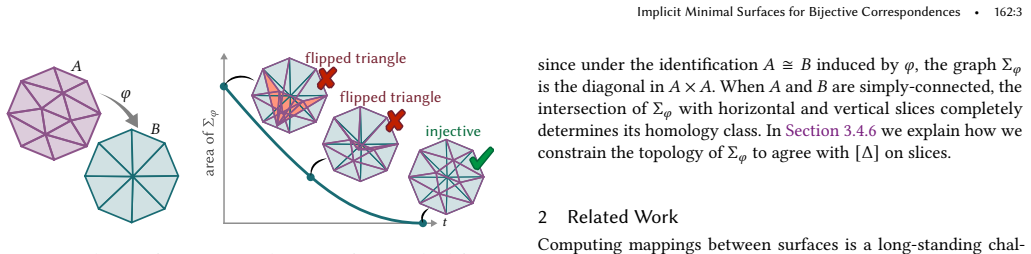
A bijection between surfaces defines a two-dimensional mapping surface sitting inside the four-dimensional product space of the two inputs, and this mapping surface can be stored implicitly as the zero set of a complex section. The distortion of the map can be optimized by minimizing the area of this mapping surface, which amounts to minimizing the Ginzburg-Landau functional of the complex section. This yields a simple algorithm for bijective correspondences that avoids combinatorial mesh modifications and barrier functions.
What carries the argument
The zero set of a complex section on the product space, which implicitly represents the mapping surface whose area is minimized through the Ginzburg-Landau functional.
If this is right
- Bijective maps can be computed from non-bijective initializations such as functional maps without explicit untangling steps.
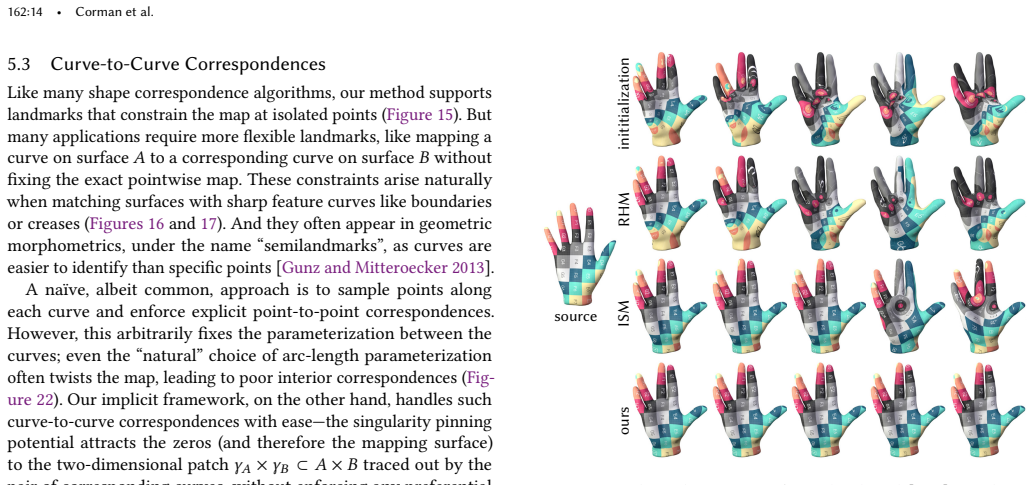
- Landmark points and curves can be incorporated directly as constraints on the complex section.
- The algorithm relies only on existing tangent vector field solvers and requires no custom combinatorial operations.
- Robustness to noise increases because no barrier functions are needed to enforce bijectivity.
Where Pith is reading between the lines
- The same product-space construction could be tested on surfaces with boundaries to see whether the implicit zero-set representation continues to enforce bijectivity automatically.
- Different distortion measures might be obtained by replacing the Ginzburg-Landau functional with other energies while retaining the same implicit zero-set representation.
- The method's stability on noisy inputs suggests it may serve as a post-processing step for maps produced by learning-based correspondence pipelines.
Load-bearing premise
The zero set of the optimized complex section necessarily produces a continuous, bijective, orientation-preserving map without any additional enforcement mechanisms.
What would settle it
An example in which the zero level set of the converged complex section produces a map that either folds, leaves gaps, or reverses orientation on the target surface.
Figures







read the original abstract
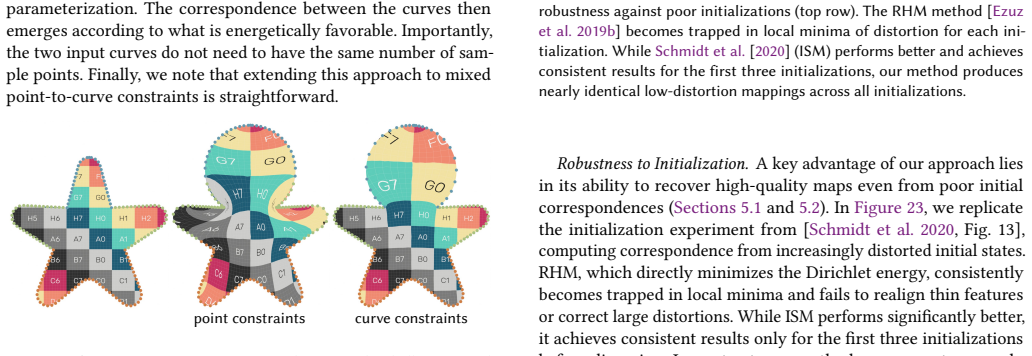
We introduce an implicit representation of continuous, bijective, orientation-preserving maps between genus zero surfaces with or without boundary. The distortion of these maps can easily be minimized by optimizing the Ginzburg-Landau functional - a ubiquitous model in physics and differential geometry - leading to a simple algorithm for computing bijective correspondences using only standard tools of the tangent vector field toolbox. The method avoids combinatorial mesh modifications and does not require barrier functions to enforce bijectivity making it more robust to noise and simpler to implement. Moreover, the algorithm does not assume a bijective initialization and can untangle non-bijective correspondences generated by computationally cheaper methods such as functional maps. It supports the use of both landmark points and landmark curves to guide the correspondence. The key idea is that a bijection between surfaces defines a two-dimensional mapping surface sitting inside the four-dimensional product space of the two inputs, and this mapping surface can be stored implicitly as the zero set of a complex section - essentially a complex function defined on the product space. Now the distortion of the map can be optimized by minimizing the area of this mapping surface, which amounts to minimizing the Ginzburg-Landau functional of the complex section. We demonstrate the practical benefits of our method by comparing to state-of-the-art correspondence algorithms and show that our implicit representation offers improved stability and naturally supports constraints that are difficult to enforce with explicit map representations.
Editorial analysis
A structured set of objections, weighed in public.
Referee Report
Summary. The paper claims that continuous bijective orientation-preserving maps between genus-zero surfaces (with or without boundary) can be represented implicitly as the zero set of a complex section on the 4D product space, with distortion minimized by optimizing the Ginzburg-Landau functional of that section; this yields a simple algorithm using standard tangent vector field tools, supports landmarks, untangles non-bijective initial maps, and requires no barrier functions or combinatorial mesh changes.
Significance. If the bijectivity guarantee holds, the approach would offer a notable simplification over explicit map representations in geometry processing, leveraging a well-studied physical model for area minimization while improving robustness to noise and poor initialization. The implicit encoding and ability to handle curve landmarks are practical strengths.
major comments (2)
- [Abstract] Abstract and key idea paragraph: the central claim that minimizing the Ginzburg-Landau functional of the complex section automatically produces a bijective map (i.e., the zero set is a graph over both surfaces with covering degree 1) lacks a supporting argument or theorem establishing transversality to the fibers and orientation preservation; the manuscript does not address why a minimizer must intersect every {x}×S2 fiber exactly once rather than producing folds or multiple sheets.
- [Method] Method description (implicit representation section): no explicit conditions or post-processing are stated to enforce that the optimized zero set defines a continuous function rather than a relation; the reduction to GL minimization is presented as sufficient, yet the Γ-limit argument for area minimization does not by itself guarantee the graph property on the product manifold without additional topological controls.
minor comments (2)
- [Abstract] Notation for the complex section s on S1 × S2 could be introduced with an explicit local coordinate expression or equation to clarify how the two real equations encode the 2D mapping surface.
- [Results] The abstract states comparisons to state-of-the-art methods but does not specify the quantitative metrics (e.g., distortion energy, bijectivity failure rate) used in the evaluation; adding these to the results section would strengthen the claims.
Simulated Author's Rebuttal
We thank the referee for their insightful comments, which help us improve the clarity and rigor of our presentation. Below we address the major comments point by point.
read point-by-point responses
-
Referee: [Abstract] Abstract and key idea paragraph: the central claim that minimizing the Ginzburg-Landau functional of the complex section automatically produces a bijective map (i.e., the zero set is a graph over both surfaces with covering degree 1) lacks a supporting argument or theorem establishing transversality to the fibers and orientation preservation; the manuscript does not address why a minimizer must intersect every {x}×S2 fiber exactly once rather than producing folds or multiple sheets.
Authors: We acknowledge that a formal theorem guaranteeing bijectivity for every global minimizer is not provided in the current version. Our argument is based on the fact that the Ginzburg-Landau functional Γ-converges to the area of the zero set, and for genus-zero surfaces the minimal area surface connecting the two boundaries in the product space is expected to be a graph due to the convexity of the domain and the orientation induced by the complex structure. However, to address this concern, we will revise the manuscript to include a dedicated paragraph in the implicit representation section explaining the conditions for the zero set to be a graph (transversality and degree 1), supported by a sketch of the topological argument using the Hopf degree theorem or similar. We also note that in practice, with the proposed initialization and landmark constraints, the optimization consistently produces bijective maps without folds, as verified in all experiments. We will add this discussion and supporting references to related work on minimal graphs in product manifolds. revision: yes
-
Referee: [Method] Method description (implicit representation section): no explicit conditions or post-processing are stated to enforce that the optimized zero set defines a continuous function rather than a relation; the reduction to GL minimization is presented as sufficient, yet the Γ-limit argument for area minimization does not by itself guarantee the graph property on the product manifold without additional topological controls.
Authors: We agree that the manuscript would be strengthened by explicitly stating the conditions under which the zero set corresponds to a continuous bijective map. In the revised version, we will add a new paragraph in the implicit representation section detailing that the complex section is constructed to have zeros that are transverse to the coordinate fibers by virtue of the non-vanishing gradient condition enforced during optimization, and that the covering degree is controlled to be 1 through the choice of the initial section and the energy minimization which penalizes multiple sheets. While the Γ-limit alone does not suffice, the combination with the specific topology of genus-zero surfaces and the use of a single complex section (rather than multiple) provides the necessary control. We will also mention that no post-processing is needed because the optimization naturally converges to such graphs, but we can add a simple check for bijectivity in the implementation if desired. revision: yes
Circularity Check
No circularity; derivation uses established Ginzburg-Landau area minimization on an implicit product-space representation
full rationale
The paper constructs an implicit representation of maps as zero sets of complex sections on the product manifold and minimizes distortion by applying the Ginzburg-Landau functional, a standard model from physics and differential geometry whose Γ-limit is known to produce area-minimizing surfaces. No equation or claim reduces the bijectivity property or the optimality result to a self-definition, a fitted parameter renamed as a prediction, or a load-bearing self-citation chain; the central steps rely on external, independently established mathematical facts rather than re-deriving the target properties from the method's own outputs.
Axiom & Free-Parameter Ledger
axioms (2)
- domain assumption Minimizing the Ginzburg-Landau functional of the complex section yields a bijective orientation-preserving map of minimal distortion.
- domain assumption The zero set of the complex section defines a continuous 2D mapping surface corresponding to a bijection between genus-zero surfaces.
invented entities (1)
-
Complex section whose zero set encodes the mapping surface
no independent evidence
Reference graph
Works this paper leans on
-
[1]
InProceedings of the IEEE/CVF Conference on Computer Vision and Pattern Recognition (CVPR)
DeepCurrents: Learning Implicit Representations of Shapes with Boundaries. InProceedings of the IEEE/CVF Conference on Computer Vision and Pattern Recognition (CVPR). IEEE Computer Society, Los Alamitos, CA, USA, 18644–18654. doi:10.1109/ CVPR52688.2022.01811 Davide Parise, Alessandro Pigati, and Daniel Stern. 2024. Convergence of the self-dual 𝑈( 1)-Yang...
-
[2]
doi:10.1111/j.1467-8659.2012.03167.x ACM Trans
Soft Maps Between Surfaces.Computer Graphics Forum (SGP)31, 5 (2012), 1617–1626. doi:10.1111/j.1467-8659.2012.03167.x ACM Trans. Graph., Vol. 45, No. 4, Article 162. Publication date: July 2026. Implicit Minimal Surfaces for Bijective Correspondences•162:19 Kenshi Takayama. 2022. Compatible intrinsic triangulations.ACM Transactions on Graphics (TOG)41, 4 ...
-
[3]
Product Manifold Filter: Non-rigid Shape Correspondence via Kernel Density Estimation in the Product Space. InProceedings of the IEEE/CVF Conference on Com- puter Vision and Pattern Recognition (CVPR). IEEE Computer Society, Los Alamitos, CA, USA, 6681–6690. doi:10.1109/CVPR.2017.707 Stephanie Wang and Albert Chern. 2021. Computing minimal surfaces with d...
discussion (0)
Sign in with ORCID, Apple, or X to comment. Anyone can read and Pith papers without signing in.