Recognition: unknown
Double twist knots and lattice paths
Pith reviewed 2026-05-08 02:54 UTC · model grok-4.3
The pith
Specializing the quiver generating series for the unreduced r-colored HOMFLY-PT polynomial of twist knots and double twist knots at a=0 and q=1 produces lattice path models.
A machine-rendered reading of the paper's core claim, the machinery that carries it, and where it could break.
Core claim
In this work, we explore the combinatorics arising from the quiver generating series of the unreduced r-colored HOMFLY-PT polynomial for some twist-knots and double twist knots. By taking the limit a = 0 and q = 1, we obtain lattice path models for these knots.
What carries the argument
The quiver generating series of the unreduced r-colored HOMFLY-PT polynomial, which after the specialization a=0 and q=1 becomes the generating function enumerating lattice paths for the knots.
If this is right
- Lattice path counting supplies a combinatorial interpretation for the specialized unreduced r-colored HOMFLY-PT polynomials of the examined twist knots and double twist knots.
- The same specialization procedure applies uniformly across the families of twist knots and double twist knots considered.
- Coefficients in the specialized series equal the numbers of lattice paths associated to each term for these knots.
- The quiver representation encodes the path data for the knots once the limit is taken, without further adjustment.
Where Pith is reading between the lines
- The lattice path models could be used to derive recurrence relations satisfied by the specialized polynomials for varying knot parameters.
- Analogous limits applied to quivers of other knot families might produce combinatorial models if the encoding property holds.
- Direct verification for additional knots or higher values of r would provide further checks on the correspondence between series and paths.
- The path enumeration may connect to existing combinatorial techniques for counting objects in knot theory or related discrete structures.
Load-bearing premise
The quiver generating series exactly encodes the unreduced r-colored HOMFLY-PT polynomial for the chosen twist and double twist knots so that the limit a=0 and q=1 directly produces a valid lattice path enumeration.
What would settle it
Computing the specialized series for a concrete knot such as the 5_2 double twist knot and comparing its coefficients against the independently enumerated number of lattice paths; any mismatch in the counts would falsify the claim.
Figures

read the original abstract
In this work, we explore the combinatorics arising from the quiver generating series of the unreduced $r$-colored HOMFLY-PT polynomial $\bar{P}_r(a,q)$ for some twist-knots and double twist knots. By taking the limit $a = 0$ and $q = 1$, we indeed obtain lattice path models for these knots.
Editorial analysis
A structured set of objections, weighed in public.
Referee Report
Summary. The manuscript explores the combinatorics arising from the quiver generating series of the unreduced r-colored HOMFLY-PT polynomial for selected twist knots and double twist knots. Explicit quiver matrices are constructed, the corresponding generating series are written, and the specialization a=0, q=1 is performed term-by-term; the resulting univariate series are identified with the ordinary generating functions of standard lattice-path families (Dyck paths, Motzkin paths, etc.) via direct coefficient comparison.
Significance. If the identifications hold, the work supplies explicit combinatorial models for the specialized colored HOMFLY-PT polynomials of these knots in terms of well-known lattice-path enumerations. The approach stays strictly inside the established quiver formalism for unreduced colored HOMFLY-PT polynomials, uses explicit matrices, performs the limit without hidden cancellations, and preserves non-negative integer coefficients, all of which are strengths for an enumerative result.
minor comments (2)
- [§3] §3: the term-by-term a=0, q=1 specialization is carried out explicitly, but a short remark confirming that no negative coefficients appear after specialization (or why they cannot) would make the lattice-path enumeration claim fully self-contained.
- [Table 1] Table 1: the quiver matrices for the double-twist knots are listed, yet an additional column or footnote indicating the precise knot diagram or crossing number for each matrix would improve readability and allow immediate verification.
Simulated Author's Rebuttal
We thank the referee for the positive assessment of our manuscript, the recognition of its strengths within the quiver formalism, and the recommendation for minor revision. No specific major comments were raised in the report.
Circularity Check
No significant circularity; explicit matrices and direct coefficient matching
full rationale
The paper supplies explicit quiver matrices for the selected twist knots and double twist knots, constructs the corresponding generating series from the established unreduced r-colored HOMFLY-PT quiver formalism, performs the a=0 q=1 specialization term-by-term, and identifies the resulting univariate series with ordinary generating functions of standard lattice-path families (Dyck, Motzkin, etc.) via direct coefficient comparison. All steps remain within external, independently established quiver representations; no parameters are fitted to the target lattice-path counts, no self-definitional loops appear in the equations, and no load-bearing self-citations reduce the central claim to prior work by the same authors. The derivation is therefore self-contained against external benchmarks.
Axiom & Free-Parameter Ledger
axioms (1)
- domain assumption The unreduced r-colored HOMFLY-PT polynomial for twist and double twist knots can be expressed as a quiver generating series.
Reference graph
Works this paper leans on
-
[1]
In such a set-up, we first need to obtain the augmented quiver ˜Q+ K1 for the knotK 1 with lower number of twists
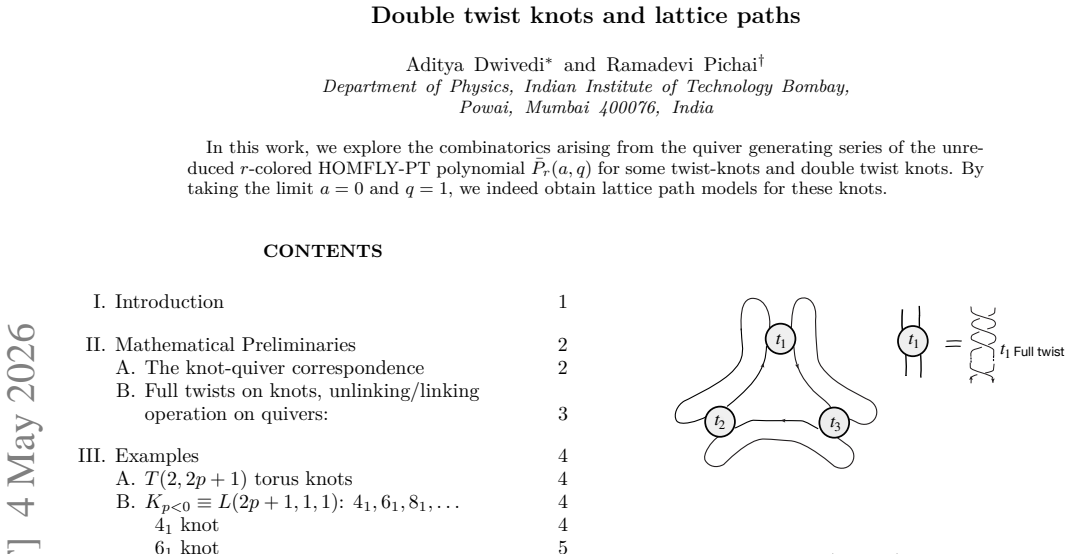
on generating the quiver presentation for 3-pretzel knot family gives a tangible idea to systematize the lat- tice counting. In such a set-up, we first need to obtain the augmented quiver ˜Q+ K1 for the knotK 1 with lower number of twists. For instance,41≡Kp=−1is the lowest knot in the twist knot family. Then, invokingtwisting on knotsto theunlinking/link...
-
[2]
Thus the recursive rela- tion gives theP r(Ki)for the tower of knots
for details) involvingλi’s. Thus the recursive rela- tion gives theP r(Ki)for the tower of knots. In fact, the twisting operation on the knot side corresponds on the quiver side as local operations calledunlinkingand linking[11]. The unlinking operation enlarges a quiver by one extra node. IfQ= (C,x)is a symmetric quiver withmnodes then unlinking the pair...
1995
-
[3]
•N (p,f=1) k (a= 0,q= 1)(24) which counts lat- ticepathsfrom(0,0)to((2|p|−1)k+2|p|−2,k) lying weakly below the liney= x 2|p|−1
For the negative twist knot familyKp<0 with fram- ingfwe obtained the following results: •N (p,f=0) k (a= 0,q= 1)(23) which counts lat- tice paths from(0,0)to(2|p|k+ 2|p|−2,k) with stepsE= (1,0)andN= (0,1)lying weakly below the liney= x 2|p|. •N (p,f=1) k (a= 0,q= 1)(24) which counts lat- ticepathsfrom(0,0)to((2|p|−1)k+2|p|−2,k) lying weakly below the lin...
-
[4]
•The data of various framing is presented in Tables IV, V and VI
For positive twist knotsKp>1 with framingf= 1, we obtain the following lattice interpretation: •N (p,f=1) k (a= 0,q= 1)(29) count lattice paths from(0,0)to(2pk+ 2p−1,k), again using stepsE= (1,0)andN= (0,1), and staying weakly below the liney= x 2p. •The data of various framing is presented in Tables IV, V and VI. We showed that the resulting sequences fi...
-
[5]
The integer sequences and lattice path interpreta- tion for the double twist knots74 and9 5, referring top= 1,2respectively in the 3-pretzel knots family L(2p+ 1,3,1)are : •For the fixed framingf= 0,N (p,0) k (a= 0,q= 1)(32). This is the Raney number R2p+6,2p+2(k)which counts paths from(0,0) to((2p+ 5)k+ 2p+ 1,k)with stepsE= (1,0) andN= (0,1), constrained...
-
[6]
Kucharski, M
P. Kucharski, M. Reineke, M. Stošić, and P. Sułkowski, Bps states, knots, and quivers, Physical Review D96, 121902 (2017)
2017
-
[7]
Gorsky, q, t-catalan numbers and knot homology, arXiv preprint arXiv:1003.0916 (2010)
E. Gorsky, q, t-catalan numbers and knot homology, arXiv preprint arXiv:1003.0916 (2010)
-
[8]
P. Kucharski and P. Sułkowski, BPS counting for knots and combinatorics on words, JHEP11, 120, arXiv:1608.06600 [hep-th]
-
[9]
P. Kucharski, M. Reineke, M. Stosic, and P. Sułkowski, Knots-quivers correspondence, arXiv preprint arXiv:1707.04017 (2017)
- [10]
-
[11]
M. Stošić and P. Sułkowski, Torus knots and general- ized Schröder paths, Nucl. Phys. B1012, 116814 (2025), arXiv:2405.10161 [hep-th]
-
[12]
M. T. L. Bizley, Derivation of a new formula for the num- ber of minimal lattice paths from (0, 0) to (km, kn) hav- ing just t contacts with the line my= nx and having no points above this line; and a proof of grossman’s formula for the number of paths which may touch but do not rise above this line, Journal of the Institute of Actuaries80, 55 (1954)
1954
-
[13]
D. Ðorđević and M. Stošić, Lattice paths and quiver gen- erating series with higher level generators, arXiv preprint 9 arXiv:2408.01832 (2024)
- [14]
-
[15]
S. Banerjee, J. Jankowski, and P. Sułkowski, Revisiting the Melvin-Morton-Rozansky Expansion, or There and Back Again, JHEP12, 095, arXiv:2007.00579 [hep-th]
-
[16]
S. Chauhan, P. Kucharski, D. Noshchenko, R. Pichai, V. K. Singh, and M. Stosic, Full twists and stability of knots and quivers, arXiv e-prints , arXiv:2508.18417 (2025), arXiv:2508.18417 [hep-th]
-
[17]
Aval, Multivariate fuss-catalan numbers (2007), arXiv:0711.0906 [math.CO]
J.-C. Aval, Multivariate fuss-catalan numbers (2007), arXiv:0711.0906 [math.CO]
-
[18]
OEIS Foundation Inc., The On-Line Encyclopedia of In- teger Sequences (2026), published electronically athttp: //oeis.org
2026
-
[19]
J. E. Beagley and P. Drube, The raney generalization of catalan numbers and the enumeration of planar embed- dings, Australasian J. Combin63, 130 (2015)
2015
-
[20]
J. G. Michaels and K. H. Rosen,Applications of discrete mathematics, Vol. 267 (McGraw-Hill New York, 1991)
1991
discussion (0)
Sign in with ORCID, Apple, or X to comment. Anyone can read and Pith papers without signing in.