Recognition: unknown
Third moments of nucleon unpolarized, polarized, and transversity parton distribution functions from physical-point lattice QCD
Pith reviewed 2026-05-08 01:44 UTC · model grok-4.3
The pith
Lattice QCD at physical pion mass yields the first direct values for the third Mellin moments of nucleon parton distributions.
A machine-rendered reading of the paper's core claim, the machinery that carries it, and where it could break.
Core claim
Using forward matrix elements of local leading-twist operators on two lattice QCD ensembles at the physical pion mass, generated with a tree-level Symanzik-improved gauge action and 2+1 flavor HEX-smeared Wilson Clover fermions, the authors extract the isovector third Mellin moments of the unpolarized, polarized, and transversity parton distribution functions. Multiple operators, two extraction methods, and bootstrapped model averages are combined to control uncertainties, providing the first direct calculation of these observables performed at the physical pion mass.
What carries the argument
Forward matrix elements of local leading-twist operators evaluated on physical-pion-mass lattice ensembles to obtain the isovector third Mellin moments of nucleon PDFs.
If this is right
- The results supply benchmark numbers for the third moments that can be compared directly with phenomenological extractions from scattering data.
- Working at the physical pion mass removes the dominant systematic uncertainty from chiral extrapolation that affected earlier lattice studies of higher moments.
- The combination of multiple operators and model averaging provides a controlled way to handle excited-state contamination and renormalization.
- These moments add new constraints on the x-dependence of parton distributions beyond what first moments alone can provide.
Where Pith is reading between the lines
- Alignment of these lattice numbers with global PDF fits would increase trust in lattice methods for computing higher moments.
- Adding disconnected diagrams in future runs would give a fuller accounting of sea-quark contributions to the same moments.
- Repeating the calculation on finer lattices would permit a full continuum extrapolation and quantify remaining cutoff effects.
- The values can serve as inputs for planning measurements at facilities such as the Electron-Ion Collider where higher moments are difficult to access experimentally.
Load-bearing premise
Discretization effects, finite-volume corrections, and operator renormalization are under sufficient control on the two physical-point ensembles so that the extracted matrix elements correspond to continuum QCD values.
What would settle it
A substantial difference between these extracted moments and results from a controlled continuum extrapolation on finer lattices, or from independent global fits to experimental data, would show that the current values do not yet represent physical QCD.
Figures







read the original abstract
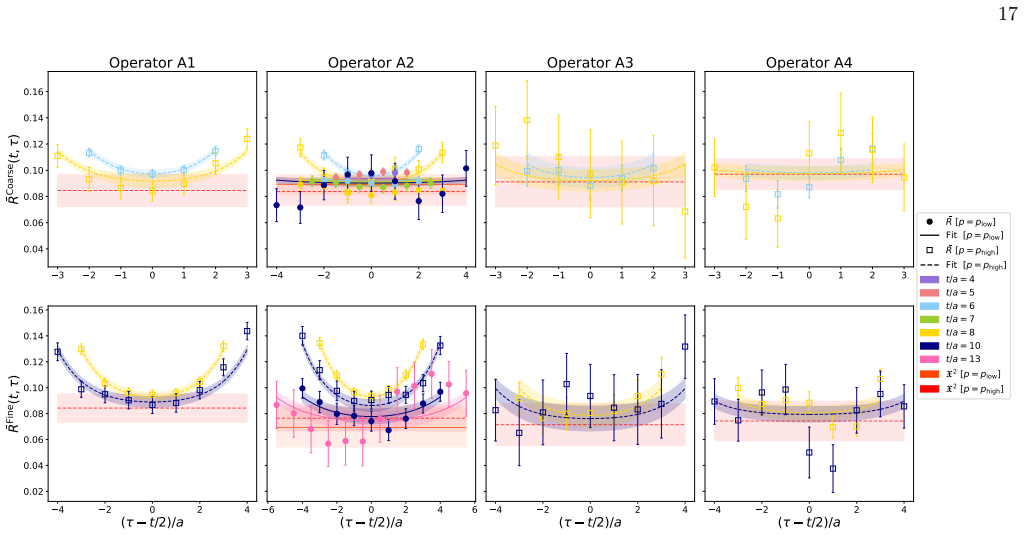
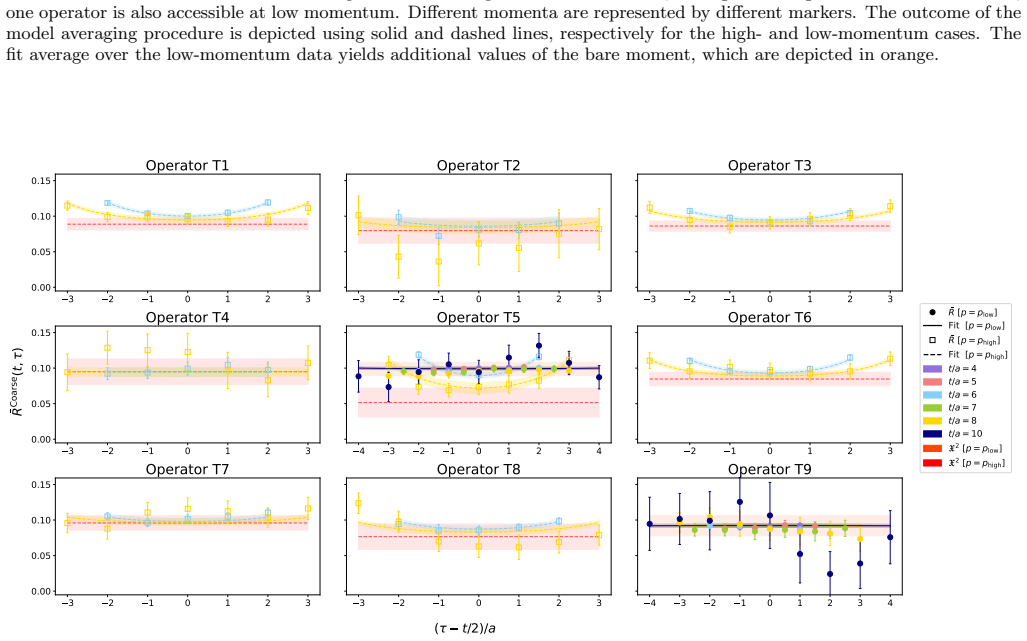
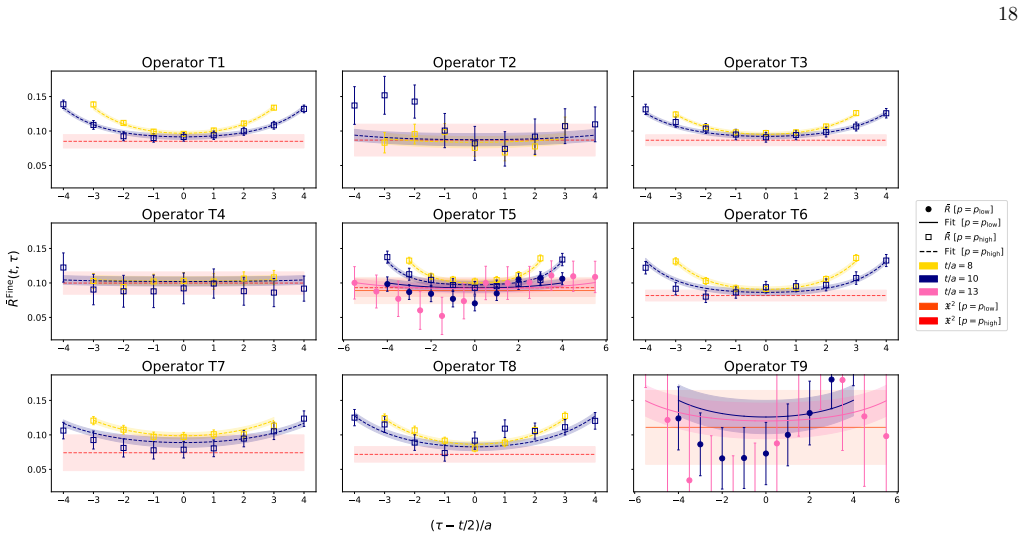
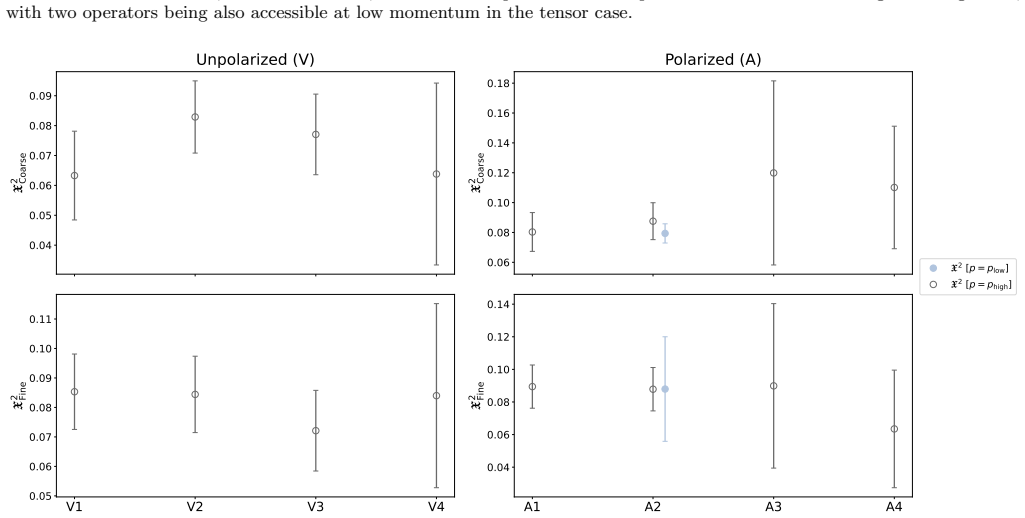
Using forward matrix elements of local leading-twist operators, we present a determination of the isovector third Mellin moments $\left< x^2 \right>$ of nucleon unpolarized, polarized, and transversity parton distribution functions. Two lattice QCD ensembles at the physical pion mass are used, which were generated using a tree-level Symanzik-improved gauge action and 2+1 flavor tree-level improved Wilson Clover fermions coupling via 2-level HEX-smearing. Leveraging a wide set of operators, two extraction methods for the matrix elements, and the automatic inclusion of model uncertainties via bootstrapped model averages, we extract values of the third Mellin moments. This is the first direct calculation of these observables performed at the physical pion mass.
Editorial analysis
A structured set of objections, weighed in public.
Referee Report
Summary. The manuscript reports the first lattice QCD determination of the isovector third Mellin moments ⟨x²⟩ of the nucleon unpolarized, polarized, and transversity parton distribution functions at the physical pion mass. Using forward matrix elements of local leading-twist operators on two physical-point ensembles generated with a tree-level Symanzik-improved gauge action and 2+1 flavor tree-level improved Wilson Clover fermions with HEX-smearing, the authors employ a wide operator basis, two extraction methods, and bootstrapped model averaging to extract the moments while incorporating systematic uncertainties.
Significance. If the systematic effects are shown to be under control, this calculation would represent a significant advance by providing direct first-principles results for these higher moments at the physical point, which are currently poorly constrained by phenomenology. The strengths include the physical pion mass, the use of multiple operators and methods, and the inclusion of model uncertainties via bootstrapping, which help address excited-state contamination and other systematics.
major comments (1)
- The central claim that the extracted matrix elements correspond to continuum QCD values at the physical point rests on the assumption that discretization and finite-volume effects are negligible or subdominant. With only two physical-point ensembles, no continuum extrapolation is performed, and residual O(a²) cutoff effects (particularly for the dimension-6 local operators) together with finite-volume corrections (dependent on m_π L) are not explicitly quantified or shown to lie below the statistical errors. This issue is load-bearing for the reliability of the reported moments and the assertion of a 'direct' physical-point result.
minor comments (2)
- The abstract would benefit from explicitly quoting the final numerical values and uncertainties for each of the three moments to allow immediate assessment of the results.
- Notation for the Mellin moments and operator basis could be introduced more clearly in the introduction to aid readers unfamiliar with the specific conventions used.
Simulated Author's Rebuttal
We thank the referee for their careful review and for recognizing the significance of performing this calculation at the physical pion mass. We address the major comment on discretization and finite-volume effects below, and we propose targeted revisions to the manuscript.
read point-by-point responses
-
Referee: The central claim that the extracted matrix elements correspond to continuum QCD values at the physical point rests on the assumption that discretization and finite-volume effects are negligible or subdominant. With only two physical-point ensembles, no continuum extrapolation is performed, and residual O(a²) cutoff effects (particularly for the dimension-6 local operators) together with finite-volume corrections (dependent on m_π L) are not explicitly quantified or shown to lie below the statistical errors. This issue is load-bearing for the reliability of the reported moments and the assertion of a 'direct' physical-point result.
Authors: We agree that a full continuum extrapolation would be preferable and that the current setup with two ensembles does not permit one. The two ensembles have different lattice spacings (a ≈ 0.093 fm and a ≈ 0.071 fm) at the same physical pion mass, and we have checked that the extracted third moments agree within statistical uncertainties between them. This provides evidence that residual O(a²) effects are subdominant to the quoted errors for the operators considered. For finite-volume effects, both ensembles satisfy m_π L > 4.2, consistent with values used in other nucleon matrix-element studies where such corrections are typically estimated to be a few percent or less. Nevertheless, we acknowledge that these effects have not been explicitly quantified in the original submission. We will add a new subsection in the results section that (i) reports the ensemble-by-ensemble comparison, (ii) cites existing literature estimates for cutoff and finite-volume corrections in similar local-operator calculations, and (iii) qualifies the abstract and introduction statements to read “at the physical pion mass and at finite lattice spacing, with evidence that discretization and finite-volume effects lie below the statistical precision.” This constitutes a partial revision that directly responds to the concern without requiring new simulations. revision: partial
Circularity Check
Direct numerical lattice extraction with no reduction to fitted forms or self-referential definitions
full rationale
The paper computes isovector third Mellin moments directly via forward matrix elements of local leading-twist operators on two physical-point ensembles. Extraction uses a wide set of operators, two methods, and bootstrapped model averages to handle excited states and uncertainties. No equations or steps reduce the final values to a fit of the target observables themselves, nor to a self-citation chain that defines the result by construction. Standard lattice techniques (Symanzik action, HEX smearing, renormalization) are applied to new data; the central claim remains an independent numerical evaluation rather than a tautology.
Axiom & Free-Parameter Ledger
axioms (2)
- domain assumption The tree-level Symanzik-improved gauge action and HEX-smeared Wilson fermions produce sufficiently small discretization effects at the chosen lattice spacings.
- domain assumption Forward matrix elements of local leading-twist operators yield the third Mellin moments after proper renormalization.
Reference graph
Works this paper leans on
-
[1]
[67]), or at a different renormalization scale (Ref
The transversity moment was either reported normalized to the tensor charge (Ref. [67]), or at a different renormalization scale (Ref. [62]) or both (Refs. [66] and [68]); thus, in order to compare with our result, we used the tensor charge from the FLAG review and computed the relevant numerical factors needed for a change of renormalization scale 3. If ...
-
[2]
Conditions and matching Our strategy starts with the decomposition, in the continuum, of Λ OXαµν(p′, p) into products of O(4)-invariant functions and kinematic tensors: ΛOXαµν(p′, p) = X i Σ(i) OX (p2)Λ(i) OXαµν (p′, p).(D4) 22 Taking into account the reduced symmetry of the lattice, we then decompose this into irreducible representations of the hypercubi...
-
[3]
[27, 41]
Calculation We again follow Refs. [27, 41]. Using periodic boundary conditions in space and time for the quarks (this is partially twisted, since the sea quarks are antiperiodic in time), we construct plane-wave sources with momenta either along the four-dimensional diagonalp (′) ∈ { 2π L (k, k, k, k), 2π L (k, k, k,−k)}or along the two-dimensional diagon...
2000
-
[4]
A. De Roeck and R. S. Thorne, Structure Functions, Prog. Part. Nucl. Phys.66, 727 (2011), arXiv:1103.0555 [hep-ph]
-
[5]
S. Forte and G. Watt, Progress in the Determination of the Partonic Structure of the Proton, Ann. Rev. Nucl. Part. Sci. 63, 291 (2013), arXiv:1301.6754 [hep-ph]
-
[6]
The Theory of Deeply Inelastic Scattering
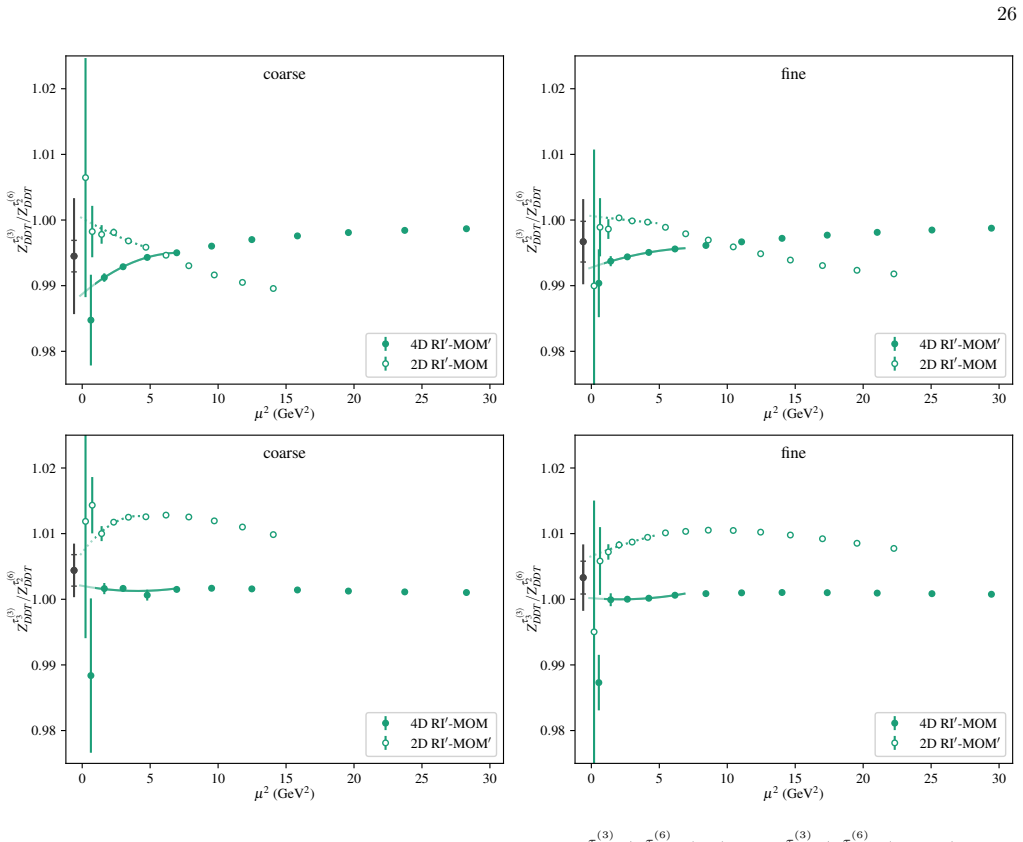
J. Bl¨ umlein, The Theory of Deeply Inelastic Scattering, Prog. Part. Nucl. Phys.69, 28 (2013), arXiv:1208.6087 [hep-ph]. 8The square root of this was also used as a correction in Ref. [41], although not mentioned in the article. 25 0 5 10 15 20 25 30 µ2 (GeV2) 1.10 1.12 1.14 1.16 1.18 1.20 1.22 1.24 1.26 1.28 1.30 Z τ (4) 2 DDV/ZV matched to MS(2 GeV) co...
work page Pith review arXiv 2013
-
[7]
E. Perez and E. Rizvi, The Quark and Gluon Structure of the Proton, Rept. Prog. Phys.76, 046201 (2013), arXiv:1208.1178 [hep-ex]
- [8]
-
[9]
J. Gao, L. Harland-Lang, and J. Rojo, The Structure of the Proton in the LHC Precision Era, Phys. Rept.742, 1 (2018), arXiv:1709.04922 [hep-ph]
work page Pith review arXiv 2018
- [10]
-
[11]
Parton distributions and lattice QCD calculations: a community white paper
H.-W. Linet al., Parton distributions and lattice QCD calculations: a community white paper, Prog. Part. Nucl. Phys. 100, 107 (2018), arXiv:1711.07916 [hep-ph]
work page Pith review arXiv 2018
-
[12]
M. Constantinouet al., Lattice QCD Calculations of Parton Physics, (2022), arXiv:2202.07193 [hep-lat]
-
[13]
Lin, Mapping parton distributions of hadrons with lattice QCD, Prog
H.-W. Lin, Mapping parton distributions of hadrons with lattice QCD, Prog. Part. Nucl. Phys.144, 104177 (2025), arXiv:2506.05025 [hep-lat]
-
[14]
C. Alexandrou, S. Bacchio, M. Constantinou, J. Finkenrath, R. Frezzotti, B. Kostrzewa, G. Koutsou, G. Spanoudes, and C. Urbach (Extended Twisted Mass), Nucleon axial and pseudoscalar form factors using twisted-mass fermion ensembles at the physical point, Phys. Rev. D109, 034503 (2024), arXiv:2309.05774 [hep-lat]
- [15]
-
[16]
A. Walker-Loudet al., Lattice QCD Determination ofg A, PoSCD2018, 020 (2020), arXiv:1912.08321 [hep-lat]
-
[17]
C. Alexandrou, S. Bacchio, M. Constantinou, J. Finkenrath, K. Hadjiyiannakou, K. Jansen, G. Koutsou, and A. Vaquero Aviles-Casco, Nucleon axial, tensor, and scalar charges andσ-terms in lattice QCD, Phys. Rev. D102, 054517 (2020), arXiv:1909.00485 [hep-lat]. 27
-
[18]
R. Gupta, Y.-C. Jang, B. Yoon, H.-W. Lin, V. Cirigliano, and T. Bhattacharya, Isovector Charges of the Nucleon from 2+1+1-flavor Lattice QCD, Phys. Rev. D98, 034503 (2018), arXiv:1806.09006 [hep-lat]
- [19]
-
[20]
E. Berkowitzet al., An accurate calculation of the nucleon axial charge with lattice QCD, (2017), arXiv:1704.01114 [hep-lat]
-
[21]
T. Bhattacharya, V. Cirigliano, S. Cohen, R. Gupta, H.-W. Lin, and B. Yoon, Axial, Scalar and Tensor Charges of the Nucleon from 2+1+1-flavor Lattice QCD, Phys. Rev. D94, 054508 (2016), arXiv:1606.07049 [hep-lat]
-
[22]
D. Djukanovic, G. von Hippel, H. B. Meyer, K. Ottnad, and H. Wittig, Improved analysis of isovector nucleon matrix elements with Nf=2+1 flavors of O(a) improved Wilson fermions, Phys. Rev. D109, 074507 (2024), arXiv:2402.03024 [hep-lat]
-
[23]
R. Tsuji, Y. Aoki, K.-I. Ishikawa, Y. Kuramashi, S. Sasaki, K. Sato, E. Shintani, H. Watanabe, and T. Yamazaki (PACS), Nucleon form factors in Nf=2+1 lattice QCD at the physical point: Finite lattice spacing effect on the root-mean-square radii, Phys. Rev. D109, 094505 (2024), arXiv:2311.10345 [hep-lat]
- [24]
- [25]
- [26]
-
[27]
D. Djukanovic, G. von Hippel, J. Koponen, H. B. Meyer, K. Ottnad, T. Schulz, and H. Wittig, Isovector axial form factor of the nucleon from lattice QCD, Phys. Rev. D106, 074503 (2022), arXiv:2207.03440 [hep-lat]
- [28]
-
[29]
B. Blossier, P. Boucaud, M. Brinet, F. De Soto, V. Morenas, O. P` ene, K. Petrov, and J. Rodr´ ıguez-Quintero (ETM), High statistics determination of the strong coupling constant in Taylor scheme and its OPE Wilson coefficient from lattice QCD with a dynamical charm, Phys. Rev. D89, 014507 (2014), arXiv:1310.3763 [hep-ph]
- [30]
- [31]
-
[32]
E. Shintani, K.-I. Ishikawa, Y. Kuramashi, S. Sasaki, and T. Yamazaki, Nucleon form factors and root-mean-square radii on a (10.8 fm)4 lattice at the physical point, Phys. Rev. D99, 014510 (2019), [Erratum: Phys.Rev.D 102, 019902 (2020)], arXiv:1811.07292 [hep-lat]
-
[33]
K.-I. Ishikawa, Y. Kuramashi, S. Sasaki, N. Tsukamoto, A. Ukawa, and T. Yamazaki (PACS), Nucleon form factors on a large volume lattice near the physical point in 2+1 flavor QCD, Phys. Rev. D98, 074510 (2018), arXiv:1807.03974 [hep-lat]
-
[34]
J. Liang, Y.-B. Yang, T. Draper, M. Gong, and K.-F. Liu, Quark spins and Anomalous Ward Identity, Phys. Rev. D98, 074505 (2018), arXiv:1806.08366 [hep-ph]
-
[35]
N. Yamanaka, S. Hashimoto, T. Kaneko, and H. Ohki (JLQCD), Nucleon charges with dynamical overlap fermions, Phys. Rev. D98, 054516 (2018), arXiv:1805.10507 [hep-lat]
- [36]
-
[37]
M. Abramczyk, T. Blum, T. Izubuchi, C. Jung, M. Lin, A. Lytle, S. Ohta, and E. Shintani, Nucleon mass and isovector couplings in 2+1-flavor dynamical domain-wall lattice QCD near physical mass, Phys. Rev. D101, 034510 (2020), arXiv:1911.03524 [hep-lat]
-
[38]
Alexandrouet al., Moments of the nucleon transverse quark spin densities using lattice QCD, Phys
C. Alexandrouet al., Moments of the nucleon transverse quark spin densities using lattice QCD, Phys. Rev. D107, 054504 (2023), arXiv:2202.09871 [hep-lat]
-
[39]
T. Bhattacharya, V. Cirigliano, S. Cohen, R. Gupta, A. Joseph, H.-W. Lin, and B. Yoon (PNDME), Iso-vector and Iso-scalar Tensor Charges of the Nucleon from Lattice QCD, Phys. Rev. D92, 094511 (2015), arXiv:1506.06411 [hep-lat]
-
[40]
T. Bhattacharya, V. Cirigliano, R. Gupta, H.-W. Lin, and B. Yoon, Neutron Electric Dipole Moment and Tensor Charges from Lattice QCD, Phys. Rev. Lett.115, 212002 (2015), arXiv:1506.04196 [hep-lat]
- [41]
-
[42]
C. Alexandrou, S. Bacchio, M. Constantinou, J. Finkenrath, K. Hadjiyiannakou, K. Jansen, G. Koutsou, H. Panagopoulos, and G. Spanoudes, Complete flavor decomposition of the spin and momentum fraction of the proton using lattice QCD simulations at physical pion mass, Phys. Rev. D101, 094513 (2020), arXiv:2003.08486 [hep-lat]
-
[43]
C. Alexandrouet al., Moments of nucleon generalized parton distributions from lattice QCD simulations at physical pion mass, Phys. Rev. D101, 034519 (2020), arXiv:1908.10706 [hep-lat]
-
[44]
M. Rodekamp, M. Engelhardt, J. R. Green, S. Krieg, S. Liuti, S. Meinel, J. W. Negele, A. Pochinsky, and S. Syritsyn, 28 Moments of nucleon unpolarized, polarized, and transversity parton distribution functions from lattice QCD at the physical point, Phys. Rev. D109, 074508 (2024), arXiv:2401.05360 [hep-lat]
- [45]
- [46]
- [47]
- [48]
- [49]
- [50]
- [51]
-
[52]
C. Alexandrou, M. Constantinou, K. Hadjiyiannakou, K. Jansen, C. Kallidonis, G. Koutsou, A. Vaquero Avil´ es-Casco, and C. Wiese, Nucleon Spin and Momentum Decomposition Using Lattice QCD Simulations, Phys. Rev. Lett.119, 142002 (2017), arXiv:1706.02973 [hep-lat]
-
[53]
Nucleon and pion structure with lattice QCD simulations at physical value of the pion mass
A. Abdel-Rehimet al., Nucleon and pion structure with lattice QCD simulations at physical value of the pion mass, Phys. Rev. D92, 114513 (2015), [Erratum: Phys.Rev.D 93, 039904 (2016)], arXiv:1507.04936 [hep-lat]
work page Pith review arXiv 2015
-
[54]
G. S. Bali, S. Collins, B. Gl¨ aßle, M. G¨ ockeler, J. Najjar, R. H. R¨ odl, A. Sch¨ afer, R. W. Schiel, A. Sternbeck, and W. S¨ oldner, The moment⟨x⟩u−d of the nucleon fromN f = 2 lattice QCD down to nearly physical quark masses, Phys. Rev. D90, 074510 (2014), arXiv:1408.6850 [hep-lat]
-
[55]
Aokiet al.(Flavour Lattice Averaging Group (FLAG)), FLAG review 2024, Phys
Y. Aokiet al.(Flavour Lattice Averaging Group (FLAG)), FLAG review 2024, Phys. Rev. D113, 014508 (2026), arXiv:2411.04268 [hep-lat]
-
[56]
S. B¨ urger, T. Wurm, M. L¨ offler, M. G¨ ockeler, G. Bali, S. Collins, A. Sch¨ afer, and A. Sternbeck (RQCD), Lattice results for the longitudinal spin structure and color forces on quarks in a nucleon, Phys. Rev. D105, 054504 (2022), arXiv:2111.08306 [hep-lat]
-
[57]
M. Brunoet al., Simulation of QCD with N f = 2 + 1 flavors of non-perturbatively improved Wilson fermions, JHEP02, 043, arXiv:1411.3982 [hep-lat]
-
[58]
M. G¨ ockeler, P. H¨ agler, R. Horsley, D. Pleiter, P. E. L. Rakow, A. Sch¨ afer, G. Schierholz, and J. M. Zanotti (QCDSF), Generalized parton distributions and structure functions from full lattice QCD, Nucl. Phys. B Proc. Suppl.140, 399 (2005), arXiv:hep-lat/0409162
-
[59]
D. Dolgovet al.(LHPC, TXL), Moments of nucleon light cone quark distributions calculated in full lattice QCD, Phys. Rev. D66, 034506 (2002), arXiv:hep-lat/0201021
-
[60]
M. G¨ ockeler, R. Horsley, D. Pleiter, P. E. L. Rakow, A. Sch¨ afer, G. Schierholz, H. St¨ uben, and J. M. Zanotti, Investigation of the second moment of the nucleon’sg 1 andg 2 structure functions in two-flavor lattice QCD, Phys. Rev. D72, 054507 (2005), arXiv:hep-lat/0506017
work page Pith review arXiv 2005
-
[61]
A. Francis, P. Fritzsch, R. Karur, J. Kim, G. Pederiva, D. A. Pefkou, A. Rago, A. Shindler, A. Walker-Loud, and S. Zafeiropoulos, Moments of parton distributions functions of the pion from lattice QCD using gradient flow, (2025), arXiv:2510.26738 [hep-lat]
-
[62]
Shindler,Moments of parton distribution functions of any order from lattice QCD,Phys
A. Shindler, Moments of parton distribution functions of any order from lattice QCD, Phys. Rev. D110, L051503 (2024), arXiv:2311.18704 [hep-lat]
-
[63]
W. Detmold, A. V. Grebe, I. Kanamori, C. J. D. Lin, R. J. Perry, and Y. Zhao (HOPE), Parton physics from a heavy- quark operator product expansion: Lattice QCD calculation of the fourth moment of the pion distribution amplitude, Phys. Rev. D113, 014510 (2026), arXiv:2509.04799 [hep-lat]
-
[64]
K. Cichy and M. Constantinou, A guide to light-cone PDFs from Lattice QCD: an overview of approaches, techniques and results, Adv. High Energy Phys.2019, 3036904 (2019), arXiv:1811.07248 [hep-lat]
-
[65]
C. Alexandrou, M. Constantinou, K. Hadjiyiannakou, K. Jansen, and F. Manigrasso, Flavor decomposition of the nucleon unpolarized, helicity, and transversity parton distribution functions from lattice QCD simulations, Phys. Rev. D104, 054503 (2021), arXiv:2106.16065 [hep-lat]
- [66]
- [67]
-
[68]
X. Gao, A. D. Hanlon, S. Mukherjee, P. Petreczky, H.-T. Shu, F. Yao, R. Zhang, and Y. Zhao, Proton isovector helicity PDF at NNLO and the twist-3 moment ˜d2 from lattice QCD at physical quark masses, (2026), arXiv:2604.00143 [hep-lat]
work page internal anchor Pith review Pith/arXiv arXiv 2026
-
[69]
C. Egereret al.(HadStruc), Transversity parton distribution function of the nucleon using the pseudodistribution ap- 29 proach, Phys. Rev. D105, 034507 (2022), arXiv:2111.01808 [hep-lat]
- [70]
-
[71]
Z. Pang, J.-H. Zhang, and D.-J. Zhao, Moments from momentum derivatives in lattice QCD, Chin. Phys.49, 101001 (2025), arXiv:2412.19862 [hep-lat]
-
[72]
Sakata, A general method for obtaining Clebsch-Gordan coefficients of finite groups
I. Sakata, A general method for obtaining Clebsch-Gordan coefficients of finite groups. I. Its application to point and space groups, J. Math. Phys.15, 1702 (1974)
1974
-
[73]
Baake, B
M. Baake, B. Gem¨ unden, and R. Oedingen, Structure and Representations of the Symmetry Group of the Four-dimensional Cube, J. Math. Phys.23, 944 (1982), [Erratum: J.Math.Phys. 23, 2595 (1982)]
1982
-
[74]
M. G¨ ockeler, R. Horsley, E.-M. Ilgenfritz, H. Perlt, P. E. L. Rakow, G. Schierholz, and A. Schiller, Lattice operators for moments of the structure functions and their transformation under the hypercubic group, Phys. Rev. D54, 5705 (1996), arXiv:hep-lat/9602029
-
[75]
Wandzura and F
S. Wandzura and F. Wilczek, Sum Rules for Spin Dependent Electroproduction: Test of Relativistic Constituent Quarks, Phys. Lett. B72, 195 (1977)
1977
-
[76]
R. L. Jaffe,g 2—The Nucleon’s Other Spin-Dependent Structure Function, Comments Nucl. Part. Phys.19, 239 (1990)
1990
-
[77]
R. L. Jaffe and X.-D. Ji, Chiral odd parton distributions and Drell-Yan processes, Nucl. Phys. B375, 527 (1992)
1992
-
[78]
S. Capitani and G. Rossi, Deep inelastic scattering in improved lattice QCD. 1. The First moment of structure functions, Nucl. Phys. B433, 351 (1995), arXiv:hep-lat/9401014
-
[79]
M. G¨ ockeler, R. Horsley, E.-M. Ilgenfritz, H. Perlt, P. E. L. Rakow, G. Schierholz, and A. Schiller, Polarized and unpo- larized nucleon structure functions from lattice QCD, Phys. Rev. D53, 2317 (1996), arXiv:hep-lat/9508004
-
[80]
M. G¨ ockeler, R. Horsley, E.-M. Ilgenfritz, H. Perlt, P. E. L. Rakow, G. Schierholz, and A. Schiller, Perturbative renor- malization of lattice bilinear quark operators, Nucl. Phys. B472, 309 (1996), arXiv:hep-lat/9603006
discussion (0)
Sign in with ORCID, Apple, or X to comment. Anyone can read and Pith papers without signing in.