Recognition: unknown
Proton isovector helicity PDF at NNLO and the twist-3 moment tilde{d}₂ from lattice QCD at physical quark masses
Pith reviewed 2026-05-08 02:22 UTC · model gemini-3-flash-preview
The pith
Lattice QCD maps the proton's internal spin structure and calculates the average color force acting on its quarks.
A machine-rendered reading of the paper's core claim, the machinery that carries it, and where it could break.
Core claim
The authors calculated the isovector helicity PDF for the proton and the twist-3 moment $\tilde{d}_2$ using lattice QCD at the physical pion mass. By boosting the proton to high momenta and applying Large Momentum Effective Theory with next-to-next-to-leading order matching, they determined the helicity distribution in the valence quark region ($x \in [0.25, 0.75]$). Their result for the twist-3 moment, $\tilde{d}_2^{u-d}(2 \text{ GeV}) = 0.0024(46)$, provides a first-of-its-kind estimate in the $\overline{\text{MS}}$ scheme at physical mass, suggesting that the net color Lorentz force acting on the difference between up and down quarks is very small at this energy scale.
What carries the argument
Large Momentum Effective Theory (LaMET), a framework that transforms static lattice calculations into the high-velocity frame required to observe the proton's internal momentum distribution.
If this is right
- The calculated helicity PDF serves as a parameter-free prediction for the spin distribution of quarks in the proton's core.
- The near-zero value of the $\tilde{d}_2$ moment suggests a near-cancellation of the average color-electric and color-magnetic forces on the quarks.
- The inclusion of higher-order perturbative matching (NNLO) reduces theoretical uncertainty in the conversion from lattice data to physical observables.
- The results provide a necessary component for reconstructing the full three-dimensional spin structure of the nucleon.
Where Pith is reading between the lines
- If future experiments confirm this small $\tilde{d}_2$ value, it would suggest that the transverse tug of the gluon field is less dominant in the proton's spin budget than some models predict.
- The success of this approach at physical quark masses indicates that lattice QCD is approaching the precision needed to guide the design of future detector experiments.
- This framework could likely be adapted to study the spin structure of other hadrons, such as pions or kaons, to see if the color Lorentz force behaves universally.
Load-bearing premise
The calculation assumes that the proton's momentum is high enough that corrections scaling with the inverse of that momentum can be accurately handled by current theoretical expansions.
What would settle it
A high-precision measurement of the $g_2$ structure function in deep inelastic scattering experiments that yields a $\tilde{d}_2$ value significantly different from $0.0024 \pm 0.0046$ would challenge the reliability of the current lattice simulation.
Figures




read the original abstract
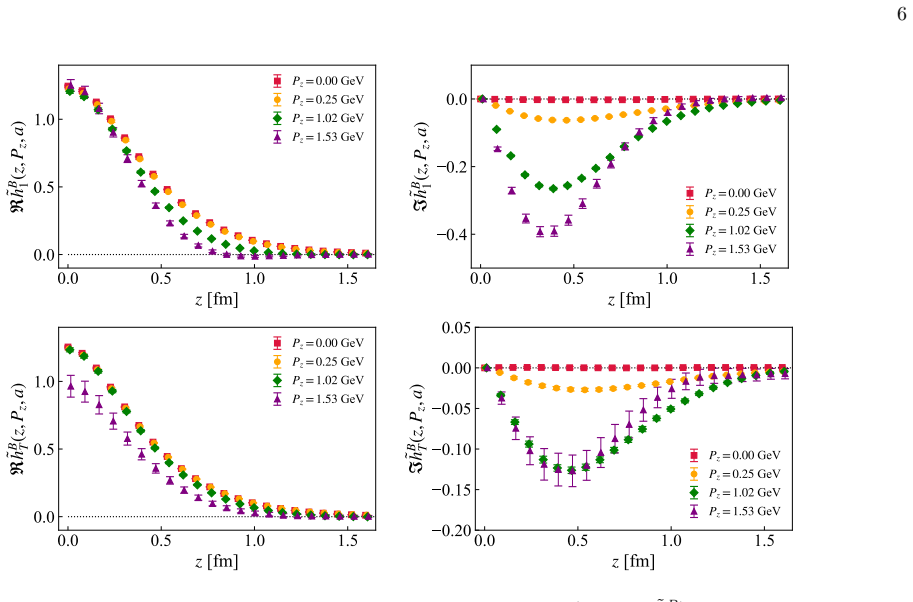
We present a lattice quantum chromodynamics calculation of the $x$-dependent isovector quark helicity parton distribution function (PDF) of the proton in the large momentum effective theory (LaMET) framework. Through operator product expansion (OPE) we also extract the $\tilde{d}_2$ moment of the twist-3 PDF $g_T(x)$ for the first time in the $\overline{\rm MS}$ scheme, which is proportional to the average color Lorentz force experienced by the quark in the proton. This calculation is performed on a lattice of spacing $a$ = 0.076 fm at physical quark masses. The quasi-PDF matrix elements are measured in proton states boosted to momenta $P_z=\{0, 0.25, 1.02, 1.53\}$ GeV. We first extract the lowest few helicity PDF moments from the renormalization-group (RG) invariant ratios of the matrix elements with OPE. Combined with the matrix elements relevant for $g_T(x)$, we obtain $\tilde{d}_2^{u-d}(2\ {\rm GeV})=0.0024(46)$ at next-to-leading order in $\overline{\rm MS}$. Then, the helicity quasi-PDF matrix elements are renormalized in the hybrid scheme with linear renormalon resummation and Fourier transformed to the $x$-space after an asymptotic extrapolation. The quasi-PDF is perturbatively matched to the $\overline{\rm MS}$ PDF with RG and threshold resummations at next-to-leading power and next-to-next-to-leading logarithmic accuracies. After resummations, we determine the PDF in the region $x\in[0.25,0.75]$ with controlled systematic uncertainties. The end-point regions are then parameterized, combined with the LaMET prediction at moderate $x$, and fitted to the short-distance matrix elements in coordinate space.
Editorial analysis
A structured set of objections, weighed in public.
Referee Report
Summary. This manuscript presents a lattice QCD calculation of the proton isovector helicity PDF at the physical pion mass, utilizing the Large Momentum Effective Theory (LaMET) framework. The calculation incorporates several state-of-the-art features: next-to-next-to-leading order (NNLO) perturbative matching, threshold resummation for the matching coefficients, and a hybrid renormalization scheme that addresses the linear power divergence and renormalon ambiguities. In addition to the x-dependent PDF, the authors extract the twist-3 moment ñ₂ by analyzing the power corrections in the operator product expansion (OPE) of the quasi-PDF matrix elements across different proton momenta (Pz up to 1.53 GeV). The results are compared with global experimental fits (JAM, NNPDF), showing consistency in the moderate-x region.
Significance. This work is significant as it provides the first lattice determination of the twist-3 moment ñ₂ in the MS-bar scheme at physical quark masses, an quantity crucial for understanding the color Lorentz force within the proton. Technically, the inclusion of NNLO matching and threshold resummations (NLL accuracy) represents a high standard for lattice PDF calculations, pushing the systematic precision of the LaMET approach. The use of physical pion masses eliminates the systematic uncertainty associated with chiral extrapolation, making the comparison with experimental data more direct and robust.
major comments (3)
- [Section 3.2, Table II] The extraction of the twist-3 moment ñ₂ relies on the isolating the 1/Pz² power correction. However, the calculation uses a maximum momentum of Pz = 1.53 GeV, where the expansion parameter (M/Pz)² is approximately 0.38. With only two high-momentum points (1.02 and 1.53 GeV) effectively driving the fit to the OPE, the results are potentially sensitive to O(1/Pz⁴) corrections or NNLO corrections to the Wilson coefficients that mimic power-law behavior. The authors should quantify the systematic uncertainty associated with the truncation of the 1/Pz series, perhaps by demonstrating the stability of ñ₂ when varying the fit range or including a higher-order term, if possible.
- [Section 4.1, Eq. (14)] The hybrid renormalization scheme involves a transition from the coordinate-space renormalization to the MS-bar scheme at a distance z_S. The manuscript should clarify how sensitive the final x-dependent PDF is to the specific choice of z_S (0.23 fm here). A variation of this parameter is standard in the literature to ensure that the lattice results are in the perturbative regime at z_S while remaining far enough from the lattice spacing cutoff.
- [Section 5.3, Fig. 8] While the comparison with NNPDF and JAM is favorable, the 'physical' x-range is limited to [0.25, 0.75]. The authors use an asymptotic extrapolation for the large-z matrix elements (Sec 4.3). It is not clear if the systematic error shown in Fig. 8 fully encompasses the model dependence of this extrapolation. A comparison of the PDF obtained using different functional forms for the large-z extrapolation (e.g., changing the power-law decay) would strengthen the claim of controlled systematics.
minor comments (3)
- [Section 2.1] Please specify the spatial volume (L/a or L in fm) for the physical mass ensemble used in the calculation to allow for a better assessment of potential finite-volume effects.
- [Figure 3] The labels and legends are quite small; increasing the font size would improve readability.
- [Section 5.2] There is a typo in the second paragraph: 'the the' is repeated.
Simulated Author's Rebuttal
We thank the referee for their positive evaluation of our work, particularly regarding the significance of the first physical-mass determination of the twist-3 moment d2 and the inclusion of NNLO matching with threshold resummations. The referee raised three major points concerning the stability of the 1/Pz series, the sensitivity to the hybrid renormalization scale zS, and the model dependence of the large-z extrapolation. We have addressed these points by performing additional sensitivity checks and will update the manuscript to include these results, further strengthening the reliability of our extracted PDF and twist-3 moment.
read point-by-point responses
-
Referee: [Section 3.2, Table II] The extraction of the twist-3 moment ñ₂ relies on the isolating the 1/Pz² power correction. However, the calculation uses a maximum momentum of Pz = 1.53 GeV, where the expansion parameter (M/Pz)² is approximately 0.38. With only two high-momentum points (1.02 and 1.53 GeV) effectively driving the fit to the OPE, the results are potentially sensitive to O(1/Pz⁴) corrections or NNLO corrections to the Wilson coefficients that mimic power-law behavior. The authors should quantify the systematic uncertainty associated with the truncation of the 1/Pz series.
Authors: The referee is correct that the power correction expansion parameter is not as small as in typical high-energy phenomenology. However, the OPE analysis is performed on the ratio of matrix elements at finite momentum to those at Pz=0, which significantly cancels certain systematics and lattice artifacts. To address the sensitivity to the truncation, we have performed a stability test by excluding the lowest non-zero momentum (0.25 GeV) and checking the variation of the fit parameters. Furthermore, we have estimated the potential impact of O(1/Pz^4) terms by including a nominal term of that order with a coefficient of O(1) in the fit. We find that the value of d2 remains consistent within the quoted 1-sigma statistical error. In the revised manuscript, we will add a discussion on this stability and include a systematic error contribution accounting for the O(1/Pz^4) truncation. revision: yes
-
Referee: [Section 4.1, Eq. (14)] The hybrid renormalization scheme involves a transition from the coordinate-space renormalization to the MS-bar scheme at a distance z_S. The manuscript should clarify how sensitive the final x-dependent PDF is to the specific choice of z_S (0.23 fm here).
Authors: The choice of zS = 0.23 fm was made to satisfy the dual requirements of being small enough for the applicability of perturbative matching while being large enough to avoid significant lattice discretization effects (zS/a ~ 3). To address the referee's concern, we have recalculated the x-dependent PDF by varying zS in the range [0.15, 0.30] fm. We observe that for x in the moderate-x range [0.2, 0.8], the resulting PDF is very stable, with variations well within the existing systematic error band. We will include a plot or a detailed summary of this sensitivity study in the revised manuscript to justify our choice and demonstrate the robustness of the hybrid scheme. revision: yes
-
Referee: [Section 5.3, Fig. 8] While the comparison with NNPDF and JAM is favorable, the 'physical' x-range is limited to [0.25, 0.75]. The authors use an asymptotic extrapolation for the large-z matrix elements (Sec 4.3). It is not clear if the systematic error shown in Fig. 8 fully encompasses the model dependence of this extrapolation. A comparison of the PDF obtained using different functional forms for the large-z extrapolation (e.g., changing the power-law decay) would strengthen the claim of controlled systematics.
Authors: The extrapolation of the quasi-PDF matrix elements to large-z is indeed a source of systematic uncertainty, particularly at the endpoints. In the current version, we used an algebraic decay (z^-d). To test the model dependence, we have now implemented an alternative extrapolation using an exponential decay form (e^{-mz}/z^n), which is motivated by the expected behavior of correlation functions in a finite-size system. Our results show that while the small-x and large-x regions are sensitive to this choice, the moderate-x region [0.25, 0.75] is remarkably robust. We will update the manuscript to include the results from this alternative extrapolation and incorporate the variation into the total systematic error budget shown in Fig. 8. revision: yes
Circularity Check
No significant circularity: Ab initio lattice calculation with independent perturbative matching
full rationale
The paper presents a self-contained lattice QCD calculation of the proton isovector helicity PDF and the twist-3 moment d̃₂. The derivation follows the Large Momentum Effective Theory (LaMET) framework, which is an ab initio approach starting from the QCD Lagrangian. The inputs are the lattice gauge configurations (at physical quark masses) and the lattice spacing (determined by external hadron spectroscopy), which are independent of the target helicity PDF. The quasi-PDF matrix elements are renormalized using a hybrid scheme and matched to the MS-bar PDF using NNLO perturbative kernels that are calculated analytically. The extraction of the d̃₂ moment is achieved by fitting the Operator Product Expansion (OPE) to the short-distance behavior of the lattice matrix elements, which is a standard inference procedure from first-principles data. While the authors cite their own previous work for the development of the LaMET framework and specific renormalization techniques (e.g., the hybrid scheme and renormalon resummation), these represent the application of a consistent methodological pipeline to new data rather than a circular logic loop. Comparisons with experimental global fits (JAM, NNPDF) are performed only at the end of the analysis to validate the results, and these external fits are not used as inputs or constraints in the lattice calculation itself. The skeptic's concerns regarding the limited momentum lever arm (P_z ≤ 1.53 GeV) and the potential for higher-twist contamination are valid questions regarding the systematic uncertainty and reliability of the numerical results, but they do not constitute circularity in the derivation.
Axiom & Free-Parameter Ledger
free parameters (2)
- Lattice spacing (a) =
0.076 fm
- Pion mass (m_pi) =
135 MeV
axioms (2)
- domain assumption Large Momentum Effective Theory (LaMET)
- domain assumption Universality of PDFs
Forward citations
Cited by 1 Pith paper
-
Third moments of nucleon unpolarized, polarized, and transversity parton distribution functions from physical-point lattice QCD
First lattice QCD calculation at the physical pion mass of the isovector third moments of nucleon unpolarized, polarized, and transversity PDFs via forward matrix elements of local operators.
Reference graph
Works this paper leans on
-
[1]
Form 2”) [125], ˜hasy 1 (z, Pz) = Aeiϕsgn(z) + A′eiϕ′sgn(z) |z| ! e−|z|Λ,(37) whereA, A ′, ϕ, ϕ′,Λ are fit parameters. The leading term proportional toAis equivalent to “Form 1
,(34) whereµ 0 = 2κe−γE /zandµ ′ 0 = 2κe−γE /z′ are the phys- ical scales of the system,I(µ) = R dα γ(α) β(α) |α=αs(µ) is the renormalization group evolution factor ofC 0 that relates the quantity at two different physical scales, andκcan be varied to examine the scale variations uncertainty. It is suggested in Ref. [36] to define the regularize scheme of...
-
[2]
R. L. Jaffe and A. Manohar, Nucl. Phys. B337, 509 (1990)
1990
-
[3]
Ji, Phys
X.-D. Ji, Phys. Rev. Lett.78, 610 (1997)
1997
-
[4]
Ashmanet al.(European Muon), Phys
J. Ashmanet al.(European Muon), Phys. Lett. B206, 364 (1988)
1988
-
[5]
Cocuzza, W
C. Cocuzza, W. Melnitchouk, A. Metz, and N. Sato (Jefferson Lab Angular Momentum (JAM)), Phys. Rev. D106, L031502 (2022)
2022
-
[6]
Borsa, M
I. Borsa, M. Stratmann, W. Vogelsang, D. de Florian, and R. Sassot, Phys. Rev. Lett.133, 151901 (2024)
2024
-
[7]
Bertone, A
V. Bertone, A. Chiefa, and E. R. Nocera (MAP (Multi- dimensional Analyses of Partonic distributions)), Phys. Lett. B865, 139497 (2025)
2025
-
[8]
Cruz-Martinez, T
J. Cruz-Martinez, T. Hasenack, F. Hekhorn, G. Magni, E. R. Nocera, T. R. Rabemananjara, J. Rojo, T. Sharma, and G. van Seeventer, JHEP07, 168 (2025)
2025
-
[9]
Adamczyket al.(STAR), Phys
L. Adamczyket al.(STAR), Phys. Rev. Lett.115, 092002 (2015)
2015
-
[10]
Adareet al.(PHENIX), Phys
A. Adareet al.(PHENIX), Phys. Rev. D90, 012007 (2014)
2014
-
[11]
Adareet al.(PHENIX), Phys
A. Adareet al.(PHENIX), Phys. Rev. D93, 011501 (2016). 22
2016
-
[12]
Adolphet al.(COMPASS), Phys
C. Adolphet al.(COMPASS), Phys. Rev. D87, 052018 (2013)
2013
-
[13]
Alekseevet al.(COMPASS), Phys
M. Alekseevet al.(COMPASS), Phys. Lett. B680, 217 (2009)
2009
-
[14]
M. G. Alekseevet al.(COMPASS), Phys. Lett. B693, 227 (2010)
2010
-
[15]
Airapetianet al.(HERMES), Phys
A. Airapetianet al.(HERMES), Phys. Rev. D71, 012003 (2005)
2005
-
[16]
Dudeket al., Eur
J. Dudeket al., Eur. Phys. J. A48, 187 (2012)
2012
-
[17]
Accardiet al., Eur
A. Accardiet al., Eur. Phys. J. A52, 268 (2016)
2016
-
[18]
Abdul Khaleket al., Nucl
R. Abdul Khaleket al., Nucl. Phys. A1026, 122447 (2022)
2022
-
[19]
D. P. Anderle, T.-J. Hou, H. Xing, M. Yan, C. P. Yuan, and Y. Zhao, JHEP08, 034 (2021)
2021
-
[20]
Ji, Phys
X. Ji, Phys. Rev. Lett.110, 262002 (2013)
2013
-
[21]
X. Ji, Sci. China Phys. Mech. Astron.57, 1407 (2014)
2014
-
[22]
Ji, Y.-S
X. Ji, Y.-S. Liu, Y. Liu, J.-H. Zhang, and Y. Zhao, Rev. Mod. Phys.93, 035005 (2021)
2021
-
[23]
Ji, J.-H
X. Ji, J.-H. Zhang, and Y. Zhao, Phys. Rev. Lett.120, 112001 (2018)
2018
-
[24]
Green, K
J. Green, K. Jansen, and F. Steffens, Phys. Rev. Lett. 121, 022004 (2018)
2018
-
[25]
Ishikawa, Y.-Q
T. Ishikawa, Y.-Q. Ma, J.-W. Qiu, and S. Yoshida, Phys. Rev. D96, 094019 (2017)
2017
-
[26]
Alexandrou, K
C. Alexandrou, K. Cichy, M. Constantinou, K. Had- jiyiannakou, K. Jansen, H. Panagopoulos, and F. Stef- fens, Nucl. Phys. B923, 394 (2017)
2017
-
[27]
J.-W. Chen, T. Ishikawa, L. Jin, H.-W. Lin, Y.-B. Yang, J.-H. Zhang, and Y. Zhao, Phys. Rev. D97, 014505 (2018)
2018
-
[28]
Constantinou and H
M. Constantinou and H. Panagopoulos, Phys. Rev. D 96, 054506 (2017)
2017
-
[29]
I. W. Stewart and Y. Zhao, Phys. Rev. D97, 054512 (2018)
2018
-
[30]
X. Ji, Y. Liu, A. Sch¨ afer, W. Wang, Y.-B. Yang, J.-H. Zhang, and Y. Zhao, Nucl. Phys. B964, 115311 (2021)
2021
-
[31]
Huoet al.(Lattice Parton (LPC)), Nucl
Y.-K. Huoet al.(Lattice Parton (LPC)), Nucl. Phys. B 969, 115443 (2021)
2021
-
[32]
Izubuchi, X
T. Izubuchi, X. Ji, L. Jin, I. W. Stewart, and Y. Zhao, Phys. Rev. D98, 056004 (2018)
2018
-
[33]
Li, Y.-Q
Z.-Y. Li, Y.-Q. Ma, and J.-W. Qiu, Phys. Rev. Lett. 126, 072001 (2021)
2021
-
[34]
L.-B. Chen, W. Wang, and R. Zhu, Phys. Rev. Lett. 126, 072002 (2021)
2021
-
[35]
Cheng, L.-H
C. Cheng, L.-H. Huang, X. Li, Z.-Y. Li, and Y.-Q. Ma, Phys. Rev. Lett.134, 251902 (2025)
2025
-
[36]
V. M. Braun, A. Vladimirov, and J.-H. Zhang, Phys. Rev. D99, 014013 (2019)
2019
-
[37]
Zhang, J
R. Zhang, J. Holligan, X. Ji, and Y. Su, Phys. Lett. B 844, 138081 (2023)
2023
-
[38]
Holligan, X
J. Holligan, X. Ji, H.-W. Lin, Y. Su, and R. Zhang, Nucl. Phys. B993, 116282 (2023)
2023
-
[39]
X. Gao, K. Lee, S. Mukherjee, C. Shugert, and Y. Zhao, Phys. Rev. D103, 094504 (2021)
2021
-
[40]
Y. Su, J. Holligan, X. Ji, F. Yao, J.-H. Zhang, and R. Zhang, Nucl. Phys. B991, 116201 (2023)
2023
-
[41]
X. Ji, Y. Liu, and Y. Su, JHEP08, 037 (2023)
2023
-
[42]
Baker, D
E. Baker, D. Bollweg, P. Boyle, I. Clo¨ et, X. Gao, S. Mukherjee, P. Petreczky, R. Zhang, and Y. Zhao, JHEP07, 211 (2024)
2024
-
[43]
X. Ji, Y. Liu, Y. Su, and R. Zhang, JHEP03, 045 (2025)
2025
-
[44]
Holligan, H.-W
J. Holligan, H.-W. Lin, R. Zhang, and Y. Zhao, JHEP 207, 241 (2025)
2025
-
[45]
Gao, W.-Y
X. Gao, W.-Y. Liu, and Y. Zhao, Phys. Rev. D109, 094506 (2024)
2024
-
[46]
Zhao, Phys
Y. Zhao, Phys. Rev. Lett.133, 241904 (2024)
2024
-
[47]
Bollweg, X
D. Bollweg, X. Gao, S. Mukherjee, and Y. Zhao, Phys. Lett. B852, 138617 (2024)
2024
-
[48]
Braun and D
V. Braun and D. M¨ uller, Eur. Phys. J. C55, 349 (2008)
2008
-
[49]
A. V. Radyushkin, Phys. Rev. D96, 034025 (2017)
2017
-
[50]
Orginos, A
K. Orginos, A. Radyushkin, J. Karpie, and S. Zafeiropoulos, Phys. Rev. D96, 094503 (2017)
2017
-
[51]
Ma and J.-W
Y.-Q. Ma and J.-W. Qiu, Phys. Rev. Lett.120, 022003 (2018)
2018
-
[52]
Liu and S.-J
K.-F. Liu and S.-J. Dong, Phys. Rev. Lett.72, 1790 (1994)
1994
-
[53]
Liang, T
J. Liang, T. Draper, K.-F. Liu, A. Rothkopf, and Y.-B. Yang (XQCD), Phys. Rev. D101, 114503 (2020)
2020
-
[54]
Detmold and C
W. Detmold and C. J. D. Lin, Phys. Rev. D73, 014501 (2006)
2006
-
[55]
Detmold, A
W. Detmold, A. V. Grebe, I. Kanamori, C. J. D. Lin, R. J. Perry, and Y. Zhao (HOPE), Phys. Rev. D104, 074511 (2021)
2021
-
[56]
A. J. Chambers, R. Horsley, Y. Nakamura, H. Perlt, P. E. L. Rakow, G. Schierholz, A. Schiller, K. Somfleth, R. D. Young, and J. M. Zanotti, Phys. Rev. Lett.118, 242001 (2017)
2017
-
[57]
Davoudi and M
Z. Davoudi and M. J. Savage, Phys. Rev. D86, 054505 (2012)
2012
-
[58]
Shindler, Phys
A. Shindler, Phys. Rev. D110, L051503 (2024)
2024
-
[59]
Francis, P
A. Francis, P. Fritzsch, R. Karur, J. Kim, G. Pederiva, D. A. Pefkou, A. Rago, A. Shindler, A. Walker-Loud, and S. Zafeiropoulos, (2025)
2025
-
[60]
Liuet al.(Lattice Parton), Phys
Y.-S. Liuet al.(Lattice Parton), Phys. Rev. D101, 034020 (2020)
2020
-
[61]
Lin, J.-W
H.-W. Lin, J.-W. Chen, T. Ishikawa, and J.-H. Zhang (LP3), Phys. Rev. D98, 054504 (2018)
2018
-
[62]
Alexandrou, K
C. Alexandrou, K. Cichy, M. Constantinou, K. Jansen, A. Scapellato, and F. Steffens, Phys. Rev. Lett.121, 112001 (2018)
2018
-
[63]
J.-W. Chen, L. Jin, H.-W. Lin, Y.-S. Liu, Y.-B. Yang, J.-H. Zhang, and Y. Zhao, (2018)
2018
-
[64]
Alexandrou, K
C. Alexandrou, K. Cichy, M. Constantinou, K. Had- jiyiannakou, K. Jansen, A. Scapellato, and F. Steffens, Phys. Rev. D99, 114504 (2019)
2019
-
[65]
Jo´ o, J
B. Jo´ o, J. Karpie, K. Orginos, A. Radyushkin, D. Richards, and S. Zafeiropoulos, JHEP12, 081 (2019)
2019
-
[66]
Jo´ o, J
B. Jo´ o, J. Karpie, K. Orginos, A. V. Radyushkin, D. G. Richards, and S. Zafeiropoulos, Phys. Rev. Lett.125, 232003 (2020)
2020
-
[67]
X. Gao, A. D. Hanlon, J. Holligan, N. Karthik, S. Mukherjee, P. Petreczky, S. Syritsyn, and Y. Zhao, Phys. Rev. D107, 074509 (2023)
2023
-
[68]
Liu, J.-W
Y.-S. Liu, J.-W. Chen, L. Jin, R. Li, H.-W. Lin, Y.-B. Yang, J.-H. Zhang, and Y. Zhao, (2018)
2018
-
[69]
Alexandrou, K
C. Alexandrou, K. Cichy, M. Constantinou, K. Jansen, A. Scapellato, and F. Steffens, Phys. Rev. D98, 091503 (2018)
2018
-
[70]
Yaoet al.(Lattice Parton), Phys
F. Yaoet al.(Lattice Parton), Phys. Rev. Lett.131, 261901 (2023)
2023
-
[71]
X. Gao, A. D. Hanlon, S. Mukherjee, P. Petreczky, Q. Shi, S. Syritsyn, and Y. Zhao, Phys. Rev. D109, 054506 (2024)
2024
-
[72]
J.-W. Chen, S. D. Cohen, X. Ji, H.-W. Lin, and J.-H. Zhang, Nucl. Phys. B911, 246 (2016)
2016
-
[73]
Lin, J.-W
H.-W. Lin, J.-W. Chen, X. Ji, L. Jin, R. Li, Y.-S. Liu, 23 Y.-B. Yang, J.-H. Zhang, and Y. Zhao, Phys. Rev. Lett. 121, 242003 (2018)
2018
-
[74]
Lin and R
H.-W. Lin and R. Zhang, Phys. Rev. D100, 074502 (2019)
2019
-
[75]
Alexandrou, K
C. Alexandrou, K. Cichy, M. Constantinou, J. R. Green, K. Hadjiyiannakou, K. Jansen, F. Manigrasso, A. Scapellato, and F. Steffens, Phys. Rev. D103, 094512 (2021)
2021
-
[76]
Alexandrou, M
C. Alexandrou, M. Constantinou, K. Hadjiyiannakou, K. Jansen, and F. Manigrasso, Phys. Rev. D104, 054503 (2021)
2021
-
[77]
Alexandrou, M
C. Alexandrou, M. Constantinou, K. Hadjiyiannakou, K. Jansen, and F. Manigrasso, Phys. Rev. Lett.126, 102003 (2021)
2021
-
[78]
Z. Fan, X. Gao, R. Li, H.-W. Lin, N. Karthik, S. Mukherjee, P. Petreczky, S. Syritsyn, Y.-B. Yang, and R. Zhang, Phys. Rev. D102, 074504 (2020)
2020
-
[79]
R. G. Edwardset al.(HadStruc), JHEP03, 086 (2023)
2023
-
[80]
Holligan and H.-W
J. Holligan and H.-W. Lin, Phys. Lett. B854, 138731 (2024)
2024
discussion (0)
Sign in with ORCID, Apple, or X to comment. Anyone can read and Pith papers without signing in.