Recognition: 2 theorem links
· Lean TheoremInsureConnect: Blockchain and Digital Identity for the Property Insurance Market
Pith reviewed 2026-05-08 18:14 UTC · model grok-4.3
The pith
InsureConnect integrates blockchain, self-sovereign identity, and satellite imagery to enhance property insurance transparency and auditability after disasters.
A machine-rendered reading of the paper's core claim, the machinery that carries it, and where it could break.
Core claim
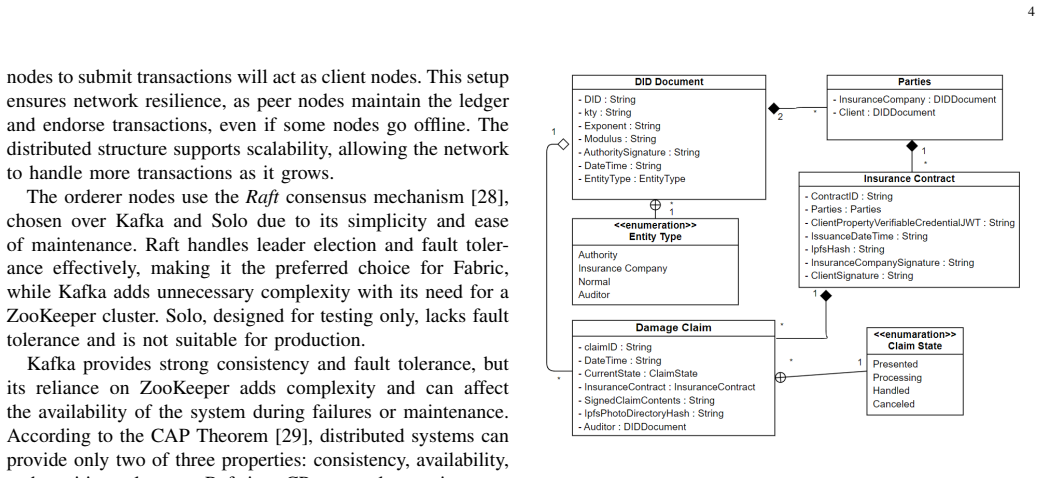
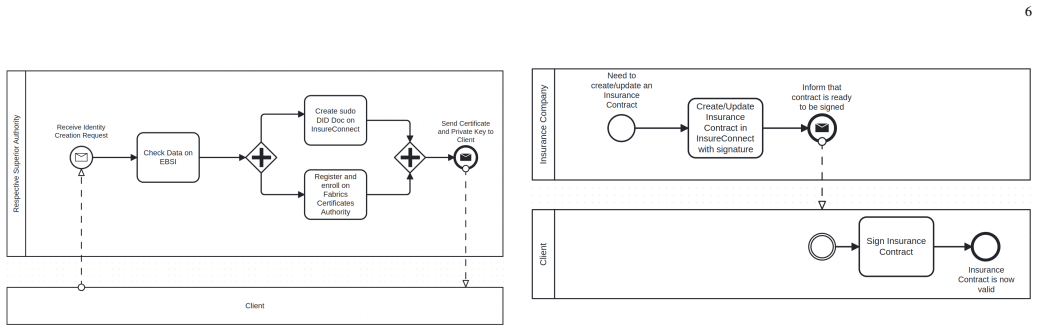
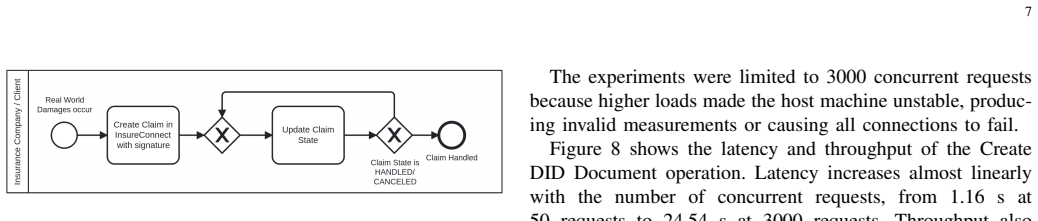
InsureConnect is a blockchain-based system for property-insurance workflows after natural disasters that combines Self-Sovereign Identity (SSI), Decentralized Identifiers (DIDs), Verifiable Credentials (VCs), satellite imagery, Hyperledger Fabric, and IPFS to register identities, insurance contracts, and damage claims. Property images are stored off-chain in IPFS while content hashes and signed records are maintained on the permissioned blockchain. Users interact through a desktop application, chaincode enforces role-based access control and validates digital signatures. The prototype was evaluated under concurrent request loads from 50 to 3000, and the results show it sustains increasing 0,
What carries the argument
InsureConnect prototype that integrates SSI with DIDs and VCs for identity registration, Hyperledger Fabric permissioned blockchain with chaincode for role-based access and signature validation, IPFS for off-chain storage of property images, and satellite imagery to support damage claim validation.
If this is right
- The system registers identities, insurance contracts, and damage claims with improved transparency, authentication, and auditability.
- The prototype sustains increasing throughput under concurrent request loads from 50 to 3000.
- Latency rises and dropped connections appear at higher concurrency levels.
- Chaincode enforces role-based access control and validates digital signatures for all records.
Where Pith is reading between the lines
- The same integration of digital identities and evidence storage could apply to other insurance types that rely on verifiable external data.
- Permissioned blockchains may limit full decentralization but could ease regulatory compliance for insurers.
- Satellite-based damage assessment might shorten claims timelines by reducing the need for immediate physical inspections.
- Performance at 3000 requests suggests the design is viable for regional rather than global-scale events without further tuning.
Load-bearing premise
Satellite imagery combined with digital signatures will reliably and accurately validate property damage and user identities in real disaster scenarios without significant errors, security failures, or adoption barriers.
What would settle it
Running the system on actual post-disaster satellite images and claims data and finding frequent mismatches between assessed damage and verified claims or repeated signature validation failures.
Figures



read the original abstract
This paper presents InsureConnect, a blockchain-based system for improving transparency, authentication, and auditability in property-insurance workflows after natural disasters. The system combines Self-Sovereign Identity (SSI), Decentralized Identifiers (DIDs), Verifiable Credentials (VCs), satellite imagery, Hyperledger Fabric, and IPFS to register identities, insurance contracts, and damage claims. Property images are stored off-chain in IPFS, while content hashes and signed records are maintained on a permissioned blockchain. Users interact with the system through a desktop application, while chaincode enforces role-based access control and validates digital signatures. The prototype was evaluated under concurrent request loads from 50 to 3000 requests, measuring latency, throughput, and dropped connections. The results indicate that the system sustains increasing throughput under load, although latency rises and dropped connections appear at higher concurrency levels.
Editorial analysis
A structured set of objections, weighed in public.
Referee Report
Summary. The paper presents InsureConnect, a blockchain-based prototype that integrates Self-Sovereign Identity (SSI), Decentralized Identifiers (DIDs), Verifiable Credentials (VCs), satellite imagery, Hyperledger Fabric, and IPFS to register user identities, insurance contracts, and post-disaster damage claims. Property images are stored off-chain in IPFS with content hashes and signed records on the permissioned ledger; a desktop application and chaincode enforce role-based access control and signature validation. The only reported evaluation consists of a load test exercising the system with 50 to 3000 concurrent requests while measuring latency, throughput, and dropped connections.
Significance. If the untested assumption that satellite imagery plus digital signatures can reliably validate property damage holds, the architecture could provide a concrete mechanism for transparent, auditable claims processing in disaster insurance. The work demonstrates that a permissioned blockchain can sustain increasing throughput under synthetic concurrency and correctly combines SSI primitives with off-chain storage, which is a modest but useful engineering contribution. However, the absence of any accuracy metrics, ground-truth comparison, or end-to-end validation for the satellite component means the asserted benefits for authentication and auditability remain unsupported.
major comments (3)
- [Evaluation section] Evaluation section: the reported load test (50–3000 concurrent requests) measures only blockchain-level latency, throughput, and dropped connections; no section describes the satellite imagery processing pipeline, any ground-truth damage dataset, detection algorithm, or false-positive/negative rates. Without these data the central claim that the system improves transparency and auditability for damage claims cannot be assessed.
- [System architecture description] System architecture description: the integration of satellite imagery with VCs for damage claims is asserted but never specified (e.g., how imagery is analyzed, how results are encoded as verifiable claims, or how false detections are handled), leaving the core workflow for post-disaster claims ungrounded.
- [Security and validation] Security and validation: no threat model, formal security analysis, or empirical validation of the combined SSI/DID/VC + satellite + Fabric system is provided, despite the paper’s emphasis on authentication and auditability.
minor comments (1)
- [Abstract] The abstract states that “the system sustains increasing throughput under load” yet also notes that “latency rises and dropped connections appear at higher concurrency levels”; a single clarifying sentence would remove the apparent tension.
Simulated Author's Rebuttal
We thank the referee for the constructive comments on our manuscript describing the InsureConnect prototype. We address the major comments point-by-point below, clarifying that our focus is on the blockchain integration and system performance rather than comprehensive evaluation of the satellite damage detection component.
read point-by-point responses
-
Referee: [Evaluation section] Evaluation section: the reported load test (50–3000 concurrent requests) measures only blockchain-level latency, throughput, and dropped connections; no section describes the satellite imagery processing pipeline, any ground-truth damage dataset, detection algorithm, or false-positive/negative rates. Without these data the central claim that the system improves transparency and auditability for damage claims cannot be assessed.
Authors: The load test evaluates the blockchain's ability to handle concurrent requests for identity registration, contract issuance, and claim processing, which supports the auditability claims by showing the system can operate under realistic loads. The satellite imagery processing is an input to the system but not the core evaluated component; we use it to generate claims that are then recorded transparently on the ledger. We will revise the evaluation section to explicitly state the scope and add a discussion on the satellite component's role and limitations. revision: partial
-
Referee: [System architecture description] System architecture description: the integration of satellite imagery with VCs for damage claims is asserted but never specified (e.g., how imagery is analyzed, how results are encoded as verifiable claims, or how false detections are handled), leaving the core workflow for post-disaster claims ungrounded.
Authors: In the system architecture, satellite imagery is acquired post-disaster, stored in IPFS with hashes on the blockchain, and damage assessments lead to VCs issued by the insurance provider after review. The encoding into VCs includes the claim details and signatures. False detections can be challenged through the audit trail. We will enhance the architecture description with a detailed workflow diagram and explanations in the revised version to ground the claims workflow. revision: yes
-
Referee: [Security and validation] Security and validation: no threat model, formal security analysis, or empirical validation of the combined SSI/DID/VC + satellite + Fabric system is provided, despite the paper’s emphasis on authentication and auditability.
Authors: Authentication and auditability are achieved through the use of DIDs for identities, VCs for claims with cryptographic proofs, and Hyperledger Fabric's permissioned ledger with chaincode for validation. While we did not include a formal threat model, the design follows best practices for SSI and blockchain security. We will add a security analysis section outlining the assumed threat model and how the components address them in the revision. revision: yes
Circularity Check
No circularity: system description and direct measurements are independent of inputs
full rationale
The paper presents a blockchain prototype architecture and reports direct empirical measurements of latency, throughput, and dropped connections under synthetic loads (50–3000 requests). No equations, fitted parameters, predictions, or derivations are present that could reduce to self-definition or self-citation. Central claims rest on the described components (SSI/DID/VC, Hyperledger Fabric, IPFS) and the reported benchmark results rather than any circular reduction. Self-citations, if present, are not load-bearing for the architecture or evaluation.
Axiom & Free-Parameter Ledger
axioms (2)
- domain assumption Hyperledger Fabric provides secure, permissioned blockchain functionality with enforceable role-based access control
- domain assumption Satellite imagery can be used to objectively assess property damage for insurance claims
Reference graph
Works this paper leans on
-
[1]
Bitcoin: A peer-to-peer electronic cash system,
S. Nakamoto, “Bitcoin: A peer-to-peer electronic cash system,” 2008
2008
-
[2]
Blockchains: How they work and why they’ll change the world,
M. E. Peck, “Blockchains: How they work and why they’ll change the world,”IEEE Spectrum, vol. 54, no. 10, pp. 26–35, 2017
2017
-
[3]
The path to self-sovereign identity,
C. Allen, “The path to self-sovereign identity,”Life With Alacrity,
-
[4]
Available: https://www.lifewithalacrity.com/article/the- path-to-self-soverereign-identity/
[Online]. Available: https://www.lifewithalacrity.com/article/the- path-to-self-soverereign-identity/
-
[5]
Decentralized identifiers (DIDs) v1. 0,
D. Reed, M. Sporny, D. Longley, C. Allen, R. Grant, M. Sabadello, and J. Holt, “Decentralized identifiers (DIDs) v1. 0,”Draft Community Group Report, 2020
2020
-
[6]
Verifiable credentials data model 1.0,
M. Sporny, D. Longley, and D. Chadwick, “Verifiable credentials data model 1.0,” W3C, Tech. Rep., 2019. [Online]. Avail- able: https://w3c.github.io/vcdata-model/https://www.w3.org/TR/vc- data-model/
2019
-
[7]
Sporny, T
M. Sporny, T. T. Jr, I. Herman, M. B. Jones, and G. Cohen,Verifiable Credentials Data Model v2.0 (W3C Candidate Recommendation Draft), W3C, oct 2024
2024
-
[8]
Untangling blockchain: A data processing view of blockchain systems,
T. T. A. Dinh, R. Liu, M. Zhang, G. Chen, B. C. Ooi, and J. Wang, “Untangling blockchain: A data processing view of blockchain systems,” IEEE Transactions on Knowledge and Data Engineering, vol. 30, no. 7, pp. 1366–1385, 2018
2018
-
[9]
Ethereum: A next-generation smart contract and decentralized application platform,
V . Buterin and Ethereum team, “Ethereum: A next-generation smart contract and decentralized application platform,” 2014-17, white paper
2014
-
[10]
Hyperledger Fabric documentation,
Hyperledger Fabric team, “Hyperledger Fabric documentation,” 2024, accessed: 2024-10-08. [Online]. Available: https://hyperledger- fabric.readthedocs.io/en/release-2.5/
2024
-
[11]
IPFS - Content Addressed, Versioned, P2P File System
J. Benet, “IPFS: Content addressed, versioned, P2P file system,”arXiv preprint arXiv:1407.3561, 2014
work page Pith review arXiv 2014
-
[12]
The state of art, opportunities and challenges of blockchain in the insurance industry: A systematic literature review,
T. Dominguez Anguiano and L. Parte, “The state of art, opportunities and challenges of blockchain in the insurance industry: A systematic literature review,”Management Review Quarterly, vol. 74, no. 2, pp. 1097–1118, 2024
2024
-
[13]
A blockchain and IPFS-based anticounterfeit traceable functionality of car insurance claims system,
C.-L. Chen, Y .-M. Zheng, D.-C. Huang, L.-C. Liu, and H.-C. Chen, “A blockchain and IPFS-based anticounterfeit traceable functionality of car insurance claims system,”Sensors, vol. 23, no. 23, p. 9577, 2023
2023
-
[14]
INCHAIN: A cyber insurance architecture with smart contracts and self-sovereign identity on top of blockchain,
A. Farao, G. Paparis, S. Panda, E. Panaousis, A. Zarras, and C. Xenakis, “INCHAIN: A cyber insurance architecture with smart contracts and self-sovereign identity on top of blockchain,”International Journal of Information Security, vol. 23, pp. 347–371, 2024
2024
-
[15]
A gen- eralized framework for designing open-source natural hazard parametric insurance,
C. B. Steinmann, B. P. Guillod, C. Fairless, and D. N. Bresch, “A gen- eralized framework for designing open-source natural hazard parametric insurance,”Environment Systems and Decisions, vol. 43, no. 4, pp. 555– 568, 2023
2023
-
[16]
A blockchain-based approach for parametric insurance under multiple sources of truth,
T. Rabehaja, S. Pal, A. Hill, and M. Hitchens, “A blockchain-based approach for parametric insurance under multiple sources of truth,” IEEE Transactions on Services Computing, vol. 17, no. 3, pp. 718–732,
-
[17]
Available: https://doi.org/10.1109/TSC.2023.3296808
[Online]. Available: https://doi.org/10.1109/TSC.2023.3296808
-
[18]
Privacy-preserving blockchain- enabled parametric insurance via remote sensing and IoT,
M. Hao, K. Qian, and S. C.-K. Chau, “Privacy-preserving blockchain- enabled parametric insurance via remote sensing and IoT,”IEEE Trans- actions on Services Computing, vol. 18, no. 5, pp. 3093–3105, 2025
2025
-
[19]
Blockchain-based method for spatial retrieval and verification of remote sensing images,
Y . Liu and Y . Chang, “Blockchain-based method for spatial retrieval and verification of remote sensing images,”Sensors, vol. 24, no. 7, 2024
2024
-
[20]
(2016) Blockchain and land registry
International Council for Accreditation of IT Managers. (2016) Blockchain and land registry. [Online]. Available: https://ica- it.org/pdf/Blockchain Landregistry Report.pdf
2016
-
[21]
(2020) Land registration using blockchain
Government of India, Ministry of Electronics and Information Tech- nology. (2020) Land registration using blockchain. [Online]. Available: https://blockchain.gov.in/Home/CaseStudy?CaseStudy=LandRegistration
2020
-
[22]
(2021) Blockchain-based land registry
Borgen Project. (2021) Blockchain-based land registry. [Online]. Available: https://borgenproject.org/blockchain-based-land-registry/
2021
-
[23]
N. Asia. (2017) Japan to tidy up scattered property records. [Online]. Available: https://asia.nikkei.com/Markets/Property/Japan-to- tidy-up-scattered-property-records
2017
-
[24]
Title and code: Real estate transaction recording in the blockchain in Brazil (RCPLAC-01),
V . Lemieux, C. Lacombe, and D. Flores, “Title and code: Real estate transaction recording in the blockchain in Brazil (RCPLAC-01),”Case Study, vol. 1, 2018
2018
-
[25]
Blockchain based land registry system using ethereum blockchain,
R. Khan, S. Ansari, S. Jain, and S. Sachdeva, “Blockchain based land registry system using ethereum blockchain,”Journal of Xi’an University of Architecture & Technology, vol. 12, pp. 3640–3648, 2020
2020
-
[26]
Smart contract definition for land registry in blockchain,
A. Sahai and R. Pandey, “Smart contract definition for land registry in blockchain,” inIEEE 9th International Conference on Communication Systems and Network Technologies, 2020, pp. 230–235
2020
-
[27]
Blockchain-based framework for secure and reliable land registry system,
M. Shuaib, S. M. Daud, S. Alam, and W. Z. Khan, “Blockchain-based framework for secure and reliable land registry system,”TELKOMNIKA (Telecommunication Computing Electronics and Control), vol. 18, no. 5, pp. 2560–2571, 2020
2020
-
[28]
Decentralised land registration and transaction with blockchain and self-sovereign identity,
P. C. Henriques and M. Correia, “Decentralised land registration and transaction with blockchain and self-sovereign identity,” in2025 44th International Symposium on Reliable Distributed Systems (SRDS), DLT4SEC 2025 - International Workshop on DLT for Cybersecurity and Vice Versa. IEEE, 2025, pp. 404–409
2025
-
[29]
Dhillon, D
V . Dhillon, D. Metcalf, and M. Hooper,The Hyperledger Project. Berkeley, CA: Apress, 2017, pp. 139–149
2017
-
[30]
In search of an understandable consensus algorithm,
D. Ongaro and J. Ousterhout, “In search of an understandable consensus algorithm,” in2014 USENIX Annual Technical Conference, 2014, pp. 305–319
2014
-
[31]
Perspectives on the CAP theorem,
S. Gilbert and N. Lynch, “Perspectives on the CAP theorem,”Computer, vol. 45, no. 2, pp. 30–36, 2012
2012
-
[32]
Incentives build robustness in bittorrent,
B. Cohen, “Incentives build robustness in bittorrent,” inWorkshop on Economics of Peer-to-Peer systems, vol. 6, 2003, pp. 68–72
2003
-
[33]
Swarm: The decentralized storage and communication system for a sovereign digital society,
Swarm Foundation, “Swarm: The decentralized storage and communication system for a sovereign digital society,” https://www.ethswarm.org/swarm-whitepaper.pdf, 2020, accessed: 2024-08-16
2020
discussion (0)
Sign in with ORCID, Apple, or X to comment. Anyone can read and Pith papers without signing in.