Recognition: unknown
Structure of the ⁸B and ⁸Li nuclei and the astrophysical S₁₇(0)-factor of the ⁷Be(p,γ)⁸B direct capture process within a three-body model
Pith reviewed 2026-05-08 17:08 UTC · model grok-4.3
The pith
A three-body model of 8B gives the zero-energy S-factor for 7Be(p,γ)8B as 22.492 eV b.
A machine-rendered reading of the paper's core claim, the machinery that carries it, and where it could break.
Core claim
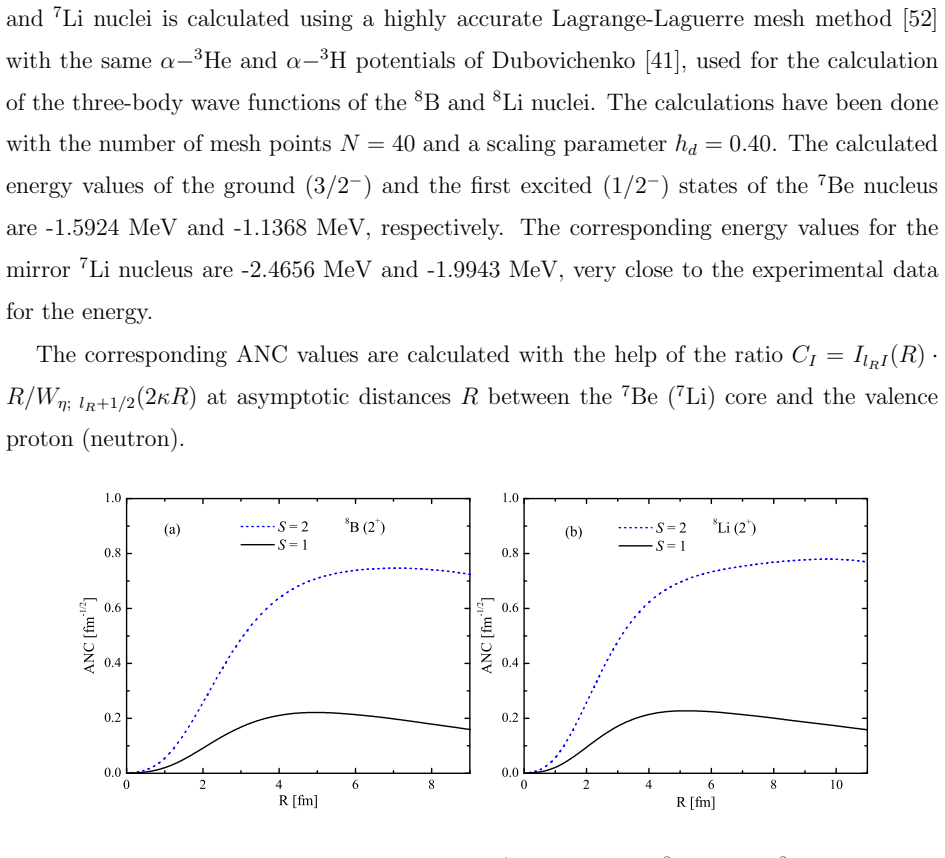
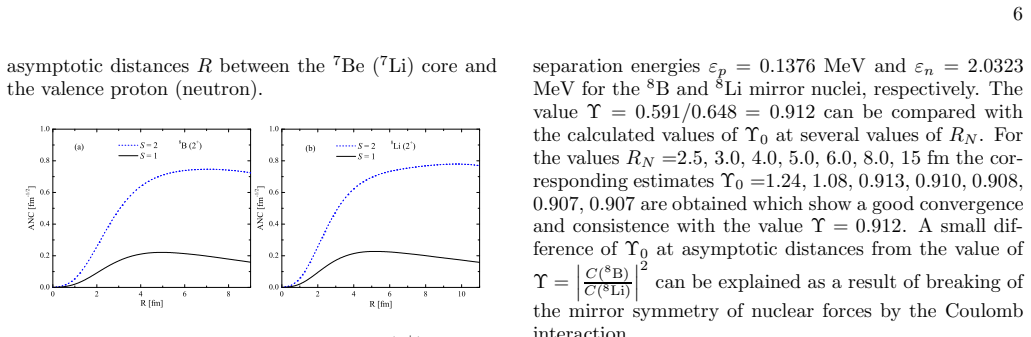
Within the alpha + 3He + p three-body potential cluster model using the hyperspherical Lagrange-mesh method with literature two-body potentials, convergent binding energies and matter radii are obtained for the ground 2+ and excited 1+ states of 8B and 8Li at maximal hypermomenta Kmax=22 and 28. The ANC values for the 8B virtual transition are 0.211 fm^{-1/2} and 0.739 fm^{-1/2} in the spin-1 and spin-2 channels. Insertion of these constants into Baye's asymptotic theory produces the zero-energy astrophysical factor S17(0) = 22.492 ± 0.014 eV b for the 7Be(p,γ)8B direct capture process, with the spin-2 channel contributing 20.838 ± 0.014 eV b.
What carries the argument
The asymptotic normalization constants extracted from the overlap integrals of the three-body wave functions matched to their known exponential decay, which are then inserted into Baye's asymptotic theory for the radiative capture cross section.
If this is right
- The spin-2 channel supplies the large majority of the total S17(0) value.
- The computed S17(0) agrees with the input used in the BAR2M solar model while lying above the SF III recommended value.
- The same framework supplies ANC estimates for the mirror nucleus 8Li of 0.220 fm^{-1/2} and 0.774 fm^{-1/2}.
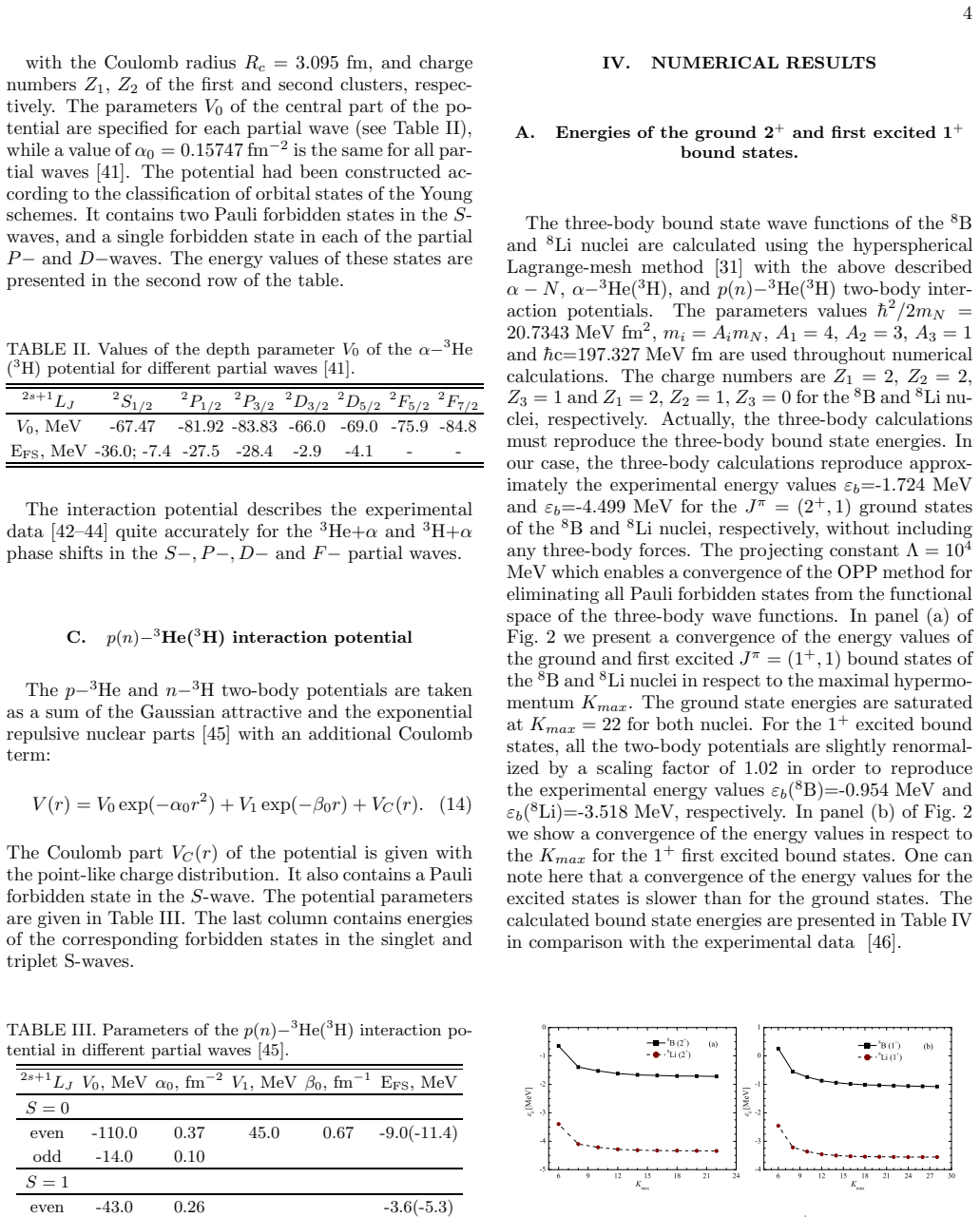
- Converged results require hypermomentum cutoffs up to Kmax = 28 for the excited 1+ state.
Where Pith is reading between the lines
- A higher S17(0) would increase the predicted boron-8 solar neutrino flux in standard solar models.
- The method can be applied directly to other low-energy capture reactions on light nuclei once suitable two-body potentials are chosen.
- Differences with other S17(0) calculations may be traceable to the specific choice of two-body potentials or the treatment of channel coupling in the three-body wave functions.
- Direct measurement of the ANC for 8B at low momentum transfer would provide an independent test of the model's wave-function tail.
Load-bearing premise
The three-body wave functions generated from literature two-body potentials, once matched to their asymptotic form, correctly reproduce the ANC values that determine the S-factor.
What would settle it
An experimental measurement of the asymptotic normalization constant for the 8B ground state that deviates by more than a few percent from 0.739 fm^{-1/2} in the dominant spin-2 channel.
Figures



read the original abstract
The structure of the ground $(2^+)$ and excited $(1^+)$ bound states of the $^8$B and $^8$Li nuclei is studied within the framework of the $\alpha+^3$He($^3$H)+$p(n)$ three-body potential cluster model based on the hyperspherical Lagrange-mesh method. The two-body $\alpha-^3$He($^3$H), $\alpha$-N, and $^3$He($^3$H)-N realistic potentials have been applied from the literature. Convergent theoretical estimates for the three-body binding energy and matter radius have been obtained with the maximal hypermomentum $K_{max}=22$ and 28 for the ground and excited $1^+$ states, respectively. The ANC value of the virtual transition of the $^8$B nucleus is estimated self-consistently by matching the overlap integral of the $^8$B three-body and the $^7$Be two-body wave functions with it's asymptotics. The obtained values are $0.211$~fm$^{-1/2}$ and $0.739$~fm$^{-1/2}$ in the spin 1 and spin 2 channels, respectively. For the ANC values of the $^8$Li nucleus the estimates $0.220$~fm$^{-1/2}$ and $0.774$~fm$^{-1/2}$ are extracted. For the zero-energy astrophysical factor of the direct nuclear capture process $^7$Be(p,$\gamma)^8$B an estimate $22.492\pm0.014$ eV b was obtained based on the asymptotic theory developed by D. Baye [Phys. Rev. C {\bf 62}, 065803 (2000)]. The most important contribution comes from the spin 2 channel with $S^{(2)}_{17}(0)=20.838 \pm 0.014$ eV b, while the spin 1 channel yields $S^{(1)}_{17}(0)=1.654 \pm 0.003$ eV b. These results for $S_{17}(0)$ are in a good agreement with the estimate $20.8\pm0.7{\rm(th)}\pm1.4{\rm(exp)}$ eV b of the SF II, but larger than the recommended value $20.5\pm0.70$ eV b of the SF III. At the same time, our estimate is very close to the value 22.4 eV b used in the most successful Solar Model BAR2M [W.~Yang and Z.~Tian, AJ {\bf 970}, 38 (2024)].
Editorial analysis
A structured set of objections, weighed in public.
Referee Report
Summary. The manuscript applies a three-body α + ³He + p (and mirror) cluster model within the hyperspherical Lagrange-mesh method to the ground (2⁺) and excited (1⁺) states of ⁸B and ⁸Li. Literature two-body potentials are used without adjustment; convergence of binding energies and radii is reported at K_max = 22 (ground) and 28 (excited). Asymptotic normalization coefficients are extracted by explicit matching of the three-body overlap integrals to their known asymptotic forms, giving channel-specific values 0.211 and 0.739 fm^{-1/2} for ⁸B (spin 1 and 2). These ANCs are inserted into Baye’s asymptotic formula to obtain S_{17}(0) = 22.492 ± 0.014 eV b, with the spin-2 channel contributing 20.838 ± 0.014 eV b.
Significance. If the ANCs prove robust, the calculation supplies an independent, channel-resolved theoretical value for S_{17}(0) that lies close to the input used in the BAR2M solar model and within the broader SF II uncertainty band. Explicit convergence checks at high K_max and direct matching of the overlap integrals to asymptotics are positive features, as is the clean separation of spin-1 and spin-2 contributions. The result could usefully inform solar-neutrino analyses once model-dependence is quantified.
major comments (2)
- [Abstract and S-factor results] Abstract and the section describing the S_{17}(0) evaluation: the quoted uncertainty ±0.014 eV b is stated to reflect only the numerical stability of the ANC-matching procedure. Because S_{17}(0) ∝ ANC² in each channel and the two-body potentials are taken unchanged from the literature, any systematic shift arising from reasonable variations in potential depths, ranges, or alternative parametrizations would propagate directly into the central value. No such sensitivity tests are reported, so the reported precision does not capture the dominant theoretical uncertainty.
- [ANC extraction and convergence tests] Section on ANC extraction and convergence: while K_max convergence is demonstrated for the three-body binding energies and radii, the manuscript does not show that the extracted ANCs themselves have stabilized with respect to further increases in K_max or with respect to the choice of the three-body Lagrange-mesh parameters. Because the final S_{17}(0) is obtained solely from these ANCs via Baye’s formula, residual truncation error in the ANCs remains unquantified.
minor comments (2)
- [Abstract] Abstract: 'it's asymptotics' should read 'its asymptotics'.
- [Discussion] The manuscript compares the new S_{17}(0) only to the SF II and SF III compilations and to the BAR2M value. A compact table listing additional recent theoretical and experimental determinations (with references) would improve readability.
Simulated Author's Rebuttal
We thank the referee for the thorough review and valuable comments on our manuscript. We address each major comment below and indicate the revisions made to strengthen the presentation of uncertainties and convergence.
read point-by-point responses
-
Referee: Abstract and the section describing the S_{17}(0) evaluation: the quoted uncertainty ±0.014 eV b is stated to reflect only the numerical stability of the ANC-matching procedure. Because S_{17}(0) ∝ ANC² in each channel and the two-body potentials are taken unchanged from the literature, any systematic shift arising from reasonable variations in potential depths, ranges, or alternative parametrizations would propagate directly into the central value. No such sensitivity tests are reported, so the reported precision does not capture the dominant theoretical uncertainty.
Authors: We agree that the uncertainty ±0.014 eV b represents only the numerical stability of the ANC-matching procedure and does not include systematic effects from variations in the two-body potentials. In the revised manuscript, we will explicitly state this in the abstract and results section. We will also add a discussion noting that the potentials are taken from established literature sources without adjustment, and that our S_{17}(0) value aligns closely with the SF II recommendation and the BAR2M solar model. A comprehensive sensitivity analysis to potential parameters is beyond the scope of the current work but will be considered in future studies. revision: partial
-
Referee: Section on ANC extraction and convergence: while K_max convergence is demonstrated for the three-body binding energies and radii, the manuscript does not show that the extracted ANCs themselves have stabilized with respect to further increases in K_max or with respect to the choice of the three-body Lagrange-mesh parameters. Because the final S_{17}(0) is obtained solely from these ANCs via Baye’s formula, residual truncation error in the ANCs remains unquantified.
Authors: We acknowledge that explicit convergence of the ANCs with K_max and Lagrange-mesh parameters was not demonstrated, although the binding energies and radii converge at the reported K_max values. In the revised version, we will include new figures or tables displaying the ANC values as a function of K_max for both channels, confirming stabilization at K_max = 22 (ground state) and 28 (excited state). We will also discuss the insensitivity to the Lagrange-mesh parameters in the converged regime, thereby quantifying the truncation error in the ANCs. revision: yes
Circularity Check
No circularity: S17(0) derived from external potentials and independent asymptotic formula
full rationale
The derivation proceeds as: literature two-body potentials (α-³He, α-N, ³He-N) → hyperspherical Lagrange-mesh three-body wave functions at finite K_max → numerical overlap integral matched to known asymptotic form → ANC values → insertion into Baye's external formula (Phys. Rev. C 62, 065803) to obtain S17(0). No parameter is adjusted to the S17 datum, no self-citation supplies a load-bearing uniqueness theorem or ansatz, and the quoted ±0.014 error is stated to arise only from matching precision. The central result is therefore a genuine model prediction, not a renaming or re-derivation of its inputs.
Axiom & Free-Parameter Ledger
axioms (2)
- domain assumption The three-body potential cluster model with the chosen literature potentials accurately represents the low-energy structure of 8B and 8Li.
- standard math The hyperspherical Lagrange-mesh expansion converges for Kmax = 22 (ground) and 28 (excited).
Reference graph
Works this paper leans on
-
[1]
739 fm − 1/ 2 in the spin 1 and spin 2 channels, respectively
211 fm − 1/ 2 and CI=2 = 0 . 739 fm − 1/ 2 in the spin 1 and spin 2 channels, respectively. For the ANC values of the 8Li→ 7Li+n virtual transition the estimates CI=1 = 0 . 220 fm − 1/ 2 and CI=2 =
-
[2]
For the zero-energy astrophysical factor of the direct nuclear capture process 7Be(p,γ)8B an estimate S17(0) = 22
774 fm − 1/ 2 are extracted. For the zero-energy astrophysical factor of the direct nuclear capture process 7Be(p,γ)8B an estimate S17(0) = 22 . 492 ± 0. 014 eV b was obtained based on the asymptotic theory developed by D. Baye [Phys. Rev. C 62, 065803 (2000)]. It was found that the most important contribution comes from the spin 2 channel with S(2) 17 (0...
2000
-
[3]
for this quantity. The ANC value can also be cal- culated within purely realistic theoretical models such as the microscopic three-body cluster model [10–12], the ab-initio no-core shell model/resonating group method (NCSM/RGM) [13], and Skyrme Hartree-Fock theory [14], as well as halo effective field theory (EFT) [15, 16] at next-to-leading order. The ANC ...
work page internal anchor Pith review Pith/arXiv arXiv 2026
-
[4]
044 fm − 1 [26] was obtained from the analy- sis of the experimental differential cross-sections of the 13C(7Li,8Li)12C transfer reaction in the frame of the DWBA
432 ± 0. 044 fm − 1 [26] was obtained from the analy- sis of the experimental differential cross-sections of the 13C(7Li,8Li)12C transfer reaction in the frame of the DWBA. In particular, the authors of Refs. [11, 27] have studied the three-body structure of the 8Li nucleus with further application to the radiative capture process 7Li(n,γ)8Li within the hy...
-
[5]
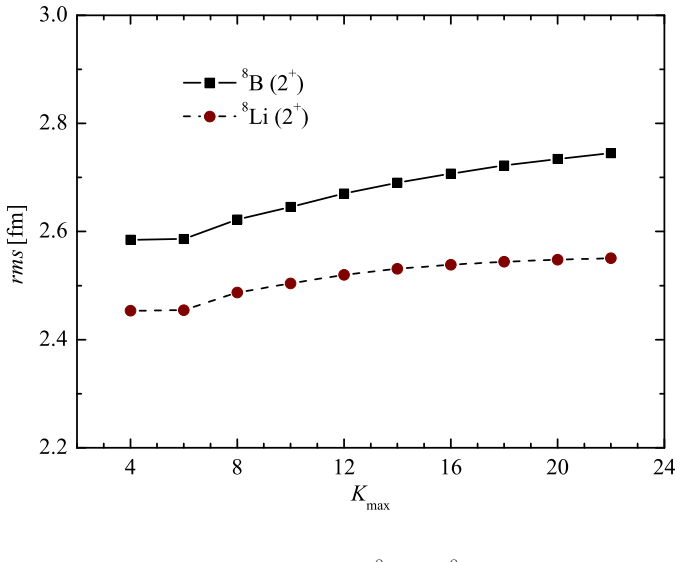
instead of <r 2 3He >1/ 2 as for the second particle. In Fig. 3 we examine a convergence of the calculated matter radii for the ground states of the 8B and 8Li nuclei as a function of Kmax, which varies from 4 up to 22. Within the developed three-body model the matter rms radius of the 8B one-proton halo nucleus is overestimated by about 5%. At the same t...
-
[6]
7(th) ± 1
8 ± 0. 7(th) ± 1. 4(exp) eV b, while higher than the recommended value S17(0) = 20 . 50 ± 0. 70 eV b of the Solar Fusion III analysis [1]. Surprisingly, the estimate of the three-body model is very close to the value 22.4 eV b, used for the most successful new Solar Model BAR2M among other Solar Models, which predicts both a nearly flat rotation profile in ...
-
[7]
Acharya, et al
Solar Fusion III (B. Acharya, et al. ), Rev. Mod. Phys. 97, 035002 (2025)
2025
-
[8]
Adelberger, et al.), Rev
Solar Fusion II (E.G. Adelberger, et al.), Rev. Mod. Phys. 83, 195 (2011)
2011
-
[9]
D. Baye. Phys. Rev. C 62, 065803 (2000)
2000
-
[10]
Tak´ acs, D
M.P. Tak´ acs, D. Bemmerer, A.R. Junghans, and K. Zu- ber, Nucl. Phys. A 970, 78 (2018)
2018
-
[11]
A. M. Mukhamedzhanov, H. L. Clark, C. A. Gagliardi, et al. , Phys. Rev. C 56, 1302 (1997)
1997
-
[12]
Carstoiu, L
F. Carstoiu, L. Trache, C.A. Gagliardi, R.E. Tribble, and A.M. Mukhamedzhanov, Phys. Rev. C 63, 054310 (2001)
2001
-
[13]
Azhari, V
A. Azhari, V. Burjan, F. Carstoiu, H. Dejbakhsh, C.A. Gagliardi, V. Kroha, A.M. Mukhamedzhanov, L. Trache, and R.E. Tribble, Phys. Rev. Lett. 82, 3960 (1999)
1999
-
[14]
Tabacaru, A
G. Tabacaru, A. Azhari, J. Brinkley, et al. , Phys. Rev. C 73, 025808 (2006)
2006
-
[15]
Tojiboev, R
O.R. Tojiboev, R. Yarmukhamedov, S.V. Artemov and S.B. Sakuta, Phys. Rev. C 94, 054616 (2016)
2016
-
[16]
Descouvemont, Phys
P. Descouvemont, Phys. Rev. C 70, 065802 (2004)
2004
-
[17]
Grigorenko, B.V
L.V. Grigorenko, B.V. Danilin, V.D. Efros, N.B. Shul’gina, M.V. Zhukov, Phys. Rev. C 57, R2099 (1998)
1998
-
[18]
Grigorenko, B.V
L.V. Grigorenko, B.V. Danilin, V.D. Efros, N.B. Shul’gina, M.V. Zhukov, Phys. Rev. C 60, 044312 (1999)
1999
-
[19]
Navratil, R
P. Navratil, R. Roth, and S. Quaglioni, Phys. Lett. B 704, 379 (2011)
2011
-
[20]
Chandel, S.K
S.S. Chandel, S.K. Dhiman, and R. Shyam. Phys. Rev. C 68, 054320 (2003)
2003
-
[21]
Zhang, K.M
X. Zhang, K.M. Nollett, and D.R. Phillips, Phys. Lett. B 751, 535 (2015)
2015
-
[22]
Zhang, K.M
X. Zhang, K.M. Nollett, and D.R. Phillips, Phys. Rev. C 98, 034616 (2018)
2018
-
[23]
Nollet and R.B.Wiringa, Phys
K.M. Nollet and R.B.Wiringa, Phys. Rev. C 83, 041001(R) (2011)
2011
-
[24]
S¨ urer, F.M
¨O. S¨ urer, F.M. Nunes, M. Plumlee, and S.M. Wild, Phys. Rev. C 106, 024607 (2022)
2022
-
[25]
Agostini, et al
Borexino Collaboration (M. Agostini, et al. ), Phys. Rev. D 100, 082004 (2019)
2019
-
[26]
Tursunov, S.A
E.M. Tursunov, S.A. Turakulov, A.S. Kadyrov, and L.D. Blokhintsev, Phys. Rev. C 104, 045806 (2021)
2021
-
[27]
Paneru, C.R
S.N. Paneru, C.R. Brune, R. Giri, et al. , Phys. Rev. C 99, 045807 (2019)
2019
-
[28]
Yang and Z
W. Yang and Z. Tian, AJ 970, 38 (2024)
2024
-
[29]
Bahcall and M.H
J.N. Bahcall and M.H. Pinsonneault, Rev. Mod. Phys 64, 885 (1992)
1992
-
[30]
M. Heil, F. K¨ appeler, M. Wiescher, and A. Mengoni, Astrophys. Jour. 507, 997 (1998)
1998
-
[31]
Igashira and T
M. Igashira and T. Ohsaki, Sci. Technol. Adv. Mater. 5, 567 (2004)
2004
-
[32]
Trache, A
L. Trache, A. Azhari, F. Carstoiu, et al. , Phys. Rev. C 67, 062801(R) (2003)
2003
-
[33]
Shul’gina, B.V
N.B. Shul’gina, B.V. Danilin, V.D. Efros, J.M. Bang, J. S. Vaagen, M.V. Zhukov, Nucl. Phys. A 597, 197 (1996)
1996
-
[34]
Burkova, S.B
N.A. Burkova, S.B. Dubovichenko, A.V. Dzhazairov- Kakhramanov, S.Zh. Nurakhmetova, J. Phys. G, Nucl. Part. Phys. 48, 045201 (2018)
2018
-
[35]
Zhukov, B.V
M.V. Zhukov, B.V. Danilin, D.V. Fedorov, J.M. Bang, I.J. Thompson, J.S. Vaagen, Phys. Rep. 231, 51 (1993)
1993
-
[36]
Lin, Phys
C.D. Lin, Phys. Rep. 257, 1 (1995)
1995
-
[37]
Descouvemont, C
P. Descouvemont, C. Daniel, D. Baye, Phys. Rev. C 67, 044309 (2003)
2003
-
[38]
Tursunov, A.S
E.M. Tursunov, A.S. Kadyrov, S.A. Turakulov, and I. Bray, Phys. Rev. C 94, 015801 (2016)
2016
-
[39]
Baye and E
D. Baye and E. M. Tursunov, J. Phys. G: Nucl. Part. Phys. 45,085102 (2018)
2018
-
[40]
Tursunov, S.A
E.M. Tursunov, S.A. Turakulov, A.S. Kadyrov, and I. Bray, Phys. Rev. C 98, 055803 (2018)
2018
-
[41]
Tursunov, S.A
E.M. Tursunov, S.A. Turakulov, and A.S. Kadyrov, Nucl. Phys. A 1000, 121884 (2020)
2020
-
[42]
Descouvemont, E.M
P. Descouvemont, E.M. Tursunov, D. Baye, Nucl. Phys. A 765, 370 (2006)
2006
-
[43]
Danilin, M.V
B.V. Danilin, M.V. Zhukov, S.N. Ershov, F.A. Gareev, R.S. Kurmanov, J.S. Vaagen, J.M. Bang, Phys. Rev. C 43, 2835 (1991)
1991
-
[44]
Raynal, J
J. Raynal, J. Revai, Nuovo Cimento A 68, 612 (1970)
1970
-
[45]
Voronchev, V.I
V.T. Voronchev, V.I. Kukulin, V.N. Pomerantsev, G.G. Ryzhikh, Few-Body Systems 18, 191 (1995)
1995
-
[46]
Reichstein, Y.C
I. Reichstein, Y.C. Tang, Nucl. Phys. A 158, 529 (1970)
1970
-
[47]
Dubovichenko, Physics of Atomic Nuclei, 73, 1526 (2010)
S.B. Dubovichenko, Physics of Atomic Nuclei, 73, 1526 (2010)
2010
-
[48]
Boykin, S.D
W.R. Boykin, S.D. Baker, D.M. Hardy, Nucl. Phys. A 195, 241 (1972)
1972
-
[49]
Hardy, R.J
D.M. Hardy, R.J. Spiger, S.D. Baker, Y.S. Chen, T.A. Tombrello, Nucl. Phys. A 195, 250 (1972)
1972
-
[50]
Spiger and T.A
R.J. Spiger and T.A. Tombrello, Phys. Rev. 163, 964 (1967)
1967
-
[51]
Dubovichenko, A.V
S.B. Dubovichenko, A.V. Dzhazairov-Kakhramanov, Elem. Chast. Atomn. Yadra 28, 1529-1594 (1997)
1997
-
[52]
Tilley, H.R
D.R. Tilley, H.R. Weller, and G.M. Hale, Nucl.Phys. A 541, 1 (1992)
1992
-
[53]
Krauth, K.Schuhmann, M.A
J.J. Krauth, K.Schuhmann, M.A. Ahmed, et al. , Nature 589, 527 (2021)
2021
-
[54]
Angeli, K.P
I. Angeli, K.P. Marinova, At. Data Nucl. Data Tables 99, 69 (2013)
2013
-
[55]
Maisenbacher, V.Wirthl, A
L. Maisenbacher, V.Wirthl, A. Matveev, et al. , Nature 650, 845 (2026)
2026
-
[56]
Alkhazov, I.S
G.D. Alkhazov, I.S. Novikov, and Yu.M. Shabelski, Int. Jour. Mod. Phys. E 20, 583 (2011)
2011
-
[57]
Korolev, A.V
G.A. Korolev, A.V. Dobrovolsky, A.G. Inglessi, et al. , Phys. Lett. B 780, 200 (2018)
2018
-
[58]
Baye, Phys
D. Baye, Phys. Rep. 565, 1 (2015)
2015
-
[59]
Kukulin, V.N
V.I. Kukulin, V.N. Pomerantsev, Kh.D. Razikov, V.T. Voronchev, G.G. Ryzhikh, Nucl. Phys. A 586, 151 (1995)
1995
-
[60]
Ogata, S
K. Ogata, S. Hashimoto, Y. Iseri, M. Kamimura, and M. Yahiro, Phys. Rev. C 73, 024605 (2006)
2006
-
[61]
Ogata, M
K. Ogata, M. Yahiro, Y. Iseri, and M. Kamimura, Phys. Rev. C 67, 011602(R) (2003)
2003
-
[62]
Trache, F
L. Trache, F. Carstoiu, C.A. Gagliardi, and R.E. Tribbl e, Phys. Rev. Lett. 87, 271102 (2001). 9
2001
-
[63]
Huang, C.A
J.T. Huang, C.A. Bertulani, and V. Guimar˜ aes, At. Data Nucl. Data Tables 96, 824 (2010)
2010
-
[64]
Belyaeva, E.F
T.L. Belyaeva, E.F. Aguilera, E. Martinez-Quiroz, A.M . Moro, and J.J. Kolata, Phys. Rev. C 80, 064617 (2009)
2009
-
[65]
L.T. Baby, C. Bordeanu, G. Goldring, et al. , Phys. Rev. Lett. 90, 022501 (2003); Phys. Rev. C 67, 065805 (2003)
2003
-
[66]
Junghans, K.A
A.R. Junghans, K.A. Snover, M.C. Mohrmann, E.G. Adelberger, and L. Buchmann, Phys. Rev. C 81, 012801(R) (2010)
2010
-
[67]
Buompane, A
R. Buompane, A. DiLeva, L.Gialanella, et al., Phys. Lett. B 824, 136819 (2022)
2022
discussion (0)
Sign in with ORCID, Apple, or X to comment. Anyone can read and Pith papers without signing in.