Recognition: 2 theorem links
· Lean TheoremTRACE: Temporal Reasoning over Context and Evidence for Activity Recognition in Smart Homes
Pith reviewed 2026-05-08 18:00 UTC · model grok-4.3
The pith
TRACE integrates user-specific context with sparse sensor data to resolve ambiguities in smart home activity recognition.
A machine-rendered reading of the paper's core claim, the machinery that carries it, and where it could break.
Core claim
TRACE performs contextual reasoning over context and evidence by integrating multi-source sensor observations with user-specific contextual priors, allowing it to resolve ambiguities that defeat local classification, reduce fragmented predictions, and infer semantically richer activities than short-window methods achieve.
What carries the argument
The TRACE framework, which replaces local classification with temporal reasoning that fuses sensor evidence and user-specific contextual priors to disambiguate activities.
If this is right
- Recognition accuracy rises specifically for activities whose local sensor signatures overlap with other activities.
- Output sequences become more consistent with a given user's established routines instead of switching between plausible but contextually wrong labels.
- Performance holds when the system is transferred to a different home or when one or more sensor modalities are unavailable.
- The need for dense labeled training data decreases because context supplies disambiguating information.
Where Pith is reading between the lines
- Systems could maintain useful performance after initial setup with only modest routine descriptions rather than exhaustive activity logs.
- The same reasoning structure might transfer to other sparse-sensor domains such as wearable health monitoring where local signals are similarly ambiguous.
- Routine priors could be updated online from the system's own predictions, creating a feedback loop that further reduces labeling effort.
Load-bearing premise
User-specific contextual priors can be obtained reliably and combined with sparse sensor data without introducing bias or demanding large amounts of new labeled examples.
What would settle it
An experiment in which TRACE produces no measurable gain in accuracy on semantically complex activities or no reduction in temporally incoherent predictions compared with standard short-window classifiers on the same public benchmarks and deployment data.
Figures




read the original abstract
Human activity recognition (HAR) in smart homes remains challenging because many daily activities exhibit similar local sensor patterns, while minimally intrusive sensing provides sparse and ambiguous observations. As a result, methods based on short temporal or event windows often fail to capture the broader temporal and behavioral context needed for reliable activity understanding. We present TRACE (Temporal Reasoning over Context and Evidence), a contextual activity recognition framework for smart homes that integrates multi-source sensor evidence with user-specific contextual priors to improve activity interpretation. Rather than treating recognition as a local classification problem, TRACE leverages contextual reasoning to resolve ambiguities, reduce fragmented predictions, and infer more semantically specific activities. We evaluate TRACE on public benchmarks and in a deployment study conducted in our smart-home environment. Results show that TRACE improves recognition accuracy for semantically complex activities, produces more temporally coherent predictions that better align with user-specific routines, and maintains robust performance under cross-domain transfer and missing-modality conditions. These findings demonstrate the value of contextual reasoning for advancing smart-home HAR.
Editorial analysis
A structured set of objections, weighed in public.
Referee Report
Summary. The manuscript presents TRACE, a contextual activity recognition framework for smart homes that integrates multi-source sensor evidence with user-specific contextual priors via temporal reasoning. Rather than relying on short local windows, it resolves ambiguities in sparse observations to produce more accurate interpretations of semantically complex activities, temporally coherent predictions aligned with individual routines, and robust performance under cross-domain transfer and missing-modality conditions. Claims are grounded in evaluations on public benchmarks plus a deployment study in the authors' smart-home environment.
Significance. If the quantitative results hold, the work could meaningfully advance smart-home HAR by showing that explicit contextual and user-specific priors yield gains over local classification, particularly for ambiguous or routine-dependent activities. The deployment study is a strength, providing evidence beyond benchmarks, and the robustness claims under missing modalities could guide practical system design. The approach aligns with field trends toward hybrid reasoning but requires clearer empirical grounding to realize this potential.
major comments (2)
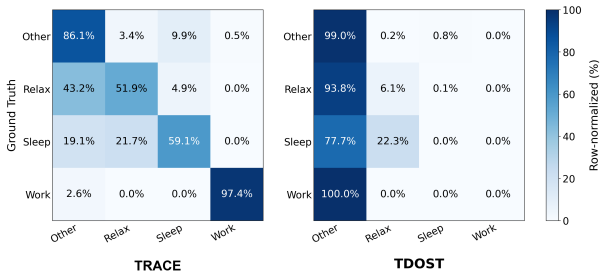
- [§4 (Evaluation)] §4 (Evaluation) and abstract: the central claims of improved accuracy for complex activities, better routine alignment, and cross-domain robustness are stated without any reported metrics, baselines, error bars, or statistical tests. This is load-bearing because the abstract and evaluation description supply no numbers against which to judge whether the data support the performance assertions.
- [§3 (Method)] §3 (Method), user-specific priors subsection: the mechanism for extracting and integrating contextual priors from user routines is not specified (e.g., learned vs. hand-crafted, data volume required, or bias mitigation). This directly affects the claim of robustness without large additional labeled data, as the skeptic concern that priors may implicitly encode substantial per-user supervision remains unaddressed.
minor comments (2)
- [Abstract] Abstract: adding at least one key quantitative result (e.g., accuracy delta on a benchmark) would strengthen the summary of findings.
- [Throughout] Notation: define all acronyms (HAR, TRACE) on first use and ensure consistent terminology for 'contextual priors' across sections.
Simulated Author's Rebuttal
We thank the referee for the constructive comments, which help strengthen the clarity and empirical grounding of our work. We address each major comment point by point below.
read point-by-point responses
-
Referee: [§4 (Evaluation)] §4 (Evaluation) and abstract: the central claims of improved accuracy for complex activities, better routine alignment, and cross-domain robustness are stated without any reported metrics, baselines, error bars, or statistical tests. This is load-bearing because the abstract and evaluation description supply no numbers against which to judge whether the data support the performance assertions.
Authors: We agree that the abstract and the narrative description in §4 would benefit from explicit numerical support to make the claims immediately verifiable. While §4 contains tables and figures with quantitative comparisons to baselines, the textual description does not embed specific metrics, error bars, or statistical tests. In the revised manuscript we will (1) add a concise sentence to the abstract reporting key accuracy gains and coherence improvements on the public benchmarks, and (2) expand the evaluation narrative in §4 to state the main metrics, report error bars, and note the statistical tests performed. This directly addresses the load-bearing concern without altering the underlying results. revision: yes
-
Referee: [§3 (Method)] §3 (Method), user-specific priors subsection: the mechanism for extracting and integrating contextual priors from user routines is not specified (e.g., learned vs. hand-crafted, data volume required, or bias mitigation). This directly affects the claim of robustness without large additional labeled data, as the skeptic concern that priors may implicitly encode substantial per-user supervision remains unaddressed.
Authors: We acknowledge that the current description of the user-specific priors is insufficiently detailed. The priors are extracted via a data-driven temporal pattern-mining procedure applied to each user’s historical sensor logs (frequency and sequence statistics over the same unlabeled streams used for base-model training); they are therefore learned rather than hand-crafted and require no extra labeled data. In the revised version we will expand the “user-specific priors” subsection to specify the exact extraction algorithm, the typical data volume (weeks of per-user logs), and the bias-mitigation steps (per-user cross-validation and temporal hold-out). This clarification directly addresses the supervision concern and supports the robustness claim. revision: yes
Circularity Check
No circularity: framework claims grounded in external benchmarks and deployment study
full rationale
The paper introduces TRACE as a framework integrating sensor evidence with user-specific priors for activity recognition. Its central claims rest on evaluations performed on public benchmarks plus an in-house deployment study, with no equations, fitted parameters, or derivation steps presented that reduce outputs to inputs by construction. No self-citations are invoked as load-bearing uniqueness theorems, and no ansatz or renaming of known results is described. The derivation chain is therefore self-contained against external data rather than internally circular.
Axiom & Free-Parameter Ledger
Reference graph
Works this paper leans on
-
[1]
1988.The dynamic structure of everyday life
Philip E Agre. 1988.The dynamic structure of everyday life. Technical Report
1988
-
[2]
Mohammed AA Al-qaness, Abdelghani Dahou, Mohamed Abd Elaziz, and Ahmed M Helmi. 2024. Human activity recognition and fall detection using convolutional neural network and transformer-based architecture.Biomedical Signal Processing and Control95 (2024), 106412
2024
-
[3]
Talal Alshammari, Nasser Alshammari, Mohamed Sedky, and Chris Howard. 2018. Evaluating Machine Learning Techniques for Activity Classification in Smart Home Environments.Journal of information and communication convergence engineering(2018). doi:10.5281/zenodo.1315749
-
[4]
Sonia Ancoli-Israel, Roger Cole, Cathy Alessi, Mark Chambers, William Moorcroft, and Charles P Pollak. 2003. The role of actigraphy in the study of sleep and circadian rhythms.Sleep26, 3 (2003), 342–392
2003
-
[5]
Luca Arrotta, Claudio Bettini, and Gabriele Civitarese. 2021. The marble dataset: Multi-inhabitant activities of daily living combining wearable and environmental sensors data. InInternational conference on mobile and ubiquitous systems: computing, networking, and services. Springer, 451–468
2021
-
[6]
Luca Arrotta, Claudio Bettini, Gabriele Civitarese, and Michele Fiori. 2024. Contextgpt: Infusing llms knowledge into neuro-symbolic activity recognition models. In2024 IEEE International Conference on Smart Computing (SMARTCOMP). IEEE, 55–62
2024
-
[7]
Anna Asch, Ethan J Brady, Hugo Gallardo, John Hood, Bryan Chu, and Mohammad Farazmand. 2022. Model-assisted deep learning of rare extreme events from partial observations.Chaos: An Interdisciplinary Journal of Nonlinear Science32, 4 (2022)
2022
-
[8]
Aaron F Bobick. 1997. Movement, activity and action: the role of knowledge in the perception of motion.Philosophical Transactions of the Royal Society of London. Series B: Biological Sciences352, 1358 (1997), 1257–1265
1997
-
[9]
Maarten Bosma, Ed Chi, Brian Ichter, Quoc V Le, Dale Schuurmans, Xuezhi Wang, Jason Wei, Fei Xia, and Komal Jalan. 2022. Chain-Of-Thought Prompting Elicits Reasoning in Large Language Models. (2022). doi:10.52202/068431-1800
-
[10]
Nguyen, Christopher Lohr, Benoit Leduc, and I
Damien Bouchabou, S. Nguyen, Christopher Lohr, Benoit Leduc, and I. Kanellos. 2021. A Survey of Human Activity Recognition in Smart Homes Based on IoT Sensors Algorithms: Taxonomies, Challenges, and Opportunities with Deep Learning.Italian National Conference on Sensors(2021). doi:10.3390/s21186037
-
[11]
Damien Bouchabou, Sao Mai Nguyen, Christophe Lohr, Benoit Leduc, and Ioannis Kanellos. 2021. Fully convolutional network bootstrapped by word encoding and embedding for activity recognition in smart homes. InInternational Workshop on Deep Learning for Human Activity Recognition. Springer, 111–125
2021
-
[12]
Kaixuan Chen, Dalin Zhang, Lina Yao, Bin Guo, Zhiwen Yu, and Yunhao Liu. 2020. Deep Learning for Sensor-based Human Activity Recognition. Comput. Surveys(2020). doi:10.1145/3447744
-
[13]
Liming Chen and Chris Nugent. 2009. Ontology-based activity recognition in intelligent pervasive environments.International Journal of Web Information Systems5, 4 (2009), 410–430
2009
-
[14]
Liming Chen, Chris D Nugent, and Hui Wang. 2011. A knowledge-driven approach to activity recognition in smart homes.IEEE Transactions on Knowledge and Data Engineering24, 6 (2011), 961–974
2011
-
[15]
Liming Luke Chen and C. Nugent. 2019. Human Activity Recognition and Behaviour Analysis.Springer International Publishing(2019). doi:10. 1007/978-3-030-19408-6
2019
-
[16]
Gabriele Civitarese, Michele Fiori, Priyankar Choudhary, and Claudio Bettini. 2025. Large language models are zero-shot recognizers for activities of daily living.ACM Transactions on Intelligent Systems and Technology16, 4 (2025), 1–32
2025
-
[17]
D. Cook. 2012. Learning Setting-Generalized Activity Models for Smart Spaces.IEEE Intelligent Systems(2012). doi:10.1109/mis.2010.112
-
[18]
Diane J Cook, Aaron S Crandall, Brian L Thomas, and Narayanan C Krishnan. 2012. CASAS: A smart home in a box.Computer46, 7 (2012), 62–69
2012
-
[19]
2015.Activity learning: discovering, recognizing, and predicting human behavior from sensor data
Diane J Cook and Narayanan C Krishnan. 2015.Activity learning: discovering, recognizing, and predicting human behavior from sensor data. John Wiley & Sons
2015
-
[20]
Mihaly Csikszentmihalyi and Reed Larson. 1987. Validity and reliability of the experience-sampling method.The Journal of nervous and mental disease175, 9 (1987), 526–536
1987
- [21]
-
[22]
Minh Dang, Kyungbok Min, Hanxiang Wang, Md
L. Minh Dang, Kyungbok Min, Hanxiang Wang, Md. Jalil Piran, Cheol Hee Lee, and Hyeonjoon Moon. 2020. Sensor-based and vision-based human activity recognition: A comprehensive survey.Pattern Recognition(2020). doi:10.1016/j.patcog.2020.107561
-
[23]
Ilker Demirel, Karan Thakkar, Benjamin Elizalde, Miquel Espi Marques, Shirley Ren, and Jaya Narain. 2025. Using LLMs for Late Multimodal Sensor Fusion for Activity Recognition.arXiv.org(2025). doi:10.48550/arxiv.2509.10729
-
[24]
Anind K Dey, Gregory D Abowd, and Daniel Salber. 2000. A context-based infrastructure for smart environments. InManaging Interactions in Smart Environments: 1st International Workshop on Managing Interactions in Smart Environments (MANSE’99), Dublin, December 1999. Springer, 114–128
2000
-
[25]
Aiden Doherty, Dan Jackson, Nils Hammerla, Thomas Plötz, Patrick Olivier, Malcolm H Granat, Tom White, Vincent T Van Hees, Michael I Trenell, Christoper G Owen, et al. 2017. Large scale population assessment of physical activity using wrist worn accelerometers: the UK biobank study. PloS one12, 2 (2017), e0169649
2017
-
[26]
Aiden Doherty, Karl Smith-Byrne, Teresa Ferreira, Michael V Holmes, Chris Holmes, Sara L Pulit, and Cecilia M Lindgren. 2018. GWAS identifies 14 loci for device-measured physical activity and sleep duration.Nature communications9, 1 (2018), 1–8
2018
-
[27]
Chen, Huansheng Ning, and Yaping Wan
Furong Duan, Tao Zhu, Jinqiang Wang, L. Chen, Huansheng Ning, and Yaping Wan. 2023. A Multitask Deep Learning Approach for Sensor-Based Human Activity Recognition and Segmentation.IEEE Transactions on Instrumentation and Measurement(2023). doi:10.1109/tim.2023.3273673 This manuscript is under review. Please contact yshi457@gatech.edu for up-to-date information
-
[28]
Joffre Dumazedier. 1975. The Use of Time. Daily activities of urban and suburban population in twelve countries
1975
-
[29]
Fahad, Syed Fahad Tahir, and M
L. Fahad, Syed Fahad Tahir, and M. Rajarajan. 2014. Activity Recognition in Smart Homes Using Clustering Based Classification.2014 22nd International Conference on Pattern Recognition(2014). doi:10.1109/icpr.2014.241
- [30]
-
[31]
Navid Mohammadi Foumani, Lynn Miller, Chang Wei Tan, G. I. Webb, G. Forestier, and Mahsa Salehi. 2024. Deep Learning for Time Series Classification and Extrinsic Regression: A Current Survey.Comput. Surveys(2024). doi:10.1145/3649448
-
[32]
L Mary Gladence, Hari Haran Sivakumar, Gobinath Venkatesan, and S Shanmuga Priya. 2017. Home and office automation system using human activity recognition. In2017 International conference on communication and signal processing (ICCSP). IEEE, 0758–0762
2017
-
[33]
Jibing Gong, Li Cui, Kejiang Xiao, and Rui Wang. 2012. MPD-Model: A Distributed Multipreference-Driven Data Fusion Model and Its Application in a WSNs-Based Healthcare Monitoring System.International Journal of Distributed Sensor Networks(2012). doi:10.1155/2012/602358
-
[34]
Edward T Hall. 1969. Ecological psychology: Concepts and methods for studying the environment of human behavior
1969
-
[35]
Rebeen Ali Hamad, Alberto Salguero Hidalgo, Mohamed-Rafik Bouguelia, Macarena Espinilla Estévez, and J. M. Quero. 2020. Efficient Activity Recognition in Smart Homes Using Delayed Fuzzy Temporal Windows on Binary Sensors.IEEE journal of biomedical and health informatics(2020). doi:10.1109/jbhi.2019.2918412
-
[36]
Rebeen Ali Hamad, Longzhi Yang, W. L. Woo, and Bo Wei. 2020. Joint Learning of Temporal Models to Handle Imbalanced Data for Human Activity Recognition.Applied Sciences(2020). doi:10.3390/app10155293
-
[37]
Hammerla, Shane Halloran, and Thomas Plötz
Nils Y. Hammerla, Shane Halloran, and Thomas Plötz. 2016. Deep, convolutional, and recurrent models for human activity recognition using wearables.arXiv (Cornell University)(2016)
2016
-
[38]
Nils Y Hammerla and Thomas Plötz. 2015. Let’s (not) stick together: pairwise similarity biases cross-validation in activity recognition. InProceedings of the 2015 ACM international joint conference on pervasive and ubiquitous computing. 1041–1051
2015
-
[39]
Grady, Irfan Essa, Judy Hoffman, and Thomas Plötz
Harish Haresamudram, Apoorva Beedu, Varun Agrawal, Patrick L. Grady, Irfan Essa, Judy Hoffman, and Thomas Plötz. 2020. Masked reconstruction based self-supervision for human activity recognition. InProceedings of the 2020 ACM International Symposium on Wearable Computers(Virtual Event, Mexico)(ISWC ’20). Association for Computing Machinery, New York, NY, ...
-
[40]
Syed Mhamudul Hasan. 2024. Multidimensional Human Activity Recognition With Large Language Model: A Conceptual Framework.arXiv.org (2024). doi:10.48550/arxiv.2410.03546
-
[41]
Shruthi K Hiremath, Yasutaka Nishimura, Sonia Chernova, and Thomas Plötz. 2022. Bootstrapping human activity recognition systems for smart homes from scratch.Proceedings of the ACM on interactive, mobile, wearable and ubiquitous technologies6, 3 (2022), 1–27
2022
-
[42]
Shruthi K Hiremath and Thomas Plötz. 2023. The lifespan of human activity recognition systems for smart homes.Sensors23, 18 (2023), 7729
2023
-
[43]
Shruthi K Hiremath and Thomas Plötz. 2024. Maintenance required: Updating and extending bootstrapped human activity recognition systems for smart homes. In2024 International Conference on Activity and Behavior Computing (ABC). IEEE, 1–13
2024
-
[44]
Zhiqing Hong, Yiwei Song, Zelong Li, Anlan Yu, Shuxin Zhong, Yi Ding, Tian He, and Desheng Zhang. 2025. LLM4HAR: Generalizable On-device Human Activity Recognition with Pretrained LLMs.Proceedings of the 31st ACM SIGKDD Conference on Knowledge Discovery and Data Mining V.2 (2025). doi:10.1145/3711896.3737226
-
[45]
Ahmad Jalal, Md Zia Uddin, Jeong Tai Kim, and Tae-Seong Kim. 2012. Recognition of human home activities via depth silhouettes and R transformation for smart homes.Indoor and Built Environment21, 1 (2012), 184–190
2012
-
[46]
Sijie Ji, Xinzhe Zheng, and Chenshu Wu. 2024. HARGPT: Are LLMs Zero-Shot Human Activity Recognizers?arXiv.org(2024). doi:10.48550/arxiv. 2403.02727
work page internal anchor Pith review doi:10.48550/arxiv 2024
-
[47]
Wenchao Jiang and Zhaozheng Yin. 2015. Human activity recognition using wearable sensors by deep convolutional neural networks. InProceedings of the 23rd ACM international conference on Multimedia. 1307–1310
2015
-
[48]
Licheng Jiao, Yuhan Wang, Xu Liu, Lingling Li, Fang Liu, Wenping Ma, Yuwei Guo, Puhua Chen, Shuyuan Yang, and Biao Hou. 2024. Causal Inference Meets Deep Learning: A Comprehensive Survey.Research7 (2024), 0467. arXiv:https://spj.science.org/doi/pdf/10.34133/research.0467 doi:10.34133/research.0467
-
[49]
Narayanan C Krishnan and Diane J Cook. 2014. Activity recognition on streaming sensor data.Pervasive and mobile computing10 (2014), 138–154
2014
-
[50]
Farzana Kulsoom, Sanam Narejo, Zahid Mehmood, Hassan Nazeer Chaudhry, Aisha butt, and Ali Kashif Bashir. 2022. A review of machine learning-based human activity recognition for diverse applications.Neural computing & applications (Print)(2022). doi:10.1007/s00521-022-07665-9
-
[51]
Christopher A Kurby and Jeffrey M Zacks. 2008. Segmentation in the perception and memory of events.Trends in cognitive sciences12, 2 (2008), 72–79
2008
-
[52]
Oscar D Lara and Miguel A Labrador. 2012. A survey on human activity recognition using wearable sensors.IEEE communications surveys & tutorials15, 3 (2012), 1192–1209
2012
-
[53]
Ha Le, Akshat Choube, Vedant Das Swain, Varun Mishra, and Stephen Intille. 2025. A Multi-Agent LLM Network for Suggesting and Correcting Human Activity and Posture Annotations. InCompanion of the 2025 ACM International Joint Conference on Pervasive and Ubiquitous Computing. 877–884
2025
-
[54]
Zikang Leng, Hyeokhyen Kwon, and Thomas Plötz. 2023. Generating virtual on-body accelerometer data from virtual textual descriptions for human activity recognition. InProceedings of the 2023 ACM International Symposium on Wearable Computers. 39–43. This manuscript is under review. Please contact yshi457@gatech.edu for up-to-date information
2023
-
[55]
Zikang Leng, Megha Thukral, Yaqi Liu, Hrudhai Rajasekhar, Shruthi K Hiremath, Jiaman He, and Thomas Plötz. 2026. Agentsense: Virtual sensor data generation using llm agents in simulated home environments. InProceedings of the AAAI Conference on Artificial Intelligence, Vol. 40. 1891–1899
2026
-
[56]
Zechen Li, Shohreh Deldari, Linyao Chen, Hao Xue, and Flora D Salim. 2025. Sensorllm: Aligning large language models with motion sensors for human activity recognition. InProceedings of the 2025 Conference on Empirical Methods in Natural Language Processing. 354–379
2025
- [57]
-
[58]
Daniele Liciotti, Michele Bernardini, Luca Romeo, and Emanuele Frontoni. 2020. A sequential deep learning application for recognising human activities in smart homes.Neurocomputing396 (2020), 501–513
2020
-
[59]
Xiaoyi Liu, Yingtian Shi, Chun Yu, Cheng Gao, Tianao Yang, Chen Liang, and Yuanchun Shi. 2023. Understanding in-situ programming for smart home automation.Proceedings of the ACM on Interactive, Mobile, Wearable and Ubiquitous Technologies7, 2 (2023), 1–31
2023
-
[60]
Mohd Halim Mohd Noor, Sen Yan Tan, and Mohd Nadhir Ab Wahab. 2022. Deep temporal Conv-LSTM for activity recognition.Neural Processing Letters54, 5 (2022), 4027–4049
2022
-
[61]
Abdulmajid Murad and Jae-Young Pyun. 2017. Deep recurrent neural networks for human activity recognition.Sensors17, 11 (2017), 2556
2017
-
[62]
Inez Myin-Germeys, Zuzana Kasanova, Thomas Vaessen, Hugo Vachon, Olivia Kirtley, Wolfgang Viechtbauer, and Ulrich Reininghaus. 2018. Experience sampling methodology in mental health research: new insights and technical developments.World Psychiatry17, 2 (2018), 123–132
2018
-
[63]
H-H Nagel. 1988. From image sequences towards conceptual descriptions.Image and vision computing6, 2 (1988), 59–74
1988
-
[64]
Adebola Omolaja, Abayomi Otebolaku, and Ali Alfoudi. 2022. Context-aware complex human activity recognition using hybrid deep learning models.Applied Sciences12, 18 (2022), 9305
2022
-
[65]
Francisco Javier Ordóñez and Daniel Roggen. 2016. Deep Convolutional and LSTM Recurrent Neural Networks for Multimodal Wearable Activity Recognition.Sensors16, 1 (2016). doi:10.3390/s16010115
-
[66]
Donald J Patterson, Dieter Fox, Henry Kautz, and Matthai Philipose. 2005. Fine-grained activity recognition by aggregating abstract object usage. InNinth IEEE International Symposium on Wearable Computers (ISWC’05). IEEE, 44–51
2005
- [67]
-
[68]
T. Plötz, N. Hammerla, and P. Olivier. 2011. Feature Learning for Activity Recognition in Ubiquitous Computing.IJCAI(2011). doi:10.5591/978-1- 57735-516-8/ijcai11-290
-
[69]
Bronagh Quigley, M. Donnelly, G. Moore, and L. Galway. 2018. A Comparative Analysis of Windowing Approaches in Dense Sensing Environments. UCAmI(2018). doi:10.3390/proceedings2191245
-
[70]
Valentin Radu, Catherine Tong, Sourav Bhattacharya, Nicholas D Lane, Cecilia Mascolo, Mahesh K Marina, and Fahim Kawsar. 2018. Multimodal deep learning for activity and context recognition.Proceedings of the ACM on interactive, mobile, wearable and ubiquitous technologies1, 4 (2018), 1–27
2018
-
[71]
Parisa Rashidi, Diane J Cook, Lawrence B Holder, and Maureen Schmitter-Edgecombe. 2010. Discovering activities to recognize and track in a smart environment.IEEE transactions on knowledge and data engineering23, 4 (2010), 527–539
2010
-
[72]
Daniele Riboni and Claudio Bettini. 2011. COSAR: hybrid reasoning for context-aware activity recognition.Personal and Ubiquitous Computing (2011). doi:10.1007/s00779-010-0331-7
-
[73]
Elsen Ronando and Sozo Inoue. 2025. LLM-Guided Exemplar Selection for Few-Shot Wearable-Sensor Human Activity Recognition.arXiv.org (2025). doi:10.48550/arxiv.2512.22385
-
[74]
Yossi Rubner, Carlo Tomasi, and Leonidas J Guibas. 2000. The earth mover’s distance as a metric for image retrieval.International journal of computer vision40, 2 (2000), 99–121
2000
-
[75]
Kirti Sundar Sahu, Arlene Oetomo, and P. Morita. 2022. Health Monitoring Using Smart Home Technologies: Scoping Review.JMIR mHealth and uHealth(2022). doi:10.2196/37347
-
[76]
Aarti Sathyanarayana, Ferda Ofli, Luis Fernandez-Luque, Jaideep Srivastava, Ahmed Elmagarmid, Teresa Arora, and Shahrad Taheri. 2016. Robust automated human activity recognition and its application to sleep research. In2016 IEEE 16th International Conference on Data Mining Workshops (ICDMW). IEEE, 495–502
2016
-
[77]
2013.Scripts, plans, goals, and understanding: An inquiry into human knowledge structures
Roger C Schank and Robert P Abelson. 2013.Scripts, plans, goals, and understanding: An inquiry into human knowledge structures. Psychology press
2013
-
[78]
Himanshi Sharma, Rahul Sachdeva, and AK Mishra. 2025. Human Activity Recognition in Smart Homes: Advancements and Future Trends With Edge Computing Integration and Ethical Frameworks.IITM Journal of Management and IT(2025), 80–87
2025
- [79]
-
[80]
Md Shakhrul Iman Siam, Ishtiaque Ahmed Showmik, Guanqun Song, and Ting Zhu. 2025. On-device Large Multi-modal Agent for Human Activity Recognition.arXiv (Cornell University)(2025). doi:10.48550/arxiv.2512.19742
discussion (0)
Sign in with ORCID, Apple, or X to comment. Anyone can read and Pith papers without signing in.