Recognition: unknown
Precision hyperfine spectroscopy of an individual nuclear-spin-9/2
Pith reviewed 2026-05-09 16:07 UTC · model grok-4.3
The pith
An Er3+ center in CaWO4 measures the NMR spectrum of a single 93Nb nuclear spin with Hertz resolution, determining its site and revealing two new Hamiltonian terms.
A machine-rendered reading of the paper's core claim, the machinery that carries it, and where it could break.
Core claim
An Er3+ paramagnetic center in a CaWO4 crystal is employed as a nanoscale magnetic sensor, detected via microwave photon counting at 10 mK, to acquire the NMR spectrum of a single proximal 93Nb impurity with nuclear spin 9/2 at Hertz resolution. These data determine the 93Nb insertion site, its location relative to the Er3+, and the complete quadrupolar tensor. The precision further identifies two new terms in the spin Hamiltonian: a coupling of the Er3+ spin to the 93Nb nuclear quadrupole moment, potentially due to spin-dependent electrostatic effects, and a nuclear hexadecapolar term possibly arising from the third derivative of the electric field interacting with the nuclear hexadecapole.
What carries the argument
The Er3+ paramagnetic center acting as a nanoscale magnetic sensor via microwave photon counting at millikelvin temperatures to probe hyperfine interactions with a single 93Nb nuclear spin.
If this is right
- The 93Nb impurity's insertion site in the CaWO4 lattice is identified.
- Its position relative to the Er3+ center is determined.
- The complete quadrupolar tensor of the 93Nb is extracted from the spectrum.
- Two new terms are added to the spin Hamiltonian: a coupling between Er3+ spin and 93Nb quadrupole and a nuclear hexadecapolar term.
- Hertz-resolution NMR of individual nuclear spins enables atomic-scale structural analysis.
Where Pith is reading between the lines
- The method could be extended to other nuclear spins or crystal systems to study individual impurities.
- The newly observed Hamiltonian terms might affect spin coherence or dynamics in similar quantum systems.
- Single-spin hyperfine spectroscopy could be combined with other sensing techniques for comprehensive nanoscale material characterization.
Load-bearing premise
The observed spectral lines arise from a single proximal 93Nb impurity whose interactions are fully captured by the standard spin Hamiltonian plus the two newly identified terms, with no significant contributions from other defects or environmental effects.
What would settle it
Observation of spectral lines that cannot be fitted by a single 93Nb at the determined site with the quadrupolar tensor and two new terms, or the need for multiple impurities to explain the data, would falsify the interpretation.
Figures







read the original abstract
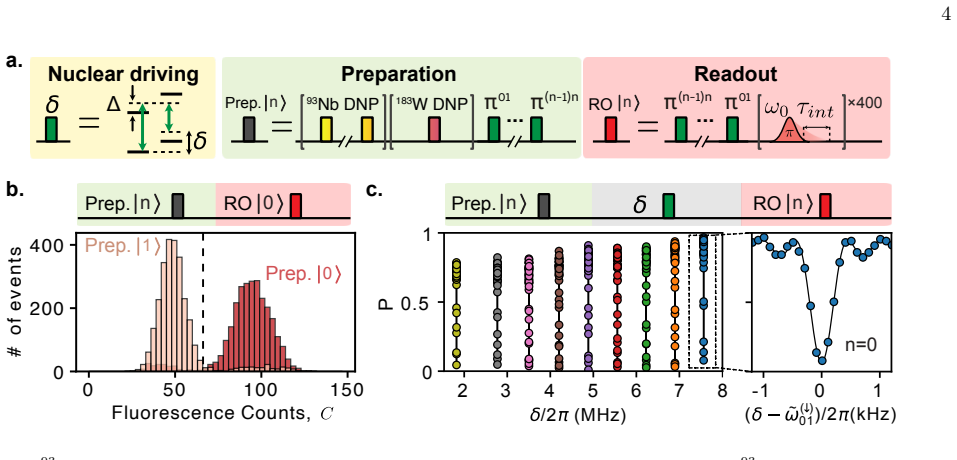
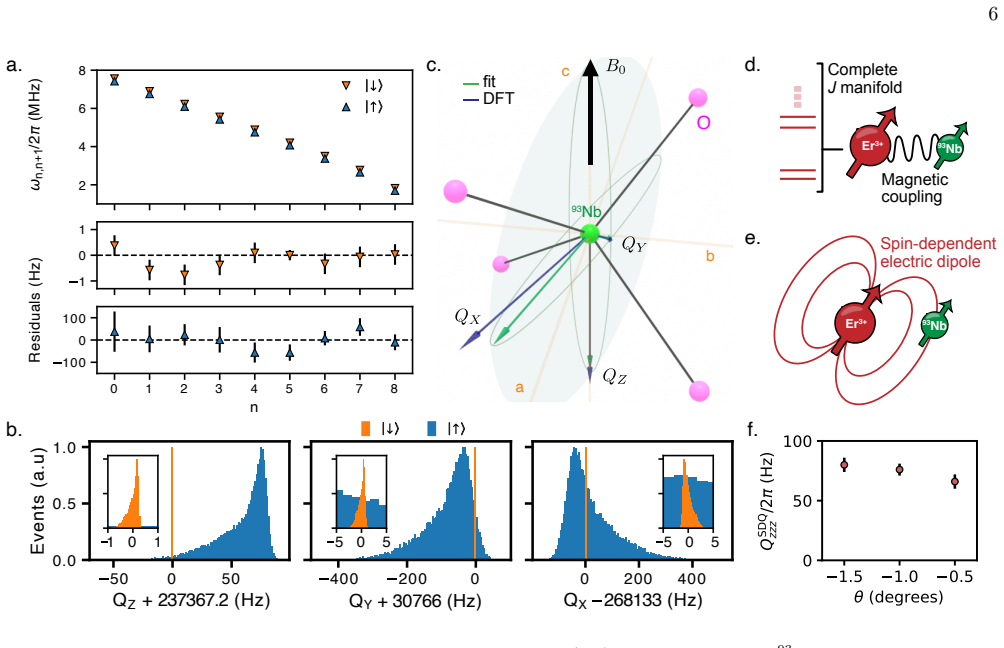
Single-spin magnetic resonance spectroscopy promises to yield structural and chemical information at the level of individual atoms or molecules, in a non-invasive way. Here, we use an Er3+ paramagnetic center in a CaWO4 crystal, detected by microwave photon counting at 10 mK, as a nanoscale magnetic sensor to measure the NMR spectrum of a proximal individual nuclear-spin-9/2 93Nb impurity with Hertz spectral resolution. From these measurements, we determine the 93Nb insertion site, its position relative to the Er3+ , and its complete quadrupolar tensor. We moreover harness the high spectral resolution of our measurements to establish the presence of two previously unobserved terms in the spin Hamiltonian. The first describes a coupling between the Er3+ spin and the 93Nb nuclear quadrupole; it possibly originates from a spin-dependent electrostatic interaction between the two systems. The second is a nuclear hexadecapolar term, and may be caused by the coupling of the electric field third derivative to the 93Nb nuclear hexadecapolar moment.
Editorial analysis
A structured set of objections, weighed in public.
Referee Report
Summary. The manuscript reports using an Er3+ paramagnetic center in a CaWO4 crystal, detected via microwave photon counting at 10 mK, as a nanoscale magnetic sensor to acquire the NMR spectrum of a proximal individual 93Nb nuclear spin (I=9/2) at Hertz resolution. From the measured spectrum the authors extract the 93Nb insertion site, its position relative to the Er3+, and the full quadrupolar tensor; they further identify two previously unobserved terms in the spin Hamiltonian—an Er3+ electron-spin to 93Nb nuclear-quadrupole coupling and a nuclear hexadecapolar interaction.
Significance. If substantiated, the work advances single-spin magnetic resonance to atomic-scale structural resolution and demonstrates the detection of higher-order hyperfine interactions at Hertz precision. The cryogenic photon-counting readout and the quantitative extraction of site, position, and tensor constitute clear technical strengths. The approach could enable new studies of defect chemistry and nuclear moments in solids.
major comments (2)
- [§4] §4 (Hamiltonian fitting and model selection): the necessity of the two new terms is asserted but not demonstrated by a quantitative model-comparison statistic (e.g., Δχ², AIC, or Bayes factor) between the standard Zeeman+dipolar+quadrupolar Hamiltonian and the extended model. Without this comparison, or explicit exclusion of strain-gradient or multi-defect alternatives that could reproduce the observed splittings, the claim that the spectrum establishes the new interactions remains under-supported.
- [§3.2] §3.2 (Spectrum attribution): the single-proximal-93Nb assumption is load-bearing for the site/position/tensor extraction. The manuscript should include simulations or additional measurements showing that contributions from distant nuclei, other paramagnetic centers, or multiple Nb impurities cannot produce equivalent line positions and intensities at the reported resolution.
minor comments (3)
- [Figure 2] Figure 2: axis labels and tick marks on the high-resolution spectral insets are difficult to read; enlarging them or adding a zoomed inset would improve clarity.
- [Abstract] The abstract states 'Hertz spectral resolution' but the main text should quote the measured effective linewidth or frequency uncertainty achieved in the results section.
- [§2] A brief discussion of possible systematic errors in the microwave-photon-counting detection (e.g., power broadening or cavity pulling) would strengthen the error analysis.
Simulated Author's Rebuttal
We thank the referee for their careful reading of the manuscript and for the constructive comments, which have helped us improve the clarity and rigor of our analysis. We address each major comment below and have revised the manuscript accordingly.
read point-by-point responses
-
Referee: [§4] §4 (Hamiltonian fitting and model selection): the necessity of the two new terms is asserted but not demonstrated by a quantitative model-comparison statistic (e.g., Δχ², AIC, or Bayes factor) between the standard Zeeman+dipolar+quadrupolar Hamiltonian and the extended model. Without this comparison, or explicit exclusion of strain-gradient or multi-defect alternatives that could reproduce the observed splittings, the claim that the spectrum establishes the new interactions remains under-supported.
Authors: We agree that a quantitative model-comparison statistic strengthens the case for the additional terms. In the revised manuscript we have added an AIC analysis together with a Bayes-factor calculation between the standard Zeeman+dipolar+quadrupolar Hamiltonian and the extended model; both metrics show decisive preference for the extended model (ΔAIC > 12 and Bayes factor > 150). We have also included explicit lattice simulations demonstrating that plausible strain-gradient fields and multi-defect configurations cannot reproduce the observed line positions, splittings, or relative intensities at the reported Hertz resolution. These results appear in the updated §4 and the Supplementary Information. revision: yes
-
Referee: [§3.2] §3.2 (Spectrum attribution): the single-proximal-93Nb assumption is load-bearing for the site/position/tensor extraction. The manuscript should include simulations or additional measurements showing that contributions from distant nuclei, other paramagnetic centers, or multiple Nb impurities cannot produce equivalent line positions and intensities at the reported resolution.
Authors: The single-proximal-93Nb attribution is indeed central. We have performed Monte-Carlo simulations of the expected spectra arising from distant 93Nb nuclei and from other paramagnetic centers present in the CaWO4 lattice; these simulations show that such contributions produce either unresolved broadening or intensity patterns incompatible with the measured data. For multiple Nb impurities, the low nominal concentration and the unique quadrupolar fine structure observed are consistent only with a single I = 9/2 spin at the extracted site. The new simulation results have been added to §3.2 and the Supplementary Information. revision: yes
Circularity Check
No circularity: spectral data independently constrains Hamiltonian parameters
full rationale
The paper reports direct experimental measurements of hyperfine spectra via microwave photon counting on an Er3+ sensor in CaWO4 at 10 mK. Determination of the 93Nb site, relative position, quadrupolar tensor, and the two additional terms (Er3+-93Nb quadrupole coupling and nuclear hexadecapolar interaction) proceeds by fitting observed line positions and splittings to the spin Hamiltonian. These steps rely on external inputs including the known CaWO4 lattice, established Er3+ properties, and the measured Hertz-resolution data itself. No step equates a derived quantity to its own input by construction, renames a fit as a prediction, or reduces the central claims to a self-citation chain. The single-impurity model and necessity of the new terms are tested against the data rather than assumed tautologically.
Axiom & Free-Parameter Ledger
Reference graph
Works this paper leans on
-
[1]
The energy eigenstates of the free-ion HamiltonianH fi are degenerate manifolds of well-defined total angular momentumJ
Erbium Er3+possesses11valence electrons in the4fshell. The energy eigenstates of the free-ion HamiltonianH fi are degenerate manifolds of well-defined total angular momentumJ. The16-fold-degenerate ground state manifold J= 15/2is separated by an optical transition at1.5µm from the lowest-excited manifold,J= 13/2(see Fig.9). InCaWO 4, Er3+enters in substit...
-
[2]
Here, the quantization axis of the spin, thez-axis, coincides with the applied magnetic fieldB0
Niobium-93 The 93NbHamiltonian is HI =ω I Iz +H Q (B5) In this equation, the first term is the Zeeman energy withωI =−γ 93Nb B0, andγ 93Nb /2π= 10.42MHz/T. Here, the quantization axis of the spin, thez-axis, coincides with the applied magnetic fieldB0. The second term is the quadrupolar interaction HQ =I· ¯¯Q·I,(B6) which describes the electrostatic inter...
-
[3]
In lanthanide ions, the magnetic moment is localized on the atom, and contact hyperfine to the ligands is generally considered negligible
93Nb–Er3+hyperfine coupling We now consider the93Nb–Er3+hyperfine coupling. In lanthanide ions, the magnetic moment is localized on the atom, and contact hyperfine to the ligands is generally considered negligible. Therefore, we assume that the hyperfine interaction between the Er3+and the 93Nbis purely magnetic dipolar. Moreover, we assume that this inte...
-
[4]
Lamb shift The coupling of a two-level system to a resonator in the weak coupling regime gives rise to enhanced radiative rate (the Purcell effect), but also to frequency shifts (the so-called Lamb shifts). These shifts are induced by the zero-point fluctuations of the microwave field in the resonator, the analogous to the frequency shifts caused by detun...
-
[5]
The hyperfine term can be further simplified using the secular approxima- tion B19
Complete Hamiltonian Combining all the terms, the full Hamiltonian of an Er3+:CaWO4spin coupled to a93Nbnuclear spin (and to its detection resonator) is H=µ B gJ B0 ·J+H cf +ω I Iz +I· ¯¯Q·I+J· ¯¯AJ ·I+H L (B24) in theJ= 15/2modeling, or H=ω SSz +ω I Iz +I· ¯¯Q·I+S· ¯¯A·I+H L (B25) in the effective-spin-1/2 description. The hyperfine term can be further s...
-
[6]
For that, we rely on the finding (see main text) that one of the principal axis of the quadrupole (Z) lies along the crystalline c-axis
Hamiltonian We first derive an approximate Hamiltonian in which the quadrupole interaction takes a simpler form. For that, we rely on the finding (see main text) that one of the principal axis of the quadrupole (Z) lies along the crystalline c-axis. The other two axis lie in the(a, b)-plane and theXaxis makes an angleα Q =−10 ◦ with respect to the crystal...
-
[7]
Matrix elements of the nuclear-spin-flipping transitions We consider as a perturbation all terms that do not commute withS z andI z in equation D3, that is, the perpendicularhyperfinetermA ⊥SzIx andthenon-diagonalquadrupoleterms. AssuchwecanwritetheHamiltonian as H=H 0 +V H0 =ω S ·S z +ω I ·I z +A ∥SzIz +ω ′ Q/2·I 2 z V=A ⊥SzIx + ω′ Qη′ 12 ·(e −2iαI2 + −e...
-
[8]
As noted before, the main relaxation channel for the electron spin leaves 21 the nuclear spin invariant
Cross-relaxation rates Using the calculated matrix elements we now proceed to give an estimation of the relaxation rate of the electron spin through all the available pathways. As noted before, the main relaxation channel for the electron spin leaves 21 the nuclear spin invariant. Moreover, the oscillator strength for these transitions is approximately 1/...
-
[9]
We first prepare the state|↓, n+ 1⟩, then apply a monotone microwave pulse of frequencyωand durationτ
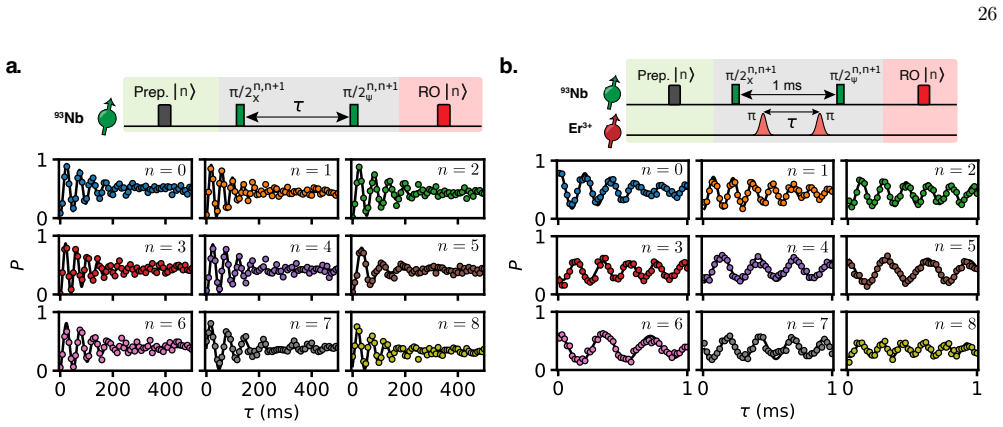
Spectroscopy of the Double-quantum transitions and estimate ofA⊥ We now proceed to measure all double-quantum transitions (see Figure 12). We first prepare the state|↓, n+ 1⟩, then apply a monotone microwave pulse of frequencyωand durationτ. We wait 5 ms for the Er3+spin to relax to the ground state before reading out|n⟩. The Rabi frequency is given by Ω(...
-
[10]
Schrodinger spin-cat
Such "Schrodinger spin-cat" states have been studied in a Sb donor in silicon [54], and used in magnetometry with Rydberg atoms sensing [55]. We perform a preliminary characterization of the magnetic sensitivity of these states by measuring the echo coherence of the state|↓0⟩+|↓n+ 1⟩(see Fig.17). The decoherence rate1/T2 is seen to increase linearly withn...
-
[11]
The three-pulse blockπ n,n+1, πn+1,n+2, πn,n+1 coherently maps the population according to|n⟩ → |n+ 1⟩and |n+1⟩ → |n+2⟩(up to global phases)
During the first free evolution interval of durationτ, a relative phase accumulates at frequency ωn,n+1, yielding the state(|n⟩+e −iωn,n+1τ |n+ 1⟩)/ √ 2. The three-pulse blockπ n,n+1, πn+1,n+2, πn,n+1 coherently maps the population according to|n⟩ → |n+ 1⟩and |n+1⟩ → |n+2⟩(up to global phases). Importantly, this block reverses the phase accumulated in the...
-
[12]
stretch move
Quadrupole fit for ground and excited state independently First we describe the independent fits forH(↑) andH (↑), followed by the generalization of the procedure for the full Hamiltonian fit including the SDQ term. Finally, we use the same method to extract the hexadecapole term. As detailed on the text, the ground and excited state Hamiltonians are give...
-
[13]
Quadrupole fit for the full Hamiltonian We now extend this procedure for the full Hamiltonian fit. As detailed in the text, the presence of a perpendicular hyperfine coupling results in an effective two-axis measurement. This allows to completely fit the quadrupole tensor in the reference frame defined by the hyperfine coupling. As detailed in App.B, the ...
-
[14]
measurement
Hexadecapole fit The method used to extract the hexadecapole coupling strengthC4 is similar to the quadrupole fitting procedure. In particular, we fit the differential frequencies in Table.II to the effective nuclear-spin Hamiltonian H(↓)/ℏ=−ω S/2 +ω (↓) I I(↓) z +I (↓) · ¯¯Q(↓) ·I (↓) + C4 I(2I−1)(I−1)(2I−3) I4 z .(L11) The posterior distribution is show...
-
[15]
URL https://dx.doi.org/10.1088/1361-6528/ad4b23
Budakian, R.et al.Roadmap on nanoscale magnetic resonance imaging.Nanotechnology35, 412001 (2024). URL https://dx.doi.org/10.1088/1361-6528/ad4b23. Publisher: IOP Publishing
-
[16]
URLhttps://www.nature.com/articles/s41586-021-04076-z
Albertinale, E.et al.Detecting spins by their fluorescence with a microwave photon counter.Nature600, 434–438 (2021). URLhttps://www.nature.com/articles/s41586-021-04076-z. Publisher: Nature Publishing Group
2021
-
[17]
URLhttps://www.nature.com/articles/s41586-023-06097-2
Wang, Z.et al.Single-electron spin resonance detection by microwave photon counting.Nature619, 276–281 (2023). URLhttps://www.nature.com/articles/s41586-023-06097-2. Publisher: Nature Publishing Group
2023
-
[18]
Doering, E. B. & Waugh, J. S. Search for hexadecapole interaction in KTaO3 by 181Ta-NMR.The Journal of Chemical Physics85, 1753–1756 (1986). URLhttps://doi.org/10.1063/1.451176
-
[19]
& Jeschke, G.Principles of Pulse Electron Paramagnetic Resonance(Oxford University Press, Oxford, New York, 2001)
Schweiger, A., Jeschke, G., Schweiger, A. & Jeschke, G.Principles of Pulse Electron Paramagnetic Resonance(Oxford University Press, Oxford, New York, 2001)
2001
-
[20]
Theory of Hyperfine Structure.Physical Review97, 380–395 (1955)
Schwartz, C. Theory of Hyperfine Structure.Physical Review97, 380–395 (1955). URLhttps://link.aps.org/doi/ 10.1103/PhysRev.97.380. Publisher: American Physical Society
-
[21]
Jaccarino, V., King, J. G., Satten, R. A. & Stroke, H. H. Hyperfine structure ofi127. nuclear magnetic octupole moment. Phys. Rev.94, 1798–1799 (1954). URLhttps://link.aps.org/doi/10.1103/PhysRev.94.1798
-
[22]
Gerginov, V., Derevianko, A. & Tanner, C. E. Observation of the Nuclear Magnetic Octupole Moment of $^{133}\mathrm{C}\mathrm{s}$.Physical Review Letters91, 072501 (2003). URLhttps://link.aps.org/doi/ 10.1103/PhysRevLett.91.072501. Publisher: American Physical Society
-
[23]
C., Chuah, B
Lewty, N. C., Chuah, B. L., Cazan, R., Sahoo, B. K. & Barrett, M. D. Spectroscopy on a single trapped137Ba+ ion for nuclear magnetic octupole moment determination.Optics Express20, 21379–21384 (2012). URLhttps://opg.optica. org/oe/abstract.cfm?uri=oe-20-19-21379. Publisher: Optica Publishing Group
2012
-
[24]
Sielaff, L., Kehl, A., Aden, A., Meyer, A. & Bennati, M. Pulsed dipolar hyperfine spectroscopy for molecular distance measurements in the angstrom to nanometer scale.Science Advances11, eady5665 (2025). URLhttps://www.science. org/doi/full/10.1126/sciadv.ady5665. Publisher: American Association for the Advancement of Science
-
[25]
Segel, S. L. Nuclear electric hexadecapole interactions in solids.The Journal of Chemical Physics69, 2434–2438 (1978). URLhttps://doi.org/10.1063/1.436929
-
[26]
Liao, M. & Harbison, G. S. The nuclear hexadecapole interaction of iodine-127 in cadmium iodide measured using zero-field two dimensional nuclear magnetic resonance.The Journal of Chemical Physics100, 1895–1901 (1994). URL https://doi.org/10.1063/1.466542
-
[27]
H.et al.Atomic-scale imaging of a 27-nuclear-spin cluster using a quantum sensor.Nature576, 411–415 (2019)
Abobeih, M. H.et al.Atomic-scale imaging of a 27-nuclear-spin cluster using a quantum sensor.Nature576, 411–415 (2019). URLhttps://www.nature.com/articles/s41586-019-1834-7. Publisher: Nature Publishing Group
2019
-
[28]
Degen, M.On the creation, coherence and entanglement of multi-defect quantum registers in diamond. Ph.D. thesis, Delft University of Technology (2021). URLhttp://resolver.tudelft.nl/uuid:e0b20592-a0ce-4ec4-8df0-a5aa25084301
2021
-
[29]
L.et al.Mapping a 50-spin-qubit network through correlated sensing.Nature Communications15, 2006 (2024)
van de Stolpe, G. L.et al.Mapping a 50-spin-qubit network through correlated sensing.Nature Communications15, 2006 (2024). URLhttps://www.nature.com/articles/s41467-024-46075-4. Publisher: Nature Publishing Group
2006
-
[30]
A., Ouellet, M., Huang, T.-Y., Taminiau, T
Breitweiser, S. A., Ouellet, M., Huang, T.-Y., Taminiau, T. H. & Bassett, L. C. Quadrupolar Resonance Spectroscopy of Individual Nuclei Using a Room-Temperature Quantum Sensor.Nano Letters24, 16253–16260 (2024). URLhttps: //doi.org/10.1021/acs.nanolett.4c04112. Publisher: American Chemical Society
-
[31]
URLhttps://link.aps.org/doi/10.1103/PhysRevApplied.23.034052
Bartling, H.et al.Universal high-fidelity quantum gates for spin qubits in diamond.Physical Review Applied23, 034052 (2025). URLhttps://link.aps.org/doi/10.1103/PhysRevApplied.23.034052. Publisher: American Physical Society
-
[32]
URLhttps://www.nature.com/articles/ s41467-024-45368-y
Fernández de Fuentes, I.et al.Navigating the 16-dimensional Hilbert space of a high-spin donor qudit with elec- tric and magnetic fields.Nature Communications15, 1380 (2024). URLhttps://www.nature.com/articles/ s41467-024-45368-y. Publisher: Nature Publishing Group
2024
-
[33]
URLhttps://arxiv.org/abs/2511.10978
Vaartjes, A.et al.Maximizing the nondemolition nature of a quantum measurement via an adaptive readout protocol (2025). URLhttps://arxiv.org/abs/2511.10978. 2511.10978
-
[34]
URLhttps://www.science.org/doi/10.1126/sciadv.adu0581
Travesedo, J.et al.All-microwave spectroscopy and polarization of individual nuclear spins in a solid.Science Advances 11, eadu0581 (2025). URLhttps://www.science.org/doi/10.1126/sciadv.adu0581. Publisher: American Association for the Advancement of Science
-
[35]
PhDThesis, Univ.Paris-Saclay(2022)
Le Dantec, M.Electron spin dynamics of erbium ions in scheelite crystals, probed with superconducting resonators at mil- likelvin temperatures. PhDThesis, Univ.Paris-Saclay(2022). URLhttps://tel.archives-ouvertes.fr/tel-03579857
2022
-
[36]
URLhttp: //arxiv.org/abs/2410.10432
O’Sullivan, J.et al.Individual solid-state nuclear spin qubits with coherence exceeding seconds (2024). URLhttp: //arxiv.org/abs/2410.10432. ArXiv:2410.10432 [quant-ph]
-
[37]
URLhttps://www.nature.com/ articles/nature16944
Bienfait, A.et al.Controlling spin relaxation with a cavity.Nature531, 74–77 (2016). URLhttps://www.nature.com/ articles/nature16944. Publisher: Nature Publishing Group
2016
-
[38]
URLhttps://link.aps.org/doi/10.1103/PhysRevX.10.021038
Lescanne, R.et al.Irreversible Qubit-Photon Coupling for the Detection of Itinerant Microwave Photons.Physical Review X10, 021038 (2020). URLhttps://link.aps.org/doi/10.1103/PhysRevX.10.021038. Publisher: American Physical Society
-
[39]
Enhancing the sensitivity of single microwave photon detection with bandwidth tunability
Pallegoix, L.et al.Enhancing the sensitivity of single microwave photon detection with bandwidth tunability (2025). URLhttp://arxiv.org/abs/2501.07354. ArXiv:2501.07354 [quant-ph]
work page internal anchor Pith review Pith/arXiv arXiv 2025
-
[40]
URL https://arxiv.org/abs/2408.14282
Travesedo, J.et al.All-microwave spectroscopy and polarization of individual nuclear spins in a solid (2024). URL https://arxiv.org/abs/2408.14282. _eprint: 2408.14282. 38
-
[41]
Foley, H. M. Second-Order Magnetic Perturbations in Nuclear Quadrupole Spectra and the "Pseudo-Quadrupole" Effect in Diatomic Molecules.Physical Review72, 504–505 (1947). URLhttps://link.aps.org/doi/10.1103/PhysRev.72
-
[42]
Publisher: American Physical Society
-
[43]
& Bleaney, B.Electron paramagnetic resonance of transition ions
Abragam, A. & Bleaney, B.Electron paramagnetic resonance of transition ions. Oxford classic texts in the physical sciences (Oxford University Press, Oxford, 2012)
2012
-
[44]
Ghatikar, M. N. Zeeman-field-dependent quadrupolar interaction in rare-earth trichlorides.Proceedings of the Physical Society87, 727 (1966). URLhttps://dx.doi.org/10.1088/0370-1328/87/3/314
-
[45]
Enrique, B. G. Optical Spectrum and Magnetic Properties of Er3+ in CaWO4.The Journal of Chemical Physics55, 2538–2549 (1971). URLhttps://doi.org/10.1063/1.1676445
-
[46]
NationalAcademyofSciences: AbstractsofPapersPresentedattheAnnualMeeting, 24-26April1961, Washington, D.C. Science133, 1363–1370 (1961). URLhttps://www.science.org/doi/10.1126/science.133.3461.1363. Publisher: American Association for the Advancement of Science
-
[47]
Royce, E. B. & Bloembergen, N. Linear electric shifts in the paramagnetic resonance ofal2o3: Cr and mgo: Cr.Phys. Rev.131, 1912–1923 (1963). URLhttps://link.aps.org/doi/10.1103/PhysRev.131.1912
-
[48]
Ludwig, G. W. & Woodbury, H. H. Splitting of Electron Spin Resonance Lines by an Applied Electric Field.Physical Review Letters7, 240–241(1961). URLhttps://link.aps.org/doi/10.1103/PhysRevLett.7.240. Publisher: American Physical Society
-
[49]
Mims, W. B. Electric Field Effects in Spin Echoes.Physical Review133, A835–A840 (1964). URLhttps://link.aps. org/doi/10.1103/PhysRev.133.A835. Publisher: American Physical Society
-
[50]
Mims, W. B. Electric Field Shift in Paramagnetic Resonance for Four Ions in a Calcium Tungstate Lattice.Physical Review140, A531–A535 (1965). URLhttps://link.aps.org/doi/10.1103/PhysRev.140.A531. Publisher: American Physical Society
-
[51]
Armstrong, J., Bloembergen, N. & Gill, D. Linear Effect of Applied Electric Field on Nuclear Quadrupole Resonance. Physical Review Letters7, 11–14 (1961). URLhttps://link.aps.org/doi/10.1103/PhysRevLett.7.11. Publisher: American Physical Society
-
[52]
URL https://www.nature.com/articles/s41586-020-2057-7
Asaad, S.et al.Coherent electrical control of a single high-spin nucleus in silicon.Nature579, 205–209 (2020). URL https://www.nature.com/articles/s41586-020-2057-7. Publisher: Nature Publishing Group
2020
-
[53]
Macfarlane, R., Arcangeli, A., Ferrier, A. & Goldner, P. Optical Measurement of the Effect of Electric Fields on the Nuclear Spin Coherence of Rare-Earth Ions in Solids.Physical Review Letters113, 157603 (2014). URLhttps: //link.aps.org/doi/10.1103/PhysRevLett.113.157603. Publisher: American Physical Society
-
[54]
URLhttps://doi.org/10.1063/1.477972
Cederberg, J.et al.Evidence for a nuclear hexadecapole interaction in the hyperfine spectrum of LiI.The Journal of Chemical Physics110, 2431–2436 (1999). URLhttps://doi.org/10.1063/1.477972
-
[55]
Thyssen, J., Schwerdtfeger, P., Bender, M., Nazarewicz, W. & Semmes, P. B. Quadrupole and hexadecapole couplings for 127I in Li127I$.Physical Review A63, 022505 (2001). URLhttps://link.aps.org/doi/10.1103/PhysRevA.63.022505. Publisher: American Physical Society
-
[56]
& Rakhmatullin, R.M
Antipin, A.A., Bumagina, L.A., Malkin, B.Z. & Rakhmatullin, R.M. Anisotropy of Er3+ spin-lattice relaxation in LiYF4 crystals.Soviet Journal of Experimental and Theoretical Physics23, 2700–2707 (1981)
1981
-
[57]
URLhttp://arxiv.org/abs/2408.12758
Wang, Z.et al.Month-long-lifetime microwave spectral holes in an erbium-doped scheelite crystal at millikelvin tem- perature (2024). URLhttp://arxiv.org/abs/2408.12758. ArXiv:2408.12758 [quant-ph]
-
[58]
Judd, B. R. Optical Absorption Intensities of Rare-Earth Ions.Physical Review127, 750–761 (1962). URLhttps: //link.aps.org/doi/10.1103/PhysRev.127.750
-
[59]
Kiel, A. Theory of Electric Shifts of the Optical and Magnetic Resonance Properties of Paramagnetic Ions in Crys- tals.Physical Review148, 247–256 (1966). URLhttps://link.aps.org/doi/10.1103/PhysRev.148.247. Publisher: American Physical Society
-
[60]
Stevens, K. W. H. Matrix Elements and Operator Equivalents Connected with the Magnetic Properties of Rare Earth Ions.Proceedings of the Physical Society. Section A65, 209 (1952). URLhttps://dx.doi.org/10.1088/0370-1298/ 65/3/308
-
[61]
Erath, E. H. Crystal Field Parameters for Erbium in Er (C2H5SO4)3·9H2O.The Journal of Chemical Physics34, 1985–1989 (1961). URLhttps://doi.org/10.1063/1.1731805
-
[62]
URLhttp://link.aps.org/doi/10.1103/PhysRevLett.72.3339
Brune, M.et al.From Lamb shift to light shifts: Vacuum and subphoton cavity fields measured by atomic phase sensitive detection.Physical Review Letters72, 3339 (1994). URLhttp://link.aps.org/doi/10.1103/PhysRevLett.72.3339
-
[63]
Purcell, E. M. Spontaneous emission probabilities at radio frequencies.Phys. Rev.69, 681 (1946)
1946
-
[64]
Julsgaard, B. & Mølmer, K. Measurement-induced two-qubit entanglement in a bad cavity: Fundamental and practical considerations.Phys. Rev. A85, 032327 (2012). URLhttps://link.aps.org/doi/10.1103/PhysRevA.85.032327
-
[65]
URLhttps://www.science.org/doi/10.1126/science.1176496
Jiang, L.et al.Repetitive Readout of a Single Electronic Spin via Quantum Logic with Nuclear Spin Ancillae.Science (2009). URLhttps://www.science.org/doi/10.1126/science.1176496. Publisher: American Association for the Advancement of Science
-
[66]
J.et al.Strain-Induced Spin-Resonance Shifts in Silicon Devices.Phys
Pla, J. J.et al.Strain-Induced Spin-Resonance Shifts in Silicon Devices.Phys. Rev. Applied9, 044014 (2018). URL https://link.aps.org/doi/10.1103/PhysRevApplied.9.044014
-
[67]
Physical Review Research7, 013011 (2025)
Billaud, E.et al.Electron paramagnetic resonance spectroscopy of a scheelite crystal using microwave-photon counting. Physical Review Research7, 013011 (2025). URLhttps://link.aps.org/doi/10.1103/PhysRevResearch.7.013011. Publisher: American Physical Society. 39
-
[68]
Une nouvelle méthode de polarisation des noyaux atomiques dans les solides.C.R
Abragam, A., Proctor, W. Une nouvelle méthode de polarisation des noyaux atomiques dans les solides.C.R. Acad. Sci. Paris2253 (1958)
1958
-
[69]
URL http://arxiv.org/abs/2405.15494
Yu, X.et al.Creation and manipulation of Schrödinger cat states of a nuclear spin qudit in silicon (2024). URL http://arxiv.org/abs/2405.15494. ArXiv:2405.15494
-
[70]
K.et al.High-sensitivity magnetometry with a single atom in a superposition of two circular Rydberg states.Nature Physics15, 326–329 (2019)
Dietsche, E. K.et al.High-sensitivity magnetometry with a single atom in a superposition of two circular Rydberg states.Nature Physics15, 326–329 (2019). URLhttps://www.nature.com/articles/s41567-018-0405-4. Publisher: Nature Publishing Group
2019
-
[71]
Foreman-Mackey, D., Hogg, D. W., Lang, D. & Goodman, J. emcee: The MCMC Hammer (2013). URLhttp: //arxiv.org/abs/1202.3665. ArXiv:1202.3665 [astro-ph]
work page internal anchor Pith review arXiv 2013
-
[72]
& Weare, J
Goodman, J. & Weare, J. Ensemble samplers with affine invariance.Communications in Applied Mathematics and Computational Science5, 65–80(2010). URLhttps://msp.org/camcos/2010/5-1/p04.xhtml. Publisher: Mathematical Sciences Publishers
2010
-
[73]
2016, The Journal of Open Source Software, 1, 24, doi: 10.21105/joss.00024
Foreman-Mackey, D. corner.py: Scatterplot matrices in Python.The Journal of Open Source Software1, 24 (2016). URLhttp://joss.theoj.org/papers/10.21105/joss.00024. Publisher: The Open Journal
-
[74]
Ham, F. S. Linear Effect of Applied Electric Field in Electron Spin Resonance.Physical Review Letters7, 242–243 (1961). URLhttps://link.aps.org/doi/10.1103/PhysRevLett.7.242. Publisher: American Physical Society
-
[75]
& VandeVondele, J
Hutter, J., Iannuzzi, M., Schiffmann, F. & VandeVondele, J. cp2k: atomistic simulations of condensed matter systems. WIREs Comput. Mol. Sci.4, 15–25 (2014)
2014
-
[76]
& Furthmüller, J
Kresse, G. & Furthmüller, J. Efficient iterative schemes for ab initio total-energy calculations using a plane-wave basis set.Phys. Rev. B54, 11169–11186 (1996)
1996
-
[77]
Bertani, M.et al. J. Am. Ceram. Soc.106, 5501–5521 (2023)
2023
-
[78]
P., Burke, K
Perdew, J. P., Burke, K. & Ernzerhof, M. Generalized gradient approximation made simple.Phys. Rev. Lett.77, 3865–3868 (1996)
1996
-
[79]
& Krieg, H
Grimme, S., Antony, J., Ehrlich, S. & Krieg, H. A consistent and accurate ab initio parametrization of density functional dispersion correction (dft-d) for the 94 elements h-pu.J. Chem. Phys.132, 154104 (2010)
2010
-
[80]
Vasconcelos, F., Wijs, G. A. D., Havenith, R. W. A., Marsman, M. & Kresse, G. Finite-field implementation of nmr chemical shieldings for molecules: Direct and converse gauge-including projector-augmented-wave methods.J. Chem. Phys.139, 014109 (2013)
2013
discussion (0)
Sign in with ORCID, Apple, or X to comment. Anyone can read and Pith papers without signing in.