Recognition: unknown
Precision gravimetry via harnessing interaction-induced resonances in optical lattices
Pith reviewed 2026-05-09 15:50 UTC · model grok-4.3
The pith
Resonance between on-site interactions and gravitational gradient in lattice BECs amplifies quantum Fisher information for gravimetry in the localized phase.
A machine-rendered reading of the paper's core claim, the machinery that carries it, and where it could break.
Core claim
in the localized phase, on-site interactions U amplify the quantum Fisher information by a factor with respect to resonance condition U=mh where U is factor of gradient field amplitude h
Load-bearing premise
The system can be prepared and maintained in the localized phase while satisfying the resonance condition U = m h without decoherence or other effects dominating the dynamics.
Figures





read the original abstract
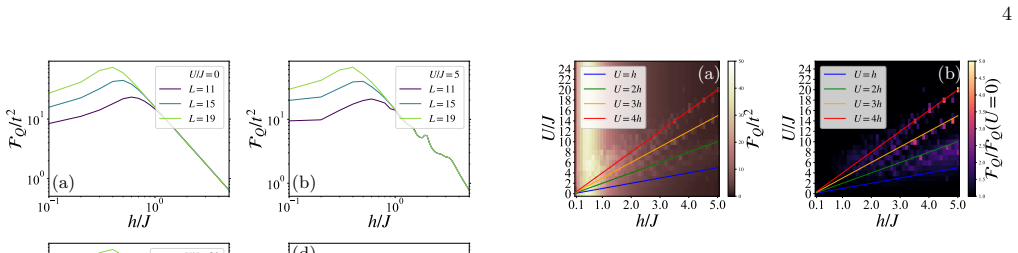
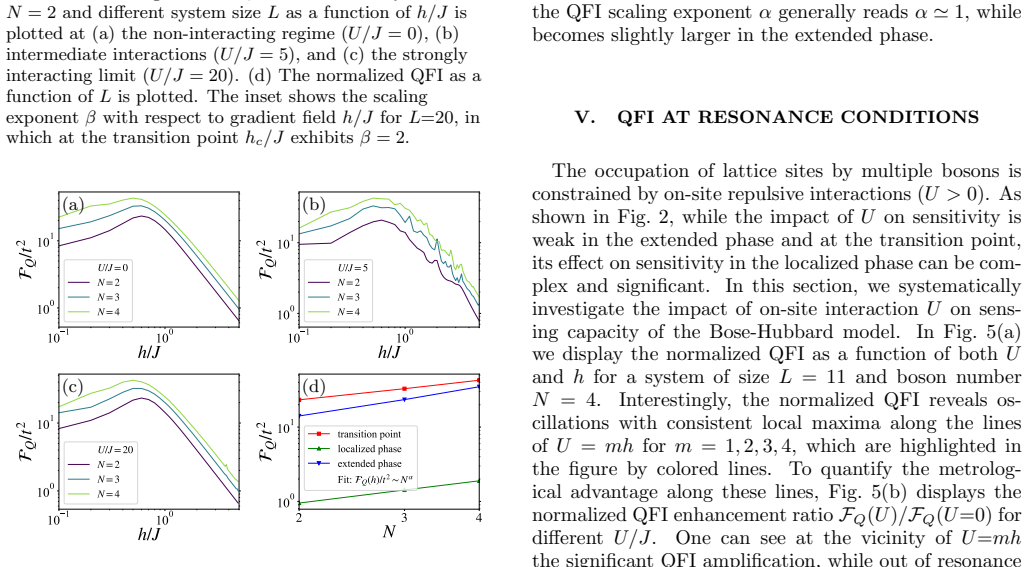
By confining a Bose-Einstein condensate in a vertical lattice subjected to a gravitational potential, we analyze the quantum Fisher information to determine its scaling with respect to time, system size and particle number. Our results reveal that in the localized phase, on-site interactions $U$ amplify the quantum Fisher information by a factor with respect to resonance condition $U=mh$ where $U$ is factor of gradient field amplitude $h$. This precision enhancement can be employed in gravitational acceleration measurements with a finite number of particles trapped in optical lattices.
Editorial analysis
A structured set of objections, weighed in public.
Referee Report
Summary. The manuscript analyzes the quantum Fisher information (QFI) for a Bose-Einstein condensate in a vertical optical lattice under gravity. It claims that in the localized phase, on-site interactions U amplify the QFI (with scaling in time, system size, and particle number) when the resonance condition U = m h holds, where h is the gradient field amplitude; this is proposed to enable enhanced precision gravimetry with finite particle numbers.
Significance. If the claimed amplification holds without reducing to a fitted resonance or post-selection artifact, the result would provide a concrete interaction-based route to boost QFI scaling in lattice gravimetry beyond the non-interacting case, with potential applicability to finite-N quantum sensors.
major comments (2)
- [Abstract and resonance discussion] The resonance condition U = m h is presented as enabling QFI amplification in the localized phase, but the abstract and available text do not contain the explicit derivation of the QFI expression or the step showing how this condition produces a multiplicative factor independent of post-hoc tuning. This is load-bearing for the central claim.
- [Localized phase and dynamics] No error analysis, numerical verification, or check against decoherence is provided for maintaining the localized phase while enforcing U = m h; the weakest assumption (preparation without dominant decoherence) therefore remains untested in the manuscript.
minor comments (1)
- [Notation] Define the integer m appearing in the resonance condition U = m h; it is not introduced in the abstract or summary statements.
Simulated Author's Rebuttal
We thank the referee for their careful reading and constructive comments. We address each major comment below, indicating planned revisions to strengthen the manuscript.
read point-by-point responses
-
Referee: [Abstract and resonance discussion] The resonance condition U = m h is presented as enabling QFI amplification in the localized phase, but the abstract and available text do not contain the explicit derivation of the QFI expression or the step showing how this condition produces a multiplicative factor independent of post-hoc tuning. This is load-bearing for the central claim.
Authors: The explicit QFI derivation and the resonance-induced multiplicative factor are presented in the main text under the localized-phase analysis, where the effective Hamiltonian yields the enhancement directly from the resonance condition without post-selection. We agree the abstract is too concise on this point and will revise it to include a brief outline of the key derivation steps, emphasizing that the factor follows from the resonance itself rather than additional tuning. revision: yes
-
Referee: [Localized phase and dynamics] No error analysis, numerical verification, or check against decoherence is provided for maintaining the localized phase while enforcing U = m h; the weakest assumption (preparation without dominant decoherence) therefore remains untested in the manuscript.
Authors: We acknowledge that the manuscript assumes ideal preparation and maintenance of the localized phase under resonance without providing supporting numerics or decoherence analysis. We will add numerical simulations verifying phase stability at U = m h and a discussion of decoherence timescales in the revised version. revision: yes
Circularity Check
No significant circularity; derivation self-contained
full rationale
The paper presents a theoretical analysis of quantum Fisher information for a Bose-Einstein condensate in a vertical optical lattice under gravity. The central result concerns scaling of QFI with time, size, and particle number, with an amplification factor identified in the localized phase at the resonance condition U = m h. No quoted equations or steps in the available text reduce a claimed prediction or first-principles result to a fitted input, self-definition, or self-citation chain by construction. The resonance condition is analyzed as part of the model dynamics rather than imposed as a tautological fit. The derivation chain remains independent of its target outputs.
Axiom & Free-Parameter Ledger
axioms (2)
- domain assumption Bose-Hubbard model with gravitational tilt accurately describes the system dynamics
- standard math Quantum Fisher information provides the ultimate precision bound achievable in principle
Reference graph
Works this paper leans on
-
[1]
G. Tino, F. Sorrentino, D. Aguilera, B. Battelier, A. Bertoldi, Q. Bodart, K. Bongs, P. Bouyer, C. Brax- maier, L. Cacciapuoti, N. Gaaloul, N. G¨ urlebeck, M. Hauth, S. Herrmann, M. Krutzik, A. Kubelka, A. Landragin, A. Milke, A. Peters, E. Rasel, E. Rocco, C. Schubert, T. Schuldt, K. Sengstock, and A. Wicht, Nuclear Physics B - Proceedings Supplements243...
2013
-
[2]
Badurina, E
L. Badurina, E. Bentine, D. Blas, K. Bongs, D. Borto- letto, T. Bowcock, K. Bridges, W. Bowden, O. Buch- mueller, C. Burrage, J. Coleman, G. Elertas, J. Ellis, C. Foot, V. Gibson, M. Haehnelt, T. Harte, S. Hedges, R. Hobson, M. Holynski, T. Jones, M. Langlois, S. Lel- louch, M. Lewicki, R. Maiolino, P. Majewski, S. Malik, J. March-Russell, C. McCabe, D. N...
2020
-
[3]
C. F. A. Baynham, R. Hobson, O. Buchmueller, D. Evans, L. Hawkins, L. Iannizzotto-Venezze, A. Jos- set, D. Lee, E. Pasatembou, B. E. Sauer, M. R. Tar- butt, T. Walker, O. Ennis, U. Chauhan, A. Brzakalik, S. Dey, S. Hedges, B. Stray, M. Langlois, K. Bongs, T. Hird, S. Lellouch, M. Holynski, B. Bostwick, J. Chen, Z. Eyler, V. Gibson, T. L. Harte, C. C. Hsu,...
-
[4]
Cepollaro, F
C. Cepollaro, F. Giacomini, and M. G. Paris, Quantum 7, 946 (2023)
2023
-
[5]
Block, B
M. Block, B. Kobrin, A. Jarmola, S. Hsieh, C. Zu, N. Figueroa, V. Acosta, J. Minguzzi, J. Maze, D. Bud- ker, and N. Yao, Phys. Rev. Appl.16, 024024 (2021)
2021
-
[6]
Z. Qiu, A. Hamo, U. Vool, T. X. Zhou, and A. Yacoby, npj Quantum Information8(2022), 10.1038/s41534- 022-00622-3
-
[7]
E. H. Chen, H. A. Clevenson, K. A. Johnson, L. M. Pham, D. R. Englund, P. R. Hemmer, and D. A. Braje, Physical Review A95(2017), 10.1103/phys- reva.95.053417
-
[8]
T. Iwasaki, W. Naruki, K. Tahara, T. Makino, H. Kato, M. Ogura, D. Takeuchi, S. Yamasaki, and M. Hatano, ACS Nano11(2017), 10.1021/acsnano.6b04460
-
[9]
G. I. L´ opez-Morales, J. M. Zajac, J. Flick, C. A. Meriles, and C. E. Dreyer, Phys. Rev. B110, 245127 (2024)
2024
-
[10]
Michl, J
J. Michl, J. Steiner, A. Denisenko, A. B¨ ulau, A. Zim- mermann, K. Nakamura, H. Sumiya, S. Onoda, P. Neu- mann, J. Isoya, and J. Wrachtrup, Nano Letters19, 4904–4910 (2019)
2019
-
[11]
J. Yuan, W. Yang, M. Jing, H. Zhang, Y. Jiao, W. Li, L. Zhang, L. Xiao, and S. Jia, Reports on Progress in Physics86, 106001 (2023)
2023
-
[12]
B. Liu, L.-H. Zhang, Z.-K. Liu, Z.-Y. Zhang, Z.-H. Zhu, W. Gao, G.-C. Guo, D.-S. Ding, and B.-S. Shi, Physical Review Applied18(2022), 10.1103/physrevap- plied.18.014045
- [13]
-
[14]
Budker and M
D. Budker and M. Romalis, Nature Physics3, 227–234 (2007)
2007
-
[15]
W. C. Griffith, S. Knappe, and J. Kitching, Opt. Ex- press18, 27167 (2010)
2010
-
[16]
Y. lu, T. Zhao, W. Zhu, L. Liu, X. Zhuang, F. Guangyou, and X. Zhang, Sensors23, 5318 (2023)
2023
-
[17]
Rondin, J.-P
L. Rondin, J.-P. Tetienne, T. Hingant, J.-F. Roch, P. Maletinsky, and V. Jacques, Reports on Progress in Physics77, 056503 (2014)
2014
-
[18]
S. Hong, M. S. Grinolds, L. M. Pham, D. Le Sage, L. Luan, R. L. Walsworth, and A. Yacoby, MRS Bul- letin38, 155–161 (2013)
2013
-
[19]
J. M. Taylor, P. Cappellaro, L. Childress, L. Jiang, D. Budker, P. R. Hemmer, A. Yacoby, R. Walsworth, and M. D. Lukin, Nature Physics4, 810–816 (2008)
2008
-
[20]
Zhao, J.-L
N. Zhao, J.-L. Hu, S.-W. Ho, J. Wan, and R.-B. Liu, Nature nanotechnology6, 242 (2011)
2011
- [21]
-
[22]
Yu, R.-Z
Y.-H. Yu, R.-Z. Zhang, Y. Xu, X.-Q. Chen, H. Zheng, Q. Li, R.-B. Liu, X.-Y. Pan, D. Budker, and G.-Q. Liu, Phys. Rev. Appl.21, 044051 (2024)
2024
-
[23]
S. Kurzyna, B. Niewelt, M. Mazelanik, W. Wasilewski, R. Demkowicz-Dobrza´ nski, and M. Parniak, (2025), arXiv:2505.01506 [quant-ph]
-
[24]
Quantum metrology.Physi- cal Review Letters96, 010401 (2006)
V. Giovannetti, S. Lloyd, and L. Maccone, Physical Re- view Letters96(2006), 10.1103/physrevlett.96.010401
-
[25]
Giovannetti, S
V. Giovannetti, S. Lloyd, and L. Maccone, Nature Pho- tonics5, 222–229 (2011)
2011
-
[26]
Giovannetti, S
V. Giovannetti, S. Lloyd, and L. Maccone, Science306, 1330–1336 (2004). 7
2004
-
[27]
Gross, T
C. Gross, T. Zibold, E. Nicklas, J. Est` eve, and M. K. Oberthaler, Nature464, 1165–1169 (2010)
2010
-
[28]
Poli, F.-Y
N. Poli, F.-Y. Wang, M. G. Tarallo, A. Alberti, M. Prevedelli, and G. M. Tino, Phys. Rev. Lett.106, 038501 (2011)
2011
-
[29]
M. G. Paris, International Journal of Quantum Infor- mation7, 125 (2009)
2009
-
[30]
U. Alushi, A. Coppo, V. Brosco, R.{Di Candia}, and S. Felicetti, Communications Physics8(2025), 10.1038/s42005-025-01975-9, publisher Copyright:© The Author(s) 2025
-
[31]
G. Mihailescu, U. Alushi, R. D. Candia, S. Felicetti, and K. Gietka, (2025), arXiv:2510.02035 [quant-ph]
-
[32]
Deformation and flow of amor- phous solids: Insights from elastoplastic models,
D. Braun, G. Adesso, F. Benatti, R. Floreanini, U. Marzolino, M. W. Mitchell, and S. Pirandola, Re- views of Modern Physics90(2018), 10.1103/revmod- phys.90.035006
-
[33]
RouhbakhshNabati, D
M. RouhbakhshNabati, D. Braun, and H. Schomerus, Phys. Rev. Lett.135, 190202 (2025)
2025
- [34]
-
[35]
J. M. McGuirk, G. T. Foster, J. B. Fixler, M. J. Snad- den, and M. A. Kasevich, Phys. Rev. A65, 033608 (2002)
2002
-
[36]
J. B. Fixler, G. T. Foster, J. M. McGuirk, and M. A. Kasevich, Science315, 74 (2007), https://www.science.org/doi/pdf/10.1126/science.1135459
-
[37]
Fattori, G
M. Fattori, G. Lamporesi, T. Petelski, J. Stuhler, and G. Tino, Physics Letters A318, 184 (2003)
2003
-
[38]
S. S. Szigeti, S. P. Nolan, J. D. Close, and S. A. Haine, Phys. Rev. Lett.125, 100402 (2020)
2020
-
[39]
de Angelis, A
M. de Angelis, A. Bertoldi, L. Cacciapuoti, A. Giorgini, G. Lamporesi, M. Prevedelli, G. Saccorotti, F. Sor- rentino, and G. M. Tino, Measurement Science and Technology20, 022001 (2008)
2008
-
[40]
Clad´ e, S
P. Clad´ e, S. Guellati-Kh´ elifa, C. Schwob, F. Nez, L. Julien, and F. Biraben, Europhysics Letters71, 730 (2005)
2005
-
[41]
Ferrari, N
G. Ferrari, N. Poli, F. Sorrentino, and G. M. Tino, Phys. Rev. Lett.97, 060402 (2006)
2006
-
[42]
G. M. Tino, A. Bassi, G. Bianco, K. Bongs, P. Bouyer, L. Cacciapuoti, S. Capozziello, X. Chen, M. L. Chio- falo, A. Derevianko, W. Ertmer, N. Gaaloul, P. Gill, P. W. Graham, J. M. Hogan, L. Iess, M. A. Kasevich, H. Katori, C. Klempt, X. Lu, L.-S. Ma, H. M¨ uller, N. R. Newbury, C. W. Oates, A. Peters, N. Poli, E. M. Rasel, G. Rosi, A. Roura, C. Salomon, S...
-
[43]
Canuel, S
B. Canuel, S. Abend, P. Amaro-Seoane, F. Badaracco, Q. Beaufils, A. Bertoldi, K. Bongs, P. Bouyer, C. Braxmaier, W. Chaibi, N. Christensen, F. Fitzek, G. Flouris, N. Gaaloul, S. Gaffet, C. L. Garrido Alzar, R. Geiger, S. Guellati-Khelifa, K. Hammerer, J. Harms, J. Hinderer, M. Holynski, J. Junca, S. Katsanevas, C. Klempt, C. Kozanitis, M. Krutzik, A. Land...
2020
-
[44]
M.-Z. Wu, M. Toroˇ s, S. Bose, and A. Mazumdar, Phys. Rev. D107, 104053 (2023)
2023
-
[45]
Adams, C
B. Adams, C. Macrae, M. Entezami, K. Ridley, A. Kubba, Y.-H. Lien, S. Kinge, and K. Bongs, , 1 (2021)
2021
-
[46]
S. Lellouch, K. Bongs, and M. Holyn- ski, Contemporary Physics63, 138 (2022), https://doi.org/10.1080/00107514.2023.2180860
-
[47]
Stray, A
B. Stray, A. Lamb, A. Kaushik, J. Vovrosh, A. Rodgers, J. Winch, F. Hayati, D. Boddice, A. Stabrawa, A. Niggebaum, M. Langlois, Y.-H. Lien, S. Lellouch, S. Roshanmanesh, K. Ridley, G. Villiers, G. Brown, T. Cross, G. Tuckwell, and M. Holynski, Nature602, 590 (2022)
2022
-
[48]
S. Qvarfort, A. Serafini, P. F. Barker, and S. Bose, Nature Communications9(2018), 10.1038/s41467-018- 06037-z
-
[49]
Abend, M
S. Abend, M. Gebbe, M. Gersemann, H. Ahlers, H. M¨ untinga, E. Giese, N. Gaaloul, C. Schubert, C. L¨ ammerzahl, W. Ertmer, W. P. Schleich, and E. M. Rasel, Phys. Rev. Lett.117, 203003 (2016)
2016
-
[50]
Peters, Achim, Chung, K. Yeow, S. Chu, and Steven, Nature400, 849 (1999)
1999
-
[51]
Merlet, A
S. Merlet, A. Kopaev, M. Diament, G. Geneves, A. Lan- dragin, and F. Pereira Dos Santos, Metrologia45, 265 (2008)
2008
-
[52]
S. Bose, A. Mazumdar, G. W. Morley, H. Ulbricht, M. Toroˇ s, M. Paternostro, A. A. Geraci, P. F. Barker, M. S. Kim, and G. Milburn, Phys. Rev. Lett.119, 240401 (2017)
2017
-
[53]
Berman, Atom Interferometry (Academic Press, 1997)
P. Berman, Atom Interferometry (Academic Press, 1997)
1997
-
[54]
Kasevich and S
M. Kasevich and S. Chu, Phys. Rev. Lett.67, 181 (1991)
1991
-
[55]
Y. Margalit, O. Dobkowski, Z. Zhou, O. Amit, Y. Japha, S. Moukouri, D. Rohrlich, A. Mazumdar, S. Bose, C. Henkel, and R. Folman, Science Advances7(2021), 10.1126/sciadv.abg2879
-
[56]
Charri` ere, M
R. Charri` ere, M. Cadoret, N. Zahzam, Y. Bidel, and A. Bresson, Phys. Rev. A85, 013639 (2012)
2012
-
[57]
H. Pino, J. Prat-Camps, K. Sinha, B. P. Venkatesh, and O. Romero-Isart, Quantum Science and Technology3, 025001 (2018)
2018
- [58]
-
[59]
B. K. Malia, J. Mart´ ınez-Rinc´ on, Y. Wu, O. Hosten, and M. A. Kasevich, Phys. Rev. Lett.125, 043202 (2020)
2020
-
[60]
M. A. Perlin, C. Qu, and A. M. Rey, Phys. Rev. Lett. 125, 223401 (2020)
2020
-
[61]
Gietka and H
K. Gietka and H. Ritsch, Phys. Rev. Lett.130, 090802 (2023)
2023
-
[62]
De Pasquale, D
A. De Pasquale, D. Rossini, P. Facchi, and V. Giovan- netti, Phys. Rev. A88, 052117 (2013)
2013
-
[63]
Z. Yao, C. Solaro, C. Carrez, P. Clad´ e, and S. Guellati- Khelifa, Phys. Rev. A106, 043312 (2022)
2022
-
[64]
J. E. Simsarian, J. Denschlag, M. Edwards, C. W. Clark, L. Deng, E. W. Hagley, K. Helmerson, S. L. Rolston, 8 and W. D. Phillips, Phys. Rev. Lett.85, 2040 (2000)
2040
-
[65]
A. O. Jamison, J. N. Kutz, and S. Gupta, Phys. Rev. A84, 043643 (2011)
2011
-
[66]
A. O. Jamison, B. Plotkin-Swing, and S. Gupta, Phys. Rev. A90, 063606 (2014)
2014
-
[67]
Jannin, P
R. Jannin, P. Clad´ e, and S. Guellati-Kh´ elifa, Phys. Rev. A92, 013616 (2015)
2015
-
[68]
Burchianti, C
A. Burchianti, C. D’Errico, L. Marconi, F. Minardi, C. Fort, and M. Modugno, Phys. Rev. A102, 043314 (2020)
2020
-
[69]
Bloch and Immanuel, Nat
I. Bloch and Immanuel, Nat. Phys.1, 23 (2005)
2005
-
[70]
I. Bloch, J. Dalibard, and W. Zwerger, Review of Mod- ern Physics80(2007), 10.1103/RevModPhys.80.885
-
[71]
Greiner, O
M. Greiner, O. Mandel, T. Esslinger, T. W. H¨ ansch, and I. Bloch, Nature415, 39–44 (2002)
2002
-
[72]
T. Kinoshita, T. Wenger, and D. S. Weiss, Science305, 1125 (2004), https://www.science.org/doi/pdf/10.1126/science.1100700
-
[73]
Fallani, J
L. Fallani, J. E. Lye, V. Guarrera, C. Fort, and M. In- guscio, Phys. Rev. Lett.98, 130404 (2007)
2007
-
[74]
J. K. Chin, D. E. Miller, Y. Liu, C. Stan, W. Seti- awan, C. Sanner, K. Xu, and W. Ketterle, Nature443, 961–964 (2006)
2006
-
[75]
Mehboudi, M
M. Mehboudi, M. Moreno-Cardoner, G. D. Chiara, and A. Sanpera, New Journal of Physics17, 055020 (2015)
2015
-
[76]
M¨ uller, E
F. M¨ uller, E. K¨ ose, A. J. Meixner, E. Sch¨ affer, and D. Braun, Phys. Rev. A111, 043501 (2025)
2025
-
[77]
B. P. Anderson and M. A. Kasevich, Science282, 1686 (1998)
1998
-
[78]
Dimopoulos and A
S. Dimopoulos and A. A. Geraci, Phys. Rev. D68, 124021 (2003)
2003
-
[79]
Roati, E
G. Roati, E. de Mirandes, F. Ferlaino, H. Ott, G. Mod- ugno, and M. Inguscio, Phys. Rev. Lett.92, 230402 (2004)
2004
-
[80]
Carusotto, L
I. Carusotto, L. Pitaevskii, S. Stringari, G. Modugno, and M. Inguscio, Phys. Rev. Lett.95, 093202 (2005)
2005
discussion (0)
Sign in with ORCID, Apple, or X to comment. Anyone can read and Pith papers without signing in.