Recognition: 3 theorem links
· Lean TheoremAGN STORM 2. XII. Ground-Based Optical Photometry and Lag Measurements of Mrk 817
Pith reviewed 2026-05-08 18:10 UTC · model grok-4.3
The pith
Optical continuum lags in Mrk 817 follow the wavelength scaling expected for thin-disk reprocessing but exceed model predictions by factors of three to six.
A machine-rendered reading of the paper's core claim, the machinery that carries it, and where it could break.
Core claim
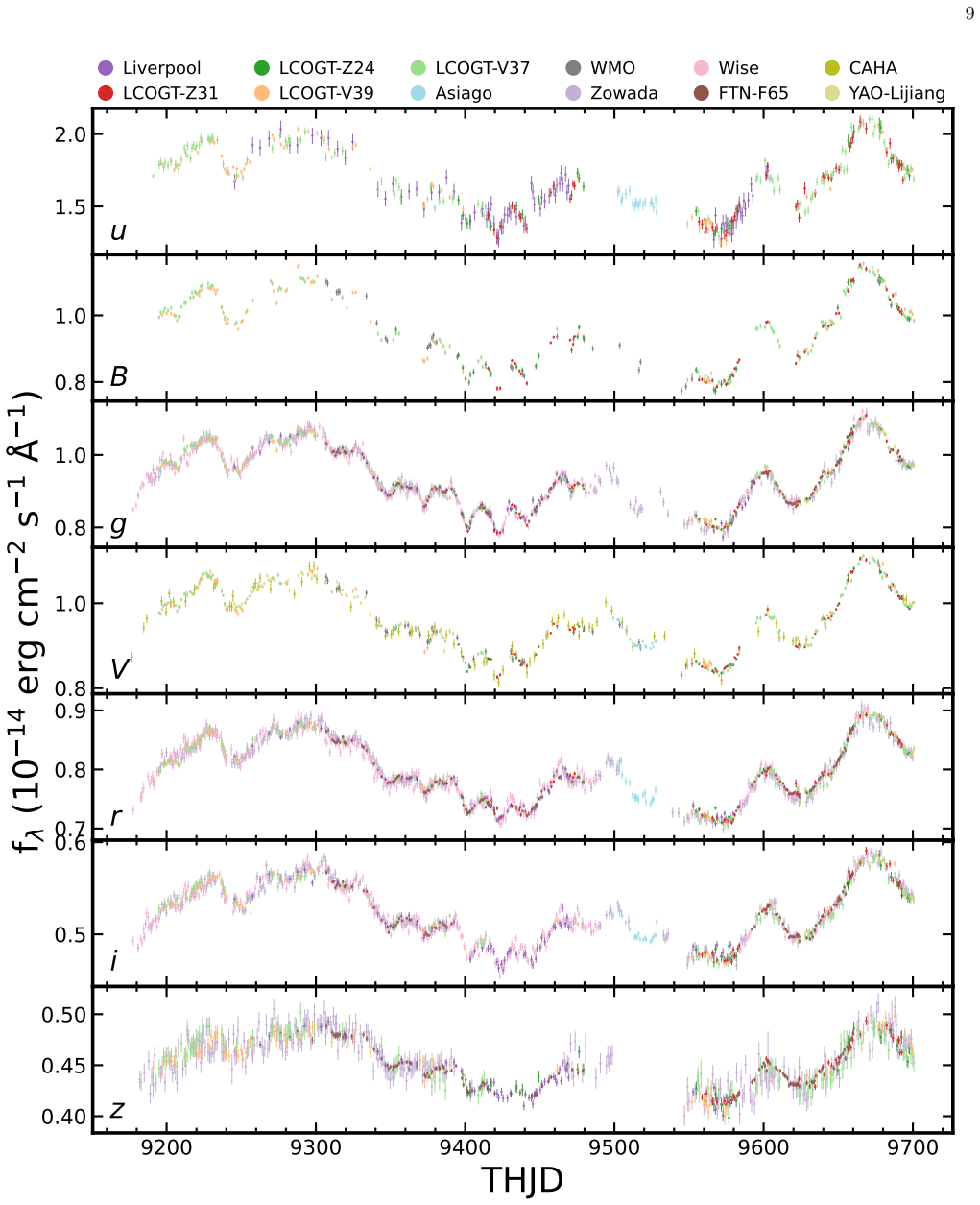
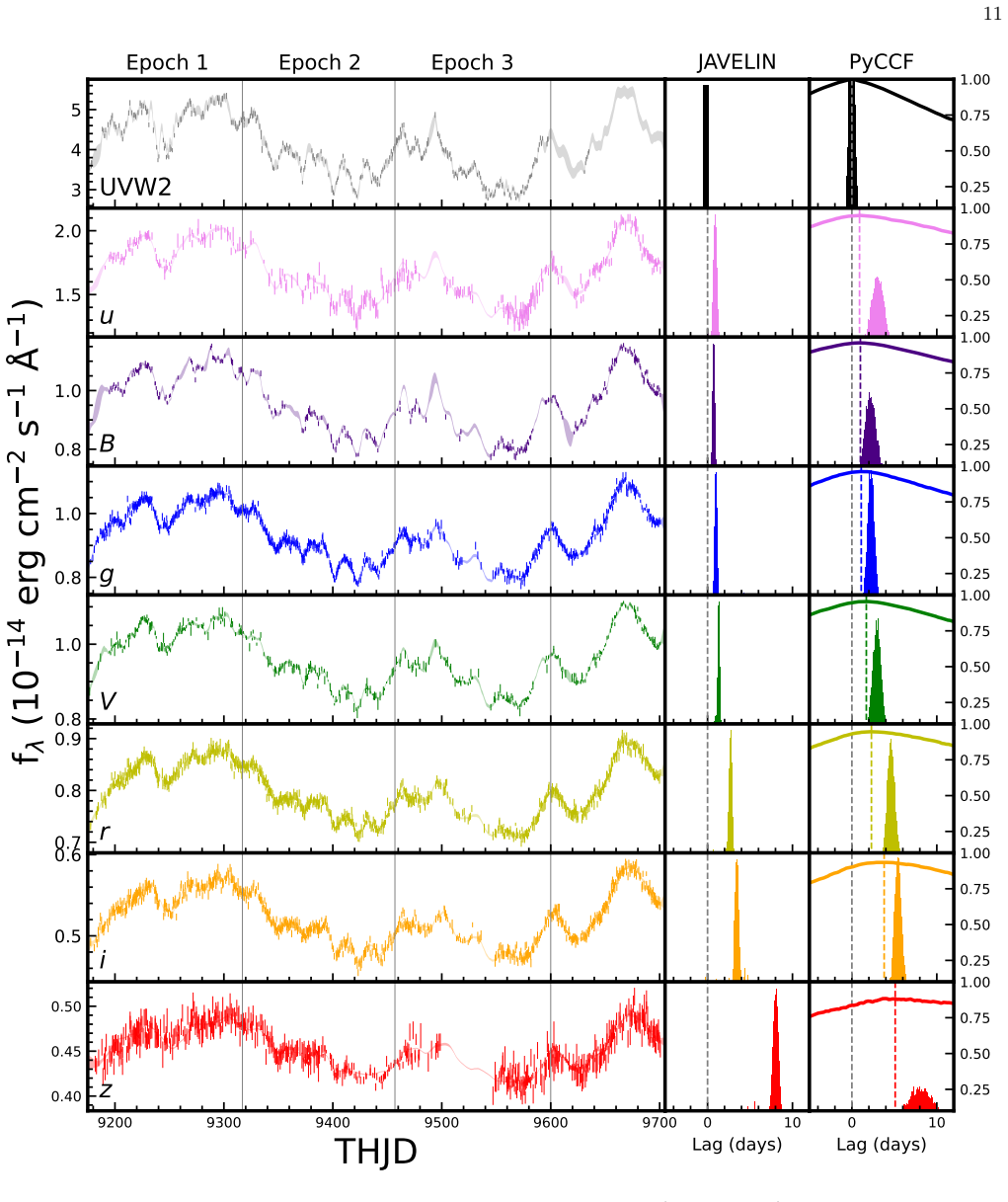
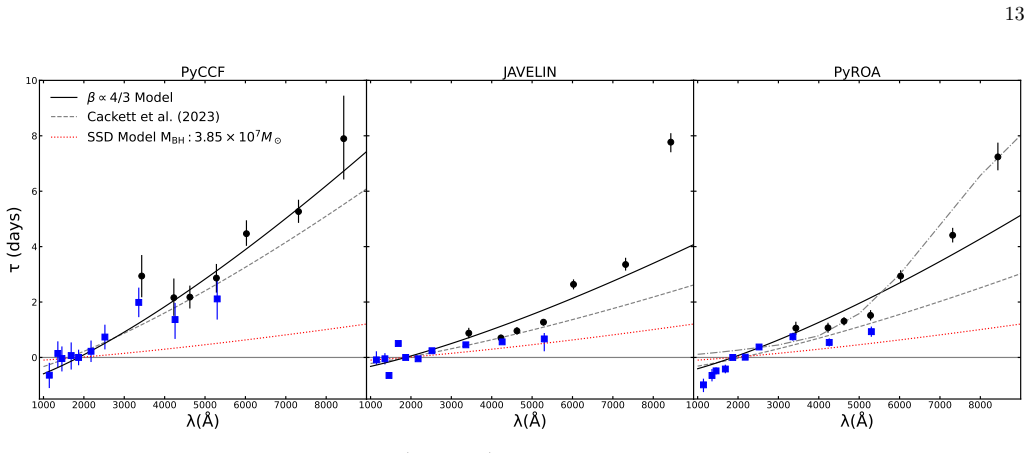
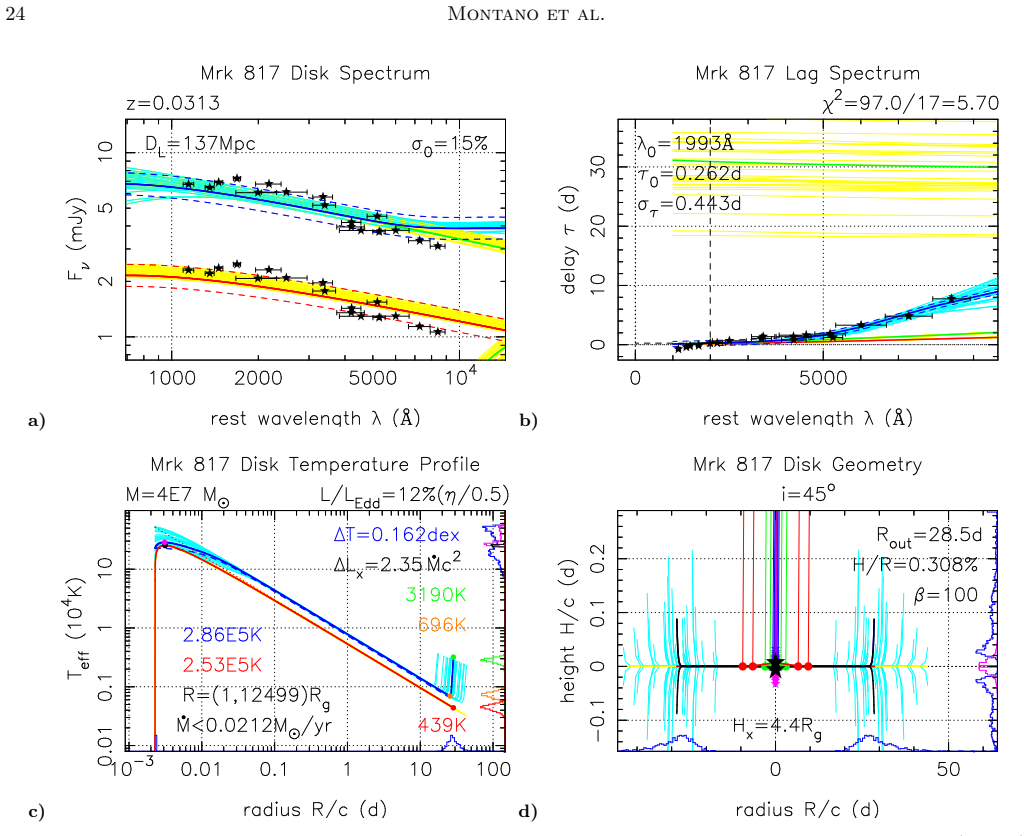
Ground-based uBgVriz photometry of Mrk 817 over 1.4 years produces ICCF centroid lags ranging from 3.0 plus or minus 0.8 days in the u band to 7.9 plus or minus 1.5 days in the z band. These lags are consistent with a tau proportional to lambda to the four-thirds power law expected for reprocessing by a thin accretion disk under lamp-post illumination. The lags exceed thin-disk reprocessing predictions by factors of three to six and vary by up to a factor of two between three epochs that differ in ionizing luminosity and obscuring column. The longest lags occur during the brightest and bluest portion of the campaign, suggesting that changes in ionizing luminosity alter the diffuse continuum,
What carries the argument
ICCF centroid lag measurements across optical bands, tested for consistency with the tau proportional to lambda to the four-thirds scaling from Shakura-Sunyaev thin-disk reprocessing.
If this is right
- The observed wavelength dependence supports the basic lamp-post reprocessing geometry on a standard thin disk.
- The factor-of-three-to-six excess over thin-disk predictions requires additional reprocessing sites such as diffuse continuum from the broad-line region.
- Lag variations of up to a factor of two between epochs show that the effective reprocessing radius responds to changes in ionizing luminosity on timescales of months.
- Alternative lag estimators produce shorter values that deviate from the four-thirds power law at the longest wavelengths.
Where Pith is reading between the lines
- Monitoring campaigns that track lag changes with luminosity state could separate disk reprocessing from broad-line region contributions in other AGN.
- The universal disk-size discrepancy seen across Seyferts may be resolved by incorporating time-variable broad-line region emission into reprocessing models.
- High-cadence multi-epoch observations could map how obscuring outflows modulate the observed continuum lags.
Load-bearing premise
The Swift UVW2 band supplies an uncontaminated reference light curve whose variations are driven solely by the central engine.
What would settle it
An independent size measurement of the Mrk 817 accretion disk, for example via microlensing, that matches thin-disk predictions instead of the larger reverberation lags reported here.
Figures





read the original abstract
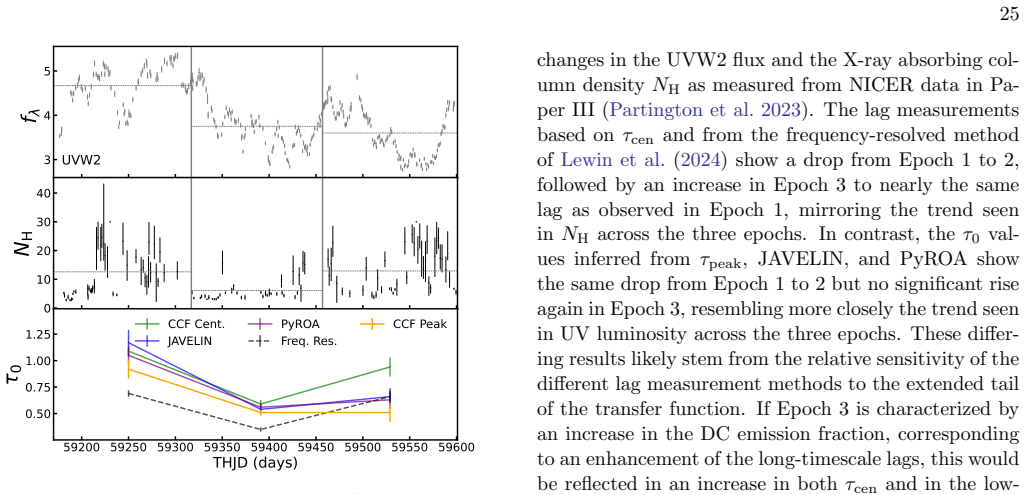
We present the ground-based imaging campaign and light curves of Markarian 817 as part of the multiwavelength monitoring program AGN STORM\,2. Observations were carried out over 1.4 years in \emph{uBgVriz} filters, with a median cadence of 0.4 days in \emph{g}. Reverberation lags are measured using three methods (ICCF, JAVELIN, and PyROA) with the Swift UVW2 band (1928 \AA) as the reference light curve. The ICCF centroid lags range from $3.0\pm0.8$ days for the $u$ band up to $7.9\pm1.5$ days for $z$, and are consistent with a $\tau\propto \lambda^{4/3}$ dependence, the relation expected for lamp-post reprocessing by a Shakura-Sunyaev disk. Lags measured with the other methods are systematically shorter, and deviate from a $\lambda^{4/3}$ power-law spectrum at long wavelengths. The lags exceed thin-disk reprocessing predictions by factors of $\sim$3-6, similar to the ``disk size discrepancy'' seen in other Seyfert galaxies. We divide the campaign into three epochs with different levels of mean luminosity and X-ray obscuring column density and find that the lags vary by as much as a factor of 2 between epochs. The intrinsic spectral energy distribution is bluer and brighter during the first third of the campaign, and the longest continuum reverberation lags are obtained during that period. These results suggest that changes in ionizing luminosity can produce large variations in continuum lags on short timescales by altering the diffuse continuum luminosity emitted by the broad-line region and/or obscuring outflow, although changes in obscuration between the central engine and broad-line region may also contribute to the lag variations.
Editorial analysis
A structured set of objections, weighed in public.
Referee Report
Summary. The paper presents 1.4-year ground-based uBgVriz photometry of Mrk 817 (median 0.4 d cadence in g) from the AGN STORM 2 campaign. Continuum reverberation lags are measured against the Swift UVW2 reference using ICCF, JAVELIN, and PyROA. ICCF centroid lags range from 3.0±0.8 d (u) to 7.9±1.5 d (z), follow τ∝λ^{4/3}, exceed thin-disk predictions by factors of 3–6, and vary by up to a factor of ~2 across three epochs split by mean luminosity and X-ray column density. The authors interpret the epoch variations as evidence that changes in ionizing luminosity alter BLR diffuse continuum or obscuration contributions to the lags.
Significance. If the epoch-dependent lag variations prove robust after accounting for reference-band systematics, the result would strengthen the case that continuum lags are not static but respond to changes in the ionizing continuum on month-long timescales. This directly addresses the disk-size discrepancy and the possible role of BLR diffuse continuum, providing an observational test that is currently rare in the literature.
major comments (2)
- [Abstract and epoch-division analysis] The central claim that ICCF lags vary by a factor of ~2 between the three epochs (longest in the first, brighter/bluer segment) rests on the assumption that the Swift UVW2 (1928 Å) light curve is an uncontaminated continuum reference. The manuscript itself invokes variable BLR diffuse continuum to explain the overall 3–6× size excess; if this component leaks into UVW2 at a luminosity-dependent level, the reported epoch differences could be partly artifactual. A quantitative test (e.g., lag recovery with an alternative reference band or simulated contamination) is needed in the epoch-analysis section.
- [Lag measurement and comparison subsection] ICCF lags are reported to follow the expected τ∝λ^{4/3} power law, while JAVELIN and PyROA lags are systematically shorter and deviate from the power law at long wavelengths. Because the headline interpretation of both the size discrepancy and the epoch variations relies on the ICCF results, the manuscript should explicitly justify the preference for ICCF or demonstrate that the method dependence does not undermine the λ^{4/3} and epoch-variation conclusions.
minor comments (2)
- [Figures showing light curves] The light-curve figures would be clearer if the three epoch boundaries were marked directly on the panels, together with the mean luminosity and column-density values used to define them.
- [Lag measurement methods] The error budget on the ICCF centroid lags should include an explicit statement of how the choice of interpolation and the number of Monte Carlo realizations affect the quoted uncertainties.
Simulated Author's Rebuttal
We thank the referee for the constructive and detailed comments on our manuscript. These have helped us clarify the robustness of our epoch-dependent results and the rationale for emphasizing the ICCF measurements. We address each major comment below and have revised the manuscript accordingly to incorporate additional tests and discussion.
read point-by-point responses
-
Referee: [Abstract and epoch-division analysis] The central claim that ICCF lags vary by a factor of ~2 between the three epochs (longest in the first, brighter/bluer segment) rests on the assumption that the Swift UVW2 (1928 Å) light curve is an uncontaminated continuum reference. The manuscript itself invokes variable BLR diffuse continuum to explain the overall 3–6× size excess; if this component leaks into UVW2 at a luminosity-dependent level, the reported epoch differences could be partly artifactual. A quantitative test (e.g., lag recovery with an alternative reference band or simulated contamination) is needed in the epoch-analysis section.
Authors: We agree that potential BLR diffuse continuum leakage into the UVW2 reference band represents a legitimate concern, particularly since we invoke this component to explain the overall lag excess relative to thin-disk models. However, the epoch divisions are defined independently using the observed X-ray column density and mean optical luminosity, which are not derived from the UVW2 light curve. In the revised manuscript we have added a quantitative test in the epoch-analysis section: we recompute the ICCF lags for each epoch using the ground-based u-band light curve as the reference instead of UVW2. The factor-of-two variations remain, with the longest lags still occurring in the first (brighter) epoch. We have also included a short Monte Carlo simulation of luminosity-dependent contamination to demonstrate that unrealistically large variations in the diffuse continuum fraction would be required to erase the observed differences. These additions are now presented in Section 4.3 with an expanded discussion of the associated caveats. revision: yes
-
Referee: [Lag measurement and comparison subsection] ICCF lags are reported to follow the expected τ∝λ^{4/3} power law, while JAVELIN and PyROA lags are systematically shorter and deviate from the power law at long wavelengths. Because the headline interpretation of both the size discrepancy and the epoch variations relies on the ICCF results, the manuscript should explicitly justify the preference for ICCF or demonstrate that the method dependence does not undermine the λ^{4/3} and epoch-variation conclusions.
Authors: We have expanded the lag-measurement subsection to provide an explicit justification for emphasizing the ICCF results while still presenting all three methods. ICCF is a non-parametric cross-correlation approach that does not presuppose a particular transfer-function shape, whereas JAVELIN assumes a top-hat response and PyROA employs a specific Gaussian-process kernel; these modeling assumptions can suppress long-wavelength lags and introduce deviations from λ^{4/3}. In the revised text we now demonstrate that the primary scientific conclusions are not undermined by method choice: all three techniques recover lags that exceed thin-disk predictions by factors of 3–6, and the relative epoch-to-epoch variations (longer lags in the brighter first epoch) are qualitatively recovered by JAVELIN and PyROA, albeit with larger uncertainties. We have added a supplementary figure that overlays the epoch-dependent lags from all methods to illustrate this consistency. The λ^{4/3} trend is most clearly recovered by ICCF, which is why we retain it as the headline result, but the revised discussion makes clear that the size discrepancy and variability conclusions hold across methods. revision: yes
Circularity Check
No circularity; purely observational lag measurements
full rationale
The paper reports direct measurements of reverberation lags via ICCF, JAVELIN, and PyROA cross-correlations between ground-based uBgVriz light curves and the Swift UVW2 reference. These are computed from the observed photometry with no derivation chain that reduces to a fitted parameter or self-referential input by construction. The noted consistency with a τ∝λ^{4/3} relation is a post-measurement comparison to an external thin-disk expectation, not a derived result. Epoch divisions are defined from observed mean luminosity and X-ray column; the factor-of-2 lag variations are reported as measured differences. No self-citations, ansatzes, or uniqueness theorems are invoked as load-bearing steps for the central claims. The work is self-contained observational analysis against external benchmarks.
Axiom & Free-Parameter Ledger
axioms (2)
- domain assumption Reverberation lags trace light-travel time from the central engine to reprocessing regions
- standard math Thin-disk reprocessing predicts τ ∝ λ^{4/3}
Reference graph
Works this paper leans on
-
[1]
Astropy Collaboration, Robitaille, T. P., Tollerud, E. J., et al. 2013, A&A, 558, A33, doi: 10.1051/0004-6361/201322068 Astropy Collaboration, Price-Whelan, A. M., Sip˝ ocz, B. M., et al. 2018, AJ, 156, 123, doi: 10.3847/1538-3881/aabc4f Astropy Collaboration, Price-Whelan, A. M., Lim, P. L., et al. 2022, ApJ, 935, 167, doi: 10.3847/1538-4357/ac7c74
-
[2]
Bentz, M. C., & Katz, S. 2015, PASP, 127, 67, doi: 10.1086/679601
-
[3]
2009, ApJ, 697, 160, doi: 10.1088/0004-637X/697/1/160
Vestergaard, M. 2009, ApJ, 697, 160, doi: 10.1088/0004-637X/697/1/160
-
[4]
Bentz, M. C., Denney, K. D., Grier, C. J., et al. 2013, ApJ, 767, 149, doi: 10.1088/0004-637X/767/2/149
-
[5]
S., Castelli, F., & Plez, B
Bessell, M. S., Castelli, F., & Plez, B. 1998, A&A, 333, 231
1998
-
[6]
A., Pooley, D., Rappaport, S., & Schechter, P
Blackburne, J. A., Pooley, D., Rappaport, S., & Schechter, P. L. 2011, ApJ, 729, 34, doi: 10.1088/0004-637X/729/1/34
-
[7]
Blandford, R. D., & McKee, C. F. 1982, ApJ, 255, 419, doi: 10.1086/159843
-
[8]
2008, Ap&SS, 314, 163, doi: 10.1007/s10509-008-9752-4
Brosch, N., Polishook, D., Shporer, A., et al. 2008, Ap&SS, 314, 163, doi: 10.1007/s10509-008-9752-4
-
[9]
Brown, T. M., Baliber, N., Bianco, F. B., et al. 2013, PASP, 125, 1031, doi: 10.1086/673168
-
[10]
2003, MNRAS, 340, 1214, doi: 10.1046/j.1365-8711.2003.06380.x
Bruzual, G., & Charlot, S. 2003, MNRAS, 344, 1000, doi: 10.1046/j.1365-8711.2003.06897.x
-
[11]
Cackett, E. M., Bentz, M. C., & Kara, E. 2021, iScience, 24, 102557, doi: https://doi.org/10.1016/j.isci.2021.102557
-
[12]
M., Chiang, C.-Y., McHardy, I., et al
Cackett, E. M., Chiang, C.-Y., McHardy, I., et al. 2018, ApJ, 857, 53, doi: 10.3847/1538-4357/aab4f7
-
[13]
Cackett, E. M., Horne, K., & Winkler, H. 2007, MNRAS, 380, 669, doi: 10.1111/j.1365-2966.2007.12098.x
-
[14]
M., Gelbord, J., Li, Y.-R., et al
Cackett, E. M., Gelbord, J., Li, Y.-R., et al. 2020a, ApJ, 896, 1, doi: 10.3847/1538-4357/ab91b5 —. 2020b, ApJ, 896, 1, doi: 10.3847/1538-4357/ab91b5
-
[15]
Cackett, E. M., Gelbord, J., Barth, A. J., et al. 2023, ApJ, 958, 195, doi: 10.3847/1538-4357/acfdac
-
[16]
2024, Universe, 10, 282, doi: 10.3390/universe10070282
Cai, M., Wan, Z., Cai, Z., Fan, L., & Wang, J. 2024, Universe, 10, 282, doi: 10.3390/universe10070282
-
[17]
2018, ApJ, 855, 117, doi: 10.3847/1538-4357/aab091
Cai, Z.-Y., Wang, J.-X., Zhu, F.-F., et al. 2018, ApJ, 855, 117, doi: 10.3847/1538-4357/aab091
-
[18]
Cardelli, J. A., Clayton, G. C., & Mathis, J. S. 1989, ApJ, 345, 245, doi: 10.1086/167900
-
[19]
2022, PASP, 134, 045002, doi: 10.1088/1538-3873/ac5b87
Carr, R., Cinabro, D., Cackett, E., Moutard, D., & Carroll, R. 2022, PASP, 134, 045002, doi: 10.1088/1538-3873/ac5b87
-
[20]
2019, Nature Astronomy, 3, 251, doi: 10.1038/s41550-018-0659-x
Chelouche, D., Pozo Nu˜ nez, F., & Kaspi, S. 2019, Nature Astronomy, 3, 251, doi: 10.1038/s41550-018-0659-x
-
[21]
Collier, S., Horne, K., Wanders, I., & Peterson, B. M. 1999, MNRAS, 302, L24, doi: 10.1046/j.1365-8711.1999.02250.x
-
[22]
2017, ApJ, 846, 154, doi: 10.3847/1538-4357/aa8810
Czerny, B., Li, Y.-R., Hryniewicz, K., et al. 2017, ApJ, 846, 154, doi: 10.3847/1538-4357/aa8810
-
[23]
Czesla, S., Schr¨ oter, S., Schneider, C. P., et al. 2019, PyA: Python astronomy-related packages. http://ascl.net/1906.010 De Rosa, G., Peterson, B. M., Ely, J., et al. 2015, ApJ, 806, 128, doi: 10.1088/0004-637X/806/1/128
-
[24]
R., Horne, K., & Hern´ andez Santisteban, J
Donnan, F. R., Horne, K., & Hern´ andez Santisteban, J. V. 2021, MNRAS, 508, 5449, doi: 10.1093/mnras/stab2832
-
[25]
Edelson, R., Gelbord, J. M., Horne, K., et al. 2015, ApJ, 806, 129, doi: 10.1088/0004-637X/806/1/129
-
[26]
Edelson, R., Gelbord, J., Cackett, E., et al. 2019, ApJ, 870, 123, doi: 10.3847/1538-4357/aaf3b4
-
[27]
Fausnaugh, M. M., Denney, K. D., Barth, A. J., et al. 2016, ApJ, 821, 56, doi: 10.3847/0004-637X/821/1/56
-
[28]
Fukugita, M., Ichikawa, T., Gunn, J. E., et al. 1996, AJ, 111, 1748, doi: 10.1086/117915
-
[29]
2017, MNRAS, 470, 3591, doi: 10.1093/mnras/stx946
Gardner, E., & Done, C. 2017, MNRAS, 470, 3591, doi: 10.1093/mnras/stx946
-
[30]
Gaskell, C. M. 2024, Astronomical and Astrophysical Transactions, 34, 221, doi: 10.48550/arXiv.2501.12757
-
[31]
Gaskell, C. M., & Peterson, B. M. 1987, ApJS, 65, 1, doi: 10.1086/191216
-
[32]
Gonzalez-Buitrago, D., Barth, A. J., Edelson, R., et al. 2025, Departures from Standard Disk Predictions in Intensive Ground-Based Monitoring of Three AGN. https://arxiv.org/abs/2508.08720
-
[33]
Guo, H., Barth, A. J., & Wang, S. 2022, ApJ, 940, 20, doi: 10.3847/1538-4357/ac96ec
-
[34]
Guo, W.-J., Li, Y.-R., Zhang, Z.-X., Ho, L. C., & Wang, J.-M. 2022, ApJ, 929, 19, doi: 10.3847/1538-4357/ac4e84
-
[35]
Monthly Notices of the Royal Astronomical Society , author =
Hagen, S., Done, C., & Edelson, R. 2024, MNRAS, 530, 4850, doi: 10.1093/mnras/stae1177
-
[36]
Hall, P. B., Sarrouh, G. T., & Horne, K. 2018, ApJ, 854, 93, doi: 10.3847/1538-4357/aaa768
-
[37]
Heckman, T. M., & Best, P. N. 2014, ARA&A, 52, 589, doi: 10.1146/annurev-astro-081913-035722
work page internal anchor Pith review doi:10.1146/annurev-astro-081913-035722 2014
-
[38]
A., Levine, S., Terrell, D., et al
Henden, A. A., Levine, S., Terrell, D., et al. 2018, in American Astronomical Society Meeting Abstracts, Vol. 232, American Astronomical Society Meeting Abstracts #232, 223.06 Hern´ andez Santisteban, J. V., Edelson, R., Horne, K., et al. 2020, MNRAS, 498, 5399, doi: 10.1093/mnras/staa2365
-
[39]
Homayouni, Y., Sturm, M. R., Trump, J. R., et al. 2022, ApJ, 926, 225, doi: 10.3847/1538-4357/ac478b
-
[40]
Homayouni, Y., Rosa, G. D., Plesha, R., et al. 2023, ApJ, 948, 85, doi: 10.3847/1538-4357/acc45a 32Montano et al
-
[41]
Homayouni, Y., Kriss, G. A., De Rosa, G., et al. 2024, ApJ, 963, 123, doi: 10.3847/1538-4357/ad1be4
-
[42]
Horne, K., De Rosa, G., Peterson, B. M., et al. 2021, ApJ, 907, 76, doi: 10.3847/1538-4357/abce60
-
[43]
Hunter, J. D. 2007, Computing in Science & Engineering, 9, 90, doi: 10.1109/MCSE.2007.55 H¨ onig, S. F. 2014, ApJL, 784, L4, doi: 10.1088/2041-8205/784/1/L4
-
[44]
K., Joshi, R., Chand, H., et al
Jha, V. K., Joshi, R., Chand, H., et al. 2022, MNRAS, 511, 3005, doi: 10.1093/mnras/stac109
-
[45]
Jiang, Y.-F., Green, P. J., Greene, J. E., et al. 2017, ApJ, 836, 186, doi: 10.3847/1538-4357/aa5b91
-
[46]
S., Dovˇ ciak, M., Papadakis, I
Kammoun, E. S., Dovˇ ciak, M., Papadakis, I. E., Caballero-Garc´ ıa, M. D., & Karas, V. 2021, ApJ, 907, 20, doi: 10.3847/1538-4357/abcb93
-
[47]
Kara, E., Mehdipour, M., Kriss, G. A., et al. 2021, ApJ, 922, 151, doi: 10.3847/1538-4357/ac2159
-
[48]
Kara, E., Barth, A. J., Cackett, E. M., et al. 2023, ApJ, 947, 62, doi: 10.3847/1538-4357/acbcd3
-
[49]
Korista, K. T., & Goad, M. R. 2001, ApJ, 553, 695, doi: 10.1086/320964
-
[50]
Korista, K. T., & Goad, M. R. 2019, MNRAS, 489, 5284, doi: 10.1093/mnras/stz2330
-
[51]
Kormendy, J., & Ho, L. C. 2013, ARA&A, 51, 511, doi: 10.1146/annurev-astro-082708-101811
work page Pith review doi:10.1146/annurev-astro-082708-101811 2013
-
[52]
Landt, H., Boizelle, B. D., Brotherton, M. S., et al. 2026, ApJ, 997, 22, doi: 10.3847/1538-4357/ae17cd
-
[53]
W., Mierle, K., Blanton, M., & Roweis, S
Lang, D., Hogg, D. W., Mierle, K., Blanton, M., & Roweis, S. 2010, AJ, 139, 1782, doi: 10.1088/0004-6256/139/5/1782
-
[54]
Vestergaard, M. 2018, MNRAS, 481, 533, doi: 10.1093/mnras/sty2242
-
[55]
Lewin, C., Kara, E., Barth, A. J., et al. 2024, ApJ, 974, 271, doi: 10.3847/1538-4357/ad6b08
-
[56]
2014, ApJL, 786, L6, doi: 10.1088/2041-8205/786/1/L6
Li, Y.-R., Wang, J.-M., Hu, C., Du, P., & Bai, J.-M. 2014, ApJL, 786, L6, doi: 10.1088/2041-8205/786/1/L6
-
[57]
Liu, T., Edelson, R., Santisteban, J. V. H., et al. 2024, ApJ, 964, 167, doi: 10.3847/1538-4357/ad23e2
-
[58]
2018, LCOGT/banzai: Initial Release, 0.9.4, Zenodo
McCully, C., Turner, M., Volgenau, N., et al. 2018, LCOGT/banzai: Initial Release, 0.9.4, Zenodo
2018
-
[59]
Miller, J. A., Cackett, E. M., Bentz, M. C., et al. 2026, ApJ, 997, 62, doi: 10.3847/1538-4357/ae1c44
-
[60]
Montano, J. W., Guo, H., Barth, A. J., et al. 2022, ApJ, 934, L37, doi: 10.3847/2041-8213/ac7e54
-
[61]
Morales, A. M., Miller, J. M., Cackett, E. M., Reynolds, M. T., & Zoghbi, A. 2019, ApJ, 870, 54, doi: 10.3847/1538-4357/aaeff9
-
[62]
The Astrophysical Journal , author =
Morgan, C. W., Kochanek, C. S., Morgan, N. D., & Falco, E. E. 2010, ApJ, 712, 1129, doi: 10.1088/0004-637X/712/2/1129
-
[63]
2018, ApJ, 862, 123, doi: 10.3847/1538-4357/aac9bb
Mudd, D., Martini, P., Zu, Y., et al. 2018, ApJ, 862, 123, doi: 10.3847/1538-4357/aac9bb
-
[64]
2020, in Ground-based and Airborne Instrumentation for Astronomy VIII, ed
Narita, N., Fukui, A., Yamamuro, T., et al. 2020, in Ground-based and Airborne Instrumentation for Astronomy VIII, ed. C. J. Evans, J. J. Bryant, & K. Motohara, Vol. 11447, International Society for Optics and Photonics (SPIE), 1199 – 1205, doi: 10.1117/12.2559947
-
[65]
2022, MNRAS, 509, 2637, doi: 10.1093/mnras/stab3133 —
Netzer, H. 2022, MNRAS, 509, 2637, doi: 10.1093/mnras/stab3133 —. 2025, MNRAS, 539, 3242, doi: 10.1093/mnras/staf671
-
[66]
Netzer, H., Goad, M. R., Barth, A. J., et al. 2024, ApJ, 976, 59, doi: 10.3847/1538-4357/ad8160
-
[67]
Neustadt, J. M. M., Kochanek, C. S., Montano, J., et al. 2024, ApJ, 961, 219, doi: 10.3847/1538-4357/ad1386
-
[68]
2023, lmfit/lmfit-py: 1.2.2, 1.2.2, Zenodo, doi: 10.5281/zenodo.8145703
Newville, M., Otten, R., Nelson, A., et al. 2023, lmfit/lmfit-py: 1.2.2, 1.2.2, Zenodo, doi: 10.5281/zenodo.8145703
-
[69]
The Astrophysical Journal , author =
Onken, C. A., Ferrarese, L., Merritt, D., et al. 2004, ApJ, 615, 645, doi: 10.1086/424655
-
[70]
The Astrophysical Journal , author =
Panagiotou, C., Kara, E., & Dovˇ ciak, M. 2022, ApJ, 941, 57, doi: 10.3847/1538-4357/aca2a4
-
[71]
Partington, E. R., Cackett, E. M., Kara, E., et al. 2023, ApJ, 947, 2, doi: 10.3847/1538-4357/acbf44
-
[72]
Pei, L., Barth, A. J., Aldering, G. S., et al. 2014, ApJ, 795, 38, doi: 10.1088/0004-637X/795/1/38
-
[73]
Peterson, B. M. 1993, PASP, 105, 247, doi: 10.1086/133140
-
[74]
Peterson, B. M., Wanders, I., Horne, K., et al. 1998, PASP, 110, 660, doi: 10.1086/316177
-
[75]
Peterson, B. M., Ferrarese, L., Gilbert, K. M., et al. 2004, ApJ, 613, 682, doi: 10.1086/423269
-
[76]
Prince, R., Hern´ andez Santisteban, J. V., Horne, K., et al. 2025, MNRAS, 541, 642, doi: 10.1093/mnras/staf983
-
[77]
Secunda, A., Jiang, Y.-F., & Greene, J. E. 2024, ApJL, 965, L29, doi: 10.3847/2041-8213/ad34b0
-
[78]
Merkulova, N. I., & Sergeeva, E. A. 2005, ApJ, 622, 129, doi: 10.1086/427820
-
[79]
I., & Sunyaev, R
Shakura, N. I., & Sunyaev, R. A. 1973, A&A, 24, 337
1973
-
[80]
Slone, O., & Netzer, H. 2012, MNRAS, 426, 656, doi: 10.1111/j.1365-2966.2012.21699.x
discussion (0)
Sign in with ORCID, Apple, or X to comment. Anyone can read and Pith papers without signing in.