Recognition: no theorem link
Agentic AI-Based Joint Computing and Networking via Mixture of Experts and Large Language Models
Pith reviewed 2026-05-10 18:56 UTC · model grok-4.3
The pith
An LLM dynamically composes optimization experts from a library to reach near-optimal performance in joint computing and networking.
A machine-rendered reading of the paper's core claim, the machinery that carries it, and where it could break.
Core claim
The central claim is that an LLM can act as a semantic gate to reason over operator objectives and uncertainty descriptions, dynamically composing suitable optimization agents from a library of experts, thereby bridging human-readable network intents with low-level resource allocation decisions in a model-agnostic manner. In the representative case of a joint communication and computing network, this produces near-optimal results across throughput, fairness, and delay-driven objectives under both regular and robust conditions.
What carries the argument
The LLM semantic gate, which interprets high-level intents to select and orchestrate agents from a library of specialized optimization experts covering throughput, fairness, delay, and robust variants.
If this is right
- The framework applies to any collection of optimization experts without requiring changes to the underlying solvers.
- Performance stays near the exhaustive optimum while exceeding any individual expert across multiple objectives.
- Human-readable intents can be directly translated into low-level allocation decisions for heterogeneous network conditions.
- The same structure supports both regular and robust optimization variants within one library.
Where Pith is reading between the lines
- The approach could lower the need to run every expert in parallel by using the LLM to prune the set in advance.
- Adding more experts to the library would let the same gate handle additional objectives such as energy efficiency without redesigning the reasoning step.
- If the LLM reasoning step is made more robust to edge-case intents, the framework could extend to multi-objective trade-offs that current fixed solvers handle poorly.
Load-bearing premise
The large language model can reliably interpret operator objectives and uncertainty descriptions to select and combine the right experts without introducing errors or suboptimal choices.
What would settle it
A test case in which the LLM selects a combination of experts that yields worse delay or lower throughput than the single best expert or the exhaustive best combination would show the dynamic composition does not work as claimed.
Figures



read the original abstract
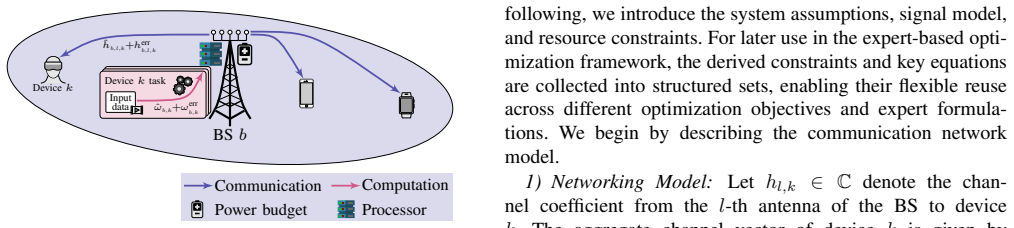
Future sixth-generation (6G) mobile networks are envisioned to be equipped with a diverse set of powerful, yet highly specialized, optimization experts. Such a promising vision is concurrently expected to give rise to the need for scalable mechanisms that can select, combine, and orchestrate such experts based on high-level intent and uncertainty descriptions. In this paper, we propose an agentic artificial intelligence (AI)-based network optimization framework that integrates mixture of experts (MoE) architectures with large language models (LLMs). Under the proposed framework, the employed LLM acts as a semantic gate to reason over operator objectives and dynamically compose suitable optimization agents. The proposed framework is formulated in a model-agnostic manner and bridges human-readable network intents with low-level resource allocation decisions, enabling flexible optimization across heterogeneous objectives and operating conditions. As a representative instantiation, we apply the framework to a joint communication and computing network and design a library of specialized optimization experts covering throughput, fairness, and delay-driven objectives under both regular and robust conditions. Numerical simulations demonstrate that the proposed agentic MoE framework consistently achieves near-optimal performance compared to exhaustive expert combinations while outperforming individual experts across diverse objectives, including delay minimization and throughput maximization.
Editorial analysis
A structured set of objections, weighed in public.
Referee Report
Summary. The paper proposes an agentic AI framework for 6G joint communication and computing optimization that integrates mixture-of-experts (MoE) architectures with large language models (LLMs). The LLM functions as a model-agnostic semantic gate that reasons over high-level operator intents and uncertainty descriptions to dynamically select and compose specialized optimization agents (experts) covering objectives such as throughput maximization, fairness, and delay minimization under both nominal and robust conditions. The central claim is that numerical simulations demonstrate the resulting agentic MoE framework achieves near-optimal performance relative to exhaustive expert combinations while outperforming any single expert across the tested objectives.
Significance. If the reported simulation outcomes prove reproducible and the LLM composition step remains reliable under realistic prompt and uncertainty variation, the framework could offer a practical bridge between human-readable network intents and low-level resource allocation in heterogeneous 6G settings. The model-agnostic formulation is a positive feature that could allow reuse with different expert libraries. However, the absence of any closed-form derivation or machine-checked component means the contribution rests entirely on empirical demonstration.
major comments (2)
- [§5] §5: The headline performance claims (near-optimal versus exhaustive combinations, consistent outperformance of individual experts on delay and throughput) are supported only by end-to-end metrics whose simulation parameters, network topology, baseline algorithms, exact quantitative metrics, number of Monte-Carlo runs, error bars, and data-exclusion criteria are not reported. Because these results constitute the sole evidence for the central claim, the lack of detail renders the claims unverifiable.
- [§3] §3: The LLM is formulated as a reliable semantic gate that maps intents and uncertainty descriptions to expert subsets without introducing selection errors. No ablation, prompt-variation test, or substitution of a weaker LLM is presented to quantify how often suboptimal subsets are chosen or how sensitive the observed performance gap is to this step. This assumption is load-bearing for the reported advantage over individual experts.
minor comments (1)
- The manuscript would benefit from a single figure or pseudocode block that explicitly shows the information flow from operator intent through the LLM gate to the selected expert subset and final resource allocation.
Simulated Author's Rebuttal
We thank the referee for the detailed and constructive review. The comments highlight important aspects of reproducibility and validation that we will address in the revision. Below we respond point by point to the major comments.
read point-by-point responses
-
Referee: [§5] §5: The headline performance claims (near-optimal versus exhaustive combinations, consistent outperformance of individual experts on delay and throughput) are supported only by end-to-end metrics whose simulation parameters, network topology, baseline algorithms, exact quantitative metrics, number of Monte-Carlo runs, error bars, and data-exclusion criteria are not reported. Because these results constitute the sole evidence for the central claim, the lack of detail renders the claims unverifiable.
Authors: We agree that the simulation details provided in the original manuscript are insufficient for full reproducibility and verification. In the revised version we will expand Section 5 (and the associated appendix) to include a complete description of the simulation parameters, network topology, baseline algorithms, exact quantitative metrics, number of Monte-Carlo runs, error bars, and any data-exclusion criteria used to generate the reported results. revision: yes
-
Referee: [§3] §3: The LLM is formulated as a reliable semantic gate that maps intents and uncertainty descriptions to expert subsets without introducing selection errors. No ablation, prompt-variation test, or substitution of a weaker LLM is presented to quantify how often suboptimal subsets are chosen or how sensitive the observed performance gap is to this step. This assumption is load-bearing for the reported advantage over individual experts.
Authors: We acknowledge that the manuscript does not contain ablations or sensitivity analyses on the LLM-based selection step. To address this, the revised manuscript will include new experiments that (i) vary prompt phrasing and uncertainty descriptions, (ii) substitute a weaker LLM, and (iii) report the frequency of suboptimal expert selections together with the resulting performance degradation. These additions will quantify the robustness of the semantic-gate assumption. revision: yes
Circularity Check
No circularity: framework proposal and simulation claims are self-contained
full rationale
The paper proposes an agentic MoE+LLM framework for 6G network optimization, formulates the LLM as a model-agnostic semantic gate mapping intents to expert subsets, instantiates a library of optimization experts for throughput/fairness/delay objectives, and reports numerical simulation results showing near-optimal performance versus exhaustive combinations. No equations, closed-form derivations, or parameter-fitting steps appear that reduce any claimed prediction to its own inputs by construction. Performance claims rest on end-to-end simulations rather than analytical reductions or self-citation chains; the central premise (LLM-driven composition) is presented as an architectural choice validated externally by simulation outcomes, not derived from itself. This satisfies the default expectation of no significant circularity.
Axiom & Free-Parameter Ledger
Reference graph
Works this paper leans on
-
[1]
TelecomGPT: A framework to build telecom-specific large language models,
H. Zou, Q. Zhao, Y . Tian, L. Bariah, F. Bader, T. Lestable, and M. Debbah, “TelecomGPT: A framework to build telecom-specific large language models,”IEEE Transactions on Machine Learning in Communications and Networking, vol. 3, pp. 948–975, 2025
2025
-
[2]
MX-AI: Agentic observ- ability and control platform for open and AI-RAN,
I. Chatzistefanidis, A. Leone, A. Yaghoubian, M. Irazabal, S. Nassim, L. Bariah, M. Debbah, and N. Nikaein, “MX-AI: Agentic observ- ability and control platform for open and AI-RAN,”arXiv preprint arXiv:2508.09197, 2025
-
[3]
A vision of 6G wireless systems: Applications, trends, technologies, and open research problems,
W. Saad, M. Bennis, and M. Chen, “A vision of 6G wireless systems: Applications, trends, technologies, and open research problems,”IEEE Network, vol. 34, no. 3, pp. 134–142, 2020. TABLE IX: Excerpt of the system promptQ sys used for the LLM-enabled gate network. General setup You are a helpful assistant that receive requests in natural language and then, ...
2020
-
[4]
Communication throughput focused
Comm SumR Reg: Expert for maximization of sum- communication-rates of all users in network. Communication throughput focused. Optimized solution accounts for regular conditions, with accurate channel estimations and perfectly known channel state information. [ . . . ] Tool setup The available tools for the router are listed below: infer expert with params...
-
[5]
Combining federated learning and edge computing toward ubiquitous intelligence in 6G network: Challenges, recent advances, and future directions,
Q. Duan, J. Huang, S. Hu, R. Deng, Z. Lu, and S. Yu, “Combining federated learning and edge computing toward ubiquitous intelligence in 6G network: Challenges, recent advances, and future directions,”IEEE Communications Surveys & Tutorials, vol. 25, no. 4, pp. 2892–2950, 2023
2023
-
[6]
5G networks evolution for extended reality,
A. Cedergren, F. de Laval, S. Falahati, L. Falk, D. H. Kang, R. S. Karlsson, Y . Lyazidi, A. Mirzaei, J. Olsson, J. L. Pradas, P. Schliwa- Bertling, N. Shi, B. Singh, R. Tano, and A. M. V oicu, “5G networks evolution for extended reality,”IIEEE Commun. Stand. Mag., vol. 8, no. 3, pp. 54–59, 2024
2024
-
[7]
The roadmap to 6G: AI empowered wireless networks,
K. B. Letaief, W. Chen, Y . Shi, J. Zhang, and Y .-J. A. Zhang, “The roadmap to 6G: AI empowered wireless networks,”IEEE Communica- tions Magazine, vol. 57, no. 8, pp. 84–90, 2019
2019
-
[8]
Uncertainty injection: A deep learning method for robust optimization,
W. Cui and W. Yu, “Uncertainty injection: A deep learning method for robust optimization,”IEEE Transactions on Wireless Communications, vol. 22, no. 11, pp. 7201–7213, 2023
2023
-
[9]
Robust communication and computation using deep learning via joint uncertainty injection,
R.-J. Reifert, H. Dahrouj, A. Alameer Ahmad, H. Gacanin, and A. Sez- gin, “Robust communication and computation using deep learning via joint uncertainty injection,” inProc. ISWCS, 2024, pp. 1–6
2024
-
[10]
Agentic AI for 6G: A New Paradigm for Autonomous RAN Security Compliance
S. Chatzimiltis, M. B. Mashhadi, M. Shojafar, M. Debbah, and R. Tafa- zolli, “Agentic AI for 6G: A new paradigm for autonomous RAN security compliance,”arXiv preprint arXiv:2512.12400, 2025
work page internal anchor Pith review Pith/arXiv arXiv 2025
-
[11]
A-core: A novel framework of agentic AI in the 6G core network,
W. Tong, W. Huo, T. Lejkin, J. Penhoat, C. Peng, C. Pereira, F. Wang, S. Wu, L. Yang, and Y . Shi, “A-core: A novel framework of agentic AI in the 6G core network,” inin Prof. IEEE ICC Workshops, 2025, pp. 1104–1109
2025
-
[12]
Wirelessagent++: Automated agentic workflow design and benchmarking for wireless networks,
J. Tong, Z. Li, F. Liu, W. Guo, and J. Zhang, “Wirelessagent++: Automated agentic workflow design and benchmarking for wireless networks,” 2026. [Online]. Available: https://arxiv.org/abs/2603.00501
-
[13]
Towards agentic AI networking in 6G: A generative foundation model-as-agent approach,
Y . Xiao, G. Shi, and P. Zhang, “Towards agentic AI networking in 6G: A generative foundation model-as-agent approach,”arXiv preprint arXiv:2503.15764, 2025
-
[14]
Artificial general intelligence (AGI)-native wireless systems: A journey beyond 6G,
W. Saad, O. Hashash, C. K. Thomas, C. Chaccour, M. Debbah, N. Man- dayam, and Z. Han, “Artificial general intelligence (AGI)-native wireless systems: A journey beyond 6G,”Proceedings of the IEEE, vol. 113, no. 9, pp. 849–887, 2025
2025
-
[15]
AI embodiment through 6G: Shaping the future of AGI,
L. Bariah and M. Debbah, “AI embodiment through 6G: Shaping the future of AGI,”IEEE Wireless Communications, vol. 31, no. 5, pp. 174– 181, 2024
2024
-
[16]
Twenty years of mixture of experts,
S. E. Yuksel, J. N. Wilson, and P. D. Gader, “Twenty years of mixture of experts,”IEEE Transactions on Neural Networks and Learning Systems, vol. 23, no. 8, pp. 1177–1193, 2012
2012
-
[17]
Mixture of experts for decentralized generative AI and reinforcement learning in wireless networks: A comprehensive survey,
Y . Xu, J. Wang, R. Zhang, C. Zhao, D. Niyato, J. Kang, Z. Xiong, B. Qian, H. Zhou, S. Mao, A. Jamalipour, X. Shen, and D. I. Kim, “Mixture of experts for decentralized generative AI and reinforcement learning in wireless networks: A comprehensive survey,”IEEE Commu- nications Surveys & Tutorials, vol. 28, pp. 4051–4085, 2026
2026
-
[18]
Large language model (LLM) for telecommunications: A comprehensive survey on principles, key techniques, and opportunities,
H. Zhou, C. Hu, Y . Yuan, Y . Cui, Y . Jin, C. Chen, H. Wu, D. Yuan, L. Jiang, D. Wu, X. Liu, J. Zhang, X. Wang, and J. Liu, “Large language model (LLM) for telecommunications: A comprehensive survey on principles, key techniques, and opportunities,”IEEE Communications Surveys & Tutorials, vol. 27, no. 3, pp. 1955–2005, 2025
1955
-
[19]
Mixture of experts for network optimization: a large language model- enabled approach,
H. Du, G. Liu, Y . Lin, D. Niyato, J. Kang, Z. Xiong, and D. I. Kim, “Mixture of experts for network optimization: a large language model- enabled approach,”arXiv preprint arXiv:2402.09756, 2024
-
[20]
Mixture of experts for intelligent networks: A large language model-enabled approach,
——, “Mixture of experts for intelligent networks: A large language model-enabled approach,” inProc. IWCMC, 2024, pp. 531–536
2024
-
[21]
On the convergence of large language model optimizer for black-box network management,
H. Lee, W. Zhou, M. Debbah, and I. Lee, “On the convergence of large language model optimizer for black-box network management,”arXiv preprint arXiv:2507.02689, 2025
-
[22]
LLM- based task offloading and resource allocation in satellite edge computing networks,
M. Sun, J. Hou, K. Qiu, K. Wang, X. Chu, and Z. Zhang, “LLM- based task offloading and resource allocation in satellite edge computing networks,”IEEE Transactions on Vehicular Technology, pp. 1–6, 2025
2025
-
[23]
Wireless power control based on large language models,
J. Wang, Y . Sheng, L. Liang, H. Ye, and S. Jin, “Wireless power control based on large language models,” 2026. [Online]. Available: https://arxiv.org/abs/2603.00474
-
[24]
Toward 6G native-AI network: Foundation model- based cloud-edge-end collaboration framework,
X. Chen, Z. Guo, X. Wang, C. Feng, H. H. Yang, S. Han, X. Wang, and T. Q. S. Quek, “Toward 6G native-AI network: Foundation model- based cloud-edge-end collaboration framework,”IEEE Communications Magazine, vol. 63, no. 8, pp. 23–30, 2025
2025
-
[25]
Revolutionizing wireless modeling and simulation with network-oriented LLMs,
J. Liu, Z. Peng, D. Xu, and Y . Liu, “Revolutionizing wireless modeling and simulation with network-oriented LLMs,” inProc. IEEE IPCCC, 2024, pp. 1–8
2024
-
[26]
Large language models for com- puter networking operations and management: A survey on applications, key techniques, and opportunities,
F. Liu, B. Farkiani, and P. Crowley, “Large language models for com- puter networking operations and management: A survey on applications, key techniques, and opportunities,”Computer Networks, p. 111614, 2025
2025
-
[27]
Towards edge general intelli- gence: Knowledge distillation for mobile agentic AI,
Y . Wu, L. Ma, R. Zhang, Y . Liu, D. Niyato, S. Tang, Z. Xiong, Z. Han, Z. Yang, K. Huanget al., “Towards edge general intelli- gence: Knowledge distillation for mobile agentic AI,”arXiv preprint arXiv:2511.19947, 2025
-
[28]
Resource allocation for twin maintenance and task processing in vehicular edge computing network,
Y . Xie, Q. Wu, P. Fan, N. Cheng, W. Chen, J. Wang, and K. B. Letaief, “Resource allocation for twin maintenance and task processing in vehicular edge computing network,”IEEE Internet of Things Journal, vol. 12, no. 15, pp. 32 008–32 021, 2025
2025
-
[29]
Extended reality via cooper- ative NOMA in hybrid cloud/mobile-edge computing networks,
R.-J. Reifert, H. Dahrouj, and A. Sezgin, “Extended reality via cooper- ative NOMA in hybrid cloud/mobile-edge computing networks,”IEEE Internet of Things Journal, vol. 11, no. 7, pp. 12 834–12 852, 2024
2024
-
[30]
Joint optimization of computation and communication power in multi-user massive MIMO systems,
X. Ge, Y . Sun, H. Gharavi, and J. Thompson, “Joint optimization of computation and communication power in multi-user massive MIMO systems,”IEEE Trans. Wirel. Commun., vol. 17, no. 6, pp. 4051–4063, 2018
2018
-
[31]
Robust energy efficiency for joint communication and computation in ML-aided cell-free networks,
R.-J. Reifert, H. Dahrouj, and A. Sezgin, “Robust energy efficiency for joint communication and computation in ML-aided cell-free networks,” inProc. 59th Asilomar Conference on Signals, Systems, and Computers, 2025. r o b u s t n e s s com m unication com pu tin g f a i r n e s s th r o u g h p u t d elay rate E x p e r t 1 7 : J C C L o g R R e g R {r k ...
2025
discussion (0)
Sign in with ORCID, Apple, or X to comment. Anyone can read and Pith papers without signing in.