Recognition: unknown
Electron-impact ionization rates for neutral He, Li, and Be in the Tsallis framework
Pith reviewed 2026-05-09 20:38 UTC · model grok-4.3
The pith
A benchmark for He, Li, and Be separates cross-section model uncertainty from EEDF shape uncertainty in ionization rates.
A machine-rendered reading of the paper's core claim, the machinery that carries it, and where it could break.
Core claim
The single-ionization rate coefficient of a plasma neutral depends both on the microscopic electron-impact cross section and on the macroscopic shape of the electron energy distribution function. Using the recommended Bell cross sections together with a normalized two-temperature Tsallis q-generalized EEDF, the calculation cleanly separates the two independent uncertainty axes of cross-section model (Bell versus Lotz) and EEDF shape (Maxwellian versus Tsallis). Sub-extensive distributions with q less than 1 suppress ionization through a hard tail cut-off, while super-extensive distributions with q greater than 1 enhance low-temperature ionization through a kappa-like power-law tail; the Bell
What carries the argument
Properly normalized two-temperature Tsallis q-generalized EEDF combined with Bell cross sections to isolate EEDF-shape effects from cross-section-model effects while scanning q and hot-electron fraction.
If this is right
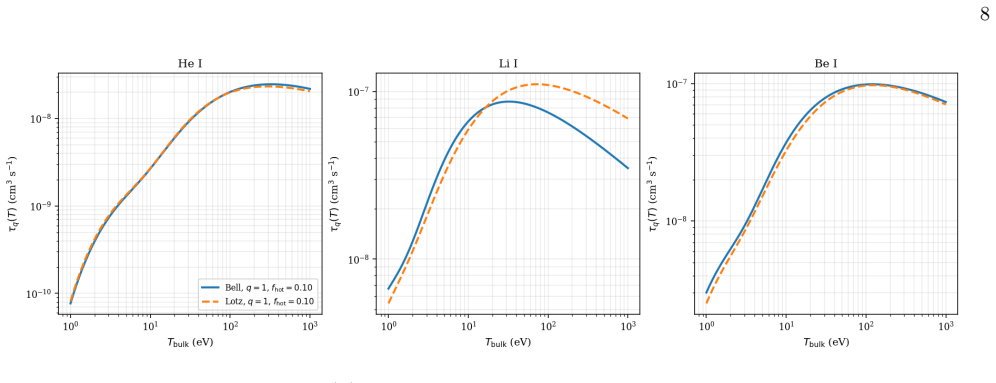
- The Bell–Lotz spread on the rate coefficient remains within 7 percent for He, reaches about 17 percent for Be, and climbs to +95 percent for Li at 1 keV.
- EEDF effects scale with ionization potential over temperature, producing the strongest response in He and the weakest in Li.
- The quantitatively safest non-Maxwellian cases are q equal to 1 and q equal to 1.2; q equal to 1.4 and 1.6 serve only as heavy-tail stress tests.
- The released numerical pipeline supplies a drop-in module for collisional-radiative and ionization-balance codes.
Where Pith is reading between the lines
- The same separation of axes could be applied to heavier atoms or to ions to decide whether cross-section data or distribution modeling should be improved first for a given plasma regime.
- In fusion or astrophysical contexts where non-Maxwellian tails are already observed, inserting these rates would give a clearer bound on uncertainty in neutral densities and line emission.
- Varying the fixed temperature ratio T_hot/T_bulk beyond 10 would test how sensitive the enhancement or suppression remains to the precise contrast between bulk and hot populations.
Load-bearing premise
The two-temperature Tsallis EEDF with the chosen q values and fixed T_hot/T_bulk equal to 10 provides a representative model of non-Maxwellian effects in the plasmas of interest.
What would settle it
A laboratory measurement of the ionization rate or neutral density for helium at 1 keV in a plasma whose EEDF has been independently fitted to a Tsallis form with known q.
Figures




read the original abstract
The single-ionization rate coefficient of a plasma neutral depends both on the microscopic electron-impact cross section and on the macroscopic shape of the electron energy distribution function (EEDF). We present a reproducible benchmark and sensitivity study -- not a new theory -- of these two effects for the three lightest neutrals He, Li, and Be, combining the recommended Bell~\textit{et~al.}\ (1983) cross sections with a properly normalized two-temperature Tsallis $q$-generalized EEDF and varying $q$ on both sides of the Maxwellian limit and the hot-electron fraction $f_{\mathrm{hot}}$ at $T_{\mathrm{hot}}=10\,T_{\mathrm{bulk}}$. The calculation cleanly separates two independent uncertainty axes -- cross-section model (Bell vs.\ Lotz) and EEDF shape (Maxwellian vs.\ Tsallis). The Bell--Lotz spread on $\tau_M$ is small for He (within about $7\%$), moderate for Be ($\lesssim 17\%$), and largest for Li (up to $+95\%$ at $T=1$~keV); sub-extensive distributions ($q<1$) suppress ionization through a hard tail cut-off, while super-extensive distributions ($q>1$) enhance low-temperature ionization through a $\kappa$-like power-law tail with $\kappa=1/(q-1)$. The quantitatively safest non-Maxwellian cases are $q=1$ and $q=1.2$ ($\kappa=5$), which lie inside the finite-mean-energy regime; the cases $q=1.4$ and $q=1.6$ are retained as heavy-tail stress tests and should be read as qualitative trends rather than as quantitatively reliable predictions. Both EEDF effects scale with $I_p/k_BT$, so He responds most strongly and Li least. The full numerical pipeline is released as a persistent reproducibility package, intended as a drop-in non-Maxwellian ionization module for collisional-radiative and ionization-balance modelling of light-neutral plasmas.
Editorial analysis
A structured set of objections, weighed in public.
Referee Report
Summary. The manuscript presents a reproducible computational benchmark and sensitivity study—not a new theory—of single-ionization rate coefficients for neutral He, Li, and Be. It combines the recommended Bell et al. (1983) cross sections with a properly normalized two-temperature Tsallis q-generalized EEDF, varying q on both sides of the Maxwellian limit (q=1) and the hot-electron fraction f_hot at fixed T_hot=10 T_bulk. The calculation separates two independent uncertainty axes (cross-section model Bell vs. Lotz; EEDF shape Maxwellian vs. Tsallis), reports the resulting spreads in the ionization rate coefficient τ_M, and notes that sub-extensive (q<1) distributions suppress rates via hard tail cutoff while super-extensive (q>1) enhance low-T rates via power-law tails, with effects scaling as I_p/kT. The full numerical pipeline is released as a persistent reproducibility package.
Significance. If the numerical implementation holds, the work supplies a practical, drop-in non-Maxwellian ionization module for collisional-radiative and ionization-balance modeling of light-neutral plasmas. Its principal strengths are the clean separation of the two uncertainty axes by construction (microscopic cross section multiplies the macroscopic EEDF in the rate integral), explicit treatment of Tsallis cases as sensitivity tests rather than physical assertions, and the released reproducibility package that includes validation against known Maxwellian limits. The quantitative distinction between reliable cases (q=1 and q=1.2) and heavy-tail stress tests (q=1.4, 1.6) is useful guidance for users.
minor comments (3)
- The abstract and introduction state that the EEDF is 'properly normalized,' but the main text should include the explicit normalization integral (or its reduction to the Maxwellian limit at q=1) to allow readers to verify the separation of effects without consulting the released code.
- Define τ_M explicitly on first use (it appears to be the mean ionization time or rate coefficient); the current notation is clear only after reading the results section.
- The reproducibility package is credited as a strength; the manuscript should add a short paragraph confirming that it contains all parameter files, the exact quadrature routine used for the rate integral, and the Maxwellian-limit validation runs mentioned in the abstract.
Simulated Author's Rebuttal
We thank the referee for the positive assessment of our manuscript, the accurate summary of its scope as a reproducible benchmark and sensitivity study, and the recommendation for minor revision. The highlighted strengths—clean separation of cross-section and EEDF uncertainties, treatment of Tsallis cases as sensitivity tests, and the released reproducibility package—align with our intent. No specific major comments were provided in the report.
Circularity Check
No significant circularity
full rationale
The paper is explicitly framed as a numerical benchmark and sensitivity study that multiplies independent inputs (recommended Bell/Lotz cross sections and a normalized two-temperature Tsallis EEDF) inside a standard rate integral. No parameters are fitted to the output rates, no predictions are derived from self-defined constants, and the two uncertainty axes are varied explicitly rather than reduced by construction. All cited cross-section data and the Tsallis form are external to the present calculation; the work contains no load-bearing self-citation chain or ansatz smuggling.
Axiom & Free-Parameter Ledger
free parameters (2)
- q
- f_hot
axioms (1)
- domain assumption The two-temperature Tsallis EEDF is properly normalized for use as an electron energy distribution function
Reference graph
Works this paper leans on
-
[1]
(1983) [31] analytic representation ofσ(E) for the neutrals He, Li, and Be—with the corrected nega- tive signs ofB 1, B2 for Heiand ofB 1 for Lii—as the primary cross-section input
to implement the recommended Bellet al. (1983) [31] analytic representation ofσ(E) for the neutrals He, Li, and Be—with the corrected nega- tive signs ofB 1, B2 for Heiand ofB 1 for Lii—as the primary cross-section input
1983
-
[2]
to quantify the species-dependent sensitivity of the rate coefficient to the cross-section model by prop- agating both the Bell and the Lotz [33, 34] cross sections through the same Tsallis rate integral
-
[3]
to clarify the exact limit in which the present cal- culation reduces to a single Maxwellian, so that τq(T)| q=1,fhot=0 can be positioned with respect to standard Maxwellian rate tables [7, 8], and to map the super-extensive branch onto theκ-distribution language standard in heliospheric and astrophysical plasma physics. The three neutrals have been chose...
2000
-
[4]
The Bell analytic coefficients must be implemented with the negative signs ofB 1, B2 for Heiand ofB 1 for Lii(Table I) to reproduce Bell’s recommended Heiplate
-
[5]
Lotz cross-section model dependence is strongly species-dependent: the two models agree within≲7% onτ M for He, within≲17% for Be, and differ by up to +95% atT= 1 keV for Li
The Bell vs. Lotz cross-section model dependence is strongly species-dependent: the two models agree within≲7% onτ M for He, within≲17% for Be, and differ by up to +95% atT= 1 keV for Li. The ordering is transmitted fromσ(E) toτ q(T) without qualitative change
-
[6]
Sub-extensive distributions (q <1) suppress ionization—strongly for He, moderately for Be, mildly for Li
The non-Maxwellian correction scales with Ip/kBT. Sub-extensive distributions (q <1) suppress ionization—strongly for He, moderately for Be, mildly for Li. Super-extensive distributions (q >1) enhance ionization at lowT, with the same species ordering
-
[7]
The super-extensive branch coincides with theκ- distribution under the mappingκ= 1/(q−1) (Eq. (7)). The valuesq∈ {1.2,1.4,1.6}used here 11 FIG. 8. Bell-based rate coefficients in the super-extensive regime:q∈ {1.2,1.4,1.6}(κ∈ {5,2.5,1. 6}), at fixedf hot = 0.10. Thick solid blue: strict Maxwellian reference (q, f hot) = (1,0). The three super-extensive cu...
-
[8]
(1) reads fq(E;T) =A q(T) √ E 1−(1−q) E T 1/(1−q) ,(A3) with compact support 0≤E≤E max =T /(1−q)
Sub-extensive branch (q <1) Forq <1 the EEDF Eq. (1) reads fq(E;T) =A q(T) √ E 1−(1−q) E T 1/(1−q) ,(A3) with compact support 0≤E≤E max =T /(1−q). The normalization condition is 1 = Z Emax 0 fq(E;T)dE=A q(T)I <(T),(A4) with I<(T) = Z Emax 0 √ E 1−(1−q) E T 1/(1−q) dE.(A5) Introduce the dimensionless variable t= (1−q) E T , E= T 1−q t, dE= T 1−q dt.(A6) Th...
-
[9]
(1) reads fq(E;T) =A q(T) √ E 1 + (q−1) E T −1/(q−1) , (A11) with supportE∈[0,∞)
Super-extensive branch (q >1) Forq >1 the EEDF Eq. (1) reads fq(E;T) =A q(T) √ E 1 + (q−1) E T −1/(q−1) , (A11) with supportE∈[0,∞). The normalization condition is 1 =A q(T)I >(T),(A12) with I>(T) = Z ∞ 0 √ E 1 + (q−1) E T −1/(q−1) dE.(A13) Introduce u= (q−1) E T , E= T q−1 u, dE= T q−1 du. (A14) The bounds of integration becomeu∈[0,∞) and the integrand b...
-
[10]
(A10) and Eq
Maxwellian limit and consistency check In the Maxwellian limitq→1 ± both Eq. (A10) and Eq. (A21) should reduce to the standard Maxwell– Boltzmann prefactorA 1(T) = 2√π T −3/2 of Eq. (3). This follows from the Stirling-type asymptotic identity [45] lim n→∞ n−c Γ(n+c) Γ(n) = 1,(A22) which holds for any constantc∈R. Consider first the sub-extensive branch Eq...
-
[11]
(A11) only by the exponent: it has−κ−1 instead of −1/(q−1) =−κ
Relation to the standardκ-form The conventionalκ-distributionf κ(E;T)∝ √ E[1 + (E/T)/κ] −κ−1 used in plasma physics differs from Eq. (A11) only by the exponent: it has−κ−1 instead of −1/(q−1) =−κ. The two conventions are equivalent up to a trivial shift of the parameter,κ here =κ plasma+1, and in either case the kinetic-convergence bound Eq. (A18) carries...
-
[12]
T. D. M¨ ark and G. H. Dunn,Electron Impact Ionization (Springer-Verlag, Vienna, 1985). doi:10.1007/978-3-7091- 4028-4
-
[13]
Cross sections for inner-shell ionization by electron im- pact,
X. Llovet, C. J. Powell, F. Salvat, and A. Jablonski, “Cross sections for inner-shell ionization by electron im- pact,” J. Phys. Chem. Ref. Data43, 013102 (2014). doi: 10.1063/1.4832851
-
[14]
Non-Maxwellian electron distributions in the solar atmosphere and the CHIANTI database,
G. Del Zanna, E. Dzifˇ c´ akov´ a, J. Dud´ ık, and H. E. Ma- son, “Non-Maxwellian electron distributions in the solar atmosphere and the CHIANTI database,” Astrophys. J. 930, 155 (2022). doi:10.3847/1538-4357/ac6177
-
[15]
A new method to deter- mine electron temperatures and densities in the solar transition region,
M. Hahn and D. W. Savin, “A new method to deter- mine electron temperatures and densities in the solar transition region,” Astrophys. J.848, 25 (2017). doi: 10.3847/1538-4357/aa8a72
-
[16]
P. Bryans, E. Landi, and D. W. Savin, “A new approach to analyzing solar coronal spectra and updated collisional ionization equilibrium calculations. II. Updated ioniza- 14 tion rate coefficients,” Astrophys. J.691, 1540 (2009). doi:10.1088/0004-637X/691/2/1540
-
[17]
K. P. Dere, “Ionization rate coefficients for the elements hydrogen through zinc,” Astron. Astrophys.466, 771 (2007). doi:10.1051/0004-6361:20066728
-
[18]
T. Kato, K. Masai, and M. Arnaud,Comparison of Ion- ization Rate Coefficients of Ions from Hydrogen through Nickel, NIFS-DATA-014, National Institute for Fusion Science (1991)
1991
-
[19]
An updated evaluation of recombination and ionization rates,
M. Arnaud and R. Rothenflug, “An updated evaluation of recombination and ionization rates,” Astron. Astro- phys. Suppl. Ser.60, 425 (1985)
1985
-
[20]
V. Pierrard and M. Lazar, “Kappa distributions: Theory and applications in space plasmas,” Solar Phys.267, 153 (2010). doi:10.1007/s11207-010-9640-2
-
[21]
Livadiotis,Kappa Distributions: Theory and Appli- cations in Plasmas(Elsevier, Amsterdam, 2017)
G. Livadiotis,Kappa Distributions: Theory and Appli- cations in Plasmas(Elsevier, Amsterdam, 2017). doi: 10.1016/C2015-0-04400-2
-
[22]
J. Dud´ ık, G. Del Zanna, P. Dzifˇ c´ akov´ a, H. E. Ma- son, and E. Dzifˇ c´ akov´ a, “Non-Maxwellian analysis of the transition-region line profiles observed by the Interface Region Imaging Spectrograph,” Astrophys. J.842, 19 (2017). doi:10.3847/1538-4357/aa71a8
-
[23]
Ionization equilibrium of iron in solar corona for a non-Maxwellian electron distribution,
E. Dzifˇ c´ akov´ a, “Ionization equilibrium of iron in solar corona for a non-Maxwellian electron distribution,” Solar Phys.140, 247 (1992). doi:10.1007/BF00146311
-
[24]
E. Dzifˇ c´ akov´ a and J. Dud´ ık, “H to Zn ionization equilib- rium for the non-thermalκ-distributions of electrons,” Astrophys. J. Suppl.206, 6 (2013). doi:10.1088/0067- 0049/206/1/6
-
[25]
Kappa distribution model for hard X-ray coronal sources of solar flares,
M. Oka, S. Ishikawa, P. Saint-Hilaire, S. Krucker, and R. P. Lin, “Kappa distribution model for hard X-ray coronal sources of solar flares,” Astrophys. J.764, 6 (2013). doi:10.1088/0004-637X/764/1/6
-
[26]
J. L¨ orinˇ c´ ık, J. Dud´ ık, G. Del Zanna, E. Dzifˇ c´ akov´ a, and H. E. Mason, “Plasma diagnostics from active region and quiet-Sun spectra observed by Hinode/EIS: Quantifying the departures from a Maxwellian distribution,” Astro- phys. J.893, 34 (2020). doi:10.3847/1538-4357/ab8011
-
[27]
N. L. S. Jeffrey, E. P. Kontar, G. Motorina, and H. A. S. Reid, “A modeling investigation for solar flare X-ray stereoscopy with Solar Orbiter/STIX and earth- orbiting missions,” Astrophys. J.964, 145 (2024). doi: 10.3847/1538-4357/ad236f
-
[28]
V. Pierrard, M. Lazar, S. Poedts, S. M. Shaaban, H. Fichtner, and M. M. Yoon, Solar Phys.297, 153 (2022). doi:10.1007/s11207-022-02087-1
-
[29]
M. Lazar, S. Poedts, V. Pierrard, and H. Fichtner, Astron. Astrophys.650, A45 (2021). doi:10.1051/0004- 6361/202040188
-
[30]
Temperature fluctuation mea- surements with ECE at W7-AS,
H. J. Hartfuss, S. Sattler, M. H¨ ase, M. Hirsch, T. Geist, and the W7-AS Team, “Temperature fluctuation mea- surements with ECE at W7-AS,” Fusion Eng. Des.34– 35, 81 (1997). doi:10.1016/S0920-3796(96)00688-6
-
[31]
Effects of the electron energy distribution function on modeled X- ray spectra,
S. B. Hansen and A. S. Shlyaptseva, “Effects of the electron energy distribution function on modeled X- ray spectra,” Phys. Rev. E70, 036402 (2004). doi: 10.1103/PhysRevE.70.036402
-
[32]
Re- cent improvements of the JET lithium beam diag- nostic,
M. Brix, N. C. Hawkes, A. Boboc, V. Drozdov, S. E. Sharapov, and JET-EFDA Contributors, “Re- cent improvements of the JET lithium beam diag- nostic,” Rev. Sci. Instrum.81, 10D733 (2010). doi: 10.1063/1.3502320
-
[33]
Enhanced diamagnetism by energetic tail electrons in a magne- tized plasma,
K. Takahashi, C. Charles, and R. W. Boswell, “Enhanced diamagnetism by energetic tail electrons in a magne- tized plasma,” Phys. Rev. Res.5, L022029 (2023). doi: 10.1103/PhysRevResearch.5.L022029
-
[34]
Y. Hu, F. Skiff, and E. E. Scime, Phys. Plasmas25, 083506 (2018)
2018
-
[35]
A. L. Milder, S. T. Ivancic, J. P. Palastro, and D. H. Froula, “Impact of non-Maxwellian electron ve- locity distribution functions on inferred plasma param- eters in collective Thomson scattering,” Phys. Plasmas 26, 022711 (2019). doi:10.1063/1.5085664
-
[36]
Possible generalization of Boltzmann-Gibbs statistics,
C. Tsallis, “Possible generalization of Boltzmann– Gibbs statistics,” J. Stat. Phys.52, 479 (1988). doi: 10.1007/BF01016429
-
[37]
Introduction to Nonextensive Statistical Mechanics: Approaching a Complex World
C. Tsallis,Introduction to Nonextensive Statistical Me- chanics: Approaching a Complex World(Springer, New York, 2009). doi:10.1007/978-0-387-85359-8
-
[38]
Beyond Boltzmann–Gibbs–Shannon in physics and elsewhere,
C. Tsallis, “Beyond Boltzmann–Gibbs–Shannon in physics and elsewhere,” Entropy21, 696 (2019). doi: 10.3390/e21070696
-
[39]
Beyond kappa distributions: Exploiting Tsallis statistical mechanics in space plasmas
G. Livadiotis and D. J. McComas, “Beyond kappa distri- butions: Exploiting Tsallis statistical mechanics in space plasmas,” J. Geophys. Res.114, A11105 (2009). doi: 10.1029/2009JA014352
-
[40]
Transport equation of kappa distributions in the heliosphere,
G. Livadiotis and D. J. McComas, “Transport equation of kappa distributions in the heliosphere,” Astrophys. J. 954, 72 (2023). doi:10.3847/1538-4357/ace1e3
-
[41]
P. H. Yoon, M. Lazar, K. Scherer, H. Fichtner, and R. Schlickeiser, Astrophys. J.945, 65 (2023). doi: 10.3847/1538-4357/acba0c
-
[42]
Recommended data on the elec- tron impact ionization of light atoms and ions,
K. L. Bell, H. B. Gilbody, J. G. Hughes, A. E. Kingston, and F. J. Smith, “Recommended data on the elec- tron impact ionization of light atoms and ions,” J. Phys. Chem. Ref. Data12, 891 (1983). doi: 10.1063/1.555700
-
[43]
Atomic Data and Nuclear Data Tables , year = 1997, month = jan, volume =
G. S. Voronov, “A practical fit formula for ionization rate coefficients of atoms and ions by electron impact: Z= 1–28,” At. Data Nucl. Data Tables65, 1 (1997). doi:10.1006/adnd.1997.0732
-
[44]
An empirical formula for the electron-impact ionization cross-section,
W. Lotz, “An empirical formula for the electron-impact ionization cross-section,” Z. Phys.206, 205 (1967). doi: 10.1007/BF01325928
-
[45]
W. Lotz, “Electron-impact ionization cross-sections and ionization rate coefficients for atoms and ions from hy- drogen to calcium,” Z. Phys.216, 241 (1968). doi: 10.1007/BF01392963
-
[46]
P. Bryans, N. R. Badnell, T. W. Gorczyca, J. M. Lam- ing, W. Mitthumsiri, and D. W. Savin, “Collisional ion- ization equilibrium for optically thin plasmas. I. Updated recombination rate coefficients for bare through sodium- like ions,” Astrophys. J. Suppl.167, 343 (2006). doi: 10.1086/507629
-
[47]
A. Kramida, Yu. Ralchenko, J. Reader, and NIST ASD Team,NIST Atomic Spectra Database (version 5.10), National Institute of Stan- dards and Technology, Gaithersburg, MD (2022).https://physics.nist.gov/asd; doi: 10.18434/T4W30F
-
[48]
Tsallis statis- tics applied to electron-impact ionization rate coefficients of light atoms,
F. Khalfaoui, S. Dilmi, and A. Boumali, “Tsallis statis- tics applied to electron-impact ionization rate coefficients of light atoms,” Physica A596, 127193 (2022). doi: 10.1016/j.physa.2022.127193
-
[49]
P. J. Davis and P. Rabinowitz,Methods of Numerical Integration, 2nd ed. (Academic Press, Orlando, 1984). 15
1984
-
[50]
Calculation of Gauss quadrature rules,
G. H. Golub and J. H. Welsch, “Calculation of Gauss quadrature rules,” Math. Comp.23, 221 (1969). doi: 10.1090/S0025-5718-69-99647-1
-
[51]
Is Gauss quadrature better than Clenshaw–Curtis?,
L. N. Trefethen, “Is Gauss quadrature better than Clenshaw–Curtis?,” SIAM Rev.50, 67 (2008). doi: 10.1137/060659831
-
[52]
C. R. Harriset al., “Array programming with NumPy,” Nature585, 357 (2020). doi:10.1038/s41586-020-2649-2
-
[53]
R. Piessens, E. deDoncker-Kapenga, C. W. ¨Uberhuber, and D. K. Kahaner,QUADPACK: A Subroutine Package for Automatic Integration(Springer, Berlin, 1983). doi: 10.1007/978-3-642-61786-7
-
[54]
P. Virtanenet al., “SciPy 1.0: Fundamental algorithms for scientific computing in Python,” Nat. Methods17, 261 (2020). doi:10.1038/s41592-019-0686-2
-
[55]
Computing in Science and Engineering , keywords =
J. D. Hunter, “Matplotlib: A 2D graphics envi- ronment,” Comput. Sci. Eng.9, 90 (2007). doi: 10.1109/MCSE.2007.55
-
[56]
Abramowitz and I
M. Abramowitz and I. A. Stegun,Handbook of Mathe- matical Functions(Dover, New York, 1972)
1972
discussion (0)
Sign in with ORCID, Apple, or X to comment. Anyone can read and Pith papers without signing in.