Recognition: unknown
Proposal for applying the novel gas-dynamic ion-beam extraction and bunching technique to the cryogenic stopping cells at FAIR
Pith reviewed 2026-05-09 20:28 UTC · model grok-4.3
The pith
A gas-dynamic extraction technique with cylindrical electrodes can replace RFQs in FAIR cryogenic stopping cells to achieve world-record ion beam emittance over a wide mass range.
A machine-rendered reading of the paper's core claim, the machinery that carries it, and where it could break.
Core claim
The central claim is that the gas-dynamic technique, implemented via a short stack of thin cylindrical electrodes behind the RF carpet, will enable world-record emittance for extracted ion beams in a wide mass range. Simulations of gas dynamics and ion trajectories support this outcome for both the existing FRS stopping cell and the Super-FRS cell under development, offering an alternative to the RFQ approach with full transmission.
What carries the argument
The novel gas-dynamic ion-beam extraction and bunching technique, implemented by placing a short stack of thin cylindrical electrodes behind the extraction RF carpet to achieve 100 percent transmission and low-emittance bunching.
If this is right
- Enhanced quality of pulsed cold ion beams from the FRS and Super-FRS cryogenic stopping cells at FAIR.
- Achievement of world-record emittance values for ion beams across a wide mass range.
- Full 100 percent ion transmission as an alternative to the RFQ method.
- Direct applicability to both the current FRS setup and the new Super-FRS stopping cell.
Where Pith is reading between the lines
- If the technique performs as simulated, it could be adapted to cryogenic stopping cells at other accelerator facilities beyond FAIR.
- The electrode stack design might allow further reductions in emittance through adjustments to spacing or voltage in future iterations.
- Lower emittance beams could shorten the time needed for beam preparation in downstream experiments.
Load-bearing premise
The gas-dynamic and ion trajectory computer simulations accurately reflect the real physical conditions, electrode performance, and cryogenic environment inside the stopping cells.
What would settle it
Experimental measurement of emittance for ion beams extracted from the actual FAIR cryogenic stopping cells after installing the proposed electrode stack, to check whether the values match the simulated world-record levels.
Figures


read the original abstract
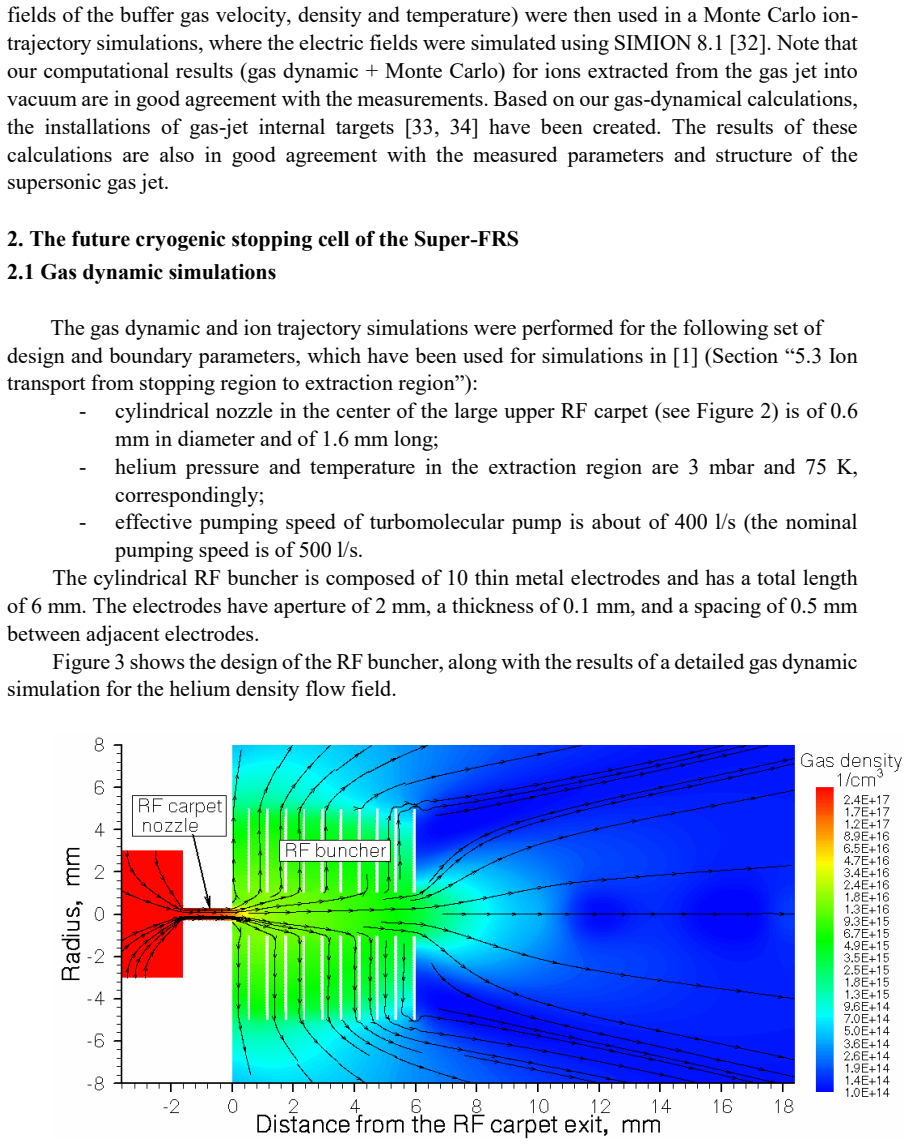
To enhance the quality of pulsed cold ion beams extracted from the two cryogenic stopping cells at FAIR (i.e., the one currently used in the FRS and the one under development for the Super-FRS at FAIR), we propose using a novel gas-dynamic ion beam extraction and bunching technique as an alternative to the radiofrequency quadrupole (RFQ) method. This technique allows for 100% ion transmission by placing a short stack of thin cylindrical electrodes behind the extraction RF carpet. Detailed gas-dynamic and ion trajectory computer simulations demonstrate that implementing this proposal will enable the achievement of world-record emittance values for ion beams in a wide mass range. The results of these simulations are presented and discussed.
Editorial analysis
A structured set of objections, weighed in public.
Referee Report
Summary. The manuscript proposes replacing the radiofrequency quadrupole (RFQ) with a novel gas-dynamic ion-beam extraction and bunching technique consisting of a short stack of thin cylindrical electrodes placed behind the extraction RF carpet in the cryogenic stopping cells at FAIR. It claims that gas-dynamic and ion trajectory computer simulations demonstrate 100% ion transmission and world-record emittance values across a wide mass range.
Significance. If the simulation predictions are accurate and transferable to the real cryogenic environment, the proposal could meaningfully improve beam quality for downstream experiments at FAIR, particularly in precision mass spectrometry and nuclear structure studies that benefit from low-emittance pulsed beams.
major comments (1)
- [Abstract] Abstract: The central claim that the proposed technique achieves world-record emittance rests entirely on unspecified gas-dynamic and ion trajectory simulations. No information is provided on the simulation code, mesh resolution, gas-flow model (e.g., viscosity at cryogenic temperatures), electrode potentials, boundary conditions, or quantitative validation against measured emittance or transmission data from the operating FRS stopping cell. This gap is load-bearing because unmodeled effects such as surface charging, condensation, or fringe-field distortions could alter the predicted performance.
Simulated Author's Rebuttal
We thank the referee for their careful and constructive review of our proposal. We address the single major comment below and will revise the manuscript to provide greater transparency on the simulation methodology while maintaining the focus on the novel technique.
read point-by-point responses
-
Referee: [Abstract] Abstract: The central claim that the proposed technique achieves world-record emittance rests entirely on unspecified gas-dynamic and ion trajectory simulations. No information is provided on the simulation code, mesh resolution, gas-flow model (e.g., viscosity at cryogenic temperatures), electrode potentials, boundary conditions, or quantitative validation against measured emittance or transmission data from the operating FRS stopping cell. This gap is load-bearing because unmodeled effects such as surface charging, condensation, or fringe-field distortions could alter the predicted performance.
Authors: We agree that the abstract and manuscript would benefit from additional methodological details to allow readers to evaluate the simulation results. In the revised manuscript we will add a dedicated subsection describing the gas-dynamic and ion-trajectory simulations. This will include the specific codes employed, mesh resolution and convergence criteria, the gas-flow model with cryogenic viscosity and other relevant properties, the applied electrode potentials, and the boundary conditions. We will also discuss potential unmodeled effects (surface charging, condensation, fringe fields) and explain, based on the cryogenic operating conditions and prior experience with RF carpets, why these are not expected to degrade the predicted 100 % transmission and emittance. As this is a forward-looking proposal paper, direct experimental validation against the operating FRS cell is not yet available; however, we will include comparisons to published data from similar extraction systems to support the simulation approach. revision: yes
Circularity Check
No circularity: forward simulations of proposed extraction technique
full rationale
The manuscript is a proposal whose central claim rests on forward gas-dynamic and ion-trajectory simulations of a new electrode stack placed after the RF carpet. No equations, fitted parameters, or self-citations are shown to reduce the predicted emittance values to the input assumptions by construction. The simulations are presented as independent numerical predictions rather than tautological re-statements of fitted data or prior self-referential results. Absence of validation against existing cells is a separate empirical concern, not a circularity defect.
Axiom & Free-Parameter Ledger
axioms (1)
- domain assumption Gas-dynamic extraction with the proposed electrode stack achieves 100% transmission and record emittance under cryogenic stopping-cell conditions.
Reference graph
Works this paper leans on
-
[1]
Plaß, Timo Dickel, Samuel Ayet San Andr´es, Peter Dendooven15, Hans Geissel, Emma Haettner, Muhsin N
Daler Amanbayev, Wolfgang R. Plaß, Timo Dickel, Samuel Ayet San Andr´es, Peter Dendooven15, Hans Geissel, Emma Haettner, Muhsin N. Harakeh, Ivan Miskun, Sivaji Purushothaman, Manisha Ranjan, Moritz P. Reiter, Ann -Kathrin Rink, Christoph Scheidenberger, Zoran Andelkovic, Soumya Bagchi, Dimiter Balabanski, S¨onke Beck, Julian Bergmann1, Michael Block, Paul...
-
[2]
A. Jaries , J. Ruotsalainen, R. Kronholm, T. Eronen, A. Kankainen, HIBISCUS: a new ion beam radio - frequency quadrupole cooler-buncher for high-precision experiments with exotic radioactive ions, Nuclear Instruments and Methods in Physics Research Section A 1073 (2025) 170273, https://doi.org/10.1016/j.nima.2025.170273. – 14 –
-
[3]
A. Nieminen, J. Huikari, A. Jokinen, J. Äystö, P. Campbell, E. Cochrane, Beam cooler for low -energy radioactive ions, Nuclear Instruments and Methods in Physics Research Section A 469 (2001) 244–253, http://dx.doi.org/10.1016/S0168-9002(00)00750-6
-
[4]
Nieminen, P
A. Nieminen, P. Campbell, J. Billowes, D. H. Forest, J. A. R. Griffith, J. Huikari, A. Jokinen, I. D. Moore, R. Moore, G. Tungate, J. Äystö, On-Line Ion Cooling and Bunching for Collinear Laser Spectroscopy, Phys. Rev. Lett. 88, 094801, Feb 2002
2002
-
[5]
I.D. Moore, P. Dendooven, J. Ärje, The IGISOL technique—three decades of developments, Hyperfine Interact. 223 (1) (2014) 17–62, http://dx.doi.org/10.1007/s10751-013-0871-0
-
[6]
Moore, New concepts for the ion guide technique, Nuclear Instruments and Methods in Physics Research Section B, 266 (2008) 4434
I.D. Moore, New concepts for the ion guide technique, Nuclear Instruments and Methods in Physics Research Section B, 266 (2008) 4434
2008
-
[7]
Herfurth, J
F. Herfurth, J. Dilling, A. Kellerbauer, G. Bollen, S. Henry, H.-J. Kluge, E. Lamour, D. Lunney, R.B. Moore, C. Scheidenberger, S. Schwarz, G. Sikler, J. Szerypo, A linear radiofrequency ion trap for accumulation, bunching, and emittance improvement of radioactive ion beams, Nuclear Instruments and Methods in Physics Research Section A 469 (2001) 254–275
2001
-
[8]
G. Savard, A.F. Levand, B.J. Zabransky, The CARIBU gas catcher, Nuclear Instruments and Methods in Physics Research Section A 685 (2012) 70, https://doi.org/10.1016/j.nima.2012.05.031
-
[9]
Ramzi Boussaid, G. Ban, G. Quéméner, Y. Merrer, and J. Lorry, Development of a radio-frequency quadrupole cooler for high beam currents, Phys. Rev. Accel. Beams, 20, (2017) 124701, https://doi.org/10.1103/PhysRevAccelBeams.20.124701
-
[10]
B.R. Barquest, G. Bollen, P.F. Mantica, K. Minamisono, R. Ringle, S. Schwarz, RFQ beam cooler and buncher for collinear laser spectroscopy of rare isotopes, Nuclear Instruments and Methods in Physics Research Section A, 866 (2017) 18, https://doi.org/10.1016/j.nima.2017.05.036
-
[11]
S. Schwarz, G. Bollen, R. Ringle, J. Savory, P. Schury, The LEBIT ion cooler and buncher, Nuclear Instruments and Methods in Physics Research Section A, 816 (2017) 131, https://doi.org/10.1016/j.nima.2016.01.078
-
[12]
H. Franberg, P. Delahaye, J. Billowes, K. Blaum, R. Catherall, F. Duval, O. Gianfrancesco, T. Giles, A. Jokinen, M. Lindroos, D. Lunney, E. Mane, I. Podadera, Off-line commissioning of the ISOLDE cooler, Nuclear Instruments and Methods in Physics Research Section A, 266 (2008) 4502, https://doi.org/10.1016/j.nimb.2008.05.097
-
[13]
B.R. Barquest, J.C. Bale, J. Dilling, G. Gwinner, R. Kanungo, R. Krücke, M.R. Pearson, Development of a new RFQ beam cooler and buncher for the CANREB project at TRIUMF, Nuclear Instruments and Methods in Physics Research Section B, 376 (2016) 207, https://doi.org/10.1016/j.nimb.2016.02.035
-
[14]
Brunner, M.J
T. Brunner, M.J. Smith, M .Brodeur, S. Ettenauer, A.T .Gallant, V.V. Simon, A. Chaudhuri, A. Lapierre, E. Mane´, R. Ringle, M.C .Simon, J.A. Vaz, P. Delheij, M. Good, M.R. Pearson, J. Dill ing, TITAN’s digital RFQ ion beam cooler and buncher, operation and performance, Nuclear Instruments and Methods in Physics Research Section A, 676 (2012) 32
2012
-
[15]
A. A. Valverde, M. Brodeur, D. P. Burdette, J. A. Clark, J. W. Klimes, D. Lascar, P. D. O’Malley, R. Ringle, G. Savard, V. Varentsov, Stopped, bunched beams for the TwinSol facility, Hyperfine Interactions, (2019) 240:38, https://doi.org/10.1007/s10751-019-1591-x
-
[16]
Status and prospects of the PandaX-III experiment,
A. Ruzzon, M. Maggiore, C. Roncolato, G. Ban, J.F. Cam, C. Gautier and C. Vandamme, Realization and simulations of the new SPES Beam Cooler, 2023 JINST 18 P10031, https://doi.org/10.1088/1748- 0221/18/10/P10031
-
[17]
Yin-Shen Liu, Han-Rui Hu, Xiao-Fei Yang, Wen-Cong Mei, Yang-Fan Guo, Zhou Yan, Shao-Jie Chen, Shi-wei Bai, Shu-Jing Wang, Yong-Chao Liu, Peng Zhang, Dong-Yang Chen, Yan-Lin Ye, Qi-Te Li, Jie Yang, Stephan Malbrunot-Ettenauer, Simon Lechner, Carina Kanitz, Commissioning of a radiofrequency quadrupole cooler-buncher for collinear laser spectroscopy, Preprin...
-
[18]
M. Gerbaux, P. Ascher, A Husson, Antoine de Roubin, P. Alfaurt, M. Aouadi, Bertram Blank, Laurent Daudin, S El Abbeir, M Flayol, H. Guérin, S. Grevy, M. Hukkanen, B Lachacinski, David Lunney, S Perard, BARRY H. THOMAS, The General Purpose Ion Buncher: A radiofreq uency quadrupole cooler- buncher for DESIR at SPIRAL2, Nuclear Instruments and Methods in Phy...
-
[19]
D.P. Burdette, R. Zite, M. Brodeur, A.A. Valverde, O. Bruce, R. Bualuan, A. Cannon, J.A. Clark, C. Davis, T. Florenzo, A.T. Gallant, J. Harkin, A.M. Houff, J. Li, B. Liu, J.Long, P.D. O'Malley, W.S. – 15 – Porter, C. Quick, R. Ringle, F. Rivero, G. Savard, M.A. Yeck, Off-line commissioning of the St. Benedict Radiofrequency Quadrupole Cooler-Buncher, Prep...
-
[20]
V.A. Virtanen a, T. Eronen a, A. Kankainen a, O. Beliuskina a, P. Campbell b, R. Delaplanche c, Z. Ge a, R.P. de Groote d, M. Hukkanen a e, A. Jaries a, R. Kronholm a, I.D. Moore a, A. Raggio a, A. de Roubin f, J. Ruotsalainen a, M. Schuh, Miniaturised cooler-buncher for reduction of longitudinal emittance at IGISOL, Nuclear Instruments and Methods in Phy...
-
[21]
S. Lehner, S. SelsI. , Belosevic, F. Buchinger, P. Fischer, C. Kanitz, V.Lagaki, F.M. Maier, P. Plattner, L. Schweikhard, M. Vilen, S. Malbrunot-Ettenauer, Simulations of a cryogenic, buffer-gas filled Paul trap for low-emittance ion bunches, Nuclear Instruments and Methods in Physics Research Section A 1065 (2024) 169471, https://doi.org/10.1016/j.nima.2...
-
[22]
Regan Zite, Maxime Brodeur, O. Bruce, D. Gan, P. D. O'Malley, William Samuel Porter, Fabi o Rivero, Off-line Commissioning of the St. Benedict Radio Frequency Quadrupole Ion Guide, Nuclear Inst. and Methods in Physics Research, A 1088 (2026) 171483; https://doi.org/10.1016/j.nima.2026.171483
-
[23]
V. Varentsov, A New Approach to the Extraction System Design, SHIPTRAP Collaboration Meeting, Mainz, March 19, 2001; http://doi.org/10.13140/RG.2.2.30119.55200
-
[24]
Victor Varentsov, Review of Gas Dynamic RF-Only Funnel Technique for Low-Energy and High- Quality Ion Beam Extraction into a Vacuum, Micromachines 2023, 14(9), 1771; https://doi.org/10.3390/mi14091771
-
[25]
Victor Varentsov, Proposal of a New Double-Nozzle Technique for In-Gas-Jet Laser Resonance Ionization Spectroscopy, Atoms 2023, 11,88; https://doi.org/10.3390/atoms11060088
-
[26]
Victor Varentsov, The Double-Nozzle Technique Equipped with RF-Only Funnel and RF-Buncher for the Ion Beam Extraction into Vacuum, Atoms 2023, 11(10), 123; https://www.mdpi.com/2218- 2004/11/10/123
2023
-
[27]
Victor Varentsov, Towards a new and compact gas-dynamic cooler-buncher for the FAIR Laspec and MATS experiments, Journal of Instrumentation, , 20 (August 2025):P08031, https://doi.org/10.1088/1748-0221/20/08/P0803 1
-
[28]
Tim Ratajczyk, Philipp Bollinger, Tim Lellinger, Victor Varentsov, Wilfried Nörtershäuser, Towards a He-buffered laser ablation ion source for collinear laser spectroscopy, Hyperfine Interactions, (2020) 241:52, https://doi.org/10.1007/s10751-020-1698-0
-
[29]
Tim Ratajczyk, Kristian König, Philipp Bollinger, Tim Lellinger, Victor Varentsov, Wilfried Nörtershäuser and Julian Spahn, Transition frequencies, isotope shifts, and hyperfine structure in 4 s → 4 p transitions of stable Ti + ions, Physical Review A 100(3) 2024, http://dx.doi.org/10.1103/PhysRevA.110.032807
-
[30]
Tim Ratajczyk, Philipp Bollinger, Tim Lellinger, Victor Varentsov, Wilfried Nörtershäuser, A versatile laser ablation ion source for reference measurements at LASPEC, NUSTAR Collaboration Meeting, February 25 2021, http://doi.org/10.13140/RG.2.2.32743.11681
-
[31]
V.L. Varentsov. A.A. Ignatiev. Numerical investigations of internal supersonic jet targets formation for storage rings. Nuclear Instruments and Methods in Physics Research Section A 413 (1998) 447-456. http://dx.doi.org/10.1016/S0168-9002(98)00354-4
-
[32]
1027 Old York Road
Scientific Instrument Services, Inc. 1027 Old York Road. Ringoes, NJ 08551-1054. USA. http://simion.com
-
[33]
V.L. Varentsov, N. Kuroda, Y. Nagata, H. A. Torii, M. Shibata, and Y. Yamazaki, ASACUSA Gas-Jet Target: Present Status And Future Development, AIP Conference Proceedings 793 (2005) 328 -340, https://doi.org/10.1063/1.2121994
-
[34]
D. Tiedemann, K.E. Stiebing, D.F.A. Winters, W. Quint, V. Varentsov, A. Warczak, A. Malarz, Th. Stöhlker, A pulsed supersonic gas jet target for precision spectroscopy at the HITRAP facility at GSI, Nucl. Instrum. Methods Phys. Res. A 764 (2014) 387–393, http://doi.org/10.1016/j.nima.2014.08.017
discussion (0)
Sign in with ORCID, Apple, or X to comment. Anyone can read and Pith papers without signing in.