Recognition: 3 theorem links
· Lean TheoremPeering down the barrel with DESI DR2: 10 000+ inflows at z < 0.6 reveal how galaxies accrete cold gas
Pith reviewed 2026-05-08 18:13 UTC · model grok-4.3
The pith
Galaxies at low redshift accrete cold gas through multiple pathways including radial inflows and satellite accretion.
A machine-rendered reading of the paper's core claim, the machinery that carries it, and where it could break.
Core claim
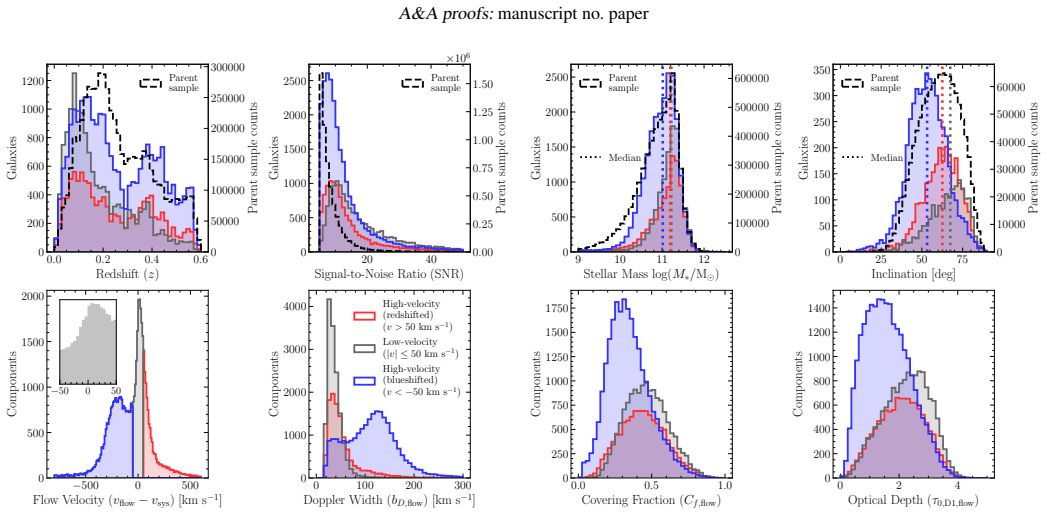
The analysis yields a catalogue of over 50,000 galaxies with evidence for down-the-barrel absorption, where the velocity distribution shows approximately 50 percent of components at inflow speeds below -50 km/s, 30 percent near systemic velocity, and 20 percent outflowing, together with a statistically significant population of low-velocity infalling absorbers at roughly 20 km/s in edge-on galaxies and a tighter link to velocity dispersion than to mass in early-type systems.
What carries the argument
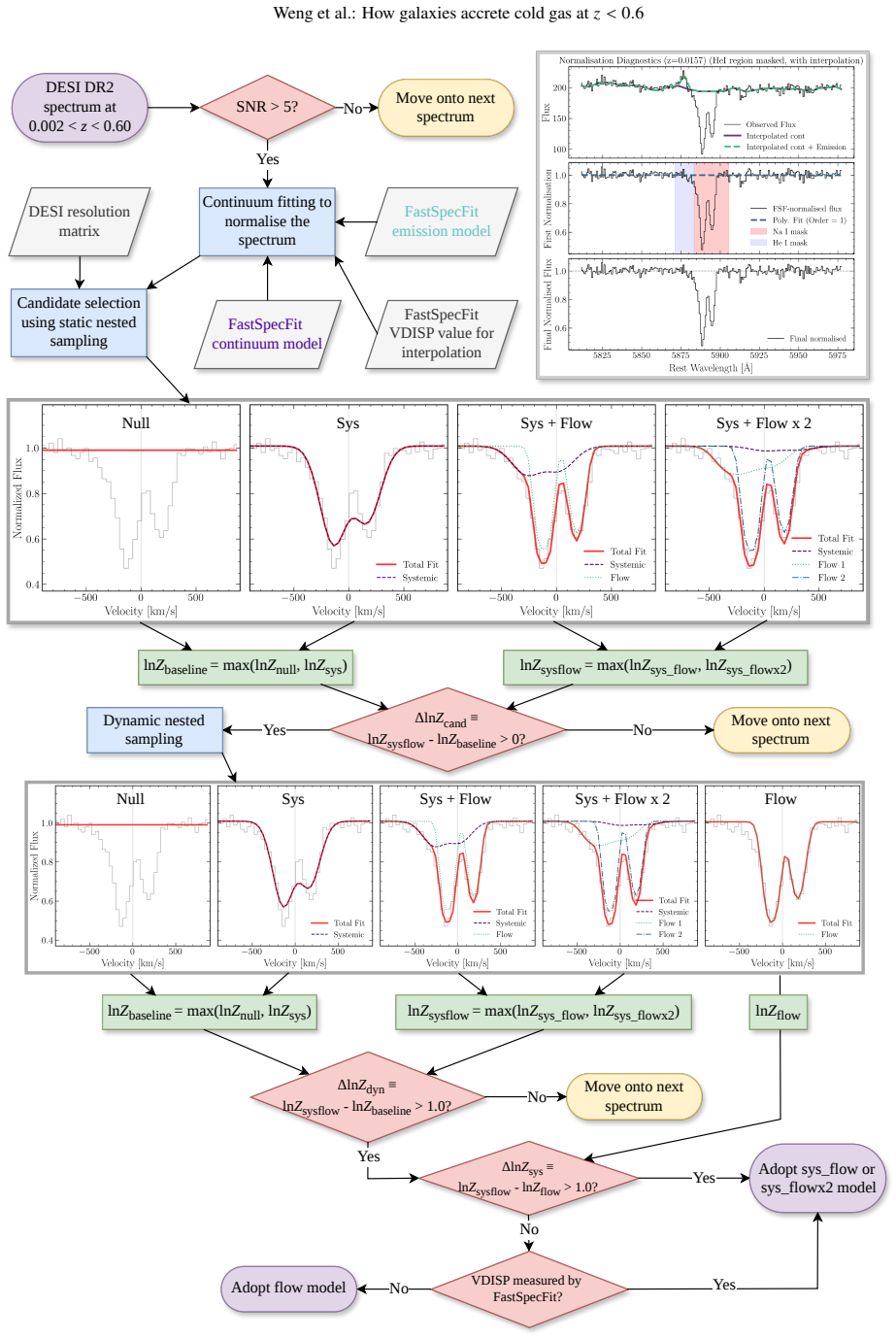
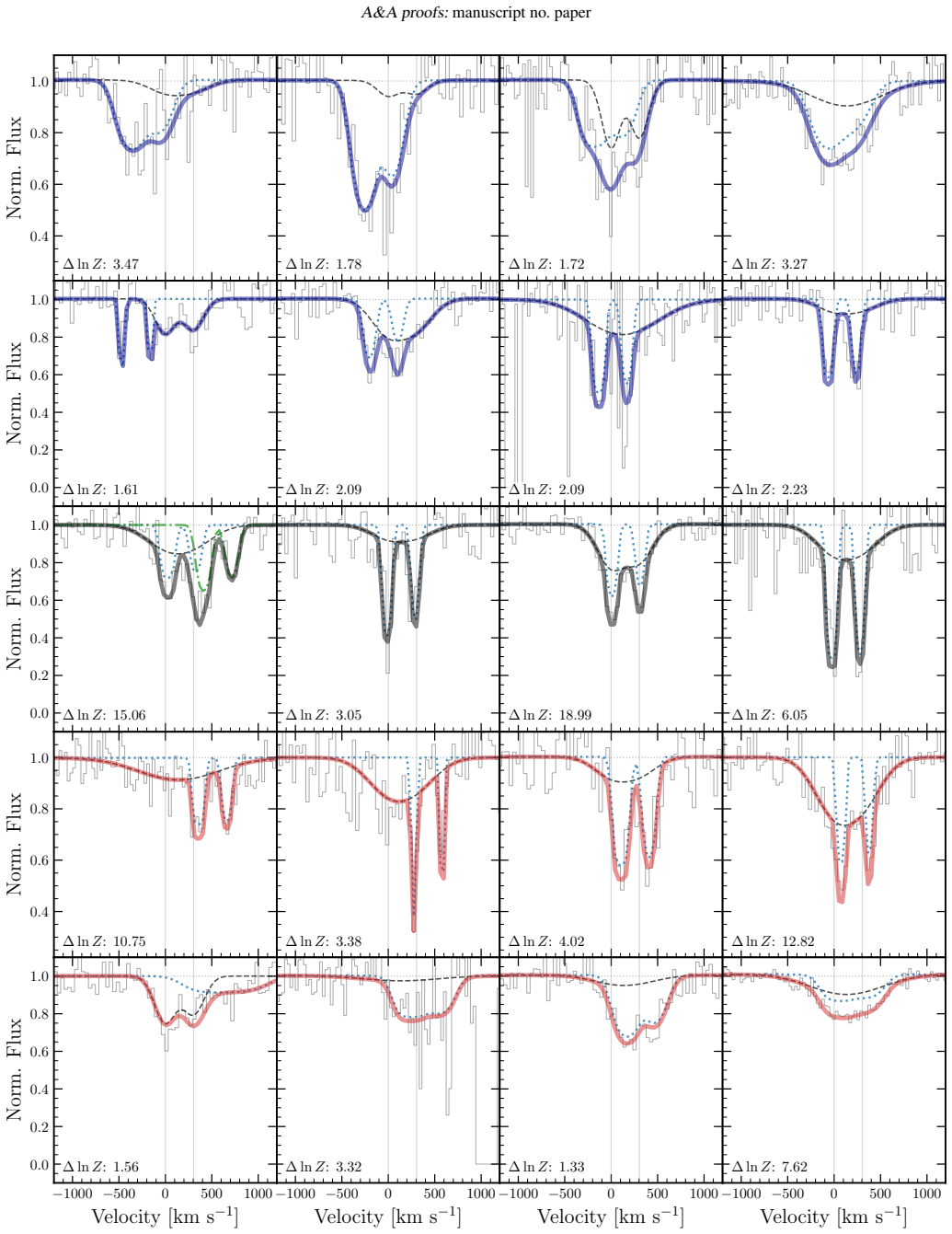
Bayesian evidence ratios applied to NaI D lines to test whether spectra require additional absorption components tracing interstellar gas flows separate from the systemic galaxy velocity.
If this is right
- Roughly half of all detected absorbers exhibit clear inflow velocities.
- A distinct population of low-velocity inflows at about 20 km/s appears preferentially in edge-on galaxies, matching predictions for radial accretion.
- In early-type galaxies the inflow velocity correlates more strongly with stellar velocity dispersion than with stellar mass, consistent with accretion from satellites.
- These patterns together indicate that galaxies at z less than 0.6 draw gas from more than one physical channel.
Where Pith is reading between the lines
- The detected inflows could supply a measurable fraction of the gas needed to sustain ongoing star formation in the local universe.
- Similar absorption searches at higher redshifts could test whether the balance between these pathways changes over cosmic time.
- The velocity and orientation trends offer a direct observational test for hydrodynamical simulations that predict cold-mode accretion persisting to low redshift.
Load-bearing premise
That Bayesian evidence ratios reliably separate additional absorption components tracing distinct interstellar inflows from the systemic galaxy component, without significant contamination from other velocity structures.
What would settle it
Independent higher-resolution spectroscopy of a subset of the catalogue galaxies that fails to confirm the extra absorption components as distinct inflows rather than rotation, outflows, or other structures would falsify the detection of multiple accretion pathways.
Figures



read the original abstract
Direct observational constraints on how galaxies acquire their gas remain remarkably limited, hindering our understanding of the baryon cycle. We present a search for down-the-barrel NaI D absorption towards 15.6 million galaxies at $z < 0.6$ in DESI Data Release 2. We use Bayesian evidence ratios to assess whether the absorption requires additional components tracing interstellar gas distinct from the systemic component of the galaxy. We construct a catalogue of 50 088 (27 420) galaxies with moderate (strong) evidence for down-the-barrel absorption. The inferred absorption components are broadly distributed in velocity, with approximately 50% at $v_{\rm flow} < -50$ km/s, 30% within 50 km/s of the systemic velocity and the remaining 20% at $v_{\rm flow} > 50$ km/s. We find strong evidence for a large population of low-velocity, infalling absorbers with velocities $\sim$20 km/s in edge-on galaxies, consistent with radial inflows predicted in simulations. The stronger correlation in early-type galaxies between inflow velocity and stellar velocity dispersion, compared to that with stellar mass, suggests that a portion of these inflows may be associated with accreting satellites. These results reveal the multiple pathways in which galaxies accrete gas at redshift $z < 0.6$ for the first time in a statistically significant sample.
Editorial analysis
A structured set of objections, weighed in public.
Referee Report
Summary. The manuscript describes the use of DESI DR2 data to search for NaI D absorption in 15.6 million galaxies at z < 0.6. Using Bayesian evidence ratios, they identify 50,088 galaxies with moderate evidence for additional absorption components beyond the systemic velocity, and analyze the velocity distribution and correlations with galaxy properties to infer multiple gas accretion pathways.
Significance. This large sample offers unprecedented statistical power to study cold gas inflows in the local universe. The finding of a substantial population of low-velocity inflows in edge-on galaxies provides direct observational support for simulation predictions of radial accretion, and the differential correlations in early-type galaxies point to satellite contributions. These results have the potential to significantly advance models of the baryon cycle if the component identification is validated.
major comments (3)
- [Abstract] Abstract: the central claim that the catalogue reveals multiple distinct accretion pathways rests on the interpretation of the velocity histogram (50% at v_flow < -50 km/s) as inflows. However, without quantitative modeling of how disk rotation projects in the line-of-sight for various inclinations, the separation from systemic and rotational components remains uncertain.
- [Methods (Bayesian analysis)] Methods (Bayesian analysis): the application of Bayesian evidence ratios to decide on additional components does not include a thorough false-positive analysis using mock spectra that incorporate realistic noise, continuum placement, and kinematic structures such as outflows or satellite motions.
- [Results on correlations] Results on correlations: the reported stronger correlation between inflow velocity and stellar velocity dispersion in early-type galaxies (compared to stellar mass) is used to suggest satellite accretion, but the manuscript does not present the statistical significance of this difference or control for confounding factors like galaxy environment.
minor comments (2)
- [Abstract] The term 'v_flow' is used without explicit definition in the abstract; it should be clarified as the velocity offset relative to the systemic redshift.
- [Figure (velocity distribution)] The velocity histograms would be clearer with overlaid model fits or uncertainty bands to assess the robustness of the 50%/30%/20% breakdown.
Simulated Author's Rebuttal
We thank the referee for their constructive and detailed comments, which have identified areas where the manuscript can be strengthened. We address each major comment below, indicating the revisions we will incorporate.
read point-by-point responses
-
Referee: [Abstract] Abstract: the central claim that the catalogue reveals multiple distinct accretion pathways rests on the interpretation of the velocity histogram (50% at v_flow < -50 km/s) as inflows. However, without quantitative modeling of how disk rotation projects in the line-of-sight for various inclinations, the separation from systemic and rotational components remains uncertain.
Authors: We agree that explicit quantitative modeling of line-of-sight projection effects from disk rotation would strengthen the interpretation. The current analysis already separates the velocity distributions by inclination (Figure 5), showing that the prominent low-velocity (~20 km/s) component appears predominantly in edge-on galaxies while being absent in face-on systems; pure rotational broadening would instead produce symmetric velocity wings independent of inclination. In the revised manuscript we will add a dedicated subsection with simple geometric models of rotating disks (using observed stellar velocity dispersions and assumed scale heights) to quantify the maximum expected LOS velocity contribution from rotation at different inclinations and demonstrate that it cannot account for the observed low-velocity excess. revision: partial
-
Referee: [Methods (Bayesian analysis)] Methods (Bayesian analysis): the application of Bayesian evidence ratios to decide on additional components does not include a thorough false-positive analysis using mock spectra that incorporate realistic noise, continuum placement, and kinematic structures such as outflows or satellite motions.
Authors: We acknowledge that a more comprehensive false-positive validation is required. The original analysis included basic tests with noise-added mock spectra and continuum perturbations, but these did not fully explore complex kinematic contaminants. We will expand the Methods section with a new subsection presenting results from an expanded suite of mock spectra that incorporate realistic noise, continuum placement errors, outflow signatures, and satellite orbital motions, and we will report the resulting false-positive and false-negative rates for the adopted evidence-ratio thresholds. revision: yes
-
Referee: [Results on correlations] Results on correlations: the reported stronger correlation between inflow velocity and stellar velocity dispersion in early-type galaxies (compared to stellar mass) is used to suggest satellite accretion, but the manuscript does not present the statistical significance of this difference or control for confounding factors like galaxy environment.
Authors: We will add quantitative measures of the statistical significance of the difference between the two correlations (using bootstrap resampling and Fisher's z-transformation) to the revised Results section. For environmental confounding, DESI DR2 provides local density estimates; we will re-run the correlation analysis in low- and high-density subsamples and include these controls. Should residual environmental dependence remain after these splits, we will discuss it explicitly as a caveat while noting that the velocity-dispersion correlation is the stronger predictor in both regimes. revision: yes
Circularity Check
No significant circularity in observational catalog construction
full rationale
The paper constructs an observational catalog of NaI D absorption components from DESI DR2 spectra using Bayesian evidence ratios to decide on additional velocity components. No equations, fitted parameters, or self-citations reduce the central results (velocity distributions, inflow statistics) to inputs by construction. The analysis is data-driven with external survey data and standard statistical methods; the separation of inflow components is an interpretive step subject to validation against simulations or mocks, but does not create a self-definitional or fitted-input loop. This is a typical observational study whose claims rest on the data and methodology rather than any circular derivation chain.
Axiom & Free-Parameter Ledger
axioms (2)
- domain assumption NaI D absorption lines trace cold neutral gas in galaxies
- domain assumption Bayesian evidence ratios can isolate distinct kinematic components from systemic velocity
Lean theorems connected to this paper
-
Cost.FunctionalEquation / Foundation.BranchSelection (no overlap)washburn_uniqueness_aczel (not invoked; paper uses standard astrophysical line-profile model) unclear?
unclearRelation between the paper passage and the cited Recognition theorem.
Gas flows are described using a partial-covering model ... Gaussian optical depth profiles are assumed for each member of the doublet, with the NaI D oscillator strength ratio fixed to 1:2.
What do these tags mean?
- matches
- The paper's claim is directly supported by a theorem in the formal canon.
- supports
- The theorem supports part of the paper's argument, but the paper may add assumptions or extra steps.
- extends
- The paper goes beyond the formal theorem; the theorem is a base layer rather than the whole result.
- uses
- The paper appears to rely on the theorem as machinery.
- contradicts
- The paper's claim conflicts with a theorem or certificate in the canon.
- unclear
- Pith found a possible connection, but the passage is too broad, indirect, or ambiguous to say the theorem truly supports the claim.
Reference graph
Works this paper leans on
-
[1]
Spectral Classification and Redshift Measurement for the SDSS-III Baryon Oscillation Spectroscopic Survey. , keywords =. doi:10.1088/0004-6256/144/5/144 , archivePrefix =. 1207.7326 , primaryClass =
-
[2]
2023, The Astrophysical Journal, 943, 68, doi: 10.3847/1538-4357/aca5fa
The DESI Survey Validation: Results from Visual Inspection of Bright Galaxies, Luminous Red Galaxies, and Emission-line Galaxies. , keywords =. doi:10.3847/1538-4357/aca5fa , archivePrefix =. 2208.08516 , primaryClass =
-
[3]
The DESI One-Percent Survey: exploring a generalized SHAM for multiple tracers with the UNIT simulation. , keywords =. doi:10.1093/mnras/stad3559 , archivePrefix =. 2306.06313 , primaryClass =
-
[4]
Keck Absorption-Line Spectroscopy of Galactic Winds in Ultraluminous Infrared Galaxies. , keywords =. doi:10.1086/339789 , archivePrefix =. astro-ph/0201371 , primaryClass =
-
[5]
Outflows in Infrared-Luminous Starbursts at z < 0.5. I. Sample, Na I D Spectra, and Profile Fitting. , keywords =. doi:10.1086/432886 , archivePrefix =. astro-ph/0506610 , primaryClass =
-
[6]
Outflows in Infrared-Luminous Starbursts at z < 0.5. II. Analysis and Discussion. , keywords =. doi:10.1086/432889 , archivePrefix =. astro-ph/0506611 , primaryClass =
-
[7]
Keck High-Resolution Spectroscopy of Outflows in Infrared-luminous Galaxies. , keywords =. doi:10.1086/496973 , archivePrefix =. astro-ph/0509075 , primaryClass =
-
[8]
2000, ApJS, 129, 493, doi: 10.1086/313421
Absorption-Line Probes of Gas and Dust in Galactic Superwinds. , keywords =. doi:10.1086/313421 , archivePrefix =. astro-ph/0002526 , primaryClass =
-
[9]
Evidence for Ubiquitous Collimated Galactic-scale Outflows along the Star-forming Sequence at z -0.5ex 0.5. , keywords =. doi:10.1088/0004-637X/794/2/156 , archivePrefix =. 1307.1476 , primaryClass =
-
[10]
AEGIS: The Nature of the Host Galaxies of Low-Ionization Outflows at z < 0.6. , keywords =. doi:10.1088/0004-637X/696/1/214 , archivePrefix =. 0804.4312 , primaryClass =
-
[11]
Probing neutral outflows in z -0.5ex 2 galaxies using JWST observations of Ca II H and K absorption lines. arXiv e-prints , keywords =. doi:10.48550/arXiv.2506.05470 , archivePrefix =. 2506.05470 , primaryClass =
-
[12]
Ubiquitous Outflows in DEEP2 Spectra of Star-Forming Galaxies at z = 1.4. , keywords =. doi:10.1088/0004-637X/692/1/187 , archivePrefix =. 0804.4686 , primaryClass =
-
[13]
Absorption-line Probes of the Prevalence and Properties of Outflows in Present-day Star-forming Galaxies. , keywords =. doi:10.1088/0004-6256/140/2/445 , archivePrefix =. 1003.5425 , primaryClass =
-
[14]
Two-face(s): ionized and neutral gas winds in the local Universe. , keywords =. doi:10.1051/0004-6361/201732152 , archivePrefix =. 1710.08423 , primaryClass =
-
[15]
The prevalence and properties of cold gas inflows and outflows around galaxies in the local Universe. , keywords =. doi:10.1093/mnras/sty2824 , archivePrefix =. 1807.07575 , primaryClass =
-
[16]
Outflows in star-forming galaxies: Stacking analyses of resolved winds and the relation to their hosts' properties. , keywords =. doi:10.1093/mnras/staa464 , archivePrefix =. 2002.05724 , primaryClass =
-
[17]
dynesty: a dynamic nested sampling package for estimating Bayesian posteriors and evidences
DYNESTY: a dynamic nested sampling package for estimating Bayesian posteriors and evidences. , keywords =. doi:10.1093/mnras/staa278 , archivePrefix =. 1904.02180 , primaryClass =
-
[18]
doi:10.5281/zenodo.17268284 , url =
Sergey Koposov and Josh Speagle and Kyle Barbary and Gregory Ashton and Ed Bennett and Johannes Buchner and Carl Scheffler and Colm Talbot and Ben Cook and James Guillochon and Patricio Cubillos and Andrés Asensio Ramos and Matthieu Dartiailh and Ilya and Erik Tollerud and Dustin Lang and Ben Johnson and jtmendel and Edward Higson and Thomas Vandal and Ta...
-
[19]
Nested Sampling. Bayesian Inference and Maximum Entropy Methods in Science and Engineering: 24th International Workshop on Bayesian Inference and Maximum Entropy Methods in Science and Engineering , year = 2004, editor =. doi:10.1063/1.1835238 , adsurl =
-
[20]
Bayesian Analysis , number =
John Skilling , title =. Bayesian Analysis , number =. 2006 , doi =
2006
-
[21]
1939 , publisher =
Jeffreys, Harold , title =. 1939 , publisher =
1939
-
[22]
Importance Nested Sampling and the MultiNest Algorithm. The Open Journal of Astrophysics , keywords =. doi:10.21105/astro.1306.2144 , archivePrefix =. 1306.2144 , primaryClass =
-
[23]
A Keck/HIRES Study of Kinematics of the Cold Interstellar Medium in Dwarf Starburst Galaxies. , keywords =. doi:10.1086/421546 , archivePrefix =. astro-ph/0404148 , primaryClass =
-
[24]
Mapping Large-Scale Gaseous Outflows in Ultraluminous Galaxies with Keck II ESI Spectra: Variations in Outflow Velocity with Galactic Mass. , keywords =. doi:10.1086/427277 , archivePrefix =. astro-ph/0410247 , primaryClass =
-
[25]
Nuclear and large-Scale Outflows in NGC 1808. , keywords =. doi:10.1086/116447 , adsurl =
-
[26]
, year = 1997, month = jul, volume =
Kinematics of the Interstellar Medium in NGC 1705: Implications for Distant Star-Forming Galaxies. , year = 1997, month = jul, volume =. doi:10.1086/118453 , adsurl =
-
[27]
The Systematic Properties of the Warm Phase of Starburst-Driven Galactic Winds. , keywords =. doi:10.1088/0004-637X/809/2/147 , archivePrefix =. 1507.05622 , primaryClass =
-
[28]
The Structure and Kinematics of the Circumgalactic Medium from Far-ultraviolet Spectra of z -0.5ex = 2-3 Galaxies. , keywords =. doi:10.1088/0004-637X/717/1/289 , archivePrefix =. 1003.0679 , primaryClass =
-
[29]
New Perspective on Galaxy Outflows from the First Detection of Both Intrinsic and Traverse Metal-line Absorption. , keywords =. doi:10.1088/2041-8205/792/1/L12 , archivePrefix =. 1407.4126 , primaryClass =
-
[30]
THE PERSISTENCE OF COOL GALACTIC WINDS IN HIGH STELLAR MASS GALAXIES BETWEEN<i>z</i>∼ 1.4 AND ∼1
The Persistence of Cool Galactic Winds in High Stellar Mass Galaxies between z -0.5ex 1.4 and -0.5ex 1. , keywords =. doi:10.1088/0004-637X/719/2/1503 , archivePrefix =. 0912.2343 , primaryClass =
-
[31]
L., Belli, S., Park, M., et al
JWST reveals widespread AGN-driven neutral gas outflows in massive z 2 galaxies. , keywords =. doi:10.1093/mnras/stae327 , archivePrefix =. 2310.17939 , primaryClass =
-
[32]
Galactic Outflows in Absorption and Emission: Near-ultraviolet Spectroscopy of Galaxies at 1 < z < 2. , keywords =. doi:10.1088/0004-637X/759/1/26 , archivePrefix =. 1209.4903 , primaryClass =
-
[33]
Demographics and Physical Properties of Gas Outflows/Inflows at 0.4 < z < 1.4. , keywords =. doi:10.1088/0004-637X/760/2/127 , archivePrefix =. 1206.5552 , primaryClass =
-
[34]
Theory and Observation of Winds from Star-Forming Galaxies. , keywords =. doi:10.1146/annurev-astro-041224-011924 , archivePrefix =. 2406.08561 , primaryClass =
-
[35]
1999, Publications of the Astronomical Society of the Pacific, 111, 63, doi: 10.1086/316293 33
Correcting for the Effects of Interstellar Extinction. , keywords =. doi:10.1086/316293 , archivePrefix =. astro-ph/9809387 , primaryClass =
-
[36]
FastSpecFit: Fast spectral synthesis and emission-line fitting of DESI spectra
-
[37]
The Annals of Statistics , year =
Schwarz, Gideon , title =. The Annals of Statistics , year =
-
[38]
Ultrastrong Mg II absorbers trace both inflowing and outflowing gas: insights from dual down-the-barrel and quasar sightlines. , keywords =. doi:10.1093/mnras/staf1712 , archivePrefix =. 2510.02708 , primaryClass =
-
[39]
Properties of the multiphase outflows in local (ultra)luminous infrared galaxies. , keywords =. doi:10.1093/mnras/stab1666 , archivePrefix =. 2006.13232 , primaryClass =
-
[40]
Galactic Stellar and Substellar Initial Mass Function. , keywords =. doi:10.1086/376392 , archivePrefix =. astro-ph/0304382 , primaryClass =
-
[41]
The X-shooter Spectral Library (XSL): Data Release 3. , keywords =. doi:10.1051/0004-6361/202142388 , archivePrefix =. 2110.10188 , primaryClass =
-
[42]
2004, PASP, 116, 138, doi: 10.1086/381875
Parametric Recovery of Line-of-Sight Velocity Distributions from Absorption-Line Spectra of Galaxies via Penalized Likelihood. , keywords =. doi:10.1086/381875 , archivePrefix =. astro-ph/0312201 , primaryClass =
-
[43]
2017, MNRAS, 466, 798, doi: 10.1093/mnras/stw3020
Improving the full spectrum fitting method: accurate convolution with Gauss-Hermite functions. , keywords =. doi:10.1093/mnras/stw3020 , archivePrefix =. 1607.08538 , primaryClass =
work page internal anchor Pith review doi:10.1093/mnras/stw3020
-
[44]
Sloan Digital Sky Survey IV MaStar: Quantification and Abatement of Interstellar Absorption in the Largest Empirical Stellar Spectral Library. , keywords =. doi:10.3847/1538-4357/ad8eb6 , archivePrefix =. 2502.09707 , primaryClass =
-
[45]
SDSS-IV MaNGA: Spectroscopic Probes of Neutral Gas in Nearby Galaxies. , keywords =. doi:10.3847/1538-4357/adb72d , adsurl =
-
[46]
2024, ApJ, 961, 173, doi: 10.3847/1538-4357/ad1409
A Large Sample of Extremely Metal-poor Galaxies at z < 1 Identified from the DESI Early Data. , keywords =. doi:10.3847/1538-4357/ad1409 , archivePrefix =. 2312.00300 , primaryClass =
-
[47]
2003, MNRAS, 340, 1214, doi: 10.1046/j.1365-8711.2003.06380.x
Stellar population synthesis at the resolution of 2003. , keywords =. doi:10.1046/j.1365-8711.2003.06897.x , archivePrefix =. astro-ph/0309134 , primaryClass =
-
[48]
M., 2000, @doi [ ] 10.1086/309250 , http://adsabs.harvard.edu/abs/2000ApJ...539..718C 539, 718
A Simple Model for the Absorption of Starlight by Dust in Galaxies. , keywords =. doi:10.1086/309250 , archivePrefix =. astro-ph/0003128 , primaryClass =
-
[49]
Star formation and dust attenuation properties in galaxies from a statistical ultraviolet-to-far-infrared analysis. , keywords =. doi:10.1111/j.1365-2966.2005.09131.x , archivePrefix =. astro-ph/0504434 , primaryClass =
-
[50]
Analysis of galaxy SEDs from far-UV to far-IR with CIGALE: Studying a SINGS test sample
Analysis of galaxy spectral energy distributions from far-UV to far-IR with CIGALE: studying a SINGS test sample. , keywords =. doi:10.1051/0004-6361/200912497 , archivePrefix =. 0909.5439 , primaryClass =
-
[51]
2019, A&A, 622, A103, doi: 10.1051/0004-6361/201834156
CIGALE: a python Code Investigating GALaxy Emission. , keywords =. doi:10.1051/0004-6361/201834156 , archivePrefix =. 1811.03094 , primaryClass =
-
[52]
Meddelanden fran Lunds Astronomiska Observatorium Serie II , year = 1946, month = jan, volume =
On the Apparent Diameters and the Orientation in Space of Extragalactic Nebulae. Meddelanden fran Lunds Astronomiska Observatorium Serie II , year = 1946, month = jan, volume =
1946
-
[53]
Overview of the DESI Legacy Imaging Surveys. , keywords =. doi:10.3847/1538-3881/ab089d , archivePrefix =. 1804.08657 , primaryClass =
-
[54]
Star formation shut down by multiphase gas outflow in a galaxy at a redshift of 2.45. , keywords =. doi:10.1038/s41586-024-07412-1 , archivePrefix =. 2308.05795 , primaryClass =
-
[55]
The wide-field, multiplexed, spectroscopic facility WEAVE: Survey design, overview, and simulated implementation. , keywords =. doi:10.1093/mnras/stad557 , archivePrefix =. 2212.03981 , primaryClass =
-
[56]
Ground-based and Airborne Instrumentation for Astronomy IV , year = 2012, editor =
4MOST: 4-metre multi-object spectroscopic telescope. Ground-based and Airborne Instrumentation for Astronomy IV , year = 2012, editor =. doi:10.1117/12.926239 , archivePrefix =. 1206.6885 , primaryClass =
-
[57]
Ground-based and Airborne Instrumentation for Astronomy VI , year = 2016, editor =
Prime Focus Spectrograph (PFS) for the Subaru telescope: overview, recent progress, and future perspectives. Ground-based and Airborne Instrumentation for Astronomy VI , year = 2016, editor =. doi:10.1117/12.2232103 , archivePrefix =. 1608.01075 , primaryClass =
-
[58]
MOONS: The New Multi-Object Spectrograph for the VLT. The Messenger , keywords =. doi:10.18727/0722-6691/5195 , archivePrefix =. 2009.00628 , primaryClass =
-
[59]
Neutral Gas Outflows and Inflows in Infrared-faint Seyfert Galaxies. , keywords =. doi:10.1088/0004-637X/708/2/1145 , archivePrefix =. 0911.3897 , primaryClass =
-
[60]
The Direct Detection of Cool, Metal-enriched Gas Accretion onto Galaxies at z -0.5ex 0.5. , keywords =. doi:10.1088/2041-8205/747/2/L26 , archivePrefix =. 1110.0837 , primaryClass =
-
[61]
430, Gas Accretion onto Galaxies
Gas Accretion via Condensation and Fountains. Gas Accretion onto Galaxies , year = 2017, editor =. doi:10.1007/978-3-319-52512-9_14 , archivePrefix =. 1612.00477 , primaryClass =
-
[62]
2011, MNRAS, 418, 467, doi: 10.1111/j.1365-2966.2011.19497.x
Supernova-driven gas accretion in the Milky Way. , keywords =. doi:10.1111/j.1365-2966.2011.19771.x , archivePrefix =. 1109.1010 , primaryClass =
-
[63]
The mode of gas accretion on to star-forming galaxies. , keywords =. doi:10.1111/j.1365-2966.2010.16352.x , archivePrefix =. 1001.2446 , primaryClass =
-
[64]
2016, MNRAS, 462, 4157, doi: 10.1093/mnras/stw1930
Efficiency of gas cooling and accretion at the disc-corona interface. , keywords =. doi:10.1093/mnras/stw1930 , archivePrefix =. 1608.06290 , primaryClass =
-
[65]
H I Absorption in Radio Elliptical Galaxies---Evidence for Infall. , keywords =. doi:10.1086/115016 , adsurl =
-
[66]
Pilot survey data release and first results
The first large absorption survey in H I (FLASH): II. Pilot survey data release and first results. , keywords =. doi:10.1017/pasa.2025.10046 , archivePrefix =. 2408.06626 , primaryClass =
-
[67]
How do galaxies get their gas?. , keywords =. doi:10.1111/j.1365-2966.2005.09451.x , archivePrefix =. astro-ph/0407095 , primaryClass =
-
[68]
2009, MNRAS, 396, 1383, doi:10.1111/j.1365-2966.2009.14843.x
Galaxies in a simulated CDM Universe - I. Cold mode and hot cores. , keywords =. doi:10.1111/j.1365-2966.2009.14541.x , archivePrefix =. 0809.1430 , primaryClass =
-
[69]
Moving mesh cosmology: tracing cosmological gas accretion. , keywords =. doi:10.1093/mnras/sts595 , archivePrefix =. 1301.6753 , primaryClass =
-
[70]
Orbiting Circumgalactic Gas as a Signature of Cosmological Accretion. , keywords =. doi:10.1088/0004-637X/738/1/39 , archivePrefix =. 1103.4388 , primaryClass =
-
[71]
Angular Momentum Acquisition in Galaxy Halos. , keywords =. doi:10.1088/0004-637X/769/1/74 , archivePrefix =. 1301.3143 , primaryClass =
-
[72]
2011, MNRAS, 418, 467, doi: 10.1111/j.1365-2966.2011.19497.x
The rates and modes of gas accretion on to galaxies and their gaseous haloes. , keywords =. doi:10.1111/j.1365-2966.2011.18565.x , archivePrefix =. 1011.2491 , primaryClass =
-
[73]
Formation of Massive Galaxies at High Redshift: Cold Streams, Clumpy Disks, and Compact Spheroids. , keywords =. doi:10.1088/0004-637X/703/1/785 , archivePrefix =. 0901.2458 , primaryClass =
-
[74]
2009, Nature, 457, 451, doi: 10.1038/nature07648
Cold streams in early massive hot haloes as the main mode of galaxy formation. , keywords =. doi:10.1038/nature07648 , archivePrefix =. 0808.0553 , primaryClass =
-
[75]
The Cosmic Baryon and Metal Cycles. , keywords =. doi:10.1146/annurev-astro-021820-120014 , archivePrefix =. 2011.01935 , primaryClass =
-
[76]
The Circumgalactic Medium. , keywords =. doi:10.1146/annurev-astro-091916-055240 , archivePrefix =. 1709.09180 , primaryClass =
work page internal anchor Pith review doi:10.1146/annurev-astro-091916-055240
-
[77]
Key Physical Processes in the Circumgalactic Medium. , keywords =. doi:10.1146/annurev-astro-052920-125203 , archivePrefix =. 2301.10253 , primaryClass =
-
[78]
Galactic Winds. , keywords =. doi:10.1146/annurev.astro.43.072103.150610 , archivePrefix =. astro-ph/0504435 , primaryClass =
-
[79]
Impact of supermassive black hole growth on star formation. Nature Astronomy , keywords =. doi:10.1038/s41550-017-0165 , archivePrefix =. 1703.06889 , primaryClass =
-
[80]
The Average Star Formation Histories of Galaxies in Dark Matter Halos from z = 0-8. , keywords =. doi:10.1088/0004-637X/770/1/57 , archivePrefix =. 1207.6105 , primaryClass =
discussion (0)
Sign in with ORCID, Apple, or X to comment. Anyone can read and Pith papers without signing in.