Recognition: 3 theorem links
· Lean TheoremParafermionic and decoupled multicritical points in a frustrated mathbb{Z}₆ clock chain
Pith reviewed 2026-05-08 17:55 UTC · model grok-4.3
The pith
A generalized Z6 clock chain decouples into independent Ising and three-state Potts models at a multicritical point and hosts a Z6 parafermion multicritical point that terminates its Luttinger-liquid phase.
A machine-rendered reading of the paper's core claim, the machinery that carries it, and where it could break.
Core claim
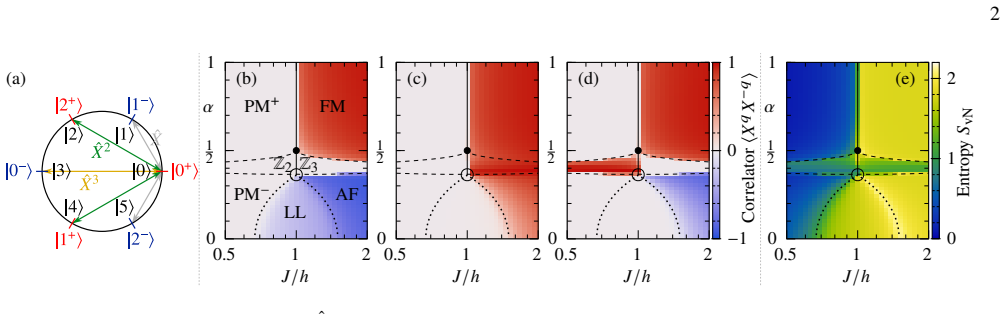
By introducing a one-parameter family of Z6 clock Hamiltonians with competing interactions, the phase diagram contains a line of decoupled Ising-plus-Potts criticality that separates regions breaking Z2 from regions breaking Z3. The floating Luttinger-liquid phase of the clock model terminates at a Z6 parafermion multicritical point that can be identified unambiguously from the finite-size spectrum and from boundary-condition-dependent scaling dimensions.
What carries the argument
The one-parameter family of frustrated Z6 clock Hamiltonians that continuously connects the clock and Potts limits; the combination of boundary conformal field theory and level spectroscopy used to classify the multicritical points.
Load-bearing premise
The chosen generalization of the clock Hamiltonian correctly interpolates between the clock and Potts limits, and level spectroscopy on finite chains unambiguously identifies the parafermion CFT without additional fitting or post-selection of data.
What would settle it
A computation of the low-lying energy levels and their degeneracies at the candidate parafermion point on larger chains that fails to match the expected dimensions and fusion rules of the Z6 parafermion CFT, or an observation that the Z2 and Z3 order parameters remain coupled rather than decoupling independently near the multicritical point.
Figures



read the original abstract
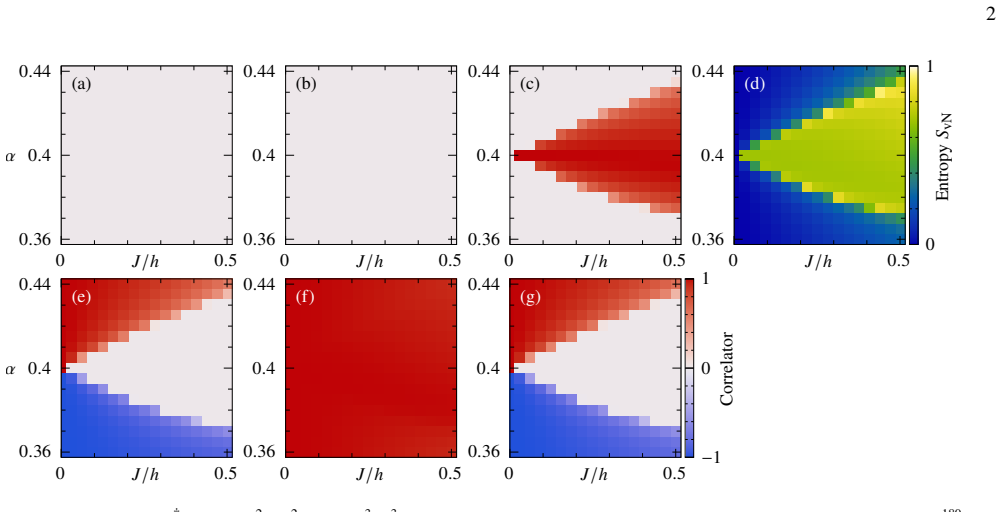
We introduce a generalised six-state clock chain that interpolates between the clock and Potts models via a multicritical point described by decoupled Ising and three-state Potts models. We find that this decoupling extends into stable phases that break only $\mathbb{Z}_2$ or $\mathbb{Z}_3$ symmetry. We also use boundary CFT analysis and level spectroscopy to conclusively identify a $\mathbb{Z}_6$ parafermion multicritical point terminating the clock model Luttinger-liquid phase. Our work shows that parafermions emerge far from integrability, even in systems with intertwined Ising and three-state Potts orders.
Editorial analysis
A structured set of objections, weighed in public.
Referee Report
Summary. The paper introduces a generalized six-state clock chain Hamiltonian interpolating between the standard clock model and the three-state Potts model. It identifies a multicritical point at which the system decouples into independent Ising and Potts models, with this decoupling extending into stable phases that break only Z2 or Z3 symmetry. The authors further apply boundary CFT analysis and level spectroscopy to identify a Z6 parafermion multicritical point terminating the Luttinger-liquid phase of the clock model, claiming that parafermions can emerge far from integrability in systems with intertwined orders.
Significance. If the central identifications hold, the work provides a concrete lattice realization of decoupled multicritical points and Z6 parafermion criticality in a frustrated, non-integrable clock chain. This extends the known settings for parafermionic CFTs beyond integrable models and demonstrates how intertwined Z2 and Z3 orders can still host higher parafermion fixed points, which may inform studies of one-dimensional quantum criticality and potential experimental platforms.
major comments (2)
- [Results (level spectroscopy subsection)] Results section on level spectroscopy: The identification of the Z6 parafermion multicritical point requires the finite-size spectrum (after velocity normalization) to match the expected operator content and degeneracies of the parafermion CFT, including specific scaling dimensions such as 0, 1/6, 1/3, and 2/3 in the appropriate sectors. The manuscript does not provide exhaustive tables of low-lying levels for multiple chain lengths or a quantitative assessment of deviations from the pure parafermion tower versus possible mixing with nearby Ising+Potts operators (c=1.3 vs. 1.25).
- [Model definition (Hamiltonian)] Hamiltonian definition and interpolation: The generalized clock chain is stated to interpolate between clock and Potts limits via a multicritical point of decoupled Ising and Potts models. However, the specific form of the interpolation coupling is not shown to guarantee that the system sits exactly at the pure parafermion fixed point rather than near it, where irrelevant perturbations could distort the spectrum on accessible finite sizes.
minor comments (2)
- [Abstract] Abstract: The phrase 'conclusively identify' should be tempered to reflect the reliance on numerical spectroscopy, which is subject to finite-size effects.
- [Throughout] Notation: Ensure consistent use of Z6 vs. Z_6 throughout the text and figures.
Simulated Author's Rebuttal
We thank the referee for their careful reading of our manuscript and for the positive overall assessment of the work on decoupled multicritical points and Z6 parafermion criticality. We address the two major comments point by point below. Where the comments correctly identify areas for improvement in presentation or detail, we have revised the manuscript accordingly.
read point-by-point responses
-
Referee: Results section on level spectroscopy: The identification of the Z6 parafermion multicritical point requires the finite-size spectrum (after velocity normalization) to match the expected operator content and degeneracies of the parafermion CFT, including specific scaling dimensions such as 0, 1/6, 1/3, and 2/3 in the appropriate sectors. The manuscript does not provide exhaustive tables of low-lying levels for multiple chain lengths or a quantitative assessment of deviations from the pure parafermion tower versus possible mixing with nearby Ising+Potts operators (c=1.3 vs. 1.25).
Authors: We agree that additional spectral data would make the identification more transparent. In the revised manuscript we have added exhaustive tables of the low-lying levels (after velocity normalization) for chain lengths L=12,16,20,24 in the level-spectroscopy subsection. We also include a quantitative comparison of the extracted scaling dimensions to the parafermion values 0, 1/6, 1/3, 2/3, … together with the expected 1/L^2 finite-size corrections. The deviations are shown to decrease systematically with L and to be inconsistent with the degeneracies and central-charge shift that would accompany mixing with the decoupled Ising+Potts tower (c=1.3). The observed spectrum remains compatible with the pure Z6 parafermion CFT (c=1.25) within the resolution of our data. revision: yes
-
Referee: Hamiltonian definition and interpolation: The generalized clock chain is stated to interpolate between clock and Potts limits via a multicritical point of decoupled Ising and Potts models. However, the specific form of the interpolation coupling is not shown to guarantee that the system sits exactly at the pure parafermion fixed point rather than near it, where irrelevant perturbations could distort the spectrum on accessible finite sizes.
Authors: The parafermion point is located by tuning the single interpolation parameter until the finite-size spectrum and boundary CFT data match the parafermion operator content and degeneracies. We have clarified this tuning procedure in the revised model-definition section, showing the explicit value of the coupling at which the match occurs. Because the diagnostic is the spectrum itself, the identified point is at the fixed point within numerical resolution; any residual irrelevant operators produce only the sub-leading 1/L^2 drifts that are already subtracted in the level-spectroscopy analysis. The boundary CFT results, which are insensitive to bulk irrelevant perturbations, provide independent confirmation that the system sits at the parafermion fixed point rather than merely nearby. revision: yes
Circularity Check
No circularity: identification uses independent CFT matching and level spectroscopy on explicitly defined Hamiltonian
full rationale
The paper defines a generalized Z6 clock Hamiltonian that interpolates between known limits, then applies standard boundary CFT analysis and level spectroscopy to match finite-size spectra against the independent Z6 parafermion CFT operator content (scaling dimensions and degeneracies). No step fits a parameter to the target multicritical point and renames it a prediction, invokes a self-citation as a uniqueness theorem, or reduces the identification to a definition or ansatz smuggled from prior work by the same authors. The methods are externally falsifiable against established CFT tables and do not rely on post-selection that would make the result tautological.
Axiom & Free-Parameter Ledger
free parameters (1)
- interpolation coupling
axioms (2)
- domain assumption Boundary conformal field theory correctly describes the low-energy spectrum at the multicritical points
- domain assumption Level spectroscopy on finite open chains faithfully extracts the CFT operator content
Lean theorems connected to this paper
-
Foundation/BranchSelection.lean (RS isolates J via coupling combiner, not Zn parafermion CFT)branch_selection unclear?
unclearRelation between the paper passage and the cited Recognition theorem.
we... conclusively identify a Z6 parafermion multicritical point terminating the clock model Luttinger-liquid phase
What do these tags mean?
- matches
- The paper's claim is directly supported by a theorem in the formal canon.
- supports
- The theorem supports part of the paper's argument, but the paper may add assumptions or extra steps.
- extends
- The paper goes beyond the formal theorem; the theorem is a base layer rather than the whole result.
- uses
- The paper appears to rely on the theorem as machinery.
- contradicts
- The paper's claim conflicts with a theorem or certificate in the canon.
- unclear
- Pith found a possible connection, but the passage is too broad, indirect, or ambiguous to say the theorem truly supports the claim.
Reference graph
Works this paper leans on
-
[1]
A. A. Belavin, A. M. Polyakov, and A. B. Zamolodchikov, In- finite conformal symmetry in two-dimensional quantum field theory, Nucl. Phys. B241, 333 (1984)
1984
-
[2]
Friedan, Z
D. Friedan, Z. Qiu, and S. Shenker, Conformal invariance, uni- tarity,andcriticalexponentsintwodimensions,Phys.Rev.Lett. 52, 1575 (1984)
1984
-
[3]
V. S. Dotsenko and V. A. Fateev, Conformal algebra and multi- pointcorrelationfunctionsin2Dstatisticalmodels,Nucl.Phys. B240, 312 (1984)
1984
-
[4]
V. S. Dotsenko, Critical Behavior and Associated Conformal Algebra of the Z(3) Potts Model, Nucl. Phys. B235, 54 (1984)
1984
-
[5]
V. A. Fateev and A. B. Zamolodchikov, Conformal quantum field theory models in two dimensions havingZ3 symmetry, Nucl. Phys. B280, 644 (1987)
1987
-
[6]
J. L. Cardy, Operator content of two-dimensional conformally invariant theories, Nucl. Phys. B270, 186 (1986)
1986
-
[7]
R. J. Baxter, Eight-vertex model in lattice statistics, Phys. Rev. Lett.26, 832 (1971)
1971
-
[8]
L. P. Kadanoff and F. J. Wegner, Some critical properties of the eight-vertex model, Phys. Rev. B4, 3989 (1971)
1971
-
[9]
C.Fan,OncriticalpropertiesoftheAshkin–Tellermodel,Phys. Lett. A39, 136 (1972). 5
1972
-
[10]
L. P. Kadanoff and A. C. Brown, Correlation functions on the criticallinesoftheBaxterandAshkin–Tellermodels,Ann.Phys. 121, 318 (1979)
1979
-
[11]
Kohmoto, M
M. Kohmoto, M. den Nijs, and L. P. Kadanoff, Hamiltonian studies of the𝑑=2ashkin-teller model, Phys. Rev. B24, 5229 (1981)
1981
-
[12]
R. J. Baxter, Potts model at the critical temperature, J. Phys. C 6, L445 (1973)
1973
-
[13]
F. Y. Wu, The Potts model, Rev. Mod. Phys.54, 235 (1982)
1982
-
[14]
J. V. José, L. P. Kadanoff, S. Kirkpatrick, and D. R. Nelson, Renormalization, vortices, and symmetry-breaking perturba- tions in the two-dimensional planar model, Phys. Rev. B16, 1217 (1977)
1977
-
[15]
Elitzur, R
S. Elitzur, R. B. Pearson, and J. Shigemitsu, Phase structure of discrete abelian spin and gauge systems, Phys. Rev. D19, 3698 (1979)
1979
-
[16]
G.Ortiz,E.Cobanera,andZ.Nussinov,Dualitiesandthephase diagram of the𝑝-clock model, Nucl. Phys. B854, 780 (2012)
2012
-
[17]
G. Sun, T. Vekua, E. Cobanera, and G. Ortiz, Phase transitions in theZ 𝑝 and U(1) clock models, Phys. Rev. B100, 094428 (2019)
2019
-
[18]
V.FateevandA.Zamolodchikov,Self-dualsolutionsofthestar- triangle relations in𝑍𝑁-models, Phys. Lett. A92, 37 (1982)
1982
-
[19]
F. C. Alcaraz and A. Lima Santos, Conservation laws for𝑍(𝑁) symmetric quantum spin models and their exact ground state energies, Nucl. Phys. B275, 436 (1986)
1986
-
[20]
A.B.ZamolodchikovandV.A.Fateev,Nonlocal(parafermion) currents in two-dimensional conformal quantum field theory andself-dualcriticalpointsin𝑍 𝑁-symmetricstatisticalsystems, Sov. Phys. JETP62, 215 (1985)
1985
-
[21]
M.Jimbo,T.Miwa,andM.Okado,Solvablelatticemodelswith broken𝑍 𝑁 symmetry and Hecke’s indefinite modular forms, Nuclear Physics B275, 517 (1986)
1986
-
[22]
G. Albertini, Fateev–Zamolodchikov spin chain: Excitation spectrum,completenessandthermodynamics,Int.J.Mod.Phys. A9, 4921 (1994), arXiv:hep-th/9310133
-
[23]
Fradkin and L
E. Fradkin and L. P. Kadanoff, Disorder variables and para- fermions in two-dimensional statistical mechanics, Nucl. Phys. B170, 1 (1980)
1980
-
[24]
M. S. S. Challa and D. P. Landau, Critical behavior of the six-state clock model in two dimensions, Phys. Rev. B33, 437 (1986)
1986
-
[25]
Matsuo and K
H. Matsuo and K. Nomura, Berezinskii–Kosterlitz–Thouless transitions in the six-state clock model, J. Phys. A39, 2953 (2006)
2006
-
[26]
Irreversibility
A. B. Zamolodchikov, “Irreversibility” of the flux of the renor- malizationgroupina2Dfieldtheory,JETPLett.43,730(1986)
1986
-
[27]
J. L. Cardy, Conformal invariance and statistical mechanics, in Les Houches Summer School in Theoretical Physics: Fields, Strings, Critical Phenomena, Vol. 49 (1988)
1988
-
[28]
P.Francesco,P.Mathieu,andD.Sénéchal,Conformalfieldthe- ory,GraduateTextsinContemporaryPhysics(Springer-Verlag, 1997)
1997
-
[29]
Calabrese and J
P. Calabrese and J. Cardy, Entanglement entropy and quantum field theory, J. Stat. Mech.2004, P06002 (2004)
2004
-
[30]
Chepiga and F
N. Chepiga and F. Mila, Excitation spectrum and density ma- trix renormalization group iterations, Phys. Rev. B96, 054425 (2017)
2017
-
[31]
C. Gils, E. Ardonne, S. Trebst, D. A. Huse, A. W. W. Ludwig, M. Troyer, and Z. Wang, Anyonic quantum spin chains: Spin- 1 generalizations and topological stability, Phys. Rev. B87, 235120 (2013)
2013
-
[32]
Polackova and A
M. Polackova and A. Gendiar, Anisotropic deformation of the 6-state clock model: Tricritical-point classification, Physica A 624, 128907 (2023)
2023
- [33]
-
[34]
Fendley, Parafermionic edge zero modes in𝑍𝑛-invariant spin chains, J
P. Fendley, Parafermionic edge zero modes in𝑍𝑛-invariant spin chains, J. Stat. Mech.2012, P11020 (2012)
2012
-
[35]
J.AliceaandP.Fendley,Topologicalphaseswithparafermions: Theory and blueprints, Annu. Rev. Condens. Matter Phys.7, 119 (2016)
2016
-
[36]
N.Goss,A.Morvan,B.Marinelli,B.K.Mitchell,L.B.Nguyen, R. K. Naik, L. Chen, J. M. Kreikebaum, D. I. Santiago, J. J. Wallman, and I. Siddiqi, High-fidelity qutrit entangling gates for superconducting circuits, Nat. Commun.13, 7481 (2022)
2022
-
[37]
M.Iqbal,A.Lyons,C.F.B.Lo,N.Tantivasadakarn,J.Dreiling, C.Foltz,T.M.Gatterman,D.Gresh,N.Hewitt,C.A.Holliman, J.Johansen,B.Neyenhuis,Y.Matsuoka,M.Mills,S.A.Moses, P. Siegfried, A. Vishwanath, R. Verresen, and H. Dreyer, Qutrit toric code and parafermions in trapped ions, Nat. Commun.16, 6301 (2025), arXiv:2411.04185 [quant-ph]
-
[38]
M. Ringbauer, M. Meth, L. Postler, R. Stricker, R. Blatt, P.Schindler,andT.Monz,Auniversalquditquantumprocessor withtrappedions,Nat.Phys.18,1053(2022),arXiv:2109.06903 [quant-ph]
- [39]
- [40]
-
[41]
S. Taie, R. Yamazaki, S. Sugawa, and Y. Takahashi, An𝑆𝑈(6) Mott insulator of an atomic Fermi gas realized by large-spin Pomeranchuk cooling, Nat. Phys.8, 825 (2012)
2012
-
[42]
Phys.10, 198 (2014)
G.Pagano, M.Mancini, G.Cappellini, P.Lombardi,F.Schäfer, H.Hu,X.-J.Liu,J.Catani,C.Sias,M.Inguscio,andL.Fallani, A one-dimensional liquid of fermions with tunable spin, Nat. Phys.10, 198 (2014)
2014
-
[43]
Scazza, C
F. Scazza, C. Hofrichter, M. Höfer, P. C. De Groot, I. Bloch, and S. Fölling, Observation of two-orbital spin-exchange inter- actions with ultracold𝑆𝑈(𝑁)-symmetric fermions, Nat. Phys. 10, 779 (2014)
2014
- [44]
-
[45]
S. H. Skjærvø, C. H. Marrows, R. L. Stamps, and L. J. Hey- derman, Advances in artificial spin ice, Nat. Rev. Phys.2, 13 (2020)
2020
-
[46]
A.HutterandD.Loss,Quantumcomputingwithparafermions, Phys. Rev. B93, 125105 (2016)
2016
-
[47]
J. Hauschild and F. Pollmann, Efficient numerical simulations withtensornetworks: TensorNetworkPython(TeNPy),SciPost Phys. Lect. Notes5, 10.21468/SciPostPhysLectNotes.5 (2018)
- [48]
-
[49]
2015, arXiv e-prints, arXiv:1509.03700, doi: 10.48550/arXiv.1509.03700
P. Kovesi, Good colour maps: How to design them (2015), ready-made colour maps athttps://colorcet.com, arXiv:1509.03700 [cs.GR]. 6
-
[50]
zero-site
S. Singh, R. N. C. Pfeifer, and G. Vidal, Tensor network states andalgorithmsinthepresenceofaglobalU(1)symmetry,Phys. Rev. B83, 115125 (2011). 7 FIG. 5. (a) Effective Hamiltonian𝐻𝑐𝑑 𝑎𝑏 for estimating the spectrum inFig.4(b). (b)IllustrationoftheconservedZ 6 chargeonthevirtual MPS indices. (c) Evaluating the string operator (11b) in aZ6 sym- metric MPS. Di...
2011
discussion (0)
Sign in with ORCID, Apple, or X to comment. Anyone can read and Pith papers without signing in.