Recognition: unknown
The ALMA survey to Resolve exoKuiper belt Substructures (ARKS) XI: Gas-dust interactions and radial offsets between micron and millimetre-sized grains
Pith reviewed 2026-05-08 17:01 UTC · model grok-4.3
The pith
Gas-dust interactions explain radial offsets between small and large grains in debris disks.
A machine-rendered reading of the paper's core claim, the machinery that carries it, and where it could break.
Core claim
The paper establishes that gas-dust interactions can explain the observed radial offsets in debris disks where the peak of small dust grains lies outward of that for large grains. Numerical simulations reveal that the offset strength increases with gas mass but is limited by the disk's optical depth, which controls how long particles survive collisions before drifting. Additionally, a greater proportion of micron-sized grains leads to more pronounced offsets, while the model indicates that mid-infrared observations would help trace these effects and that secondary rings could develop in scattered light images.
What carries the argument
The radial drift of dust particles induced by gas drag, in competition with their collisional lifetime as set by the disk optical depth.
Load-bearing premise
The simulations rely on specific assumed gas surface density profiles, collisional lifetimes, and optical depth values set to match typical conditions, which if wrong for actual disks would mean the predicted offsets do not hold.
What would settle it
Observing a gas-rich debris disk with no radial offset between small and large grain distributions, or a gas-poor disk with a clear offset, would disprove the gas-dust interaction explanation.
Figures





read the original abstract
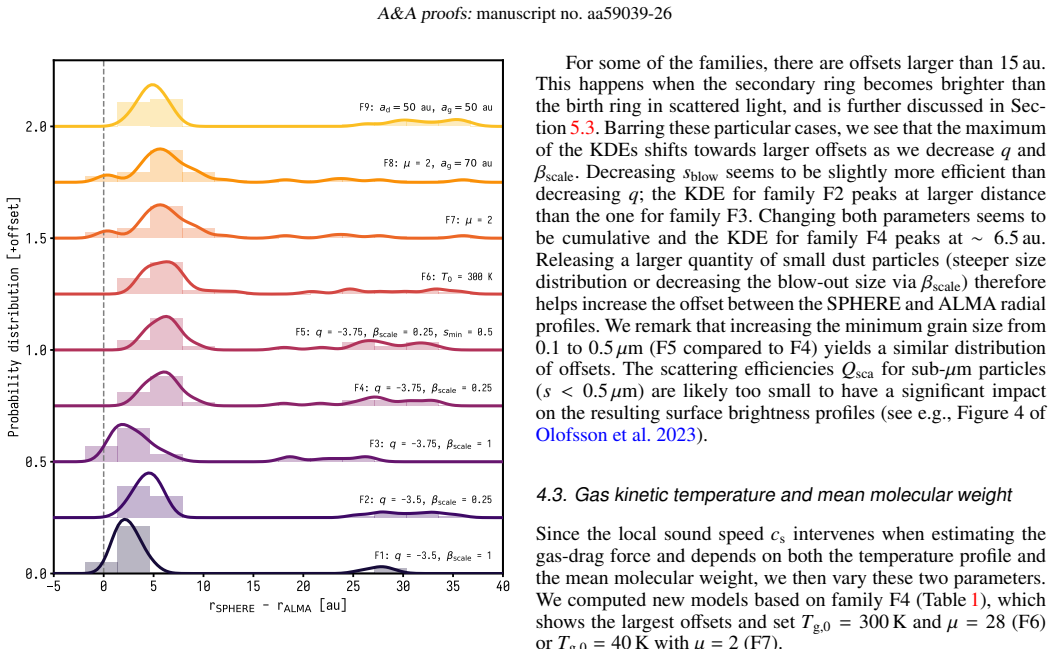
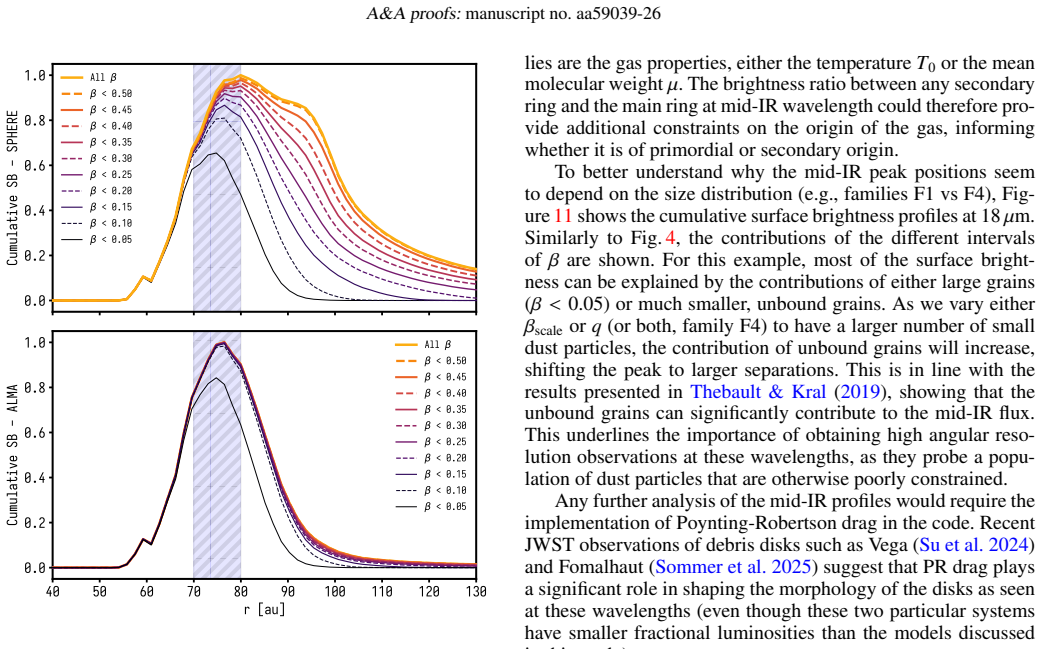
The dust observed in debris disks is the result of a collisional cascade initiated from $\sim$ km-sized parent bodies. Using near-infrared to sub-millimeter observations, we can probe particle sizes spanning 2-3 orders of magnitude, and with sufficient angular resolution we can follow the dynamics of these dust particles. Observations taken as part of the ALMA ARKS program allowed for a detailed comparison with near-infrared scattered light observations, at unprecedented resolution. The comparison between the two wavelength regimes reveals that for most gas-bearing debris disks, the distribution of small dust grains peaks outward of the distribution of large dust grains. In this paper we investigate whether gas-dust interactions can explain such radial offsets. We perform numerical simulations and compute surface brightness profiles at several wavelengths to assess which parameters drive these radial offsets. We find that while larger gas masses lead to more efficient outward radial drift, the resulting radial offset strongly depends on the optical depth of the disk, as the drift efficiency directly competes with the particles' collisional lifetime. We also find that increasing the relative number of $\mu$m-sized dust grains usually yields a larger radial offset between scattered light and millimeter observations. Finally, we show that mid-infrared observations can complement near-infrared and sub-millimeter images, and we discuss the formation of secondary rings at near-infrared wavelengths. The angular resolution achieved by the ARKS program has opened a new avenue to study the dynamics of dust particles in debris disks, revealing unexpected differences between the appearance of the disks scattered light and thermal emission. We showed that gas-dust interactions can explain the observed radial offsets and provide pointers as to which parameters have the most significant impact.
Editorial analysis
A structured set of objections, weighed in public.
Referee Report
Summary. The paper claims that gas-dust interactions explain the observed radial offsets between NIR scattered light (micron grains) and ALMA mm emission (larger grains) in most gas-bearing debris disks from the ARKS survey. Numerical simulations show that larger gas masses enhance outward radial drift, but the offset magnitude depends strongly on optical depth because drift efficiency competes with collisional lifetime; increasing the relative abundance of small grains also increases the offset. The work further discusses mid-IR complementarity and secondary NIR rings.
Significance. If the results hold, this provides a physical mechanism for an unexpected multi-wavelength feature in high-resolution debris disk imaging, highlighting gas's role in dust dynamics. The direct comparison of ARKS ALMA data with NIR observations is a clear strength, as is the exploration of parameter dependencies (gas mass, optical depth, grain abundance). However, the lack of system-specific constraints from the ARKS CO or SED data limits immediate applicability to the observed sample.
major comments (2)
- [Numerical modeling section] Numerical modeling section: The gas surface density profiles, collisional lifetimes, and optical depth values are adopted from generic 'typical' debris-disk conditions rather than derived from the ARKS sample (e.g., via CO line modeling or SED fitting of the specific disks). This assumption is load-bearing for the central claim, because the reported strong dependence of radial offset on optical depth is produced by the competition between drift efficiency and collisional lifetime; if the actual radial profiles or loss terms differ, the predicted offset-τ relation does not hold for the observed systems.
- [Results section] Results section: No quantitative validation of the simulated surface-brightness profiles against the actual ARKS ALMA or NIR data is presented, nor are the simulation code, grid resolution, time-stepping, or initial grain-size distributions described in sufficient detail to allow reproduction or assessment of numerical robustness. This undermines evaluation of whether the reported parameter dependencies (gas mass, optical depth) are reliable.
minor comments (1)
- [Abstract] The abstract states that simulations 'compute surface brightness profiles at several wavelengths' but provides no information on the wavelengths, radiative-transfer method, or assumed grain properties; adding one sentence would improve clarity.
Simulated Author's Rebuttal
We thank the referee for their constructive and detailed report. We address each major comment below and outline the changes we will make to strengthen the manuscript.
read point-by-point responses
-
Referee: [Numerical modeling section] Numerical modeling section: The gas surface density profiles, collisional lifetimes, and optical depth values are adopted from generic 'typical' debris-disk conditions rather than derived from the ARKS sample (e.g., via CO line modeling or SED fitting of the specific disks). This assumption is load-bearing for the central claim, because the reported strong dependence of radial offset on optical depth is produced by the competition between drift efficiency and collisional lifetime; if the actual radial profiles or loss terms differ, the predicted offset-τ relation does not hold for the observed systems.
Authors: We appreciate the referee pointing out this limitation. Our numerical models use representative parameters from the literature on typical debris disks to explore the general dependence of radial offsets on gas mass, optical depth, and grain abundance, rather than performing system-by-system fits. While we agree that incorporating ARKS-specific CO-derived gas masses and SED-constrained optical depths would increase direct applicability, such tailored modeling lies beyond the scope of the present work, which aims to identify the underlying physical mechanisms. In the revised manuscript we will add a new discussion subsection that maps the explored parameter ranges onto published ARKS CO and SED constraints for the gas-bearing targets, and we will explicitly discuss how deviations from the adopted profiles could affect the predicted offset–τ relation. revision: partial
-
Referee: [Results section] Results section: No quantitative validation of the simulated surface-brightness profiles against the actual ARKS ALMA or NIR data is presented, nor are the simulation code, grid resolution, time-stepping, or initial grain-size distributions described in sufficient detail to allow reproduction or assessment of numerical robustness. This undermines evaluation of whether the reported parameter dependencies (gas mass, optical depth) are reliable.
Authors: We agree that the current description of the numerical setup is insufficient for reproducibility and that direct quantitative comparisons with the ARKS data would strengthen the results. In the revised manuscript we will expand the Numerical Modeling section to provide a complete description of the simulation code, spatial grid resolution, time-stepping scheme and convergence criteria, and the adopted initial grain-size distribution together with its physical justification. We will also add a new subsection presenting quantitative comparisons of the simulated radial surface-brightness profiles with representative ARKS ALMA and NIR observations, including measured peak-radius offsets and their agreement with the data, to demonstrate the reliability of the reported parameter dependencies. revision: yes
Circularity Check
No significant circularity; simulation outcomes emerge from physical model rather than tautology.
full rationale
The paper derives its claims about radial offsets from numerical simulations that adopt parameterized gas surface density profiles, collisional lifetimes, and optical depths chosen to represent typical debris-disk conditions. The reported dependencies (e.g., offset magnitude varying with optical depth because outward drift competes with particle lifetime) are computed outputs of the model, not quantities defined into the inputs or fitted to the ARKS data. Surface-brightness profiles are generated at multiple wavelengths and compared to independent ALMA and near-IR observations; no load-bearing step reduces by construction to self-citation, ansatz smuggling, or renaming of known results. The derivation chain is therefore self-contained against external benchmarks.
Axiom & Free-Parameter Ledger
free parameters (3)
- gas mass
- optical depth
- relative abundance of micron grains
axioms (2)
- domain assumption Dust follows Epstein drag in low-density gas.
- domain assumption Collisional lifetime depends on local density and velocities.
Reference graph
Works this paper leans on
-
[1]
A., Weinberger, A
Arnold, J. A., Weinberger, A. J., Videen, G., & Zubko, E. S. 2019, AJ, 157, 157 Astropy Collaboration, Price-Whelan, A. M., Sip ˝o cz, B. M., et al. 2018, AJ, 156, 123 Astropy Collaboration, Robitaille, T. P., Tollerud, E. J., et al. 2013, A&A, 558, A33
2019
-
[2]
L., Vigan, A., Mouillet, D., et al
Beuzit, J. L., Vigan, A., Mouillet, D., et al. 2019, A&A, 631, A155
2019
-
[3]
2017, A&A, 597, L7
Bonnefoy, M., Milli, J., Ménard, F., et al. 2017, A&A, 597, L7
2017
-
[4]
2026, A&A, 705, A201
Brennan, A., Matrà, L., Mac Manamon, S., et al. 2026, A&A, 705, A201
2026
-
[5]
A., Lamy, P
Burns, J. A., Lamy, P. L., & Soter, S. 1979, Icarus, 40, 1
1979
-
[6]
2025, A&A, 698, A183
Desgrange, C., Milli, J., Chauvin, G., et al. 2025, A&A, 698, A183
2025
-
[7]
2021, OpTool: Command-line driven tool for creating complex dust opacities, Astrophysics Source Code Library, record ascl:2104.010
Dominik, C., Min, M., & Tazaki, R. 2021, OpTool: Command-line driven tool for creating complex dust opacities, Astrophysics Source Code Library, record ascl:2104.010
2021
-
[8]
2017, A&A, 601, A7
Feldt, M., Olofsson, J., Boccaletti, A., et al. 2017, A&A, 601, A7
2017
-
[9]
M., Hughes, A
Flaherty, K. M., Hughes, A. M., Andrews, S. M., et al. 2016, ApJ, 818, 97 Gáspár, A., Psaltis, D., Rieke, G. H., & Özel, F. 2012, ApJ, 754, 74
2016
-
[10]
2026, A&A, 705, A196
Han, Y ., Mansell, E., Jennings, J., et al. 2026, A&A, 705, A196
2026
-
[11]
R., Millman, K
Harris, C. R., Millman, K. J., van der Walt, S. J., et al. 2020, Nature, 585, 357
2020
-
[12]
Hunter, J. D. 2007, Computing in Science & Engineering, 9, 90
2007
-
[13]
R., Pawellek, N., Zander, J., et al
Jankovic, M. R., Pawellek, N., Zander, J., et al. 2026, A&A, 705, A204
2026
-
[14]
M., Marino, S., & Wyatt, M
Kral, Q., Matrà, L., Kennedy, G. M., Marino, S., & Wyatt, M. C. 2020, MNRAS, 497, 2811
2020
-
[15]
Krivov, A. V . 2010, Research in Astronomy and Astrophysics, 10, 383
2010
-
[16]
V ., Herrmann, F., Brandeker, A., & Thé bault, P
Krivov, A. V ., Herrmann, F., Brandeker, A., & Thé bault, P. 2009, A&A, 507, 1503
2009
-
[17]
Krivov, A. V . & Wyatt, M. C. 2021, MNRAS, 500, 718
2021
-
[18]
K., Pitrou, A., & Seibert, S
Lam, S. K., Pitrou, A., & Seibert, S. 2015, in Proceedings of the Second Work- shop on the LLVM Compiler Infrastructure in HPC, LLVM ’15 (New York, NY , USA: Association for Computing Machinery)
2015
-
[19]
Lau, T. C. H., Birnstiel, T., Dr˛ a˙ zkowska , J., & Stammler, S. M. 2024, A&A, 688, A22 Mac Manamon, S., Matrà, L., Marino, S., et al. 2026, A&A, 705, A198
2024
-
[20]
R., Matrà , L., & Wyatt, M
Marino, S., Cataldi, G., Jankovic, M. R., Matrà , L., & Wyatt, M. C. 2022, MN- RAS, 515, 507
2022
-
[21]
2020, MNRAS, 492, 4409
Marino, S., Flock, M., Henning, T., et al. 2020, MNRAS, 492, 4409
2020
-
[22]
2026, A&A, 705, A199
Milli, J., Olofsson, J., Bonduelle, M., et al. 2026, A&A, 705, A199
2026
-
[23]
W., & de Koter, A
Min, M., Hovenier, J. W., & de Koter, A. 2005, A&A, 432, 909
2005
-
[24]
2023, A&A, 674, A84
Olofsson, J., Thébault, P., Bayo, A., et al. 2023, A&A, 674, A84
2023
-
[25]
2022, MNRAS, 513, 713
Olofsson, J., Thébault, P., Kral, Q., et al. 2022, MNRAS, 513, 713
2022
-
[26]
2021, A&A, 653, A79
Singh, G., Bhowmik, T., Boccaletti, A., et al. 2021, A&A, 653, A79
2021
-
[27]
2025, MNRAS, 539, 439
Sommer, M., Wyatt, M., & Han, Y . 2025, MNRAS, 539, 439
2025
-
[28]
Strubbe, L. E. & Chiang, E. I. 2006, ApJ, 648, 652
2006
-
[29]
Su, K. Y . L., Gáspár, A., Rieke, G. H., et al. 2024, ApJ, 977, 277
2024
-
[30]
& Artymowicz, P
Takeuchi, T. & Artymowicz, P. 2001, ApJ, 557, 990
2001
-
[31]
& Dominik, C
Tazaki, R. & Dominik, C. 2022, A&A, 663, A57 Thébault, P. 2012, A&A, 537, A65
2022
-
[32]
& Kral, Q
Thebault, P. & Kral, Q. 2019, A&A, 626, A24 Thébault, P., Olofsson, J., & Kral, Q. 2023, A&A, 674, A51 Thébault, P. & Wu, Y . 2008, A&A, 481, 713
2019
-
[33]
2026, A&A, 705, A203
Weber, P., Pérez, S., Baruteau, C., et al. 2026, A&A, 705, A203
2026
-
[34]
2016, A&A, 586, A103
Woitke, P., Min, M., Pinte, C., et al. 2016, A&A, 586, A103
2016
-
[35]
Wyatt, M. C. 2008, ARA&A, 46, 339
2008
-
[36]
& Song, I
Zuckerman, B. & Song, I. 2012, ApJ, 758, 77 1 European Southern Observatory, Karl-Schwarzschild-Strasse 2, 85748 Garching bei München, Germany 2 Institute of Physics Belgrade, University of Belgrade, Pregrevica 118, 11080 Belgrade, Serbia 3 Department of Physics and Astronomy, University of Exeter, Stocker Road, Exeter EX4 4QL, UK 4 Astrophysikalisches In...
2012
discussion (0)
Sign in with ORCID, Apple, or X to comment. Anyone can read and Pith papers without signing in.