Recognition: 2 theorem links
· Lean TheoremDiscovery of the first outbursting hot subdwarf binary: ZTF J0007+4804
Pith reviewed 2026-05-08 17:58 UTC · model grok-4.3
The pith
ZTF J000742.62+480414.51 is the first hot subdwarf-white dwarf binary to show dwarf nova outbursts.
A machine-rendered reading of the paper's core claim, the machinery that carries it, and where it could break.
Core claim
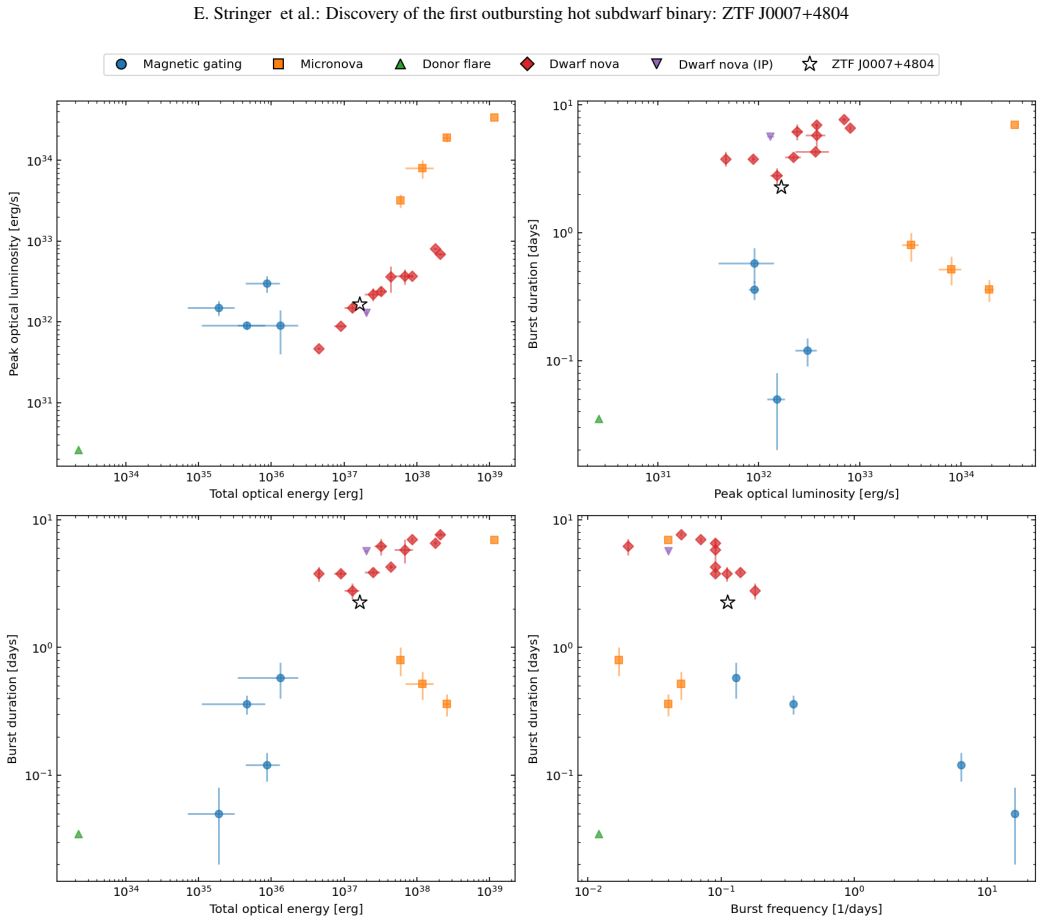
ZTF J000742.62+480414.51 consists of an accreting 0.48 solar mass white dwarf with a 0.42 solar mass B-type hot subdwarf acting as a donor. The system exhibits SU UMa type dwarf nova outbursts with a recurrence time of approximately 9 days. The orbital period is 108.72 minutes, the system lies in the Galactic thin disk, and modeling indicates it formed from a main-sequence binary with component masses at least 2 solar masses and will likely merge into a single white dwarf.
What carries the argument
The accretion disk around the white dwarf that produces the dwarf nova outbursts, together with Lomb-Scargle period analysis, time-resolved spectroscopy, and light-curve modeling that together fix the component masses, effective temperatures, and orbital period.
If this is right
- The system is expected to merge into a single white dwarf on a timescale set by angular-momentum loss.
- A thermonuclear explosion remains possible and cannot yet be excluded.
- No X-ray emission is detected, with an upper limit of roughly 3 times 10 to the 31 erg per second.
- The binary formed from a main-sequence pair whose stars each had initial masses of at least 2 solar masses.
Where Pith is reading between the lines
- Additional short-period hot subdwarf binaries may show similar outbursts once monitored at sufficient photometric cadence.
- Population synthesis calculations for hot subdwarf-white dwarf systems can now be tested against an observed case that includes active accretion.
- Targeted X-ray or ultraviolet follow-up during future outbursts could directly constrain the accretion rate and disk temperature.
Load-bearing premise
The observed brightening events arise from an accretion disk around the white dwarf and the light-curve plus spectroscopic modeling returns unbiased component masses and temperatures despite possible disk light or distance uncertainties.
What would settle it
High-resolution spectra taken during a brightening event that show no hydrogen-rich disk features or mass-transfer signatures, or a revised distance or photometric solution that moves the component masses outside the quoted 0.01 solar mass uncertainties.
Figures






read the original abstract
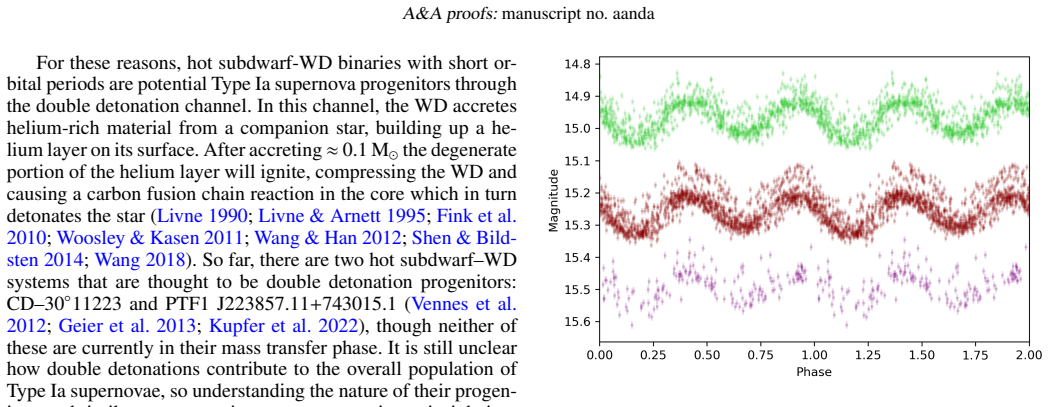
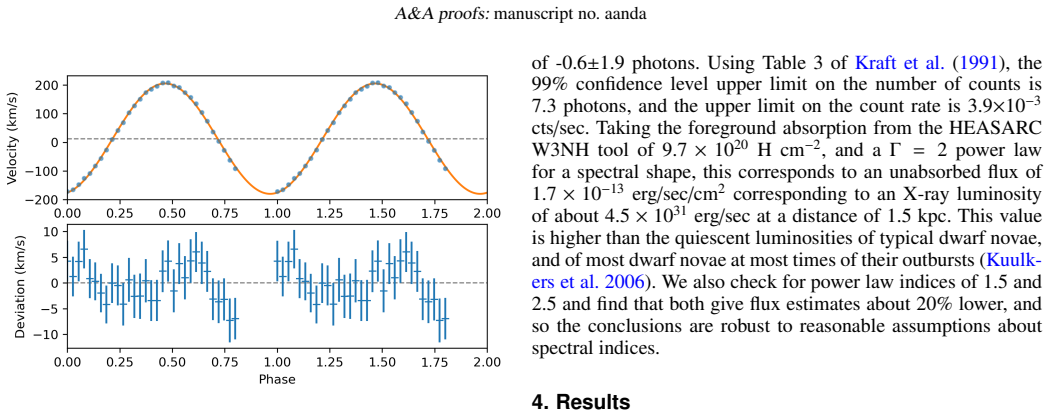
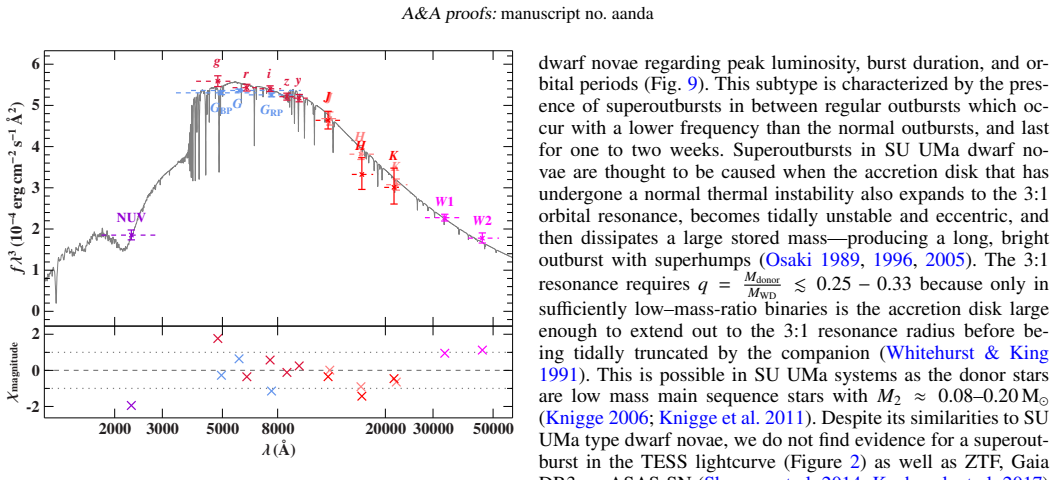
Hot subdwarf binaries with white dwarf companions with orbital periods of less than two hours are progenitor candidates for massive single white dwarfs as well as a variety of thermonuclear explosions. Our aim is to determine the binary properties of the hot subdwarf -- white dwarf system ZTF J000742.62+480414.51, model its future evolution, and characterize the brightening events seen in TESS photometry. Using data from ZTF and TESS, we performed a Lomb Scargle analysis to find the orbital period and the period of the brightening events. Analysis of time-resolved spectroscopy was combined with light curve modeling to determine the effective temperature, surface gravity, and radius of the primary star, the masses of both stars, and to confirm the presence of an accretion disk. X-ray observations were performed with Swift, and MESA modeling was used to find the future evolution of the system. The kinematics of the system were also calculated. ZTF J000742.62+480414.51 consists of an accreting $0.48\pm0.01\,M_\odot$ white dwarf with a $0.42\pm0.01\,M_\odot$ B-type hot subdwarf acting as a donor. The system exhibits SU UMa type dwarf nova outbursts with a recurrence time of $P_{\mathrm{out}} \approx 9$ days. No X-rays were detected, with an upper limit on the X-ray luminosity of about $3\times10^{31}$ erg/sec. The system lies in the Galactic thin disk, and has an orbital period of $P_{\mathrm{orb}} = 108.72\pm0.01$ minutes. The system has likely formed from a main sequence binary with component masses $\gtrsim2\,\mathrm{M_{\odot}}$ and will likely merge into a single white dwarf, but a thermonuclear explosion cannot be ruled out. ZTF J000742.62+480414.51 consists of a low mass white dwarf actively accreting hydrogen rich material from a B-type hot subdwarf, and is the first hot subdwarf -- white dwarf system discovered that produces dwarf nova outbursts.
Editorial analysis
A structured set of objections, weighed in public.
Referee Report
Summary. The manuscript reports the discovery of ZTF J000742.62+480414.51 as the first hot subdwarf-white dwarf binary exhibiting SU UMa-type dwarf nova outbursts. Using ZTF and TESS photometry, an orbital period of 108.72 ± 0.01 minutes and outburst recurrence of approximately 9 days are determined. Time-resolved spectroscopy combined with light-curve modeling yields component masses of 0.48 ± 0.01 M⊙ for the accreting white dwarf and 0.42 ± 0.01 M⊙ for the B-type hot subdwarf donor, along with confirmation of an accretion disk. MESA evolutionary models indicate the system will likely merge into a single white dwarf, though a thermonuclear explosion cannot be excluded. No X-ray emission is detected, and the system is located in the Galactic thin disk.
Significance. If the derived parameters and disk interpretation hold, this is a significant discovery as the first observed hot subdwarf binary with dwarf nova outbursts. It provides a new observational anchor for binary evolution models of short-period systems, accretion physics in low-mass donors, and potential pathways to white dwarf mergers or thermonuclear events. The multi-survey photometric and spectroscopic approach, combined with evolutionary modeling, strengthens the case for using time-domain data to identify rare progenitor systems.
major comments (2)
- [§4] §4 (light-curve and spectroscopic modeling): The reported masses of 0.48±0.01 M⊙ and 0.42±0.01 M⊙ carry quoted uncertainties that do not include quantified systematic contributions from possible accretion-disk continuum in the spectra or from distance/reddening assumptions in the light-curve decomposition. These systematics can shift the inferred radii and log g by amounts comparable to the stated errors, directly impacting the central mass and temperature claims.
- [§2.2] §2.2 (photometric analysis of outbursts): The SU UMa classification rests on the ~9-day recurrence time and TESS light-curve morphology, but the text provides no search for or upper limits on superhump periods, which are the standard photometric diagnostic used to confirm this subtype. Without this, the classification remains tentative and affects the interpretation of the accretion disk.
minor comments (2)
- [Abstract] Abstract: No mention is made of how distance, reddening, or disk-contamination uncertainties were handled, which would improve reader assessment of the parameter robustness.
- [Figures] Figure captions: Several photometry figures lack annotations for the orbital and outburst periods, reducing clarity for readers.
Simulated Author's Rebuttal
We thank the referee for their careful and constructive review of our manuscript. We have addressed each major comment below and revised the manuscript accordingly to strengthen the analysis and interpretations.
read point-by-point responses
-
Referee: [§4] §4 (light-curve and spectroscopic modeling): The reported masses of 0.48±0.01 M⊙ and 0.42±0.01 M⊙ carry quoted uncertainties that do not include quantified systematic contributions from possible accretion-disk continuum in the spectra or from distance/reddening assumptions in the light-curve decomposition. These systematics can shift the inferred radii and log g by amounts comparable to the stated errors, directly impacting the central mass and temperature claims.
Authors: We agree that systematic uncertainties from the accretion-disk continuum and distance/reddening assumptions warrant explicit quantification. The original uncertainties were statistical only. In the revised manuscript we have added a new subsection in §4 that quantifies these effects: we re-fit the spectra allowing a variable disk continuum contribution (0–30% of the flux) and re-ran the light-curve decomposition with both Gaia and photometric distances plus two reddening maps. The resulting shifts in log g and radius are ≤0.04 dex and ≤0.02 R⊙, propagating to mass uncertainties of ~0.015 M⊙. We have therefore updated the reported masses to 0.48 ± 0.02 M⊙ and 0.42 ± 0.02 M⊙ (statistical plus systematic added in quadrature) while retaining the central values. This change does not affect our conclusions but makes the error budget more complete and transparent. revision: yes
-
Referee: [§2.2] §2.2 (photometric analysis of outbursts): The SU UMa classification rests on the ~9-day recurrence time and TESS light-curve morphology, but the text provides no search for or upper limits on superhump periods, which are the standard photometric diagnostic used to confirm this subtype. Without this, the classification remains tentative and affects the interpretation of the accretion disk.
Authors: We acknowledge that a dedicated search for superhumps would provide stronger confirmation of the SU UMa subtype. In the revised §2.2 we have added a periodogram analysis of the TESS data restricted to the outburst intervals. No significant periodic signal is detected at periods 1–5% longer than the orbital period; we place a 3σ upper limit of 0.005 mag on any superhump amplitude. This non-detection is consistent with some short-period SU UMa systems in which superhumps are weak or transient. We have updated the text to report this search and the upper limit, thereby reinforcing both the SU UMa classification and the presence of an accretion disk while noting that the recurrence time and morphology remain the primary diagnostics. revision: yes
Circularity Check
No circularity: masses, periods and evolution derived from external data and standard codes
full rationale
The paper obtains orbital period via Lomb-Scargle on ZTF/TESS photometry, component masses and temperatures via time-resolved spectroscopy plus light-curve modeling, X-ray limits from Swift, and future evolution from MESA runs. None of these steps reduce by construction to a fitted parameter or self-citation that is itself defined by the present work; the modeling assumptions are external and the quoted values are direct outputs of the data reduction. No load-bearing uniqueness theorem or ansatz is imported from the authors' prior papers.
Axiom & Free-Parameter Ledger
free parameters (2)
- component masses
- orbital period
axioms (1)
- domain assumption Standard assumptions of stellar atmospheres and Roche-lobe overflow in close binaries
Reference graph
Works this paper leans on
-
[1]
M., & et al
Astropy Collaboration, Price-Whelan, A. M., & et al. 2018, AJ, 156, 123 Astropy Collaboration, Robitaille, T. P., Tollerud, E. J., et al. 2013, A&A, 558, A33
2018
-
[2]
N., Corcoran, K
Barlow, B. N., Corcoran, K. A., Parker, I. M., et al. 2022, ApJ, 928, 20
2022
-
[3]
Bauer, E. B. & Kupfer, T. 2021, ApJ, 922, 245
2021
-
[4]
Bellm, E. C. & et al. 2019, PASP, 131, 018002
2019
-
[5]
2017, ApJS, 230, 24
Bianchi, L., Shiao, B., & Thilker, D. 2017, ApJS, 230, 24
2017
-
[6]
J., Parsons, S
Brown, A. J., Parsons, S. G., Littlefair, S. P., et al. 2022, MNRAS, 513, 3050
2022
-
[7]
N., Hill, J
Burrows, D. N., Hill, J. E., Nousek, J. A., et al. 2000, in Society of Photo-Optical Instrumentation Engineers (SPIE) Conference Series, V ol. 4140, X-Ray and Gamma-Ray Instrumentation for Astronomy XI, ed. K. A. Flanagan & O. H. Siegmund, 64–75
2000
-
[8]
2016, ApJ, 823, 102
Choi, J., Dotter, A., Conroy, C., et al. 2016, ApJ, 823, 102
2016
-
[9]
2017, A&A, 600, A30
Claret, A. 2017, A&A, 600, A30
2017
-
[10]
& Bloemen, S
Claret, A. & Bloemen, S. 2011, A&A, 529, A75
2011
-
[11]
M., Marsh, T
Copperwheat, C. M., Marsh, T. R., Dhillon, V . S., et al. 2010, MNRAS, 402, 1824
2010
-
[12]
M., Morales-Rueda, L., Marsh, T
Copperwheat, C. M., Morales-Rueda, L., Marsh, T. R., Maxted, P. F. L., & Heber, U. 2011, MNRAS, 415, 1381
2011
-
[13]
M., Skrutskie, M
Cutri, R. M., Skrutskie, M. F., van Dyk, S., et al. 2003, 2MASS All Sky Catalog of point sources
2003
-
[14]
2026, A&A, 707, A6
Dawson, H., Dorsch, M., Geier, S., et al. 2026, A&A, 707, A6
2026
-
[15]
B., Kupfer, T., & Dorsch, M
Deshmukh, K., Bauer, E. B., Kupfer, T., & Dorsch, M. 2024, MNRAS, 527, 2072
2024
-
[16]
2023, MNRAS, 519, 148
Deshmukh, K., Kupfer, T., Hakala, P., et al. 2023, MNRAS, 519, 148
2023
-
[17]
S., Bezawada, N., Black, M., et al
Dhillon, V . S., Bezawada, N., Black, M., et al. 2021, MNRAS, 507, 350
2021
-
[18]
S., Marsh, T
Dhillon, V . S., Marsh, T. R., Atkinson, D. C., et al. 2014, MNRAS, 444, 4009
2014
-
[19]
A., et al
Dye, S., Lawrence, A., Read, M. A., et al. 2018, MNRAS, 473, 5113
2018
-
[20]
K., Hillebrandt, W., et al
Fink, M., Röpke, F. K., Hillebrandt, W., et al. 2010, A&A, 514, A53
2010
-
[21]
L., Massa, D., Gordon, K
Fitzpatrick, E. L., Massa, D., Gordon, K. D., Bohlin, R., & Clayton, G. C. 2019, ApJ, 886, 108
2019
-
[22]
2001, PASP, 113, 409
Fontaine, G., Brassard, P., & Bergeron, P. 2001, PASP, 113, 409
2001
-
[23]
W., Lang, D., & Goodman, J
Foreman-Mackey, D., Hogg, D. W., Lang, D., & Goodman, J. 2013, PASP, 125, 306 Article number, page 9 of 13 A&A proofs:manuscript no. aanda Gaia Collaboration, Brown, A. G. A., Vallenari, A., et al. 2021, A&A, 649, A1 Gaia Collaboration, Prusti, T., de Bruijne, J. H. J., et al. 2016, A&A, 595, A1 Gaia Collaboration, Vallenari, A., Brown, A. G. A., et al. 2...
2013
-
[24]
R., Wang, B., et al
Geier, S., Marsh, T. R., Wang, B., et al. 2013, A&A, 554, A54
2013
-
[25]
P., & Marsh, T
Geier, S., Raddi, R., Gentile Fusillo, N. P., & Marsh, T. R. 2019, A&A, 621, A38
2019
-
[26]
Giddings, J. R. 1981, Ph.d. thesis, University of London
1981
-
[27]
Graham, M. J. & et al. 2019, PASP, 131, 078001
2019
-
[28]
M., Schlafly, E., Zucker, C., Speagle, J
Green, G. M., Schlafly, E., Zucker, C., Speagle, J. S., & Finkbeiner, D. 2019, ApJ, 887, 93
2019
-
[29]
Hameury, J. M. 2020, Advances in Space Research, 66, 1004
2020
-
[30]
Han, Z., Podsiadlowski, P., Maxted, P. F. L., & Marsh, T. R. 2003, MNRAS, 341, 669
2003
-
[31]
Han, Z., Podsiadlowski, P., Maxted, P. F. L., Marsh, T. R., & Ivanova, N. 2002, MNRAS, 336, 449
2002
-
[32]
2009, ARA&A, 47, 211
Heber, U. 2009, ARA&A, 47, 211
2009
-
[33]
2016, PASP, 128, 082001
Heber, U. 2016, PASP, 128, 082001
2016
-
[34]
2018, Open Astronomy, 27, 35
Heber, U., Irrgang, A., & Schaffenroth, J. 2018, Open Astronomy, 27, 35
2018
-
[35]
2026, arXiv e-prints, arXiv:2602.15692
Heber, U., Kufleitner, L., Dorsch, M., et al. 2026, arXiv e-prints, arXiv:2602.15692
-
[36]
S., Kupfer, T., Belloni, D., & Schreiber, M
Hernandez, M. S., Kupfer, T., Belloni, D., & Schreiber, M. R. 2026, arXiv e- prints, arXiv:2602.04421
-
[37]
E., Zugger, M
Hill, J. E., Zugger, M. E., Shoemaker, J., et al. 2000, in Society of Photo-Optical Instrumentation Engineers (SPIE) Conference Series, V ol. 4140, X-Ray and Gamma-Ray Instrumentation for Astronomy XI, ed. K. A. Flanagan & O. H. Siegmund, 87–98
2000
-
[38]
Houck, J. C. & Denicola, L. A. 2000, in Astronomical Society of the Pacific Con- ference Series, V ol. 216, Astronomical Data Analysis Software and Systems IX, ed. N. Manset, C. Veillet, & D. Crabtree, 591 Iłkiewicz, K., Scaringi, S., Veresvarska, M., et al. 2024, ApJ, 962, L34
2000
-
[39]
2014, PhD thesis, University of Erlangen-Nuremberg, Germany
Irrgang, A. 2014, PhD thesis, University of Erlangen-Nuremberg, Germany
2014
-
[40]
2013, A&A, 549, A137
Irrgang, A., Wilcox, B., Tucker, E., & Schiefelbein, L. 2013, A&A, 549, A137
2013
-
[41]
S., Bauer, E
Jermyn, A. S., Bauer, E. B., Schwab, J., et al. 2023, ApJS, 265, 15
2023
-
[42]
2006, MNRAS, 373, 484
Knigge, C. 2006, MNRAS, 373, 484
2006
-
[43]
2011, ApJS, 194, 28
Knigge, C., Baraffe, I., & Patterson, J. 2011, ApJS, 194, 28
2011
-
[44]
S., Shappee, B
Kochanek, C. S., Shappee, B. J., Stanek, K. Z., et al. 2017, PASP, 129, 104502
2017
-
[45]
P., Burrows, D
Kraft, R. P., Burrows, D. N., & Nousek, J. A. 1991, ApJ, 374, 344
1991
-
[46]
B., van Roestel, J., et al
Kupfer, T., Bauer, E. B., van Roestel, J., et al. 2022, ApJ, 925, L12
2022
-
[47]
Kurucz, R. L. 1996, in Astronomical Society of the Pacific Conference Series, V ol. 108, M.A.S.S., Model Atmospheres and Spectrum Synthesis, ed. S. J
1996
-
[48]
2006, in Compact stellar X-ray sources, ed
Kuulkers, E., Norton, A., Schwope, A., & Warner, B. 2006, in Compact stellar X-ray sources, ed. W. H. G. Lewin & M. van der Klis, V ol. 39, 421–460
2006
-
[49]
& Breger, M
Lenz, P. & Breger, M. 2005, Communications in Asteroseismology, 146, 53
2005
-
[50]
A., Wolf, C., et al
Li, J., Onken, C. A., Wolf, C., et al. 2022, MNRAS, 515, 3370
2022
-
[51]
A., Hernández, J., et al
Lindegren, L., Klioner, S. A., Hernández, J., et al. 2021, A&A, 649, A2
2021
-
[52]
& Arnett, D
Livne, E. & Arnett, D. 1995, ApJ, 452, 62
1995
-
[53]
Lomb, N. R. 1976, Ap&SS, 39, 447
1976
-
[54]
A., Schlafly, E
Magnier, E. A., Schlafly, E. F., Finkbeiner, D. P., et al. 2020, ApJS, 251, 6
2020
-
[55]
C., Fanson, J., Schiminovich, D., et al
Martin, D. C., Fanson, J., Schiminovich, D., et al. 2005, ApJ, 619, L1
2005
-
[56]
J., Laher, R
Masci, F. J., Laher, R. R., Rusholme, B., et al. 2019, PASP, 131, 018003
2019
-
[57]
Maxted, P. F. L., Heber, U., Marsh, T. R., & North, R. C. 2001, MNRAS, 326, 1391
2001
-
[58]
2022, ApJ, 931, 13
Mereghetti, S., La Palombara, N., Kupfer, T., et al. 2022, ApJ, 931, 13
2022
-
[59]
A., Lisker, T., et al
Napiwotzki, R., Karl, C. A., Lisker, T., et al. 2004, Ap&SS, 291, 321
2004
-
[60]
1989, Publications of the Astronomical Society of Japan, 41, 1005
Osaki, Y . 1989, Publications of the Astronomical Society of Japan, 41, 1005
1989
-
[61]
1996, in Cataclysmic Variables and Related Objects, ed
Osaki, Y . 1996, in Cataclysmic Variables and Related Objects, ed. A. B. Editor (Astronomical Society of the Pacific)
1996
-
[62]
2005, Proceedings of the Japan Academy, Series B, 81, 291
Osaki, Y . 2005, Proceedings of the Japan Academy, Series B, 81, 291
2005
-
[63]
2016, MNRAS, 460, 2526
Otulakowska-Hypka, M., Olech, A., & Patterson, J. 2016, MNRAS, 460, 2526
2016
-
[64]
2011, ApJS, 192, 3
Paxton, B., Bildsten, L., Dotter, A., et al. 2011, ApJS, 192, 3
2011
-
[65]
2013, ApJS, 208, 4
Paxton, B., Cantiello, M., Arras, P., et al. 2013, ApJS, 208, 4
2013
-
[66]
2015, ApJS, 220, 15
Paxton, B., Marchant, P., Schwab, J., et al. 2015, ApJS, 220, 15
2015
-
[67]
B., et al
Paxton, B., Schwab, J., Bauer, E. B., et al. 2018, ApJS, 234, 34
2018
-
[68]
2019, ApJS, 243, 10
Paxton, B., Smolec, R., Schwab, J., et al. 2019, ApJS, 243, 10
2019
-
[69]
Pelisoli, I., V os, J., Geier, S., Schaffenroth, V ., & Baran, A. S. 2020, A&A, 642, A180
2020
-
[70]
2020, The Journal of Open Source Software, 5, 2308
Prochaska, J., Hennawi, J., Westfall, K., et al. 2020, The Journal of Open Source Software, 5, 2308
2020
-
[71]
2011, in Journal of Physics Conference
Przybilla, N., Nieva, M.-F., & Butler, K. 2011, in Journal of Physics Conference
2011
-
[72]
2007, in Astronomical Society of the Pacific Conference Series, V ol
Richter, R., Heber, U., & Napiwotzki, R. 2007, in Astronomical Society of the Pacific Conference Series, V ol. 372, 15th European Workshop on White Dwarfs, ed. R. Napiwotzki & M. R. Burleigh, 107
2007
-
[73]
R., Winn, J
Ricker, G. R., Winn, J. N., Vanderspek, R., et al. 2015, Journal of Astronomical
2015
-
[74]
2020, The Astronomer’s Telegram, 13444, 1 Rivera Sandoval, L
Telescopes, Instruments, and Systems, 1, 014003 Rivera Sandoval, L., Murawski, G., Copperwheat, C., & Maccarone, T. 2020, The Astronomer’s Telegram, 13444, 1 Rivera Sandoval, L. E., Maccarone, T., & Murawski, G. 2019, The Astronomer’s Telegram, 12847, 1
2020
-
[75]
C., Reylé, C., Derrière, S., & Picaud, S
Robin, A. C., Reylé, C., Derrière, S., & Picaud, S. 2003, A&A, 409, 523
2003
-
[76]
Scargle, J. D. 1982, ApJ, 263, 835
1982
-
[77]
F., Meisner, A
Schlafly, E. F., Meisner, A. M., & Green, G. M. 2019, ApJS, 240, 30
2019
-
[78]
C., Vrba, F
Schneider, A. C., Vrba, F. J., Bruursema, J., et al. 2025, AJ, 170, 86
2025
-
[79]
& Bauer, E
Schwab, J. & Bauer, E. B. 2021, ApJ, 920, 110
2021
-
[80]
J., Prieto, J
Shappee, B. J., Prieto, J. L., Grupe, D., et al. 2014, ApJ, 788, 48
2014
discussion (0)
Sign in with ORCID, Apple, or X to comment. Anyone can read and Pith papers without signing in.