Recognition: unknown
Universal Theory of Incoherent Metals
Pith reviewed 2026-05-08 17:32 UTC · model grok-4.3
The pith
The two-dimensional Yukawa-SYK model accounts for incoherent metallic transport in quantum-critical systems through a non-Boltzmann resistivity-lifetime relation and violations of established bounds.
A machine-rendered reading of the paper's core claim, the machinery that carries it, and where it could break.
Core claim
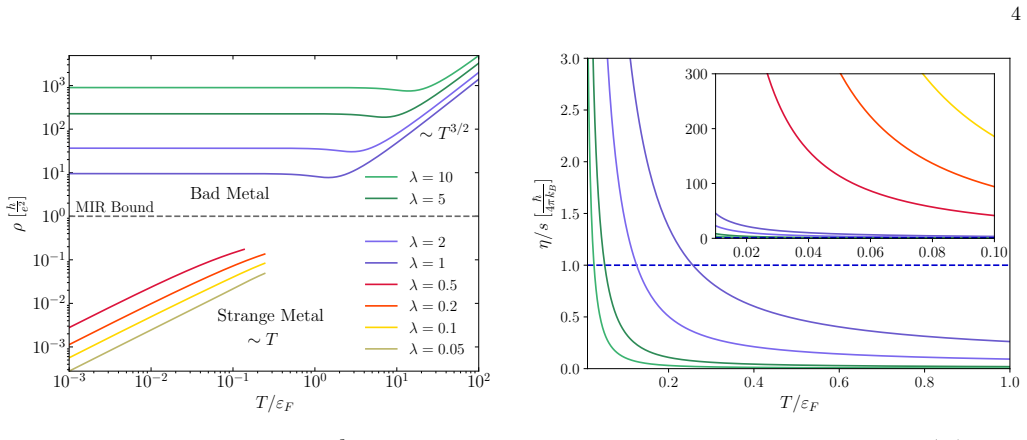
The two-dimensional Yukawa-SYK model of fermions with spatially random coupling to quantum-critical bosons serves as a microscopic model for quantum-critical incoherent metals, producing a non-Boltzmann transport formula between resistivity and quasiparticle lifetime, along with violations of the Mott-Ioffe-Regel resistivity bound and the Kovtun-Son-Starinets shear viscosity to entropy density bound.
What carries the argument
The two-dimensional Yukawa-SYK model with spatially random coupling to quantum-critical bosons, which permits a non-perturbative treatment of transport.
If this is right
- Resistivity and quasiparticle lifetime follow a non-Boltzmann transport formula.
- Resistivity can exceed the Mott-Ioffe-Regel bound.
- The shear viscosity to entropy density ratio can fall below the Kovtun-Son-Starinets bound.
- These features describe transport in materials that exhibit incoherent metallic behavior above the superconducting critical temperature.
Where Pith is reading between the lines
- The random spatial coupling may highlight the role of inhomogeneity in producing incoherence across a wider class of strongly interacting electron systems.
- Direct probes of shear viscosity in two-dimensional materials could provide an independent test of the predicted bound violation.
- The framework suggests that similar non-perturbative methods could be applied to other models with quantum-critical bosonic modes.
Load-bearing premise
The two-dimensional Yukawa-SYK model with spatially random coupling to quantum-critical bosons faithfully captures the essential physics of real materials such as cuprates and twisted-bilayer graphene.
What would settle it
A measurement in cuprate or twisted-bilayer-graphene samples that checks whether resistivity scales with quasiparticle lifetime according to the specific non-Boltzmann relation derived from the model, or whether the viscosity-to-entropy ratio falls below the Kovtun-Son-Starinets bound.
Figures


read the original abstract
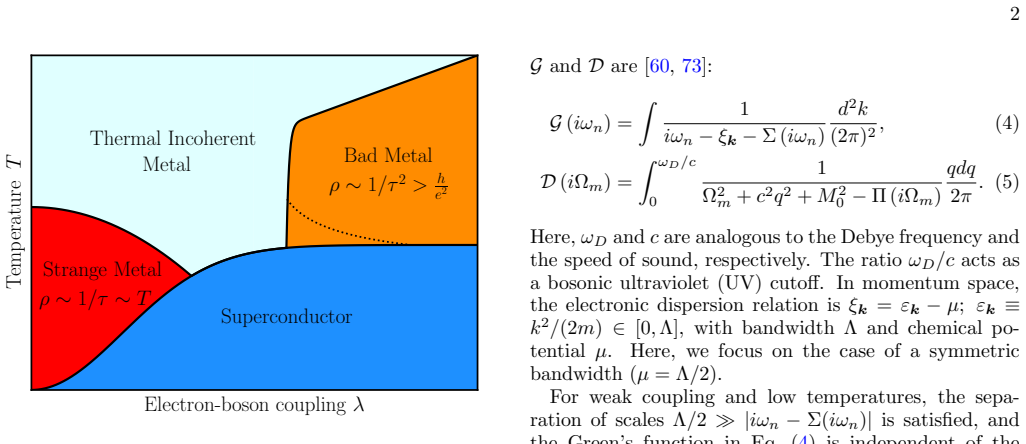
Numerous unconventional superconductors such as cuprates, heavy-fermions, and twisted-bilayer graphene exhibit incoherent metallic transport above the superconducting critical temperature. This phenomenon cannot be described with Fermi-liquid theory and has presented a significant theoretical challenge to overcome. We utilize the two-dimensional Yukawa-SYK model of fermions with spatially random coupling to quantum-critical bosons to study transport in a manner which is non-perturbative in the coupling strength. Our work provides a microscopic model of quantum-critical incoherent metals and their concomitant properties, including a non-Boltzmann transport formula between resistivity and quasi-particle lifetime, violation of the Mott-Ioffe-Regel resistivity bound, and violation of the Kovtun-Son-Starinets shear viscosity to entropy density bound.
Editorial analysis
A structured set of objections, weighed in public.
Referee Report
Summary. The manuscript introduces the two-dimensional Yukawa-SYK model with spatially random couplings between fermions and quantum-critical bosons as a microscopic, non-perturbative (large-N) framework for incoherent metallic transport above the superconducting dome in materials such as cuprates and twisted-bilayer graphene. It reports a non-Boltzmann relation between resistivity and quasiparticle lifetime together with explicit violations of the Mott-Ioffe-Regel resistivity bound and the Kovtun-Son-Starinets shear-viscosity-to-entropy-density bound.
Significance. If the reported transport relations and bound violations can be shown to survive deformations of the microscopic Hamiltonian, the work would supply a concrete, solvable example of quantum-critical incoherent transport that could guide interpretation of strange-metal phenomenology. The non-perturbative large-N treatment and the absence of free parameters in the final transport formula are positive features.
major comments (2)
- [Abstract] Abstract and title: the designation 'Universal Theory' is not supported by any demonstration that the non-Boltzmann resistivity-lifetime relation or the bound violations remain unchanged when the boson dispersion, the Yukawa vertex structure, or the spatial correlation of the random couplings are altered; the saddle-point equations are solved only for the specific 2D Yukawa-SYK ensemble.
- [Model and saddle-point analysis] The central claim of a parameter-free non-Boltzmann transport formula rests on the large-N saddle-point solution after disorder averaging, yet no explicit derivation, error estimate, or comparison to the perturbative limit is supplied to confirm that the relation is independent of microscopic details rather than an artifact of the chosen disorder ensemble and dimensionality.
minor comments (1)
- [Abstract] The abstract would be clearer if it stated the large-N limit and the two-dimensional setting at the outset.
Simulated Author's Rebuttal
We thank the referee for the careful reading of our manuscript and the constructive feedback. We provide point-by-point responses to the major comments and indicate the revisions we plan to implement.
read point-by-point responses
-
Referee: [Abstract] Abstract and title: the designation 'Universal Theory' is not supported by any demonstration that the non-Boltzmann resistivity-lifetime relation or the bound violations remain unchanged when the boson dispersion, the Yukawa vertex structure, or the spatial correlation of the random couplings are altered; the saddle-point equations are solved only for the specific 2D Yukawa-SYK ensemble.
Authors: We agree that our use of 'Universal Theory' in the title and abstract implies a level of generality that has not been explicitly demonstrated through variations of the microscopic details. The present work solves the saddle-point equations specifically for the 2D Yukawa-SYK model with spatially random couplings. The non-Boltzmann relation and bound violations are derived within this framework. To address the concern, we will change the title to 'Microscopic Theory of Incoherent Metals in the 2D Yukawa-SYK Model' and revise the abstract to emphasize that this model provides a concrete, solvable example of such transport properties. We will also add a paragraph discussing why we expect these features to be robust in similar quantum-critical models with random interactions. revision: yes
-
Referee: [Model and saddle-point analysis] The central claim of a parameter-free non-Boltzmann transport formula rests on the large-N saddle-point solution after disorder averaging, yet no explicit derivation, error estimate, or comparison to the perturbative limit is supplied to confirm that the relation is independent of microscopic details rather than an artifact of the chosen disorder ensemble and dimensionality.
Authors: The derivation of the saddle-point equations following disorder averaging is provided in the main text, where the effective action leads to self-consistent equations for the fermion and boson propagators. The transport is obtained from the current-current correlator in the large-N limit. The absence of free parameters results from the scaling properties in the critical regime. We acknowledge that an expanded presentation would be beneficial. In the revised manuscript, we will include a dedicated appendix with the full step-by-step derivation of the resistivity from the saddle-point solution, an estimate of subleading 1/N corrections, and a comparison to the perturbative weak-coupling limit in which the conventional Boltzmann transport is recovered. This will help demonstrate that the non-Boltzmann behavior is characteristic of the strong-coupling incoherent regime rather than specific to the ensemble chosen. revision: yes
- Explicit verification that the non-Boltzmann relation and bound violations persist under changes to the boson dispersion, Yukawa vertex, or spatial correlation of couplings is not provided in the manuscript and would require further model variations and solutions.
Circularity Check
No significant circularity detected; derivation is a direct large-N saddle-point solution of the specified model.
full rationale
The paper defines the 2D Yukawa-SYK Hamiltonian with spatially random Yukawa couplings, performs the disorder average, and solves the resulting saddle-point equations non-perturbatively in the large-N limit to extract the Green's functions, self-energies, and transport quantities. The non-Boltzmann resistivity-lifetime relation, MIR violation, and KSS violation are computed outputs of those equations for the chosen microscopic Hamiltonian; they are not obtained by fitting parameters to the target observables and then relabeling the fit as a prediction, nor by self-citation of an unverified uniqueness theorem, nor by smuggling an ansatz. The derivation chain is therefore self-contained relative to the model's stated assumptions and does not reduce to its inputs by construction. Claims of universality for the broader class of quantum-critical incoherent metals are interpretive rather than part of the formal derivation.
Axiom & Free-Parameter Ledger
axioms (1)
- domain assumption The two-dimensional Yukawa-SYK model with spatially random coupling captures the essential physics of quantum-critical incoherent metals in the cited material classes.
Reference graph
Works this paper leans on
-
[1]
E. T. Whittaker and G. N. Watson,A Course of Modern Analysis, 4th ed. (Cambridge University Press, Cam- bridge, 1996)
1996
-
[2]
F. W. J. Olver,Asymptotics and Special Functions (Academic Press, Inc., New York, 1974)
1974
-
[3]
1 + 1 (Ω/ωD)2 + 2πλ|Ω|/ε F # dΩ ωD = T ωD X Ωm log
Lewin,Dilogarithmis and Associated Functions(Mac- donald and Co., London, 1958). Supplemental Material: Universal Theory of Incoherent Metals Aaron Kleger, 1,∗ Nikolay Gnezdilov,1,† and Rufus Boyack 1,‡ 1Department of Physics and Astronomy, Dartmouth College, Hanover, New Hampshire 03755, USA Contents I. The model 2 A. Normal-state Green’s functions 2 B. ...
1958
-
[4]
Esterlis and J
I. Esterlis and J. Schmalian, Cooper pairing of incoherent electrons: An electron-phonon version of the Sachdev-Ye-Kitaev model, Phys. Rev. B100, 115132 (2019)
2019
-
[5]
Wang, Solvable Strong-Coupling Quantum-Dot Model with a Non-Fermi-Liquid Pairing Transition, Phys
Y. Wang, Solvable Strong-Coupling Quantum-Dot Model with a Non-Fermi-Liquid Pairing Transition, Phys. Rev. Lett. 124, 017002 (2020)
2020
-
[6]
Sachdev, Quantum spin glasses and Sachdev-Ye-Kitaev models (2024), arXiv:2402.17824 [hep-th]
S. Sachdev, Quantum spin glasses and Sachdev-Ye-Kitaev models (2024), arXiv:2402.17824 [hep-th]
-
[7]
N. V. Gnezdilov and R. Boyack, Upper bound onT c in a strongly coupled electron-boson superconductor, Phys. Rev. B 112, L180504 (2025)
2025
-
[8]
A. A. Abrikosov, L. P. Gor’kov, and I. Y. Dzyaloshinskii,Quantum field theoretical methods in statistical physics, 2nd ed. (Pergamon press Ltd., Oxford, 1965)
1965
-
[9]
Esterlis, H
I. Esterlis, H. Guo, A. A. Patel, and S. Sachdev, Large-Ntheory of critical Fermi surfaces, Phys. Rev. B103, 235129 (2021)
2021
-
[10]
Marsiglio and J
F. Marsiglio and J. P. Carbotte, Electron-Phonon Superconductivity, inSuperconductivity, Conventional and Unconven- tional Superconductors, edited by K. H. Bennemann and J. B. Ketterson (Springer, Berlin, 2008) pp. 73–162
2008
-
[11]
A. A. Patel, J. McGreevy, D. P. Arovas, and S. Sachdev, Magnetotransport in a Model of a Disordered Strange Metal, Phys. Rev. X8, 021049 (2018)
2018
-
[12]
E. T. Whittaker and G. N. Watson,A Course of Modern Analysis, 4th ed. (Cambridge University Press, Cambridge, 1996)
1996
-
[13]
Classen and A
L. Classen and A. Chubukov, Superconductivity of incoherent electrons in the Yukawa Sachdev-Ye-Kitaev model, Phys. Rev. B104, 125120 (2021)
2021
-
[14]
G. Pan, W. Wang, A. Davis, Y. Wang, and Z. Y. Meng, Yukawa-SYK model and self-tuned quantum criticality, Phys. Rev. Res.3, 013250 (2021)
2021
-
[15]
F. W. J. Olver,Asymptotics and Special Functions(Academic Press, Inc., New York, 1974)
1974
-
[16]
J. M. Luttinger and J. C. Ward, Ground-State Energy of a Many-Fermion System. II, Phys. Rev.118, 1417 (1960)
1960
-
[17]
G. M. Eliashberg, The low temperature specific heat of metals, Sov. Phys. JETP16, 780 (1963)
1963
-
[18]
Zhang, E
S.-S. Zhang, E. Berg, and A. V. Chubukov, Free energy and specific heat near a quantum critical point of a metal, Phys. 30 Rev. B107, 144507 (2023)
2023
-
[19]
Lewin,Dilogarithmis and Associated Functions(Macdonald and Co., London, 1958)
1958
-
[20]
Crisan and C
M. Crisan and C. P. Moca, Specific heat of a marginal Fermi liquid, Journal of Superconductivity9, 49 (1996)
1996
-
[21]
G. D. Mahan,Many-Particle Physics, 2nd ed. (Plenum Press, New York, 1990)
1990
-
[22]
C. M. Varma, P. B. Littlewood, S. Schmitt-Rink, E. Abrahams, and A. E. Ruckenstein, Phenomenology of the normal state of Cu-O high-temperature superconductors, Phys. Rev. Lett.63, 1996 (1989)
1996
-
[23]
Marsiglio, M
F. Marsiglio, M. Schossmann, and J. P. Carbotte, Iterative analytic continuation of the electron self-energy to the real axis, Phys. Rev. B37, 4965 (1988)
1988
-
[24]
A. E. Karakozov, E. G. Maksimov, and S. A. Mashkov, Effect of the frequency dependence of the electron-phonon interaction spectral function on the thermodynamic properties of superconductors, Sov. Phys. JETP41, 971 (1975)
1975
-
[25]
Schmalian, M
J. Schmalian, M. Langer, S. Grabowski, and K. Bennemann, Self-consistent summation of many-particle diagrams on the real frequency axis and its application to the FLEX approximation, Computer Physics Communications93, 141 (1996)
1996
-
[26]
I. Esterlis and J. Schmalian, Quantum Critical Eliashberg Theory (2025), arXiv:2506.11952 [cond-mat.str-el]
-
[27]
Dotsenko,Introduction to the Replica Theory of Disordered Statistical Systems(Cambridge University Press, Cambridge, 2001)
V. Dotsenko,Introduction to the Replica Theory of Disordered Statistical Systems(Cambridge University Press, Cambridge, 2001)
2001
-
[28]
A. A. Patel, H. Guo, I. Esterlis, and S. Sachdev, Universal theory of strange metals from spatially random interactions, Science381, 790 (2023)
2023
-
[29]
J. M. Ziman,Electrons and Phonons(Oxford University Press, Clarendon, 1960)
1960
- [30]
-
[31]
N. F. Mott, Conduction in non-crystalline systems IX. the minimum metallic conductivity, The Philosophical Magazine: A Journal of Theoretical Experimental and Applied Physics26, 1015 (1972)
1972
-
[32]
N. E. Hussey, K. Takenaka, and H. Takagi, Universality of the Motte-Ioffe-Regel limit in metals, Philosophical Magazine 84, 2847 (2004)
2004
-
[33]
L. P. Kadanoff and P. C. Martin, Hydrodynamic equations and correlation functions, Annals of Physics24, 419 (1963)
1963
-
[34]
Hosoya, M
A. Hosoya, M. aki Sakagami, and M. Takao, Nonequilibrium thermodynamics in field theory: Transport coefficients, Annals of Physics154, 229 (1984)
1984
-
[35]
Ge, S.-K
X.-H. Ge, S.-K. Jian, Y.-L. Wang, Z.-Y. Xian, and H. Yao, Violation of the viscosity/entropy bound in translationally invariant non-Fermi liquids, Phys. Rev. Res.2, 023366 (2020)
2020
-
[36]
J. M. Luttinger, Theory of Thermal Transport Coefficients, Phys. Rev.135, A1505 (1964)
1964
-
[37]
Taylor and M
E. Taylor and M. Randeria, Viscosity of strongly interacting quantum fluids: Spectral functions and sum rules, Phys. Rev. A81, 053610 (2010)
2010
-
[38]
Bradlyn, M
B. Bradlyn, M. Goldstein, and N. Read, Kubo formulas for viscosity: Hall viscosity, Ward identities, and the relation with conductivity, Phys. Rev. B86, 245309 (2012)
2012
-
[39]
He and K
Y. He and K. Levin, Establishing conservation laws in pair-correlated many-body theories:T-matrix approaches, Phys. Rev. B89, 035106 (2014)
2014
-
[40]
Kovtun, D
P. Kovtun, D. T. Son, and A. O. Starinets, Holography and hydrodynamics: diffusion on stretched horizons, Journal of High Energy Physics2003, 064 (2003)
2003
-
[41]
S. A. Hartnoll, Theory of universal incoherent metallic transport, Nature Physics11, 54 (2015)
2015
-
[42]
Hartman, S
T. Hartman, S. A. Hartnoll, and R. Mahajan, Upper Bound on Diffusivity, Phys. Rev. Lett.119, 141601 (2017)
2017
-
[43]
Valentinis, G
D. Valentinis, G. A. Inkof, and J. Schmalian, Correlation between phase stiffness and condensation energy across the non-Fermi to Fermi-liquid crossover in the Yukawa-Sachdev-Ye-Kitaev model on a lattice, Phys. Rev. Res.5, 043007 (2023)
2023
discussion (0)
Sign in with ORCID, Apple, or X to comment. Anyone can read and Pith papers without signing in.