Recognition: 2 theorem links
Resolving the Multiphase Outflow, Shock Signatures, and PAHs in the AGN-Starburst Composite ULIRG F10565+2448 with JWST MIRI/MRS
Pith reviewed 2026-05-08 17:45 UTC · model grok-4.3
The pith
New JWST observations show both AGN and star formation drive the multiphase outflows in the ULIRG F10565+2448
A machine-rendered reading of the paper's core claim, the machinery that carries it, and where it could break.
Core claim
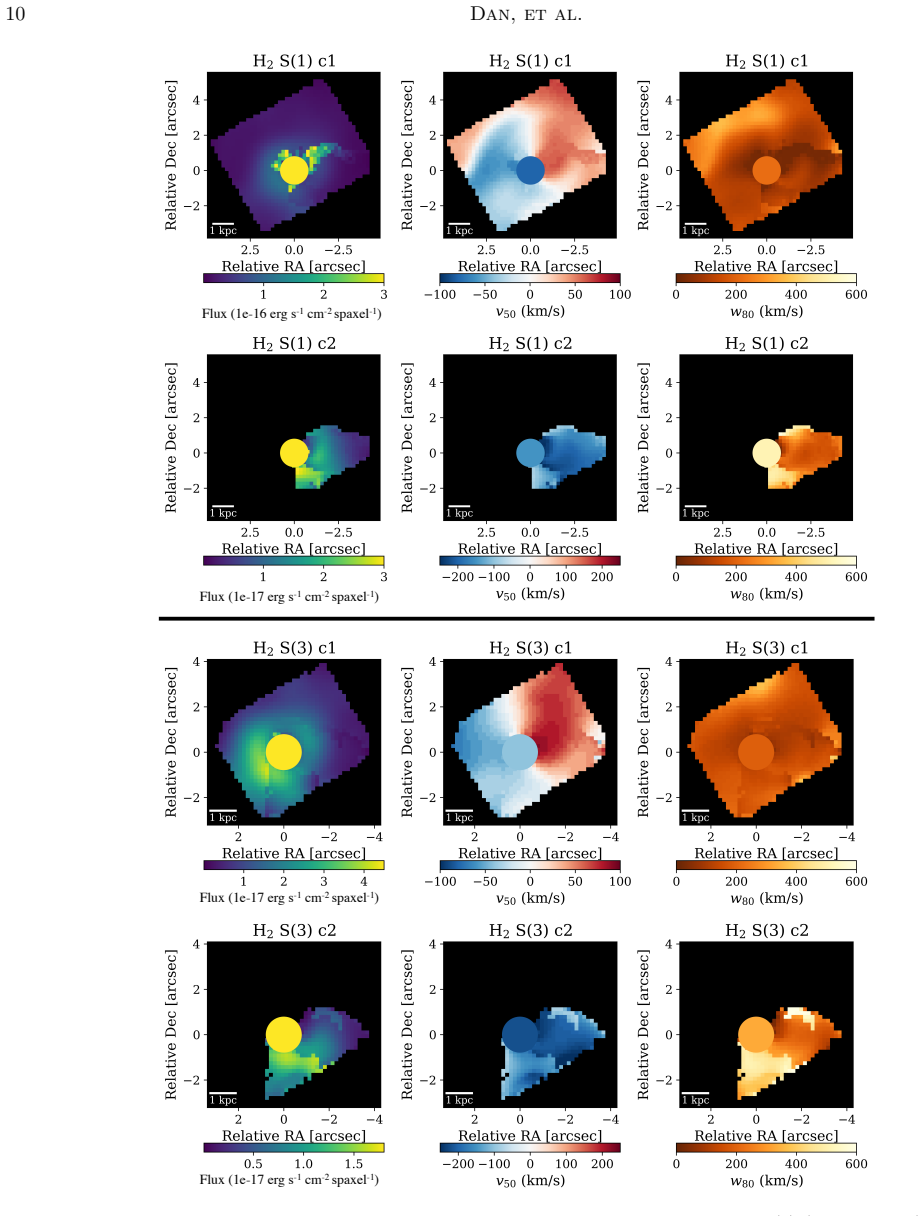
The central claim is that the multiphase outflows in F10565+2448, featuring ionized gas velocities up to -520 km/s and molecular outflows at -150 km/s unresolved plus slower resolved components, along with [Fe II]/Pfα shock signatures and radial PAH trends, demonstrate that the galaxy is an AGN-starburst composite requiring both star formation and AGN-powered phenomena to explain the outflow energetics.
What carries the argument
The multiphase (warm-ionized and warm-molecular) outflow and the [Fe II] 5.34 μm/Pfα ratio as a shock diagnostic that helps identify contributions from different energy sources.
If this is right
- The outflow energetics cannot be accounted for by star formation or AGN activity alone.
- The resolved warm-molecular outflow is only slightly faster than the disk rotation and likely bound to the galaxy.
- Areas of higher temperature and lower column density in the outflow suggest the presence of shock fronts.
- PAH features display ionization and grain size trends that first decrease then increase with radius out to 3 kpc.
Where Pith is reading between the lines
- Observations of other similar galaxies could test whether composite AGN-starburst driving is a common feature of ULIRGs.
- This work implies that feedback models should account for the combined effects of AGN and starbursts on gas expulsion.
- The identified shock signatures and PAH variations may help identify composite systems in larger surveys.
Load-bearing premise
The assumption that the measured projected velocities and the [Fe II]/Pfα ratio indicate shocks and that the outflows do not exceed the escape velocity.
What would settle it
If the total energy in the outflows can be fully explained by star formation alone or if velocities are found to exceed escape speed without AGN contribution, the requirement for both mechanisms would be falsified.
Figures





read the original abstract
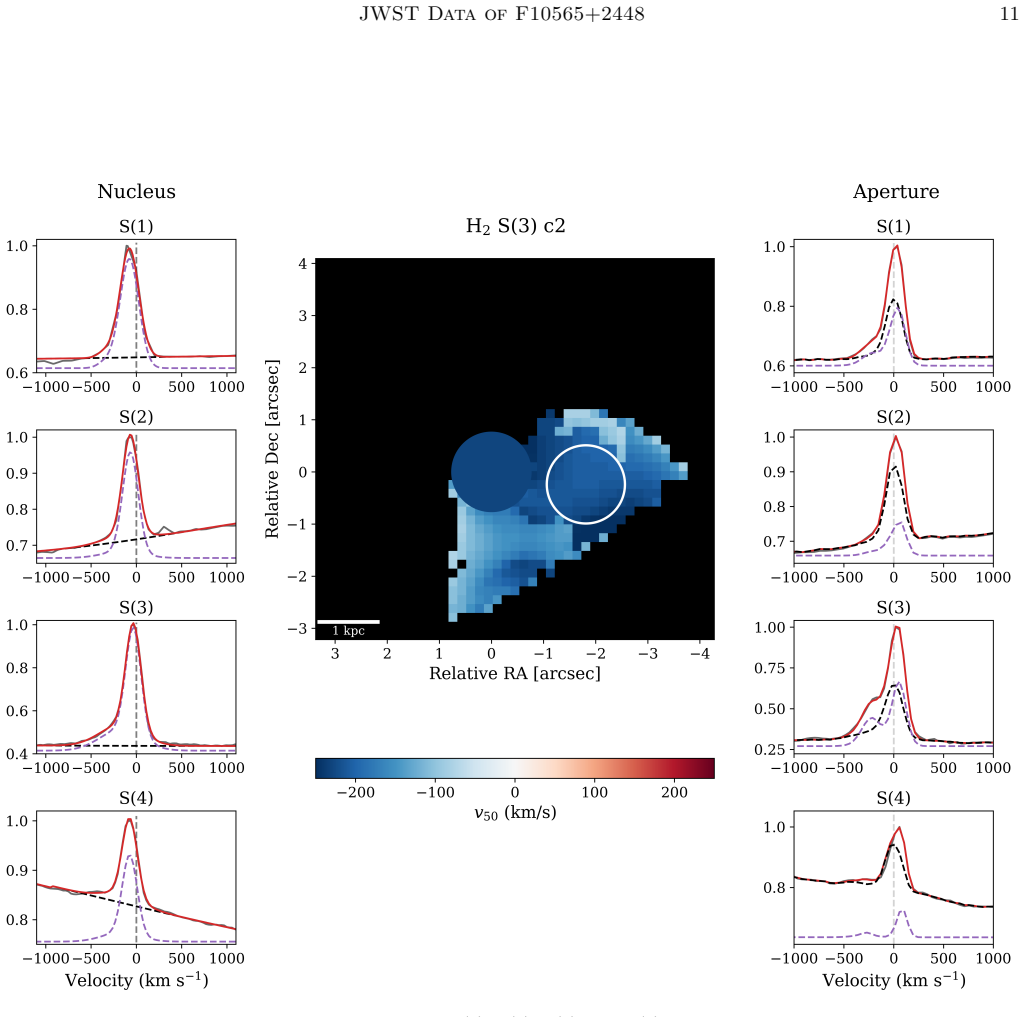
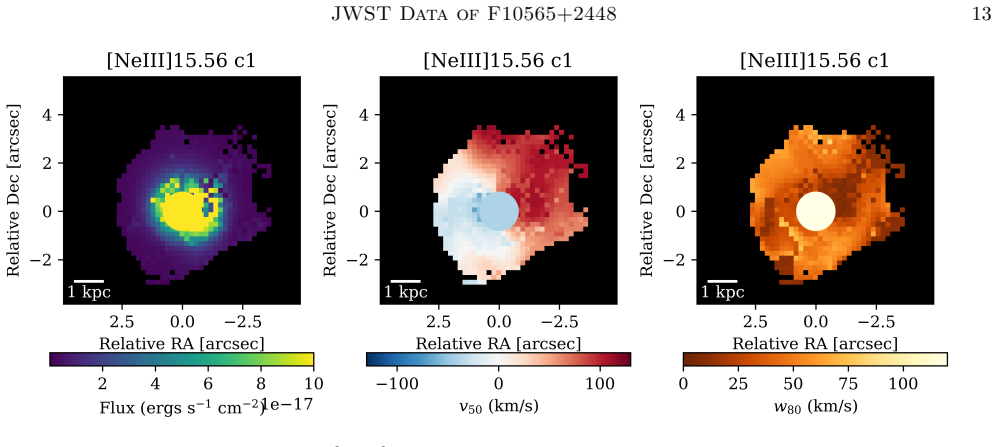
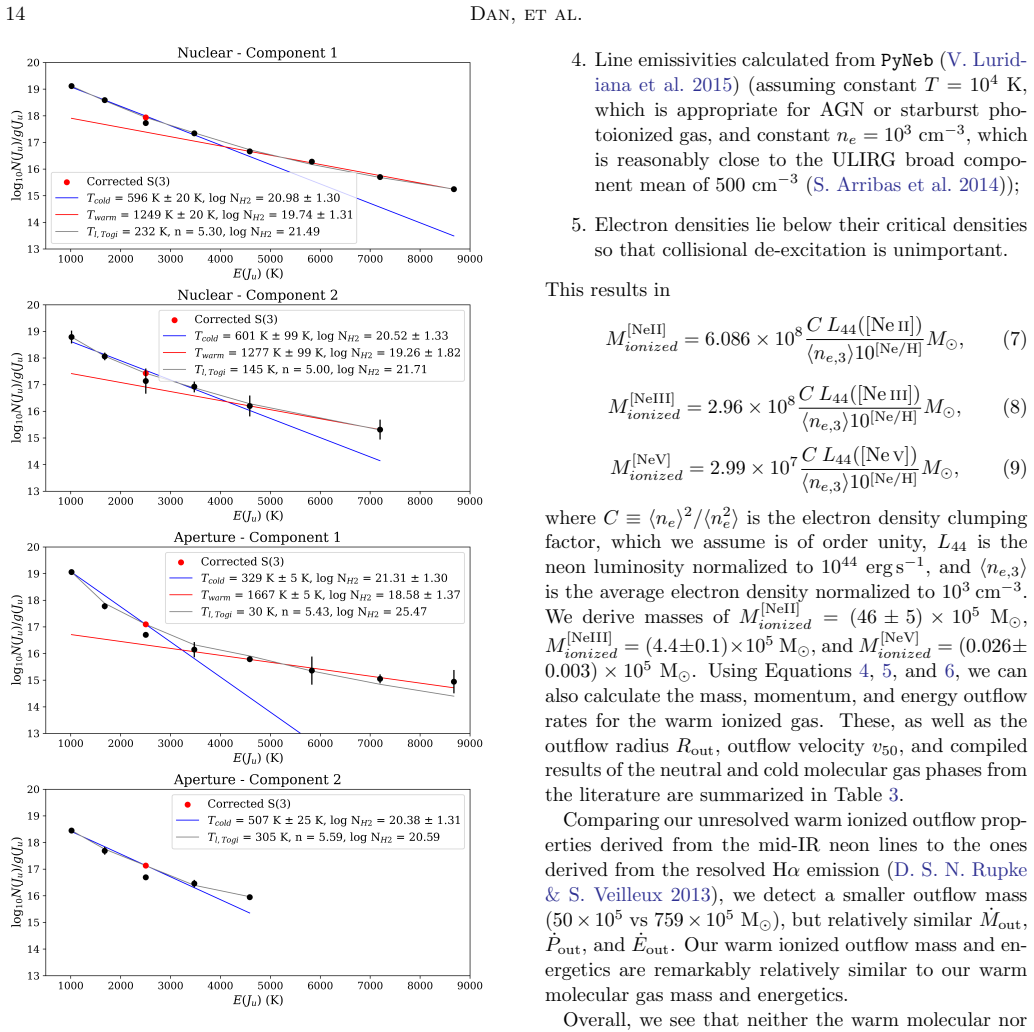
We present new James Webb Space Telescope Mid-Infrared Instrument (MIRI) Medium-Resolution Spectrometer (MRS) observations of the nearby ultra-luminous infrared galaxy F10565+2448. These integral field spectroscopic data reveal an unresolved nuclear outflow in both warm-ionized and warm-molecular gas phases as well as a resolved blueshifted kpc-scale warm-molecular outflow. The unresolved warm-ionized outflow has a mean projected velocity up to $-520$ km/s, while the unresolved warm-molecular outflow is slower at $-150$ km/s. For the resolved warm-molecular outflow, the projected mean velocity ($-280 < v_{50} < -110$ km/s) is only slightly faster than the velocity of the disk ($-70 < v_{50} < 120$ km/s) and as such likely does not exceed the estimated escape velocity of $\gtrsim 300$ km/s. The warm-molecular outflow is slightly hotter ($507 \pm 25$K) than the disk ($329 \pm 5$K), and displays areas of higher temperature and lower column density that may indicate a shock front, which we explore using the [Fe II] 5.34 $\mu$m/Pf$\alpha$ shock diagnostic. Analysis of the polycyclic aromatic hydrocarbon features reveal trends of ionization and grain size that first decrease with radius up to 1 kpc before increasing up to 3 kpc. These results bolster the picture of F10565+2448 being an AGN-starburst composite where both star formation and AGN-powered phenomena are required to explain the outflow energetics.
Editorial analysis
A structured set of objections, weighed in public.
Referee Report
Summary. The paper reports JWST MIRI/MRS integral field spectroscopy of the ULIRG F10565+2448, identifying an unresolved nuclear outflow in warm-ionized gas with mean projected velocity up to -520 km/s and in warm-molecular gas at -150 km/s, as well as a resolved kpc-scale warm-molecular outflow with projected velocities between -280 and -110 km/s. It measures the molecular gas temperature as 507 ± 25 K in the outflow versus 329 ± 5 K in the disk, identifies potential shock fronts using the [Fe II] 5.34 μm/Pfα ratio, and analyzes PAH features showing radial trends in ionization and grain size that decrease to 1 kpc then increase to 3 kpc. The authors conclude that these observations support F10565+2448 as an AGN-starburst composite where both components are needed to explain the outflow energetics.
Significance. If the interpretations of the velocities, shock signatures, and energetics hold, this work provides valuable spatially resolved mid-infrared spectroscopy of a nearby ULIRG, offering concrete measurements of multiphase outflows and PAH properties that contribute to the understanding of AGN-starburst interactions and feedback processes. The use of new JWST data allows for detailed kinematic and excitation analysis not previously available. Strengths include the reporting of specific velocity, temperature, and ratio values from the observations.
major comments (3)
- Abstract: The central claim that both star formation and AGN-powered phenomena are required to explain the outflow energetics lacks a quantitative energy budget comparison (e.g., outflow kinetic luminosity versus supernova energy input from the star formation rate or AGN bolometric luminosity). Without this, the necessity of the AGN component for the observed velocities and shocks remains interpretive rather than demonstrated.
- Abstract: The escape velocity is given as ≳300 km/s without the underlying dynamical mass, radius, or derivation method. Since all reported velocities are line-of-sight projections (ionized up to -520 km/s, molecular -280 to -110 km/s) with no inclination correction or statistical deprojection discussed, it is unclear whether any component exceeds escape velocity or is unbound.
- Abstract: The [Fe II] 5.34 μm/Pfα ratio is used to explore shock fronts in the warm-molecular outflow, but no measured numerical values, model thresholds, error bars, or alternative explanations (such as AGN photoionization) are provided. This makes the shock interpretation and its link to the composite nature difficult to evaluate.
minor comments (2)
- Abstract: The PAH ionization and grain size trends are described qualitatively; a table or plot summarizing the radial changes with uncertainties would improve clarity.
- Abstract: Velocities are reported as ranges or means without consistent uncertainties; adding error estimates where derived from the spectra would strengthen the presentation.
Simulated Author's Rebuttal
We thank the referee for their constructive comments on our manuscript. We address each of the major comments in detail below and have revised the manuscript to incorporate the suggested improvements where possible.
read point-by-point responses
-
Referee: Abstract: The central claim that both star formation and AGN-powered phenomena are required to explain the outflow energetics lacks a quantitative energy budget comparison (e.g., outflow kinetic luminosity versus supernova energy input from the star formation rate or AGN bolometric luminosity). Without this, the necessity of the AGN component for the observed velocities and shocks remains interpretive rather than demonstrated.
Authors: We agree that providing a quantitative energy budget comparison would make the argument more robust. The original manuscript includes a discussion of the outflow energetics in Section 4, comparing the observed velocities to those expected from starburst-driven winds and AGN feedback. However, to directly address this point, we have added in the revised version explicit calculations of the outflow kinetic luminosity (using the mass outflow rate and velocity) and compared it to the supernova energy input estimated from the star formation rate (SFR ≈ 100 M⊙ yr⁻¹ from prior studies) and the AGN bolometric luminosity (L_bol ≈ 10^45 erg s⁻¹). These additions show that the starburst alone may not account for the highest velocities, supporting the need for the AGN component. revision: yes
-
Referee: Abstract: The escape velocity is given as ≳300 km/s without the underlying dynamical mass, radius, or derivation method. Since all reported velocities are line-of-sight projections (ionized up to -520 km/s, molecular -280 to -110 km/s) with no inclination correction or statistical deprojection discussed, it is unclear whether any component exceeds escape velocity or is unbound.
Authors: Thank you for highlighting this omission. The escape velocity estimate of ≳300 km/s is based on the dynamical mass M_dyn ≈ 10^10 M⊙ within a radius of 1 kpc, derived from previous CO observations (reference to literature). We have now included the dynamical mass, radius, and the escape velocity formula (v_esc ≈ √(2GM/r)) in the revised abstract and in the main text. For the projection issue, we have added a paragraph discussing that the reported velocities are projected, and without a precise inclination (estimated ~30-60 degrees from morphology), full deprojection is not possible. We note that the nuclear ionized outflow at -520 km/s is likely unbound even in projection, while the kpc-scale molecular outflow at up to -280 km/s may be bound or marginally unbound depending on the exact geometry. We have clarified this in the text. revision: yes
-
Referee: Abstract: The [Fe II] 5.34 μm/Pfα ratio is used to explore shock fronts in the warm-molecular outflow, but no measured numerical values, model thresholds, error bars, or alternative explanations (such as AGN photoionization) are provided. This makes the shock interpretation and its link to the composite nature difficult to evaluate.
Authors: We acknowledge that the abstract does not provide these specifics due to length constraints. In the full manuscript (Section 3.3), we report the measured [Fe II] 5.34 μm/Pfα ratios, which are elevated (values of 0.5-2.0) in the outflow regions compared to the disk (0.1-0.3), consistent with shock models from Allen et al. (2008) where ratios >0.5 indicate shocks. Error bars are typically 10-20% from the line fitting. We also consider AGN photoionization as an alternative but note that the spatial distribution aligns with the molecular outflow and other diagnostics (e.g., H2 lines) support shocks over pure photoionization. To better link to the abstract, we have included a short phrase mentioning the elevated ratios indicative of shocks in the revised abstract. revision: partial
Circularity Check
No circularity: direct observational measurements and line-ratio diagnostics
full rationale
The paper reports new JWST MIRI/MRS integral-field spectra of F10565+2448. All reported quantities (projected velocities up to -520 km/s ionized and -280 to -110 km/s molecular, warm-molecular temperature 507 K vs. disk 329 K, [Fe II] 5.34 μm/Pfα ratios, PAH ionization and grain-size trends) are extracted directly from the observed spectra and spatial maps. No model is fitted to a subset of the data and then used to “predict” a closely related quantity; no uniqueness theorem or ansatz is imported via self-citation; no parameter is redefined as a first-principles result. The interpretive claim that both AGN and starburst activity are required follows from comparing the measured energetics and shock indicators to literature expectations, without reducing to a tautology or self-referential fit. The analysis is therefore self-contained against external benchmarks.
Axiom & Free-Parameter Ledger
free parameters (1)
- escape velocity threshold
axioms (1)
- domain assumption [Fe II] 5.34 μm / Pfα ratio serves as a reliable shock diagnostic
Reference graph
Works this paper leans on
-
[1]
Alam, S., Albareti, F. D., Allende Prieto, C., et al. 2015, ApJS, 219, 12, doi: 10.1088/0067-0049/219/1/12
-
[2]
Alonso-Herrero, A., Rieke, M. J., Rieke, G. H., & Ruiz, M. 1997, ApJ, 482, 747, doi: 10.1086/304184 Alonso Herrero, A., Hermosa Mu˜ noz, L., Labiano, A., et al. 2024, A&A, 690, A95, doi: 10.1051/0004-6361/202450071 Alonso Herrero, A., Hermosa Mu˜ noz, L., Labiano, A., et al. 2025, A&A, 699, A334, doi: 10.1051/0004-6361/202554823
-
[4]
Argyriou, I., Glasse, A., Law, D. R., et al. 2023b, A&A, 675, A111, doi: 10.1051/0004-6361/202346489
-
[5]
Arribas, S., Colina, L., Bellocchi, E., Maiolino, R., & Villar-Mart´ ın, M. 2014, A&A, 568, A14, doi: 10.1051/0004-6361/201323324
-
[6]
Asplund, M., Grevesse, N., Sauval, A. J., & Scott, P. 2009, ARA&A, 47, 481, doi: 10.1146/annurev.astro.46.060407.145222 Astropy Collaboration, Robitaille, T. P., Tollerud, E. J., et al. 2013, A&A, 558, A33, doi: 10.1051/0004-6361/201322068 20Dan, et al. Astropy Collaboration, Price-Whelan, A. M., Sip˝ ocz, B. M., et al. 2018, AJ, 156, 123, doi: 10.3847/15...
-
[7]
Bennett, C. L., Larson, D., Weiland, J. L., & Hinshaw, G. 2014, ApJ, 794, 135, doi: 10.1088/0004-637X/794/2/135
-
[8]
Buiten, V. A., van der Werf, P. P., Viti, S., et al. 2025, A&A, 699, A312, doi: 10.1051/0004-6361/202554141
-
[9]
2022, 1.8.2, Zenodo, doi: 10.5281/zenodo.7325378 17
Bushouse, H., Eisenhamer, J., Dencheva, N., et al. 2022, JWST Calibration Pipeline, 1.8.2 Zenodo, doi: 10.5281/zenodo.7325378
-
[10]
2024, JWST Calibration Pipeline, Zenodo
Bushouse, H., Eisenhamer, J., Dencheva, N., et al. 2024, JWST Calibration Pipeline, Zenodo
2024
-
[11]
2014, A&A, 562, A21, doi: 10.1051/0004-6361/201322464
Cicone, C., Maiolino, R., Sturm, E., et al. 2014, Astronomy and Astrophysics, 562, A21, doi: 10.1051/0004-6361/201322464
-
[12]
Understanding the two-dimensional ionization structure in luminous infrared galaxies
Colina, L., Piqueras L´ opez, J., Arribas, S., et al. 2015, A&A, 578, A48, doi: 10.1051/0004-6361/201425567
-
[13]
Dan, K. Y., Seebeck, J., Veilleux, S., et al. 2025, ApJ, 979, 68, doi: 10.3847/1538-4357/ad9a50
-
[14]
1986, ApJ, 303, 39, doi: 10.1086/164050
Dekel, A., & Silk, J. 1986, ApJ, 303, 39, doi: 10.1086/164050
-
[15]
2024, ApJ, 966, 61, doi: 10.3847/1538-4357/ad2c93 Di Matteo, T., Springel, V., & Hernquist, L
Dey, S., Goyal, A., Ma lek, K., & D´ ıaz-Santos, T. 2024, ApJ, 966, 61, doi: 10.3847/1538-4357/ad2c93 Di Matteo, T., Springel, V., & Hernquist, L. 2005, Nature, 433, 604, doi: 10.1038/nature03335
-
[16]
Diamond-Stanic, A. M., & Rieke, G. H. 2012, ApJ, 746, 168, doi: 10.1088/0004-637X/746/2/168
-
[17]
Diaz-Santos, T., Lai, T. S. Y., Finnerty, L., et al. 2025, CAFE: Continuum And Feature Extraction tool,, Astrophysics Source Code Library, record ascl:2501.001
2025
-
[18]
Downes, D., & Solomon, P. M. 1998, ApJ, 507, 615, doi: 10.1086/306339
-
[19]
Draine, B. T., & Li, A. 2007, ApJ, 657, 810, doi: 10.1086/511055
-
[20]
Draine, B. T., Li, A., Hensley, B. S., et al. 2021, ApJ, 917, 3, doi: 10.3847/1538-4357/abff51
-
[21]
Elmegreen, B. G., & Lada, C. J. 1977, ApJ, 214, 725, doi: 10.1086/155302
-
[22]
Fluetsch, A., Maiolino, R., Carniani, S., et al. 2019, MNRAS, 483, 4586, doi: 10.1093/mnras/sty3449 Garc´ ıa-Bernete, I., Rigopoulou, D., Alonso-Herrero, A., et al. 2022a, MNRAS, 509, 4256, doi: 10.1093/mnras/stab3127 Garc´ ıa-Bernete, I., Rigopoulou, D., Alonso-Herrero, A., et al. 2022b, A&A, 666, L5, doi: 10.1051/0004-6361/202244806 Garc´ ıa-Bernete, I....
-
[23]
1998, ApJ, 498, 579, doi: 10.1086/305576
Genzel, R., Lutz, D., Sturm, E., et al. 1998, ApJ, 498, 579, doi: 10.1086/305576
-
[24]
Glenn, J., & Hunter, T. R. 2001, ApJS, 135, 177, doi: 10.1086/321791 Gonz´ alez-Alfonso, E., Fischer, J., Spoon, H. W. W., et al. 2017, ApJ, 836, 11, doi: 10.3847/1538-4357/836/1/11
-
[25]
Gordon, K. D., Clayton, G. C., Decleir, M., et al. 2023, ApJ, 950, 86, doi: 10.3847/1538-4357/accb59
-
[26]
2005, SSRv, 119, 71, doi: 10.1007/s11214-005-8062-1
Habart, E., Walmsley, M., Verstraete, L., et al. 2005, SSRv, 119, 71, doi: 10.1007/s11214-005-8062-1
-
[27]
Harris, C. R., Millman, K. J., van der Walt, S. J., et al. 2020, Nature, 585, 357, doi: 10.1038/s41586-020-2649-2
-
[28]
Heckman, T. M., & Thompson, T. A. 2017, arXiv e-prints, arXiv:1701.09062, doi: 10.48550/arXiv.1701.09062
-
[29]
Hensley, B. S., & Draine, B. T. 2023, ApJ, 948, 55, doi: 10.3847/1538-4357/acc4c2 Hermosa Mu˜ noz, L., Alonso-Herrero, A., Labiano, A., et al. 2025, A&A, 693, A321, doi: 10.1051/0004-6361/202452437
-
[30]
Hopkins, P. F., Kereˇ s, D., O˜ norbe, J., et al. 2014, MNRAS, 445, 581, doi: 10.1093/mnras/stu1738
-
[31]
Hopkins, P. F., Quataert, E., & Murray, N. 2012, MNRAS, 421, 3522, doi: 10.1111/j.1365-2966.2012.20593.x
-
[32]
Hunter, J. D. 2007, Computing in Science & Engineering, 9, 90, doi: 10.1109/MCSE.2007.55
-
[33]
Jones, L. H., Hernandez, S., Smith, L. J., et al. 2024, arXiv e-prints, arXiv:2410.09020, doi: 10.48550/arXiv.2410.09020
-
[34]
Jones, O. C., ´Alvarez-M´ arquez, J., Sloan, G. C., et al. 2023, MNRAS, 523, 2519, doi: 10.1093/mnras/stad1609
-
[35]
A., U, V., Barcos-Mu˜ noz, L., et al
Kader, J. A., U, V., Barcos-Mu˜ noz, L., et al. 2026, arXiv e-prints, arXiv:2601.08791, doi: 10.48550/arXiv.2601.08791
- [36]
- [37]
-
[38]
Krumholz, M. R., & Matzner, C. D. 2009, ApJ, 703, 1352, doi: 10.1088/0004-637X/703/2/1352
-
[39]
2022, A&A, 668, A45, doi: 10.1051/0004-6361/202244054
Lamperti, I., Pereira-Santaella, M., Perna, M., et al. 2022, A&A, 668, A45, doi: 10.1051/0004-6361/202244054
-
[40]
2020, ApJ, 905, 166, doi: 10.3847/1538-4357/abc269
Liu, W., Veilleux, S., Canalizo, G., et al. 2020, ApJ, 905, 166, doi: 10.3847/1538-4357/abc269
-
[41]
Luridiana, V., Morisset, C., & Shaw, R. A. 2015, A&A, 573, A42, doi: 10.1051/0004-6361/201323152
-
[42]
2022, A&A, 659, A123, doi: 10.1051/0004-6361/201936803
Lutz, D., Sturm, E., Janssen, A., et al. 2020, A&A, 633, A134, doi: 10.1051/0004-6361/201936803
-
[43]
Maiolino, R., Russell, H. R., Fabian, A. C., et al. 2017, Nature, 544, 202, doi: 10.1038/nature21677
-
[44]
Mirabel, I. F., & Sanders, D. B. 1988, ApJ, 335, 104, doi: 10.1086/166909 JWST Data of F10565+244821
-
[45]
Murray, N., Quataert, E., & Thompson, T. A. 2005, ApJ, 618, 569, doi: 10.1086/426067
-
[46]
Nicholls, D. C., Sutherland, R. S., Dopita, M. A., Kewley, L. J., & Groves, B. A. 2017, MNRAS, 466, 4403, doi: 10.1093/mnras/stw3235
-
[47]
2018, A&A, 616, A171, doi: 10.1051/0004-6361/201833089
Pereira-Santaella, M., Colina, L., Garc´ ıa-Burillo, S., et al. 2018, A&A, 616, A171, doi: 10.1051/0004-6361/201833089
-
[48]
Rigopoulou, D., Barale, M., Clary, D. C., et al. 2021, MNRAS, 504, 5287, doi: 10.1093/mnras/stab959 Rodr´ ıguez-Ardila, A., Riffel, R., & Pastoriza, M. G. 2005, MNRAS, 364, 1041, doi: 10.1111/j.1365-2966.2005.09638.x
-
[49]
Roueff, E., Abgrall, H., Czachorowski, P., et al. 2019, A&A, 630, A58, doi: 10.1051/0004-6361/201936249
-
[50]
Roussel, H., Helou, G., Hollenbach, D. J., et al. 2007, ApJ, 669, 959, doi: 10.1086/521667
-
[51]
S., Veilleux, S., & Sanders, D
Rupke, D. S., Veilleux, S., & Sanders, D. B. 2005, ApJS, 160, 115, doi: 10.1086/432889
-
[52]
Rupke, D. S. N. 2014, IFSFIT: Spectral Fitting for Integral Field Spectrographs, http://ascl.net/1409.005
2014
-
[53]
Rupke, D. S. N., G¨ ultekin, K., & Veilleux, S. 2017, ApJ, 850, 40, doi: 10.3847/1538-4357/aa94d1
-
[54]
Rupke, D. S. N., Schweitzer, M., Viola, V., et al. 2021, QUESTFIT: Fitter for mid-infrared galaxy spectra, http://ascl.net/2112.002
2021
-
[55]
Rupke, D. S. N., & Veilleux, S. 2013, ApJ, 768, 75, doi: 10.1088/0004-637X/768/1/75
-
[56]
Rupke, D. S. N., Wylezalek, D., Zakamska, N. L., et al. 2023, ApJL, 953, L26, doi: 10.3847/2041-8213/aced85
-
[57]
Sanders, D. B., Mazzarella, J. M., Kim, D. C., Surace, J. A., & Soifer, B. T. 2003, AJ, 126, 1607, doi: 10.1086/376841
-
[58]
2008, ApJ, 677, 926, doi: 10.1086/529014
Heckman, T. 2008, ApJ, 677, 926, doi: 10.1086/529014
-
[59]
Seebeck, J., Veilleux, S., Liu, W., et al. 2024, ApJ, 976, 240, doi: 10.3847/1538-4357/ad815e
-
[60]
Seebeck, J., Dan, K. Y., Veilleux, S., et al. 2026, ApJ, 999, 68, doi: 10.3847/1538-4357/ae3c05
-
[61]
Shih, H.-Y., & Rupke, D. S. N. 2010, ApJ, 724, 1430, doi: 10.1088/0004-637X/724/2/1430
-
[62]
2016, ApJ, 818, 60, doi: 10.3847/0004-637X/818/1/60
Shipley, H. V., Papovich, C., Rieke, G. H., Brown, M. J. I., & Moustakas, J. 2016, ApJ, 818, 60, doi: 10.3847/0004-637X/818/1/60
-
[63]
Silk, J. 2013, ApJ, 772, 112, doi: 10.1088/0004-637X/772/2/112
-
[64]
Silk, J., & Rees, M. J. 1998, A&A, 331, L1, doi: 10.48550/arXiv.astro-ph/9801013
-
[65]
, archivePrefix = "arXiv", eprint =
Somerville, R. S., & Dav´ e, R. 2015, ARA&A, 53, 51, doi: 10.1146/annurev-astro-082812-140951
work page Pith review doi:10.1146/annurev-astro-082812-140951 2015
-
[66]
Spence, R. A. W., Tadhunter, C. N., Rose, M., & Rodr´ ıguez Zaur´ ın, J. 2018, MNRAS, 478, 2438, doi: 10.1093/mnras/sty1046
-
[67]
Spinoglio, L., & Malkan, M. A. 1992, ApJ, 399, 504, doi: 10.1086/171943
-
[68]
Spoon, H. W. W., Armus, L., Cami, J., et al. 2004, ApJS, 154, 184, doi: 10.1086/422813
-
[69]
Strickland, D. K., & Heckman, T. M. 2009, ApJ, 697, 2030, doi: 10.1088/0004-637X/697/2/2030
-
[70]
2000, MNRAS, 314, 498, doi: 10.1046/j.1365-8711.2000.03357.x
Strickland, D. K., & Stevens, I. R. 2000, MNRAS, 314, 511, doi: 10.1046/j.1365-8711.2000.03391.x
-
[71]
Su, R., Mahony, E. K., Gu, M., et al. 2023, MNRAS, 520, 5712, doi: 10.1093/mnras/stad370
-
[72]
Togi, A., & Smith, J. D. T. 2016, ApJ, 830, 18, doi: 10.3847/0004-637X/830/1/18 Van De Putte, D., Peeters, E., Gordon, K. D., et al. 2025, A&A, 701, A111, doi: 10.1051/0004-6361/202554991
-
[73]
Vayner, A., Zakamska, N. L., Ishikawa, Y., et al. 2023, ApJ, 955, 92, doi: 10.3847/1538-4357/ace784
-
[74]
Veilleux, S., Cecil, G., & Bland-Hawthorn, J. 2005, ARA&A, 43, 769, doi: 10.1146/annurev.astro.43.072103.150610
-
[75]
Veilleux, S., Maiolino, R., Bolatto, A. D., & Aalto, S. 2020, A&A Rv, 28, 2, doi: 10.1007/s00159-019-0121-9
-
[76]
Veilleux, S., Rupke, D. S. N., Kim, D. C., et al. 2009, ApJS, 182, 628, doi: 10.1088/0067-0049/182/2/628
-
[77]
Veilleux, S., Mel´ endez, M., Sturm, E., et al. 2013, ApJ, 776, 27, doi: 10.1088/0004-637X/776/1/27
-
[78]
Veilleux, S., Liu, W., Vayner, A., et al. 2023, ApJ, 953, 56, doi: 10.3847/1538-4357/ace10f
-
[79]
Virtanen, P., Gommers, R., Oliphant, T. E., et al. 2020, Nature Methods, 17, 261, doi: 10.1038/s41592-019-0686-2
-
[80]
Wagner, A. Y., Bicknell, G. V., & Umemura, M. 2012, ApJ, 757, 136, doi: 10.1088/0004-637X/757/2/136
-
[81]
Khan, S. A. 2012, MNRAS, 424, 416, doi: 10.1111/j.1365-2966.2012.21214.x
discussion (0)
Sign in with ORCID, Apple, or X to comment. Anyone can read and Pith papers without signing in.