Recognition: 2 theorem links
· Lean TheoremChromosphere of the quiet Sun -- II. Atmospheric response to small-scale magnetic flux emergence
Pith reviewed 2026-05-08 17:51 UTC · model grok-4.3
The pith
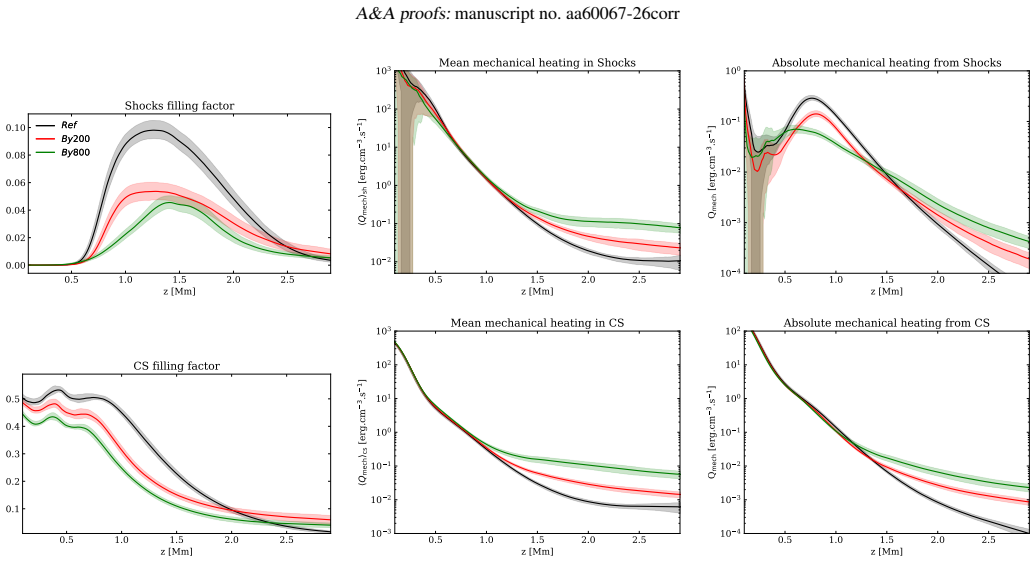
Stronger small-scale magnetic flux in the quiet Sun heats the chromosphere but cools the coronal base by raising density and radiative losses.
A machine-rendered reading of the paper's core claim, the machinery that carries it, and where it could break.
Core claim
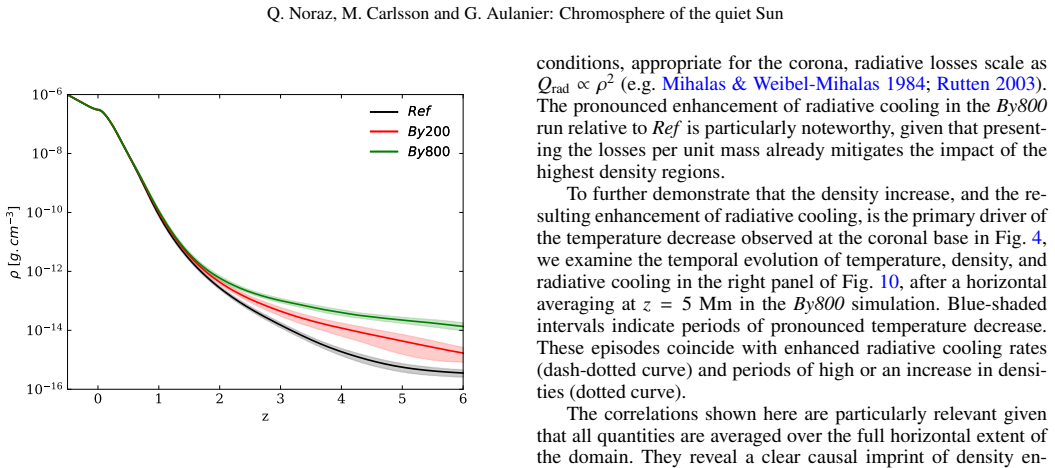
In parametric 3D radiative-MHD simulations, horizontal magnetic flux of rising amplitude is injected beneath a quiet-Sun model. Chromospheric temperatures and mechanical heating increase monotonically with field strength, although the fractional role of shocks declines while reconnecting current sheets sustain about 50 percent of the heating. Coronal-base temperature instead shows a non-monotonic response, maximising at intermediate flux and declining at the highest amplitudes because enhanced chromospheric heating drives greater mass loading, elevating density and thereby amplifying radiative losses that then control the coronal energy balance.
What carries the argument
Chromospheric mass loading that raises coronal-base density and triggers dominant radiative cooling despite increased heating.
If this is right
- Chromospheric temperatures and heating increase monotonically with magnetic-field strength.
- Coronal-base density rises with stronger flux through efficient upward mass transport.
- Density-driven radiative losses at the coronal base grow to dominate the energy balance.
- Coronal-base temperature reaches a maximum at intermediate flux amplitudes and declines thereafter.
- The chromosphere functions as a thermodynamic regulator for the overlying corona.
Where Pith is reading between the lines
- Solar-wind source models may need explicit treatment of small-scale flux emergence to capture realistic coronal densities and temperatures.
- Targeted observations of quiet-Sun patches with differing flux levels could test the predicted inverse temperature-density relation at high flux.
- Extending simulations to still stronger or weaker flux regimes could identify saturation points where the cooling response changes.
Load-bearing premise
The chosen amplitudes of injected horizontal magnetic flux and the radiative-MHD treatment accurately represent the real quiet-Sun thermodynamic response without dominant omissions.
What would settle it
Direct comparison of observed coronal-base temperature and density trends versus measured small-scale flux emergence rates in quiet-Sun regions, checking for the predicted non-monotonic temperature peak.
Figures






read the original abstract
Coupling between the photosphere, chromosphere and corona in the quiet Sun (QS) is governed by a complex interplay between magnetic structuring, heating, mass loading, and radiative cooling. Constraining how this balance responds to variations in small-scale magnetic flux remains limited. We investigate how chromospheric heating and its thermodynamic coupling to higher atmospheric layers vary as a function of small-scale magnetic flux emergence. We performed a parametric set of 3D radiative-MHD simulations with the Bifrost code, starting from a weakly magnetised QS reference model and injecting horizontal magnetic flux of increasing amplitude into the sub-surface convection zone. The resulting chromospheric dynamics, heating, mass loading, and coronal response were analysed. Chromospheric temperatures and mechanical heating rise monotonically with increasing magnetic-field strength. Although the fractional contribution of shocks decreases, reconnecting current sheets keeps maintaining about 50%. In contrast, the temperature at the base of the corona exhibits a non-monotonic response, reaching a maximum at intermediate magnetic amplitudes and decreasing for the strongest-field case. We show that stronger magnetic-field strength increases chromospheric heating, which increases the coronal-base density through efficient mass loading, and amplifies radiative losses. These density-driven radiative losses dominate the coronal energy balance and thus lead to reduced coronal-base temperatures despite increased heating. Our results demonstrate the sensitivity of chromospheric structure and dynamics to small-scale flux emergence, and its key role in regulating coronal thermodynamics. This result illustrates the chromosphere-s role as a thermodynamic gatekeeper, and further warrants future investigations of atmospheric models relevant to global solar-wind models and space-weather forecasts.
Editorial analysis
A structured set of objections, weighed in public.
Referee Report
Summary. The paper reports results from a parametric suite of 3D radiative-MHD simulations performed with the Bifrost code. Starting from a weakly magnetized quiet-Sun reference state, horizontal magnetic flux of progressively larger amplitude is injected into the sub-surface convection zone. Chromospheric temperatures and mechanical heating are found to increase monotonically with injected flux strength, while the fractional contribution of shocks declines but reconnection in current sheets remains near 50%. In contrast, the temperature at the coronal base exhibits a non-monotonic dependence, peaking at intermediate flux amplitudes and declining for the strongest fields. The authors attribute the temperature drop to enhanced chromospheric heating that drives greater mass loading, raising coronal-base density and thereby amplifying radiative losses that dominate the local energy balance despite the increased heating. They conclude that the chromosphere functions as a thermodynamic gatekeeper regulating coronal conditions, with implications for global solar-wind and space-weather modeling.
Significance. If the reported energy-balance partitioning is robust, the work supplies a concrete, simulation-based illustration of how small-scale flux emergence couples the chromosphere to the corona in the quiet Sun. The parametric approach reveals a non-monotonic coronal response that is not obvious from simple heating arguments and underscores the chromosphere's role in mass and energy regulation. Such results are directly relevant to the construction of realistic lower-boundary conditions for global coronal and solar-wind models.
major comments (2)
- Abstract and the central claim paragraph: the assertion that 'density-driven radiative losses dominate the coronal energy balance' is load-bearing for the non-monotonic temperature result. The manuscript does not present an explicit term-by-term decomposition (radiative cooling, thermal conduction divergence, advection, viscous/resistive heating) evaluated at the coronal base across the flux-amplitude sequence. Without this comparison it remains possible that adjustments in conduction or magnetic topology, rather than the density-radiation mechanism, control the temperature drop.
- Methods and results sections describing the parametric runs: the injected horizontal-flux amplitudes and the specific Bifrost radiative-MHD configuration (resolution, boundary conditions, radiative-transfer approximations) are treated as given. The manuscript should quantify how sensitive the reported mass-loading rates, heating fractions, and coronal-base temperatures are to these choices; otherwise the weakest assumption identified in the review—that the chosen parameters faithfully represent the real quiet-Sun response—cannot be assessed.
minor comments (2)
- Abstract: the statement that reconnecting current sheets 'keeps maintaining about 50%' should specify whether this fraction is time-averaged, spatially averaged, or varies across the parametric sequence.
- Figure captions and text: ensure that the precise height or temperature threshold used to define the 'coronal base' is stated consistently, as small shifts near the transition region can alter the diagnosed energy-balance terms.
Simulated Author's Rebuttal
We thank the referee for the thorough and constructive review of our manuscript. The comments have helped us strengthen the presentation of our results. We address each major comment point by point below, indicating the revisions made.
read point-by-point responses
-
Referee: Abstract and the central claim paragraph: the assertion that 'density-driven radiative losses dominate the coronal energy balance' is load-bearing for the non-monotonic temperature result. The manuscript does not present an explicit term-by-term decomposition (radiative cooling, thermal conduction divergence, advection, viscous/resistive heating) evaluated at the coronal base across the flux-amplitude sequence. Without this comparison it remains possible that adjustments in conduction or magnetic topology, rather than the density-radiation mechanism, control the temperature drop.
Authors: We agree that an explicit term-by-term decomposition is required to substantiate the central claim regarding the non-monotonic coronal-base temperature. In the revised manuscript we have added a new subsection (3.4) and Figure 8 that provides the requested vertical profiles of the energy-balance terms (radiative losses, thermal conduction, advection, viscous and resistive heating) evaluated at the coronal base for every run in the parametric sequence. The decomposition confirms that the rise in density-driven radiative losses at high flux amplitudes exceeds the modest adjustments in conduction and advection, thereby driving the observed temperature decline. The abstract and discussion have been updated to reference this new analysis. revision: yes
-
Referee: Methods and results sections describing the parametric runs: the injected horizontal-flux amplitudes and the specific Bifrost radiative-MHD configuration (resolution, boundary conditions, radiative-transfer approximations) are treated as given. The manuscript should quantify how sensitive the reported mass-loading rates, heating fractions, and coronal-base temperatures are to these choices; otherwise the weakest assumption identified in the review—that the chosen parameters faithfully represent the real quiet-Sun response—cannot be assessed.
Authors: The flux amplitudes were selected to cover a physically relevant range while remaining computationally tractable, extending our earlier Bifrost quiet-Sun models. The numerical configuration (horizontal resolution 48 km, standard 4-bin radiative transfer, open boundaries) follows the setup validated in multiple prior studies. A full quantitative sensitivity analysis to resolution, boundary conditions and radiative-transfer details would require an additional suite of simulations that exceeds the scope and resources of the present work. In the revision we have expanded the Methods section with a paragraph that justifies the chosen parameters, cites convergence tests reported in related Bifrost papers, and explicitly notes the limitations of the current parameter set. This addition allows readers to assess the robustness of the results within the stated assumptions. revision: partial
Circularity Check
No circularity: results are direct numerical outputs from parametric Bifrost simulations
full rationale
The paper reports trends from a set of 3D radiative-MHD simulations with Bifrost, starting from a reference QS model and varying injected horizontal flux amplitude. The central claims (monotonic rise in chromospheric heating and temperature with field strength, non-monotonic coronal-base temperature due to density-driven radiative losses) are presented as direct analysis outputs of the simulated fields, velocities, temperatures, and energy terms. No analytic derivation chain exists, no parameters are fitted to data and then re-predicted, and no self-citations or ansatzes are invoked to justify load-bearing steps. The energy-balance interpretation follows from the simulated quantities themselves rather than reducing to any input definition or prior self-result by construction.
Axiom & Free-Parameter Ledger
free parameters (1)
- amplitude of injected horizontal magnetic flux
axioms (1)
- domain assumption Bifrost code accurately captures the dominant radiative, conductive, and magnetic processes in the solar chromosphere and transition region
Reference graph
Works this paper leans on
-
[1]
& Hansteen, V
Archontis, V . & Hansteen, V . 2014, The Astrophysical Journal, 788, L2
2014
-
[2]
2004, Journal of Atmospheric and Solar-Terrestrial Physics, 66, 1295
Arge, C., Luhmann, J., Odstrcil, D., Schrijver, C., & Li, Y . 2004, Journal of Atmospheric and Solar-Terrestrial Physics, 66, 1295
2004
-
[3]
Arge, C. N. & Pizzo, V . J. 2000, Journal of Geophysical Research: Space Physics, 105, 10465 Bellot Rubio, L. & Orozco Suárez, D. 2019, Living Reviews in Solar Physics, 16, 1
2000
-
[4]
& ten Bruggencate, P
Biermann, L. & ten Bruggencate, P. 1947, Veroeffentlichungen der Universitaets- Sternwarte zu Goettingen, 0005, 223
1947
-
[5]
2025, As- tronomy & Astrophysics, 693, A74
Brchnelova, M., Gudiksen, B., Carlsson, M., Lani, A., & Poedts, S. 2025, As- tronomy & Astrophysics, 693, A74
2025
-
[6]
2023, Astronomy & Astrophysics, 678, A117
Brchnelova, M., Ku´ zma, B., Zhang, F., Lani, A., & Poedts, S. 2023, Astronomy & Astrophysics, 678, A117
2023
-
[7]
Breu, C., Peter, H., Cameron, R., & Solanki, S. K. 2023, Astronomy & Astro- physics, 675, A94
2023
-
[8]
Cargill, P. J. 1993, Solar Physics, 147, 263
1993
-
[9]
Carlsson, M., De Pontieu, B., & Hansteen, V . H. 2019, Annual Review of As- tronomy and Astrophysics, 57, 189
2019
-
[10]
H., Gudiksen, B
Carlsson, M., Hansteen, V . H., Gudiksen, B. V ., Leenaarts, J., & De Pontieu, B. 2016, Astronomy & Astrophysics, 585, A4
2016
-
[11]
& Leenaarts, J
Carlsson, M. & Leenaarts, J. 2012, Astronomy & Astrophysics, 539, A39 Article number, page 12 of 13 Q. Noraz, M. Carlsson and G. Aulanier: Chromosphere of the quiet Sun
2012
-
[12]
Chandra, S., Cameron, R., Przybylski, D., & Solanki, S. K. 2025, Statistical Properties of Spicules in MURaM-ChE
2025
-
[13]
2025, Data-Driven Radiative Magnetohydrodynamics Simulations with the MURaM Code: The Emerging Active Region Corona
Chen, F. 2025, Data-Driven Radiative Magnetohydrodynamics Simulations with the MURaM Code: The Emerging Active Region Corona
2025
-
[14]
J., & Noraz, Q
Cherry, G., Gudiksen, B., Finley, A. J., & Noraz, Q. 2025, Decomposing Wave Activity in the Solar Atmosphere: Shocks, Jets and Swirls in the Quiet Sun
2025
-
[15]
Cheung, M. C. M. & Isobe, H. 2014, Living Reviews in Solar Physics, 11 De La Cruz Rodríguez, J. & Van Noort, M. 2017, Space Science Reviews, 210, 109 De Pontieu, B., Hansteen, V . H., Rouppe Van Der V oort, L., Van Noort, M., &
2014
-
[16]
2007, The Astrophysical Journal, 655, 624
Carlsson, M. 2007, The Astrophysical Journal, 655, 624
2007
-
[17]
P., Landi, E., Mason, H
Dere, K. P., Landi, E., Mason, H. E., Monsignori Fossi, B. C., & Young, P. R. 1997, Astronomy and Astrophysics Supplement Series, 125, 149 Díaz-Castillo, S. M., Fischer, C. E., Moreno-Insertis, F., et al. 2025, Emergence of Magnetic Flux Sheets in the Quiet Sun. I. Statistical Properties
1997
-
[18]
K., Leenaarts, J., Carlsson, M., & Szydlarski, M
Druett, M. K., Leenaarts, J., Carlsson, M., & Szydlarski, M. 2022, Astronomy & Astrophysics, 665, A6
2022
-
[19]
V ., & De Moortel, I
Enerhaug, E., Carlsson, M., Szydlarski, M., Gudiksen, B. V ., & De Moortel, I. 2025, Astronomy & Astrophysics, 701, A137
2025
-
[20]
P., & Van Der Holst, B
Fang, F., Manchester Iv, W., Abbett, W. P., & Van Der Holst, B. 2012, The As- trophysical Journal, 745, 37
2012
-
[21]
J., Brun, A
Finley, A. J., Brun, A. S., Carlsson, M., et al. 2022, Astronomy & Astrophysics, 665, A118 Fröhlich, C. & Lean, J. 2004, The Astronomy and Astrophysics Review, 12, 273
2022
-
[22]
Gabriel, A. H. 1976, Philosophical Transactions of the Royal Society of London. Series A, Mathematical and Physical Sciences Goši´c, M., Hansteen, V . H., Dalda, A. S., Pontieu, B. D., & van der V oort, L. H. M. R. 2025, Bifrost Models of the Quiet Sun. I. Comparison with Solar Observations
1976
-
[23]
V ., Carlsson, M., Hansteen, V
Gudiksen, B. V ., Carlsson, M., Hansteen, V . H., et al. 2011, Astronomy & Astro- physics, 531, A154
2011
-
[24]
D., & Carlsson, M
Hansteen, V ., Guerreiro, N., Pontieu, B. D., & Carlsson, M. 2015, The Astro- physical Journal, 811, 106
2015
-
[25]
2019, Astronomy & Astrophysics, 626, A33
Hansteen, V ., Ortiz, A., Archontis, V ., et al. 2019, Astronomy & Astrophysics, 626, A33
2019
-
[26]
H., Archontis, V ., Pereira, T
Hansteen, V . H., Archontis, V ., Pereira, T. M. D., et al. 2017, The Astrophysical Journal, 839, 22
2017
-
[27]
2006, The Astrophysical Journal, 647, L73
Carlsson, M. 2006, The Astrophysical Journal, 647, L73
2006
-
[28]
R., Millman, K
Harris, C. R., Millman, K. J., Van Der Walt, S. J., et al. 2020, Nature, 585, 357
2020
-
[29]
L., Sheeley, Jr., N
Harvey, K. L., Sheeley, Jr., N. R., & Harvey, J. W. 1982, Solar Physics, 79, 149
1982
-
[30]
R., & Rust, D
Heyvaerts, J., Priest, E. R., & Rust, D. M. 1977, The Astrophysical Journal, 216, 123
1977
-
[31]
P., Teriaca, L., et al
Huang, Z., Chitta, L. P., Teriaca, L., et al. 2026, High-Resolution Observations of Small-Scale Activity in Coronal Hole Plumes
2026
-
[32]
Hunter, J. D. 2007, Computing in Science & Engineering, 9, 90
2007
-
[33]
2005, Nature, 434, 478
Isobe, H., Miyagoshi, T., Shibata, K., & Yokoyama, T. 2005, Nature, 434, 478
2005
-
[34]
Isobe, H., Proctor, M. R. E., & Weiss, N. O. 2008, The Astrophysical Journal, 679, L57
2008
-
[35]
B., Morton, R
Jess, D. B., Morton, R. J., Verth, G., et al. 2015, Space Science Reviews, 190, 103
2015
-
[36]
Klimchuk, J. A. 2015, Philosophical Transactions of the Royal Society A: Math- ematical, Physical and Engineering Sciences, 373, 20140256 Ku´ zma, B., Brchnelova, M., Perri, B., et al. 2023, The Astrophysical Journal, 942, 31
2015
-
[37]
2025, Avalanches in Magnetohy- drodynamical Simulations
Lamarre, H., Charbonneau, P., Noraz, Q., et al. 2025, Avalanches in Magnetohy- drodynamical Simulations
2025
-
[38]
R., et al
Landi, E., Del Zanna, G., Young, P. R., et al. 2006, The Astrophysical Journal Supplement Series, 162, 261 Martínez González, M. J. & Bellot Rubio, L. R. 2009, The Astrophysical Journal, 700, 1391 Martínez-Sykora, J., De La Cruz Rodríguez, J., Goši ´c, M., et al. 2023, The As- trophysical Journal Letters, 943, L14 Martínez-Sykora, J., De Pontieu, B., & Ha...
2006
-
[39]
& Weibel-Mihalas, B
Mihalas, D. & Weibel-Mihalas, B. 1984, Foundations of Radiation Hydrody- namics (New York: Oxford University Press)
1984
-
[40]
1986, Astronomy and Astrophysics, 166, 291
Moreno-Insertis, F. 1986, Astronomy and Astrophysics, 166, 291
1986
-
[41]
J., & Leenaarts, J
Morosin, R., De La Cruz Rodríguez, J., Díaz Baso, C. J., & Leenaarts, J. 2022, Astronomy & Astrophysics, 664, A8
2022
-
[42]
2022, Frontiers in Astronomy and Space Sciences, 9, 981205 Nóbrega-Siverio, D., Cabello, I., Bose, S., et al
Nindos, A., Patsourakos, S., Jafarzadeh, S., & Shimojo, M. 2022, Frontiers in Astronomy and Space Sciences, 9, 981205 Nóbrega-Siverio, D., Cabello, I., Bose, S., et al. 2024, Astronomy & Astro- physics, 686, A218 Nóbrega-Siverio, D., Martínez-Sykora, J., Moreno-Insertis, F., & Carlsson, M. 2020, Astronomy & Astrophysics, 638, A79
2022
-
[43]
2026, Astronomy & Astrophysics, 705, A86
Noraz, Q., Carlsson, M., & Aulanier, G. 2026, Astronomy & Astrophysics, 705, A86
2026
-
[44]
R., Hansteen, V
Ortiz, A., Bellot Rubio, L. R., Hansteen, V . H., De La Cruz Rodríguez, J., & Van Der V oort, L. R. 2014, The Astrophysical Journal, 781, 126
2014
-
[45]
S., et al
Parenti, S., Réville, V ., Brun, A. S., et al. 2022, The Astrophysical Journal, 929, 75
2022
-
[46]
Parker, E. N. 1972, The Astrophysical Journal, 174, 499
1972
-
[47]
Parker, E. N. 1983, The Astrophysical Journal, 264, 642
1983
-
[48]
K., et al
Przybylski, D., Cameron, R., Solanki, S. K., et al. 2025, Structure and Dynamics of the Internetwork Solar Chromosphere: Results of a Small-Scale Dynamo Simulation
2025
-
[49]
K., et al
Przybylski, D., Cameron, R., Solanki, S. K., et al. 2022, Astronomy & Astro- physics, 664, A91 Quintero Noda, C., Schlichenmaier, R., Bellot Rubio, L. R., et al. 2022, Astron- omy & Astrophysics, 666, A21
2022
-
[50]
2017, The Astrophysical Journal, 834, 10
Rempel, M. 2017, The Astrophysical Journal, 834, 10
2017
-
[51]
Robinson, R. A. & Carlsson, M. 2023, Astronomy & Astrophysics, 677, A36
2023
-
[52]
A., Carlsson, M., & Aulanier, G
Robinson, R. A., Carlsson, M., & Aulanier, G. 2022, Astronomy & Astrophysics, 668, A177
2022
-
[53]
Rutten, R. J. 2003, Radiative Transfer in Stellar Atmospheres
2003
-
[54]
1979, Astronomy and Astrophysics, 74, 273
Schmieder, B. 1979, Astronomy and Astrophysics, 74, 273
1979
-
[55]
J., Title, A
Schrijver, C. J., Title, A. M., Van Ballegooijen, A. A., Hagenaar, H. J., & Shine, R. A. 1997, The Astrophysical Journal, 487, 424
1997
-
[56]
1906, Nachrichten von der Königlichen Gesellschaft der Wis- senschaften zu Göttingen
Schwarzschild, K. 1906, Nachrichten von der Königlichen Gesellschaft der Wis- senschaften zu Göttingen. Math.-phys. Klasse, 195, 41
1906
-
[57]
1948, The Astrophysical Journal, 107, 1
Schwarzschild, M. 1948, The Astrophysical Journal, 107, 1
1948
-
[58]
D., & Przybylski, D
Shelyag, S., Khomenko, E., Vicente, A. D., & Przybylski, D. 2016, The Astro- physical Journal Letters, 819, L11
2016
-
[59]
K., Hirzberger, J., Riethmüller, T
Sinjan, J., Solanki, S. K., Hirzberger, J., Riethmüller, T. L., & Przybylski, D. 2024, Magnetograms Underestimate Even Unipolar Magnetic Flux Nearly Everywhere on the Solar Disk
2024
-
[60]
J., Fedun, V ., Goossens, M., Silva, S
Skirvin, S. J., Fedun, V ., Goossens, M., Silva, S. S. A., & Verth, G. 2024, The Astrophysical Journal, 975, 176 Sow Mondal, S., Klimchuk, J. A., & Sarkar, A. 2022, The Astrophysical Journal, 937, 71
2024
-
[61]
Stangalini, M., Del Moro, D., Berrilli, F., & Jefferies, S. M. 2011, Astronomy & Astrophysics, 534, A65
2011
-
[62]
2025, The Dynamics of Small-Scale Magnetic Fields Modulated by the Solar Cycle
Stangalini, M., Verth, G., Fedun, V ., et al. 2025, The Dynamics of Small-Scale Magnetic Fields Modulated by the Solar Cycle
2025
-
[63]
Sullivan, C. B. & Kaszynski, A. 2019, Journal of Open Source Software, 4, 1450
2019
-
[64]
A., Kee, N
Tarr, L. A., Kee, N. D., Linton, M. G., Schuck, P. W., & Leake, J. E. 2024, The Astrophysical Journal Supplement Series, 270, 30 Udnæs, E. R. & Pereira, T. M. D. 2025, Characteristics of Acoustic-Wave Heat- ing in Simulations of the Quiet Sun Chromosphere Van Der Holst, B., Sokolov, I. V ., Meng, X., et al. 2014, The Astrophysical Jour- nal, 782, 81
2024
-
[65]
2026, MHD Modelling of Open Flux Evo- lution around Solar Maximum by Coronal Model COCONUT
Wang, H., Poedts, S., Lani, A., et al. 2026, MHD Modelling of Open Flux Evo- lution around Solar Maximum by Coronal Model COCONUT
2026
-
[66]
R., & Nash, A
Wang, Y .-M., Sheeley, N. R., & Nash, A. G. 1990, Nature, 347, 439
1990
-
[67]
2025, Millimeter-Wavelength Obser- vations of the Active Sun: Unveiling the Origins of Space Weather
Wedemeyer, S., Poedts, S., Gunár, S., et al. 2025, Millimeter-Wavelength Obser- vations of the Active Sun: Unveiling the Origins of Space Weather
2025
-
[68]
Withbroe, G. L. & Noyes, R. W. 1977, Annual Review of Astronomy and Astro- physics, 15, 363
1977
-
[69]
& Shibata, K
Yokoyama, T. & Shibata, K. 1995, 375
1995
-
[70]
1987, Annual Review of Astronomy and Astrophysics, 25, 83 Article number, page 13 of 13
Zwaan, C. 1987, Annual Review of Astronomy and Astrophysics, 25, 83 Article number, page 13 of 13
1987
discussion (0)
Sign in with ORCID, Apple, or X to comment. Anyone can read and Pith papers without signing in.