Recognition: unknown
Spin-orbital exchange as a route to intertwined dipole-quadrupole orbital order in MnV₂O₄ under strong trigonal crystal field
Pith reviewed 2026-05-08 17:26 UTC · model grok-4.3
The pith
Strong trigonal crystal field and subdominant hoppings drive two-in/two-out order with spin canting and dipole-quadrupole orbital order in MnV₂O₄.
A machine-rendered reading of the paper's core claim, the machinery that carries it, and where it could break.
Core claim
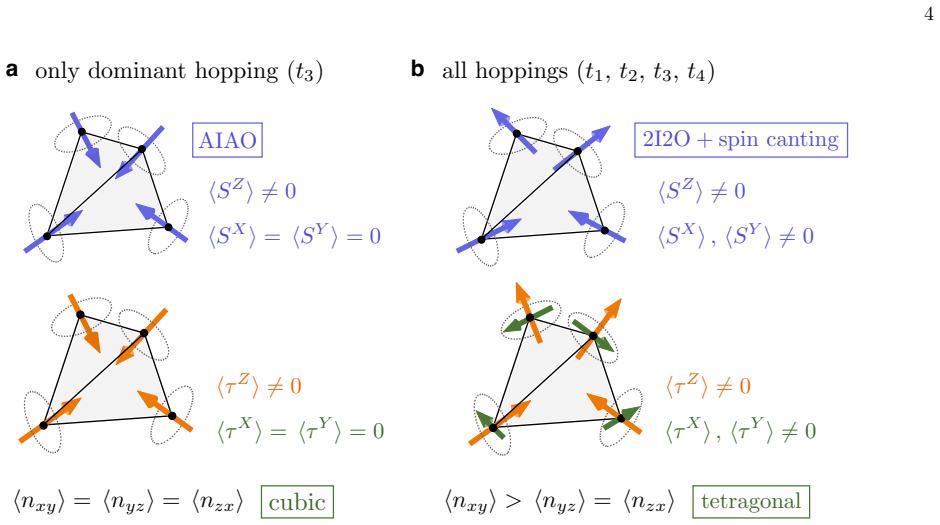
Under the influence of a strong trigonal crystal field the spin-orbital exchange interactions, after inclusion of subdominant hopping processes, stabilize a two-in/two-out magnetic configuration that exhibits spin canting and an intertwined dipole-quadrupole orbital order.
What carries the argument
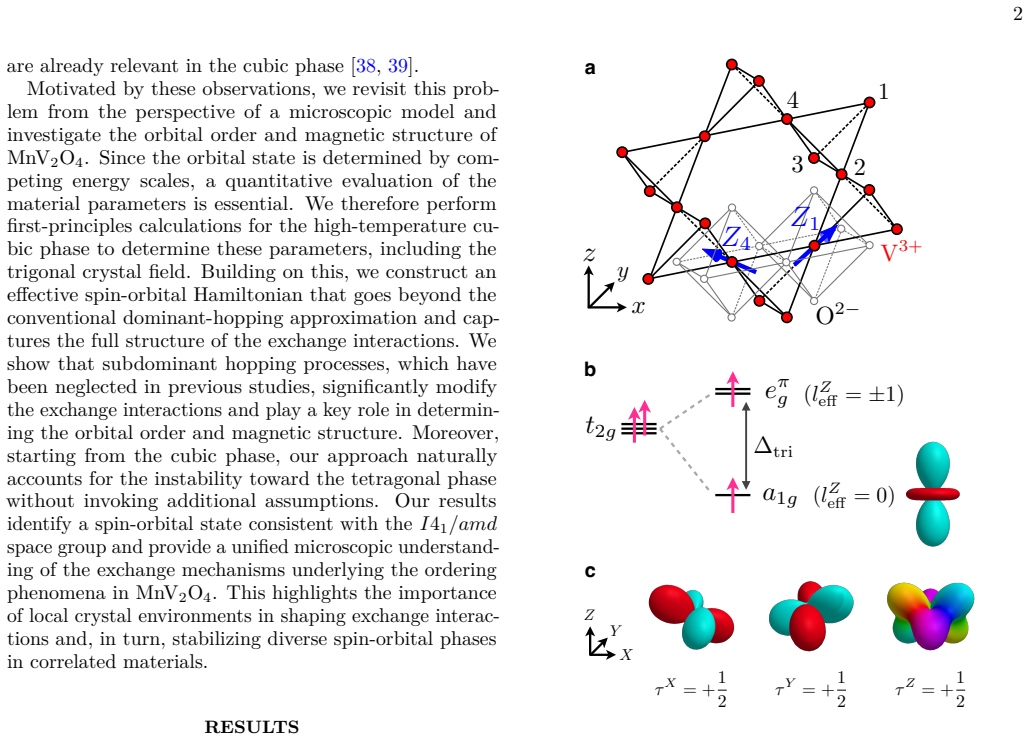
An effective spin-orbital Hamiltonian built beyond the dominant-hopping approximation, in which the trigonal crystal field first splits the low-energy degrees of freedom and thereby alters the form of the spin-orbital exchange couplings.
If this is right
- The orbital order takes an intertwined dipole-quadrupole form rather than a conventional pure-quadrupole pattern.
- Spin canting appears as an intrinsic feature of the two-in/two-out magnetic arrangement on the vanadium tetrahedra.
- The stabilization occurs through spin-orbital exchange modified by subdominant hoppings rather than through Jahn-Teller distortions alone.
- The same mechanism supplies a microscopic explanation for the orbital state that has been under debate in MnV₂O₄.
Where Pith is reading between the lines
- The result suggests that analogous trigonal-field corrections may be needed in effective models for other orbitally degenerate vanadates.
- The locked dipole-quadrupole order implies that external perturbations such as strain or magnetic fields could couple to both magnetic and orbital sectors simultaneously.
- If the subdominant hopping terms prove generic, similar intertwined orders may appear in other Kugel-Khomskii systems once crystal-field splittings are treated accurately.
Load-bearing premise
A significant trigonal crystal field is present in the high-temperature cubic phase and plays an essential role in determining the low-energy degrees of freedom.
What would settle it
Neutron or resonant X-ray diffraction that fails to detect the predicted two-in/two-out pattern with spin canting and the associated dipole-quadrupole orbital moments, or first-principles calculations showing that the same order does not appear when the trigonal field term is removed.
Figures


read the original abstract
Orbitally degenerate systems provide a promising platform for realizing novel quantum phases driven by spin-orbital exchange interactions, as described by the Kugel-Khomskii model. Spinel vanadates, in which orbital degrees of freedom remain active, exhibit structural and magnetic transitions accompanied by orbital ordering, but the nature of the orbital state in MnV$_2$O$_4$ remains under debate. Here, we combine first-principles calculations with an effective spin-orbital model to address this problem. We show that a significant trigonal crystal field is present in high-temperature cubic phase and plays an essential role in determining the low-energy degrees of freedom. Based on the resulting parameters, we construct an effective Hamiltonian beyond the conventional dominant-hopping approximation and demonstrate that subdominant hopping processes strongly modify the spin-orbital exchange interactions. As a result, the system stabilizes a two-in/two-out magnetic configuration featuring spin canting and intertwined dipole-quadrupole orbital order.
Editorial analysis
A structured set of objections, weighed in public.
Referee Report
Summary. The manuscript combines first-principles calculations with an effective spin-orbital Hamiltonian for MnV₂O₄. It argues that a significant trigonal crystal field present already in the high-temperature cubic phase reshapes the low-energy orbital basis; once subdominant hopping processes are retained beyond the usual dominant-hopping approximation, the resulting exchange interactions stabilize a two-in/two-out magnetic structure with spin canting and an intertwined dipole-quadrupole orbital order.
Significance. If the central result is robust, the work would resolve the long-standing debate on the orbital state of MnV₂O₄, illustrate how trigonal fields and subdominant hoppings can qualitatively alter Kugel-Khomskii physics in spinel vanadates, and supply a concrete, falsifiable prediction for the ground-state configuration. The explicit use of DFT-derived parameters to construct the model is a methodological strength.
major comments (2)
- [Abstract; construction of the effective Hamiltonian (presumably §3–4)] The claim that the trigonal crystal field “plays an essential role” (Abstract) is load-bearing: the orbital basis, the effective exchange parameters, and the subsequent stabilization of the two-in/two-out state all rest on this splitting being large compared with the relevant hopping scales. The manuscript provides no numerical value for the trigonal field, no comparison to the hopping amplitudes, and no sensitivity test against changes in DFT functional or Hubbard U. Without these, it is impossible to judge whether the reported order survives modest variations in the input that the authors themselves identify as decisive.
- [Effective Hamiltonian and ground-state analysis (presumably §4–5)] The assertion that “subdominant hopping processes strongly modify the spin-orbital exchange interactions” (Abstract) is the second load-bearing step. The paper must demonstrate explicitly—via a side-by-side comparison of the dominant-hopping versus full-hopping Hamiltonians—how the additional terms alter the exchange constants enough to select the canted two-in/two-out state. A quantitative table or figure showing the change in the relevant J and K parameters is required.
minor comments (2)
- [Orbital-order discussion] Define the dipole and quadrupole operators explicitly (e.g., in terms of the orbital pseudospin) when first introducing the “intertwined dipole-quadrupole orbital order.”
- [First-principles section] Add error bars or a brief discussion of the uncertainty in the DFT-derived trigonal-field value arising from functional/U choice.
Simulated Author's Rebuttal
We thank the referee for the positive overall assessment and for identifying the two load-bearing claims that require stronger quantitative support. We address both major comments below. The requested numerical values, comparisons, and sensitivity checks were not presented explicitly in the original submission, so we have revised the manuscript to include them.
read point-by-point responses
-
Referee: [Abstract; construction of the effective Hamiltonian (presumably §3–4)] The claim that the trigonal crystal field “plays an essential role” (Abstract) is load-bearing: the orbital basis, the effective exchange parameters, and the subsequent stabilization of the two-in/two-out state all rest on this splitting being large compared with the relevant hopping scales. The manuscript provides no numerical value for the trigonal field, no comparison to the hopping amplitudes, and no sensitivity test against changes in DFT functional or Hubbard U. Without these, it is impossible to judge whether the reported order survives modest variations in the input that the authors themselves identify as decisive.
Authors: We agree that explicit numerical values and robustness checks are required. Our DFT calculations in the high-temperature cubic phase (Section 3) give a trigonal splitting Δ_trig ≈ 240 meV for U = 4 eV (PBE+U), which is larger than the dominant t_{2g}–t_{2g} hoppings (∼70–90 meV). However, this comparison and its dependence on U and functional were not shown. In the revised manuscript we add Table S1 (supplement) and a new paragraph in Section 3 listing Δ_trig, the full set of hoppings, and their ratios for U = 3–5 eV and for both PBE+U and LDA+U. The trigonal field remains 200–280 meV across this range and continues to dominate the orbital basis; the two-in/two-out ground state is unchanged. These additions directly address the concern. revision: yes
-
Referee: [Effective Hamiltonian and ground-state analysis (presumably §4–5)] The assertion that “subdominant hopping processes strongly modify the spin-orbital exchange interactions” (Abstract) is the second load-bearing step. The paper must demonstrate explicitly—via a side-by-side comparison of the dominant-hopping versus full-hopping Hamiltonians—how the additional terms alter the exchange constants enough to select the canted two-in/two-out state. A quantitative table or figure showing the change in the relevant J and K parameters is required.
Authors: We accept that a direct, quantitative comparison was missing. The original Section 4 derived the full exchange tensor including all hoppings, but did not tabulate the dominant-only case. In the revision we add Table 2 and Figure 5, which list the isotropic J and anisotropic K (dipole–quadrupole) couplings for the nearest-neighbor bonds under (i) the conventional dominant t_{2g}–t_{2g} approximation and (ii) the complete hopping set. The subdominant terms increase the antiferromagnetic J by 18–27 % on the relevant bonds and introduce additional K components of order 0.3–0.5 meV; the net effect lowers the energy of the canted two-in/two-out state by ∼4.8 meV per V ion relative to the dominant-hopping minimum. The revised text and figure caption now make this quantitative shift explicit. revision: yes
Circularity Check
No significant circularity detected; derivation relies on independent first-principles inputs.
full rationale
The paper's chain proceeds from first-principles calculations that determine the trigonal crystal field and hopping parameters in the high-temperature cubic phase, followed by construction of an effective spin-orbital Hamiltonian that incorporates subdominant processes to identify the stable two-in/two-out configuration with canting and dipole-quadrupole order. This is a standard ab initio plus model workflow in which the final ground-state selection is not equivalent to the inputs by definition or construction, nor does it rely on self-citation load-bearing, ansatz smuggling, or renaming of known results. The abstract and description provide no equations or steps that reduce the claimed stabilization to a tautology or fitted prediction of the same quantity.
Axiom & Free-Parameter Ledger
free parameters (1)
- trigonal crystal field strength
axioms (1)
- domain assumption Kugel-Khomskii model captures the essential spin-orbital exchange physics
Reference graph
Works this paper leans on
-
[1]
Kugel, K. I. and Khomskii, D. I. , journal =. 1973 , month =
1973
-
[2]
Kugel, K. I. and Khomskii, D. I. , journal =. 1975 , month =
1975
-
[3]
, month = oct, year =
Khomskii, Daniel I. , month = oct, year =
-
[4]
Usp. Fiz. Nauk , author =. 1982 , pages =. doi:10.3367/UFNr.0136.198204c.0621 , number =
-
[5]
Science , author =. 2000 , pages =. doi:10.1126/science.288.5465.462 , number =
-
[6]
doi:10.1143/PTPS.160.155 , journal =
Khaliullin, Giniyat , year =. doi:10.1143/PTPS.160.155 , journal =
-
[7]
Phys.-Usp. , author =. 2017 , pages =. doi:10.3367/UFNe.2017.08.038196 , number =
-
[8]
ECS J. Solid State Sci. Technol. , author =. 2022 , pages =. doi:10.1149/2162-8777/ac6906 , number =
-
[9]
doi:10.1088/1367-2630/7/1/053 , journal =
Radaelli, Paolo G , month = feb, year =. doi:10.1088/1367-2630/7/1/053 , journal =
-
[10]
J. Phys. Soc. Jpn. , author =. 2010 , pages =. doi:10.1143/JPSJ.79.011004 , number =
-
[11]
2011 , doi =
Takagi, Hidenori and Niitaka, Seiji , editor =. 2011 , doi =
2011
-
[12]
doi:10.1016/j.physrep.2021.04.002 , journal =
Tsurkan, Vladimir and Krug Von Nidda, Hans-Albrecht and Deisenhofer, Joachim and Lunkenheimer, Peter and Loidl, Alois , month = sep, year =. doi:10.1016/j.physrep.2021.04.002 , journal =
-
[13]
Tsunetsugu, Hirokazu and Motome, Yukitoshi , journal =. 2003 , month =. doi:10.1103/PhysRevB.68.060405 , url =
-
[14]
Motome, Yukitoshi and Tsunetsugu, Hirokazu , journal =. 2004 , month =. doi:10.1103/PhysRevB.70.184427 , url =
-
[15]
Tchernyshyov, O. , journal =. 2004 , month =. doi:10.1103/PhysRevLett.93.157206 , url =
-
[16]
Di Matteo, S. and Jackeli, G. and Perkins, N. B. , journal =. 2005 , month =. doi:10.1103/PhysRevB.72.020408 , url =
-
[17]
doi:10.1143/PTPS.160.203 , journal =
Motome, Yukitoshi and Tsunetsugu, Hirokazu , year =. doi:10.1143/PTPS.160.203 , journal =
-
[18]
Sarkar, S. and Maitra, T. and Valent\'. Phys. Rev. Lett. , volume =. 2009 , month =. doi:10.1103/PhysRevLett.102.216405 , url =
-
[19]
Chern, Gia-Wei and Perkins, Natalia and Hao, Zhihao , journal =. 2010 , month =. doi:10.1103/PhysRevB.81.125127 , url =
-
[20]
Adachi, K. and Suzuki, T. and Kato, K. and Osaka, K. and Takata, M. and Katsufuji, T. , journal =. 2005 , month =. doi:10.1103/PhysRevLett.95.197202 , url =
-
[21]
Suzuki, T. and Katsumura, M. and Taniguchi, K. and Arima, T. and Katsufuji, T. , journal =. 2007 , month =. doi:10.1103/PhysRevLett.98.127203 , url =
-
[22]
Chung, J.-H. and Kim, J.-H. and Lee, S.-H. and Sato, T. J. and Suzuki, T. and Katsumura, M. and Katsufuji, T. , journal =. 2008 , month =. doi:10.1103/PhysRevB.77.054412 , url =
-
[23]
Garlea, V. O. and Jin, R. and Mandrus, D. and Roessli, B. and Huang, Q. and Miller, M. and Schultz, A. J. and Nagler, S. E. , journal =. 2008 , month =. doi:10.1103/PhysRevLett.100.066404 , url =
-
[24]
Nii, Y. and Sagayama, H. and Arima, T. and Aoyagi, S. and Sakai, R. and Maki, S. and Nishibori, E. and Sawa, H. and Sugimoto, K. and Ohsumi, H. and Takata, M. , journal =. 2012 , month =. doi:10.1103/PhysRevB.86.125142 , url =
-
[25]
Matsuura, K. and Sagayama, H. and Nii, Y. and Khanh, N. D. and Abe, N. and Arima, T. , journal =. 2015 , month =. doi:10.1103/PhysRevB.92.035133 , url =
-
[26]
Matsuura, Keisuke and Sagayama, Hajime and Uehara, Amane and Nii, Yoichi and Kajimoto, Ryoichi and Kamazawa, Kazuya and Ikeuchi, Kazuhiko and Ji, Sungdae and Abe, Nobuyuki and Arima, Taka-hisa , journal =. 2017 , month =. doi:10.1103/PhysRevLett.119.017201 , url =
-
[27]
Wheeler, Elisa M. and Lake, Bella and Islam, A. T. M. Nazmul and Reehuis, Manfred and Steffens, Paul and Guidi, Tatiana and Hill, Adrian H. , journal =. 2010 , month =. doi:10.1103/PhysRevB.82.140406 , url =
-
[28]
Lee, S.-H. and Louca, D. and Ueda, H. and Park, S. and Sato, T. J. and Isobe, M. and Ueda, Y. and Rosenkranz, S. and Zschack, P. and \'I\ niguez, J. and Qiu, Y. and Osborn, R. , journal =. 2004 , month =. doi:10.1103/PhysRevLett.93.156407 , url =
-
[29]
J. Phys. Soc. Jpn. , author =. 2008 , pages =. doi:10.1143/JPSJ.77.053708 , number =
-
[30]
Mater. Adv. , author =. 2022 , pages =. doi:10.1039/D1MA01113H , number =
-
[31]
Temperature evolution of orbital states with successive phase transitions in FeV2O4
Koyama, Chihaya and Nomura, Yusuke and Kitou, Shunsuke and Manjo, Taishun and Nakamura, Yuiga and Hara, Takeshi and Katayama, Naoyuki and Nii, Yoichi and Arita, Ryotaro and Sawa, Hiroshi and Arima, Taka-hisa , year=. 2604.04398 , archivePrefix=
work page internal anchor Pith review Pith/arXiv arXiv
-
[32]
van den Brink, Jeroen and Khomskii, Daniel , journal =. 2001 , month =. doi:10.1103/PhysRevB.63.140416 , url =
-
[33]
Mostovoy, M. V. and Khomskii, D. I. , journal =. 2002 , month =. doi:10.1103/PhysRevLett.89.227203 , url =
-
[34]
doi:10.1088/1367-2630/6/1/154 , journal =
Mochizuki, Masahito and Imada, Masatoshi , month = nov, year =. doi:10.1088/1367-2630/6/1/154 , journal =
-
[35]
Jackeli, G. and Khomskii, D. I. , journal =. 2008 , month =. doi:10.1103/PhysRevLett.100.147203 , url =
-
[36]
Jackeli, George and Khaliullin, Giniyat , journal =. 2009 , month =. doi:10.1103/PhysRevLett.103.067205 , url =
-
[37]
Feiner, Louis Felix and Ole. Phys. Rev. Lett. , volume =. 1997 , month =. doi:10.1103/PhysRevLett.78.2799 , url =
-
[38]
Kugel, K. I. and Khomskii, D. I. and Sboychakov, A. O. and Streltsov, S. V. , journal =. 2015 , month =. doi:10.1103/PhysRevB.91.155125 , url =
-
[39]
Koch-Janusz, Maciej and Khomskii, D. I. and Sela, Eran , journal =. 2015 , month =. doi:10.1103/PhysRevLett.114.247204 , url =
-
[40]
Nat. Commun. , author =. 2021 , pages =. doi:10.1038/s41467-021-23033-y , number =
-
[41]
npj Quantum Mater. , author =. 2025 , pages =. doi:10.1038/s41535-025-00744-9 , number =
-
[42]
Jackeli, G. and Khaliullin, G. , journal =. 2009 , month =. doi:10.1103/PhysRevLett.102.017205 , url =
-
[43]
and Savary, Lucile and Gaulin, Bruce D
Ross, Kate A. and Savary, Lucile and Gaulin, Bruce D. and Balents, Leon , journal =. 2011 , month =. doi:10.1103/PhysRevX.1.021002 , url =
-
[44]
Yan, Han and Benton, Owen and Jaubert, Ludovic and Shannon, Nic , journal =. 2017 , month =. doi:10.1103/PhysRevB.95.094422 , url =
-
[45]
The Rayleigh-Schrodinger perturbation and the linked-diagram theorem for a multi-configurational model space , volume =. J. Phys. B: At. Mol. Phys. , author =. 1974 , pages =. doi:10.1088/0022-3700/7/18/010 , number =
-
[46]
J. Phys. A: Math. Gen. , author =. 2000 , pages =. doi:10.1088/0305-4470/33/17/307 , number =
-
[47]
Prog. Theor. Phys. , author =. 1957 , pages =. doi:10.1143/PTP.17.177 , number =
-
[48]
Prog. Theor. Phys. , author =. 1963 , pages =. doi:10.1143/PTP.30.275 , number =
-
[49]
Annu. Rev. Condens. Matter Phys. , author =. 2013 , pages =. doi:10.1146/annurev-conmatphys-020911-125045 , number =
-
[50]
Mizokawa, T. and Fujimori, A. , journal =. 1996 , month =. doi:10.1103/PhysRevB.54.5368 , url =
-
[51]
Yang, Ke and Fan, Fengren and Wang, Hongbo and Khomskii, D. I. and Wu, Hua , journal =. 2020 , month =. doi:10.1103/PhysRevB.101.100402 , url =
-
[52]
Journal of Physics: Condensed Matter , author =
J. Phys.: Condens. Matter , author =. 2017 , pages =. doi:10.1088/1361-648X/aa8f79 , number =
-
[53]
Generalized Gradient Approximation Made Simple , author =. Phys. Rev. Lett. , volume =. 1996 , month =. doi:10.1103/PhysRevLett.77.3865 , url =
-
[54]
The PseudoDojo: Training and grading a 85 element optimized norm-conserving pseudopotential table,
Van Setten, M.J. and Giantomassi, M. and Bousquet, E. and Verstraete, M.J. and Hamann, D.R. and Gonze, X. and Rignanese, G.-M. , month = may, year =. doi:10.1016/j.cpc.2018.01.012 , journal =
-
[55]
Marzari, Nicola and Vanderbilt, David , journal =. 1997 , month =. doi:10.1103/PhysRevB.56.12847 , url =
-
[56]
Souza, Ivo and Marzari, Nicola and Vanderbilt, David , journal =. 2001 , month =. doi:10.1103/PhysRevB.65.035109 , url =
-
[57]
doi:10.1016/j.cpc.2020.107781 , journal =
Nakamura, Kazuma and Yoshimoto, Yoshihide and Nomura, Yusuke and Tadano, Terumasa and Kawamura, Mitsuaki and Kosugi, Taichi and Yoshimi, Kazuyoshi and Misawa, Takahiro and Motoyama, Yuichi , month = apr, year =. doi:10.1016/j.cpc.2020.107781 , journal =
-
[58]
Charlebois, Maxime and Mor\'ee, Jean-Baptiste and Nakamura, Kazuma and Nomura, Yusuke and Tadano, Terumasa and Yoshimoto, Yoshihide and Yamaji, Youhei and Hasegawa, Takumi and Matsuhira, Kazuyuki and Imada, Masatoshi , journal =. 2021 , month =. doi:10.1103/PhysRevB.104.075153 , url =
-
[59]
J. Phys.: Condens. Matter , author =. 2020 , pages =. doi:10.1088/1361-648X/ab51ff , number =
discussion (0)
Sign in with ORCID, Apple, or X to comment. Anyone can read and Pith papers without signing in.