Recognition: unknown
On The Nonthermal Power Laws In Magnetized Turbulent Plasmas
Pith reviewed 2026-05-08 02:52 UTC · model grok-4.3
The pith
A scaling law derived from particle transport predicts nonthermal spectral tails in magnetized turbulent plasmas.
A machine-rendered reading of the paper's core claim, the machinery that carries it, and where it could break.
Core claim
Building on recent progress in the understanding of particle transport in magnetized plasmas, we derive a scaling law for the formation of nonthermal spectral tails in mildly and strongly magnetized turbulent environments. We validate this scaling using driven-turbulence particle-in-cell simulations that incorporate particle escape, allowing the system to reach a steady state. The simulation results show good agreement with our theoretical predictions. We then discuss the astrophysical implications of these findings, focusing on proton acceleration in the coronae of supermassive black holes and the resulting high-energy neutrino emission.
What carries the argument
The scaling law for nonthermal spectral tails, obtained by combining particle transport properties in magnetized plasmas with the effects of turbulence and escape.
If this is right
- Nonthermal particle spectra reach a steady state whose power-law index is fixed by the scaling law once escape is allowed.
- The same scaling holds across the transition from mildly to strongly magnetized regimes.
- Protons accelerated in supermassive black hole coronae develop nonthermal tails whose properties are set by the scaling.
- High-energy neutrino emission from those coronae is therefore tied to the predicted proton spectra.
Where Pith is reading between the lines
- The scaling could be checked in laboratory plasma devices that generate controlled magnetized turbulence.
- It offers a route to interpret power-law indices observed in other astrophysical accelerators such as pulsar winds or galaxy clusters.
- Adding radiation reaction or different turbulence driving mechanisms would provide a direct test of the transport assumptions.
- Neutrino observatories could search for the specific spectral features implied by the proton tails in active galactic nuclei.
Load-bearing premise
The scaling law rests on assumptions about how particles are transported in magnetized plasmas.
What would settle it
A driven-turbulence particle-in-cell simulation at a new magnetization strength that produces nonthermal tails whose index deviates from the derived scaling would falsify the central claim.
Figures
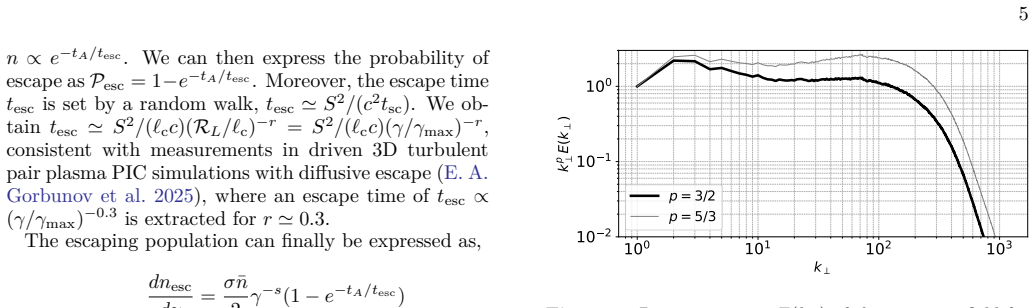


read the original abstract
Building on recent progress in the understanding of particle transport in magnetized plasmas, we derive a scaling law for the formation of nonthermal spectral tails in mildly and strongly magnetized turbulent environments. We validate this scaling using driven-turbulence particle-in-cell simulations that incorporate particle escape, allowing the system to reach a steady state. The simulation results show good agreement with our theoretical predictions. We then discuss the astrophysical implications of these findings, focusing on proton acceleration in the coronae of supermassive black holes and the resulting high-energy neutrino emission.
Editorial analysis
A structured set of objections, weighed in public.
Referee Report
Summary. The paper derives a scaling law for the formation of nonthermal spectral tails in mildly and strongly magnetized turbulent plasmas, building on recent progress in particle transport. It validates the scaling via driven-turbulence particle-in-cell simulations that incorporate particle escape to reach a steady state, reports good agreement between theory and simulations, and discusses astrophysical implications for proton acceleration in supermassive black hole coronae and associated high-energy neutrino emission.
Significance. If the derivation is independent and the simulations explicitly confirm the underlying transport assumptions (rather than merely reproducing power-law tails via escape), the result would offer a concrete, testable framework for nonthermal particle spectra in magnetized turbulence with direct relevance to high-energy astrophysics.
major comments (3)
- [§2] §2 (derivation): The scaling law is stated to build on recent progress in particle transport, but no explicit transport equations, diffusion tensor components, or mean-free-path scalings are shown; without these steps it is impossible to verify whether the final expression is independent or reduces by construction to a prior result or fitted parameter.
- [§4] §4 (simulations and validation): The manuscript asserts 'good agreement' between the derived scaling and PIC results but provides no quantitative fit metrics (e.g., reduced chi-squared, error bars on spectral indices, or R² values), no direct comparison of transport diagnostics (scattering rates, diffusion coefficients, or magnetization dependence of the mean free path), and no test that the simulated transport matches the model inserted into the derivation.
- [§4] §4: Because the simulations include an escape boundary to reach steady state, the observed power-law tails could be produced by the escape condition alone; without side-by-side transport statistics confirming that the PIC runs exhibit the same scattering and diffusion properties assumed in the scaling, the numerical match does not constitute a validation of the central claim.
minor comments (2)
- [Abstract] The abstract and introduction would benefit from a brief statement of the key transport assumptions (e.g., the form of the diffusion tensor or the regime of magnetization) to allow readers to assess applicability without consulting external references.
- [Figures] Figure captions for the spectral plots should include the exact simulation parameters (magnetization, turbulence driving scale, escape time) and the fitted spectral indices with uncertainties.
Simulated Author's Rebuttal
We thank the referee for their thorough and constructive review of our manuscript on nonthermal power laws in magnetized turbulent plasmas. We address each major comment point by point below, providing clarifications and indicating revisions made to strengthen the presentation of the derivation and validation.
read point-by-point responses
-
Referee: §2 (derivation): The scaling law is stated to build on recent progress in particle transport, but no explicit transport equations, diffusion tensor components, or mean-free-path scalings are shown; without these steps it is impossible to verify whether the final expression is independent or reduces by construction to a prior result or fitted parameter.
Authors: We appreciate the referee highlighting the need for greater explicitness in §2. The derivation builds directly on established particle transport principles in magnetized turbulence without introducing fitted parameters; the power-law index arises from the ratio of the acceleration timescale (set by the diffusion tensor) to the escape timescale. To make this fully verifiable, we have revised §2 to include the explicit form of the underlying transport equation, the relevant components of the diffusion tensor, and the mean-free-path scaling with magnetization. These additions confirm the result is independent and derived from first principles rather than reducing to a prior expression. revision: yes
-
Referee: §4 (simulations and validation): The manuscript asserts 'good agreement' between the derived scaling and PIC results but provides no quantitative fit metrics (e.g., reduced chi-squared, error bars on spectral indices, or R² values), no direct comparison of transport diagnostics (scattering rates, diffusion coefficients, or magnetization dependence of the mean free path), and no test that the simulated transport matches the model inserted into the derivation.
Authors: We agree that quantitative metrics and transport comparisons would improve the validation section. In the revised manuscript, we now report error bars on spectral indices from multiple independent simulation runs, include R² values quantifying the fit to the theoretical scaling, and add a new subsection presenting transport diagnostics extracted directly from particle trajectories. These include measured scattering rates, parallel and perpendicular diffusion coefficients, and their dependence on magnetization, all shown to be consistent with the transport model used in the derivation. revision: yes
-
Referee: §4: Because the simulations include an escape boundary to reach steady state, the observed power-law tails could be produced by the escape condition alone; without side-by-side transport statistics confirming that the PIC runs exhibit the same scattering and diffusion properties assumed in the scaling, the numerical match does not constitute a validation of the central claim.
Authors: The escape boundary is included only to permit a steady-state spectrum, as the system would otherwise accelerate particles indefinitely. To address the concern that tails might arise from escape alone, the revised §4 now includes side-by-side transport statistics: diffusion coefficients and mean-free-path scalings measured in the PIC runs are compared directly to the model assumptions, and we demonstrate that changing magnetization (while holding escape fixed) produces spectral indices that follow the derived scaling. These diagnostics confirm the power laws result from the interplay of turbulent transport and escape as modeled. revision: yes
Circularity Check
No significant circularity detected
full rationale
The abstract states that a scaling law is derived building on recent progress in particle transport and validated against driven-turbulence PIC simulations with escape, showing good agreement. No full-text equations, specific citations, or derivation steps are available for inspection in the provided context. Per hard rules, circularity can only be claimed when an exact quote exhibits a reduction by construction (self-definitional, fitted input renamed as prediction, or load-bearing self-citation chain). Absent such evidence, the derivation is treated as self-contained; the most common honest outcome when details cannot be walked.
Axiom & Free-Parameter Ledger
Reference graph
Works this paper leans on
-
[1]
arXiv , Author =:1511.05343 , Journal =
doi:10.1051/0004-6361/201527761 , Eid =. arXiv , Author =:1511.05343 , Journal =
-
[2]
arXiv , Author =:1210.4296 , Journal =
doi:10.1088/0004-637X/760/2/137 , Eid =. arXiv , Author =:1210.4296 , Journal =
-
[3]
European Physical Journal Web of Conferences , Doi =. 2019 , Bdsk-Url-1 =. arXiv , Author =:1902.08124 , Keywords =
-
[4]
Adriani, O. and Akaike, Y. and Asano, K. and Asaoka, Y. and Bagliesi, M. G. and Berti, E. and Bigongiari, G. and Binns, W. R. and Bonechi, S. and Bongi, M. and Brogi, P. and Bruno, A. and Buckley, J. H. and Cannady, N. and Castellini, G. and Checchia, C. and Cherry, M. L. and Collazuol, G. and Di Felice, V. and Ebisawa, K. and Fuke, H. and Guzik, T. G. an...
-
[5]
Manconi and M
S. Manconi and M. Di Mauro and F. Donato , Doi =. Multi-messenger constraints to the local emission of cosmic-ray electrons , Url =. Journal of Cosmology and Astroparticle Physics , Month =
-
[6]
doi:10.1088/0004-637X/786/2/124 , Eid =
2014 , Bdsk-Url-1 =. doi:10.1088/0004-637X/786/2/124 , Eid =. arXiv , Author =:1305.1242 , Journal =
-
[7]
Reviews of Modern Physics , eprint =
Reviews of Modern Physics , Keywords =. 2001 , Bdsk-Url-1 =. doi:10.1103/RevModPhys.73.1031 , Eprint =
-
[8]
Cowsik and T
R. Cowsik and T. Madziwa-Nussinov , Doi =. The Astrophysical Journal , Month =
-
[9]
doi:10.1017/S0022377816000660 , Eid =
2016 , Bdsk-Url-1 =. doi:10.1017/S0022377816000660 , Eid =. arXiv , Author =:1601.01570 , Journal =
-
[10]
Lowe, R. E. and Burgess, D. , Doi =. The properties and causes of rippling in quasi-perpendicular collisionless shock fronts , Url =. Annales Geophysicae , Number =. 2003 , Bdsk-Url-1 =
2003
-
[11]
Shock ripples observed by the
Andreas Johlander and Andris Vaivads and Yuri V Khotyaintsev and Imogen Gingell and Steven J Schwartz and Barbara L Giles and Roy B Torbert and Christopher T Russell , Doi =. Shock ripples observed by the. Plasma Physics and Controlled Fusion , Month =
-
[12]
and Schwartz, S
Johlander, A. and Schwartz, S. J. and Vaivads, A. and Khotyaintsev, Y. V. and Gingell, I. and Peng, I. B. and Markidis, S. and Lindqvist, P.-A. and Ergun, R. E. and Marklund, G. T. and Plaschke, F. and Magnes, W. and Strangeway, R. J. and Russell, C. T. and Wei, H. and Torbert, R. B. and Paterson, W. R. and Gershman, D. J. and Dorelli, J. C. and Avanov, L...
2016
-
[13]
Johlander, A. and Vaivads, A. and Khotyaintsev, Y. V. and Retin. Ion injection at Quasi-parallel Shocks Seen by the Cluster Spacecraft , Url =. , Keywords =. 2016 , Bdsk-Url-1 =. doi:10.3847/2041-8205/817/1/L4 , Eid =
-
[14]
Kinetic simulations of mildly relativistic shocks: Particle acceleration in high Mach number shocks , Url =. , Keywords =. 2019 , Bdsk-Url-1 =. doi:10.1093/mnras/stz232 , Eprint =
-
[15]
Weidl and Dan Winske and Christoph Niemann , Doi =
Martin S. Weidl and Dan Winske and Christoph Niemann , Doi =. On the Background-gyroresonant Character of Bell's Instability in the Large-current Regime , Url =. The Astrophysical Journal , Month =
-
[16]
Jokipii, J. R. , Doi =. Propagation of cosmic rays in the solar wind , Url =. 1971 , Bdsk-Url-1 =. https://agupubs.onlinelibrary.wiley.com/doi/pdf/10.1029/RG009i001p00027 , Journal =
-
[17]
The Astrophysical Journal , Month = apr, Title =
Mignone, A and Bodo, G and Vaidya, B and Mattia, G , Doi =. The Astrophysical Journal , Month = apr, Title =. 2018 , Bdsk-Url-1 =
2018
-
[18]
2012 , Bdsk-Url-1 =. doi:10.1088/0004-637X/749/1/63 , Eid =. arXiv , Author =:1107.5576 , Journal =
-
[19]
MNRAS , Keywords =. doi:10.1111/j.1365-2966.2009.15428.x , Eprint =
- [20]
-
[21]
, Keywords =
Cambridge and New York, Cambridge University Press, 1990, 292 p. , Keywords =
1990
-
[22]
doi:10.1088/1742-6596/409/1/012008 , Eid =
Journal of Physics Conference Series , Month = feb, Number = 1, Pages =. doi:10.1088/1742-6596/409/1/012008 , Eid =
-
[23]
astro-ph/9803299 , Journal =
work page internal anchor Pith review arXiv
-
[24]
MNRAS , Keywords =. 2000 , Bdsk-Url-1 =. doi:10.1046/j.1365-8711.2000.03146.x , Eprint =
-
[25]
doi:10.1016/j.astropartphys.2010.12.008 , Eprint =
, Month = mar, Pages =. doi:10.1016/j.astropartphys.2010.12.008 , Eprint =
-
[26]
Phys. Rep. , Month = sep, Pages =. doi:10.1016/j.physrep.2008.05.004 , Eprint =
-
[27]
ApJ Lett. , Keywords =. doi:10.1088/2041-8205/790/2/L21 , Eid =
-
[28]
doi:10.1016/j.astropartphys.2010.08.010 , Eprint =
, Pages =. doi:10.1016/j.astropartphys.2010.08.010 , Eprint =
-
[29]
doi:10.1016/j.nuclphysbps.2009.03.069 , Eprint =
Nuclear Physics B Proceedings Supplements , Month = may, Pages =. doi:10.1016/j.nuclphysbps.2009.03.069 , Eprint =
-
[30]
ULTRA-HIGH-ENERGY COSMIC RAYS FROM CENTAURUS A: JET INTERACTION WITH GASEOUS SHELLS
ApJ Lett. , Keywords =. doi:10.1088/2041-8205/720/2/L155 , Eprint =
-
[31]
MNRAS , Keywords =. 2010 , Bdsk-Url-1 =. doi:10.1111/j.1365-2966.2009.15784.x , Eprint =
-
[32]
doi:10.4236/ijaa.2014.43046 , Journal =
2014 , Bdsk-Url-1 =. doi:10.4236/ijaa.2014.43046 , Journal =
-
[33]
MNRAS , Keywords =. 2001 , Bdsk-Url-1 =. doi:10.1046/j.1365-8711.2001.04851.x , Eprint =
-
[34]
doi:10.1088/1367-2630/6/1/140 , Journal =
-
[35]
Physical Review Letters , Month = jul, Pages =. 1995 , Bdsk-Url-1 =. doi:10.1103/PhysRevLett.75.386 , Eprint =
-
[36]
2012, Astroparticle Physics, 35, 660, doi: 10.1016/j.astropartphys.2012.02.004
Astroparticle Physics , Month = may, Pages =. 2012 , Bdsk-Url-1 =. doi:10.1016/j.astropartphys.2012.02.004 , Eprint =
-
[37]
arXiv , Author =:1310.5477 , Journal =
Probing the origin of cosmic-rays with extremely high energy neutrinos using the IceCube Observatory , Volume =. arXiv , Author =:1310.5477 , Journal =
-
[38]
, Keywords =. doi:10.1086/510831 , Eprint =
- [39]
-
[40]
and Trivelpiece, A.W
Krall, N.A. and Trivelpiece, A.W. , Date-Added =. Principles of plasma physics , Url =. 1973 , Bdsk-Url-1 =
1973
-
[41]
, Keywords =. doi:10.1086/309533 , Eprint =
-
[42]
doi:10.1038/nphys2541 , Eprint =
Nature Physics , Month = mar, Pages =. doi:10.1038/nphys2541 , Eprint =
-
[43]
arXiv , Author =:1705.11096 , Journal =
doi:10.3847/1538-4357/aa76ea , Eid =. arXiv , Author =:1705.11096 , Journal =
-
[44]
doi:10.1063/1.866765 , Journal =
-
[45]
doi:10.1093/mnras/stt100 , Eprint =
, Keywords =. doi:10.1093/mnras/stt100 , Eprint =
-
[46]
doi:10.1088/0004-637X/721/1/828 , Eprint =
, Keywords =. doi:10.1088/0004-637X/721/1/828 , Eprint =
-
[47]
MNRAS , Keywords =. doi:10.1093/mnras/stt179 , Eprint =
-
[48]
MNRAS , Month = jan, Pages =
-
[49]
MNRAS , Month = feb, Pages =
-
[50]
2001 , Bdsk-Url-1 =
MNRAS , Month = mar, Pages =. 2001 , Bdsk-Url-1 =
2001
-
[51]
doi:10.1111/j.1365-2966.2004.08097.x , Journal =
-
[52]
, Keywords =. doi:10.1086/591308 , Eprint =
- [53]
-
[54]
doi:10.1051/0004-6361:20042015 , Eprint =
A&A , Month = apr, Pages =. doi:10.1051/0004-6361:20042015 , Eprint =
-
[55]
Akademiia Nauk SSSR Doklady , Month = jun, Pages =
-
[56]
1978 , Bdsk-Url-1 =. doi:10.1086/182658 , Journal =
-
[57]
doi:10.1142/S0217732305019213 , Eprint =
Modern Physics Letters A , Pages =. doi:10.1142/S0217732305019213 , Eprint =
-
[58]
2009 , Bdsk-Url-1 =. doi:10.1103/PhysRevLett.103.051104 , Eid =. arXiv , Author =:0903.2794 , Journal =
-
[59]
Fast electron transport in laser-produced plasmas and the
A R Bell and A P L Robinson and M Sherlock and R J Kingham and W Rozmus , Doi =. Fast electron transport in laser-produced plasmas and the. Plasma Physics and Controlled Fusion , Month =
-
[60]
doi:10.1016/0021-9991(86)90076-8 , Journal =
1986 , Bdsk-Url-1 =. doi:10.1016/0021-9991(86)90076-8 , Journal =
-
[61]
2000 , Bdsk-Url-1 =
MNRAS , Month = may, Pages =. 2000 , Bdsk-Url-1 =
2000
-
[62]
New particle pusher with hadronic interactions for modeling multimessenger emission from compact objects. , keywords =. doi:10.1103/PhysRevD.111.083032 , archivePrefix =. 2410.22781 , primaryClass =
-
[63]
doi:10.1007/BF00642346 , Journal =
-
[64]
MNRAS , Month = sep, Pages =. doi:10.1111/j.1365-2966.2006.10739.x , Eprint =
-
[65]
1982 , Bdsk-Url-1 =
A&A , Month = dec, Pages =. 1982 , Bdsk-Url-1 =
1982
-
[66]
Solar Physics , Pages =
-
[67]
A&A , Month = mar, Pages =
-
[68]
P&SS , Month = may, Pages =
-
[69]
doi:10.1088/0004-6256/145/4/104 , Eid =. arXiv , Author =:1302.4678 , Journal =
-
[70]
arXiv , Author =:1009.3319 , Journal =
doi:10.1088/0004-637X/733/1/63 , Eid =. arXiv , Author =:1009.3319 , Journal =
-
[71]
, Keywords =. 2009 , Bdsk-Url-1 =. doi:10.1088/0004-637X/694/1/626 , Eprint =
-
[72]
doi:10.1029/2012GL051581 , Eid =
, Keywords =. doi:10.1029/2012GL051581 , Eid =
-
[73]
doi:10.1088/2041-8205/765/1/L20 , Eid =
2013 , Bdsk-Url-1 =. doi:10.1088/2041-8205/765/1/L20 , Eid =. arXiv , Author =:1211.6765 , Journal =
-
[74]
2014 , Bdsk-Url-1 =. doi:10.1088/0004-637X/783/2/91 , Eid =. arXiv , Author =:1310.2943 , Journal =
-
[75]
2014 , Bdsk-Url-1 =. doi:10.1088/0004-637X/794/1/46 , Eid =. arXiv , Author =:1401.7679 , Journal =
-
[76]
2014 , Bdsk-Url-1 =. doi:10.1088/0004-637X/794/1/47 , Eid =. arXiv , Author =:1407.2261 , Journal =
- [77]
-
[78]
2015 , Bdsk-Url-1 =. doi:10.1088/0004-637X/809/1/55 , Eid =. arXiv , Author =:1412.1087 , Journal =
-
[79]
doi:10.3847/1538-4357/ab1648 , Eid =
2019 , Bdsk-Url-1 =. doi:10.3847/1538-4357/ab1648 , Eid =. arXiv , Author =:1902.10219 , Journal =
-
[80]
doi:10.1103/PhysRevLett.114.085003 , Eid =
2015 , Bdsk-Url-1 =. doi:10.1103/PhysRevLett.114.085003 , Eid =. arXiv , Author =:1412.0672 , Journal =
discussion (0)
Sign in with ORCID, Apple, or X to comment. Anyone can read and Pith papers without signing in.