Recognition: unknown
Gordian distance and clasper surgery for links
Pith reviewed 2026-05-08 02:48 UTC · model grok-4.3
The pith
Any n-component link with zero linking number can be reduced to a C_k-trivial link in at most n² crossing changes.
A machine-rendered reading of the paper's core claim, the machinery that carries it, and where it could break.
Core claim
We prove that any n-component link L with all pairwise linking numbers zero satisfies that the minimal number of crossing changes needed to reach a C_k-trivial link is at most n² for every k. We exhibit a sequence of n-component links realizing a quadratic lower bound on this distance. As a direct consequence, Milnor invariants, which are invariants of C_k-equivalence, carry only limited information about the unlinking number. When the linking numbers are nonzero and no component is C_k-trivial, we determine the precise number of crossing changes required to reach a C_k-trivial link.
What carries the argument
The Gordian distance (minimal crossing changes) from a link to a C_k-trivial link, where C_k-equivalence is the geometric relation generated by degree-k clasper surgeries.
If this is right
- Milnor invariants give only limited information about the unlinking number of a link.
- The n² upper bound on distance to C_k-triviality is independent of k.
- There exist n-component links requiring quadratically many crossing changes to reach C_k-triviality.
- When linking numbers are nonzero and no component is C_k-trivial, the exact crossing-change distance is determined.
Where Pith is reading between the lines
- The quadratic control on distance to C_k-triviality may allow similar bounds for other finite-type invariants of links.
- One could check whether the same n² ceiling holds when the target is replaced by other filtrations such as concordance or other surgery equivalences.
- The construction of quadratic lower-bound examples may generalize to produce families that remain far from C_k-triviality under additional geometric constraints such as fixed volume or bounded crossing number.
Load-bearing premise
The constructions assume that links are standardly embedded in the 3-sphere and that clasper surgery and crossing-change operations interact exactly as described in the existing literature on C_k-equivalence.
What would settle it
An explicit n-component link with all pairwise linking numbers zero whose minimal number of crossing changes to any C_k-trivial link exceeds n² for some fixed k.
Figures

read the original abstract
In 2000, Habiro introduced the notion of $C_k$-equivalence of knots and links. This geometric filtration is closely connected to finite type invariants, a class of invariants including Milnor's invariants. Shortly thereafter, Ohyama, Taniyama, and Yamada proved that $C_k$-equivalence, and by extension finite type invariants, say very little about the unknotting number by showing that any knot is at most one crossing change away from being $C_k$-trivial for any $k\in \mathbb{N}$. The same is not true for links, since the pairwise linking number gives a lower bound on unlinking and is an invariant of $C_2$-equivalence. We prove that, aside from the linking number, the result of Ohyama, Taniyama, and Yamada extends to links: any $n$-component link with linking number zero can be reduced to a $C_k$-trivial link in at most $n^2$ crossing changes. As a consequence, Milnor's invariants carry only limited information about the unlinking number. To establish a lower bound, we produce a sequence of $n$-component links for which the crossing change distance to a $C_k$-trivial link grows quadratically in $n$. Notably, these bounds are independent of the choice of $k\in \mathbb{N}$. Finally, we determine the exact number of crossing changes to a $C_k$-trivial link for links with nonzero linking numbers and where no component is $C_k$-trivial.
Editorial analysis
A structured set of objections, weighed in public.
Referee Report
Summary. The paper extends the Ohyama–Taniyama–Yamada theorem from knots to links by proving that any n-component link in S³ with vanishing pairwise linking numbers can be reduced to a C_k-trivial link by at most n² crossing changes, for arbitrary k. It supplies a quadratic lower bound via an explicit family of examples, determines the exact crossing-change distance to C_k-triviality when linking numbers are nonzero (and no component is already C_k-trivial), and concludes that Milnor invariants beyond the linking numbers give only limited information about the unlinking number. The arguments rely on standard properties of clasper surgery and crossing changes.
Significance. If the stated bounds hold, the result is significant: it shows that C_k-equivalence (and hence finite-type invariants) is strictly coarser than the Gordian distance for links once linking numbers vanish, with the gap growing quadratically in the number of components. The k-independence of the bounds and the matching lower-bound construction are notable strengths, as is the exact determination for the nonzero-linking case. The work cleanly separates the linking-number obstruction from higher-order Milnor invariants.
minor comments (4)
- §1, paragraph after Definition 1.2: the phrase 'Gordian distance to C_k-triviality' is introduced without an explicit reference to the crossing-change metric; a one-sentence reminder of the definition would improve readability for readers outside the immediate area.
- Theorem 1.3 (nonzero-linking case): the statement assumes 'no component is C_k-trivial,' but the proof sketch in §4 does not explicitly verify that this hypothesis is preserved under the sequence of moves; adding a short sentence confirming invariance would remove any ambiguity.
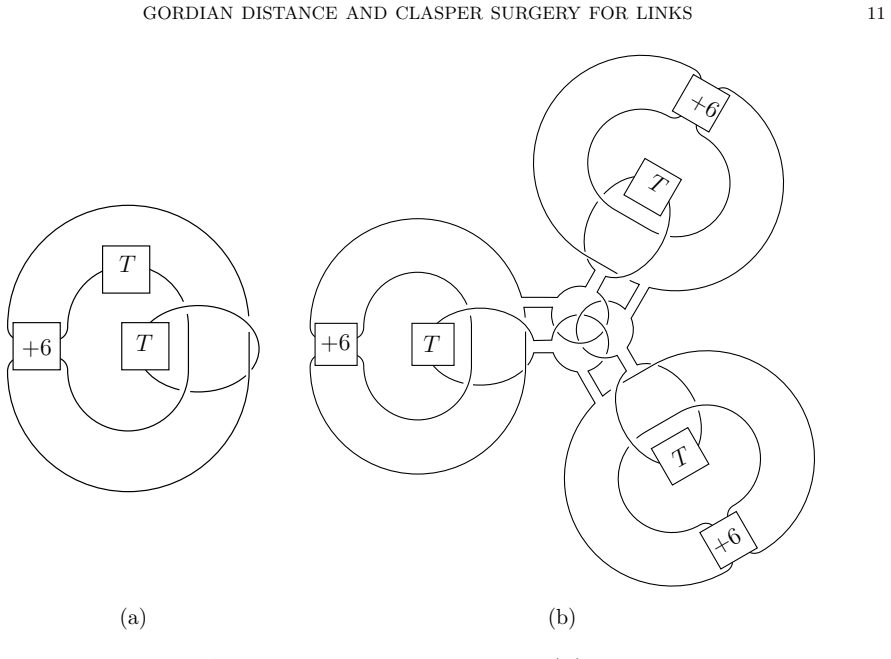
- Figure 3 (the quadratic lower-bound family): the caption does not indicate the value of k for which the diagram is drawn; since the bound is claimed independent of k, a parenthetical note '(for any k ≥ 2)' would clarify the figure's role.
- References: the citation to Habiro's original C_k paper is listed as [Hab00], but the bibliography entry lacks the journal volume and page range; this is a minor formatting omission.
Simulated Author's Rebuttal
We thank the referee for the positive assessment of our manuscript and the recommendation of minor revision. No specific major comments were raised in the report.
Circularity Check
No significant circularity detected
full rationale
The paper's central theorems extend the externally cited Ohyama-Taniyama-Yamada result on knots to links via standard geometric properties of clasper surgery and crossing changes in S^3, as established in Habiro's prior work. The n² upper bound, quadratic lower bound examples, and exact counts for nonzero linking number are derived from explicit constructions and reductions that do not reduce to self-definitions, fitted inputs, or load-bearing self-citations. All load-bearing facts about C_k-equivalence and finite-type invariants are imported from independent literature without internal circular dependence on the present claims.
Axiom & Free-Parameter Ledger
axioms (1)
- domain assumption Standard properties of links in the 3-sphere and the behavior of clasper surgery and crossing changes under C_k-equivalence
Reference graph
Works this paper leans on
-
[1]
On the indeterminacy of Milnor’s triple linking number.J
Jonah Amundsen, Eric Anderson, and Christopher William Davis. On the indeterminacy of Milnor’s triple linking number.J. Knot Theory Ramifications, 29(9):15, 2020. Id/No 2050064
2020
-
[2]
The C-complex clasp number of links.Rocky Mt
Jonah Amundsen, Eric Anderson, Christopher William Davis, and Daniel Guyer. The C-complex clasp number of links.Rocky Mt. J. Math., 50(3):839–850, 2020
2020
-
[3]
How many crossing changes or delta-moves does it take to get to a homotopy trivial link? 2025
Anthony Bosman, Christopher William Davis, Taylor Martin, Carolyn Otto, and Katherine Vance. How many crossing changes or delta-moves does it take to get to a homotopy trivial link? 2025. ArXiv: https://arxiv.org/abs/2412.18075. To appear inAlgebraic and Geometric Topology
-
[4]
Whitney tower concordance of classical links
James Conant, Rob Schneiderman, and Peter Teichner. Whitney tower concordance of classical links. Geom. Topol., 16(3):1419–1479, 2012
2012
-
[5]
Clasper concordance, whitney towers and re- peating milnor invariants.J
James Conant, Rob Schneiderman, and Peter Teichner. Clasper concordance, whitney towers and re- peating milnor invariants.J. Knot Theory Ramifications, 34(4):2550013, 2025
2025
-
[6]
Davis, Matthias Nagel, Patrick Orson, and Mark Powell
Christopher W. Davis, Matthias Nagel, Patrick Orson, and Mark Powell. Surface systems and triple linking numbers.Indiana Univ. Math. J., 69(7):2505–2547, 2020
2020
-
[7]
The classification of links up to link-homotopy.J
Nathan Habegger and Xiao-Song Lin. The classification of links up to link-homotopy.J. Amer. Math. Soc., 3(2):389–419, 1990
1990
-
[8]
On link concordance and Milnor’s µinvariants.Bull
Nathan Habegger and Xiao-Song Lin. On link concordance and Milnor’s µinvariants.Bull. London Math. Soc., 30(4):419–428, 1998
1998
-
[9]
Claspers and finite type invariants of links.Geom
Kazuo Habiro. Claspers and finite type invariants of links.Geom. Topol., 4:1–83 (electronic), 2000
2000
-
[10]
ProQuest LLC, Ann Arbor, MI, 1988
Gyo Taek Jin.Invariants of two-component links. ProQuest LLC, Ann Arbor, MI, 1988. Thesis (Ph.D.)– Brandeis University
1988
-
[11]
Two-bridge knots with unknotting number one.Proc
Taizo Kanenobu and Hitoshi Murakami. Two-bridge knots with unknotting number one.Proc. Amer. Math. Soc., 98(3):499–502, 1986
1986
-
[12]
Unlinking, splitting, and some other NP-hard problems in knot theory
Dale Koenig and Anastasiia Tsvietkova. Unlinking, splitting, and some other NP-hard problems in knot theory. InProceedings of the 32nd annual ACM-SIAM symposium on discrete algorithms, SODA 2021, Alexandria, VA, USA, virtual, January 10–13, 2021, pages 1496–1507. Philadelphia, PA: Society for Industrial and Applied Mathematics (SIAM); New York, NY: Associ...
2021
-
[13]
Two-bridge links with unlinking number one.Proc
Peter Kohn. Two-bridge links with unlinking number one.Proc. Amer. Math. Soc., 113(4):1135–1147, 1991
1991
-
[14]
Unlinking two component links.Osaka J
Peter Kohn. Unlinking two component links.Osaka J. Math., 30(4):741–752, 1993
1993
-
[15]
Link-homotopy classes of 4-component links, claspers and the Habegger-Lin algorithm.J
Yuka Kotorii and Atsuhiko Mizusawa. Link-homotopy classes of 4-component links, claspers and the Habegger-Lin algorithm.J. Knot Theory Ramifications, 32(6):Paper No. 2350045, 26, 2023
2023
-
[16]
W. B. Raymond Lickorish. The unknotting number of a classical knot. InCombinatorial methods in topology and algebraic geometry (Rochester, N.Y., 1982), volume 44 ofContemp. Math., pages 117–121. Amer. Math. Soc., Providence, RI, 1985
1982
-
[17]
Enhanced linking numbers.The American Mathematical Monthly, 110(5):361–385, 2003
Charles Livingston. Enhanced linking numbers.The American Mathematical Monthly, 110(5):361–385, 2003
2003
-
[18]
Link groups.Ann
John Milnor. Link groups.Ann. of Math. (2), 59:177–195, 1954
1954
-
[19]
Isotopy of links
John Milnor. Isotopy of links. Algebraic geometry and topology. InA symposium in honor of S. Lefschetz, pages 280–306. Princeton University Press, Princeton, N. J., 1957
1957
-
[20]
On a certain move generating link-homology.Math
Hitoshi Murakami and Yasutaka Nakanishi. On a certain move generating link-homology.Math. Ann., 284(1):75–89, 1989. GORDIAN DISTANCE AND CLASPER SURGERY FOR LINKS 13
1989
-
[21]
A note on unknotting number.Math
Yasutaka Nakanishi. A note on unknotting number.Math. Sem. Notes Kobe Univ., 9(1):99–108, 1981
1981
-
[22]
Web diagrams and realization of Vassiliev invariants by knots.J
Yoshiyuki Ohyama. Web diagrams and realization of Vassiliev invariants by knots.J. Knot Theory Ramifications, 9(5):693–701, 2000
2000
-
[23]
Realization of Vassiliev invariants by unknot- ting number one knots.Tokyo J
Yoshiyuki Ohyama, Kouki Taniyama, and Shuji Yamada. Realization of Vassiliev invariants by unknot- ting number one knots.Tokyo J. Math., 25(1):17–31, 2002. Department of Mathematics and Physics, Andrews University Email address:bosman@andrews.edu URL:andrews.edu/cas/math/faculty/bosman-anthony.html Department of Mathematics, University of Wisconsin–Eau Cl...
2002
discussion (0)
Sign in with ORCID, Apple, or X to comment. Anyone can read and Pith papers without signing in.