Recognition: unknown
Scalable generative modeling of non-Gaussian spatio-temporal fields via autoregressive Gaussian processes
Pith reviewed 2026-05-08 17:40 UTC · model grok-4.3
The pith
An autoregressive construction with Gaussian process conditionals models non-Gaussian spatio-temporal fields scalably.
A machine-rendered reading of the paper's core claim, the machinery that carries it, and where it could break.
Core claim
The authors establish that representing the joint density of a spatio-temporal field as a product of univariate conditionals, each modeled by a Gaussian process in an autoregressive transport-map construction, allows accurate generative modeling of non-Gaussian and nonstationary fields. This setup includes regularization from the prior for small samples and uses data-dependent sparsity to ensure scalability to high dimensions. Accuracy is demonstrated on climate-model output with tens of millions of data points, along with a forward-in-time variant.
What carries the argument
The autoregressive transport-map construction with Gaussian process conditionals and data-dependent sparsity in the conditioning sets.
If this is right
- Generative modeling becomes feasible for applications such as stochastic weather generators and climate-model surrogates.
- The prior regularization makes the method suitable even when only a small number of training samples are available.
- Data-dependent sparsity allows handling of high-dimensional distributions with tens of millions of points.
- The time-forward variant supports sampling or prediction from incomplete space-time trajectories.
- Empirical results confirm accuracy for non-Gaussian climate-model fields at large scales.
Where Pith is reading between the lines
- This approach could apply to other domains with high-dimensional non-Gaussian spatio-temporal data, such as ocean modeling or air quality monitoring.
- Full generative capabilities may improve uncertainty quantification in downstream tasks like risk assessment for climate events.
- Integrating physical laws as constraints within the conditionals could produce more realistic and consistent samples.
- Controlled experiments on synthetic data with known dependence structures would help quantify how well the sparsity preserves key interactions.
Load-bearing premise
The autoregressive factorization and Gaussian process conditionals can accurately represent the nonstationary and non-Gaussian dependencies, and that the data-dependent sparsity does not omit important interactions.
What would settle it
Drawing many samples from the fitted model on the climate dataset and verifying whether their joint statistics, including non-Gaussian features like tails and nonlinear correlations, match those of the original data; significant mismatch would falsify the claim of accurate representation.
Figures


read the original abstract
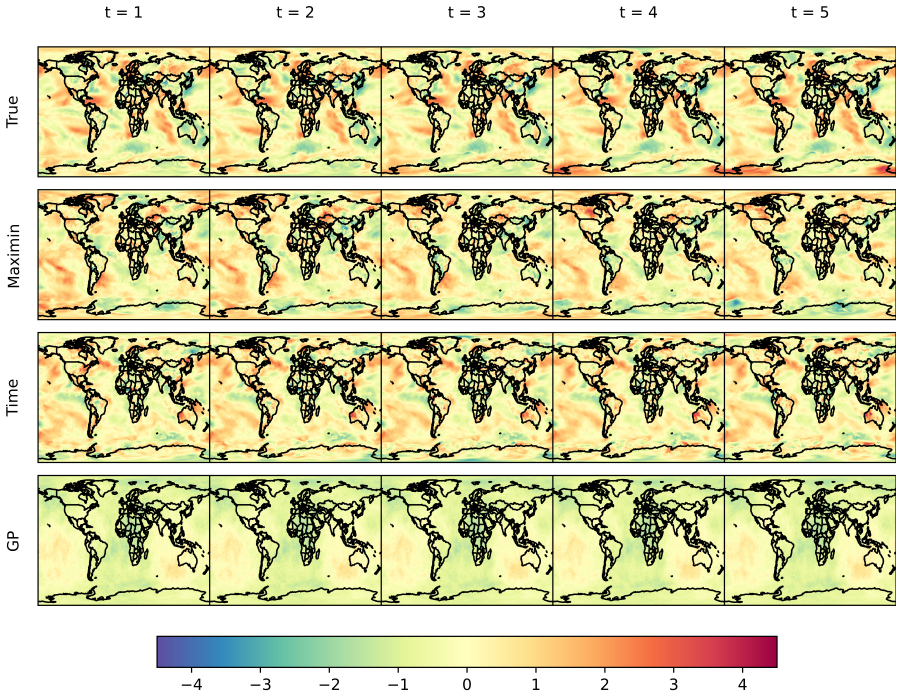
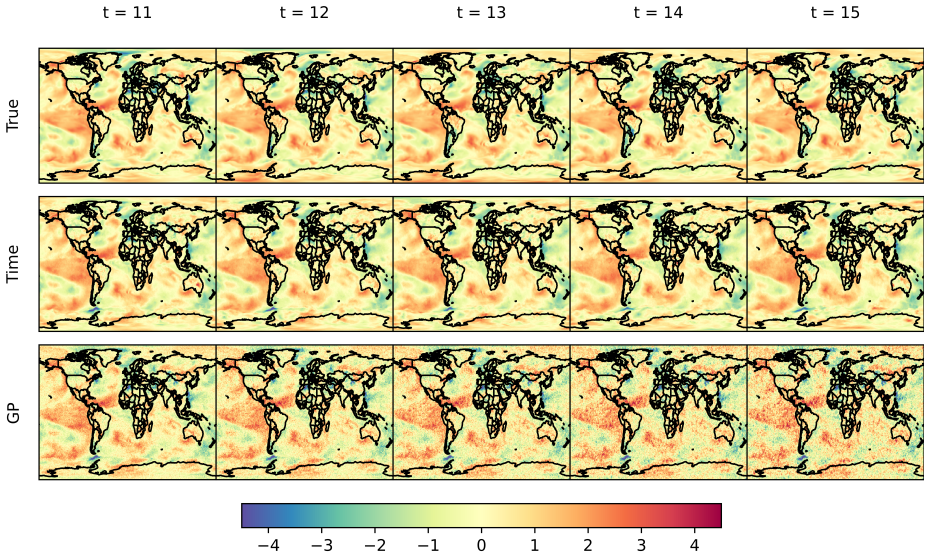
Generative modeling of spatio-temporal fields is crucial for a variety of applications, including stochastic weather generators and climate-model surrogates. However, many such fields exhibit complex dependence structures that vary across space and time and are nonlinear, resulting in nonstationary and non-Gaussian joint distributions. Our approach represents the joint density of a spatio-temporal field as a product of univariate conditional distributions and models these conditionals using Gaussian processes within an autoregressive transport-map construction. This prior distribution provides regularization, making our method suitable for a small number of training samples. Data-dependent sparsity in the conditioning sets ensures scalability to high-dimensional distributions. We also propose a variant of the method designed to sample or predict forward in time from a given incomplete space-time trajectory. We demonstrate the accuracy and scalability of our approach on non-Gaussian climate-model output with tens of millions of data points.
Editorial analysis
A structured set of objections, weighed in public.
Referee Report
Summary. The paper proposes a generative modeling framework for non-Gaussian spatio-temporal fields that factorizes the joint density as a product of univariate conditional distributions. Each conditional is modeled via a Gaussian-process-parameterized transport map in an autoregressive construction. A GP prior supplies regularization for small training sets, while data-dependent sparsity in the conditioning sets is used to achieve scalability. A forward-in-time sampling/prediction variant is also introduced, and the method is demonstrated on non-Gaussian climate-model output containing tens of millions of points.
Significance. If the central claims hold, the work would supply a flexible, regularized approach to sampling from complex nonstationary and non-Gaussian spatio-temporal distributions at scales relevant to climate applications. The combination of autoregressive factorization, transport maps, and GP priors addresses a recognized gap between expressive density estimation and practical scalability with limited data.
major comments (2)
- [Construction of the autoregressive transport map and sparsity rule] The scalability claim rests on data-dependent sparsity of conditioning sets, yet no theoretical bound or consistency result is supplied showing that the chosen sparsity rule preserves all statistically relevant long-range dependencies typical of climate fields; without such safeguards the generative distribution can be biased even if the GP prior regularizes the small-sample regime.
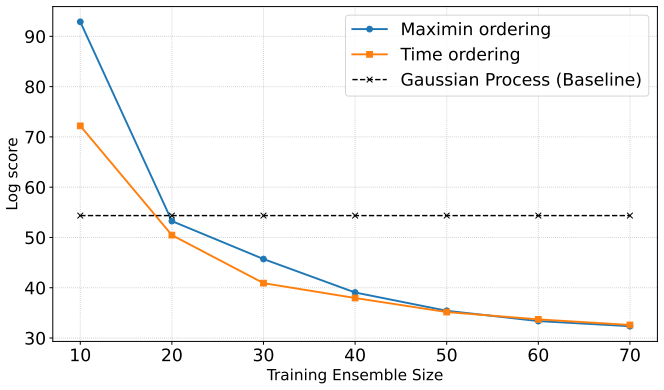
- [Numerical experiments] The experimental demonstration on climate data reports no quantitative error metrics, baseline comparisons, or ablation studies on the sparsity thresholds; this leaves the accuracy and scalability assertions without the concrete verification needed to support the central claim.
minor comments (1)
- [Method overview] The abstract and early sections would benefit from an explicit equation for the transport-map parameterization of each conditional to make the construction reproducible.
Simulated Author's Rebuttal
We thank the referee for their constructive and detailed review. The comments highlight important aspects of our work that we will address to strengthen the manuscript. We respond to each major comment below.
read point-by-point responses
-
Referee: [Construction of the autoregressive transport map and sparsity rule] The scalability claim rests on data-dependent sparsity of conditioning sets, yet no theoretical bound or consistency result is supplied showing that the chosen sparsity rule preserves all statistically relevant long-range dependencies typical of climate fields; without such safeguards the generative distribution can be biased even if the GP prior regularizes the small-sample regime.
Authors: We agree that the paper does not supply formal theoretical bounds or consistency guarantees for the data-dependent sparsity rule. The sparsity mechanism selects conditioning sets using empirical dependence measures (such as lagged correlations or mutual information thresholds computed from the training data), which are intended to retain the dominant long-range structures present in the observed climate fields. The Gaussian-process parameterization of each transport map supplies additional regularization that is particularly useful when the number of training realizations is small. While we do not claim that the rule is universally consistent for arbitrary non-Gaussian spatio-temporal processes, we will add a new discussion subsection that (i) explicitly states the empirical nature of the sparsity choice, (ii) describes the risk of under-representing weak long-range dependencies, and (iii) outlines possible future theoretical directions. This addition will clarify the scope of the current claims without overstating theoretical support. revision: partial
-
Referee: [Numerical experiments] The experimental demonstration on climate data reports no quantitative error metrics, baseline comparisons, or ablation studies on the sparsity thresholds; this leaves the accuracy and scalability assertions without the concrete verification needed to support the central claim.
Authors: We accept that the original experimental section relies primarily on visual and qualitative assessment of generated fields. In the revised manuscript we will augment the climate-data demonstration with quantitative metrics, including continuous ranked probability score (CRPS) for predictive distributions and estimated log-likelihood on held-out space-time locations. We will also add direct comparisons against two baselines: a standard separable Gaussian process and a simpler autoregressive model without transport maps. Finally, we will include an ablation study that varies the sparsity threshold and reports the resulting trade-off between generative fidelity (via the quantitative metrics) and wall-clock time. These additions will supply the concrete verification requested. revision: yes
Circularity Check
No circularity in derivation chain
full rationale
The paper constructs the joint density via the standard chain-rule factorization into univariate conditionals, each modeled by a Gaussian-process transport map. This is an explicit modeling choice, not a reduction of any output to a fitted input or self-defined quantity. Data-dependent sparsity is introduced as a pragmatic scalability device without claiming it preserves all dependencies by construction or via a self-citation uniqueness theorem. No load-bearing step renames a known result, smuggles an ansatz through prior self-work, or equates a prediction to its own fitting procedure. The derivation remains self-contained against external probabilistic and GP foundations.
Axiom & Free-Parameter Ledger
free parameters (1)
- Sparsity selection thresholds or rules
axioms (2)
- domain assumption The joint density factors exactly into a product of univariate conditional distributions
- domain assumption Gaussian processes can accurately represent the conditional distributions after transport-map adjustment
Reference graph
Works this paper leans on
-
[1]
Scalable Bayesian Transport Maps for High-Dimensional Non-Gaussian Spatial Fields , url =
Matthias Katzfuss and Florian Schäfer , doi =. Scalable Bayesian Transport Maps for High-Dimensional Non-Gaussian Spatial Fields , url =. Journal of the American Statistical Association , keywords =
-
[2]
arXiv preprint arXiv:2412.08820 , year=
Precision and Cholesky Factor Estimation for Gaussian Processes , author=. arXiv preprint arXiv:2412.08820 , year=
-
[3]
Journal of the American Statistical Association , volume =
Permutation-based Factorizations of the Gaussian Likelihood , author =. Journal of the American Statistical Association , volume =. 2018 , publisher =
2018
-
[4]
Spatial Statistics , volume =
Limitations on Low-Rank Approximations for Covariance Matrices of Spatial Data , author =. Spatial Statistics , volume =. 2014 , publisher =
2014
-
[5]
and Vertenstein, Mariana and Worley, Patrick H
Dennis, John M. and Vertenstein, Mariana and Worley, Patrick H. and Mirin, Arthur A. and Craig, Anthony P. and Jones, Philip W. and Mickelson, Shawn A. and Jacob, Robert L. , title =. International Journal of High Performance Computing Applications , volume =. 2012 , doi =
2012
-
[6]
Bulletin of the American Meteorological Society , volume=
The Community Earth System Model: A framework for collaborative research , author=. Bulletin of the American Meteorological Society , volume=. 2013 , doi=
2013
-
[7]
Stein, Michael L. , number =. 2011 , journal =. doi:10.1214/11-AOS909 , issn =
-
[8]
Elbern, H. and Schmidt, H. and Talagrand, Olivier and Ebel, A. , number =. 2000 , journal =. doi:10.1016/S1364-8152(00)00049-9 , issn =
-
[9]
and Katzfuss, Matthias and Wikle, Christopher K
Stroud, Jonathan R. and Katzfuss, Matthias and Wikle, Christopher K. , number =. 2018 , journal =. doi:10.1175/MWR-D-16-0427.1 , arxivId =
-
[10]
and Tawn, Jonathan A , number =
Coles, S.G. and Tawn, Jonathan A , number =. 1996 , journal =
1996
-
[11]
, number =
Handcock, Mark S and Stein, Michael L. , number =. 1993 , journal =
1993
-
[12]
1999 , booktitle =
Knuth, Kevin H , pages =. 1999 , booktitle =
1999
-
[13]
Stegle, Oliver and Parts, Leopold and Durbin, Richard and Winn, John , number =. 2010 , journal =. doi:10.1371/journal.pcbi.1000770 , issn =
-
[14]
Di Narzo, A. F. and Cocchi, D. , number =. 2010 , journal =. doi:10.1111/j.1467-9876.2009.00700.x , issn =
-
[15]
Katzfuss, Matthias and Hammerling, Dorit M. and Smith, Richard L. , number =. 2017 , journal =. doi:10.1002/2017GL073688 , issn =
-
[16]
and Buxton, Bruce E and Craigmile, Peter F
Paul, Rajib and Cressie, Noel and Calder, Catherine A. and Buxton, Bruce E and Craigmile, Peter F. and Li, Hongfei and Mcmillan, Nancy J and Morara, Michele and Sanford, Jessica and Santner, Thomas J and Zhang, Jian , number =. 2007 , booktitle =
2007
-
[17]
IEEE Sensor Array and Multichannel Signal Processing Workshop , author =
Proc. IEEE Sensor Array and Multichannel Signal Processing Workshop , author =
-
[18]
Xu, Ganggang and Liang, Faming and Genton, Marc G. , pages =. 2015 , journal =. doi:10.5705/ss.2013.085w , issn =
-
[19]
Wikle, Christopher K. and Berliner, L. Mark , number =. 2007 , journal =. doi:10.1016/j.physd.2006.09.017 , issn =
-
[20]
Ferro, C.A.T. and Fricker, T.E. , month =. 2012 , journal =. doi:10.1002/qj.1924 , issn =
-
[21]
and Gelfand, Alan E
Berrocal, Veronica J. and Gelfand, Alan E. and Holland, David M. , url =. 2011 , journal =
2011
-
[22]
and Jones, Andrew S
Kidder, Stanley Q. and Jones, Andrew S. , number =. 2007 , journal =
2007
-
[23]
Manzan, S and Zerom, D , number =. 2008 , journal =. doi:10.1016/j.ijforecast.2007.12.004 , issn =
-
[24]
and Datta, Abhirup and Finley, Andrew O
Heaton, Matthew J. and Datta, Abhirup and Finley, Andrew O. and Furrer, Reinhard and Guinness, Joseph and Guhaniyogi, Rajarshi and Gerber, Florian and Gramacy, Robert B. and Hammerling, Dorit M. and Katzfuss, Matthias and Lindgren, Finn and Nychka, Douglas W. and Sun, Furong and Zammit-Mangion, Andrew , number =. 2019 , journal =. doi:10.1007/s13253-018-0...
-
[25]
and Eidsvik, Jo and Guindani, Michele and Nail, Amy J
Reich, Brian J. and Eidsvik, Jo and Guindani, Michele and Nail, Amy J. and Schmidt, Alexandra M. , number =. 2011 , journal =. doi:10.1214/11-AOAS482 , issn =
-
[26]
2020 , journal =
Katzfuss, Matthias and Gong, Wenlong , number =. 2020 , journal =
2020
-
[27]
Liang, Min and Marcotte, Denis , publisher =. 2015 , journal =. doi:10.1007/s00477-015-1100-y , issn =
-
[28]
2004 , journal =
Wall, Melanie M , url =. 2004 , journal =
2004
-
[29]
Bolin, David and Lindgren, Finn , month =. 2013 , journal =. doi:10.1016/j.csda.2012.11.011 , issn =
-
[30]
Fasiolo, Matteo and Pya, Natalya and Wood, Simon N. , number =. 2016 , journal =. doi:10.1214/15-STS534 , issn =
-
[31]
2014 , journal =
Bradley, Jonathan R and Cressie, Noel and Shi, Tao , arxivId =. 2014 , journal =
2014
-
[32]
and Zimmerman, M.B
Zimmerman, D.L. and Zimmerman, M.B. , number =. 1991 , journal =
1991
-
[33]
1999 , journal =
Curriero, FC and Lele, Subhash , number =. 1999 , journal =
1999
-
[34]
Kyung, Minjung , number =. 2011 , journal =. doi:10.1214/11-BA629 , issn =
-
[35]
and Dubovik, Oleg and Schechner, Yoav , number =
Xu, Feng and Diner, David J. and Dubovik, Oleg and Schechner, Yoav , number =. 2019 , journal =. doi:10.3390/rs11070746 , issn =
-
[36]
, pages =
Horrell, Michael T and Stein, Michael L. , pages =. 2015 , journal =
2015
-
[37]
Zhou, Xingyu and Jiao, Yuling and Liu, Jin and Huang, Jian , volume =. 2022 , journal =. doi:10.1080/01621459.2021.2016424 , issn =
-
[38]
and Cressie, Noel , number =
Wikle, Christopher K. and Cressie, Noel , number =. 1999 , journal =
1999
-
[39]
Storey, John D. , number =. 2002 , journal =. doi:10.1111/1467-9868.00346 , issn =
-
[40]
2012 , journal =
Sigrist, Fabio and K. 2012 , journal =
2012
-
[41]
Tzeng, ShengLi and Huang, Hsin-Cheng and Cressie, Noel , number =. 2005 , journal =. doi:10.1198/016214505000000420 , issn =
-
[42]
Voutilainen, A. and Pyh. 2007 , journal =
2007
-
[43]
Fuentes, Montserrat , number =. 2005 , journal =. doi:10.1016/j.jmva.2004.09.003 , issn =
-
[44]
2012 , journal =
Sang, Huiyan and Huang, Jianhua Z , number =. 2012 , journal =
2012
-
[45]
Rao, B.S.Y. and Durrant-Whyte, H.F. and Sheen, J.a. , number =. 1993 , journal =. doi:10.1177/027836499301200102 , issn =
-
[46]
Kiiveri, Harri T , number =. 2008 , journal =. doi:10.1186/1471-2105-9-195 , issn =
-
[47]
Katzfuss, Matthias and Guinness, Joseph , number =. 2021 , journal =. doi:10.1214/19-STS755 , arxivId =
-
[48]
and Hooten, Mevin B , number =
Wikle, Christopher K. and Hooten, Mevin B , number =. 2010 , journal =
2010
-
[49]
Gotway, Carol A and Young, Linda J , number =. 2007 , journal =. doi:10.1198/106186007X179257 , issn =
-
[50]
Hsu, Nan-jung and Chang, Ya-mei and Huang, Hsin-cheng , number =. 2011 , journal =. doi:10.1002/env.1130 , keywords =
-
[51]
Bellone, E and Hughes, James P. and Guttorp, Peter , number =. 2000 , journal =. doi:10.3354/cr015001 , issn =
-
[52]
Royle, J. Andrew and Berliner, L. Mark , number =. 1999 , journal =. doi:10.2307/1400420 , issn =
-
[53]
Wang, Yueqing and Jiang, Xin and Yu, Bin and Jiang, Ming , number =. 2013 , journal =. doi:10.1080/01621459.2013.796834 , issn =
-
[54]
, number =
Hoff, Peter D. , number =. 2009 , journal =
2009
-
[55]
Andrew and Berliner, L
Royle, J. Andrew and Berliner, L. Mark and Wikle, Christopher K. and Milliff, Ralph F , editor =. 1999 , booktitle =
1999
-
[56]
Rajagopalan, Balaji and Lall, Upmanu , number =. 1999 , journal =. doi:10.1029/1999WR900028 , issn =
-
[57]
and Wikle, Christopher K
Xu, B. and Wikle, Christopher K. and Fox, N.I. , number =. 2005 , journal =
2005
-
[58]
Wikle, Christopher K. , number =. 2002 , journal =. doi:10.1191/1471082x02st036oa , issn =
-
[59]
and Szunyogh, Istvan and Zimin, A
Ott, Edward and Hunt, Brian R. and Szunyogh, Istvan and Zimin, A. V. and Kostelich, Eric J. and Corazza, M. and Kalnay, Eugenia and Patil, D. J. and Yorke, J. A. , pages =. 2004 , journal =. doi:10.1111/j.1600-0870.2004.00076.x , issn =
-
[60]
and Gyarmati, Gyorgyi and Kalnay, Eugenia and Hunt, Brian R
Szunyogh, Istvan and Kostelich, Eric J. and Gyarmati, Gyorgyi and Kalnay, Eugenia and Hunt, Brian R. and Ott, Edward and Satterfield, Elizabeth and Yorke, James A. , number =. 2008 , journal =. doi:10.1111/j.1600-0870.2007.00274.x , issn =
-
[61]
Anderson, Jeffrey L. , number =. 2003 , journal =. doi:10.1175/1520-0493(2003)131<0634:ALLSFF>2.0.CO;2 , issn =
-
[62]
Poterjoy, Jonathan , pages =. 2016 , journal =. doi:10.1175/MWR-D-15-0163.1 , issn =
-
[63]
2012 , journal =
Anitescu, Mihai and Chen, Jie and Wang, Lei , number =. 2012 , journal =
2012
-
[64]
Stein, Michael L. , number =. 2008 , journal =. doi:10.1016/j.jkss.2007.09.001 , issn =
-
[65]
Lei, Jing and Bickel, Peter J , pages =. 2011 , journal =. doi:10.1175/2011MWR3553.1 , issn =
-
[66]
Carlin, Bradley P and Polson, Nicholas G and Stoffer, David S , number =. 1992 , journal =. doi:10.1080/01621459.1992.10475231 , issn =
-
[67]
Anderson, Jeffrey L. and Anderson, Stephen L. , number =. 1999 , journal =. doi:10.1175/1520-0493(1999)127<2741:AMCIOT>2.0.CO;2 , issn =
-
[68]
Katzfuss, Matthias , number =. 2017 , journal =. doi:10.1080/01621459.2015.1123632 , issn =
-
[69]
and Bandyopadhyay, Soutir and Hammerling, Dorit M
Nychka, Douglas W. and Bandyopadhyay, Soutir and Hammerling, Dorit M. and Lindgren, Finn and Sain, Stephan R. , number =. 2015 , journal =
2015
-
[70]
Mike and Vazquez, Jorge and Armstrong, Edward M
Chin, T. Mike and Vazquez, Jorge and Armstrong, Edward M. , url =. 2013 , journal =
2013
-
[71]
Liu, Xuefeng and Daniels, Michael J , number =. 2006 , journal =. doi:10.1198/106186006X160681 , issn =
-
[72]
, number =
Kalman, R.E. , number =. 1960 , journal =
1960
-
[73]
and Triantafyllou, G and Korres, G , pages =
Hoteit, Ibrahim and Pham, D -T. and Triantafyllou, G and Korres, G , pages =. 2008 , journal =
2008
-
[74]
1992 , journal =
Vecchia, AV , number =. 1992 , journal =
1992
-
[75]
Wu, Hao and Wang, Chi and Wu, Zhijin , number =. 2013 , journal =. doi:10.1093/biostatistics/kxs033 , issn =
-
[76]
Anderson, Jeffrey L. , number =. 2010 , journal =. doi:10.1175/2010MWR3253.1 , issn =
-
[77]
and Guttorp, Peter and Charles, Stephen P
Hughes, James P. and Guttorp, Peter and Charles, Stephen P. , number =. 1999 , journal =
1999
-
[78]
2013 , journal =
Reich, Sebastian , number =. 2013 , journal =
2013
-
[79]
and Katzfuss, Matthias , number =
Kathuria, Dhruva and Mohanty, Binayak P. and Katzfuss, Matthias , number =. 2019 , journal =. doi:10.1029/2018WR023505 , issn =
-
[80]
Alonso, Ariel , number =. 2010 , journal =. doi:10.1198/tast.2010.09244 , issn =
discussion (0)
Sign in with ORCID, Apple, or X to comment. Anyone can read and Pith papers without signing in.