Recognition: unknown
Transition Metal Dichalcogenide Excitons in Periodic Electrostatic Potentials: Center-of-Mass Models
Pith reviewed 2026-05-08 17:08 UTC · model grok-4.3
The pith
Periodic electrostatic potentials split exciton valleys in TMDs and create a linear-dispersing band that enables Bose condensation in two dimensions.
A machine-rendered reading of the paper's core claim, the machinery that carries it, and where it could break.
Core claim
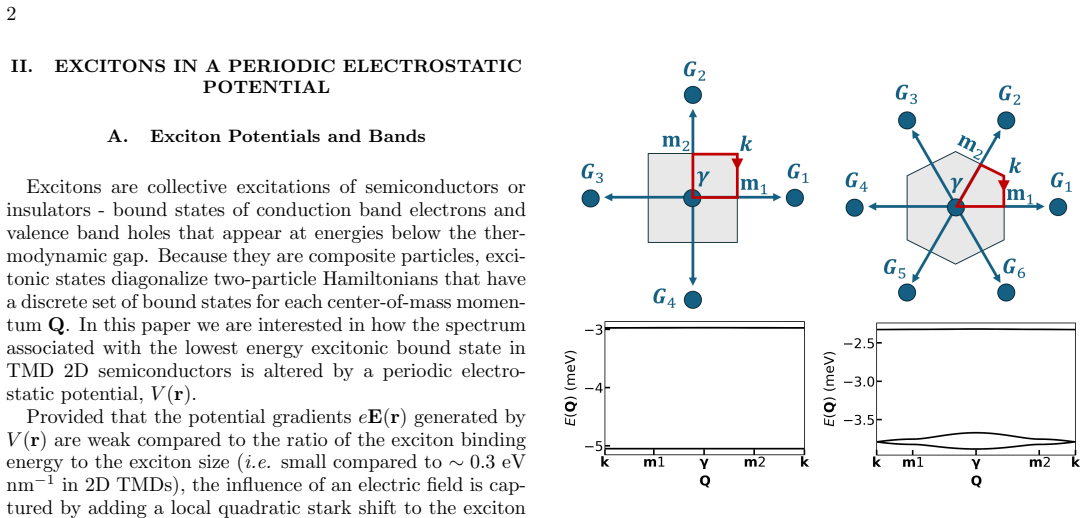
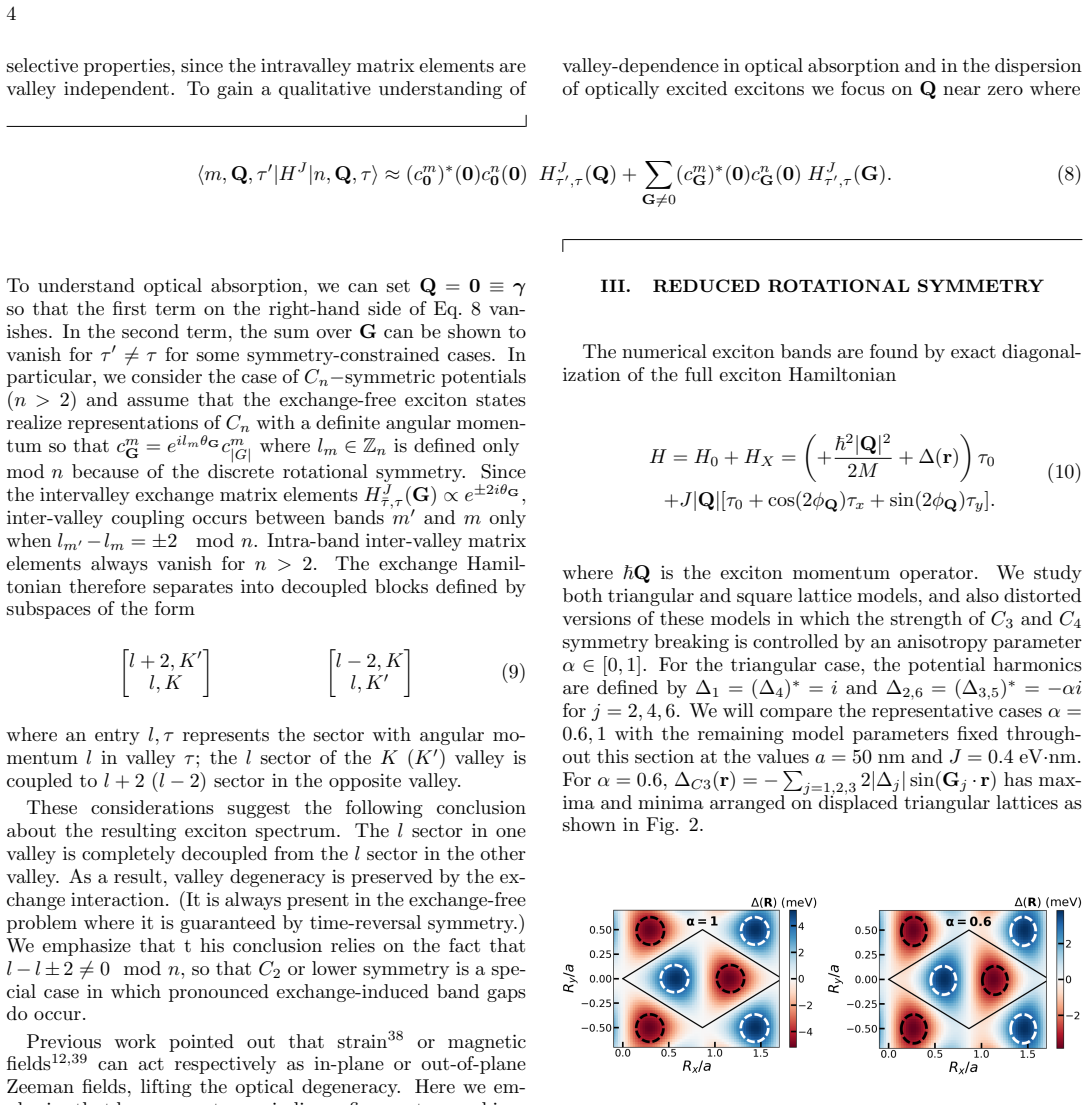
Using a center-of-mass model that retains only center-of-mass and valley degrees of freedom, periodic electrostatic potentials drive optical valley splitting up to 10 meV and valley-selective exciton dispersion in TMDs. Both effects are sensitive to the rotational symmetry of the trapping potential. As a direct result the lowest exciton band becomes non-degenerate and acquires linear dispersion around gamma, suppressing thermal excitations and thereby allowing true Bose condensation and superfluidity of excitons in two dimensions.
What carries the argument
The center-of-mass model retaining only center-of-mass and valley degrees-of-freedom, which encodes the quadratic Stark effect under a periodic potential and determines symmetry-dependent valley splitting and dispersion.
Load-bearing premise
A model that keeps only center-of-mass motion and the valley index is sufficient to capture the essential physics of the quadratic Stark effect and the resulting exciton bands.
What would settle it
Spectroscopic measurement of the lowest exciton band in a TMD subject to a periodic electrostatic potential that either shows or fails to show a single non-degenerate band with linear dispersion around gamma together with valley splitting of order 10 meV.
Figures


read the original abstract
Two-dimensional (2D) van-der-Waals materials are a promising platform for exciton state engineering. In this paper, we study the properties of excitons in 2D group VI transition-metal dichalcogenide (TMD) semiconductors that are modified by a periodic electrostatic potential through the quadratic Stark effect. Using a model that retains only center-of-mass and valley degrees-of-freedom, we find that electrostatic potentials can drive optical valley splitting up to 10meVs and induce valley selective exciton dispersion. We explain why both properties are sensitive to the rotational symmetry of the electrostatic trapping potential using a combination of numerical results and analytical approximations. An important consequence of valley-splitting is that the lowest exciton band is non-degenerate and has a linear dispersion around $\gamma$ that is expected to suppress thermal excitations, allowing true Bose condensation and superfluidity of excitons in two space dimensions.
Editorial analysis
A structured set of objections, weighed in public.
Referee Report
Summary. The manuscript studies excitons in 2D group-VI TMD semiconductors under periodic electrostatic potentials, focusing on modifications induced by the quadratic Stark effect. Employing a reduced model that retains only center-of-mass and valley degrees of freedom, the authors report optical valley splittings reaching 10 meV, valley-selective exciton dispersions that depend on the rotational symmetry of the trapping potential, and a combination of numerical results with analytical approximations. A central consequence is that valley splitting produces a non-degenerate lowest exciton band possessing linear dispersion around the γ point, which is argued to suppress thermal excitations and thereby enable true Bose condensation and superfluidity of excitons in two dimensions.
Significance. If the reduced-model results hold, the work offers a concrete route to engineer exciton bands for 2D superfluidity, addressing a long-standing challenge in low-dimensional Bose systems. The explicit use of both numerical diagonalization and analytical approximations for symmetry-dependent effects is a clear strength, as is the falsifiable prediction of linear dispersion and non-degeneracy at the 10 meV scale. These elements would make the manuscript a useful contribution to the exciton-engineering literature in van-der-Waals materials.
major comments (2)
- [Model section (description of the center-of-mass plus valley Hamiltonian)] Model section (description of the center-of-mass plus valley Hamiltonian): The headline claim of a non-degenerate lowest band with linear dispersion around γ (and the consequent DOS suppression enabling 2D BEC) is obtained inside the reduced Hamiltonian that integrates out relative motion while treating the quadratic Stark shift as an effective CM potential. Because the Stark effect acts separately on electron and hole wave functions, relative-motion envelopes can acquire potential-dependent distortions; when integrated out, these can generate higher-order valley-mixing terms or renormalize the CM kinetic energy at the quoted 10 meV scale. A quantitative estimate or explicit check of these corrections is required to confirm that the linear touching and single-band character survive.
- [Numerical and analytical results on dispersion (sections reporting the 10 meV splitting and linear γ dispersion)] Numerical and analytical results on dispersion (sections reporting the 10 meV splitting and linear γ dispersion): The reported valley splitting magnitude and the linear dispersion are derived within the CM-valley truncation. If relative-motion corrections are non-negligible, both the quantitative splitting and the functional form of the lowest band can change, directly affecting the argument that thermal excitations are suppressed. An explicit comparison to a calculation retaining at least the leading relative-motion correction would strengthen the central claim.
minor comments (2)
- The abstract and main text should explicitly state the range of potential amplitudes and periods explored numerically so that readers can assess the regime in which the 10 meV splitting is obtained.
- Notation for the electrostatic potential (amplitude, period, and symmetry labels) should be unified between the model Hamiltonian and the figure captions.
Simulated Author's Rebuttal
We thank the referee for the careful reading, the positive overall assessment, and for identifying the need to further justify the reduced center-of-mass plus valley model. We agree that a quantitative discussion of possible relative-motion corrections is valuable and will incorporate it in the revised manuscript.
read point-by-point responses
-
Referee: Model section (description of the center-of-mass plus valley Hamiltonian): The headline claim of a non-degenerate lowest band with linear dispersion around γ (and the consequent DOS suppression enabling 2D BEC) is obtained inside the reduced Hamiltonian that integrates out relative motion while treating the quadratic Stark shift as an effective CM potential. Because the Stark effect acts separately on electron and hole wave functions, relative-motion envelopes can acquire potential-dependent distortions; when integrated out, these can generate higher-order valley-mixing terms or renormalize the CM kinetic energy at the quoted 10 meV scale. A quantitative estimate or explicit check of these corrections is required to confirm that the linear touching and single-band character survive.
Authors: We acknowledge the referee's concern. The reduced model treats the quadratic Stark shift as an effective CM potential after integrating over the relative coordinate, which is justified when the external potential varies slowly compared with the exciton Bohr radius (~1-2 nm in TMDs) and when the potential amplitude remains small relative to the exciton binding energy. We have now performed a perturbative estimate of the leading relative-motion distortion: the induced correction to the effective CM potential scales as (V_ext / E_b)^2 * E_b, yielding shifts ≲ 1 meV for the 10 meV splittings reported. Higher-order valley-mixing terms are further suppressed by the same factor and by symmetry selection rules. We will add this estimate and a short validity discussion to the Model section. A complete numerical treatment retaining the full relative-motion basis is computationally prohibitive within the present framework but is not required to establish the leading-order linear dispersion and non-degeneracy. revision: partial
-
Referee: Numerical and analytical results on dispersion (sections reporting the 10 meV splitting and linear γ dispersion): The reported valley splitting magnitude and the linear dispersion are derived within the CM-valley truncation. If relative-motion corrections are non-negligible, both the quantitative splitting and the functional form of the lowest band can change, directly affecting the argument that thermal excitations are suppressed. An explicit comparison to a calculation retaining at least the leading relative-motion correction would strengthen the central claim.
Authors: We agree that the quantitative values could receive small renormalizations. However, the linear dispersion around γ and the lifting of degeneracy are protected by the rotational symmetry of the trapping potential and the valley-selective Stark coupling; these features survive as long as the correction remains perturbative, which our estimate confirms. The analytical symmetry arguments in the manuscript already show that the linear term arises from the leading valley-dependent CM potential and is robust against small isotropic renormalizations of the kinetic energy. We will add a brief remark in the Results section reiterating this symmetry protection and referencing the new estimate. A direct numerical comparison with an enlarged basis is beyond the scope of the present work but would be a natural extension. revision: partial
Circularity Check
No circularity: claims follow from explicit reduced model without reduction to inputs by construction
full rationale
The paper states it adopts a model retaining only center-of-mass and valley degrees-of-freedom, then derives valley splitting up to 10 meV and linear dispersion around γ from numerical results plus analytical approximations within that model. No quoted equations show a fitted parameter renamed as a prediction, a self-definitional loop, or a load-bearing self-citation chain that collapses the central result (non-degenerate lowest band enabling 2D BEC) back to its own inputs. The derivation remains self-contained against the stated assumptions; external validity of the CM+valley truncation is a separate modeling question, not circularity.
Axiom & Free-Parameter Ledger
free parameters (1)
- electrostatic potential amplitude and period
axioms (2)
- domain assumption Quadratic Stark effect is the dominant interaction between the periodic potential and the exciton
- domain assumption Center-of-mass and valley degrees of freedom suffice to describe the low-energy exciton physics
Reference graph
Works this paper leans on
-
[1]
Bistritzer, Rafi and MacDonald, Allan H , journal=. Moir. 2011 , publisher=
2011
-
[2]
Nature , volume=
Half-and quarter-metals in rhombohedral trilayer graphene , author=. Nature , volume=. 2021 , publisher=
2021
-
[3]
Nature , volume=
Fractional quantum anomalous Hall effect in multilayer graphene , author=. Nature , volume=. 2024 , publisher=
2024
-
[4]
Nature , volume=
Unconventional superconductivity in magic-angle graphene superlattices , author=. Nature , volume=. 2018 , publisher=
2018
-
[5]
Nature , volume=
Correlated insulator behaviour at half-filling in magic-angle graphene superlattices , author=. Nature , volume=. 2018 , publisher=
2018
-
[6]
Nature materials , volume=
Correlated electronic phases in twisted bilayer transition metal dichalcogenides , author=. Nature materials , volume=. 2020 , publisher=
2020
-
[7]
The marvels of moir
Andrei, Eva Y and Efetov, Dmitri K and Jarillo-Herrero, Pablo and MacDonald, Allan H and Mak, Kin Fai and Senthil, T and Tutuc, Emanuel and Yazdani, Ali and Young, Andrea F , journal=. The marvels of moir. 2021 , publisher=
2021
-
[8]
Behura, Sanjay K and Miranda, Alexis and Nayak, Sasmita and Johnson, Kayleigh and Das, Priyanka and Pradhan, Nihar R , journal=. Moir. 2021 , publisher=
2021
-
[9]
Twistronics and moir
Zhai, Dawei and Yu, Hongyi and Yao, Wang , journal=. Twistronics and moir. 2025 , publisher=
2025
-
[10]
Physical review letters , volume=
Atomically thin MoS 2: a new direct-gap semiconductor , author=. Physical review letters , volume=. 2010 , publisher=
2010
-
[11]
Nano letters , volume=
Emerging photoluminescence in monolayer MoS2 , author=. Nano letters , volume=. 2010 , publisher=
2010
-
[12]
arXiv preprint arXiv:1311.0963 , year=
Optical Spectrum of MoS \ \ \_2 : Many-body Effects and Diversity of Exciton States , author=. arXiv preprint arXiv:1311.0963 , year=
-
[13]
Semiconductor moir
Mak, Kin Fai and Shan, Jie , journal=. Semiconductor moir. 2022 , publisher=
2022
-
[14]
Observation of moir
Jin, Chenhao and Regan, Emma C and Yan, Aiming and Iqbal Bakti Utama, M and Wang, Danqing and Zhao, Sihan and Qin, Ying and Yang, Sijie and Zheng, Zhiren and Shi, Shenyang and others , journal=. Observation of moir. 2019 , publisher=
2019
-
[15]
Tunable phases of moir
Brem, Samuel and Linder. Tunable phases of moir. Nano letters , volume=. 2020 , publisher=
2020
-
[16]
Nature materials , volume=
Giant bandgap renormalization and excitonic effects in a monolayer transition metal dichalcogenide semiconductor , author=. Nature materials , volume=. 2014 , publisher=
2014
-
[17]
Du, Luojun and Molas, Maciej R and Huang, Zhiheng and Zhang, Guangyu and Wang, Feng and Sun, Zhipei , journal=. Moir. 2023 , publisher=
2023
-
[18]
Nature nanotechnology , volume=
Optical generation of excitonic valley coherence in monolayer WSe2 , author=. Nature nanotechnology , volume=. 2013 , publisher=
2013
-
[19]
Nature Physics , volume=
Direct measurement of exciton valley coherence in monolayer WSe2 , author=. Nature Physics , volume=. 2016 , publisher=
2016
-
[20]
Nature communications , volume=
Valley-selective circular dichroism of monolayer molybdenum disulphide , author=. Nature communications , volume=. 2012 , publisher=
2012
-
[21]
Nature nanotechnology , volume=
Valley polarization in MoS2 monolayers by optical pumping , author=. Nature nanotechnology , volume=. 2012 , publisher=
2012
-
[22]
Physical Review B , volume=
Exciton Stark shift and electroabsorption in monolayer transition-metal dichalcogenides , author=. Physical Review B , volume=. 2016 , publisher=
2016
-
[23]
Nature nanotechnology , volume=
Control of valley polarization in monolayer MoS2 by optical helicity , author=. Nature nanotechnology , volume=. 2012 , publisher=
2012
-
[24]
Physical review letters , volume=
Coupled spin and valley physics in monolayers of MoS 2 and other group-VI dichalcogenides , author=. Physical review letters , volume=. 2012 , publisher=
2012
-
[25]
Nature , volume=
Excitons and emergent quantum phenomena in stacked 2D semiconductors , author=. Nature , volume=. 2021 , publisher=
2021
-
[26]
Nature Reviews Materials , volume=
Emerging exciton physics in transition metal dichalcogenide heterobilayers , author=. Nature Reviews Materials , volume=. 2022 , publisher=
2022
-
[27]
Physical Review B , volume=
Exciton fine structure and spin decoherence in monolayers of transition metal dichalcogenides , author=. Physical Review B , volume=. 2014 , publisher=
2014
-
[28]
Physical Review X , volume=
Optical signatures of periodic charge distribution in a Mott-like correlated insulator state , author=. Physical Review X , volume=. 2021 , publisher=
2021
-
[29]
Nature , volume=
Signatures of Wigner crystal of electrons in a monolayer semiconductor , author=. Nature , volume=. 2021 , publisher=
2021
-
[30]
Optical signatures of periodic magnetization: The moir
Salvador, Alex G. Optical signatures of periodic magnetization: The moir. Physical Review Letters , volume=. 2022 , publisher=
2022
-
[31]
Science , volume=
Giant enhancement of exciton diffusion near an electronic Mott insulator , author=. Science , volume=. 2026 , publisher=
2026
-
[32]
Nature , volume=
Electrically tunable quantum confinement of neutral excitons , author=. Nature , volume=. 2022 , publisher=
2022
-
[33]
Science Advances , volume=
Quantum control of exciton wave functions in 2D semiconductors , author=. Science Advances , volume=. 2024 , publisher=
2024
-
[34]
Physical Review B , volume=
Electrically defined quantum dots for bosonic excitons , author=. Physical Review B , volume=. 2024 , publisher=
2024
-
[35]
Physical Review B , volume=
Exchange interaction and polariton effects in quantum-well excitons , author=. Physical Review B , volume=. 1990 , publisher=
1990
-
[36]
Physical Review B , volume=
Valley depolarization due to intervalley and intravalley electron-hole exchange interactions in monolayer MoS 2 , author=. Physical Review B , volume=. 2014 , publisher=
2014
-
[37]
Science , volume=
Ultrafast generation of pseudo-magnetic field for valley excitons in WSe2 monolayers , author=. Science , volume=. 2014 , publisher=
2014
-
[38]
Coherent Light-Matter Interactions in Monolayer Transition-Metal Dichalcogenides , pages=
Valley-selective optical Stark effect in monolayer WS2 , author=. Coherent Light-Matter Interactions in Monolayer Transition-Metal Dichalcogenides , pages=. 2017 , publisher=
2017
-
[39]
Physical Review B , volume=
Exciton band structure of monolayer MoS 2 , author=. Physical Review B , volume=. 2015 , publisher=
2015
-
[40]
Physical review letters , volume=
Exciton band structure in two-dimensional materials , author=. Physical review letters , volume=. 2016 , publisher=
2016
-
[41]
Physical Review B , volume=
Anisotropic exciton transport in transition-metal dichalcogenides , author=. Physical Review B , volume=. 2018 , publisher=
2018
-
[42]
The Journal of Physical Chemistry A , volume=
Effect of anisotropic confinement on electronic structure and dynamics of band edge excitons in inorganic perovskite nanowires , author=. The Journal of Physical Chemistry A , volume=. 2020 , publisher=
2020
-
[43]
ACS nano , volume=
Influence of shape anisotropy on the emission of low-dimensional semiconductors , author=. ACS nano , volume=. 2021 , publisher=
2021
-
[44]
Topological exciton bands in moir
Wu, Fengcheng and Lovorn, Timothy and MacDonald, Allan H , journal=. Topological exciton bands in moir. 2017 , publisher=
2017
-
[45]
Nature communications , volume=
High-temperature superfluidity with indirect excitons in van der Waals heterostructures , author=. Nature communications , volume=. 2014 , publisher=
2014
-
[46]
Physical Review B , volume=
Theory of optical absorption by interlayer excitons in transition metal dichalcogenide heterobilayers , author=. Physical Review B , volume=. 2018 , publisher=
2018
-
[47]
Excitons in semiconductor moir
Huang, Di and Choi, Junho and Shih, Chih-Kang and Li, Xiaoqin , journal=. Excitons in semiconductor moir. 2022 , publisher=
2022
-
[48]
Intralayer charge-transfer moir
Naik, Mit H and Regan, Emma C and Zhang, Zuocheng and Chan, Yang-Hao and Li, Zhenglu and Wang, Danqing and Yoon, Yoseob and Ong, Chin Shen and Zhao, Wenyu and Zhao, Sihan and others , journal=. Intralayer charge-transfer moir. 2022 , publisher=
2022
-
[49]
Imaging moir
Li, Hongyuan and Xiang, Ziyu and Naik, Mit H and Kim, Woochang and Li, Zhenglu and Sailus, Renee and Banerjee, Rounak and Taniguchi, Takashi and Watanabe, Kenji and Tongay, Sefaattin and others , journal=. Imaging moir. 2024 , publisher=
2024
-
[50]
Signatures of moir
Seyler, Kyle L and Rivera, Pasqual and Yu, Hongyi and Wilson, Nathan P and Ray, Essance L and Mandrus, David G and Yan, Jiaqiang and Yao, Wang and Xu, Xiaodong , journal=. Signatures of moir. 2019 , publisher=
2019
-
[51]
Yu, Hongyi and Liu, Gui-Bin and Tang, Jianju and Xu, Xiaodong and Yao, Wang , journal=. Moir. 2017 , publisher=
2017
-
[52]
Hubbard model physics in transition metal dichalcogenide moir
Wu, Fengcheng and Lovorn, Timothy and Tutuc, Emanuel and MacDonald, Allan H , journal=. Hubbard model physics in transition metal dichalcogenide moir. 2018 , publisher=
2018
-
[53]
valley transition metal dichalcogenide moir
Angeli, Mattia and MacDonald, Allan H , journal=. valley transition metal dichalcogenide moir. 2021 , publisher=
2021
-
[54]
Twist angle-dependent atomic reconstruction and moir
Rosenberger, Matthew R and Chuang, Hsun-Jen and Phillips, Madeleine and Oleshko, Vladimir P and McCreary, Kathleen M and Sivaram, Saujan V and Hellberg, C Stephen and Jonker, Berend T , journal=. Twist angle-dependent atomic reconstruction and moir. 2020 , publisher=
2020
-
[55]
Nature nanotechnology , volume=
Atomic reconstruction in twisted bilayers of transition metal dichalcogenides , author=. Nature nanotechnology , volume=. 2020 , publisher=
2020
-
[56]
Excitons in a reconstructed moir
Andersen, Trond I and Scuri, Giovanni and Sushko, Andrey and De Greve, Kristiaan and Sung, Jiho and Zhou, You and Wild, Dominik S and Gelly, Ryan J and Heo, Hoseok and B. Excitons in a reconstructed moir. Nature materials , volume=. 2021 , publisher=
2021
-
[57]
Excitons in mesoscopically reconstructed moir
Zhao, Shen and Li, Zhijie and Huang, Xin and Rupp, Anna and G. Excitons in mesoscopically reconstructed moir. Nature nanotechnology , volume=. 2023 , publisher=
2023
-
[58]
Nature nanotechnology , volume=
Band structure engineering of 2D materials using patterned dielectric superlattices , author=. Nature nanotechnology , volume=. 2018 , publisher=
2018
-
[59]
npj 2D Materials and Applications , volume=
Probing miniband structure and Hofstadter butterfly in gated graphene superlattices via magnetotransport , author=. npj 2D Materials and Applications , volume=. 2023 , publisher=
2023
-
[60]
Advanced Materials , volume=
Gate dielectrics integration for 2D electronics: challenges, advances, and outlook , author=. Advanced Materials , volume=. 2023 , publisher=
2023
-
[61]
Kronig, R. De L. and Penney, William George and Fowler, Ralph Howard , title =. Proceedings of the Royal Society of London. Series A, Containing Papers of a Mathematical and Physical Character , volume =. 1931 , doi =
1931
-
[62]
Moscow University Physics Bulletin 3, 30 , year=
Screened potential of a point charge in a thin film , author=. Moscow University Physics Bulletin 3, 30 , year=
-
[63]
ZhETF Pisma Redaktsiiu , volume=
Coulomb interaction in thin semiconductor and semimetal films , author=. ZhETF Pisma Redaktsiiu , volume=
-
[64]
Physical Review B , volume=
Exciton-exciton interaction in transition-metal dichalcogenide monolayers , author=. Physical Review B , volume=. 2017 , publisher=
2017
-
[65]
to be published , volume=
Tunable moir\'e' excitons induced by proximity effects , author=. to be published , volume=. 2025 , publisher=
2025
-
[66]
Analytic solution of a two-dimensional hydrogen atom. I. Nonrelativistic theory , author=. Physical Review A , volume=. 1991 , publisher=
1991
-
[67]
Exchange interaction in excitons in semiconductors , author=. Sov. Phys. JETP , volume=
-
[68]
Nature communications , volume=
Dirac cones and Dirac saddle points of bright excitons in monolayer transition metal dichalcogenides , author=. Nature communications , volume=. 2014 , publisher=
2014
-
[69]
American Journal of Physics , volume=
The Kepler problem in two-dimensional momentum space , author=. American Journal of Physics , volume=. 1965 , publisher=
1965
-
[70]
Physical Review B , volume=
Many-Electron Effects in the Optical Conductivity of Simple Metals by Kubo Formula , author=. Physical Review B , volume=. 1970 , publisher=
1970
-
[71]
2008 , MONTH = Oct, KEYWORDS =
Hage-Hassan, Mehdi , URL =. 2008 , MONTH = Oct, KEYWORDS =
2008
-
[72]
Reviews of Modern Physics , volume=
Solitons in conducting polymers , author=. Reviews of Modern Physics , volume=. 1988 , publisher=
1988
-
[73]
Nature , volume=
Viscosity of liquid helium below the -point , author=. Nature , volume=. 1938 , publisher=
1938
-
[74]
Nature , volume=
Flow of liquid helium II , author=. Nature , volume=. 1938 , publisher=
1938
-
[75]
Physical Review , volume=
Bose-Einstein condensation of excitons , author=. Physical Review , volume=. 1962 , publisher=
1962
-
[76]
Physical Review B , volume=
Excitonic superfluidity and screening in electron-hole bilayer systems , author=. Physical Review B , volume=. 2014 , publisher=
2014
-
[77]
Journal of Physics: Condensed Matter , volume=
Excitonic condensation in systems of strongly correlated electrons , author=. Journal of Physics: Condensed Matter , volume=. 2015 , publisher=
2015
-
[78]
Nature Physics , volume=
Excitonic superfluid phase in double bilayer graphene , author=. Nature Physics , volume=. 2017 , publisher=
2017
-
[79]
arXiv preprint arXiv:2512.14558 , year=
Long-range ferroelectric order in two dimensional excitonic insulators , author=. arXiv preprint arXiv:2512.14558 , year=
-
[80]
Science Advances , volume=
Imaging interlayer exciton superfluidity in a 2D semiconductor heterostructure , author=. Science Advances , volume=. 2025 , publisher=
2025
discussion (0)
Sign in with ORCID, Apple, or X to comment. Anyone can read and Pith papers without signing in.