Recognition: 2 theorem links
Sentinel2Cap: A Human-Annotated Benchmark Dataset for Multimodal Remote Sensing Image Captioning
Pith reviewed 2026-05-08 18:13 UTC · model grok-4.3
The pith
A new human-annotated dataset pairs Sentinel-1 SAR and Sentinel-2 image patches with validated captions to benchmark multimodal captioning models.
A machine-rendered reading of the paper's core claim, the machinery that carries it, and where it could break.
Core claim
We introduce Sentinel2Cap, a human-annotated multimodal captioning dataset containing Sentinel-1 SAR and Sentinel-2 multi-spectral image patches at 10 m and 20 m spatial resolution with diverse land cover compositions. Captions are created manually and carefully validated to ensure both semantic accuracy and linguistic quality. To evaluate Sentinel2Cap, we perform a zero-shot captioning using the Qwen3-VL-8B-Instruct model across three image modalities: RGB, multi-spectral, and SAR pseudo-RGB representations. Results show that RGB images achieve the highest captioning performance, while SAR images remain more challenging for vision-language models. Providing modality-specific contextual 
What carries the argument
The Sentinel2Cap dataset of human-annotated image-caption pairs across SAR, multi-spectral, and RGB modalities from Sentinel satellites.
If this is right
- The dataset supplies a public resource for training and comparing models that generate natural language descriptions of satellite scenes.
- SAR data will require additional techniques or context to reach the captioning accuracy observed for optical imagery.
- Modality-specific prompting can be applied to improve results in other remote-sensing vision-language tasks.
- The benchmark supports systematic study of cross-modal scene understanding for Earth observation.
Where Pith is reading between the lines
- Models improved on this data could enable reliable automated descriptions from SAR during cloud cover or at night for applications like disaster monitoring.
- The observed modality gap suggests value in developing fusion methods that combine SAR and optical inputs for richer scene descriptions.
- Extending the dataset with temporal sequences could test captioning of land-cover change over time.
Load-bearing premise
The manually created captions are semantically accurate and linguistically high-quality across diverse land covers, and the single zero-shot evaluation on one model is representative of broader multimodal remote sensing captioning challenges.
What would settle it
An independent review finding frequent semantic inaccuracies in the captions, or a test showing that other vision-language models caption SAR images as well as RGB images without prompts, would undermine the dataset's value as a benchmark.
Figures



read the original abstract
Image captioning has become an important task in computer vision, enabling models to generate natural language descriptions of visual content. While several datasets exist for natural images and high-resolution optical remote sensing imagery, the availability of captioning datasets for multimodal satellite data remains limited, particularly for SAR imagery and medium-resolution sensors. We introduce Sentinel2Cap, a human-annotated multimodal captioning dataset containing Sentinel-1 SAR and Sentinel-2 multi-spectral image patches at 10 m and 20 m spatial resolution with diverse land cover compositions. Captions are created manually and carefully validated to ensure both semantic accuracy and linguistic quality. To evaluate Sentinel2Cap, we perform a zero-shot captioning using the Qwen3-VL-8B-Instruct model across three image modalities: RGB, multi-spectral, and SAR pseudo-RGB representations. Results show that RGB images achieve the highest captioning performance, while SAR images remain more challenging for vision-language models. Providing modality-specific contextual prompts consistently improves performance across all metrics. These findings highlight both the challenges of multimodal remote sensing image captioning and the potential value of human-annotated datasets for advancing research in cross-modal scene understanding. All the material is publicly avaiable.
Editorial analysis
A structured set of objections, weighed in public.
Referee Report
Summary. The manuscript introduces Sentinel2Cap, a human-annotated multimodal captioning dataset consisting of Sentinel-1 SAR and Sentinel-2 multi-spectral image patches at 10m/20m resolution with diverse land covers. Captions are described as manually created and carefully validated for semantic accuracy and linguistic quality. Zero-shot evaluations with Qwen3-VL-8B-Instruct across RGB, multi-spectral, and SAR pseudo-RGB modalities show RGB achieving highest performance, SAR remaining challenging, and modality-specific prompts improving results; the full dataset is released publicly.
Significance. If the caption annotations are shown to be reliable, the dataset would address a clear gap in benchmarks for SAR and medium-resolution multispectral captioning, supporting research on cross-modal remote sensing understanding. The public release and empirical modality comparison are constructive contributions when supported by rigorous validation evidence.
major comments (2)
- [§3 (Dataset Construction)] §3 (Dataset Construction): The claim that captions were 'created manually and carefully validated to ensure both semantic accuracy and linguistic quality' lacks any quantitative support such as inter-annotator agreement scores, number of annotators or reviewers per caption, annotation guidelines, or disagreement resolution protocol. This directly undermines the central benchmark claim, as caption inaccuracies would confound the reported RGB vs. SAR performance gaps.
- [§4 (Experimental Results)] §4 (Experimental Results): The zero-shot evaluation reports modality differences but provides no full set of standard captioning metrics (e.g., BLEU, METEOR, CIDEr), error analysis, or explicit description of how human captions were used to score model outputs, limiting assessment of the claimed challenges in multimodal remote sensing captioning.
minor comments (2)
- [Abstract] Abstract: Typo in final sentence ('avaiable' should read 'available').
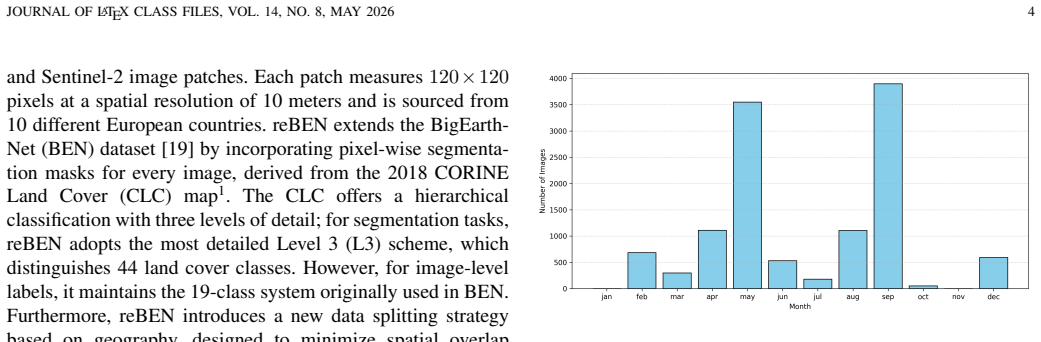
- [§3 (Dataset Construction)] The manuscript would benefit from a table or figure summarizing land-cover class distribution and caption length statistics to substantiate the 'diverse land cover compositions' claim.
Simulated Author's Rebuttal
We thank the referee for the constructive and detailed feedback on our manuscript. We have reviewed the major comments carefully and provide point-by-point responses below. Where the comments identify gaps in the current version, we agree to revise the paper accordingly.
read point-by-point responses
-
Referee: [§3 (Dataset Construction)] §3 (Dataset Construction): The claim that captions were 'created manually and carefully validated to ensure both semantic accuracy and linguistic quality' lacks any quantitative support such as inter-annotator agreement scores, number of annotators or reviewers per caption, annotation guidelines, or disagreement resolution protocol. This directly undermines the central benchmark claim, as caption inaccuracies would confound the reported RGB vs. SAR performance gaps.
Authors: We agree that the current manuscript lacks quantitative details on the annotation process, which would strengthen the reliability of the benchmark. The captions were produced by a small team of domain experts following internal guidelines focused on semantic accuracy and linguistic clarity, with cross-review for consistency, but no formal inter-annotator agreement statistics were computed. In the revised version we will add a dedicated subsection describing the annotation protocol, number of annotators, review process, and any steps taken for quality control. We will also note the absence of IAA scores as a limitation and indicate that the public dataset release enables independent verification. This revision directly addresses the concern that caption inaccuracies could confound the modality comparisons. revision: yes
-
Referee: [§4 (Experimental Results)] §4 (Experimental Results): The zero-shot evaluation reports modality differences but provides no full set of standard captioning metrics (e.g., BLEU, METEOR, CIDEr), error analysis, or explicit description of how human captions were used to score model outputs, limiting assessment of the claimed challenges in multimodal remote sensing captioning.
Authors: We appreciate this observation. While the manuscript states that performance improves 'across all metrics' and highlights RGB outperforming SAR, it does not enumerate the complete set of standard captioning metrics nor include error analysis. In the revision we will report the full suite (BLEU-1 through BLEU-4, METEOR, CIDEr, and ROUGE) for every modality and prompt condition. We will also add a concise error analysis section that categorizes common failure modes, especially for SAR inputs. Finally, we will explicitly state that the human-annotated captions serve as reference ground truth and that scores were obtained via standard evaluation libraries. These additions will make the experimental claims more transparent and easier to assess. revision: yes
Circularity Check
No circularity: empirical dataset creation and zero-shot evaluation
full rationale
The paper introduces Sentinel2Cap as a manually annotated multimodal dataset and reports zero-shot captioning results on the public Qwen3-VL-8B-Instruct model across RGB, multi-spectral, and SAR modalities. No equations, parameter fitting, predictions, or first-principles derivations appear in the provided text. The central claims rest on dataset construction and observed performance differences, which are independent of any self-referential reduction or self-citation chain. This matches the default expectation for non-circular empirical contributions; the reader's assigned score of 1.0 is consistent with minor or absent circularity.
Axiom & Free-Parameter Ledger
Reference graph
Works this paper leans on
-
[1]
Microsoft COCO Captions: Data Collection and Evaluation Server
X. Chen, H. Fang, T.-Y . Lin, R. Vedantam, S. Gupta, P. Doll ´ar, and C. L. Zitnick, “Microsoft coco captions: Data collection and evaluation server,”arXiv preprint arXiv:1504.00325, 2015
work page internal anchor Pith review arXiv 2015
-
[2]
reben: Refined bigearthnet dataset for remote sensing image analysis,
K. N. Clasen, L. Hackel, T. Burgert, G. Sumbul, B. Demir, and V . Markl, “reben: Refined bigearthnet dataset for remote sensing image analysis,” arXiv preprint arXiv:2407.03653, 2024. JOURNAL OF LATEX CLASS FILES, VOL. 14, NO. 8, MAY 2026 10
-
[3]
Nocaps: Novel object captioning at scale,
H. Agrawal, K. Desai, Y . Wang, X. Chen, R. Jain, M. Johnson, D. Batra, D. Parikh, S. Lee, and P. Anderson, “Nocaps: Novel object captioning at scale,” inProceedings of the IEEE/CVF international conference on computer vision, 2019, pp. 8948–8957
2019
-
[4]
Fashion iq: A new dataset towards retrieving images by natural language feedback,
H. Wu, Y . Gao, X. Guo, Z. Al-Halah, S. Rennie, K. Grauman, and R. Feris, “Fashion iq: A new dataset towards retrieving images by natural language feedback,” inProceedings of the IEEE/CVF Conference on computer vision and pattern recognition, 2021, pp. 11 307–11 317
2021
-
[5]
Soccer captioning: dataset, transformer-based model, and triple-level evaluation,
A. Hammoudeh, B. Vanderplaetse, and S. Dupont, “Soccer captioning: dataset, transformer-based model, and triple-level evaluation,”Procedia Computer Science, vol. 210, pp. 104–111, 2022
2022
-
[6]
Nwpu- captions dataset and mlca-net for remote sensing image captioning,
Q. Cheng, H. Huang, Y . Xu, Y . Zhou, H. Li, and Z. Wang, “Nwpu- captions dataset and mlca-net for remote sensing image captioning,” IEEE Transactions on Geoscience and Remote Sensing, vol. 60, pp. 1– 19, 2022
2022
-
[7]
Remote sensing image captioning using deep learning,
B. Yamani, N. Medavarapu, and S. Rakesh, “Remote sensing image captioning using deep learning,” in2024 International Conference on Automation and Computation (AUTOCOM). IEEE, 2024, pp. 295–302
2024
-
[8]
Exploring models and data for remote sensing image caption generation,
X. Lu, B. Wang, X. Zheng, and X. Li, “Exploring models and data for remote sensing image caption generation,”IEEE Transactions on Geoscience and Remote Sensing, vol. 56, no. 4, pp. 2183–2195, 2017
2017
-
[9]
Exploring a fine-grained multiscale method for cross-modal remote sensing image retrieval,
Z. Yuan, W. Zhang, K. Fu, X. Li, C. Deng, H. Wang, and X. Sun, “Exploring a fine-grained multiscale method for cross-modal remote sensing image retrieval,”arXiv preprint arXiv:2204.09868, 2022
-
[10]
Remote sensing image change captioning with dual-branch transformers: A new method and a large scale dataset,
C. Liu, R. Zhao, H. Chen, Z. Zou, and Z. Shi, “Remote sensing image change captioning with dual-branch transformers: A new method and a large scale dataset,”IEEE Transactions on Geoscience and Remote Sensing, vol. 60, pp. 1–20, 2022
2022
-
[11]
Xlrs-bench: Could your multimodal llms understand extremely large ultra-high-resolution remote sensing im- agery?
F. Wang, H. Wang, Z. Guo, D. Wang, Y . Wang, M. Chen, Q. Ma, L. Lan, W. Yang, J. Zhanget al., “Xlrs-bench: Could your multimodal llms understand extremely large ultra-high-resolution remote sensing im- agery?” inProceedings of the Computer Vision and Pattern Recognition Conference, 2025, pp. 14 325–14 336
2025
-
[12]
Exploring data and models in sar ship image captioning,
K. Zhao and W. Xiong, “Exploring data and models in sar ship image captioning,”IEEE Access, vol. 10, pp. 91 150–91 159, 2022
2022
-
[13]
Sarlang-1m: A benchmark for vision-language modeling in sar image understanding,
Y . Wei, A. Xiao, Y . Ren, Y . Zhu, H. Chen, J. Xia, and N. Yokoya, “Sarlang-1m: A benchmark for vision-language modeling in sar image understanding,”arXiv preprint arXiv:2504.03254, 2025
-
[14]
X. Cheng, Y . He, J. Zhu, C. Qiu, J. Wang, Q. Huang, and K. Yang, “Sar-text: A large-scale sar image-text dataset built with sar-narrator and progressive transfer learning,”arXiv preprint arXiv:2507.18743, 2025
-
[15]
Bigearthnet.txt: A large-scale multi-sensor image-text dataset and benchmark for earth observation,
J.-L. Herzog, M. J. Adler, L. Hackel, Y . Shu, A. Zavras, I. Papoutsis, P. Rota, and B. Demir, “Bigearthnet.txt: A large-scale multi-sensor image-text dataset and benchmark for earth observation,”arXiv preprint arXiv:2603.29630, 2026
-
[16]
Gaia: A global, multimodal, multiscale vision–language dataset for remote sens- ing image analysis,
A. Zavras, D. Michail, X. X. Zhu, B. Demir, and I. Papoutsis, “Gaia: A global, multimodal, multiscale vision–language dataset for remote sens- ing image analysis,”IEEE Geoscience and Remote Sensing Magazine, vol. 14, no. 2, pp. 36–63, 2026
2026
-
[17]
A review of deep learning-based remote sensing image caption: Methods, models, comparisons and future directions,
K. Zhang, P. Li, and J. Wang, “A review of deep learning-based remote sensing image caption: Methods, models, comparisons and future directions,”Remote Sensing, vol. 16, no. 21, p. 4113, 2024
2024
-
[18]
Remote sensing image scene classifi- cation: Benchmark and state of the art,
G. Cheng, J. Han, and X. Lu, “Remote sensing image scene classifi- cation: Benchmark and state of the art,”Proceedings of the IEEE, vol. 105, no. 10, pp. 1865–1883, 2017
2017
-
[19]
Bigearthnet: A large-scale benchmark archive for remote sensing image understanding,
G. Sumbul, M. Charfuelan, B. Demir, and V . Markl, “Bigearthnet: A large-scale benchmark archive for remote sensing image understanding,” arXiv preprint arXiv:1902.06148, 2019
-
[20]
Can sar improve rsvqa performance?
L. Tosato, S. Lobry, F. Weissgerber, and L. Wendling, “Can sar improve rsvqa performance?” inEUSAR 2024; 15th European Conference on Synthetic Aperture Radar. VDE, 2024, pp. 1287–1292
2024
-
[21]
Q. Team, “Qwen3 technical report,” 2025. [Online]. Available: https://arxiv.org/abs/2505.09388
work page internal anchor Pith review arXiv 2025
-
[22]
Sar strikes back: A new hope for rsvqa,
L. Tosato, S. Lobry, F. Weissgerber, and L. Wendling, “Sar strikes back: A new hope for rsvqa,”IEEE Journal of Selected Topics in Applied Earth Observations and Remote Sensing, 2025
2025
-
[23]
Checkmate: interpretable and explainable rsvqa is the endgame,
L. Tosato, C. T. Chappuis, S. Montariol, F. Weissgerber, S. Lobry, and D. Tuia, “Checkmate: interpretable and explainable rsvqa is the endgame,”arXiv preprint arXiv:2508.13086, 2025
discussion (0)
Sign in with ORCID, Apple, or X to comment. Anyone can read and Pith papers without signing in.