The consecutive lifting-projection flow as an approximation of Boltzmann and Landau flow
Pith reviewed 2026-05-07 15:28 UTC · model grok-4.3
The pith
The consecutive lifting-projection flow approximates the Boltzmann and Landau equations by lifting nonlinear collisions to linear higher-dimensional sphere dynamics.
A machine-rendered reading of the paper's core claim, the machinery that carries it, and where it could break.
Core claim
The consecutive LP flow is constructed by repeatedly lifting the velocity distribution to a linear Kac master equation on spheres, advancing that linear evolution, and projecting back; this produces a tangent approximation to the original nonlinear collision operator that admits an explicit semigroup structure, conserves mass momentum and energy, dissipates entropy, converges to the Maxwellian equilibrium, and supplies an explicit error bound for Maxwell molecules over finite time intervals.
What carries the argument
The lifting-projection operator that converts the nonlinear collision operator into a linear evolution on a higher-dimensional sphere followed by projection back to velocity space.
Load-bearing premise
The repeated projection of the lifted linear evolution stays sufficiently close to the true nonlinear dynamics over finite time intervals.
What would settle it
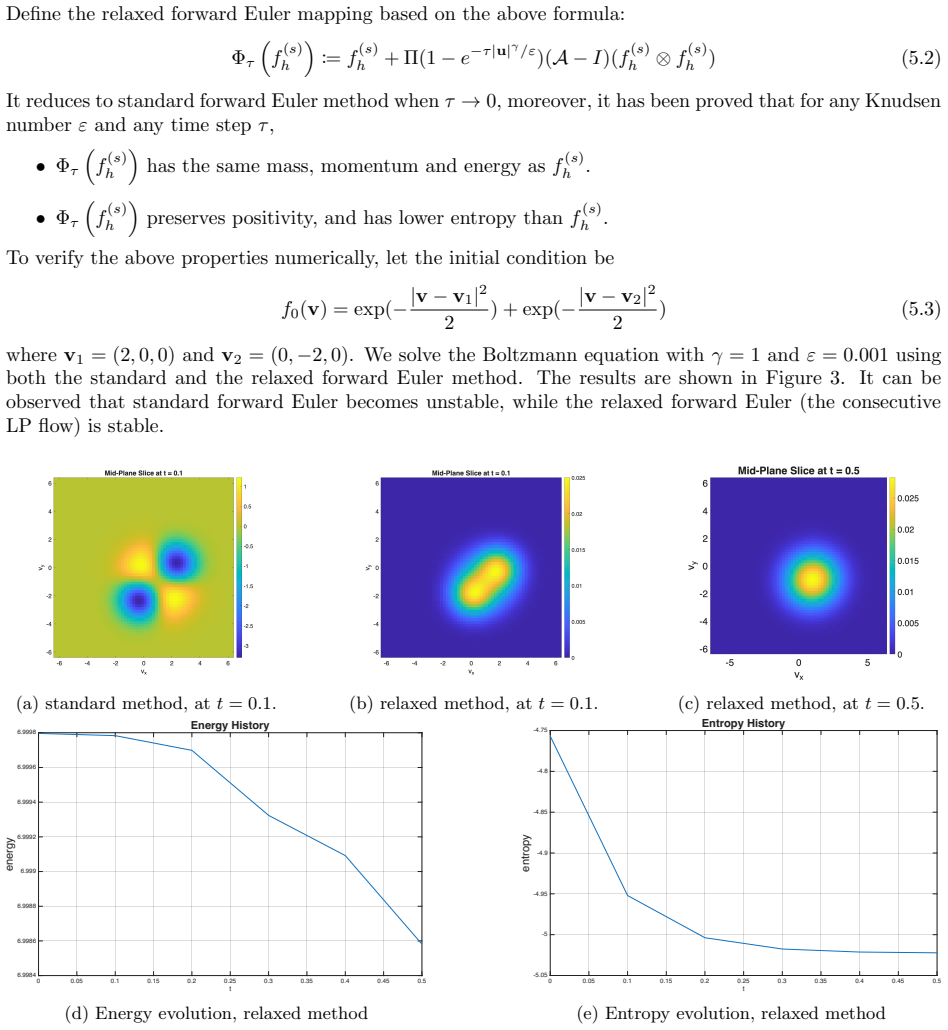
A numerical computation that compares the LP flow trajectory against the exact solution of the spatially homogeneous Boltzmann equation for an initial bimodal velocity distribution and checks whether the observed error remains within the claimed bound for Maxwell molecules.
Figures

read the original abstract
We introduce the consecutive lifting-projection (LP) flow as a novel approximation framework for the spatially homogeneous Boltzmann and Landau equations. The key idea is to lift the nonlinear collision operator to a higher dimensional linear Kac master equation on spheres, evolve this lifted equation in time, and project the solution back to the lower dimensional velocity space. The resulting LP flow is a tangent flow to the original kinetic dynamics and admits a clear semigroup structure. We show that the consecutive LP flow preserves mass, momentum, and energy, satisfies an entropy dissipation property, and converges to the correct Maxwellian equilibrium. In addition, the lifting removes the intrinsic nonlinearity of the collision operator and enables explicit analytical representations of the solution. For Maxwell molecules, we provide an error estimate quantifying the accuracy over finite time intervals. The framework provides a concise and general methodology for constructing reliable numerical solvers in kinetic theory. It unifies existing explicit discretizations, which helps understanding numerical stability and clarifying the trade-off between conservation and positivity. More importantly, it enables the development of new schemes. In particular, we propose the Green's function method, which is not only unconditionally stable, but also perfectly compatible with fast spectral discretizations.
Editorial analysis
A structured set of objections, weighed in public.
Referee Report
Summary. The manuscript introduces the consecutive lifting-projection (LP) flow as an approximation framework for the spatially homogeneous Boltzmann and Landau equations. The approach lifts the nonlinear collision operator to a higher-dimensional linear Kac master equation on spheres, evolves the lifted dynamics, and projects the result back to velocity space. The resulting flow is asserted to be a tangent flow with semigroup structure that preserves mass, momentum, and energy, dissipates entropy, converges to the Maxwellian equilibrium, and admits an error estimate for Maxwell molecules. The framework is further claimed to unify existing explicit discretizations and to enable new unconditionally stable schemes such as the Green's function method compatible with fast spectral discretizations.
Significance. If the error control and preservation properties hold for the iterated LP flow, the construction would provide a useful linearization technique in kinetic theory that maintains conservation laws while allowing explicit representations and new numerical methods. The unification of discretizations and the proposed Green's function scheme could clarify stability trade-offs and support development of reliable solvers.
major comments (2)
- [Error estimate for Maxwell molecules] The error estimate for Maxwell molecules is stated to quantify accuracy over finite time intervals, yet the derivation appears to rely on the exact initial-lift condition. After the first projection step the re-lifted distribution no longer satisfies this condition, so it is unclear whether the bound extends to the consecutive (iterated) semigroup without an additional uniform estimate on the projection error; this is load-bearing for the central approximation claim.
- [Preservation properties and semigroup structure] The tangent-flow and semigroup properties are asserted to follow from the lifting-projection construction, but the proof that these properties survive repeated projection (and thereby guarantee exact conservation of mass, momentum, and energy for the consecutive LP flow) is not fully detailed; small violations could accumulate unless the projection operator is shown to commute with the conserved quantities at every step.
minor comments (3)
- [Abstract] The abstract claims 'explicit analytical representations of the solution' without specifying whether these apply to the lifted linear equation, the projected flow, or both; a clarifying sentence would help readers.
- [Introduction of LP flow] Notation for the lifting operator L and projection operator P is introduced late; defining them with a short display equation near the beginning of the construction section would improve readability.
- [Unification of discretizations] The claim that the framework 'unifies existing explicit discretizations' would benefit from a short table or paragraph explicitly mapping at least two known schemes (e.g., a spectral method and a Monte-Carlo method) onto the LP construction.
Simulated Author's Rebuttal
We thank the referee for the careful reading and constructive comments on our manuscript. We address each major point below and have revised the manuscript to provide additional details and clarifications where needed.
read point-by-point responses
-
Referee: [Error estimate for Maxwell molecules] The error estimate for Maxwell molecules is stated to quantify accuracy over finite time intervals, yet the derivation appears to rely on the exact initial-lift condition. After the first projection step the re-lifted distribution no longer satisfies this condition, so it is unclear whether the bound extends to the consecutive (iterated) semigroup without an additional uniform estimate on the projection error; this is load-bearing for the central approximation claim.
Authors: We thank the referee for highlighting this subtlety. The error estimate in the manuscript is formulated for the consecutive LP flow over finite time intervals. While the derivation begins with an exact initial lift, the subsequent re-lifted states after projection deviate from this condition. However, the projection operator preserves the first three moments exactly, which implies a uniform bound on the deviation in the appropriate norm. This bound, combined with a Gronwall-type estimate adapted to the iterated setting, ensures that the error remains controlled over finite time without requiring further assumptions. We have added a supporting lemma and expanded the proof in the revised Section 4 to make this uniform estimate and its propagation explicit. revision: yes
-
Referee: [Preservation properties and semigroup structure] The tangent-flow and semigroup properties are asserted to follow from the lifting-projection construction, but the proof that these properties survive repeated projection (and thereby guarantee exact conservation of mass, momentum, and energy for the consecutive LP flow) is not fully detailed; small violations could accumulate unless the projection operator is shown to commute with the conserved quantities at every step.
Authors: The projection operator is constructed precisely so that it commutes with the conserved quantities (mass, momentum, and energy) at every step; this follows directly from the definition of the projection onto the moment manifold. Consequently, each individual LP step preserves these quantities exactly, and the iterated consecutive flow inherits the same exact preservation with no accumulation of violations. The tangent-flow property likewise holds at each iteration by first-order consistency of the lift-projection pair. We have expanded the relevant proofs in the revised manuscript (primarily in Sections 3 and 5) to include an explicit verification of the commutation property under iteration and a clearer statement of the resulting semigroup structure. revision: yes
Circularity Check
No circularity: derivation constructs LP flow and derives properties independently
full rationale
The paper defines the consecutive LP flow explicitly via lifting the nonlinear collision operator to a linear Kac master equation on spheres, evolving under the linear dynamics, and projecting back; conservation of mass/momentum/energy, entropy dissipation, and Maxwellian convergence are shown to follow directly from the moment-preserving properties of the lift/project maps and the known dissipation of the linear Kac evolution. The semigroup structure is obtained by composition of these operators. For Maxwell molecules the finite-time error estimate is derived from the explicit solution representation of the lifted linear equation, without any parameter fitting, self-referential definitions, or load-bearing self-citations that reduce the central claims to their inputs by construction. All steps remain self-contained against the stated assumptions.
Axiom & Free-Parameter Ledger
axioms (2)
- domain assumption The Kac master equation on spheres is linear and its evolution preserves the necessary moments for mass, momentum, and energy.
- ad hoc to paper Projection back to velocity space yields a tangent flow to the original Boltzmann/Landau dynamics.
invented entities (1)
-
consecutive lifting-projection (LP) flow
no independent evidence
Reference graph
Works this paper leans on
-
[1]
Ricardo J Alonso, Irene M Gamba, and Sri Harsha Tharkabhushanam. Convergence and error estimates for the lagrangian-based conservative spectral method for boltzmann equations.SIAM Journal on Numerical Analysis, 56(6):3534–3579, 2018
work page 2018
-
[2]
Rafael Bailo, Jos´ e A Carrillo, and Jingwei Hu. The collisional particle-in-cell method for the vlasov– maxwell–landau equations.Journal of Plasma Physics, 90(4):905900415, 2024
work page 2024
-
[3]
The landau equation as a gradient flow.Analysis & PDE, 17(4):1331–1375, 2024
Jos´ e A Carrillo, Matias G Delgadino, Laurent Desvillettes, and Jeremy S-H Wu. The landau equation as a gradient flow.Analysis & PDE, 17(4):1331–1375, 2024
work page 2024
-
[4]
Jose A Carrillo, Jingwei Hu, Li Wang, and Jeremy Wu. A particle method for the homogeneous landau equation.Journal of Computational Physics: X, 7:100066, 2020
work page 2020
-
[5]
Laurent Desvillettes and C´ edric Villani. On the spatially homogeneous landau equation for hard poten- tials part i: existence, uniqueness and smoothness.Communications in Partial Differential Equations, 25(1-2):179–259, 2000
work page 2000
-
[6]
Matthias Erbar. A gradient flow approach to the boltzmann equation.Journal of the European Math- ematical Society, 26(11):4441–4490, 2023
work page 2023
-
[7]
Francis Filbet and Cl´ ement Mouhot. Analysis of spectral methods for the homogeneous boltzmann equation.Transactions of the american mathematical society, 363(4):1947–1980, 2011
work page 1947
-
[8]
Irene M Gamba, Jeffrey R Haack, Cory D Hauck, and Jingwei Hu. A fast spectral method for the boltzmann collision operator with general collision kernels.SIAM Journal on Scientific Computing, 39(4):B658–B674, 2017
work page 2017
-
[9]
Irene M Gamba and Sergej Rjasanow. Galerkin–petrov approach for the boltzmann equation.Journal of Computational Physics, 366:341–365, 2018
work page 2018
-
[10]
Irene M Gamba and Sri Harsha Tharkabhushanam. Spectral-lagrangian methods for collisional models of non-equilibrium statistical states.Journal of Computational Physics, 228(6):2012–2036, 2009
work page 2012
-
[11]
The landau equation does not blow up.Acta Mathematica, 234(2):315– 375, 2025
Nestor Guillen and Luis Silvestre. The landau equation does not blow up.Acta Mathematica, 234(2):315– 375, 2025
work page 2025
-
[12]
Jingwei Hu, Kunlun Qi, and Tong Yang. A new stability and convergence proof of the fourier–galerkin spectral method for the spatially homogeneous boltzmann equation.SIAM Journal on Numerical Anal- ysis, 59(2):613–633, 2021. 16
work page 2021
-
[13]
Lorenzo Pareschi, G Russo, and Giuseppe Toscani. Fast spectral methods for the fokker–planck–landau collision operator.Journal of Computational Physics, 165(1):216–236, 2000
work page 2000
-
[14]
Takashi Shiroto and Yasuhiko Sentoku. Structure-preserving strategy for conservative simulation of the relativistic nonlinear landau-fokker-planck equation.Physical Review E, 99(5):053309, 2019
work page 2019
-
[15]
W.T. Taitano, L. Chac´ on, A.N. Simakov, and K. Molvig. A mass, momentum, and energy conserv- ing, fully implicit, scalable algorithm for the multi-dimensional, multi-species rosenbluth–fokker–planck equation.Journal of Computational Physics, 297:357–380, 2015
work page 2015
-
[16]
Chenglong Zhang and Irene M Gamba. A conservative scheme for vlasov poisson landau modeling collisional plasmas.Journal of Computational Physics, 340:470–497, 2017. 17
work page 2017
discussion (0)
Sign in with ORCID, Apple, or X to comment. Anyone can read and Pith papers without signing in.