Recognition: unknown
Study of the effect of electromagnetic damping force on a magnet oscillating near a non-ferromagnetic conducting plate
Pith reviewed 2026-05-09 16:39 UTC · model grok-4.3
The pith
Video analysis shows electromagnetic damping on an oscillating magnet varies with distance to a conducting plate.
A machine-rendered reading of the paper's core claim, the machinery that carries it, and where it could break.
Core claim
The authors establish that the electromagnetic damping coefficient decreases as the distance between the oscillating disc magnet and the conducting plate increases, and that this dependence can be reliably extracted by fitting video-tracked position data to the standard damped-oscillator model.
What carries the argument
The damping coefficient obtained by fitting the exponential decay envelope of oscillation amplitude from Tracker software video analysis of the magnet's motion at varying plate distances.
If this is right
- The damping arises directly from eddy currents induced in the plate in accordance with Lenz's law.
- Closer proximity to the plate increases the opposing force and shortens the time for oscillations to stop.
- The method allows students to quantify the distance dependence without contact sensors or force probes.
- One apparatus can illustrate multiple topics including damped oscillation and induced currents.
Where Pith is reading between the lines
- The same apparatus could be used to compare damping for plates of different thickness or conductivity to test theoretical scaling.
- The distance dependence observed here may connect to practical uses such as magnetic braking or vibration control.
- Replacing the plate with a ferromagnetic material would allow separation of magnetic attraction effects from pure eddy-current damping.
Load-bearing premise
Video tracking can accurately separate the electromagnetic damping contribution from air resistance and mechanical friction without significant systematic error.
What would settle it
Repeating the measurements with the conducting plate removed or replaced by a non-conducting sheet should produce a damping coefficient near zero from electromagnetic effects, or the coefficient should show no consistent change with distance.
Figures


read the original abstract
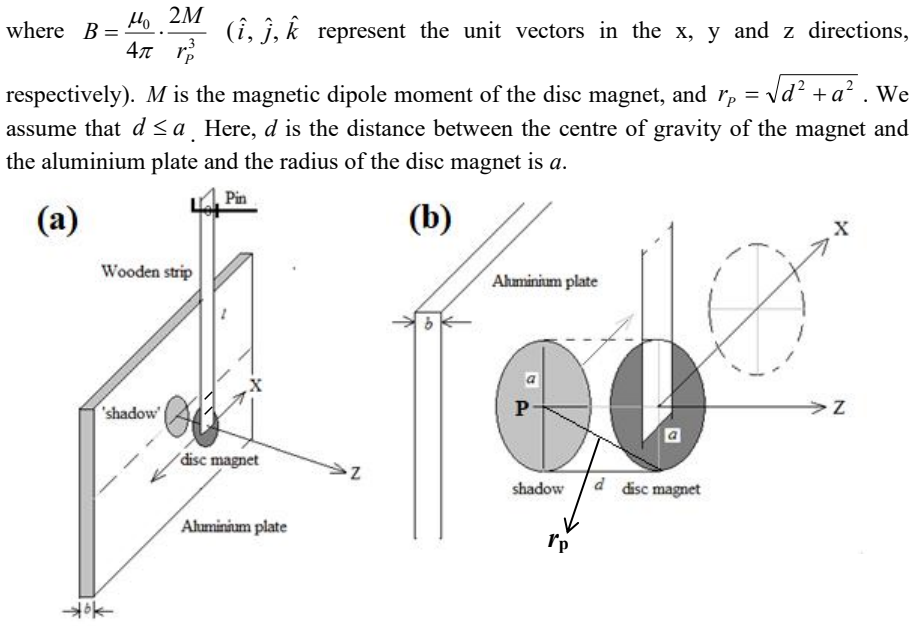
We have designed an experiment that involves studying the effects of a conducting plate on the motion of an oscillating disc magnet. We have employed the video analysis method by Tracker software to investigate the variation of electromagnetic damping coefficient with distance between the plate and the magnet. This experiment can indeed serve as a valuable educational tool for undergraduate students, covering topics such as damped oscillation, electromagnetic damping, Lenz's law, and eddy currents.
Editorial analysis
A structured set of objections, weighed in public.
Referee Report
Summary. The manuscript describes the design of an experiment in which a disc magnet oscillates near a non-ferromagnetic conducting plate. Video analysis with Tracker software is used to extract the electromagnetic damping coefficient as a function of the distance between the magnet and the plate. The authors conclude that the setup can serve as a valuable undergraduate educational tool for illustrating damped oscillations, electromagnetic damping, Lenz's law, and eddy currents.
Significance. If the method is shown to yield reproducible damping coefficients with controlled systematics, the experiment would provide an accessible, low-cost demonstration of eddy-current braking and distance-dependent damping that aligns well with standard undergraduate curricula in mechanics and electromagnetism. The choice of open-source Tracker software supports reproducibility in teaching laboratories.
major comments (1)
- [Abstract / entire manuscript] The manuscript (including the abstract) presents only the experimental design and pedagogical intent. No position-time data, extracted damping coefficients b(d), error analysis, or comparison to the expected 1/r^4 (or similar) distance dependence of eddy-current damping is reported. This is load-bearing for the central claim that the setup functions as a valuable educational tool, because the claim requires evidence that Tracker analysis can isolate electromagnetic damping from friction and air resistance with sufficient precision.
Simulated Author's Rebuttal
We thank the referee for the constructive feedback on our manuscript. We agree that experimental data and analysis are essential to substantiate the educational value of the proposed setup, and we will revise the manuscript to address this.
read point-by-point responses
-
Referee: [Abstract / entire manuscript] The manuscript (including the abstract) presents only the experimental design and pedagogical intent. No position-time data, extracted damping coefficients b(d), error analysis, or comparison to the expected 1/r^4 (or similar) distance dependence of eddy-current damping is reported. This is load-bearing for the central claim that the setup functions as a valuable educational tool, because the claim requires evidence that Tracker analysis can isolate electromagnetic damping from friction and air resistance with sufficient precision.
Authors: We acknowledge that the current version of the manuscript focuses primarily on the experimental design, the use of Tracker software, and its pedagogical potential without presenting specific data or quantitative analysis. In the revised manuscript, we will include sample position-time data extracted via video tracking, the corresponding electromagnetic damping coefficients b as a function of distance d, a quantitative error analysis showing how electromagnetic damping is isolated from friction and air resistance, and a direct comparison of the measured distance dependence to the expected theoretical scaling (approximately 1/d^4 for eddy-current damping in this geometry). These additions will demonstrate the reproducibility and precision of the method, thereby supporting the claim that the experiment serves as a valuable undergraduate tool. revision: yes
Circularity Check
No derivation chain or predictions present; purely experimental description
full rationale
The manuscript describes an experimental apparatus (oscillating disc magnet near conducting plate) and a video-analysis method using Tracker software to observe damping variation with distance. No equations, first-principles derivations, fitted parameters, or theoretical predictions are advanced that could reduce to the inputs by construction. The central claim is educational utility for topics such as Lenz's law and eddy currents; this rests on the experiment functioning as intended but contains no self-definitional steps, fitted-input predictions, or self-citation load-bearing arguments. Hence the circularity score is 0.
Axiom & Free-Parameter Ledger
axioms (1)
- domain assumption Electromagnetic induction produces a velocity-dependent damping force on a moving magnet near a conductor
Reference graph
Works this paper leans on
-
[1]
Some other researchers have conducted detailed analyses of EM damping [18 -21]
has also been investigated. Some other researchers have conducted detailed analyses of EM damping [18 -21]. Different physical quantities like displacement, velocity, and acceleration [22] and current waveforms [23 -28] were studied for magnetically damped oscillations. Inspired by these works, we have designed a demonstration experiment on the dependence...
-
[2]
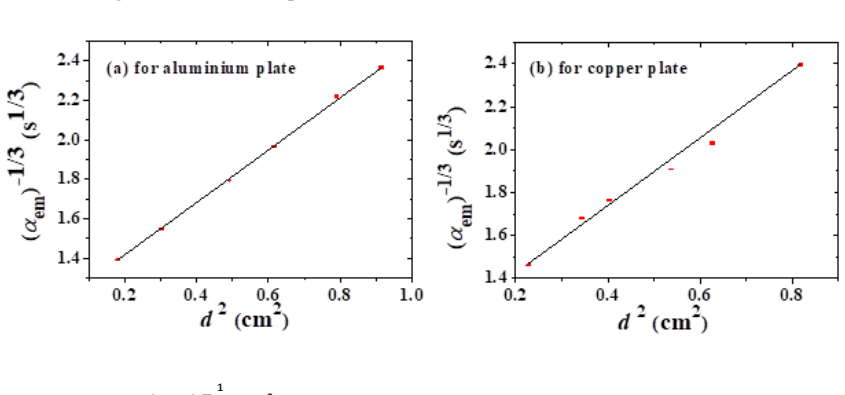
4(a) which clearly displays the linear variation of (𝛼em)− 1 3 with d2, as expected from Eq
Average αem (s-1) 0.42 0.1764 0.3722 0.3693 1.3938 0.3690 ±0.0074 ±0.0004 0.3713 0.3684 1.3950 0.3723 0.3694 1.3937 0.3708 0.3679 1.3956 0.3731 0.3702 1.3927 0.55 0.3025 0.2733 0.2704 1.5464 0.2700 ±0.0053 ±0.0004 0.2720 0.2691 1.5489 0.2729 0.2700 1.5472 0.2724 0.2695 1.5482 0.2741 0.2712 1.5449 0.70 0.4900 0.1758 0.1729 1.7950 0.1731 ±0.0032 ±0.0002 0.1...
-
[3]
Carpena P 1997 Velocity measurements through magnetic induction Am. J. Phys. 65 135–140
1997
-
[4]
Ivanov D T 2000 Another way to demonstrate Lenz’s law Phys. Teach. 38 48-49
2000
-
[5]
D’Anna M and Corridoni T 2020 Magnetic Force from Terminal Velocity Phys. Teach. 58 642-645
2020
-
[6]
S F Petru and Peppard T 2012 Lenz’s Law Demonstration Using an Ultrasound Position Sensor Phys. Teach. 50 344-346
2012
-
[7]
Wei Y 2012 A simple demonstration of terminal velocity: An experimental approach based on Lenz's law Phys. Educ. 47 265-266
2012
-
[8]
Pathare S R, Huli S, Lahane R , and Sawant S 2014 Low -cost timer to measure the terminal velocity of a magnet falling through a conducting pipe Phys. Teach. 52 160-164 9
2014
-
[9]
Zhang C G and Hu S F 2002 Another way to demonstrate Lenz’s law Phys. Teach. 40 249-249
2002
-
[10]
Wood L T, Rottmann R M , and Barrera R 2004 Faraday’s law, Lenz’s law, and conservation of energy Am. J. Phys. 72 376–380
2004
-
[11]
Pelesko J A, Cesky M , and Huertas S 2005 Lenz’s law and dimensional analysis Am. J. Phys. 73 37–39
2005
-
[12]
Íñiguez J, Raposo V, Hernández-López A, Flores A G, and Zazo M 2004 Study of the conductivity of a metallic tube by analysing the damped fall of a magnet Eur. J. Phys. 25 593–604
2004
-
[13]
Roy M K, M. K. Harbola M K , and Verma H C 2007 Demonstration of Lenz’s law: Analysis of a magnet falling through a conducting pipe Am. J. Phys. 75 728–730
2007
-
[14]
Donoso G, Ladera C L , and Martín P 2009 Magnet fall inside a conductive pipe: motion and the role of the pipe wall thickness Eur. J. Phys. 30 855–869
2009
-
[15]
Behroozi F 2018 Weighing a magnet as it falls with terminal velocity through an aluminium pipe Phys. Teach. 56 475-477
2018
-
[16]
Marín-Sepulveda C F, Castro -Palacio J C, Giménez M H , and Monsoriu J A 2023 Acoustic determination of g by tracking a freefalling body using a smartphone as a ‘sonar’ Phys. Educ. 58 035011
2023
-
[17]
Pal S K , Sarkar S, and Panchadhyayee P 2024 Determination of the magnetic moment of a magnet by letting it fall through a conducting pipe Phys. Educ. 59 015022
2024
-
[18]
Syed M and Nuessle N 2019 What a metal pipe can teach you about magnetism Phys. Teach. 57 330-333
2019
-
[19]
Íñiguez J, Raposo V, Flores A G and Zazo M , and Hernández-López A 2005 Magnetic levitation by induced eddy currents in non -magnetic conductors and conductivity measurements Eur. J. Phys. 26 951–957
2005
-
[20]
Singh A, Mohapatra Y N , and Kumar S 2002 Electromagnetic induction and damping: Quantitative experiments using a PC interface Am. J. Phys. 70 424–427
2002
-
[21]
Levin Y, da Silveira F L , and Rizzato F B 2006 Electromagnetic braking: A simple quantitative model Am. J. Phys. 74 815-817
2006
-
[22]
Donoso G, Ladera C L , and Martin P 2011 Damped fall of magnets inside a conducting pipe Am. J. Phys. 79 193–200
2011
-
[23]
Irvine B, Kemnetz M, Gangopadhyaya A , and Ruubel T 2014 Magnet traveling through a conducting pipe: A variation on the analytical approach Am. J. Phys. 82 273– 279
2014
-
[24]
Hinrichsen P F 2019 Acceleration, Velocity, and Displacement for Magnetically Damped Oscillations Phys. Teach. 57 250-253
2019
-
[25]
Ha H J , Jang T, and Sohn S H 2022 Currents induced in a circular loop by an oscillating magnet Phys. Educ. 57 065013
2022
-
[26]
Jang T, Ha H J , Go J H, and Sohn S H 2023 Theory and experiment for a solenoid based currents and the magnetic drag Eur. J. Phys. 44 045201
2023
-
[27]
Seo Y K, Jang T, Ha H J, and Sohn S H 2023 Analysis of the current induced by the motion of a magnet pendulum with a large initial angle Eur. J. Phys. 44 015204
2023
-
[28]
Kraftmakher Y 2007 Experiments with a magnetically controlled pendulum Eur. J. Phys. 28 1007–20 10
2007
-
[29]
Ladera C L, Donoso G and Martin P, 2014 Spring -magnet oscillations through a bored conductive plate Lat. Am. J. Phys. Educ. 8 109-117
2014
-
[30]
Corridoni and H.U
D’Anna, T. Corridoni and H.U. Fuchs, 2014 Damped Mechanical Oscillator: Experiment and Detailed Energy Analysis, Phys. Teach., 52 88–90
2014
-
[31]
https://physlets.org/tracker/
discussion (0)
Sign in with ORCID, Apple, or X to comment. Anyone can read and Pith papers without signing in.