Recognition: unknown
Determination of the acceleration due to gravity by studying magnet s motion through a conducting pipe
Pith reviewed 2026-05-09 16:34 UTC · model grok-4.3
The pith
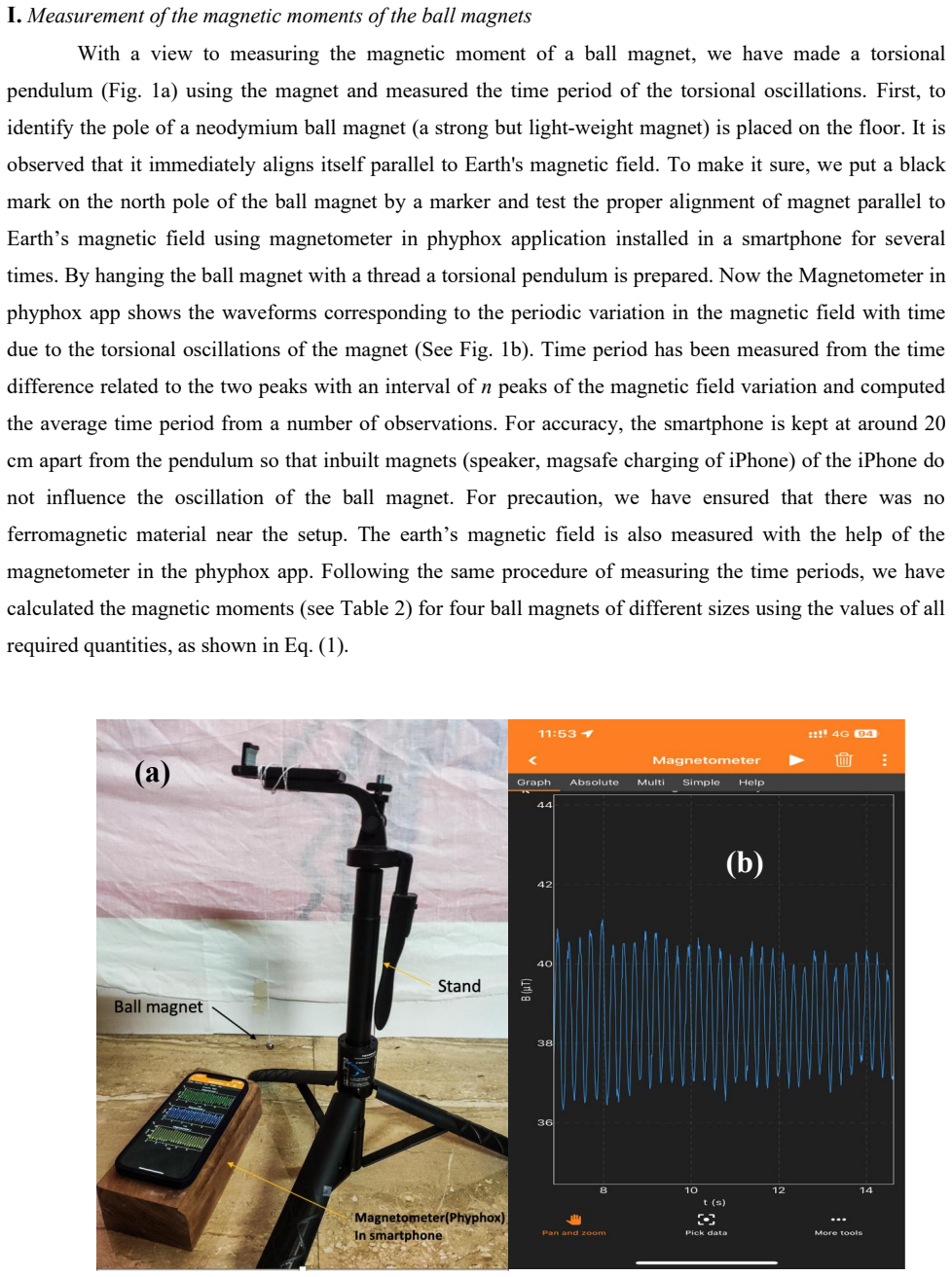
A magnet falling at terminal velocity through a conducting pipe allows determination of the acceleration due to gravity once its magnetic moment is known from torsional oscillations, using only a smartphone.
A machine-rendered reading of the paper's core claim, the machinery that carries it, and where it could break.
Core claim
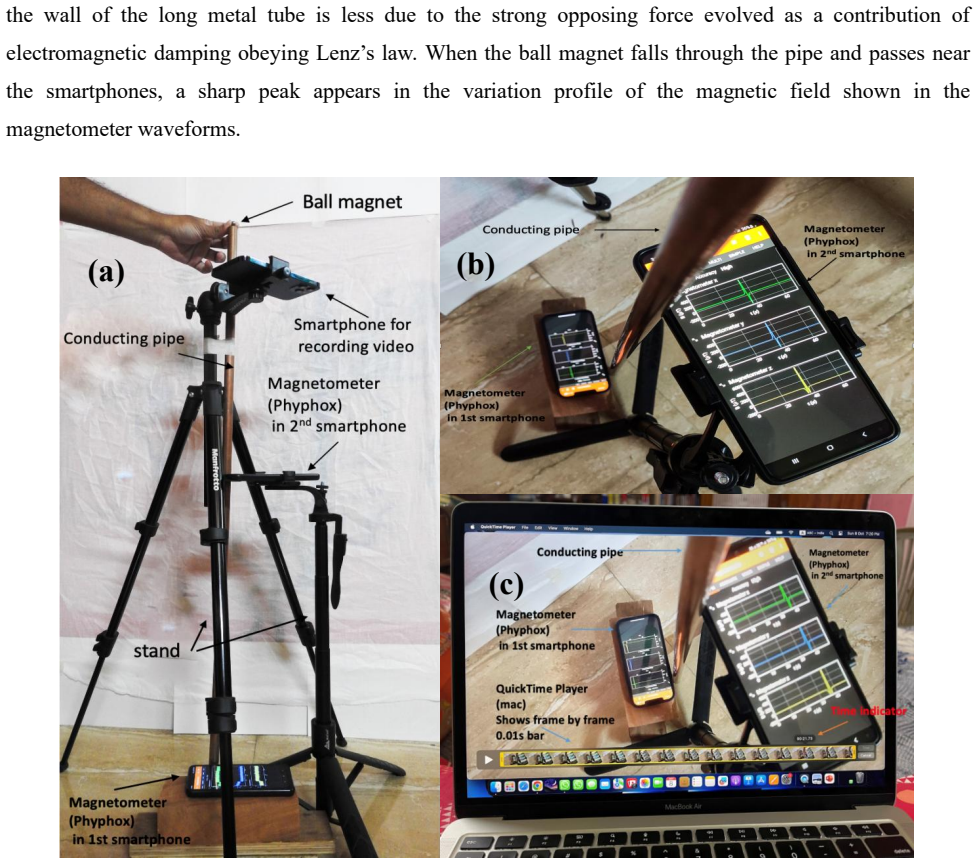
By recording the terminal velocity of a magnet falling through a conducting pipe and measuring the magnet's magnetic moment from its torsional oscillations in the Earth's field, the acceleration due to gravity is obtained from the equilibrium between the downward gravitational force and the opposing velocity-dependent electromagnetic damping force.
What carries the argument
Velocity-dependent electromagnetic damping force arising from eddy currents induced in the pipe walls by the moving magnet, whose magnitude scales with the square of the magnetic moment and produces a terminal velocity from which g is extracted once the moment is known.
If this is right
- The experiment supplies an alternative to pendulum or free-fall timing for measuring g in teaching laboratories.
- Smartphone magnetometer and video tools make the setup portable and inexpensive.
- The magnetic moment is obtained as a direct byproduct of the same sensor suite.
- Quantitative study of electromagnetic damping becomes feasible with standard classroom equipment.
Where Pith is reading between the lines
- The approach could be adapted for field measurements of local gravity variations where traditional instruments are unavailable.
- Changing pipe wall thickness or material would test how conductivity enters the damping coefficient and might yield an independent check on the force law.
- Extending the same sensor methods to inclined pipes or different magnet shapes would probe the range of validity of the terminal-velocity relation.
Load-bearing premise
Air resistance and other mechanical drags are negligible compared with the electromagnetic damping force once the magnet reaches constant speed.
What would settle it
A direct side-by-side comparison in which the g value extracted from terminal velocity and magnetic moment deviates from the accepted local value by more than the combined experimental uncertainties would show the method fails.
Figures

read the original abstract
We determine the acceleration due to gravity (g) in a novel way using a magnetic sensor and video analysis technique of a smartphone. The same applications are used to measure the terminal velocity of a magnet falling through a conducting pipe and the magnetic moment of the magnet from its torsional oscillations. This experiment would appear to be intriguing, as it combines elements of magnetism, terminal velocity, and electromagnetic damping to determine g.
Editorial analysis
A structured set of objections, weighed in public.
Referee Report
Summary. The manuscript describes an experiment to determine the acceleration due to gravity g using a smartphone's magnetic sensor and video analysis. A magnet is dropped through a conducting pipe to measure its terminal velocity, and the magnet's magnetic moment is determined from torsional oscillations in Earth's magnetic field. These measurements are combined to calculate g based on the balance between gravitational force and electromagnetic damping force.
Significance. If the underlying model is validated and systematic errors are properly accounted for, this approach offers an innovative educational tool that integrates concepts from mechanics, electromagnetism, and data analysis using readily available technology. It could enhance student engagement in physics labs by demonstrating the application of eddy current damping to measure fundamental constants. The use of smartphone apps for multiple measurements is a practical strength.
major comments (2)
- [Theory section (equation following description of terminal velocity)] Theory section, equation for terminal velocity: The derivation equates mg to the eddy-current drag force (proportional to m² v_t with a prefactor involving pipe radius, wall thickness, and conductivity). This step is load-bearing for the central claim, yet the manuscript provides no experimental calibration of the drag coefficient, no direct measurement of conductivity (as opposed to tabulated values), and no quantitative assessment of air resistance or end effects. Without such verification, the inferred g is model-dependent rather than independently determined.
- [Results section] Results and discussion: No numerical value for g, uncertainty analysis, or comparison to the accepted 9.81 m/s² is presented. This prevents assessment of whether the method achieves useful precision and directly undermines the claim of a viable determination of g.
minor comments (2)
- [Title] The title contains a typographical error ('magnet s motion' should read 'magnet's motion').
- [Abstract] The final sentence of the abstract ('This experiment would appear to be intriguing...') uses awkward phrasing; revise for direct, professional tone.
Simulated Author's Rebuttal
We thank the referee for the constructive and detailed review of our manuscript. We address each major comment below, indicating where revisions have been made to strengthen the presentation of the method and results.
read point-by-point responses
-
Referee: Theory section (equation following description of terminal velocity): The derivation equates mg to the eddy-current drag force (proportional to m² v_t with a prefactor involving pipe radius, wall thickness, and conductivity). This step is load-bearing for the central claim, yet the manuscript provides no experimental calibration of the drag coefficient, no direct measurement of conductivity (as opposed to tabulated values), and no quantitative assessment of air resistance or end effects. Without such verification, the inferred g is model-dependent rather than independently determined.
Authors: We acknowledge that the terminal-velocity equation is derived from the theoretical balance between gravitational force and the eddy-current drag force, with the prefactor depending on pipe geometry and conductivity. The conductivity value used is the standard tabulated value for copper, as is typical for educational laboratory exercises where direct four-point probe measurements are not available. We did not perform an experimental calibration of the overall drag coefficient because the primary goal is to demonstrate the combined use of smartphone sensors for velocity and magnetic moment in an accessible setup. We agree, however, that the manuscript would benefit from explicit discussion of model assumptions. In the revised version we add quantitative estimates of air resistance (negligible at the observed speeds) and end effects, together with a statement that the extracted g is obtained within the eddy-current model using literature material properties. This is consistent with the educational intent of the work. revision: partial
-
Referee: Results and discussion: No numerical value for g, uncertainty analysis, or comparison to the accepted 9.81 m/s² is presented. This prevents assessment of whether the method achieves useful precision and directly undermines the claim of a viable determination of g.
Authors: We thank the referee for pointing out this omission. The original manuscript emphasized the experimental procedure and data-analysis steps but did not report the final numerical result for g or the associated uncertainty. We have now revised the Results section to include the measured terminal velocity, the independently determined magnetic moment, the calculated value of g with propagated uncertainties from both measurements, and a direct comparison with the accepted value of 9.81 m/s². This addition enables readers to judge the precision achieved by the method. revision: yes
Circularity Check
No circularity: g is computed from independent measurements of v_t and m via external force-balance model
full rationale
The derivation measures terminal velocity v_t via smartphone video and magnetic moment m via torsional oscillation period in Earth's field; these are independent experimental inputs. The balance mg equals eddy-current drag (proportional to m² v_t times geometry/conductivity factors) is then solved for g. No equation defines g in terms of itself, no fitted parameter is relabeled as a prediction, and no load-bearing step reduces to a self-citation or ansatz imported from the authors' prior work. The model assumptions (negligible air drag, tabulated conductivity, etc.) are external and falsifiable, not circular by construction. This is the normal case of an experimental extraction resting on physics equations plus separate measurements.
Axiom & Free-Parameter Ledger
axioms (2)
- standard math Newton's second law applies to the magnet's motion.
- domain assumption Electromagnetic induction produces damping force proportional to velocity.
Reference graph
Works this paper leans on
-
[1]
Here, a and b are the inner and outer radii of the pipe, μ0 is the permittivity of free space
𝜇0 2𝑚2𝜎 ( 1 𝑎3 − 1 𝑏3), (4) where 𝜎 is the conductivity of the material of the pipe. Here, a and b are the inner and outer radii of the pipe, μ0 is the permittivity of free space. As stated before, when the damping force becomes equal to the weight of the fallin g magnet, the velocity of the magnet reaches its terminal velocity (vT). Now we can write [12]...
-
[2]
𝜇0 2𝑚2𝜎 ( 1 𝑎3 − 1 𝑏3) 𝑣𝑇 = 𝑀𝑔, ∴ 𝑚2𝑣𝑇 = 𝑀𝑔 𝑈 , where the constant, 𝑈 = ( 15
-
[3]
Hence, 𝑔 = 𝑚2𝑣𝑇𝑈 𝑀
𝜇0 2𝜎 ( 1 𝑎3 − 1 𝑏3). Hence, 𝑔 = 𝑚2𝑣𝑇𝑈 𝑀 . (6) Using the above expression (6) the value of g is calculated where the constant, U, only depends upon the system parameters. Experimental Results As mentioned before, we have performed the experiment for measuring g in two steps. Four ball magnets are taken for this purpose. We have measured the radius of each...
2041
-
[4]
2020 Smartphone Physics on the Rise, Physics 13, 68
Wright, K. 2020 Smartphone Physics on the Rise, Physics 13, 68
2020
-
[5]
2020 A lab in the pocket, Nat
Stampfer, C.; Heinke, H.; Staacks, S. 2020 A lab in the pocket, Nat. Rev. Mater. 5, 169–170
2020
-
[6]
Teach 82(9), 32-40
Vieyra R, Vieyra C, Jeanjacuot P, Marti A C 2015 Turn your smartphone into a science laboratory , The Sci. Teach 82(9), 32-40
2015
-
[7]
Kuhn J and Vogt P 2012 Analyzing free fall with a smartphone acceleration sensor , Phys. Teach. 50, 182-183
2012
-
[8]
Pili U and Violanda R 2018 A simple pendulum-based measurement of g with a smartphone light sensor, Phys. Educ. 53, 043001
2018
-
[9]
Silva-Alé J A 2021 Determination of gravity acceleration with smartphone ambient light sensor , Phys. Teach. 59, 218-219
2021
-
[10]
Kim J, Bouman L, Cayruth F, Elliott C, Francis B, Gogo E, Hyman C, Marshall A, Masters J, Olano W, Paone A, Patel K, Richards L, Sbardella S, Snider A, Trinh B, Umari F, and Wilks H 2020 A measurement of gravitational acceleration using a metal ball, a ruler, and a smartphone Phys. Teach. 58, 192–194
2020
-
[11]
Deng X, Zhang J, Chen Q, Zhang J, and Zhuang W 2021 Measurement of g using a pendulum and a smartphone proximity sensor, Phys. Teach. 59, 584-585
2021
-
[12]
Anni M 2021 Quantitative comparison between the smartphone based experiments for the gravity acceleration measurement at home, Educ. Sci. 11, 493 (1-20) 12
2021
-
[13]
Zhang J, Zhang J, Chen Q, Deng X, and Zhuang W 2023 Measurement of g using a steel ball and a smartphone acoustic stopwatch, Phys. Teach. 61, 74–75
2023
-
[14]
Marín -Sepulveda C F, Castro -Palacio J C, Giménez M H, and Monsoriu J A 2023 Acoustic determination of g by tracking a free falling body using a smartphone as a ‘sonar’, Phys. Educ. 58, 035011
2023
-
[15]
Pal Sanjoy K., Sarkar Soumen, and Panchadhyayee Pradipta 202 4Determination of the magnetic moment of a magnet by letting it fall through a conducting pipe, Phys. Educ. 59, 015022
discussion (0)
Sign in with ORCID, Apple, or X to comment. Anyone can read and Pith papers without signing in.