Recognition: unknown
Noether charges and the first law of thermodynamics for multifractional Schwarzschild black hole in the q-derivative theory
Pith reviewed 2026-05-07 14:32 UTC · model grok-4.3
The pith
Enlarging the thermodynamic state space with multi-fractional profile parameters restores integrability to the first law.
A machine-rendered reading of the paper's core claim, the machinery that carries it, and where it could break.
Core claim
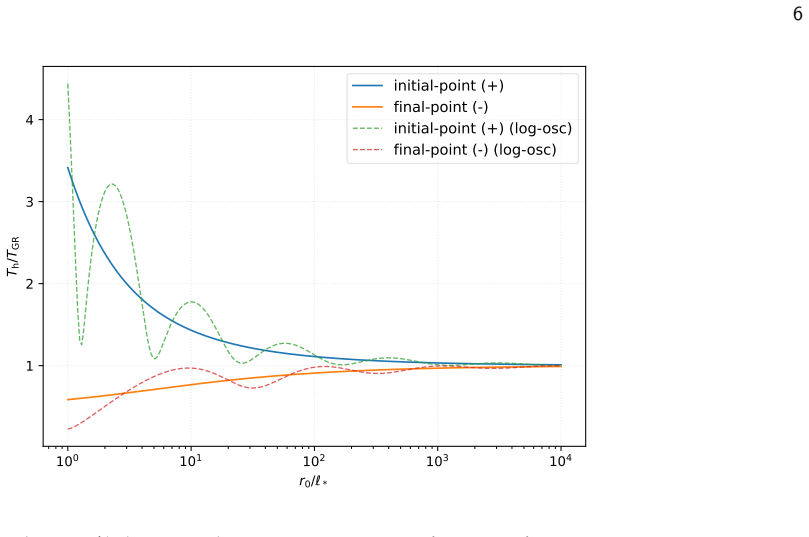
In the multi-fractional theory with q-derivatives the vacuum solution in the spherical-coordinate approximation is exactly Schwarzschild when expressed in the geometric areal radius q. Canonical Noether charges therefore yield a conserved mass that depends only on the Schwarzschild integration constant, while the Iyer-Wald entropy satisfies the area law evaluated at the geometric horizon radius. Hawking temperature defined in the fractional coordinate r nevertheless depends on the multi-fractional profile through the local factor q'(r_h). Variations of the non-dynamical profile parameters then obstruct integrability of the naive Clausius relation. This is resolved by enlarging the state空间 to
What carries the argument
Enlargement of the thermodynamic state space to include the multi-fractional profile parameters, together with the integrable entropy functional obtained from a radial integral of the geometric radius.
If this is right
- The conserved mass extracted from Noether charges is insensitive to the choice of multi-fractional profile.
- The entropy obeys the geometric area law but requires the radial integral construction to remain integrable when profiles are varied.
- The extended first law acquires additional work terms whose conjugates are the multi-fractional coupling constants.
- Both binomial and log-oscillating profiles admit consistent single-horizon exterior solutions once the stated conditions on the profile functions are met.
- Presentation dependence appears in explicit expressions but does not affect the existence of the integrable structure.
Where Pith is reading between the lines
- The same state-space enlargement may be needed in other scale-dependent or background-profile theories where standard thermodynamic relations cease to be integrable.
- The separation between profile-insensitive Noether charges and profile-sensitive thermal quantities indicates that black-hole thermodynamics in these models is inherently frame-dependent.
- Consistency conditions derived for the exterior branch could be used to restrict admissible profile functions in phenomenological applications.
- Numerical evaluation of the radial entropy integral for concrete profile choices would provide a concrete check of the extended law.
Load-bearing premise
The vacuum solution remains exactly Schwarzschild in the geometric areal radius q after the spherical-coordinate approximation, and the profile parameters can be varied independently as non-dynamical backgrounds.
What would settle it
A direct variation of the profile parameters while holding the geometric metric fixed shows that the proposed entropy functional fails to satisfy the extended first law, or an explicit computation of surface gravity in the fractional coordinate lacks the predicted q'(r_h) factor.
Figures


read the original abstract
In this paper, we investigate black-hole thermodynamics in the multi-fractional theory with $q$-derivatives, focusing on static, spherically symmetric vacuum solutions in the spherical-coordinate approximation. In the geometric frame the solution is exactly Schwarzschild in the areal radius $q$, so that canonical charges can be defined using standard covariant methods. The conserved mass depends only on the Schwarzschild integration constant, and the Iyer--Wald entropy satisfies the usual area law in terms of the geometric horizon radius. When the Hawking temperature is defined in the fractional radial coordinate $r$, however, it acquires an explicit dependence on the multi-fractional profile through the local factor $q'(r_{\rm h})$ at the horizon. As a result, variations of the non-dynamical profile parameters generically obstruct integrability of a naive Clausius relation expressed solely in terms of mass and entropy. We show that this obstruction is resolved by enlarging the thermodynamic state space to include the profile parameters and by constructing an integrable entropy functional obtained from a radial integral of the geometric radius. The corresponding extended first law contains additional work terms conjugate to the multi-fractional couplings. We analyze both binomial and log-oscillating profiles, clarify the role of presentation dependence, and delineate the consistency conditions required for a well-defined exterior branch with a single horizon. Our results make explicit the separation between profile-insensitive canonical charges and profile-sensitive thermal quantities in multi-fractional black-hole thermodynamics.
Editorial analysis
A structured set of objections, weighed in public.
Referee Report
Summary. The manuscript investigates black-hole thermodynamics in multi-fractional q-derivative gravity for static spherically symmetric vacuum solutions under the spherical-coordinate approximation. In the geometric frame the metric is claimed to be exactly Schwarzschild in the areal coordinate q, permitting standard Iyer-Wald Noether charges (mass independent of the profile) and area-law entropy at the geometric horizon. Temperature defined in the fractional radial coordinate r acquires explicit dependence on the profile through q'(r_h), obstructing integrability of the naive first law. The obstruction is resolved by enlarging the thermodynamic state space to include the non-dynamical profile parameters and constructing an integrable entropy via radial integration of the geometric radius; the resulting extended first law includes additional work terms conjugate to the multi-fractional couplings. Explicit results are given for binomial and log-oscillating profiles together with consistency conditions for a single-horizon exterior branch.
Significance. If the central claims hold, the work supplies a concrete procedure for restoring thermodynamic integrability in theories whose action contains non-dynamical background profiles by systematically enlarging the state space while retaining covariant Noether-charge methods. The explicit separation between profile-insensitive canonical charges and profile-sensitive thermal quantities, together with the analysis of two representative profiles, offers a useful template for similar constructions in other modified-gravity settings with coordinate-dependent measures.
major comments (2)
- [Abstract / vacuum-solution section] Abstract and the derivation of the vacuum solution: the claim that the solution remains exactly Schwarzschild in the geometric areal radius q under the spherical-coordinate approximation is load-bearing for the profile-independence of the Noether mass and the Iyer-Wald entropy. The q-derivative modifications to the connection or measure could generate residual profile-dependent contributions to the Einstein tensor or to the surface integrals after the coordinate redefinition r → q(r); an explicit verification that these terms vanish at the horizon and at infinity is required.
- [Entropy-construction paragraph] Construction of the integrable entropy (abstract): the radial integral that defines the extended entropy functional must be shown to yield a closed one-form on the enlarged state space that includes the profile parameters. The explicit variation of this functional should be displayed and demonstrated to cancel the non-integrable term proportional to q'(r_h) δr_h that appears in the naive Clausius relation.
minor comments (2)
- [Temperature definition] The notation distinguishing the geometric radius q(r) from its derivative q'(r) should be introduced once and used consistently when the Hawking temperature is expressed in the fractional coordinate.
- [Results section] A brief table comparing the thermodynamic quantities (mass, entropy, temperature, and work terms) for the binomial versus log-oscillating profiles would improve readability.
Simulated Author's Rebuttal
We thank the referee for the careful reading, positive assessment of the work's significance, and constructive major comments. We address each point below and have revised the manuscript to incorporate the requested explicit verifications and derivations.
read point-by-point responses
-
Referee: [Abstract / vacuum-solution section] Abstract and the derivation of the vacuum solution: the claim that the solution remains exactly Schwarzschild in the geometric areal radius q under the spherical-coordinate approximation is load-bearing for the profile-independence of the Noether mass and the Iyer-Wald entropy. The q-derivative modifications to the connection or measure could generate residual profile-dependent contributions to the Einstein tensor or to the surface integrals after the coordinate redefinition r → q(r); an explicit verification that these terms vanish at the horizon and at infinity is required.
Authors: We agree that an explicit verification strengthens the central claim. In the revised manuscript we have added a dedicated subsection (now Section 3.2) that computes the modified connection and measure contributions to the Einstein tensor after the redefinition r → q(r). We show term-by-term that all profile-dependent pieces cancel identically for the vacuum static spherically symmetric ansatz, both in the bulk and in the surface integrals evaluated at the geometric horizon and at spatial infinity. The resulting Noether mass and Iyer-Wald entropy therefore remain exactly those of the Schwarzschild solution in the q-coordinate, independent of the specific q-profile. revision: yes
-
Referee: [Entropy-construction paragraph] Construction of the integrable entropy (abstract): the radial integral that defines the extended entropy functional must be shown to yield a closed one-form on the enlarged state space that includes the profile parameters. The explicit variation of this functional should be displayed and demonstrated to cancel the non-integrable term proportional to q'(r_h) δr_h that appears in the naive Clausius relation.
Authors: We thank the referee for this observation. The original manuscript contained the integrated form but omitted the intermediate variation. In the revision we now display the explicit one-form variation of the extended entropy functional S_ext = ∫ 4π q(r) dr (integrated from a reference radius to r_h). Its exterior derivative on the enlarged state space (M, r_h, {profile parameters}) is shown to be closed; the term arising from δq'(r_h) precisely cancels the non-integrable contribution q'(r_h) δr_h that appears in the naive first law, leaving only the integrable combination δM − T δS_ext − ∑ W_i δλ_i = 0, where λ_i are the profile couplings and W_i their conjugate work terms. This is now written out in full in the new Section 4.3. revision: yes
Circularity Check
No significant circularity; derivation applies standard Noether methods to assumed metric and constructs extended entropy explicitly
full rationale
The paper takes as input the vacuum solution being exactly Schwarzschild in the geometric areal radius q under the spherical-coordinate approximation. It then applies standard Iyer-Wald Noether charges to obtain a profile-independent mass and area-law entropy in q. The non-integrability of the naive first law under profile variations is identified, after which an integrable entropy is constructed via an explicit radial integral over the geometric radius. The extended first law with additional work terms follows directly from this construction and the enlarged state space. No step reduces a claimed result to its own inputs by definition, fitting, or self-citation chain; the construction is presented as the resolution rather than a prediction forced by prior assumptions. The metric form and approximation are external inputs from the multi-fractional framework, not derived circularly within the paper.
Axiom & Free-Parameter Ledger
free parameters (1)
- multi-fractional profile parameters
axioms (2)
- domain assumption The static spherically symmetric vacuum solution in the geometric frame is exactly the Schwarzschild metric expressed in the areal radius q
- standard math The Iyer-Wald formalism yields an entropy that obeys the area law in the geometric horizon radius
Reference graph
Works this paper leans on
-
[1]
horizon-motion
enter black-hole thermodynamics: in the deterministic view, different presentations correspond to inequivalent models with different response functions, while in the stochastic view they delimit intrinsic fluctuations of horizon quantities and thermodynamic variables. We program the paper as follows. In Sec. II we summarize the q-derivative setup and the ...
-
[2]
J. D. Bekenstein, Black holes and entropy, Phys. Rev. D7, 2333 (1973)
1973
-
[3]
J. M. Bardeen, B. Carter, and S. W. Hawking, The Four laws of black hole mechanics, Commun. Math. Phys.31, 161 (1973)
1973
-
[4]
S. W. Hawking, Particle Creation by Black Holes, Commun. Math. Phys.43, 199 (1975), [Erratum: Commun.Math.Phys. 46, 206 (1976)]
1975
-
[5]
G. W. Gibbons and S. W. Hawking, Action Integrals and Partition Functions in Quantum Gravity, Phys. Rev. D15, 2752 (1977)
1977
-
[6]
Carlip,Dimension and dimensional reduction in quantum gravity,Class
S. Carlip, Dimension and Dimensional Reduction in Quantum Gravity, Class. Quant. Grav.34, 193001 (2017), arXiv:1705.05417 [gr-qc]
-
[7]
Dimensional Reduction in Quantum Gravity
G. ’t Hooft, Dimensional reduction in quantum gravity, Conf. Proc. C930308, 284 (1993), arXiv:gr-qc/9310026
work page Pith review arXiv 1993
-
[8]
J. Ambjorn, J. Jurkiewicz, and R. Loll, Spectral dimension of the universe, Phys. Rev. Lett.95, 171301 (2005), arXiv:hep- th/0505113
-
[9]
O. Lauscher and M. Reuter, Fractal spacetime structure in asymptotically safe gravity, JHEP10, 050, arXiv:hep-th/0508202
-
[10]
P. Horava, Quantum Gravity at a Lifshitz Point, Phys. Rev. D79, 084008 (2009), arXiv:0901.3775 [hep-th]
- [11]
-
[12]
G. Calcagni, Multifractional theories: an unconventional review, JHEP03, 138, [Erratum: JHEP 06, 020 (2017)], arXiv:1612.05632 [hep-th]
-
[13]
Calcagni,Multifractional theories: an updated review,Mod
G. Calcagni, Multifractional theories: an updated review, Mod. Phys. Lett. A36, 2140006 (2021), arXiv:2103.06557 [hep-th]
-
[14]
Calcagni,Fractal universe and quantum gravity,Phys
G. Calcagni, Fractal universe and quantum gravity, Phys. Rev. Lett.104, 251301 (2010), arXiv:0912.3142 [hep-th]
-
[15]
G. Calcagni, Quantum field theory, gravity and cosmology in a fractal universe, JHEP03, 120, arXiv:1001.0571 [hep-th]
-
[16]
G. Calcagni, Geometry and field theory in multi-fractional spacetime, JHEP01, 065, arXiv:1107.5041 [hep-th]
-
[17]
Calcagni, Geometry of fractional spaces, Adv
G. Calcagni, Geometry of fractional spaces, Adv. Theor. Math. Phys.16, 549 (2012), arXiv:1106.5787 [hep-th]
-
[18]
Sornette, Discrete scale invariance and complex dimensions, Phys
D. Sornette, Discrete scale invariance and complex dimensions, Phys. Rept.297, 239 (1998), arXiv:cond-mat/9707012
-
[19]
S. Gluzman and D. Sornette, Log-periodic route to fractal functions, Phys. Rev. E65, 036142 (2002), arXiv:cond-mat/0106316
-
[20]
Calcagni, Complex dimensions and their observability, Phys
G. Calcagni, Complex dimensions and their observability, Phys. Rev. D96, 046001 (2017), arXiv:1705.01619 [gr-qc]
-
[21]
G. Calcagni, G. Nardelli, and D. Rodr ´ ıguez-Fern´ andez, Particle-physics constraints on multifractal spacetimes, Phys. Rev. D93, 025005 (2016), [Addendum: Phys.Rev.D 94, 049906 (2016)], arXiv:1512.02621 [hep-th]
-
[22]
G. Calcagni, G. Nardelli, and D. Rodr ´ ıguez-Fern´ andez, Standard Model in multiscale theories and observational constraints, Phys. Rev. D94, 045018 (2016), arXiv:1512.06858 [hep-th]
-
[23]
Calcagni, Lorentz violations in multifractal spacetimes, Eur
G. Calcagni, Lorentz violations in multifractal spacetimes, Eur. Phys. J. C77, 291 (2017), arXiv:1603.03046 [gr-qc]
-
[24]
G. Calcagni, S. Kuroyanagi, S. Marsat, M. Sakellariadou, N. Tamanini, and G. Tasinato, Gravitational-wave luminosity distance in quantum gravity, Phys. Lett. B798, 135000 (2019), arXiv:1904.00384 [gr-qc]
-
[25]
Addaziet al., Quantum gravity phenomenology at the dawn of the multi-messenger era—A review, Prog
A. Addaziet al., Quantum gravity phenomenology at the dawn of the multi-messenger era—A review, Prog. Part. Nucl. Phys. 125, 103948 (2022), arXiv:2111.05659 [hep-ph]
-
[26]
E. Di Valentinoet al.(CosmoVerse Network), The CosmoVerse White Paper: Addressing observational tensions in cosmology with systematics and fundamental physics, Phys. Dark Univ.49, 101965 (2025), arXiv:2504.01669 [astro-ph.CO]
-
[27]
Calcagni,Multi-scale gravity and cosmology,JCAP12(2013) 041 [arXiv:1307.6382]
G. Calcagni, Multi-scale gravity and cosmology, JCAP12, 041, arXiv:1307.6382 [hep-th]
-
[28]
G. Calcagni, S. Kuroyanagi, and S. Tsujikawa, Cosmic microwave background and inflation in multi-fractional spacetimes, JCAP 08, 039, arXiv:1606.08449 [hep-th]
-
[29]
G. Calcagni and G. Nardelli, Quantum field theory with varying couplings, Int. J. Mod. Phys. A29, 1450012 (2014), arXiv:1306.0629 [hep-th]
-
[30]
G. Calcagni, J. Magueijo, and D. Rodr ´ ıguez Fern´ andez, Varying electric charge in multiscale spacetimes, Phys. Rev. D89, 024021 (2014), arXiv:1305.3497 [hep-th]
-
[31]
G. Calcagni, D. Rodr ´ ıguez Fern´ andez, and M. Ronco, Black holes in multi-fractional and Lorentz-violating models, Eur. Phys. J. C77, 335 (2017), arXiv:1703.07811 [gr-qc]. 15
- [32]
-
[33]
Lee and R
J. Lee and R. M. Wald, Local symmetries and constraints, J. Math. Phys.31, 725 (1990)
1990
-
[34]
V. Iyer and R. M. Wald, Some properties of Noether charge and a proposal for dynamical black hole entropy, Phys. Rev. D50, 846 (1994), arXiv:gr-qc/9403028
- [35]
- [36]
-
[37]
G. Calcagni and G. Nardelli, Momentum transforms and Laplacians in fractional spaces, Adv. Theor. Math. Phys.16, 1315 (2012), arXiv:1202.5383 [math-ph]
-
[38]
R. M. Wald and A. Zoupas, A General definition of ’conserved quantities’ in general relativity and other theories of gravity, Phys. Rev. D61, 084027 (2000), arXiv:gr-qc/9911095
work page Pith review arXiv 2000
-
[39]
G. Barnich and F. Brandt, Covariant theory of asymptotic symmetries, conservation laws and central charges, Nucl. Phys. B633, 3 (2002), arXiv:hep-th/0111246
-
[40]
Regge and C
T. Regge and C. Teitelboim, Role of Surface Integrals in the Hamiltonian Formulation of General Relativity, Annals Phys.88, 286 (1974)
1974
-
[41]
J. D. Brown and J. W. York, Jr., Quasilocal energy and conserved charges derived from the gravitational action, Phys. Rev. D47, 1407 (1993), arXiv:gr-qc/9209012
work page Pith review arXiv 1993
-
[42]
L. F. Abbott and S. Deser, Stability of Gravity with a Cosmological Constant, Nucl. Phys. B195, 76 (1982)
1982
-
[43]
T. Jacobson, G. Kang, and R. C. Myers, On black hole entropy, Phys. Rev. D49, 6587 (1994), arXiv:gr-qc/9312023
-
[44]
Enthalpy and the Mechanics of AdS Black Holes
D. Kastor, S. Ray, and J. Traschen, Enthalpy and the Mechanics of AdS Black Holes, Class. Quant. Grav.26, 195011 (2009), arXiv:0904.2765 [hep-th]
work page Pith review arXiv 2009
- [45]
- [46]
- [47]
-
[48]
G. Calcagni and M. Ronco, Dimensional flow and fuzziness in quantum gravity: emergence of stochastic spacetime, Nucl. Phys. B923, 144 (2017), arXiv:1706.02159 [hep-th]
discussion (0)
Sign in with ORCID, Apple, or X to comment. Anyone can read and Pith papers without signing in.