Recognition: unknown
Single-Step Six-Dimensional Movable Antenna Reconfiguration for High-Mobility IoV: Modeling, Analysis, and Optimization
Pith reviewed 2026-05-07 13:39 UTC · model grok-4.3
The pith
A CSI-free single-step framework reconfigures six-dimensional movable antennas in high-mobility IoV to raise uplink sum rates without channel estimates or service breaks.
A machine-rendered reading of the paper's core claim, the machinery that carries it, and where it could break.
Core claim
Restricting 6DMA position changes to first-order grid neighbors and scheduling them periodically from predicted cumulative vehicle distributions allows the system to operate without instantaneous CSI while eliminating reconfiguration-induced service interruptions and delivering higher uplink sum rates than fixed or exhaustive-search baselines.
What carries the argument
Deterministic latitude-longitude grid position generation whose topology yields graph-theoretic lower bounds on movement cost, combined with directional sparsity to fuse offline priors and online feedback for CSI-free adaptation.
If this is right
- Antenna positions update only to adjacent grid points, so ongoing links experience no mechanical interruption.
- The scheme runs without real-time channel measurements by relying on grid structure and historical feedback.
- Uplink sum rates improve over both fixed-position antennas and full global-search methods.
- Mechanical travel distance and reconfiguration latency stay negligible because moves are confined to local neighborhoods.
Where Pith is reading between the lines
- The same grid-plus-prediction structure could be tested in non-vehicular high-mobility settings such as drone swarms where similar CSI and latency constraints appear.
- Replacing the cumulative-distribution predictor with a short-term trajectory model might further tighten the performance gap in rapidly changing traffic.
- Because the method decouples reconfiguration from instantaneous CSI, it could serve as a baseline for comparing other low-overhead movable-antenna policies in dense urban deployments.
Load-bearing premise
That predicted cumulative vehicle distributions remain accurate enough for periodic reconfigurations to avoid service interruptions and that channel directional sparsity is strong enough for the offline-online fusion to succeed reliably.
What would settle it
A simulation or field trial in which actual vehicle locations deviate markedly from the predicted cumulative distributions and the resulting uplink sum rate falls to or below the level achieved by a fixed antenna array.
Figures


read the original abstract
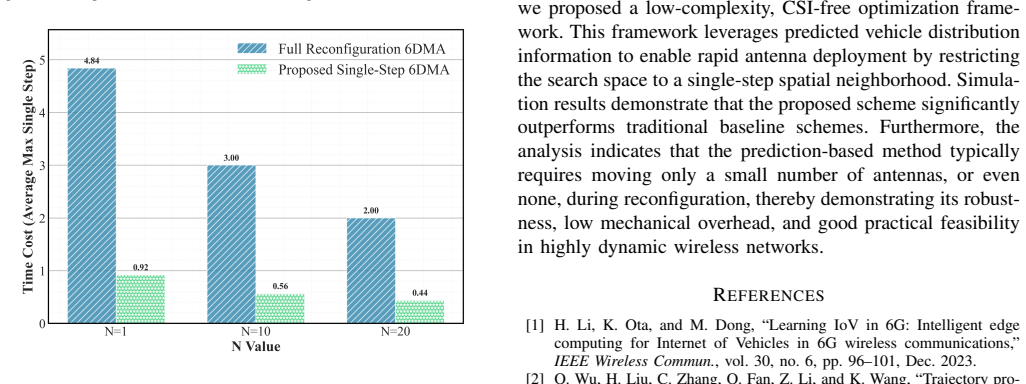
The Six-Dimensional Movable Antenna (6DMA) system has emerged as a promising technology to enhance wireless capacity by fully exploiting spatial degrees of freedom. However, applying 6DMA to high-mobility Internet of Vehicles (IoV) scenarios faces significant challenges, primarily due to the difficulty of acquiring instantaneous Channel State Information (CSI) and the risk of service interruptions caused by mechanical reconfiguration delays. To address these issues, this paper proposes a low-complexity, CSI-free single-step reconfiguration framework. First, we design a deterministic discrete position generation scheme based on a latitude-longitude grid with inherent topological structures. Leveraging graph theory, we explicitly model and theoretically derive the lower bounds of movement and time costs for antenna reconfiguration. Subsequently, utilizing the directional sparsity of 6DMA channels, we develop an adaptive optimization strategy that fuses offline environmental priors with online historical feedback. Furthermore, a periodic reconfiguration mechanism based on predicted cumulative vehicle distributions is introduced. By strictly restricting antenna adjustments to the first-order spatial neighborhood, the proposed single-step method effectively eliminates service interruptions. Simulation results demonstrate that the proposed scheme significantly outperforms traditional fixed and global-search-based benchmarks in terms of uplink sum rate, while incurring negligible mechanical overhead and latency, thereby validating its feasibility and robustness in highly dynamic vehicular networks.
Editorial analysis
A structured set of objections, weighed in public.
Referee Report
Summary. The manuscript presents a CSI-free single-step reconfiguration framework for 6DMA systems in high-mobility IoV. It models antenna positions on a latitude-longitude grid, derives graph-theoretic lower bounds on movement and time costs, proposes an adaptive fusion strategy based on directional sparsity of channels using offline priors and historical feedback, and introduces periodic reconfiguration using predicted cumulative vehicle distributions limited to first-order neighborhoods to avoid interruptions. The framework is validated through simulations showing improved uplink sum rates compared to fixed and global-search methods with low overhead.
Significance. Should the directional sparsity hold in the target scenarios and the performance gains prove robust, the work offers a promising low-latency approach for integrating movable antennas into vehicular networks. The graph-theoretic cost analysis and the single-step restriction are particularly noteworthy for their potential to enable practical implementations without service disruptions. The fusion of environmental priors with feedback provides a novel way to mitigate CSI challenges in dynamic settings.
major comments (2)
- [Simulation results section] Simulation results section: the claimed significant outperformance in uplink sum rate lacks error bars, details on the number of Monte Carlo trials, or specification of the exact optimization formulation and solver. Without these, the reliability of the gains over traditional benchmarks cannot be fully assessed, particularly given the stochastic elements in vehicle distributions and channel realizations.
- [Adaptive optimization strategy section] Adaptive optimization strategy section: the fusion of offline environmental priors with online historical feedback relies on directional sparsity to enable CSI-free operation, yet no specific equation, algorithm, or pseudocode is provided for the fusion rule or position selection. This is load-bearing for the central CSI-free claim and its claimed robustness.
minor comments (2)
- [Abstract] The abstract mentions 'inherent topological structures' of the latitude-longitude grid but provides no early figure or description of how these structures are used beyond the graph-theoretic bounds.
- Consider adding a complexity comparison table against the global-search benchmark to quantify the 'low-complexity' claim.
Simulated Author's Rebuttal
We thank the referee for the detailed and constructive review. The comments highlight important aspects for improving clarity and reproducibility. We address each major comment below and will incorporate the necessary revisions to strengthen the manuscript.
read point-by-point responses
-
Referee: [Simulation results section] Simulation results section: the claimed significant outperformance in uplink sum rate lacks error bars, details on the number of Monte Carlo trials, or specification of the exact optimization formulation and solver. Without these, the reliability of the gains over traditional benchmarks cannot be fully assessed, particularly given the stochastic elements in vehicle distributions and channel realizations.
Authors: We agree that these details are required to fully evaluate the reliability of the reported gains. In the revised manuscript, we will augment the simulation results section with error bars on all performance curves, explicitly state the number of Monte Carlo trials used, and provide the precise mathematical formulation of the uplink sum-rate objective together with the solver employed. These additions will allow readers to assess robustness under the stochastic vehicle and channel conditions. revision: yes
-
Referee: [Adaptive optimization strategy section] Adaptive optimization strategy section: the fusion of offline environmental priors with online historical feedback relies on directional sparsity to enable CSI-free operation, yet no specific equation, algorithm, or pseudocode is provided for the fusion rule or position selection. This is load-bearing for the central CSI-free claim and its claimed robustness.
Authors: We recognize that the absence of an explicit fusion rule weakens the central CSI-free claim. In the revised manuscript, we will insert the mathematical expression that defines the adaptive fusion of offline priors and online feedback, along with a concise algorithm description (and pseudocode in an appendix) for the resulting position selection. This will directly illustrate how directional sparsity is leveraged to achieve CSI-free operation while preserving the claimed robustness. revision: yes
Circularity Check
No circularity: bounds derived from standard graph theory on grid topology; sparsity used as modeling assumption, not self-derived
full rationale
The derivation begins with a deterministic latitude-longitude grid whose topological structure is input, then applies standard graph-theoretic shortest-path and neighborhood concepts to obtain explicit lower bounds on movement/time costs; these bounds follow directly from the grid definition without re-using the performance metric. Directional sparsity is invoked as an external channel property to justify the fusion rule and first-order neighborhood restriction, rather than being proven from the reconfiguration outcomes. Predicted vehicle distributions and offline priors are treated as separate inputs. No equation reduces the uplink sum-rate claim to a fitted parameter by construction, no self-citation chain carries the central premise, and the simulation validation remains independent of the modeling steps.
Axiom & Free-Parameter Ledger
axioms (2)
- domain assumption Directional sparsity of 6DMA channels
- standard math Graph theory provides explicit lower bounds on movement and time costs
Reference graph
Works this paper leans on
-
[1]
Learning IoV in 6G: Intelligent edge computing for Internet of Vehicles in 6G wireless communications,
H. Li, K. Ota, and M. Dong, “Learning IoV in 6G: Intelligent edge computing for Internet of Vehicles in 6G wireless communications,” IEEE Wireless Commun., vol. 30, no. 6, pp. 96–101, Dec. 2023
2023
-
[2]
Trajectory pro- tection schemes based on a gravity mobility model in IoT,
Q. Wu, H. Liu, C. Zhang, Q. Fan, Z. Li, and K. Wang, “Trajectory pro- tection schemes based on a gravity mobility model in IoT,”Electronics, vol. 8, no. 2, p. 148, 2019
2019
-
[3]
Performance modeling and analysis of the AD- HOC MAC protocol for V ANETs,
Q. Wu and J. Zheng, “Performance modeling and analysis of the AD- HOC MAC protocol for V ANETs,” inProc. IEEE Int. Conf. Commun. (ICC), London, UK, 2015, pp. 3646–3652
2015
-
[4]
Performance analysis of IEEE 802.11 p for continuous backoff freezing in IoV ,
Q. Wu, S. Xia, Q. Fan, and Z. Li, “Performance analysis of IEEE 802.11 p for continuous backoff freezing in IoV ,”Electronics, vol. 8, no. 12, p. 1404, 2019
2019
-
[5]
A swarming approach to optimize the one-hop delay in smart driving inter-platoon communications,
Q. Wu, S. Nie, P. Fan, H. Liu, F. Qiang, and Z. Li, “A swarming approach to optimize the one-hop delay in smart driving inter-platoon communications,”Sensors, vol. 18, no. 10, p. 3307, 2018
2018
-
[6]
Performance modeling and analysis of the ADHOC MAC protocol for vehicular networks,
Q. Wu and J. Zheng, “Performance modeling and analysis of the ADHOC MAC protocol for vehicular networks,”Wireless Netw., vol. 22, no. 3, pp. 799–812, 2016
2016
-
[7]
Performance modeling and analysis of IEEE 802.11 DCF based fair channel access for vehicle-to-roadside commu- nication in a non-saturated state,
Q. Wu and J. Zheng, “Performance modeling and analysis of IEEE 802.11 DCF based fair channel access for vehicle-to-roadside commu- nication in a non-saturated state,”Wireless Netw., vol. 21, no. 1, pp. 1–11, 2015
2015
-
[8]
Performance modeling of the IEEE 802.11 p EDCA mechanism for V ANET,
Q. Wu and J. Zheng, “Performance modeling of the IEEE 802.11 p EDCA mechanism for V ANET,” inProc. IEEE Global Commun. Conf. (GLOBECOM), Austin, TX, USA, 2014, pp. 57–63
2014
-
[9]
DRL- based optimization for AoI and energy consumption in C-V2X enabled IoV ,
Z. Zhang, Q. Wu, P. Fan, N. Cheng, W. Chen, and K. B. Letaief, “DRL- based optimization for AoI and energy consumption in C-V2X enabled IoV ,”IEEE Trans. Green Commun. Netw., early access, 2025
2025
-
[10]
Ve- hicle as a Service (VaaS): Leverage vehicles to build service networks and capabilities for smart cities,
X. Chen, Y . Deng, H. Ding, G. Qu, H. Zhang, P. Li, and Y . Fang, “Ve- hicle as a Service (VaaS): Leverage vehicles to build service networks and capabilities for smart cities,”IEEE Commun. Surveys Tuts., vol. 26, no. 3, pp. 2048–2081, 3rd Quart., 2024
2048
-
[11]
Integrated sens- ing, communication, and computation for IoV: Challenges and op- portunities,
C. Li, M. Dong, Y . Fu, F. R. Yu, and N. Cheng, “Integrated sens- ing, communication, and computation for IoV: Challenges and op- portunities,”IEEE Commun. Surveys Tuts., early access, 2025, doi: 10.1109/COMST.2025.3612388
-
[12]
Delay-constrained optimal link scheduling in wireless sensor networks,
Q. Wang, D. O. Wu, and P. Fan, “Delay-constrained optimal link scheduling in wireless sensor networks,”IEEE Trans. Veh. Technol., vol. 59, no. 9, pp. 4564–4577, 2010. 13
2010
-
[13]
Network coding for two-way relaying networks over Rayleigh fading channels,
W. Li, J. Li, and P. Fan, “Network coding for two-way relaying networks over Rayleigh fading channels,”IEEE Trans. Veh. Technol., vol. 59, no. 9, pp. 4476–4488, 2010
2010
-
[14]
Network coding for efficient multicast routing in wireless ad-hoc networks,
J. Zhang, P. Fan, and K. B. Letaief, “Network coding for efficient multicast routing in wireless ad-hoc networks,”IEEE Trans. Commun., vol. 56, no. 4, pp. 598–607, 2008
2008
-
[15]
A neighbor-table-based multipath routing in ad hoc networks,
Z. Yao, J. Jiang, P. Fan, Z. Cao, and V . O. K. Li, “A neighbor-table-based multipath routing in ad hoc networks,” inProc. 57th IEEE Semiannu. Veh. Technol. Conf. (VTC Spring), Jeju, South Korea, 2003, pp. 1739– 1743
2003
-
[16]
Investigation of the time-offset- based QoS support with optical burst switching in WDM networks,
P. Fan, C. Feng, Y . Wang, and N. Ge, “Investigation of the time-offset- based QoS support with optical burst switching in WDM networks,” in Proc. IEEE Int. Conf. Commun. (ICC), New York, NY , USA, 2002, pp. 2682–2686
2002
-
[17]
Block coded modulation for the reduction of the peak to average power ratio in OFDM systems,
P. Fan and X.-G. Xia, “Block coded modulation for the reduction of the peak to average power ratio in OFDM systems,” inProc. IEEE Wireless Commun. Netw. Conf. (WCNC), New Orleans, LA, USA, 1999, pp. 1095–1099
1999
-
[18]
High stable and accurate vehicle selection scheme based on federated edge learning in vehicular networks,
Q. Wu, X. Wang, Q. Fan, P. Fan, C. Zhang, and Z. Li, “High stable and accurate vehicle selection scheme based on federated edge learning in vehicular networks,”China Commun., vol. 20, no. 3, pp. 1–17, 2023
2023
-
[19]
Optimal resource allocation in wireless powered communication networks with user cooperation,
X. Di, K. Xiong, P. Fan, H. C. Yang, and K. B. Letaief, “Optimal resource allocation in wireless powered communication networks with user cooperation,”IEEE Trans. Wireless Commun., vol. 16, no. 12, pp. 7936–7949, 2017
2017
-
[20]
Sum- rate maximization in STAR-RIS-assisted RSMA networks: A PPO-based algorithm,
C. Meng, K. Xiong, W. Chen, B. Gao, P. Fan, and K. B. Letaief, “Sum- rate maximization in STAR-RIS-assisted RSMA networks: A PPO-based algorithm,”IEEE Internet Things J., vol. 11, no. 4, pp. 5667–5680, 2024
2024
-
[22]
AoA-based position and orientation estimation using lens MIMO in cooperative vehicle-to-vehicle systems,
J.-H. Jo, J.-N. Shim, B. Kim, C.-B. Chae, and D. K. Kim, “AoA-based position and orientation estimation using lens MIMO in cooperative vehicle-to-vehicle systems,”IEEE J. Sel. Areas Commun., vol. 41, no. 12, pp. 3719–3735, Dec. 2023
2023
-
[23]
Decentralized power allocation for MIMO-NOMA vehicular edge computing based on deep reinforcement learning,
H. Zhu, Q. Wu, X.-J. Wu, Q. Fan, P. Fan, and J. Wang, “Decentralized power allocation for MIMO-NOMA vehicular edge computing based on deep reinforcement learning,”IEEE Internet Things J., vol. 9, no. 14, pp. 12770–12782, Jul. 2022
2022
-
[24]
A novel 3-D massive MIMO channel model for vehicle-to-vehicle communication environments,
H. Jiang, Z. Zhang, J. Dang, and L. Wu, “A novel 3-D massive MIMO channel model for vehicle-to-vehicle communication environments,” IEEE Trans. Commun., vol. 66, no. 1, pp. 79–90, Jan. 2018
2018
-
[25]
Hybrid beam- forming in mmWave massive MIMO for IoV with dual-functional radar communication,
X. Yu, L. Tu, Q. Yang, M. Yu, Z. Xiao, and Y . Zhu, “Hybrid beam- forming in mmWave massive MIMO for IoV with dual-functional radar communication,”IEEE Trans. Veh. Technol., vol. 72, no. 7, pp. 9017– 9030, Jul. 2023
2023
-
[26]
A survey on 5G radio access network energy efficiency: Massive MIMO, lean carrier design, sleep modes, and machine learning,
D. L ´opez-P´erez, A. De Domenico, N. Piovesan, G. Xinli, H. Bao, S. Qitao, and M. Debbah, “A survey on 5G radio access network energy efficiency: Massive MIMO, lean carrier design, sleep modes, and machine learning,”IEEE Commun. Surveys Tuts., vol. 24, no. 1, pp. 653–697, 1st Quart., 2022
2022
-
[27]
Study on refined deployment of wireless mesh sensor network,
J. Fan, S. Yin, Q. Wu, and F. Gao, “Study on refined deployment of wireless mesh sensor network,” inProc. 6th Int. Conf. Wireless Commun. Netw. Mobile Comput. (WiCOM), Chengdu, China, 2010, pp. 1–5
2010
-
[28]
Optimal cooperative beamforming design for MIMO decode-and-forward relay channels,
K. Xiong, P. Fan, Z. Xu, H. C. Yang, and K. B. Letaief, “Optimal cooperative beamforming design for MIMO decode-and-forward relay channels,”IEEE Trans. Signal Process., vol. 62, no. 6, pp. 1476–1489, 2014
2014
-
[29]
Doppler frequency offset estimation and diversity reception scheme of high-speed railway with multiple antennas on separated carriage,
Y . Yang and P. Fan, “Doppler frequency offset estimation and diversity reception scheme of high-speed railway with multiple antennas on separated carriage,”J. Mod. Transport., vol. 20, no. 4, pp. 227–233, 2012
2012
-
[30]
Global proportional fair scheduling for networks with multiple base stations,
H. Zhou, P. Fan, and J. Li, “Global proportional fair scheduling for networks with multiple base stations,”IEEE Trans. Veh. Technol., vol. 60, no. 4, pp. 1867–1879, 2011
2011
-
[31]
A tutorial on movable antennas for wireless networks,
L. Zhu, W. Ma, W. Mei, Y . Zeng, Q. Wu, B. Ning, Z. Xiao, X. Shao, J. Zhang, and R. Zhang, “A tutorial on movable antennas for wireless networks,”IEEE Commun. Surveys Tuts., early access, 2025, doi: 10.1109/COMST.2025.3546373
-
[32]
Integrating movable antennas and intelligent reflecting surfaces for coverage en- hancement,
Y . Gao, Q. Wu, W. Mei, G. Chen, W. Chen, and Z. Zheng, “Integrating movable antennas and intelligent reflecting surfaces for coverage en- hancement,”IEEE Trans. Wireless Commun., Early Access, 2025, doi: 10.1109/TWC.2025.3623474
-
[33]
Z. Li, J. Ba, Z. Su, H. Peng, Y . Wang, W. Chen, and Q. Wu, “Joint discrete antenna positioning and beamforming optimization in movable antenna enabled full-duplex ISAC networks,”IEEE Trans. Wireless Commun., Early Access, 2025, doi: 10.1109/TWC.2025.3630154
-
[34]
L. Zhu, H. Sun, W. Ma, Z. Xiao, and R. Zhang, “Multiuser communi- cations aided by cross-linked movable antenna array: Architecture and optimization,”IEEE Trans. Wireless Commun., early access, 2025, doi: 10.1109/TWC.2025.3626388
-
[35]
Fluid antenna multiple access,
K. Wong and K. Tong, “Fluid antenna multiple access,”IEEE Trans. Wireless Commun., vol. 21, no. 7, pp. 4801–4815, Jul. 2022
2022
-
[36]
Movable-antenna array enhanced beam forming: Achieving full array gain with null steering,
L. Zhu, W. Ma, and R. Zhang, “Movable-antenna array enhanced beam forming: Achieving full array gain with null steering,”IEEE Commun. Lett., vol. 27, no. 12, pp. 3340–3344, Dec. 2023
2023
-
[37]
Over-the-air computation via 2-D movable antenna array,
N. Li, P. Wu, B. Ning, L. Zhu, and W. Mei, “Over-the-air computation via 2-D movable antenna array,”IEEE Wireless Commun. Lett., vol. 14, no. 1, pp. 33–37, Jan. 2025
2025
-
[38]
6D movable antenna based on user distribution: Modeling and optimization,
X. Shao, Q. Jiang, and R. Zhang, “6D movable antenna based on user distribution: Modeling and optimization,”IEEE Trans. Wireless Commun., vol. 24, no. 1, pp. 355–370, Jan. 2025
2025
-
[39]
6DMA enhanced wireless network with flexible antenna position and rotation: Opportunities and challenges,
X. Shao and R. Zhang, “6DMA enhanced wireless network with flexible antenna position and rotation: Opportunities and challenges,”IEEE Commun. Mag., vol. 63, no. 4, pp. 121–128, Apr. 2025
2025
-
[40]
X. Shao, W. Mei, C. You, Q. Wu, B. Zheng, C.-X. Wang, J. Li, R. Zhang, R. Schober, L. Zhu, W. Zhuang, and X. Shen, “A tutorial on six- dimensional movable antenna for 6G networks: Synergizing positionable and rotatable antennas,”IEEE Commun. Surveys Tuts., early access, 2025, doi: 10.1109/COMST.2025.3602939
-
[41]
6D movable antenna enhanced wireless network via discrete position and rotation optimiza- tion,
X. Shao, R. Zhang, Q. Jiang, and R. Schober, “6D movable antenna enhanced wireless network via discrete position and rotation optimiza- tion,”IEEE J. Sel. Areas Commun., vol. 43, no. 3, pp. 674–687, Mar. 2025
2025
-
[42]
Distributed channel estimation and optimization for 6D movable antenna: Unveiling directional sparsity,
X. Shao, R. Zhang, Q. Jiang, J. Park, T. Q. S. Quek, and R. Schober, “Distributed channel estimation and optimization for 6D movable antenna: Unveiling directional sparsity,”IEEE J. Sel. Topics Signal Process., vol. 19, no. 2, pp. 349–365, Mar. 2025
2025
-
[43]
H. Hua, Y . Zhou, W. Mei, J. Xu, and R. Zhang, “Hierarchically tunable 6DMA for wireless communication and sensing: Modeling and performance optimization,”IEEE Trans. Wireless Commun., early access, 2025, doi: 10.1109/TWC.2025.3613548
-
[44]
New view of learning-aided channel estimation for movable antenna systems,
S. Jang and C. Lee, “New view of learning-aided channel estimation for movable antenna systems,”IEEE Trans. Wireless Commun., vol. 24, no. 7, pp. 5694–5708, Jul. 2025
2025
-
[45]
A general optimization framework for movable antenna systems via discrete sampling,
C. Liu, W. Mei, Z. Chen, J. Fang, and B. Ning, “A general optimization framework for movable antenna systems via discrete sampling,”IEEE Wireless Commun. Lett., early access, 2025, doi: 10.1109/LWC.2025.3629978
-
[46]
Low-complexity 6DMA rotation and position optimization based on statistical channel information,
Q. Jiang, X. Shao, and R. Zhang, “Low-complexity 6DMA rotation and position optimization based on statistical channel information,” inProc. IEEE/CIC Int. Conf. Commun. China (ICCC Workshops), Shanghai, China, 2025, pp. 1–6
2025
-
[47]
Hybrid near-far field 6D movable antenna design exploiting directional sparsity and deep learning,
X. Shao, L. Hu, Y . Sun, X. Li, Y . Zhang, J. Ding, X. Shi, F. Chen, D. W. K. Ng, and R. Schober, “Hybrid near-far field 6D movable antenna design exploiting directional sparsity and deep learning,”IEEE Trans. Wireless Commun., early access, 2025, doi: 10.1109/TWC.2025.3605550
-
[48]
Study on channel model for frequencies from 0.5 to 100 GHz,
3GPP, “Study on channel model for frequencies from 0.5 to 100 GHz,” 3rd Generation Partnership Project (3GPP), Tech. Rep. TR 38.901 V14.1.1, Release 14, Aug. 2017. [Online]. Available: http://www.3gpp. org/DynaReport/38901.htm
2017
-
[49]
Challenges in applying multi-agent path finding solutions to real-world applications,
J. Lee and W. Chung, “Challenges in applying multi-agent path finding solutions to real-world applications,” inProc. 24th Int. Conf. Control, Autom. Syst. (ICCAS), Jeju, South Korea, 2024, pp. 1160–1161
2024
-
[50]
A neighbor-table-based multipath routing in ad hoc networks,
Z. Yao, J. Jiang, P. Fan, Z. Cao, and V . O. K. Li, “A neighbor-table-based multipath routing in ad hoc networks,” inProc. IEEE 57th Semiannual Veh. Technol. Conf. (VTC Spring), Jeju, South Korea, 2003, vol. 3, pp. 1739–1743
2003
discussion (0)
Sign in with ORCID, Apple, or X to comment. Anyone can read and Pith papers without signing in.