Recognition: unknown
Sequential Bayesian Monitoring for Recoverable and Drifting Processes
Pith reviewed 2026-05-09 16:30 UTC · model grok-4.3
The pith
Bayesian recursions compute the probability a recoverable process is currently in control at any moment.
A machine-rendered reading of the paper's core claim, the machinery that carries it, and where it could break.
Core claim
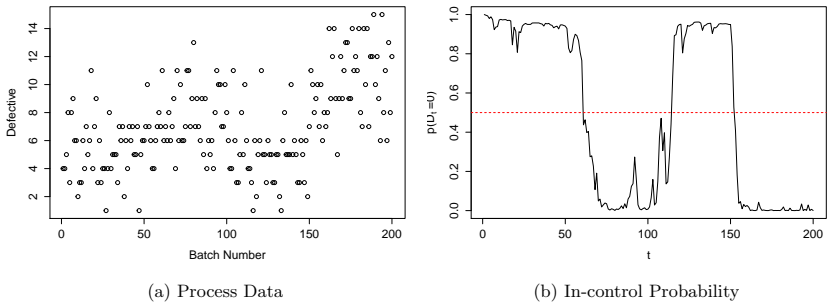
For recoverable processes that alternate between in-control and out-of-control states according to a probabilistic switching model, recursive updates give the exact posterior probability that the process is in control at the current time step. For sequential tracking where a latent parameter evolves, similar recursions monitor the posterior probability that the parameter lies inside an acceptable region. These procedures are demonstrated on time-between-failure data, Gaussian and binomial tracking examples, and a multivariate held-out dataset of white wine quality measurements.
What carries the argument
Recursive Bayesian updates for the posterior probability of current in-control status (under Markovian state alternation) or of parameter acceptability (under time-evolving latent models).
If this is right
- Monitoring can continue without reset after an out-of-control signal if corrective action restores the process.
- The same framework applies to both discrete state-switching and continuous drifting-parameter problems.
- The methods produce calibrated probabilities that can be used directly as decision thresholds in ongoing surveillance.
Where Pith is reading between the lines
- The recursions could be embedded in real-time dashboards that display live probability of acceptability rather than binary alarms.
- Extensions to non-Markovian recovery patterns would require new derivation steps but might retain the same monitoring goal.
- Comparison against frequentist control charts on the same held-out data would clarify when the Bayesian current-state focus changes decisions.
Load-bearing premise
The processes must follow the assumed probabilistic models for state switching or parameter evolution so that the posterior probabilities can be updated recursively without approximation.
What would settle it
Run the derived recursions on a simple simulated recoverable process with known state sequence and compare the reported posterior probabilities against exact posteriors obtained by direct enumeration; any systematic mismatch would show the recursions are incorrect.
Figures


read the original abstract
In many Phase II statistical process control (SPC) problems, the main concern is not whether a monitored process has ever changed, but whether it is currently operating at an acceptable level. This distinction is especially important when monitoring continues after a signal, or when corrective action may restore the process. We develop Bayesian monitoring procedures for this formulation of the Phase II task. For recoverable processes that may alternate between in-control and out-of-control states, we derive recursions for the posterior probability that the process is presently in control. For sequential tracking problems in which a latent parameter evolves over time, we monitor the posterior probability that the parameter lies inside an acceptable region of behavior. The methods are studied through calibrated time-between-failure experiments, Gaussian and Binomial tracking examples, and a held-out multivariate data illustration using white wine quality measurements.
Editorial analysis
A structured set of objections, weighed in public.
Referee Report
Summary. The manuscript develops Bayesian monitoring procedures for Phase II statistical process control, emphasizing whether a process is currently operating acceptably rather than whether it has ever changed. For recoverable processes that alternate between in-control and out-of-control states, it derives recursions for the posterior probability that the process is presently in control. For sequential tracking of drifting latent parameters, it monitors the posterior probability that the parameter lies inside an acceptable region. The methods are illustrated through calibrated time-between-failure experiments, Gaussian and Binomial tracking examples, and a held-out multivariate illustration using white wine quality data.
Significance. If the recursive derivations hold under the assumed models, the work provides a targeted Bayesian tool for ongoing Phase II monitoring that accommodates recovery and drift, addressing a practical distinction from standard change detection. The calibrated experiments and real-data example add credibility to the sequential updating approach, though overall significance hinges on the validity of the Markovian and evolution assumptions for the target applications.
major comments (2)
- [§3] §3 (Recoverable Processes): The recursions for the in-control posterior probability assume a Markov chain with fixed, known transition probabilities between states. The manuscript provides no procedure for estimating these probabilities from data nor any robustness checks against misspecification (e.g., non-Markovian alternation or unknown rates), which directly affects whether the posterior is correctly computed for general recoverable processes.
- [§4] §4 (Drifting Parameters): The monitoring rule for the posterior probability that the latent parameter lies in the acceptable region depends on a specific parametric evolution model for the drift. Without explicit validation that the acceptable region definition and evolution model match the Gaussian/Binomial examples, the claim that this yields reliable sequential tracking is not fully supported by the reported experiments.
minor comments (2)
- [Abstract] The abstract refers to 'calibrated time-between-failure experiments' without stating the calibration metric or acceptance criteria used to tune the procedures.
- [Introduction] Notation for the state probabilities and acceptable regions could be introduced with a single summary table to improve readability across the recoverable and drifting cases.
Simulated Author's Rebuttal
We thank the referee for the thoughtful and constructive comments on our manuscript. We address each major comment in detail below, providing clarifications on the scope of our contributions while acknowledging areas where additional discussion can strengthen the presentation.
read point-by-point responses
-
Referee: [§3] §3 (Recoverable Processes): The recursions for the in-control posterior probability assume a Markov chain with fixed, known transition probabilities between states. The manuscript provides no procedure for estimating these probabilities from data nor any robustness checks against misspecification (e.g., non-Markovian alternation or unknown rates), which directly affects whether the posterior is correctly computed for general recoverable processes.
Authors: The recursions are indeed derived under a Markovian model with fixed, known transition probabilities, which are treated as hyperparameters of the monitoring procedure. The primary contribution of this section is the exact recursive computation of the posterior probability that the process is currently in control, given the model. We do not provide an estimation procedure because the focus is on the sequential updating rule for Phase II monitoring rather than on model fitting; in applications, the transition probabilities can be specified from domain expertise or estimated in a separate step from historical data using standard HMM techniques such as the Baum-Welch algorithm or Bayesian posterior sampling. We agree that robustness to misspecification (including potential non-Markovian behavior) is a relevant practical concern. In revision we will add a brief discussion paragraph noting this modeling assumption and outlining possible estimation approaches, while clarifying that the derived recursions are exact under the stated model. revision: partial
-
Referee: [§4] §4 (Drifting Parameters): The monitoring rule for the posterior probability that the latent parameter lies in the acceptable region depends on a specific parametric evolution model for the drift. Without explicit validation that the acceptable region definition and evolution model match the Gaussian/Binomial examples, the claim that this yields reliable sequential tracking is not fully supported by the reported experiments.
Authors: The Gaussian and Binomial examples are constructed directly from the parametric evolution models used in the derivation (random-walk or linear-Gaussian dynamics for the latent parameter in the Gaussian case, and the corresponding binomial state evolution). The acceptable regions are defined to be consistent with the process characteristics and parameter ranges in each example, as described in the respective subsections. The experiments therefore illustrate the exact sequential monitoring rule under correctly specified models, which is the intended demonstration. We acknowledge that the manuscript could state this alignment more explicitly. In revision we will add clarifying sentences in §4 and the example sections to confirm that the evolution models and acceptable-region definitions match the simulated data-generating processes, thereby strengthening the support for the reported tracking performance. revision: yes
Circularity Check
Standard Bayesian recursions for HMM-style monitoring; no reduction to inputs by construction
full rationale
The paper derives recursive updates for the posterior probability that a recoverable process is currently in-control (or that a drifting parameter lies in an acceptable region) by applying Bayes' rule to an assumed Markovian state process with known transition probabilities. This is a direct, self-contained application of the forward algorithm for hidden Markov models and does not involve self-definition, fitted inputs renamed as predictions, or load-bearing self-citations. The central claims rest on the explicit model assumptions stated in the abstract and methods, which are externally verifiable and not equivalent to the derived recursions by construction. No circular steps are present.
Axiom & Free-Parameter Ledger
axioms (1)
- standard math Bayesian updating can be applied recursively to compute current-state posteriors for the described process models.
Reference graph
Works this paper leans on
-
[1]
Journal of Quality Technology , year =
Bourazas, Konstantinos and Kiagias, Dimitrios and Tsiamyrtzis, Panagiotis , title =. Journal of Quality Technology , year =
-
[2]
Predictive ratio
Bourazas, Konstantinos and Sobas, Fr. Predictive ratio. Journal of Quality Technology , year =
-
[3]
Design and properties of the predictive ratio
Bourazas, Konstantinos and Sobas, Fr. Design and properties of the predictive ratio. Journal of Quality Technology , year =
-
[4]
Quality and Reliability Engineering International , year =
Ali, Sajid , title =. Quality and Reliability Engineering International , year =
-
[5]
Journal of Quality Technology , year =
Capizzi, Giovanna and Masarotto, Guido , title =. Journal of Quality Technology , year =
-
[6]
Quality and Reliability Engineering International , year =
Wang, Cheng and Castagliola, Philippe and Guo, Baocai , title =. Quality and Reliability Engineering International , year =. doi:10.1002/qre.70222 , note =
-
[7]
Adams, Ryan Prescott and MacKay, David J. C. , title =. arXiv preprint arXiv:0710.3742 , year =
-
[8]
Language Resources and Evaluation , author =
Authorship attribution in the wild , volume =. Language Resources and Evaluation , author =. 2011 , pages =. doi:10.1007/s10579-009-9111-2 , abstract =
-
[9]
A. The American Statistician , author =. 2016 , pages =. doi:10.1080/00031305.2016.1148630 , language =
-
[10]
Journal of the Association for Information Science and Technology , author =
Determining if two documents are written by the same author , volume =. Journal of the Association for Information Science and Technology , author =. 2014 , keywords =. doi:10.1002/asi.22954 , abstract =
-
[11]
Narayanan, Arvind and Paskov, Hristo and Gong, Neil Zhenqiang and Bethencourt, John and Stefanov, Emil and Shin, Eui Chul Richard and Song, Dawn , month = may, year =. On the. 2012. doi:10.1109/SP.2012.46 , abstract =
-
[12]
Xun, Guangxu and Li, Yaliang and Zhao, Wayne Xin and Gao, Jing and Zhang, Aidong , pages =. A
-
[13]
Advances in Neural Information Processing Systems 26 , author =
Scalable. Advances in Neural Information Processing Systems 26 , author =. 2013 , pages =
2013
-
[14]
Advances in Neural Information Processing Systems 28 , author =
Dependent. Advances in Neural Information Processing Systems 28 , author =. 2015 , pages =
2015
-
[15]
Literary and Linguistic Computing , author =
Quantitative. Literary and Linguistic Computing , author =. 2007 , pages =. doi:10.1093/llc/fqm020 , abstract =
-
[16]
Function
Kestemont, Mike , month = apr, year =. Function. Proceedings of the 3rd
-
[17]
and Lewis, Er Genkin David D
Madigan, David and Genkin, Alexander and Lewis, David D. and Lewis, Er Genkin David D. and Argamon, Shlomo and Fradkin, Dmitriy and Ye, Li and Consulting, David D. Lewis , year =. Author. In
-
[18]
Literary and Linguistic Computing , author =
Ngram and. Literary and Linguistic Computing , author =. 2003 , pages =. doi:10.1093/llc/18.4.423 , abstract =
-
[19]
Physical Review Letters , author =
Universality in. Physical Review Letters , author =. 2006 , pages =. doi:10.1103/PhysRevLett.96.051102 , abstract =
-
[20]
Journal of Geophysical Research: Space Physics , author =
The. Journal of Geophysical Research: Space Physics , author =. 2018 , keywords =. doi:10.1029/2018JA025740 , abstract =
-
[21]
Stationarity of extreme bursts in the solar wind , volume =. Physical Review E , author =. 2014 , pages =. doi:10.1103/PhysRevE.89.052812 , abstract =
-
[22]
Waiting-time distributions of magnetic discontinuities:. Physical Review E , author =. 2009 , pages =. doi:10.1103/PhysRevE.80.046401 , abstract =
-
[23]
The Astrophysical Journal Letters , author =
Solar. The Astrophysical Journal Letters , author =. 2001 , pages =. doi:10.1086/323178 , abstract =
-
[24]
The Astrophysical Journal , author =
Reconciliation of. The Astrophysical Journal , author =. 2010 , pages =. doi:10.1088/0004-637X/717/2/683 , abstract =
-
[25]
A. The Astrophysical Journal , author =. 2015 , pages =. doi:10.1088/0004-637X/801/1/57 , language =
-
[26]
The Astrophysical Journal , author =
The. The Astrophysical Journal , author =. 2000 , pages =. doi:10.1086/312739 , abstract =
-
[27]
Chinese Journal of Astronomy and Astrophysics , author =
Waiting. Chinese Journal of Astronomy and Astrophysics , author =. 2005 , pages =. doi:10.1088/1009-9271/5/2/010 , abstract =
-
[28]
Astronomy & Astrophysics , author =
Different triggering mechanisms for solar flares and coronal mass ejections , volume =. Astronomy & Astrophysics , author =. 2008 , pages =. doi:10.1051/0004-6361:200810164 , abstract =
-
[29]
The Astrophysical Journal Letters , author =
Waiting. The Astrophysical Journal Letters , author =. 2014 , pages =. doi:10.1088/2041-8205/792/2/L26 , abstract =
-
[30]
Monthly Notices of the Royal Astronomical Society: Letters , author =
Waiting time distributions of solar and stellar flares:. Monthly Notices of the Royal Astronomical Society: Letters , author =. 2018 , pages =. doi:10.1093/mnrasl/sly117 , abstract =
-
[31]
AIP Conference Proceedings , author =
Statistical properties of solar flares and coronal mass ejections through the solar cycle , volume =. AIP Conference Proceedings , author =. 2016 , pages =. doi:10.1063/1.4943806 , number =
-
[32]
The Astrophysical Journal Letters , author =
Stochasticity and. The Astrophysical Journal Letters , author =. 2014 , pages =. doi:10.1088/2041-8205/781/1/L1 , abstract =
-
[33]
Astrophysics and Space Science , author =
Waiting. Astrophysics and Space Science , author =. 2006 , keywords =. doi:10.1007/s10509-005-9036-1 , abstract =
-
[34]
Similarities between extreme events in the solar-terrestrial system by means of nonextensivity , volume =. Nonlin. Processes Geophys. , author =. 2011 , pages =. doi:10.5194/npg-18-563-2011 , abstract =
-
[35]
Return interval distribution of extreme events and long-term memory , volume =. Physical Review E , author =. 2008 , pages =. doi:10.1103/PhysRevE.78.051113 , abstract =
-
[36]
The. Solar Physics , author =. 2003 , keywords =. doi:10.1023/A:1024222511574 , abstract =
-
[37]
Power-. SIAM Review , author =. 2009 , pages =. doi:10.1137/070710111 , abstract =
-
[38]
Journal of Applied Probability , author =
A. Journal of Applied Probability , author =. 1974 , pages =
1974
-
[39]
Journal of Geophysical Research: Solid Earth , author =
Triggering of seismicity at short timescales following. Journal of Geophysical Research: Solid Earth , author =. 2003 , keywords =. doi:10.1029/2002JB001946 , abstract =
-
[40]
Hawkes process model with a time-dependent background rate and its application to high-frequency financial data , volume =. Physical Review E , author =. 2017 , pages =. doi:10.1103/PhysRevE.96.012303 , abstract =
-
[41]
Quantifying reflexivity in financial markets:. Physical Review E , author =. 2012 , pages =. doi:10.1103/PhysRevE.85.056108 , abstract =
-
[42]
Valkeila, Esko , month = feb, year =. An. doi:10.1111/j.1751-5823.2008.00054_18.x , journal =
-
[43]
Journal of the American Statistical Association , author =
Optimal. Journal of the American Statistical Association , author =. 2012 , keywords =
2012
-
[44]
Information criteria for astrophysical model selection , volume =. Monthly Notices of the Royal Astronomical Society: Letters , author =. 2007 , keywords =. doi:10.1111/j.1745-3933.2007.00306.x , abstract =
-
[45]
The Annals of Statistics7(1), 1–26 (1979) https://doi.org/10.1214/aos/1176344552
Estimating the. The Annals of Statistics , author =. 1978 , mrnumber =. doi:10.1214/aos/1176344136 , abstract =
-
[46]
Model. Systematic Biology , author =. 2004 , pages =. doi:10.1080/10635150490522304 , abstract =
-
[47]
On the probability of occurrence of extreme space weather events , volume =. Space Weather , author =. 2012 , keywords =. doi:10.1029/2011SW000734 , abstract =
-
[48]
Using. Space Weather , author =. 2018 , keywords =. doi:10.1002/2017SW001727 , abstract =
-
[49]
Bootstrap confidence intervals,
Bootstrap confidence intervals , volume =. Statistical Science , author =. 1996 , mrnumber =. doi:10.1214/ss/1032280214 , abstract =
-
[50]
The. Risk Analysis , author =. 2017 , keywords =. doi:10.1111/risa.12765 , abstract =
-
[51]
N., Daly , E., Daglis , I., Kappenman , J
Effects of. Space Weather , author =. 2004 , file =. doi:10.1029/2003SW000044 , abstract =
-
[52]
Bulletin of the Seismological Society of America , author =
Explanation of temporal clustering of tsunami sources using the epidemic-type aftershock sequence model , volume =. Bulletin of the Seismological Society of America , author =. 2014 , note =. doi:10.1785/0120130275 , abstract =
-
[53]
The Annals of Applied Statistics , author =
Modeling for seasonal marked point processes:. The Annals of Applied Statistics , author =. 2015 , mrnumber =. doi:10.1214/14-AOAS796 , abstract =
-
[54]
Length of the. Science , author =. 1991 , pmid =. doi:10.1126/science.254.5032.698 , abstract =
-
[55]
Physical Review Letters , author =
Intensity. Physical Review Letters , author =. 2006 , pages =. doi:10.1103/PhysRevLett.96.051103 , abstract =
-
[56]
A statistical solar flare forecast method:. Space Weather , author =. 2005 , pages =. doi:10.1029/2004SW000131 , language =
-
[57]
Toward. The Astrophysical Journal Letters , author =. 2012 , pages =. doi:10.1088/2041-8205/747/2/L41 , abstract =
-
[58]
Solar. Solar Physics , author =. 2013 , keywords =. doi:10.1007/s11207-011-9896-1 , abstract =
-
[59]
Solar Physics , author =
Estimating the. Solar Physics , author =
-
[60]
Solar Physics , author =
Predicting. Solar Physics , author =
-
[61]
Journal of Physics of the Earth , author =
The centenary of the omori formula for a decay law of aftershock activity , volume =. Journal of Physics of the Earth , author =. 1995 , pages =. doi:10.4294/jpe1952.43.1 , abstract =
-
[62]
Journal of Geophysical Research: Solid Earth , author =
Bayesian analysis of the modified. Journal of Geophysical Research: Solid Earth , author =. 2012 , keywords =. doi:10.1029/2011JB009054 , abstract =
-
[63]
Annals of Geophysics , author =. 1956 , pages =. doi:10.4401/ag-5590 , abstract =
-
[64]
Bulletin of the Seismological Society of America , author =
Applying a. Bulletin of the Seismological Society of America , author =. 2007 , pages =. doi:10.1785/0120060181 , language =
-
[65]
Annals of Applied Statistics , author =
Spatially inhomogeneous background rate estimators and uncertainty quantification for nonparametric. Annals of Applied Statistics , author =. 2016 , mrnumber =
2016
-
[66]
Journal of the American Statistical Association , author =
Estimation of. Journal of the American Statistical Association , author =. 2008 , keywords =. doi:10.1198/016214508000000148 , abstract =
-
[67]
Annals of the Institute of Statistical Mathematics , author =
Space-. Annals of the Institute of Statistical Mathematics , author =. 1998 , pages =. doi:10.1023/A:1003403601725 , abstract =
-
[68]
Science (New York, N.Y.) , author =
Earthquake hazard after a mainshock in california , volume =. Science (New York, N.Y.) , author =. 1989 , pmid =. doi:10.1126/science.243.4895.1173 , abstract =
-
[69]
Real-time forecasts of tomorrow's earthquakes in. Nature , author =. 2005 , pmid =. doi:10.1038/nature03622 , abstract =
-
[70]
Forecasting large aftershocks within one day after the main shock , volume =. Scientific Reports , author =. 2013 , pages =. doi:10.1038/srep02218 , language =
-
[71]
Geophysical Research Letters , author =
Immediate and updated forecasting of aftershock hazard , volume =. Geophysical Research Letters , author =. 2006 , file =. doi:10.1029/2006GL025888 , abstract =
-
[72]
Post. Geosciences , author =. 2019 , keywords =. doi:10.3390/geosciences9080355 , abstract =
-
[73]
Bulletin of the Seismological Society of America , author =
On the estimation of seismic detection thresholds , volume =. Bulletin of the Seismological Society of America , author =. 1975 , pages =
1975
-
[74]
Handling missing data in self-exciting point process models , volume =. Spatial Statistics , author =. 2019 , pages =. doi:10.1016/j.spasta.2018.12.004 , abstract =
-
[75]
Journal of Geophysical Research: Solid Earth , author =
Importance of small earthquakes for stress transfers and earthquake triggering , volume =. Journal of Geophysical Research: Solid Earth , author =. 2005 , keywords =. doi:10.1029/2004JB003286 , abstract =
-
[76]
Technical Report , author =
Bayesian. Technical Report , author =
-
[77]
Assessing the
Alaiz-Rodriguez, Rocio and Japkowicz, Nathalie , editor =. Assessing the. Canadian. 2008 , keywords =
2008
-
[78]
Journal of the Royal Statistical Society Series A , author =
The synoptic problem: on. Journal of the Royal Statistical Society Series A , author =. 2012 , pages =
2012
-
[79]
ACM Transactions on Information Systems , author =
Writeprints:. ACM Transactions on Information Systems , author =
-
[80]
Journal of Data Science , author =
A. Journal of Data Science , author =. 2007 , keywords =
2007
discussion (0)
Sign in with ORCID, Apple, or X to comment. Anyone can read and Pith papers without signing in.