Recognition: unknown
COCONUT: Toward practical time-evolving Sun-to-Earth magnetohydrodynamic modeling
Pith reviewed 2026-05-07 14:07 UTC · model grok-4.3
The pith
Time-evolving MHD simulations from the Sun to 1 AU capture magnetic field changes that steady-state models miss.
A machine-rendered reading of the paper's core claim, the machinery that carries it, and where it could break.
Core claim
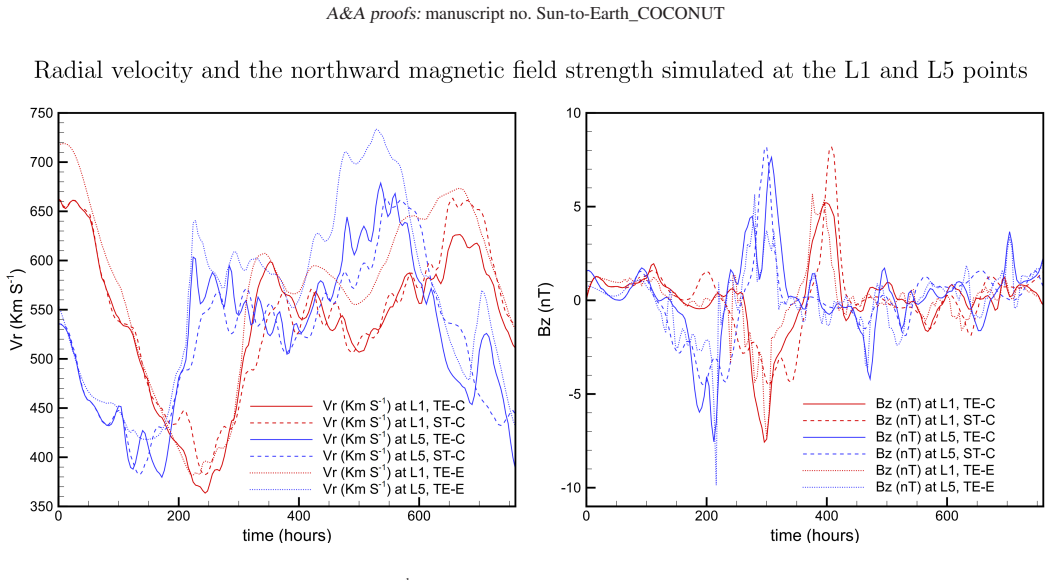
We extend the implicit time-evolving coronal MHD model out to 1 AU and utilise it to investigate solar coronal and wind evolutions around a solar maximum Carrington rotation. We compare quasi-steady-state and time-evolving Sun-to-Earth simulations to evaluate the impact of the inner-boundary magnetic field evolution, which is neglected in steady-state simulations, on background plasma parameters. The results show that the time-evolving implicit MHD modelling approach yields noticeable differences compared to oversimplified steady-state simulations, and is efficient enough for practical applications. Modelling the solar corona and wind using a single MHD model simplifies the modelling pipline
What carries the argument
Implicit time-dependent MHD solver that incorporates continuous updates to the inner-boundary magnetic field across the full domain from the solar surface to 1 AU.
If this is right
- Time-evolving simulations produce different temporal histories of plasma parameters at L1 and L5 than steady-state runs do.
- A single MHD model for the entire Sun-to-Earth domain removes coupling uncertainties between separate coronal and inner-heliosphere codes.
- The overall consistent evolutionary trends support the use of L5 observations to forecast solar wind conditions near Earth roughly four days ahead.
- The method remains efficient enough for routine application around periods of solar maximum.
Where Pith is reading between the lines
- The same single-model framework could be tested on intervals that include coronal mass ejections to quantify improvements in space-weather arrival predictions.
- Direct comparison of the model outputs against simultaneous in-situ data from multiple spacecraft would provide a concrete test of forecast skill.
- Adopting continuous magnetic driving as standard input might reduce systematic biases that arise when static magnetograms are used for long-term studies.
Load-bearing premise
The implicit solver stays numerically stable and physically accurate when the domain reaches 1 AU and the inner-boundary magnetic field evolves continuously without new instabilities or extra physics modules.
What would settle it
Running both the time-evolving and quasi-steady-state versions for the same Carrington rotation and finding no measurable differences in density, velocity, or magnetic field at L1 and L5 would show that the continuous boundary evolution does not matter.
Figures


read the original abstract
Due to computational efficiency and numerical stability limitations, coronal simulations constrained by static magnetograms are typically performed first and then used to drive inner-heliosphere (IH) models. In this paper, we calculate the Sun-to-Earth coronal and wind evolutions using a single time-evolving MHD model, showing that implicit MHD models have the potential to meaningfully simplify and improve the overall Sun-to-Earth modelling pipeline. We extend the implicit time-evolving coronal MHD model COCONUT out to 1 AU, and utilise it to investigate solar coronal and wind evolutions around a solar maximum Carrington rotation (CR). We compare quasi-steady-state and time-evolving Sun-to-Earth simulations to evaluate the impact of the inner-boundary magnetic field evolution, which is neglected in steady-state simulations, on background plasma parameters. Comparisons with commonly used coupled Sun-to-Earth simulations are also conducted to further validate and assess the Sun-to-Earth model COCONUT. The results show that the time-evolving implicit MHD modelling approach yields noticeable differences compared to oversimplified steady-state simulations, and is efficient enough for practical applications. Modelling the solar corona and wind using a single MHD model simplifies the modelling pipeline and avoids uncertainties associated with coupling different coronal and IH models. The noticeable differences in the temporal evolution of plasma parameters at the L1 and L5 points highlight the need to use continuously evolving, synchronised magnetic field observations to improve global coronal and solar wind simulations, whereas the overall consistent evolutionary trend reveals the reliability of using L5 observations to forecast solar wind conditions near Earth about four days in advance.
Editorial analysis
A structured set of objections, weighed in public.
Referee Report
Summary. The manuscript extends the implicit MHD model COCONUT to perform time-evolving Sun-to-Earth simulations out to 1 AU within a single framework. For a solar-maximum Carrington rotation, it compares these runs against quasi-steady-state simulations (neglecting inner-boundary evolution) and against standard coupled coronal-heliospheric models, reporting noticeable differences in plasma parameters at L1 and L5 and asserting that the approach is computationally efficient enough for practical use while simplifying the modeling pipeline.
Significance. If the numerical stability and physical fidelity of the extended-domain runs are confirmed, the work would demonstrate that a unified time-dependent MHD model can capture the dynamical effects of evolving photospheric fields on solar-wind structure, thereby reducing coupling uncertainties and supporting more accurate operational forecasts of solar-wind conditions at Earth.
major comments (2)
- [Abstract and Results] Abstract and Results sections: the central claim that time-evolving simulations produce 'noticeable differences' and 'reliable' evolutionary trends at L1/L5 is not supported by any quantitative metrics (relative differences, RMS errors, correlation coefficients, or statistical significance tests); without these, it remains unclear whether the reported differences exceed numerical uncertainties or arise from the intended physical effect of boundary evolution.
- [Numerical Methods] Numerical setup and validation: no convergence studies, time-step statistics, residual histories, or resolution-sensitivity tests are presented for the domain extended to 1 AU with continuously updated inner-boundary magnetograms; this information is required to verify that the implicit solver remains stable and physically accurate, which is load-bearing for the claim of practical feasibility.
minor comments (1)
- [Abstract] The abstract uses the term 'oversimplified steady-state simulations' without explicitly stating which physical assumptions (e.g., fixed boundary, neglect of time-dependent driving) are being relaxed in the time-evolving case.
Simulated Author's Rebuttal
We thank the referee for the constructive and detailed review. We address each major comment below and will revise the manuscript to incorporate the suggested improvements.
read point-by-point responses
-
Referee: [Abstract and Results] Abstract and Results sections: the central claim that time-evolving simulations produce 'noticeable differences' and 'reliable' evolutionary trends at L1/L5 is not supported by any quantitative metrics (relative differences, RMS errors, correlation coefficients, or statistical significance tests); without these, it remains unclear whether the reported differences exceed numerical uncertainties or arise from the intended physical effect of boundary evolution.
Authors: We agree that quantitative metrics are needed to substantiate the claims and to confirm that differences arise from physical boundary evolution rather than numerical effects. In the revised manuscript we will add relative differences, RMS errors, and correlation coefficients for plasma parameters at L1 and L5 between the time-evolving and quasi-steady-state runs. We will also report appropriate statistical significance tests. These additions will quantify the magnitude of the differences and strengthen the assertion that the evolutionary trends are reliable. revision: yes
-
Referee: [Numerical Methods] Numerical setup and validation: no convergence studies, time-step statistics, residual histories, or resolution-sensitivity tests are presented for the domain extended to 1 AU with continuously updated inner-boundary magnetograms; this information is required to verify that the implicit solver remains stable and physically accurate, which is load-bearing for the claim of practical feasibility.
Authors: We acknowledge that explicit numerical validation for the extended domain is required to support the claim of practical feasibility. In the revised manuscript we will include grid-convergence studies, time-step statistics from the implicit solver, residual histories for the full Sun-to-Earth runs, and resolution-sensitivity tests that also examine the effect of magnetogram update cadence. These diagnostics will demonstrate numerical stability and physical accuracy out to 1 AU. revision: yes
Circularity Check
No circularity: results from direct numerical simulations with external comparisons
full rationale
The paper reports numerical MHD simulations extending the COCONUT model from corona to 1 AU, comparing time-evolving runs against steady-state and coupled-model baselines. All load-bearing steps are simulation outputs (plasma parameters at L1/L5, efficiency metrics) rather than closed mathematical derivations. No equation reduces to a fitted parameter renamed as prediction, no self-citation supplies a uniqueness theorem that forces the central claim, and no ansatz is smuggled in. Self-citations to prior COCONUT development are background for the base solver; the present work's claims rest on the new extended-domain runs and their direct comparisons, which are independently falsifiable. This is the normal, non-circular case for a simulation study.
Axiom & Free-Parameter Ledger
axioms (2)
- standard math Standard ideal magnetohydrodynamic equations govern the plasma and magnetic field evolution.
- domain assumption Inner-boundary magnetic field can be continuously updated from time-dependent observations without introducing unphysical artifacts.
Reference graph
Works this paper leans on
-
[1]
N., Odstrcil, D., Pizzo, V
Arge, C. N., Odstrcil, D., Pizzo, V . J., & Mayer, L. R. 2003, AI P Conf. Proc., 679, 190
2003
-
[2]
Aschwanden, M. J. 2005, Physics of the Solar Corona. An Intro duction with Problems and Solutions (2nd edition) (V erlag Berlin Heidel berg New Y ork: Springer)
2005
-
[3]
J., Forsyth, R
Balogh, A., Southwood, D. J., Forsyth, R. J., et al. 1995, Sci ence, 268, 1007
1995
-
[4]
2024, A & A
Baratashvili, T., Brchnelova, M., Linan, L., Lani, A., & Poe dts, S. 2024, A & A
2024
-
[5]
2017, ApJL, 850, L29
Bourdin, P .-A. 2017, ApJL, 850, L29
2017
-
[6]
2022, ApJS, 263, 18
Brchnelova, M., Ku´ zma, B., Perri, B., Lani, A., & Poedts, S. 2022, ApJS, 263, 18
2022
-
[7]
Brchnelova, M., Zhang, F., Leitner, P ., et al. 2022, J. Plasm a Phys., 88, 905880205
2022
-
[8]
2025, A&A, 693, A74
Brchnelova, M., Gudiksen, B., Carlsson, M., Lani, A., & Poed ts, S. 2025, A&A, 693, A74
2025
-
[9]
Burlaga, L. F. 1984, Space Sci. Rev., 39, 255
1984
-
[10]
M., Linker, J
Caplan, R. M., Linker, J. A., Miki ´c, Z., et al. 2019, J. Phys.: Conf. Ser., 1225, 012012
2019
-
[11]
M., Miki ´c, Z., Linker, J
Caplan, R. M., Miki ´c, Z., Linker, J. A., & Lionello, R. 2017, J. Phys.: Conf. Ser. , 837, 012016
2017
-
[12]
N., Livingston, W
Cox, A. N., Livingston, W. C., & Matthews, M. S., eds. 1991, So lar Interior and
1991
-
[13]
Cranmer, S. R. 2010, ApJ, 710, 676
2010
-
[14]
Cranmer, S. R. & van Ballegooijen, A. A. 2005, ApJS, 156, 265
2005
-
[15]
Dedner, A., Kemm, F., Kröner, D., et al. 2002, J. Comput. Phys ., 175, 645
2002
-
[16]
Detman, T., Smith, Z., Dryer, M., et al. 2006, J. Geophys. Res .: Space Phys., 111, A07102
2006
-
[17]
A., Caplan, R
Downs, C., Linker, J. A., Caplan, R. M., et al. 2025, Science, 388, 1306
2025
-
[18]
I., van der Holst, B., et al
Downs, C., Roussev, I. I., van der Holst, B., et al. 2010, ApJ, 712, 1219
2010
-
[19]
P ., Biffis, E., Hapgood, M
Eastwood, J. P ., Biffis, E., Hapgood, M. A., et al. 2017, Risk Anal., 37, 206 Erdös, G. & Balogh, A. 2012, ApJ, 753, 130 Erdös, G. & Balogh, A. 2014, ApJ, 781, 50
2017
-
[20]
Evans, C. R. & Hawley, J. F. 1988, ApJ, 332, 659
1988
-
[21]
Feng, X. S. 2020, Magnetohydrodynamic Modeling of the Solar Corona and Heliosphere (Singapore: Springer)
2020
-
[22]
S., Jiang, C
Feng, X. S., Jiang, C. W., Xiang, C. Q., Zhao, X. P ., & Wu, S. T. 2012, ApJ, 758, 62
2012
-
[23]
S., Liu, X
Feng, X. S., Liu, X. J., Xiang, C. Q., Li, H. C., & Wei, F. S. 2019 , ApJ, 871, 226
2019
-
[24]
S., Lv, J
Feng, X. S., Lv, J. K., Xiang, C. Q., & Jiang, C. W. 2023, Mon. No t. R. Astron. Soc., 519, 6297
2023
-
[25]
S., Wang, H
Feng, X. S., Wang, H. P ., Xiang, C. Q., et al. 2021, ApJS, 257, 3 4
2021
-
[26]
S., Xiang, C
Feng, X. S., Xiang, C. Q., & Zhong, D. K. 2011, Sci Sin-Terrae, 41, 1
2011
-
[27]
S., Zhong, D
Feng, X. S., Zhong, D. K., Xiang, C. Q., & Zhang, Y . 2013b, Sci. China Earth Sci., 56, 1864 Fränz, M. & Harper, D. 2002, Planet. Space Sci, 50, 217
2002
-
[28]
M., Owens, M., Macneil, A., & Lockwood, M
Frost, A. M., Owens, M., Macneil, A., & Lockwood, M. 2022, Sol . Phys., 297
2022
-
[29]
I., Chen, Y
Gombosi, T. I., Chen, Y . X., Glocer, A., et al. 2021, J. Space W eather Space Clim., 11, 42
2021
-
[30]
Groth, C. P . T., De Zeeuw, D. L., Gombosi, T. I., & Powell, K. G. 2000, J. Geophys. Res.: Space Phys., 105, 25053
2000
-
[31]
D., & Leer, B
Harten, A., Lax, P . D., & Leer, B. v. 1983, SIAM Review, 25, 35
1983
-
[32]
Hayashi, K. 2012, J. Geophys. Res.: Space Phys., 117
2012
-
[33]
P ., Cheung, M
Hayashi, K., Abbett, W. P ., Cheung, M. C. M., & Fisher, G. H. 2021, ApJS, 254, 1
2021
-
[34]
T., Abbett, W
Hoeksema, J. T., Abbett, W. P ., Bercik, D. J., et al. 2020, ApJ S, 250, 28
2020
-
[35]
W., Bian, X
Jiang, C. W., Bian, X. K., Sun, T. T., & Feng, X. S. 2021, Fronti ers in Physics, 9
2021
-
[36]
W., Feng, X
Jiang, C. W., Feng, X. S., Bian, X. K., et al. 2023
2023
-
[37]
B., van der Holst, B., et al
Jin, M., Manchester, W. B., van der Holst, B., et al. 2011, ApJ , 745, 6
2011
-
[38]
D., Tarr, L
Kee, N. D., Tarr, L. A., Schuck, P . W., Linton, M. G., & Leake, J . E. 2025, ApJ, 983, 80
2025
-
[39]
2005, in Proc
Kimpe, D., Lani, A., Quintino, T., Poedts, S., & V andewalle, S. 2005, in Proc. 12th European Parallel Virtual Machine and Message Passing Interface Con- ference, ed. D. K. B. Di Martino & J. J. Dongarra (Sorrento: Sp ringer), 520– 527
2005
-
[40]
King, J. H. & Papitashvili, N. E. 2005, J. Geophys. Res.: Spac e Phys., 110, A02104
2005
-
[41]
2005, in LNCS 3514, V ol
Lani, A., Quintino, T., Kimpe, D., et al. 2005, in LNCS 3514, V ol. 1, Compu- tational Science ICCS 2005, ed. V . S. Sunderan, G. D. van Alba da, P . M. A. Sloot, & J. J. Dongarra, Emory University (Atlanta, GA, USA: Springer), 281–286
2005
-
[42]
2013, in AIAA 2013-2589, 21th AIAA CFD Conference, San Diego (CA)
Lani, A., Villedieu, N., Bensassi, K., et al. 2013, in AIAA 2013-2589, 21th AIAA CFD Conference, San Diego (CA)
2013
-
[43]
C., Feng, X
Li, H. C., Feng, X. S., & Wei, F. S. 2021, J. Geophys. Res.: Spac e Phys., 126, e2020JA028870
2021
-
[44]
2025, A &A, 693, A229
Linan, L., Baratashvili, T., Lani, A., et al. 2025, A &A, 693, A229
2025
-
[45]
A., Torok, T., Downs, C., et al
Linker, J. A., Torok, T., Downs, C., et al. 2024, J. Phys.: Conf. Ser., 2742, 012012
2024
-
[46]
A., et al
Lionello, R., Downs, C., Linker, J. A., et al. 2013, ApJ, 777, 76 Article number, page 9 of 11 A&A proofs: manuscript no. Sun-to-Earth_COCONUT
2013
-
[47]
I., et al
Lionello, R., Downs, C., Mason, E. I., et al. 2023, ApJ, 959, 7 7
2023
-
[48]
A., & Miki ´c, Z
Lionello, R., Linker, J. A., & Miki ´c, Z. 2009, ApJ, 690, 902
2009
-
[49]
Lionello, R., Miki ´c, Z., & Linker, J. A. 1999, Journal of Computational Physics , 152, 346
1999
-
[50]
Lockwood, M., Owens, M., & Rouillard, A. P . 2009, J. Geophys. Res.: Space Phys., 114 Manchester IV , W. B., Gombosi, T. I., Roussev, I., et al. 2004, J. Geophys. Res.: Space Phys, 109
2009
-
[51]
McClarren, R. G. & Hauck, C. D. 2010, J. Comput. Phys., 229, 55 97
2010
-
[52]
J., Bame, S
McComas, D. J., Bame, S. J., Barker, P ., et al. 1998, Space Sci . Rev., 86, 1572
1998
-
[53]
G., Lyon, J
Merkin, V . G., Lyon, J. G., Lario, D., Arge, C. N., & Henney, C. J. 2016, J. Geophys. Res.: Space Phys., 121, 2866
2016
-
[54]
2007, ApJS, 170, 228 Miki´c, Z., Downs, C., Linker, J
Mignone, A., Bodo, G., Massaglia, S., et al. 2007, ApJS, 170, 228 Miki´c, Z., Downs, C., Linker, J. A., et al. 2018, Nature Astronomy , 2, 913 Miki´c, Z., Lionello, R., Mok, Y ., Linker, J. A., & Winebarger, A. R . 2013, ApJ, 773, 94
2007
-
[55]
Mok, Y ., Miki´c, Z., Lionello, R., & Linker, J. A. 2005, ApJ, 621, 1098
2005
-
[56]
2025, RA S Tech
Murteira, J., Brchnelova, M., Lani, A., & Poedts, S. 2025, RA S Tech. Instrum., 4, rzaf030
2025
-
[57]
S., et al
Parenti, S., Réville, V ., Brun, A. S., et al. 2022, ApJ, 929, 7 5
2022
-
[58]
S., Réville, V ., & Strugarek, A
Perri, B., Brun, A. S., Réville, V ., & Strugarek, A. 2018, J. P lasma Phys., 84
2018
-
[59]
2023, ApJ, 943, 124
Perri, B., Ku´ zma, B., Brchnelova, M., et al. 2023, ApJ, 943, 124
2023
-
[60]
2022, ApJ, 936 , 19
Perri, B., Leitner, P ., Brchnelova, M., et al. 2022, ApJ, 936 , 19
2022
-
[61]
Poedts, S., Lani, A., Scolini, C., et al. 2020, J. Space Weath er Space Clim., 10, 57
2020
-
[62]
& Poedts, S
Pomoell, J. & Poedts, S. 2018, J. Space Weather Space Clim., 8 , A35
2018
-
[63]
Priest, E. R. 2014, Magnetohydrodynamics of the Sun (Cambri dge: Cambridge University Press) Réville, V . & Brun, A. S. 2017, ApJ, 850, 45
2014
-
[64]
M., et al
Riley, P ., Lionello, R., Caplan, R. M., et al. 2021, A & A, 650
2021
-
[65]
F., Magdaleni, J., et al
Samara, E., Pinto, R. F., Magdaleni, J., et al. 2021, A & A, 648 , A35
2021
-
[66]
2023, A & A, 672, 14
Schleich, S., Boro Saikia, S., Ziegler, U., Güdel, M., & Bart el, M. 2023, A & A, 672, 14
2023
-
[67]
C., Zhang, J., Wei, W
Shen, F., Y ang, Z. C., Zhang, J., Wei, W. W., & Feng, X. S. 2018, The Astro- physical Journal, 866, 18
2018
-
[68]
1998, Space Sci
Smith, C., L’Heureux, J., Ness, N., et al. 1998, Space Sci. Re v., 86, 613
1998
-
[69]
Smith, E. J. & Balogh, A. 1995, GRL, 22, 3317
1995
-
[70]
A., Kee, N
Tarr, L. A., Kee, N. D., Linton, M. G., Schuck, P . W., & Leake, J. E. 2024, ApJS, 270, 30 Török, T., Downs, C., Linker, J. A., et al. 2018, ApJ, 856, 75 Tóth, G., van der Holst, B., Sokolov, I. V ., et al. 2012, J. Com put. Phys., 231, 870 van der Holst, B., Huang, J., Sachdeva, N., et al. 2022, ApJ, 9 25, 146 van der Holst, B., Manchester, W. B., Frazin...
2024
-
[71]
MHD modeling of magnetic flux evolution around solar maximum by the coronal model COCONUT
Wang, H. P ., Poedts, S., Lani, A., et al. 2026b [ arXiv:2601.10675]
work page internal anchor Pith review arXiv
-
[72]
G., Page, D
Wenzel, K.-P ., Marsden, R. G., Page, D. E., & Smith, E. J. 1992 , Astron. Astro- phys. Suppl. Ser., 92, 207
1992
-
[73]
M., Landi, E., Manchester, W
Wraback, E. M., Landi, E., Manchester, W. B., & Szente, J. 202 5, ApJ, 980, 30 Y alim, M., V anden Abeele, D., Lani, A., Quintino, T., & Decon inck, H. 2011, Journal of Computational Physics, 230, 6136 Y alim, M. S., Pogorelov, N., & Liu, Y . 2017, J. Phys.: Conf. Ser., 837, 012015 Y ang, L. P ., Wang, H. P ., Feng, X. S., et al. 2021, ApJ, 918, 31 Y ang,...
2011
discussion (0)
Sign in with ORCID, Apple, or X to comment. Anyone can read and Pith papers without signing in.