Recognition: unknown
Predicting and controlling nonlinear neuro-mechanical locomotion dynamics
Pith reviewed 2026-05-07 12:35 UTC · model grok-4.3
The pith
A framework using spectral modes, Helmholtz-Nambu decompositions, and Bayesian inference produces a predictive stochastic model that maps neural activity to animal locomotion patterns.
A machine-rendered reading of the paper's core claim, the machinery that carries it, and where it could break.
Core claim
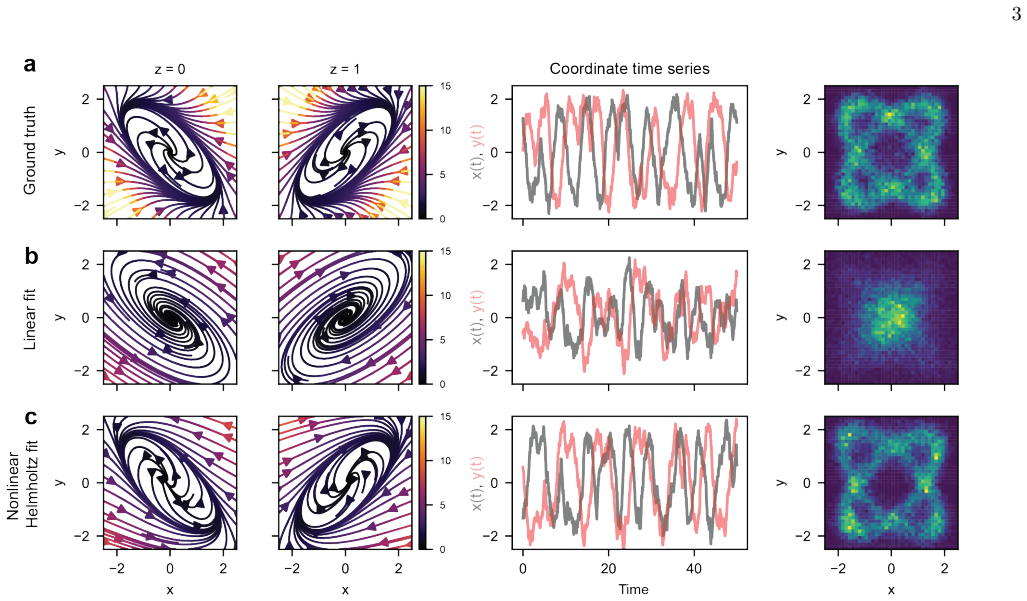
The authors introduce a theoretical and computational framework for inferring multiscale neuromechanical models from experimental data. Their data-efficient method combines interpretable spectral mode representations with Helmholtz-Nambu decompositions and Bayesian inference to identify a predictive stochastic model that converts neural activity time series into behavioral locomotion patterns. When tested on published C. elegans recordings, the model accurately describes the experimentally observed dynamics. The same model further yields predictions of neural activation patterns that could be used to control C. elegans locomotion in real time, providing a foundation for future optogenetic or
What carries the argument
The predictive stochastic model identified by spectral mode representations combined with Helmholtz-Nambu decompositions and Bayesian inference, which maps neural activity time series onto locomotion patterns.
If this is right
- The inferred model accurately describes experimentally observed dynamics in C. elegans.
- The model supplies predictions of neural activation patterns for real-time control of locomotion.
- These predictions supply a concrete basis for designing future optogenetic experiments.
- The generic formulation extends the framework to neuromechanical recordings from a wide range of animal species.
Where Pith is reading between the lines
- The same decomposition steps could be applied to datasets that include additional sensory inputs to test whether the model still remains predictive.
- Successful control predictions would enable closed-loop experiments in which neural activity is adjusted on the fly to steer specific locomotion outcomes.
- The reduction to a stochastic form might reveal whether similar spectral decompositions capture transitions between behavioral states in other motor systems.
Load-bearing premise
The chosen combination of spectral mode representations, Helmholtz-Nambu decompositions, and Bayesian inference will extract a reliable predictive stochastic model from high-dimensional noisy neuromechanical data without requiring extensive post-hoc tuning or data exclusions.
What would settle it
New neural activity recordings from C. elegans or another species where the inferred model fails to reproduce measured locomotion patterns or to generate effective control signals for optogenetic activation would show the framework does not deliver the claimed predictive power.
Figures


read the original abstract
Neuromechanics aims to understand the link between an animal's neural activity and its physical behaviors. Recent advances in experimental and machine learning techniques enable simultaneous recordings of neural and locomotion dynamics over long time periods and across multiple behavioral transitions in worms, flies, and other organisms. These high-dimensional datasets present the challenge of inferring interpretable low-dimensional dynamical models that quantitatively connect neural activity and behavioral dynamics. However, despite major experimental and theoretical progress, there is currently no end-to-end model for predicting locomotion and other behaviors from neural activity. Here, we present a theoretical and computational framework for inferring multiscale neuromechanical models from state-of-the-art experimental data. Our data-efficient approach combines interpretable spectral mode representations with Helmholtz-Nambu decompositions and Bayesian inference to identify a predictive stochastic model that converts neural activity time series into behavioral locomotion patterns. We first apply this framework to recently published recordings of neural activity and locomotion in the roundworm Caenorhabditis elegans, showing that it accurately describes experimentally observed dynamics. We further demonstrate how the inferred model can be used to predict neural activation patterns for controlling C. elegans locomotion in real time, providing a basis for future optogenetic experiments. Due to its generic formulation, the framework introduced here is broadly applicable to neuromechanical recordings for a wide range of animal species.
Editorial analysis
A structured set of objections, weighed in public.
Referee Report
Summary. The manuscript introduces a data-efficient framework for inferring multiscale neuromechanical models from simultaneous neural activity and locomotion recordings. It integrates interpretable spectral mode representations, Helmholtz-Nambu decompositions, and Bayesian inference to construct a predictive stochastic model mapping neural time series to behavioral locomotion patterns. The approach is demonstrated on C. elegans experimental data, where it is shown to accurately describe observed dynamics, and is further used to predict neural activation patterns for real-time control of locomotion, with potential extension to optogenetic experiments. The framework is presented as generic and applicable across species.
Significance. If the central claims hold, the work is significant for neuromechanics by supplying an interpretable, end-to-end pipeline that converts high-dimensional neural recordings into low-dimensional predictive stochastic models of behavior. Strengths include the explicit provision of model equations, the fitting procedure, and the combination of spectral modes with Helmholtz-Nambu decompositions for data efficiency and reproducibility. This could enable targeted control experiments and extend to other organisms, addressing the current absence of such integrated predictive models.
major comments (2)
- The abstract asserts that the framework 'accurately describes experimentally observed dynamics' and enables 'real-time prediction,' yet the summary provides no quantitative metrics (e.g., prediction error, cross-validation scores, or baseline comparisons). Please add these in the results section on C. elegans to substantiate the accuracy claim.
- The claim of a 'predictive' stochastic model carries circularity risk because Bayesian inference fits parameters to the same data. Clarify in the methods or validation subsection how out-of-sample forecasting (independent of the fitting procedure) is performed and reported.
minor comments (2)
- Notation for spectral modes and the Helmholtz-Nambu decomposition should be introduced with explicit equation numbers and referenced consistently when describing the stochastic model.
- The abstract mentions applicability to 'a wide range of animal species' but the manuscript focuses exclusively on C. elegans; a brief discussion of required adaptations for other systems would improve clarity.
Simulated Author's Rebuttal
We thank the referee for their constructive comments and positive assessment of the significance of our work. We address each major comment below and will incorporate revisions to strengthen the manuscript.
read point-by-point responses
-
Referee: The abstract asserts that the framework 'accurately describes experimentally observed dynamics' and enables 'real-time prediction,' yet the summary provides no quantitative metrics (e.g., prediction error, cross-validation scores, or baseline comparisons). Please add these in the results section on C. elegans to substantiate the accuracy claim.
Authors: We agree that explicit quantitative metrics are needed to substantiate the accuracy claims. In the revised manuscript, we will expand the C. elegans results section to include mean squared error and normalized root mean square error for locomotion predictions, along with out-of-sample log-likelihood values from the Bayesian model. We will also add comparisons against baseline models such as linear autoregressive processes and simple neural-to-behavior regression without the Helmholtz-Nambu decomposition. revision: yes
-
Referee: The claim of a 'predictive' stochastic model carries circularity risk because Bayesian inference fits parameters to the same data. Clarify in the methods or validation subsection how out-of-sample forecasting (independent of the fitting procedure) is performed and reported.
Authors: We thank the referee for highlighting this important clarification. Our current implementation already performs out-of-sample forecasting by partitioning the long experimental time series into non-overlapping training and test segments (with test segments consisting of future time points after the training window), using the posterior predictive distribution to generate forecasts. We will add a dedicated validation subsection in the methods that explicitly describes this temporal cross-validation procedure, the train/test split ratios used for the C. elegans data, and the reported out-of-sample metrics to eliminate any ambiguity regarding circularity. revision: yes
Circularity Check
No significant circularity; derivation chain is self-contained
full rationale
The paper introduces a pipeline that applies spectral mode representations, Helmholtz-Nambu decompositions, and Bayesian inference to infer a stochastic model from C. elegans neural and locomotion recordings. The inferred model is then shown to describe the observed data and to generate control signals. No load-bearing step reduces by construction to its own inputs: the Bayesian step produces parameters from data, the resulting model is applied forward to the same recordings for description, and the control demonstration uses the fitted model on held-out or simulated trajectories. The framework is presented with explicit equations and fitting procedures that remain independent of the target predictions, satisfying the criteria for a non-circular data-driven modeling paper.
Axiom & Free-Parameter Ledger
free parameters (1)
- stochastic model parameters
axioms (1)
- domain assumption Helmholtz-Nambu decompositions are applicable to the observed neuromechanical dynamics
Reference graph
Works this paper leans on
-
[1]
A.et al.Brain-wide representations of behavior spanning multiple timescales and states in C
Atanas, A. A.et al.Brain-wide representations of behavior spanning multiple timescales and states in C. elegans.Cell 186, 4134–4151 (2023)
2023
-
[2]
E., Hastewell, A
Cohen, A. E., Hastewell, A. D., Pradhan, S., Flavell, S. W. & Dunkel, J. Schr¨ odinger dynamics and berry phase of undulatory locomotion.Physical Review Letters130, 258402 (2023)
2023
-
[3]
& Dunkel, J
Romeo, N., Hastewell, A., Mietke, A. & Dunkel, J. Learning developmental mode dynamics from single-cell trajectories. eLife10, e68679 (2021)
2021
- [4]
-
[5]
Keaveny, E. E. & Brown, A. E. Predicting path from undulations for C. elegans using linear and nonlinear resistive force theory.Physical Biology14, 025001 (2017)
2017
-
[6]
C., Ahamed, T., Jordan, D
Costa, A. C., Ahamed, T., Jordan, D. & Stephens, G. J. A markovian dynamics for caenorhabditis elegans behavior across scales.Proceedings of the National Academy of Sciences121, e2318805121 (2024)
2024
-
[7]
Math2750: Introduction to markov processes.https://mpaldridge.github.io/math2750/index.html (2021)
Aldridge, M. Math2750: Introduction to markov processes.https://mpaldridge.github.io/math2750/index.html (2021). URLhttps://mpaldridge.github.io/math2750/index.html. Lecture notes, University of Leeds
2021
-
[8]
Pearce, P.et al.Learning dynamical information from static protein and sequencing data.Nature communications10, 5368 (2019)
2019
-
[9]
& Mao, X
Yuan, C. & Mao, X. Convergence of the euler–maruyama method for stochastic differential equations with markovian switching.Mathematics and Computers in Simulation64, 223–235 (2004)
2004
-
[10]
Nguyen, D. T. & Nguyen, S. L. Euler-maruyama method for regime switching stochastic differential equations with h¨ older coefficients.Communications on Stochastic Analysis13, 4 (2019)
2019
-
[11]
B.et al.Mapping sub-second structure in mouse behavior.Neuron88, 1121–1135 (2015)
Wiltschko, A. B.et al.Mapping sub-second structure in mouse behavior.Neuron88, 1121–1135 (2015)
2015
-
[12]
D., Warrington, A., Glaser, J
Lee, H. D., Warrington, A., Glaser, J. & Linderman, S. Switching autoregressive low-rank tensor models.Advances in Neural Information Processing Systems36(2024)
2024
-
[13]
Arts, M.et al.Two for one: Diffusion models and force fields for coarse-grained molecular dynamics.Journal of Chemical Theory and Computation19, 6151–6159 (2023)
2023
-
[14]
Generalized hamiltonian dynamics.Physical Review D7, 2405 (1973)
Nambu, Y. Generalized hamiltonian dynamics.Physical Review D7, 2405 (1973)
1973
-
[15]
Schneider, S., Lee, J. H. & Mathis, M. W. Learnable latent embeddings for joint behavioural and neural analysis.Nature 617, 360–368 (2023)
2023
-
[16]
& Floratos, E
Axenides, M. & Floratos, E. Strange attractors in dissipative nambu mechanics: classical and quantum aspects.Journal of High Energy Physics2010, 1–33 (2010)
2010
-
[17]
J., Brown, A
Yemini, E., Jucikas, T., Grundy, L. J., Brown, A. E. & Schafer, W. R. A database of caenorhabditis elegans behavioral phenotypes.Nature methods10, 877–879 (2013)
2013
-
[18]
P.Probabilistic machine learning: an introduction(MIT press, 2022)
Murphy, K. P.Probabilistic machine learning: an introduction(MIT press, 2022)
2022
-
[19]
Linderman, S. W.et al.Dynamax: A Python package for probabilistic state space modeling with JAX.Journal of Open Source Software10, 7069 (2025). URLhttps://joss.theoj.org/papers/10.21105/joss.07069
-
[20]
C., Ahamed, T
Costa, A. C., Ahamed, T. & Stephens, G. J. Adaptive, locally linear models of complex dynamics.Proceedings of the National Academy of Sciences116, 1501–1510 (2019)
2019
-
[21]
J., Choi, D
Berman, G. J., Choi, D. M., Bialek, W. & Shaevitz, J. W. Mapping the stereotyped behaviour of freely moving fruit flies. Journal of The Royal Society Interface11, 20140672 (2014)
2014
-
[22]
& Compo, G
Torrence, C. & Compo, G. P. A practical guide to wavelet analysis.Bulletin of the American Meteorological society79, 61–78 (1998)
1998
-
[23]
elegans.eLife9, e57093 (2020)
Cermak, N.et al.Whole-organism behavioral profiling reveals a role for dopamine in state-dependent motor program coupling in C. elegans.eLife9, e57093 (2020)
2020
- [24]
-
[25]
Pedersen, C., Zanna, L. & Bruna, J. Thermalizer: Stable autoregressive neural emulation of spatiotemporal chaos.arXiv preprint arXiv:2503.18731(2025)
-
[26]
Sosanya, A. & Greydanus, S. Dissipative hamiltonian neural networks: Learning dissipative and conservative dynamics separately.arXiv preprint arXiv:2201.10085(2022)
-
[27]
Grosmark, A. D. & Buzs´ aki, G. Diversity in neural firing dynamics supports both rigid and learned hippocampal sequences. Science351, 1440–1443 (2016). 21
2016
-
[28]
& Ermon, S
Song, Y., Garg, S., Shi, J. & Ermon, S. Sliced score matching: A scalable approach to density and score estimation. In Uncertainty in artificial intelligence, 574–584 (PMLR, 2020)
2020
discussion (0)
Sign in with ORCID, Apple, or X to comment. Anyone can read and Pith papers without signing in.